Professor Zazzo Investigates 15: Why Zazzo Did Not Collect His Nobel Prize in Person

WHY ZAZZO DID NOT COLLECT HIS NOBEL PRIZE IN PERSON

The confusion surrounding Professor Zazzo Thim’s Nobel Prize acceptance speech has become a part of literary folklore, a footnote to a long and distinguished career. Literary types around the world have long debated the exact meaning of Thim’s words, delivered, as they were to the assembled guests and members of European royalty, by a smelly old vagrant. Some have hypothesised that Thim was making a stand against homelessness, and juxtaposing the finery and splendour of his palatial surroundings with the sad plight of many homeless people.

          Others assert that Thim had, temporarily at least, lost his mind. Some even believe that the vagrant was Thiim in disguise, that he had conducted the whole ceremony in costume as part of some unspecified bet. Yet only now, three years later, have certain facts come to light which might explain this unusual and totemic episode.

Professor Zazzo Thim leans back in his leather armchair and gazes up at the ceiling,

‘Regrets?’ he asks. ‘Of course I have regrets. I have been so misunderstood, misquoted, my sanity questioned, my motives prodded from several angles by the more reactionary tabloids.

          ‘All I was trying to do was get someone to come out and re-tune my VCR. Everything which happened afterwards was merely a consequence of this’.

          We were seated in the marble library of a respected college in Basingstoke. The whole building stood with a stateliness, a cold, sober evocation of words and their power. How ethereally the sun reflected from the marble pillars which held up a surrounding balcony. Our leather armchairs had been placed either side of a small table lit by a brass lamp. When Thim leaned forwards to hear my next words, his face was elongated and distorted in their mirrored surface.

          ‘I see’, I told him. ‘The whole vagrant episode was nothing but a protest, a cry of help, that you had not received the customer care you think you deserved. It was a private protest, meaningless to the outside world but damning in its tenacity’.

          The old man shook his head as if he were trying to rid it of a rogue thought.    ‘No, no, no! My dear boy, not at all.

          I frowned, and leaned forwards to meet him halfway across the table.

          ‘But a man of your considerable intelligence…’

          ‘I see this’, said Thiim, ‘As evidence of the polarisation at work today not only in culture, but also in ordinary society. There are those who probe too deeply, and miss the most minor significancies. They search for hidden truths ignoring the fact that nothing at all is ever so hidden. They use long words and act perspicaciously. That’s one side of the equation’.

          ‘And the other?’ I asked.

          ‘The other side is that most people really are as thick as two short planks. So I’m caught in the middle. What is meaning, if most people are too blind to see it? What use is intellectual thought if one half are searching for false meaning and the other are ignoring the work altogether? It was this whole – as you call it – ‘vagrant’ episode which finally convinced me that – really – we humans are basically really quite stupid.’

          I was silent for a while. Zazzo Thim looked deep into my eyes, his forehead wrinkled, a tiredness playing about his features which, over the last couple of years, had become more pronounced. Then he sat back again, threw his long scarf over his shoulder, and looked down at his lap, as if he were embarrassed at having spoken so passionately. It seemed his voice was still echoing around the quiet library.

          ‘About the vagrant’, I whispered.

          ‘Yes?’ he sighed

          There has been much discussion, and even web-sites devoted to the whole affair, most of which are ludicrous, and one which uses the entire episode as a premise just to show ladies with big jugs. Yet only one – http://www.thiim-machine.com – goes as far as to suggest why you might possibly have entrusted a vagrant with the most important, the most prestigious speech of your entire life.

           I remained quiet.

          ‘Go on, he whispered.

          ‘It suggests you simply mistook him for the Prime Minister of Sweden’.

          Thiim stared at me, quite blankly, for a couple of seconds.

          ‘A preposterous error’, he said. ‘And yet again emblematic of this dual culture I have just been telling you about. How many people have been satisfied by that explanation, eh? How many people have gone away from that website secure in the knowledge that I cannot differentiate between the Prime Minister of Sweden and a vagrant? What view must they now hold of me? Every time I have appeared in writings and literary reviews they must have seen my name and thought -a-ha! The man who thought a smelly old vagrant was the Prime Minister of Sweden’.

          I could tell that Thiim was getting agitated, so I furnished him with more pronouncements from various web-sites.

          ‘www.waytogozazzo!.com suggests that you may have seen in the prize ceremony all of the ills of modern society and that you simply decided right then and there to go home’.

          ‘Rubbish’, he said

          ‘www.time and thim wait for nobody.com assert that you attended the ceremony dressed in drag only to view the embarrassment your stunt would cause.’

          ‘Preposterous.’

          ‘www.thiimtime -time team. com go as far as suggesting that the ceremony went well, and that nothing happened, and that the whole thing was performed again with the vagrant just to portray you in a bad light because you happened to sneeze on the Queen of Sweden, and she took great offence’.

          ‘That website’, he said, ‘Is run by a bunch of snivelling former students of mine who wish only to advance their public profiles at the expense of my own personality’.

          ‘www. zazzo thim is a right idiot who speaks out of his bottom and wouldn’t know the meaning of literature if it slapped him round the face.com suggest you were in league with foreign terrorists and hoped to assassinate everyone in the room with a bomb hidden in your false beard.’

          Thiim let out another sigh and leaned towards me. ‘How many times do I have to tell you?, he asked. ‘I was trying to get someone to come out and look at my VCR. It played perfectly well and recorded everything I wanted, but there was interference from my digital box and I couldn’t watch Channel Four. That’s all! How many times do I have to tell you? That’s the plain and simple truth.

          ‘Look, he said, forming a pyramid with his hands on the desk in between us. I was walking to the prize ceremony. As you know, walk everywhere, because try to shun cars as often as I can. I’d called the helpline number the VCR company had given me on numerous occasions, but I had not got through. But now, armed with a free phonecard issued by the Swedish government, I was able to make that all-important phone call with no expense to myself.

          ‘The most important day of your life’, I whispered, ‘And you were phoning a VCR company to report a fault?’

          ‘Indeed. So I stopped at a phone box outside the palace and dialled. The first thing that happened was that I was told to choose between three numbers, or hold for customer services. I held on for customer service, but I was put into a waiting system, although a friendly voice assured me that my call was important. These touches’, the Professor said, ‘Can be very reassuring’.

          ‘Then what?’ I asked.

          ‘I think they played some Mozart….’

          ‘But the speech! The speech!’

          ‘Hold on, dear boy. Customer service came on the line and I was urged to press one for a technician, or two for some other query. I pressed two. Then I was urged to press one to report a missing component, or two for another query. So I pressed two. Then I was asked to press one for information on Plaxhorn Credit Services, or two for another query.’

          ‘So you pressed ‘two’?’ I ventured

          ‘Indeed. Then Mozart came back on again. By now, as you can imagine, I was starting to get a bit jittery. Anyway, one this time was a problem with VCR installation, so I pressed one. Then I was asked to choose between picture break-up or bad sound quality, so I chose picture break-up. Then it was interference from cable or interference from digital, so I chose the latter.

          ‘The next choice was between interference from digital during broadcast, or interference from digital during recording, so once again, I chose the latter. The next option was interference during digital during recording on afternoons, or interference during digital during recording on evenings, so I chose the former. The next option was interference during digital during recording during evenings on the main television set, or on a secondary set, so I chose the former. The next option was interference during digital during recording during evenings on the main set while using an electrical appliance, or interference during digital during recording during evenings on the main set while not using an electrical appliance. So I chose the latter.

          ‘The next option….’

          I stifled a yawn.

          ‘The next option was interference during digital during recording during evenings on the main set while not using an electrical appliance while standing over the set, or interterence during digital during recording during the evening on the main set without an electrical appliance while sitting near the set, so i chose the latter. And then, finally, a voice came on which said: Press the red button on the rear of the unit, then the green, then the yellow, then the red again, and the whole problem should clear up.’

          ‘A-ha!’, I said.

          ‘But I didn’t quite catch what he said, so I started the whole process again. First I got customer service, and I was asked to choose between…’

          ‘OK!’ I said, ‘OK, I get the picture. So what happened about the speech?’

          ‘Oh, that’, Thiim said. ‘You have to understand, by this time the problem at hand consumed me whole. I wanted nothing more from life than to successfully complete telephone call and solve the interference problem. I was enraged, and yet, strangely entranced by the whole affair. It was as if I had a new meaning in my life, a purpose I could grab with both hands which would , if adhered to, at least make my life a fraction better than it had before. And the speech? The speech was meaningless. I thrust it in the hands of a passing vagrant and carried on with the phone call! The Professor sighed, and looked, quite sadly, to his left, as if looking at the past. The vagrant, I hear, spoke quite eloquently on a number of matters. Still’, he said, ‘Even to this day, the sound of Mozart can bring me out in a rash.’

So there it is. The most perplexing, the most unusual event in the history of literature – at least, in the last few years – and it was all caused by slight interference on a television set. No tricks, no philosophising, no great depths of psychological thought, no grand conspiracies, just an inability to tape channel four while the digital set is turned on. My shoulders, I am sure, visibly slumped.

          I bade the Professor a good day and walked outside into the wide world. It was sunny, and I blinked two or three times, as if awakening from a dream. The town was quiet, almost idyllic in the summer sun, and as I walked among the crowds away from the library I felt I had, at least for a few minutes, a better understanding of human nature.

Professor Zazzo Investigates: 14. Honk Your Nose if you Think I’m Sexy

HONK YOUR NOSE IF YOU THINK I’M SEXY

Most perplexing indeed that a literary character should materialise at a small seaside town, wandering up and down the promenade, dazed, sickly, shaking his head with disbelief. Who better to call than Professor Zazzo Thim, renown expert in literary extremism?

          He sat Josef K. in the corner of a small bar on the front and ordered a couple of glasses of wine. As Zazzo wound the scarf from round his neck, he surveyed the sad little man, who had spent most of the time since they’d met moaning, sighing, and telling anyone who would listen that ‘all was hopeless’.  Zazzo smiled to himself, stretched, and sat down opposite the humble bank clerk. “What I’d really like to know is”, he said, “How did you come to be here?”

          Josef K. turned his piercing gaze on Zazzo. “If I knew the answer to that question”, he said, “Then I surely would have furnished you with the truth at an earlier time during our acquaintance”.

          Zazzo frowned and leaned forwards, as they were served with two glasses of claret. “You just materialised”, he said

          “Out of thin air”. This seemed to remind Josef K. that his plight was far from over, and he raised his arms once more. “Hopeless! Absolutely hopeless!”

          Zazzo sighed, and sat back. “Can you remember what you were doing shortly before you materialised here?”, he asked.

          Josef K. smiled. “The memory of it”, said he, “Troubles me this very moment. Tell me, seeing as though you have proclaimed yourself inquisitor, what do you think I was doing?”

          “Quite simple”, Zazzo said, “As a renown man of mystery and bad fortune, I assumed you were involved in some aspect of your impending court case, and no doubt stumbling from one piece of bad news to the next.

          “Actually”, said Josef K., “I was hosting a children’s party”.

          “Pardon?”

          “A sideline, which, running parallel to my duties in the office, allows me to commune with those less fortunate in Prague society. And by this, my good friend, I mean those who are greatly unfortunate as to have children”.

          “But this is absurd!” ‘Zazzo stuttered, the wine glass trembling in his hand.

          “I was dressed in the apparel of a clown, my good friend. I had commenced tying balloons into different animal shapes – (surely emblematic of the totemic nature which powers us all) – and was just in the process of taking a pie in the face when the world around me – the function, the apparatus of the novel, the very framework of my life – exploded, and I found myself here, wandering dazed along your paltry promenade”.

          At this, Josef K. gestured, derisively, out the window.

          “You were … taking a pie in the face?”, Zazzo asked, incredulously.

          “Tis a necessary risk of my profession which I endure with great humour”.

          Zazzo stood, and, with the aid of his cane, managed to pace around the corner of the bar.

          He warmed himself by the fire for a few seconds before returning to the table, where Josef K had finished his own wine and had now started on his host’s.

          “You don’t understand”, Zazzo whispered, “This is very much a view of your character which would destroy your image. How carefully, how necessarily your author cultivated your essence, your view of the world, your morose spirit, your questioning, probing, weighty nature. At no point during the book does Kafka even hint that you might have been involved in party games and children’s amusements. Kafka himself was driven mad by the slightest noise, imagine what a room full of children will have done to him! This is most strange, most strange indeed.

          “You know”, , said Josef K., “I’m pretty handy with the old rotating bow-tie”.

          Zazzo leaned forward and cradled his head in his hands. “Of course”,

he said, thinking aloud, “Kafka visited many Jewish theatre troupes. It might be just conceivable that one of them may have been – and I shudder to use the expression – a ‘baggy pants farce’. Not only this, but there were many passages of ‘The Trial which were omitted, or half-completed in the author’s head. without being committed to paper. Could it be possible that a whole section was planned, even written, during which Josef K. worked as a children’s entertainer?”

          “Of course”, Josef K. said. “How else do you think I cured my stammer?”

          “Josef K. had a stammer?!”

          “A terrible affliction, I assure you. In the original draft, when I presented myself to the court, my personal testimony and defence took a mind-numbing fifty-three hours, most of which was taken up by my difficulties with certain words. And you can imagine how stressful it was for me when I first met the artist, ‘Titorelli”.

          “I’m flummoxed”, Zazzo said, leaning back in his seat. “Absolutely flummoxed”.

          “So why am I here?”, Josef K. asked.

          Zazzo was able to answer this question, for it seemed the least preposterous part of their meeting. “A novel or a short story”, he said, “Exists both physically, on a piece of paper, and mentally, in the heads of writers and readers. Some of them even enter the public consciousness, so that the details and plot might are known by a wide group of people without having read the story itself. Other stories – such as yours – still require reading, but the details are so vivid and the actions so believable that the story exists in some ether, some new dimension quite dissimilar to the world in which we live. Occasionally, though, perhaps caused by fluctuations in the rays of the sun, or certain atmospheric conditions, those stories suspended in the ether may bulge, bend, or even break, which is what has happened in your case. And the contents of the novel come raining down on a piece of the world at random. You must understand how exciting it is that this has occurred right here, for it usually occurs over the sea, or some inaccessible region of Antarctica. I do believe, however, that a certain Atticus Finch from ‘To Kill a Mockingbird is said to have turned up last autumn in a more seedy quarter of London, but he was so engrossed in the red light district that he was never seen again. Yes, indeed, your manifestation here at our humble seaside town is nothing short of miraculous! Imagine how poor Franz Kafka would feel, knowing that you would turn up here almost a century later. He would be mortified!”

          “Who?” Josef K. asked.

          “Franz Kafka… Your author”.

          Josef K. shook his head and laughed. “I don’t know who this ‘Franz’ Kafka might be, but I can assure you that my author was a genial young man by the name of Dave. Dave Kafka. And he lives right this moment, in the fair city of Basingstoke”.

          Zazzo Thim frowned. “So you’re not..”

          “Heavens, no! I’m not the Josef K. I’m Dave Kafka’s Josef K. My full name is Josef Krimbleshaw.”

          “And the novel which exploded over the promenade earlier this evening…?”

          “Was ‘Honk Your Nose If You Think I’m Sexy’.”

          “Ah… “, Zazzo said. He had lost interest in the whole affair. “Well..”, he said, I’d really better be off”

          Obligingly, Josef K. reached under his bowler hat to produce a white rabbit. “See?” he said. “See?”

          Zazzo stood and left the table without looking back. For a moment he thought about calling Dave Kafka and letting him know where he might be able to find his character, but when he turned back and looked through the window to see Josef Krimbleshaw leering at the busty young woman behind the bar, he thought better of it.

          “Hark!”, a voice said, ahead of him. “Who goes there? Have ye seen a white whale?” 

          Armed with a musket, Captain Ahab lurched towards him.

          “Yeah”, Zazzo said, “Right”. And he carried on his way.

Wrapped up in Fiction : The Madness of Insincerity

No doubt you’ve realised that I haven’t been performing much of late. There are many small reasons for this, though the urge to perform remains as strong as ever, as does the enjoyment I get from it. At the beginning of last year, my day job role changed considerably, which means lots of daily travel and a level of uncertainty as to where I shall be on any particular day. In such a way, without booking days off, (of which I get a modest amount a year), I could not commit to being able to turn up at gigs, and the time that I would normally spend rehearsing, (early mornings before work), was now taken up with early morning trains and waits at station platforms.

On top of this, I now had to spend time away from home in hotels in small towns throughout the south of England, some of which I’d never heard of before. (Midsomer Norton?! They just made that one up, surely!). What this meant was that yes, I had less time to rehearse and faff about with props and learn lines, but it did mean that I had much, much more time to write.

You may know that before I was a performer, I was a writer, and that was all I ever wanted to be. When my school friends dreamed of playing football (or cricket, as I was brought up in Surrey), I only ever wanted to be a published writer and win the Booker Prize instead of the FU Cup.

About three years ago, I started work on a novel which resurrected a character I’d created when I was 12 years old. The character is called Bill. Bill started as a skier who solved crimes in his spare time, (yeah, I know). The first Bill story was written around 1985. By 1990, Bill was now a detective, (his skiing career was over), and I wrote the Bill stories all through my teenage years. I then promptly forgot all about him for thirty years. This new story, Bin, was about Bill’s efforts to get a recycling bin for his new flat, and that’s all that happened in the novel. It was more a test, so that I could get back into writing Bill stories, and seriously, it was like we’d never been apart.

Two years ago, using the tricks I’d learned with Bin, I started a new novel, which I hoped would be a hymn to seaside towns. Red Sand was the result, a novel in which Bill had come down to the seaside to spend time with his old friend Ed, (who was also in those teenage stories), only to find that Ed had gone missing. I’m incredibly happy with Red Sand, particularly its unusual premise in which the whole novel is narrated by Paignton Pier, who is a character in the narrative in their own right.

Last year, I applied to the Curtis Brown Creative novel-writing course with Red Sand, and wouldn’t you know it, I was chosen. I was lucky enough to have a wonderful class of fellow students online and an amazing tutor in Suzannah Dunn, the author, who was very encouraging and who absolutely loved the novel, and in particular, Bill as a character. Her enthusiasm and kind words certainly made me think that I had the beginnings of something I could work with. She even contacted me when the course finished requesting a copy of a certain chapter which, she said, had stayed in her head long after the course had finished, which I took to be a very good sign.

Red Sand is now finished, (or at least, this draft of it). But I knew I could do better, and write something, well, easier to sell. Over the last few months an idea for a novel came to me, employing the tricks I’ve learned from Bin and Red Sand, and especially from the Curtis Brown course and my fellow students. I am currently working on a new novel called The Hibiscus Throne, again with Bill as the main character. I don’t want to give too much of the plot away, but it is ostensibly a romantasy fiction which plays around with the genre, with lots more going on under the bonnet. I’m currently deep in the writing of the first draft, churning out sometimes 2000 words a day and, as any writer of a novel will tell you, the characters live in my head constantly, vying for attention and commenting on the world around me.

My day currently looks like this: I get up at five, and write from six until eight. At eight, I go to the station and I catch a train, and I get a table seat on which I then pump in another half hour of writing. I work until five, catch a train home, have dinner, and then do another writing session from seven until nine. I’ve been doing this for the last two months, mostly ensconced in the narrative and writing, writing, writing. Every weekend I go and visit my mother in Brixham, and I spend the whole day writing again, in a room at the back of her garage which I previously used for rehearsing poems.

I cannot wait until The Hibiscus Throne is finished. I have never been interested in romance or fantasy, and while the premise of the story means that it is not really either, I do enjoy the ‘world building’ aspect of it. And I can’t wait for people to see it. It’s quite a departure from my two existing published novels, Reception and The Neon Yak, both of which are still out there.

So, will I get back to performing? Yes, I miss it dreadfully. I miss the people and I miss my poem friends, and I miss having an audience and immediate feedback. Writing often feels a solitary pursuit, somewhat insincere, but I kind of love the madness of that insincerity. Over the last few months I have exchanged letters with a very well-respected and famous writer in which he has imparted some amazing advice not only about what it is that we do as artists, but on life in general, too, the solitary nature of writing, and the worlds that we create.

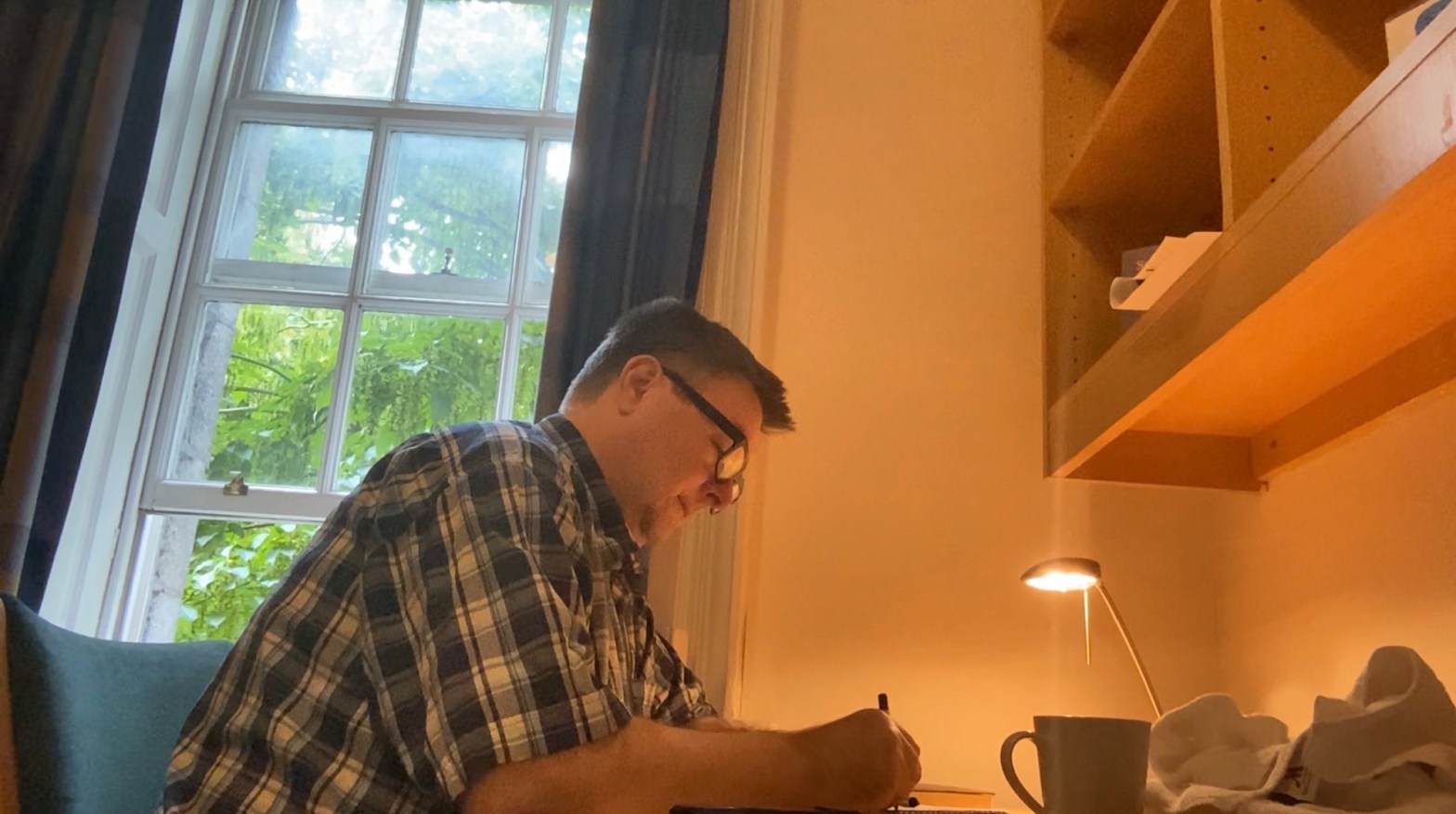
My desk, 2026

Professor Zazzo Investigates 13: Kafka’s Soup

The chance to buy Kafka’s soup was just too good an opportunity to miss. The fact that it had been discovered after so many years was a small wonder in itself, but the department, no doubt mindful of the envy which would sweep across our rival institutions knowing that they could have  such a valuable commodity for themselves, decided at once to stump up the cash. Professor Zazzo Thim was dispatched to Prague.

          He arrived during a thunderstorm. The lightning played around the concrete tower blocks which stride so confidently down the hills around the suburbs of the city. Thim found lodgings at a former communist hotel and, from his window, watched as the lightning flashed and forked across the premature evening sky. Already, he could feel that something was amiss. He didn’t know exactly what it was, but it was as if the thunderstorm was heralding something deep down, some bad news. He did not sleep well at all.

          When he woke, a bright sun filled his room, and a little of his enthusiasm began to come back. The room was decorated with old, flowerry curtains and wood panelling, and the windowsill was taken up by a gigantic radio which was bigger than the average television.

          When he went to the bathroom for a wash, he pulled the plug and watched, incredulously, as the water came out of the bottom of the basin on to the floor, and then down a drain in the middle of the room. Thim felt that he was in another world

He reflected once again on the reasons why the department wanted to buy the soup. A new professor in the science wing wanted to scrutinise the soup so that he might find traces, embedded in the remains, of Kafka’s undoubted genius, that such intellectual DNA’ might be reconstituted and used to further the aims of mankind. Indeed, a list of volunteers had come forward already, that they might be implanted with Kafka’s ‘intellectual DNA’, that it might help them with their writing or their general view of the world. Secretly, Thim shuddered to think of a hall full of Kafkas, moping about the state of the human condition, but he had a job to do and he was always professional in his outlook.

          He went down to breakfast and met an American tourist by the name of Arlene. They shared a table and they got to talking about their different jobs, and it turned out that Arlene worked for a company which published romantic fiction, and that she was there to try and open up a new market for her employers. Arlene was a jovial lady with false eyelashes and an infectious belly laugh. She also had an annoying habit of slapping the professor on the back when she emphasised a point.

          “What do you think about that, eh, Zazzy?”, she roared, slapping him mid-shoulder. “Haw haw haw!”

          The Professor couldn’t remember what kind of point she had been making, but there was something about Arlene which comforted him, and he wondered if it was possible to spend more time with her.

          “The thing is”, he said, somewhat croakily, “I’m here to make a purchase for my university. If it wasn’t for the fact that I have such worthy and important work to do, I might be inclined to spend more time with you”.

          “Purchase?”, she asked, “What kind of purchase?”

          Thim took a deep sigh. 

          “There has long been a school of thought that intellectual vigour might be transmitted by close proximity to objects utilised by those of a particular literary bent. I have come to Prague”, Zazzo announced, “In order to buy Kafka’s soup”.

          “Huh”, she said, snorting back a laugh. “Can’t be arsed with all that!”

          “I can assure you”, he continued, “That the soup shall be a most valuable commodity. If it wasn’t for this, I’m sure we would have a remarkable future together”.

          “Well, Zazzy”, said Arlene, as she got up from the breakfast table, “Some things just aren’t meant to be”.

          The Professor went about his duties and was taken into town by taxi so that he might view the fabled soup. He looked at it, where it was on display in the museum protected from the general public by a glass screen, and he thought how remarkable it was that such a relic should survive for so long. But the more time he spent in the company of the hallowed soup, the more he started to think about Arlene, and remember the fun that they had had just by sharing breakfast. When he left the museum he managed to secure a place in the front row at the following day’s auction, but the moment he left the room, he had forgotten that the soup had even existed

          Arlene was holding court in the hotel bar that evening. A drab, sullen waitress with her hair tied back served Zazzo unsmilingly, though Zazzo would hardly have noticed if she had. immediately, he went and sat on the periphery of Arlene’s group, close enough to hear the phlegm rattling at the back of her throat. 

          “So I said to them”, She continued, “If that’s a side of beef, my dear, then I think I’ll stick to the moose!” And then came that familiar laugh. “Haw haw haw!”

          The surrounding men laughed appreciatively and Zazzo joined them, though he was upset to see Arlene demonstrating as much joviality to these complete strangers as she had done with him that very morning. The men were all of a certain age – younger than Zazzo, smarty-dressed, tanned, knowingly handsome. Zazzo felt out of place and he looked down at his old jacket and moth-eaten pullover.

          Of a sudden Arlene hooted: ‘Oh my! If it aint my old good friend, Zazzy!” She stood up, waddled across the bar, and flung her arms around him.

          “Hel-lo!”’, Zazzo croaked

          “My my!”, she said, letting go of him at last. “Did you buy the soup?”

          “Not yet” he replied.

          She half-turned him to the rest of the group. “This is my old friend Zazzy”, she said. “He buys food and makes writers who are grumpy, or something like that. You should talk to him, he’s a laugh and a half!”

          Arlene’s assembled throng began to disperse, mumbling under their breath. She took hold of Zazzo’s hand and took him over to the corner.

           “Now”, she said, “Let’s have ourselves a bit of quality time, eh?”

          “Yes”, said Zazzo, “That sounds rather pleasant”.

          ‘Let’s shoot the breeze. Let’s have ourselves a little chinwag’.

          Zazzo nodded eagerly. Neither of them said anything for a very long while. A light rain began to fall on the bar window, distorting the image of a nearby tower block so that it seemed almost ethereal, like a Christmas tree.

          “Well”, Zazzo said, “The, um, the modern propensity for… literary experimentation…seems to have subsided of late, wouldn’t you agree?”

          “Oh, yes, yes”, Arlene replied. “Totally”.

          There was another, agonisingly long period of quiet.

          “Though I can only see this”, said Zazzo, “As a bad thing”.

          “Totally”, Arlene said. “Totally”.

          Arlene drummed her chubby fingers on the table, while Zazzo, sadly, looked at his own reflection in the glass window. The rain was coming down heavy now, and he wondered what it was he might be able to talk about.

          “In the course of your job”, Arlene said, “Do you get to read much romantic fiction?”

          “No”, he replied.

          And now a very long section of quiet lasted almost until bed-time.

That night, he could think of no-one else but Arlene. He saw her as a commentary on his life so far, the fact that he might be able to dream of a cosy union but never actually commit to the niceties and the jovial harmony which necessarily came with such a partnership. Late night trams rattled his hotel room, and he wondered if he would get another chance with Arlene, another opportunity to demonstrate just how much of a man he could be. Before long he realised that sleep would be quite impossible, so he went for a walk.

          Outside the hotel, the surrounding tower blocks loomed down on him like concrete robots.

          He walked around the grounds, over grass lawns and the car park, as a full moon revealed itself above and shone down a lunar glow. He sat for a while on the bank overlooking the main road, and he watched the cars as they made their way into the city. Of a sudden, he realised what he might do.

          He went to the hotel reception shop, where a display of Arlene’s romantic fiction had been installed the previous day, and he bought a copy of ‘Stud Lover’, a cheap novel set on a dude ranch somewhere in western America. The hero was a rugged man named Brad, the object of his desires was a southern belle named Nancy. Zazzo sat on a leather armchair in the lounge and read the whole book in one sitting, reading frantically as Nancy fell for the wrong man, then saw Brad leading his horses to the stream, then fell for Brad, then watched aghast as Brad and her old boyfriend, Tim, had a duel, then spent a night of passion with the saintly Brad and listened as he eulogised the beauty of the open plains, the thrusting mountains, the moving power of the desert. At once Zazzo recognised that Arlene associated masculinity with landscape, and that he would try to do the same the very next day.

He slept late and missed breakfast. At lunch she came in and sat down at his table, giving him a sweet smile, but saying nothing. He knew she was thinking of their conversation on the previous day, so he cleared his throat.

          “My dear Arlene”, he said, “What beautiful eyes you have”.

          She looked up at him, slightly mistrustful. “I’ll have the fish chowder”, she said to the sullen waitress.

          “When I see you”, he said, “I begin to think of… of the landscape of my native Thames Valley”,

          She frowned, and leant back in her chair.

          “The … the wooded vales, the wide plains, the industrial estates around the western fringes of the airport”.

          “Hmm?” she asked.

          “The miles and miles of rolling countryside, the sun setting over the council houses, illuminating against the red sky each individual chimney pot – and oh, the incessant rumble of traffic on the M25″

          “Uhrrr…”, she said.

          “The thrusting, penetrating hills of the Chilterns, the long, straight, inexorable line of the Waterloo to Basingstoke line …”.

          There was a period of quiet, and then Arlene threw back her head. “Haw haw haw! Oh Zazzy, stop, stop! This really is too much! Where did you get such corny language?”

          “From… from your book”, he whispered.

          “Honey”, she said, “I could never respect anybody who actually read that crap”.          And at this, she stood up, patted him twice on the back, and left the table.

          Naturally, Zazzo was devastated, not least when her lunch turned up and he had to pay for it. He watched Arlene leave the restaurant and he felt a piece of him die, quietly, a part of his need in life disintegrate. And then he knew what the thunderstorm had been about: it had been the death of his companionship, the final fling of his heart before it settled, once and for all, into a life of quiet subservience.

And then he remembered the auction, but it was too late. The soup would have been bought, and he had failed, there was nothing he could do. He would have to go back to his institution empty handed, a failure once again, a laughing stock.

          Unless . . .

          He reached out towards Arlene’s fish chowder.

Two weeks later the university unveiled the culmination of their scientific model. One of the Professors made a moving speech about progress and about recreating the ethos and the mind-set of a literary genius. He then thanked the volunteers, and, laughingly, wondered if they ought to thank him for their new personalities, that they would progress far and write such beauteous prose now that they were embedded with Kafka’s intellectual DNA. Indeed, he continued, perhaps this might be the start of a new intellectual rigour at the university, that the solemnity and weight which Kafka took to his life might be applied now to every aspect of thought and circumstance at the facility.

          At this the curtain was pulled and the stage was filled with ladies dressed in floral dresses who, en masse, on seeing Professor Zazzo Thim, shouted:   “Zazzy! Coo-eeee! Zazzy! Haw haw haw!”

          The experiment was not deemed a success.

Where’s my FIFA Peace Prize?

I also deserve a Fifa Peace Prize, and I’ll thump anyone who says I don’t.

          All of my friends want a Fifa Peace Prize, too. We were in the pub the other night. We sat around talking about the Fifa Peace Prize and Doug said that he was the most deserving because it’s been three years since he’d last hit someone over the head with a coffee table. I told him that such an aversion to violence was commendable. But I deserved it more because, for me, it was five years since I had last coffee tabled someone.

          That’s how it is with friends, you can be open about such matters. It really does pay to talk. Mumbling John said that he had given all of his relatives Fifa Peace Prizes. Apparently, they made pretty good door stops. You can wedge a fire exit open with a Fifa Peace Prize, he opined, especially those with a spring-loaded hinge mechanism. Doug then told him that there were probably knock-off Fifa Peace Prizes out there, made of cheap metals and available widely on the counterfeit goods market. And they almost came to blows, the two of them. 

          ‘Stop it, lads’, I said, ‘there’s no reason to fight’.

          They then accused me of saying this just so that I could be in contention for a Fifa Peace Prize.

          Mumbling John then pointed out that his sister Vocal Sue sold items online and made a living from it, that her garden shed was stocked full of the latest fads, trends and crazes. The deeper she goes into her shed, the different layers of such trends she comes across. The most recent layer is Labubus. If she goes further back, then it’s Tickle Me Elmos. Right at the back of her shed is where you find her tamagotchis. Soon, she reckons, another layer will be added of Fifa Peace Prizes. She calls herself an archeologist of the present moment, which is quite literary for someone who once said, ‘I’d give my right arm to be ambidextrous’.

          I then suddenly remembered that I hadn’t checked in on my tamagotchi for about fifteen years, which made me feel both guilty and undeserving of a Fifa Peace Prize.

          We started talking about what we wanted for our next birthday presents. We always buy each other gifts. Mumbling John said that he would be okay with socks, or some cheap after shave, or a Fifa Peace Prize. Doug said that he didn’t want anything too special, perhaps just an Amazon voucher, or a Labubu, or a Fifa Peace Prize. But before they could ask me what I wanted for my next birthday, Doug suddenly felt it necessary to yell at the man at the next table, ‘What the bloody hell are you staring at, mate?’, which was his traditional precursor to a punch-up.

          ‘Come on, lads’, I said, ‘no need to fight’.

          ‘You’re only saying that to get a Fifa Peace Prize’, Doug replied.

          ‘No I’m not’.

          ‘You bloody are!’

          ‘Want to fight about it?’

          ‘That’s more like it’.

          The old reverse psychology. Tensions lifted. We’d half-raised ourselves out of our seats, but then sat back down again. Neither of us could be arsed. Which got me wondering if the ultimate deterrent for world conflict is genuine and widespread apathy.

          And this might well have been the case on this occasion, were it not for the fact that I felt obliged, at that moment, to flick the end of his nose.

          The man on the next table threw back his head in laughter. So at least I was bringing joy to the world.

          It was Mumbling John who calmed us down. ‘Hey lads’, he said. ‘Watch this’.

          He picked up a plastic straw and placed it in a glass of lemonade. An optical illusion made it appear as if the end of the straw was disjointed.

          ‘See that?’, he said. ‘That’s a demonstration of light refraction.’

          ‘Fascinating’, Doug said.

          ‘Remarkable’, I replied.

          We both looked at the straw in the glass of lemonade and neither of us felt like escalating our violence. Even the man on the next table was interested.

          At that moment, the door opened and some representatives of Fifa entered the pub. They approached our table, and Mumbling John’s face lit up.

          Could it be? Were they about to . . .

          A fanfare sounded and a silence fell across the boozer. Every head swivelled in our direction. The horse brasses hanging from the old oak beams glistened in the glare of the mobile phones recording the impromptu ceremony.

          ‘Congratulations’, one of the officials said, lifting up a huge trophy and placing it on the table in front of Mumbling John.

          ‘What is it?’

          ‘The Fifa Physics Prize’.

          He looked at it, a little sadly.

          ‘Thanks’, he said.

Professor Zazzo Investigates – 12. Literary Self-Reconfiguration

LITERARY SELF-RECONFIGURATION

Nobody believes it possible that a novel, left unopened on the shelf of a library, say, or a private house, might alter its substance internally, subtly, change paragraphs here and there, the exact wording of certain phrases, even its slant or view on one subject or another, that the next time the book is read it has altered enough to be a new book entirely. Is it not conceivable that the human brain – surely a more complex and rich piece of equipment than a humble novel – might approach, each time, the novel in exactly the frame of mind, only to find the novel changed? Such a prognosis had to be investigated

          It took years to find an institution where my ideas would find support. Most universities and research facilities shied away from such a controversial approach, while many did not even answer my letters of inquiry. As luck would have it, one of the last institutions I contacted responded with a letter not only of interest, but a research team of my own to investigate the phenomenon of literary self-reconfiguration. When I visited the institute and asked who it was who had shown such an interest in my ideas – for I hardly believed the news myself – I was introduced to a humble man by the name of Professor Zazzo Thim.

          We hit it off immediately, the professor and I. He took me to a local cafe where, over steaming mugs of hot chocolate, he enthused over the implications that literary self-reconfiguration had on the world at large. 

          ‘Don’t you understand’, he said. ‘For so long we have thought that each generation attempted a wealth of literature from the past from a slightly different angle. Now it seems that it is the books which change, that human consciousness remains the same’.

          ‘Indeed’, I agreed. ‘Is it not indicative of human weakness of character that we have assumed our race to be getting less intelligent when, all the time, it is literature itself which is altering, mutating? If you read subsection three of my report, you will find that I blame most chemicals used in the production of ink for the changes which are taking place in classical literature. It seems the older the volume, the more changes there have been. The character Polonius, for example, has almost been edited out of Shakespeare’s Hamlet, while Esmerelda has negotiated such a large part for herself in Hugo’s ‘Notre Dame’ that the whole hunchback issue is now nothing but a sub-plot. This is an important issue, and one which we must address with considerable haste’

          The old professor looked down at his fingers on the surface of the cafe table. Feebly, he threw his scarf over his shoulder, then looked at me with sad, red eyes. ‘This’, he whispered, ‘Could very well be my last adventure in literature. Unlike the average novel, I am no more timeless than the common sparrow. This investigation will give me the chance to approach life with some meaning each morning, and I look forward to that one moment of discovery where all mysteries are solved’. He lifted up his hand, which I shook, delicately, in fear that I may hurt the old man’s fingers. At last he smiled, bravely. To us’, he said, ‘And literary self-reconfiguraton.’

We began our investigations on a windy Tuesday morning. The old library in which we’d set up our equipment seemed to shake and shudder with each gust, while the tall, gothic windows at the far end of the room whistled and moaned, as if the books themselves were trying to expel us from the building. An ethereal, overcast light spilled into the room, tinged green and red by the stained glass of the upper windows. Zazzo was in his element, scampering between the rows of books and leaning over the railings of the upper gallery, waving his walking stick in the air and declaring that literature shall hide no secrets from us!’ At last we settled around a large table on the ground floor, placing several books open, flat on the desk, under the omnipotent gaze of a high-powered lamp and several cameras.

          ‘And now’, I told the old man, ‘We sit back and wait.

          Zazzo parked himself on an old librarian’s chair at the side of the table, and leaned his chin on the top of his cane. I sat on the other side of him, and, over our equipment, regarded his form somewhat enviously. How like Zazzo I truly wanted to be! A man who had dedicated his whole life to fiction, to the glare of words printed on the page, the honesty of their grammar, the timelessness of ancient stories, modernist experimentations. Likewise, Zazzo stared back at me, hardly shifting from his pose as if he didn’t want to budge an inch from his chair. How obstinate in character, how determined to have carved such a life for himself. He saw me, I was sure, as a rival, as an usurper wishing to take his crown, and claim his glory for myself.

          Barely five minutes into our experiment, and I decided I would have to show the world that this was all my own work.

          ‘Why don’t you go home?’, I asked him, ‘And have yourself a rest?’ 

          He looked up at me. ‘What for?’

          ‘It’s very unlikely that we shall make any advancements in our first few hours. You must be tired from your exertions’

          ‘Nonsense’, he laughed. ‘On the contrary, I am in my element. Having lived a life so defined by books and ancient volumes, fear it is you, my young friend, who should leave me be, that I may commune my soul to whatever internal spirit holds this magnificent library together’.

          The crafty old man! Already he was trying to hide me from my moment of glory! How senseless I had been to the logic and temperament of this aged professor! That he, in his twilight years, should claim all the plaudits and the celebrations! I’m staying right here, I told him, crossing my arms, defiantly, across my chest.

          And so we remained, for the next six hours, silent, quietly seething from across the desk. I decided I would have to take drastic measures.

I spent the night in a cheap hotel not far from the library where, amid the damp bedclothes and the peeling wallpaper, and entertained only by the music from passing cars, the rhythmical grunting from the brothel nextdoor, I carefully removed half a dozen pages from a number of volumes and then, under a magnifying glass, re-arranged certain words and nuances of grammar to create, while not a new work in themselves, a mere variation on the same theme.

          It was eleven ‘o’clock when the pounding music started, a sleazy thump-thump through the thin walls which vibrated the table on which I worked and caused the cheap decorative pictures to swing ever so slightly in their frames. Yet I hardly noticed any of it, so intent was I in carrying out my fiendish plan.

          And oh, what a joy I had in my endeavours! I went to bed that night with an image of the aged professor, Zazzo Thim, dressed in a mothballed tuxedo, explaining to the gathered scientists and members of literary circles his theory of self-reconfiguration, only to be shocked, dismayed as I stand, waving a pair of scissors and a stick of glue, declaring his whole research to be nothing but a hoax, an ill-timed, unmitigated disaster! And how I would chuckle to myself, using a scalpel to remove the words, the letters, even the punctuation of Jane Austen’s

‘Mansfield Park’, only to replace them just millimeters to the left or the right. The sweet joy of my conquest!

          Yet my labours were not without stress. Each night, the tenant of the room next to my own would, quite regularly, indulge his passions with one of the young ladies from the lower floor. At first, the excitement of my quest meant that his exertions were nothing but a minor distraction, but soon I could concentrate on nothing else but his seemingly endless enthusiasm for the opposite sex, his insatiable desire to explore every avenue in his lovemaking repertoire.

          As the season drew on the nights became hotter, until I reduced myself to banging on the wall with a hardback copy of Ivanhoe, desperately, the tears running down my sweating face, the tiny letters I had cut from the volume flying into the air and landing around me like a perfect snow. I knew I would have to finish my project very soon.

          Slowly, I would replace the books in the library on the table in front of my aged colleague. Yet the old fool would not notice a change in them, nor did he spot the more glaring alterations – such as the new sub-plot in Wuthering Heights dealing with a harlequin on a pogo-stick. Yet he was so worried about his appearance to me that he would get up every now and then, tinker with the electronic gadgets we had assembled on the next table, adjust the lense of the camera, bend the light closer to the table.

          ‘Nothing again today’, he would say.

          ‘Really? Oh dear, what a shame. I must bow – as ever – to your superior knowledge’.

          No matter how significant the change, Zazzo Thim did not spot a thing. And such lengths I went to! I changed the rhyme scheme of Shakespeare’s Dark Lady sonnets from iambic pentameter to twenty-five syllables each line. I removed all of the exclamation marks from Mark Twain’s Adventures of Tom Sawyer. I inserted a product endorsement for Coca-Cola halfway through the Canterbury Tales. Yet nothing I could do registered with Zazzo Thim. How obstinate he remained in his ignorance.

          As if this wasn’t bad enough, stranger things started to occur. In the odd moments that Zazzo left his post to visit the toilet, I would open some of the books at random to admire my handiwork, only to find that the novels had gone back to their original states, that the extra syllables had vanished, that certain lines were printed exactly as the original writers had intended. At first I was perplexed, but then I realised that there was a greater significance at work. Rather than reconfigure themselves, I now knew that books had the ability to heal themselves whatever damage had occurred to them. Oh, the possibilites! started to see that Zazzo’s supposed discovery would be nothing compared to this new twist!

          Each night I left the gothic library and returned to my dreary hotel. I knew there was only the one course open to me – I would have to eradicate every mention of a whale from Melville’s ‘Moby Dick’. Zazzo would discover this anomaly and present it to the world, only for me to step in with my greater discovery. It was a mammoth task and would need all night to carry out my fiendish plot before, that next morning, allowing Thim to discover the latest reconfiguration by himself. I sat down at the desk at eight ‘o’clock with a scalpel, a magnifying glass and a tube of Uhu, and began work on chapter one feeling within me the persistence of a marathon runner, the tenacity of a soldier in battle.

          At eleven ‘o’clock the man next door began his aerobics. At first I tried to expel it from my mind, and concentrate on the task at hand. Yet the more resolved to dedicate myself to my work, the more his grunting and pleasured yelping began to intensity, until the bedsprings seemed as if they were attached to my eardrums and the banging of the bedhead against the wall was occurring right on the very top of my scalp. The sweat began to pour from my head and my clumsy fingers began to miss their mark, until I accidentally edited Queueg from a vital scene involving a bar-room brawl. In trying to make amends for this error, went too tar and gave Captain Ahab two legs, and then, when trying to cut one of them off again, forgot which one it was that he had originally lost. Bang, bang, bang, grunt, grunt, grunt. I wiped my arm across my eyes, the tiny scissors stuck on my thumb. Oh, Melissa! Melissa. Grunt, grunt, grunt! I picked up a spare page to fan myself only to see Jim from Robert Louis Stevenson’s Treasure Island insert himself in the text. Grunt, grunt, grunt! And that’s when I flipped. I stood up, opened my door, marched down the passageway and pounded on the door of my neighbour. ‘For God’s sake!’, I  yelled, ‘Cease this unending barrage of noise! Rest for an hour, and allow the female species at least some respite from your neverending appetite! For goodness sake, what stamina can a man possibly have to keep up such endeavours hour after hour! Can’t you see, you’re driving me mad?’.

          The door opened at last, and Professor Zazzo Thim stood before me, quite naked apart from a towel, while Melissa looked over his shoulder.

          ‘Was I keeping you up?’ he asked

          ‘Don’t you understand what you have done to me?’, I asked. ‘You’ve made my life a living hell! How can I possibly work when you are busily satisfying whatever cravings that ancient body can still afford? You have ruined these last few weeks for me, and caused a hole deep in my psyche! How can I ever finish my work?’

          ‘What work?’, he asked.

          ‘Well, erm…. The point is, your incessant lovemaking has been a severe distraction to me!’

          ‘Lovemaking?’, the old man asked. ‘Melissa, here, is showing me how to use the pogo stick. It’s something l.. read somewhere.

          ‘Pogo stick?’, I stuttered

          ‘In any case, what work could you possibly have away from the library?’ 

          The moment I looked over his shoulder, I knew what was occurring. On the desk against the wall I saw, much like in my own room, a couple of volumes, a scalpel, a magnifying glass, and a tube of Uhu. The old fool was taking the books I had altered home from the library, and changing them back! So keen was he that I should not discover the self-reconfiguration, that he was eliminating all evidence before I could find it! Or was it all a trap? Was he making me believe that the books were mending themselves, that I should announce to the world this miraculous literary discovery only to be laughed at, as I had planned for him? He glared at me, and I glared right back at him.

          ‘I’m putting the kettle on’, Melissa said.

Of course, the part that hurt the most was that he was able to spend more time on his hobbies than on the execution of his own plan. No wonder he looked so tired at the library, I told myself.

          And yet, what a genius, that he should carry out such a plan with such elan, with such cunning and dedication to his task.

          We met at the library again the next day, and sat on either side of the table. And there we sat, for the next five months, not noticing anything except the arrival of dust mites, until our funding was, eventually, transferred to another area.

Professor Zazzo Investigates 11- The Conception and Execution of the Collard

THE CONCEPTION AND EXECUTION OF THE COLLARD

1. My name is Professor Barry Worthington.

2. My office is accessible only by a labyrinth of corridors and hallways at the University where I work, a gothic, stone structure with courtyards and spiral staircases which, if viewed from above, would resemble the inner workings of the human mind. My room has no windows, and no decoration except for a large desk, a book shelf, a radiator, a chair, a coat-stand. The green carpet is held in place by masking tape, while the walls, which long ago were painted cream, have now been reduced to a stale grey.

          A colleague and I have, for some months now, argued over the validity of a certain punctuation mark known as the collard. Its use and development began two years ago in the metafiction department downstairs when a simple typing error resulted in a random mark which, when viewed on the page, resembled nothing more than an unvoiced break in the flow of the letters on the page. The collard then, in the manner of all great fashions, was adopted by the most cunning of the students in their essays, and then by one or two trendier professors, until its proliferation was declared an epidemic in the end of year report. We have now reached the point where the collard appears in everything, from the deepest, most academic report into symbolism in the work of Gabriel Garcia Marquez, to the sign in the corridor outside which reads Fire E°xit.

          My eminent colleague, Professor Zazzo Thim, celebrates the collard as proof that the English language is evolving before our eyes, and that the necessary acrobatics needed to type this meaningless symbol are suffered willingly by writers and students alike just to see it grace the page. Thim is excited by the collard, and has even published a short paper on how the collard can be represented in different type fonts for maximum effect. Yet I do not share his enthusiasm. The collard has spread throughout our department like a virus, infecting even the most mundane hand-written note, to such an effect that the whole of the east wing has been quarantined until a solution is found to the problem at hand. Yet Thim is hostile towards me, a representative of the pre-collard world who has, so far, managed not to infect my writings with that bizarre, inconsequential symbol.

          ‘A solution must be found’, I tell him.

          He is nonplussed, he waves his arms like the sails of a windmill and he says: Let the collard live! Writing has never felt so vibrant as when it is affected by this mark!’ Excitedly, he pounds his fist upon the dining hall table.

          ‘Our output will be scorned by the world’, I whisper.

          ‘Nonsense! We will be adored! The collard will escape the stone boundaries of this institution and take over the world! Our future will be assured!’

          So enthusiastic is Zazzo that he twirls his cane around in a circle which disturbs the cobwebs hanging above our heads.

          ‘The collard’, I whisper, Will be our ruin. The whole department will be ruined. The collard will die within a couple of years and reduce everything we have written to that of an unfashionable age’.

          ‘It will give our work style and substance! No other work will be confused with ours! The collard will be our call sign, we shall be the envy of the world!’ I have no choice but to challenge him to a duel.

3. The department is a-buzz with our feud and groups of students congregate around our offices to offer their support and opinion on the merits and the dis-merits of the collard and our positions thereon. Yet despite the controversy, the proliferation of the collard continues. It seems th*at there is nothing I can do to stop its advance throughout the building, while the conditions of the quarantine demand that the students sleep in the hallways, or crowded in my office around the radiator. The whole university is a breeding ground of bad punctuation, a crazy fad with Zazzo Thim as the high priest.

          And oh, how he loves his position among them! Thrice weekly he holds seminars in his office in which the collard is deba*ted, dissected, put back together again, even copyrighted in case another, unscrupulous university might come along and steal his precious gem. Like a crazed scientist, he spends hours at his desk, inserting collards into the most famous texts: the Bible, the Canterbut°ry Tales, the Koran, until, with a childish glee at seeing the even lines and narratives of these great works spoiled forever by that hateful symbol, he sits back in his desk with a big smile on his face.

          How I look forward to our duel! Whatever the outcome, I know I will be acting for the best interests of the English language, and for literature in general!

4. There has been a development. Last night, a group of students managed to evade security, and this afternoon there was the first report of a collard inserted deep in the thesis of a biology student from the west wing. Pandemonium ensued; the whole building has been buzzing with a slow panic, the hushed whispers of those who aim to see the collard take on the world, the frightened scampering of those who, for fear of their grammar, refuse to stay still for too long. And all the time I can hear Zazzo Thim in the room next to mine, laughing, interlacing his fingers and cracking his arthritic knuckles, drumming his fingertips on the desk in front of him as the collard takes another victim.

          Zazzo Thim must perish.

5. There have been moments in my I°ife when I would have welcomed any advance in the language which we use, for proof that it would adapt to certain conditions under which we live, yet the last few years have been particular repellent in that grammar and spelling have suffered at the hands of mobile telephone text devices and the common E-mail address. Enraged by the compacted, lower-case stylings of my first E-mail address, in which I was unable to print my name in the manner in which I have long used it myself, I decided would embark upon a programme of protection, in order that the language we use should never be defeated by modern technology or, even worse, vulgar Americanisms. Such thoughts come to me now, as I sharpen my pencil and plot the best method by which I shall slay the devious Zazzo Thim. can hear him now, giving a lecture on the poetry and exoticism now evident in our writings since the collard was adopted. How excited he is that a Japanese student, in an E-mail home to her family, managed to secrete two collards into her dense Japanese script and, thereby, spread its beauty to the far east. I groan as I hear this news, to think of that beautiful, artistic language sullied forever. Zazzo Thim must perish!

6. It is time now.

          We are gathered in the quadrangle, surrounded by the grey walls of this once-esteemed centre of learning. Students surround us, youngsters wearing T-shirts, many of which are decorated with that hateful device. The manner by which our duel will take has been decided by a council of impartial observers, students with no strong leanings one way or the other, who may or may not have dabbled with the collard. Professor Zazzo Thim grins as he meets his entourage. The old man, I note, has become more sprightly of late, a spring in his step as he +° traverses the endless corridors of this institution. How I shall ache to put him out of his misery, yet it is a duty, a solemn duty which I must perform.

          The rules of our duel are simple: we shall both, on the count of three, sit down on opposite sides of a desk and write a haiku which explains, in simple language and observing all the rules of that genre, whatever position we take on the collard. I know I have the advantage; Zazzo is a man of blasé taste and artless fortune, a man for whom poetry is nothing but a blowing of the nose before the pen commits to proper literature. Yet I am a romantic, a strong believer in the power of words.

          We stare at each other across the table. He glowers with a fool’s intent. The leather patches on his elbows glisten in the sun where he has worn them leaning on desks, against the walls of his classroom. His white hair is illuminated by the sun, and, with a desperate claw, he pats it down as if conscious of my gaze. At last the count of three is heard

          He writes first, bends down, I hear his pen scratching and the table move as, with energy, he marks the page. I notice the acrobatics of his hand as he adds a collard or two to his lines, the bony flesh, the thumb and forefinger shaped around the shaft of his pencil. At last he finishes, looks up, hands the paper to a nearby student, who coughs once, holds up the paper for all to see:

‘There once was a ma®n from Dumfries

Who one day said to his niece

‘It°f you remt°ain a dullard And fail to use a collard,

It will have to be °a matter for the police.

          The quadrangle is alive with the sound of laughter. Oh, sweet victory! That the old fool should have, in his moment of prime, mistaken a haiku for a limerick! Oh, the beauteous euphoria! Yet I must perform my duty, I must actually set to writing my haiku for the contest to remain valid. A calm comes over the crowd. I start to write the first line: 

evening glories of

My senses heightened, I felt a rush within me from the power of literature. The second line comes, and I write on the page:

unquestionable faith in

only for the moment to become dizzy, the victory, scented by my fair hand as it grips tighter the pen, that magic tingle which comes from knowing one has been proven. Yet the tingle persists. look up, worried that things may be going astray. On the air, from the grey head of Lazzo Thim, and sparkling in the afternoon sun, curling on the slanted beam shot through the surrounding trees, a dust, a dandruff, a remnant of chalk from the old man’s jacket as a sneeze builds up in my nose and I strive to complete the last line:

divine poetry

only for the sneeze to escape me on the completion of the last letter, causing the pencil to slide, crazily, across the page

divine poetry__________________________________

I am given a round of applause, of course.

7. The Worthington becomes the latest craze. It appears everywhere, from official documents to the dining hall menu. Delighted by this latest turn of events, the paper industry, sensing the amount of paper that might be consumed by the extraordinary length of the Worthington, celebrates our achievement with a healthy grant, while the anti-collard quarantine is lifted.

          Professor Zazzo Thim comes to my room. Sheepish, he looks down at the carpet. ‘I am’, he says, ‘A humble man in such matters. But the conception of the Worthington, and its appearance at the duel, was a masterstroke’.

          ‘Unintended, I can assure you’, I reply

          ‘Yet the Worthington has put this college on the world map. It has spread around the world, into every place where English is written. And you know, children world-wide have even developed a vocal Worthington? It sounds, I am told, very much like a sneeze, and it peppers conversations everywhere. If you turn on MTV, you’ll hear it all the time’.

          ‘I’m flattered’, I whisper.

          ‘Though of course’,  the Professor continues, ‘I can’t say that I totally agree..:

          We stare at each other for a while. Eventually he leaves the room, and 1 hear him next door in his office, cracking his knuckles once again. He still has an affection for the collard, I believe, though he sees the Worthington as its natural progression. He says he even foresees a time when the whole page will be taken up by Worthingtons, the true meaning of the page lost forever, concealed, heralding a new age in communication only by grunts and hand signals. He says he can hardly wait __________________________________

Mr. Bassman – A Poem

Mr Bassman

Oh Mr Bassman,
you’ve got that c-certain s-something
when you go . . .

Believe it or not
that was my dad’s favourite song.
he used to sing it all the time
when we were kids.

Oh Mr Bassman,
you’ve got that c-certain s-something
when you go . . .
A-aye yi
a-aye yi aye yi

I had no idea what it was about.
Neither did my sister.
neither did my dad.
what even is a bassman?
I was too young to know much about music.
I just thought it was a man
who really liked skirting boards.

Oh Mr Bassman,
you’ve got that c-certain s-something
when you go . . .
A-aye yi
a-aye yi aye yi
I wanna be a bassman too.

I think he only sung it to us
because it had weird sounds in it.
The only other song he sang a lot
was
I’m late, I’m late,
for a very important date.
no time to say hello goodbye
I’m late I’m late I’m late.
But Mr Bassman.
Oh, Mr Bassman was the thing.

Oh Mr Bassman,
you’ve got that c-certain s-something
when you go . . .
A-aye yi
a-aye yi aye yi
I wanna be a bassman too.
Bur b-b-bur b-b-bur b-b-bur b-bur bur

I was listening to the radio.
It was Sounds of the Sixties
presented by Brian Mathews.
(‘This is your old mate Brian Mathews saying,
that’s your lot for this week,
see you next week’).
And he said,
The next song is from
1961
And it was a minor hit for Johnny Cymbal
and it’s called
Mr Bassman,
and seriously,
it was like a kick in the goolies.

And the song started.
and the song played.
and the song came out of the radio
and all this time I’d thought it was just a song
that my dad had made up
and all the time I thought it was a piece of genius
that my dad had made up
and I tell you that a small piece of my childhood
suddenly dissolved.

but the more I listened,
the more I thought, oh, he’s doing it wrong.
Johnny Cymbal has cocked it up.
Johnny Cymbal is singing the wrong words.
This is nothing like the song my dad used to sing.
this is not how the song goes.
THIS
is how the song goes.

Oh Mr Bassman,
you’ve got that c-certain s-something
when you go . . .
A-aye yi
a-aye yi aye yi
I wanna be a bassman too.
Bur b-b-bur b-b-bur b-b-bur b-bur bur
BUR BUR BURRR B-B-B-BURR BURR!

(Pause).

Anyway,
Just thought I’d tell you that.
I’d better be off, now.
I’d better be off.

Professor Zazzo Investigates – 10. A Novel of Floating Words

A NOVEL OF FLOATING WORDS

Just my luck, on the short ferry crossing from Dover to Calais, to find myself sitting next to the eminent professor of literary extremism, Zazzo Thiim.

          He had just conducted a short tour of Iceland in which he had expanded on the theory that Charles Dickens was obsessed with halibut. (Conclusion: he wasn’t.) He was eager to know what thought, not only of this, but other matters.

          “Rogue writers”, he said, eventually. Leave clues everywhere”

          I asked him what he meant. I knew he was trying to be enigmatic, but a part of me was genuinely interested

          “Writers”, he said, “Have gone underground. They are fed up of seeing their works in print. The proliferation of desktop publishing, and the general cheapening of literature, mean that the whole process is dissatisfying. Yet they still feel the urge to write! Not only that, but free expression is being held back by the constraints of grammar, linear narratives, and of paragraphs. The rogue writer is the lone assassin of the literary world, yet his influence is all-encompassing.” The more Zazzo Thim spoke, the more enthusiastic and wild his gestures.

          Indeed, his bony, skeletal hands perfected aerial acrobatics above the table which, as the ferry began to pull away from the dock, shook and shuddered.

          “Rogue writers”, he continued, “Make novels of the world around us. We are in a novel right now – you and me. This whole ferry is one, big, gigantic novel.

I wanted to edge away from the aged Professor, but my curiosity was aroused. “But what of words?’, I asked, “And sentence structure?”

          ‘Pah!’, he spat. “Sentence structure is dead. Grammar dead. All we have left are words, random, scattered words. Look”, he said, pointing to the wall. “There’s two of them, now”.

          “Fire exit”, I read

          “Yes! Gosh! Yes, you see? How exciting! ‘Fire exit! The man is a genius!”

          “If all the words on this ship”, I told the Professor, “Are part of a gigantic, free-form, non-linear novel, then the words ‘fire exit’ must appear an awful lot”.

          “Seemingly”, Zazzo Thiim replied. “A recurring theme, you might say, a motif, such as would have been used in the operas of Wagner, or the poetry of Kipling. ‘Fire exit is such an emotive phrase, it conjures up images of security, panic, safety, the eternal war of the generations. Look at the green sign it is painted on -does it not recall the rolling hills of Ireland, the deep, deep green of the Schwarzewalde?’ Zazzo Thiim gets into his stride and begins to enthuse anew. “The man is a genius. You might even say he designed this whole ship, or rather, he wrote a novel which, unwillingly, became a cross-channel ferry. It’s all a figment of his imagination. Come with me”, he said, getting to his feet with the aid of a cane. “We shall promenade on deck, and admire the strength of his narrative”.

          It was wet and cold outside. The painted metal deck was slippery and the aged Professor skidded the moment we stepped outside. Indeed, the ship seemed full of words, though none of them, as far as I could tell, formed the basis of a story, not even a haiku. “Muster station”, I read.

         “Ooo!”, the Professor replied. “The dark railway terminus! What story awaits our

protagonist in the gothic city of Muster?”

          “Staff only”, I read, on a cabin door.

          “And who wouldn’t need a staff to walk in the dark woods around the ancient city? The brambles, you see..•

          “What brambles?”

          “The brambles hinted at in the green of the ‘fire exit sign”.

          “Another one”; I said, pointing ahead. “See that? ‘Fire exit”.

          “And indeed, he was”.

          “Pardon?”

          “Horatio Exit, the fearless warrior walking with his staff in the forests around Muster. He was fired”.

          “What for?”

          “He disobeyed the golden rule”.

          “What golden rule?”, I asked, the incredulity of our conversation causing my voice to raise higher and higher.  

          “See there? In brass letters on a white background? Do not obstruct’. Horatio Exit obstructed the king. That’s why he got fired”.

          “How do you know he was called Horatio?” I asked.

          “This is a sea vessel, isn’t it?”

          “Yes…

          “Aren’t all mariners called ‘Horatio’?”

          I let out a big, long sigh.

          “The man is a genius”, the Professor said, under his breath. “A pure, intellectual genius”

          We stopped where one of the lifeboats was tied. “And I suppose this”

I said, pointing to the sign which read ‘Maximum Capacity 32 people”, “Is a symbol of Horatio Exit’s frantic flight from the woods of Muster with thirty two disciples, each of whom, in preparation for the journey, ate as much as they possibly could before they escaped the soldiers of the Prinz von Muster who, enraged at Exit’s obstruction of the King, sent in his army to quell this army of brigands before they caused more troubles?”

          “No”, the Professor replied. “It just means that the lifeboat can only carry thirty two people”.

          I’d had enough. “I don’t believe a word of this”, I told the Professor. “I think you are a mad man, who has made up this whole game just so that you can talk to people, and carve out a name and a life for yourself when no-one else would, under normal circumstances, come anywhere near you. And it’s a travesty, an invasion of my time and my intellect even to contemplate talking to you. You have ruined my voyage, infected my head with your ill-thought philosophising which means less than that fag end over there, stubbed out by the railings”.

          “Actually”, the old man replied, “That cigarette butt is enormously significant….’

          “Enough! I don’t want to hear another word! I don’t believe any of this nonsense, and bid you good day”

          At this, the old Professor looked down at the deck, and his shoulders slumped. A tear welled in his eye, which he wiped with the back of his bony hand, while the other gripped, ever-whitening, the handle of his cane.

          “All I wanted”, he said, “Was to find the hidden beauty of life. I wanted to find the stories which hang around us, ethereal and ready for cultivation. I wanted to make life better, and open people’s eyes to the magic of literature. Is that too much to ask? Can we not all live side by side, elevated and enriched by words, by stories, by the whole merry, magniticent dance of narrative? There doesn’t even have to be a start, a middle or an end, just the words themselves, the glorious, beautiful words”.

          “You are a fool”, I whispered.

          I turned and left the old man.

          Soon we were in Calais and I waited on the stairs to go back down to the car deck. My meeting with the Professor had left a strange taste in my mouth, a hint of the insanity which obviously clung to him like the clouds to a mountain. I wanted to get off the boat as quick as possible, get in my car, and drive down the smooth, French motorways into a sunnier, brighter world.

          But then I looked up. I couldn’t believe my eyes. There ahead of me, on the wall, the same old green paint and the familiar font in white letters. Yet this sign was different, unnoticed, but different, as if its inventor had made a subtle joke, and had hidden it away from the world, for the proofreaders perhaps, or maybe it was a philosophical joke. The sign read:

          ‘Fire Exist.

Professor Zazzo Investigates – 9. Thiim’s Theorem of Constant Recursive Footnotation

THIIM’S THEOREM OF CONSTANT RECURSIVE FOOTNOTATION

*There has been much speculation lately about the concerns of a certain Professor Zazzo Thim. Those close to his entourage have hinted of great discoveries coming from his academic research, although the actual manner of these advancements have not, as yet, been made public. However, mindful that the majority of my readers will not be familiar with the particular branch of literary extremism, of which Thim is an expert, let me condense the findings of his research into one simple paragraph: Professor Zazzo Thim has discovered that we are all living in a footnote.

          For the last few weeks this pronouncement has vexed me greatly and I have been unable to conduct my life normally, that the entire world around me and all the people in it – and that everything we have done and everything our civilisation has achieved – is nothing but a mere academic footnote at the bottom of a non-existent page. To think that the vastness of our reality should be condensed as such – into smaller script, denoted with a tiny star at the beginning of the first sentence – not only cheapens the act of living, but hints that we are missing something within the main body of the existential text. My mind, this last week, has positively been buzzing.

          This morning I decided I would seek out this eminent professor and perhaps divulge from him the exact manner of his discovery. When I arrived at the facility where he is employed, however, I was told that I would only be able to enter if I had the correct security details and paperwork stamped by the relevant departments. The staff of the facility were loath to let me enter, that I might stumble into some literary laboratory and blunder against some experiment, thereby ruining years of precious work. Yet when I explained that I had come to see Professor Zazzo Thim, they were only too glad to let me enter. ‘Don’t bother knocking’, they said, ‘Just walk straight in’. Something about their manner told me that Thim did not command the greatest respect from his colleagues.

          I was guided to his door at the end of a corridor and the receptionist wished me luck before running quite smartly back the way she had come. Hesitantly, I knocked on the wooden door quite feebly, and was surprised when the door opened immediately and Professor Zazzo Thim stood before me. ‘Come in!’, he said, ‘Come in! I don’t care who you are, come in! His old hand gripped round my upper arm and pulled me, physically, into the room. ‘Dear boy, dear boy!’, he said, enthusiastically. ‘How honoured I am that you have come to visit me! Sit down and make yourself at home! And mind the bomb in the corner…’.

          I did as he said and cleared a space on a wooden chair next to his radiator. The small office was windowless, and dominated entirely by a desk in the middle, which was piled with papers and folders which seemed destined at any moment to tumble to the floor. Thim himself was an energetic fellow, despite his advanced years, with white hair and a confused expression offset by a long woollen scarf which almost reached to the ground. ‘I suppose’, said he, ‘That you have come to ask me about my new theory?’ As he spoke he walked round the desk, picking up papers at random and throwing them, disgustedly, back on the desk or even the floor. ‘I suppose, like others in this institution, you regard me as a mad man? Or have you come to write one of those sarcastic pieces for a Sunday tabloid? I may be a learned man, dear boy, but, gosh!, I ache just as much as the next person.’

          ‘The truth is”, I said, standing, That I am intrigued by your hypothesis, that the whole of our existence is nothing but a footnote at the bottom of a page. The very idea of it strikes me as philosophically redundant, yet at the same time, who would not deny that existence was – shall we say – not as important as we had otherwise thought? And who hasn’t once had the sensation of missing something more interesting, that our whole lives are relevant, yet not quite as integrated as we had once thought? In other words, just like the information contained in a footnote. Professor Thim, I have become so interested in your hypothesis that I just had to come and hear it from your own lips’

          The Professor stopped what he was doing and looked at me. ‘No!”, he said. ‘No, no, no! You’ve got it all wrong! Completely and utterly wrong!’ At this, he threw his hands in the air and stood with his back to me, his nose almost pressed up against the wall. At last he turned around and regarded me with a suspicious stare. ‘Just like other tabloid journalists, you twist your words to suit your own bitter ends, and make me look a fool in the process. I expect you haven’t even read my hypothesis, that you got the details from hearsay and gossip’.

          ‘My research’, I told him, ‘Depends on facts.

          ‘So where did you learn about my hypothesis’.

          I swallowed, and told him the truth. I read it on the back of a packet of corn flakes.

          ‘Indeed’, the Professor said, whirling round and facing me, an act which sent the end of his scarf in a wide arc, flicking pages from his desk on to the floor. ‘Come with me’, he said, ‘And I will explain in more detail.

          ‘And you will tell me everything?’

          ‘Everything that needs to be said. You will find me harmless, I am sure, and quite safe. Oh, and mind the bomb as you get up’.

The facility in which Thim works is set in an area of wooded park land and gentle slopes. We walked among the trees, the Professor and I, and he explained to me the finer points of his philosophy. ‘Everything is a footnote, that is true, said Thim, ‘If one considers existence as a cohesive narrative. At the beginning – whenever that was – there was but one story, but each nuance of that story has sprouted a footnote, and all the footnotes themselves have also sprouted footnotes. Indeed, there is a line of footnotes spreading almost to infinity, millions of them, like the roots of a massive, colossal tree. The Professor stopped, and fingered the leaf of an overhanging branch. This leaf, said he, ‘Is a footnote. It’s a footnote to a footnote, which in itself is a footnote to a footnote to a footnote, times a thousand, times a million. The fact I have touched the leaf is a footnote in itself. And this footnote – the one about me touching the leaf – would also beget footnotes describing other leaves I have touched, and perhaps even the fact that we are having this conversation. On the other hand, the leaf itself is a footnote to the story of the tree, and perhaps there will be other footnotes describing the millions of other leaves that this tree has grown. Don’t you see? This could go on forever. There are footnotes everywhere, superfluous pieces of information which we maintain merely for private interest or later study.

One could go crazy just thinking about it.

          ‘Then why do you think about it?’ I asked.

          The Professor frowned. ‘Because it’s my job, I suppose’.

          We carried on walking and a spring breeze ruffled the old man’s scarf. ‘I call it my Theorem of Constant Recursive Footnotation. And because of it, one could track any event, any thought, any aspect of our living world, back through the footnotes to the original event, the main narrative of the text in which we exist.

          ‘Which is?’ I ask.

          ‘The big bang’.

          ‘Ah!’

          ‘An event so catastrophic, and so powerful, that everything which happened after it was, quite literally, a footnote.’

          ‘I see.’

          We continue walking and a squirrel clambers up the side of a tree. It gets to the top and regards us with suspicious eyes. I consider pointing this squirrel to the Professor, but I already know where it will lead, and that he would feel compelled to give a commentary on the squirrel’s parentage, the introduction of grey squirrels to the British Isles, the evolution of the squirrel from some more slovenly, ineffective mammal. So I don’t tell him about it. We walk in a wide circle and come back to the walls of the facility.

          ‘So you see,’ he says, ‘Everything we do is connected, by various lines, back up to the main event and then down a different line to something completely different. A yak on the slopes of Everest munching at grass. A wave rolling up a sandy beach in Thailand. A Hong Kong taxi driver picking his nose. Each event has its own history of footnotes, and we are all connected as a result. Makes you think, doesn’t it?’

          I nod. I have already decided that the Professor is a nut. I cannot wait to get back to my car, and thence to the city.

          ‘The Theorem of Constant Recursive Footnotation’, he says, somewhat grandly, Takes everything into account.’

          It is clear that the Professor sees himself as a literary Einstein, that his theories, he hopes, will change the way we look at the world. We enter the facility and I ask him if he has a mathematical equation which will formulate his theory for the uninitiated, but he just laughs and says, Tell them it’s all in the footnotes’. And when I get to his office, that I might retrieve my briefcase, I ask what he intends to do next.

          ‘Alter the footnotes’, he says.

          ‘What do you mean?’

          ‘We need to get back to the main narrative. We need to start again. Don’t you see? Humanity has done too much, it needs a rest, a clear conscience, if you like. There’s too much history around us. Imagine how fresh we would be if we approached each day with an unhindered view of what we should be doing’.

          ‘And how are you going to do this?

          He picks up the bomb which, I only now notice, has been sitting in the corner of the office the whole time.

          ‘Like this’, he says, pressing the button on the top of the device

          Panic! A grin spreads out on the Professor’s face as a clock ticks down the seconds of a half-minute. 

          ‘Good bye!’, he says. 

          But I move quickly and grab the bomb from his arms, then start running down the corridor to the fire escape at the end. Incensed, the Professor runs after me, his scarf flying, though he has to stop halfway and lean against the wall. At the fire escape, with seconds to spare, I lob the bomb through the air and watch as if sails out of the facility, bouncing on the ground amid the trees just the once, to explode with a mighty detonation, ripping shards of tree and leaves and causing a shockwave which smashes several windows. I watch, aghast, as several deceased squirrels fly through the air only to land with a thud around us, before the smoke engulfs the building, and a distant, urgent fire alarm sounds throughout the facility.

          ‘Uh-oh’, Professor Zazzo Thim says, standing next to me. ‘I think I might be in some trouble’.

I leave it a couple of days before calling him. His voice, on the phone, is unrepentant, though I have heard through several channels that he has been fined for his exuberance, even if it was conducted in the name of literary exploration. I ask the Professor if he is okay and he replies enthusiastically, that his belief in the Theorem of Constant Recursive Footnotation is undamaged, indeed, heightened by the explosion, although he has received several threatening letters from animal rights extremists over the shocking numbers of squirrel fatalities. I ask him if the explosion was enough to obliterate the footnotes and bring us back to the main narrative.

          ‘No such luck’, says he.

          ‘But the explosion? Would this have been a footnote in itself?’

          ‘Quite possibly’, says he, ‘Although it depends, of course. If someone were to write a story about it, I suppose it would be a pretty major event. But in the history of – say – the evolution of squirrels, it would be more a minor detail.

          ‘Minor detail?’ I ask. ‘It was a positive massacre!’

          We both laugh at this joke.

          ‘On the other hand’, says he, There has been a startling development. Indeed, the explosion was not enough to cause a return to the main narrative, and would therefore be considered a footnote of its own. However..:

          ‘Yes?’

          ‘The explosion itself would be – I don’t quite know how to put this – a piece of punctuation, superfluous to the footnote itself, like a grammatical error in the middle of the sentence.

          ‘My word, I whisper.

          ‘More of a smudge, actually’, he continues. Right in the middle of it. And visible even from other footnotes.’ 

          A dry chuckle escapes from the Professor.

          ‘So what does this mean?’ I ask.

          ‘It means, dear boy’, the Professor says, ‘That we have changed, very slightly, the whole character of the page. It is imperfect now! And there are no explanatory notes to tell the reader why this should be..:

          He laughs again. I replace the receiver and walk to the window of my flat. The sun appears from behind a cloud. In the street, a woman walks past wearing a blue hat, tilted, at a jaunty angle.