
Professor Zazzo Investigates- 5. The Rubaiyat of Viktor Khayyam

THE RUBAIYAT OF VIKTOR KHAYYAM

Great excitement greeted the first publication of the volume which, under the direction of that esteemed professor of literary extremism, Zazzo Thim, has uncovered more than the wild-eyed fanatic in all of us. I believe it is time we all express this instant our eternal gratitude towards this most learned individual and the service he has done mankind, in his uncovering of this volume, The Rubaiyat of Viktor Khayyam.

          On a wet winter morning I travelled to the distant city of education where I was due to meet him. The moment I got off the train I could feel the cold wind, which seemed to whip around the old, classical architecture and across the wide squares. I made my way down the main thoroughfare to a discreet cafe where we had arranged to meet.

          A couple of students watched me enter. I ordered a hot chocolate at the bar and sat down at a table in the corner where the Professor might easily see me. One of the students came over and asked who it was I would be meeting. 

          “Professor Zazzo Thim”,  I replied, with a hint of pride.

          “Oh, him”, , they replied, and they slouched off through the door into the rain.

          I watched them leave. They walked past the plate glass window and they were both smiling, laughing. How terrible, I thought, that such an intelligent man should not command the respect of his inferiors.

          After a while the Professor himself entered the room. I recognised him immediately from the promotional material which went with the book. The long scarf, the heavy coat, the pained expression on his face, the cane which he leant on as if it were the only thing in his life which made any sense. He saw me in the corner and waved, jovially, then ordered himself a cup of coffee at the bar. He then attempted to navigate the room with the cane in one hand and the cup of coffee in the other, a feat which resulted in most of the drink being spilled on the bare wooden floorboards. The bar staff, I noticed, nudged each other in the ribs and pointed to the elderly gentleman, before suppressing giggled comments. How rude, I thought to myself, how unaccountably rude.

          I introduced myself and pulled out a chair for the Professor to sit. He lowered himself down as if into a hot bath, then sighed. “Well well well, my dear child”, he said. He took off his wet cap, unwound his long scarf, then placed his palms flat on the table surface. “No doubt”, he said, “You have requested this meeting to add to the ill-feeling, the derision and the scandal. In that case, let the butchery commence

          I shrugged, then took out a notebook. I told him how much I had enjoyed the poems, and that their discovery was nothing short of a godsend in this modern age, where word and the power of language have so recently lost all of their power to enchant. The old man leaned back in his chair and made a pyramid out of his fingers, though his face creased into a frown as if he were unsure of my true sentiments. When I told him that he had done the whole world a favour, that he was an explorer akin to those ancient adventurers who had discovered the new continents, strange tribes, buried treasure and the geographical features which now make up our general knowledge of the planet, he let out a big, long sigh and said: “Go on – what’s the punch line?”

          “There is no punch line”, I replied, “My sentiments are sincere”.

          He hummed, doubtfully.

          “How strange”, he said.

          He leaned forward and, quite sadly, looked down at his hands. “There has been”, he said, “Some controversy over the last few weeks”

          I asked that he explain, and for the first time he looked up at me, looked me straight in the eyes. He told me that he had always assumed there to be a set of poems to be discovered in the ancient city of Tangiers, that the merchants and the council of that distant town had been hiding from the modern world a work of such literary merit as would change the world forever.

          “Such beauty was hinted at” Zazzo said, “Such magnificent constructions, I just had to investigate. You see, it all dates back to a Victorian guide book I had come across in an antique shop, some thirty years ago. In detailing the attributes of Tangiers, it mentioned – and I quote – ‘ a wondrous system of oudagogoo veritably produced by his eminence Viktor Bayyam and now kept for the benefit of his excellency the sultan’. How enraptured I was by these words, for l knew that to find an oudagogoo – (the western Berber-derived word for a four-line verse set into a unified system) – would be the defining achievement of my career”.

     N.   “I left earlier this year for Tangiers. I sailed from Southampton on a steamer filled with chickens and llamas, for the desert tribes have been encouraged to experiment with different kinds of meat. The seas were unforgiving and I spent most of the time confined to my cabin, vomiting profusely and calming my volatile stomach with the image of these verses, these celebrated, yet secretive oudagogoo”

          “When I finally arrived at the city I became inextricably lost in the labyrinth of back streets. Strange people crowded me in on all sides and I was hustled in the markets, shouted at, sneered at by unforgiving locals. At once I began to realise that they had already guessed the purpose of my visit, that I had come to steal their precious oudagogoo, that their secret would soon be in the domain of the world at large. The heat was oppressive, and as the sun went down I found lodgings for the night in a small hotel set around an inner courtyard with mosaic tile walls. The hotelier, a genial man who, despite the barrier of language, attested to my every need, allowed me to sleep in the open, under the stars where at night I would gaze up at the constellations, cursing my ill luck to be so near and yet so far.

          “The morning brought fresh sunshine and a renewed determination on my part to make this momentous discovery. My host showed me to the library in the middle of the town, where, among Arabic tracts and volumes of luxurious splendour, I found no mention of the oudagogoo. I realised quite soon that the verses, being so timeless and secretive, would never be mentioned so openly in any of these books, so l asked if there were any secret libraries or private collections where information might be gathered. When he took me to the local taxidermist and presented me with the head of a camel, I knew there had been a mis-translation.

          “By the end of my third day I realised that I would not find these mythic verses. The heat was getting to me and I longed for the cold winds, the fogs of my homeland. In desperation I kept notebooks and filled them with what I hoped to find in the poems, though the images I created were obscured by the drops of sweat which fell down the side of my head on to the page. I constructed poems about the desert, about the beauty of camels, dromedaries, about the dreams and mystic visions of a traveller who longed only to see the fabled city of Basing Stoke, though at the end of each day I would screw up these vile sheets and throw them in the waster paper basket.

          “And then came the twentieth day of my expedition. A knock at the gate of my lodgings, and a mysterious fellow entered, his hair wrapped in a thick turban despite the heat, his body covered by white robes which fell down to his sandalled feet. “I hear”, he said, “That you are looking for the oudagogoo”.

          “My heart jumped, yet I dare not demonstrate an over-eagerness.

          “And what of it?”, I asked.

          “I can take you to them”.

          “My word! I could barely speak with the excitement within me. Feigning indifference, I looked at my watch. “I can spare about half an hour”, I said

“Half an hour”, he said, “But a whole lifetime of wonder”.

          “He led me through the streets, past markets and decrepit quarters where small children ran barefoot and old men smoked in the doorways of bars. We seemed to walk forever, but at last we came to a nondescript house and a large wooden door, which he opened with a key hung round his neck. When we entered I could smell the dust and the sand, a burning smell as if the centuries were falling away, crumbling before me. At last, rather grandly, he said: “Behold! The most beauteous, divine oudagogoo”

          “He turned on a row of lights to reveal a row of laundry baskets.

          “Is that it?” I asked

          “He frowned and looked at me. “What were you expecting? When word reached us that an Englishman was looking for the oudagogoo, we decided we would not help you in the slightest.

          “We have cherished these four baskets for years and have built up a system of mystic belief in their divine protection. But when you went to the local library and kept asking people for poetry, we thought, ‘Well, this isn’t any fun, let’s just show them to him’. So here we are – the oudagogoo of Tangiers”

          “‘Oudagogoo?” I asked

          “Yes. Laundry baskets. The most splendid laundry baskets for many years. My grandfather quaked in their presence, such was their beauty and power. It is said that an artist, deeply in love with a simple washer-woman, but kept from the woman he loved by his allergies to detergents, could only proclaim his love to her by these splendid laundry baskets, which she would see every day, a new oudagogoo every time she washed the clothes”.

          “But there are only four of them”.

          “They split after a week. Love can be so fickle. But the story is still, I think you would agree, deeply touching”

          “But I thought oudagogoo were … •

          “Poetry?” he asked.’

          “If this were a western-influenced Berber word, it would indeed mean

‘four line verse’. But ‘oudagogoo’ in eastern Berber means laundry basket’. And you know, we Tangiers folk have a wicked sense of humour. We called these baskets ‘The Rubaiyat of Viktor Khayyam ”

          He then commenced a deep bellied laugh which caused him to rock back and forth on his feet.

          What could I do? I thanked my host, and returned back to the guest house. But now I was faced with a conundrum. I couldn’t go back to the university empty-handed having promised them such magnificent poems. Tired, I thanked my host and left that very afternoon, taking with me a wicker basket I could show my colleagues in demonstration of my folly.

          When I arrived home, seasick and delirious with the llama and chickens the Moroccans had sent back in disgust, I was confined to my bed, though the wicker basket was an object of fascination among my colleagues. Imagine my surprise, when I emerged from my delirium, to find that a whole series of poems had been published, resultant from my travels, The Rubaiyat of Viktor Khayyam. I was intrigued, and tentatively, opened a copy to see that my name was mentioned as translator. Yet the poems were oddly familiar, and dealt with many subjects, including camels, the beauty of sand dunes shifting in the evening wind, and the bountiful, mythical city of Basing Stoke.

          “We found them”, an assistant told me, “In the luggage you brought back. How feverishly you must have translated them to have left such stains of sweat on each page! And your madness, evident in the way you screwed them up, and hid them at the bottom of the basket in which you stored your linen, as if you never wanted to see them again”.

          I looked at the aged Professor.

          “They found out, didn’t they?” I asked.

          He nodded, sadly.

          “I have disgraced the university and made it a complete laughing stock”.

          Gently, he wiped a tear from his eye. “On the plus side, my designs for laundry baskets have been taken up by a well-known DIY company”.

          I left him short afterwards and walked back out into the windy, rainy streets. Students passed me on bicycles, others walked past with heavy volumes tucked under their arms. The whole world seemed darker, colder.

Professor Zazzo Investigates – 4. The Peacocks are Restless

With a sonnet so perplexing as this, there only seemed the one course of action: to call in the literary investigator, Professor Zazzo Thim.

          He asked for accommodation on the second floor, where he might afford a view of the lawns and the sculptured hedgerows. He said he wanted to see a peacock. He said he had never seen a peacock, not a real one. I reminded him of the bad sonnet, that he had a duty to perform. I want to see the peacocks first, he replied, dropping his bags in the hall and rubbing his hands together with glee.

          I reminded our guest that he had a job to do, that he had been promised a quite substantial sum to analyse the sonnet we had uncovered in our renovating of the library.

         “Yes”,  he said. “Yes, of course, how silly of me to forget. I am here for a specific reason and your hospitality should not be taken for granted”

          The old man was taken to his room and I repaired to the library, expectant of his appearance therein. It was a crisp autumn morning and a mist rolled in from the vales across the lawn in front of the french windows. As a devotee of literature in all its forms, I had been intrigued to discover the sonnet in a notebook hidden in a crevice between two shelves and I was anxious that the work be scrutinised. that any literary merit might be deduced from its faded pages. Upon inquiry as to who might best carry out this investigation, I was told that Professor Zazzo Thim was at the very top of the profession, and I spared no expense at securing his services. I looked out on the mist-shrouded gardens with my hands behind my back, expectant and looking forward to the knowledge that he would impart, only to see his decrepit form ambling across the eastern lawn in hot pursuit of a peacock, waving his arms in the air, and hooting with delight.

          Over dinner he showed no sign of his exertions. He leaned his padded elbows on the edge of the table and grinned at me. “You know”, he said, “This whole place exudes a certain atmosphere. I can tell that there might be more to it than just the one sonnet. I fear, my friend, that this whole building might conceal a wealth of literary surprises”.

          “How so?”, I asked

          “It has a certain feel to it, the same sensation I get when I walk into a library for the first time, or museum, or even a bookshop, and sense that words have been played with here, that language has been exerting itself, contorting into new and uncomfortable positions for the benefit of general entertainment”. He then grinned, and leaned closer. “And another thing”, he said. “You’ve got peacocks here”

          “And what of it?”

          “Peacocks congregate around places where sonnets have been written. It is a well known fact in the literary community. Wherever you see peacocks, there have been works of great power created. The peacock, you see, operates on the premise of sonic reverberations, and, in particular, the beat created by iambic pentameter. Mark my words, young sir, there are sonnets in this house!”

That next morning we met in the library and I showed him the notebook I had found during the renovations. He sat down next to the fire and, with a quizzical expression on his face, began to examine it in detail with a magnifying glass. The wood crackled and spat, and I stood there, awkwardly, with my hands behind my back. The old man was a sight in himself, every facet of his aged countenance concentrated upon the page, his thin, bony legs crossed at the knee, the long, slender fingers holding the magnifying glass daintily, as if he might lose all thread of his conscience if he were to hold the handle too tightly. At long last he turned to me and he said:

          “It’s a sonnet”.

          “I know! I know!” I could not help the tone of exasperation in my voice, for I had long imagined this moment.

          “Ah”, he said. “You mean, you want me to analyse it in some greater depth?”

          “Yes!”

          He gave a great sigh and leaned his head back in the chair. “That could take some time”, he said.

          “Is this not what I am paying you for? You may have all the hospitality you need, but I want a thorough dissection of this poem so that we might know exactly what it is about, where it came from, and what it means for the history of this house”.

          “Fine”, he said. “Give me ten minutes”

          I went for a walk around the gardens. The winter chill bit into me and I pulled the coat around my shoulders. The old man was plainly mad and I wondered if he really knew what he was doing. The university department, it is true, had seemed glad to be getting rid of him for a while, or at least, that was the impression I had received from their eagerness to unload him on me. Yet he had not come without his plaudits. I had entered his name on a search engine to find a list of credible achievements in the field of literary extremism, as well as several spoof web sites in which his methods were derided and mocked by affectionate ex-students. The more I thought about him, the more I told myself that he was a gentle man, an eccentric devotee of literature who would, I was now certain, get to the bottom of the mystery of the sonnet.

          At this moment I heard a strange hooting sound. I turned a corner to see Professor Zazzo Thim, his arms outstretched, inches behind a peacock, which appeared to be running for its life.

          We met again that night over sherry in the grand hall. “I must say”, he told me, “I was surprised and enthused by the sonnet. It is a peculiar work, but it fits all the criteria of a Petrarchan sonnet, with a rather perplexing turn and a couple of cheekily-placed caesura, and a rhyme scheme which lends it a certain credibility. Yes, my friend, you have a sonnet and I think you should be proud of it”

          “I am glad”, I replied. “I feared it may have been nothing but a cheap imitation”.

          “It is a fine work, which, within its lines, compares the love of a simple country boy for a young milk maiden, for the simple joy a cow feels upon milking. Some of its imagery could be seen as quite daring for its time.”

          “Such as?”

          And now the Professor quoted, “How joyously, betwixt thumb and forefinger, the teet is squeezed”.

          “I see”

          “But my friend, there are greater mysteries here, are there not?”

          “What do you mean?”

          “The peacocks, I note, are particularly agitated in my presence”

          “Perhaps that’s because you keep chasing them all over the place”.

          “I’m sorry?”

          “Nothing”.

          As I was saying, the peacocks , perhaps knowledgeable of my literary credentials, are loath to let me into certain pars of the garden as if they are protecting something. Have, you ever noticed this before?”

          “I can’t say that I have”.

          “It is a quite odd manifestation, and I think it should be investigated at this moment. You see, it is my prognosis that the peacocks are protecting another sonnet, perhaps one of such magnificence that its iambic pentameter powers them and keeps them agile in these autumnal frosts. Surely, by now they should be deep in their hibernation”.

          “Peacocks do not hibernate!”, I told the old man.

          “Then you see, they are being energised by something beyond our control.”

          At this, Professor Zazzo Thim pulled on his jacket and slugged back the last of his sherry. “Come, he said, “We shall investigate this moment!”

          Indeed, his enthusiasm was infectious. We left the grand hall and, by way of the main front door, entered the grounds of the house. Zazzo led the way, despite the cold, and a frost which had already begun to form on the lawns, a sparkling white which lent an ethereal splendour to the night. How strange that the peacocks should still be so restless, and not confined to their winter hut. For the first time I started to believe that the Professor might even be correct in his assessment, that the peacocks were hiding something, that they didn’t want us to proceed any further.

          The gravel paths crunched under our footsteps and the lawns were hard with frost. The Professor was fearless as he pushed his way through the peacocks, their tails fanned as if in some attempt to halt our progress. And it was so cold, down in the hollow where the ornamental gardens were laid, a strong coldness which gripped my body and chilled me right to the bone. Our breath turned to vapour in the light from the torch, while the peacocks followed us down the hill, constant footsteps in our wake. At last we turned a corner to find a barrier of them blocking our path, their tails fanned, an impenetrable wall. 

          “What should we do?”, I asked, now fully reliant on the old man.

          “We must do as they want”

          “But we might risk the whole project!”

          The beady eyes of the peacocks bore down on us, and, as one, they started to call, their shrill exclamations bouncing back at us from the shrubbery, from the trees and the bushes of the ornamental garden. A cacophonous moment, both frightening and sublime, and, with a force I had never seen before, they guided us, gently but persistently, into the entrance of the maze.

          We were running now, running with them right behind us. We couldn’t stop, there would have been no option but to be pecked to death by their beaks. We turned corner after corner in the maze, the scampering feet of the peacocks just inches behind us, until, as if they had guided us, we were in the very centre, the small statue of my great, great uncle which marked the epicentre of the maze.

          And there we saw them, hundreds of them. Peacocks lined around the hedges, as if in parliament, and were in the middle of them, just us and the statue. 

          “This is it”, I whispered, “This is the end”.

          “On the contrary”, the Professor replied.

          He bent down and began to wipe his hand along the wording on the plinth of the statue.

          With a beating heart, I saw as the moss and the dirt began to be flaked off, and a poem be revealed to us, centuries old perhaps, yet persistent in its survival. The peacocks began to crowd around. The stone letters, so regular and formal in the light from our torches, archaic in their construction, their sentence structure.

          “A sonnet!”, I breathed.

          But the Professor was frowning. He crouched down and worked his way around the plinth, reading as he went. “It has a rhyme scheme”, he said. “And a ceasura, and a definite turn between the sixth and seventh lines. Yes, a sonnet, but….

          By now, the peacocks were crowded in on us, as if they, too, were trying to read.

          “But what?”

          “There’s a syllable missing in the ninth line”.

          “Read it to me!” I urged The Professor bent closer.

          ‘And yet my old heart it be not saved””.

          “Nine syllables”, I whispered, counting them on my fingers.

          The peacocks were pushing against us now, evil in their intent, crowding around, and they could surely have crushed us if they had the inclination.

          At this, the Professor reached into a pocket and pulled out a chisel. And then, using a rock to hit the top of it, carved a small accent over the ‘e’ of ‘saved’ to transform it into ‘savèd’.

          The result was instantaneous. The peacocks drew back, satisfied, then began to file out of the exit, allowing us to follow them into the cold night, from where they went back to their winter hut for hibernation.

          The Professor and I returned to the Grand Hall and helped ourselves to another sherry.

He left the next morning and I was more than happy to cough up the extra money he demanded from his extra investigations. How happy we both were, to have solved a little mystery and put right the travesty of a bad sonnet. I thanked him once again as he clambered into the taxi, and as it pulled away he rolled down the window and he waved, smiling. His last words to me were:

          “The peacocks shall bother you no more”,

          I went back to the library and looked once again at the poem l’d found, the old notebook, now so faded as to be hardly recognisable.

          I counted down the lines. “Hang on”, I said, to myself. ‘This isn’t a sonnet! It’s for fifteen lines!”

Who is Professor Zazzo Thiim?

Between the late nineties and the mid 2000s, I wrote hundreds of short stories. This was a very hectic time in my life, and probably needlessly so. In 2000, I moved into a gothic flat near the seafront in Paignton, almost directly over the road from the shop where I worked. I was studying Open University every morning, getting up at 5, studying 6-9, going over the road and working 9-5, then home, and spending every single evening writing short stories.

On my day off I’d attend a Writers’ Circle and it soon became apparent that the other attendees seemed drawn to my funnier stories. In one story, I invented a character, a professor of literature by the name of Zazzo, and soon the other members of the writers’ circle started saying things like, ‘Oh, I can’t wait to see what Zazzo gets up to next week!’

My Open University degree was in Literature, so I’d have to watch a lot of videos (it was still videos back then), and listen to lots of cassettes presented by these eccentric academic types who were a million miles away from the milieu in which I moved. I saw Zazzo as belonging to this community, perhaps barely tolerated by his contemporaries, and often shooting off at a tangent, seeing patterns where there were no patterns, narratives where there were no narratives.

Zazzo was a literary investigator. Whenever there was a mystery with a literary element, Zazzo would be there. Skateboarders quoting Shakespeare for no reason? Send in Zazzo! A crab routinely predicting the winner of the Booker Prize every year? Another case for Zazzo! The discovery of yet another Brontë sister? Who do we call? Professor Zazzo!

The Zazzo stories were saved on various floppy discs, and then promptly forgotten about for twenty years. I had no way of accessing them for quite some time, but now, thanks to various technological developments (and some paper versions I recently found), Professor Zazzo has been saved from obscurity!

My life has moved on since those days. I’ve been working as a comedy performance poet since around 2008, and worked on various other projects, so it was a delight to rediscover this strange world. And I really hope you might enjoy reading some of the stories which I shall be publishing on this blog.

Live at the Exeter Phoenix (Taking the Mic)

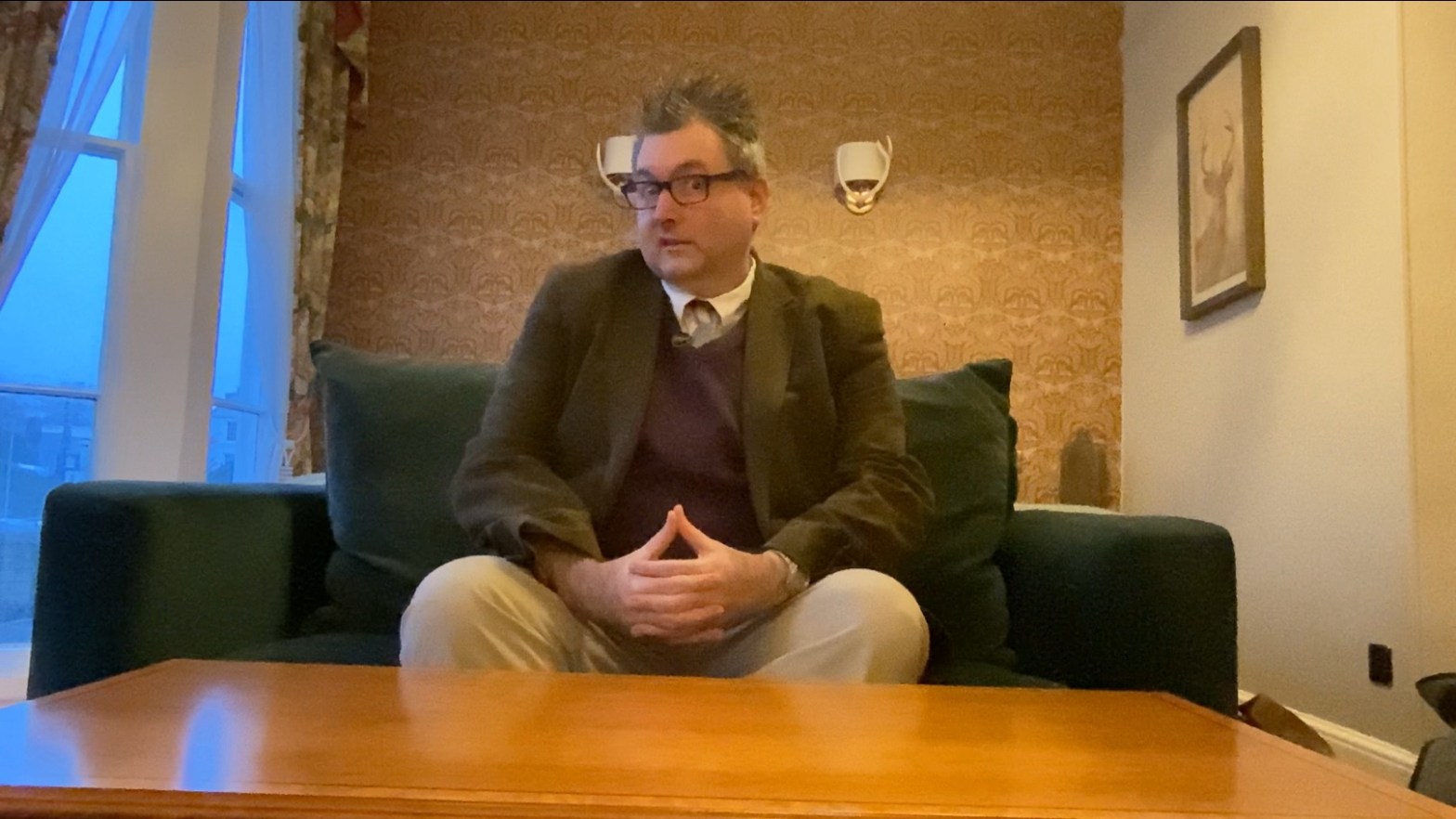
I had a lovely time last week performing a headline set at the Taking the Mic event at the Exeter Phoenix arts centre. Thank you Tim for having me!

I videoed my efforts and they can be viewed right here:

Let me know what you reckon!

Reception

In 2010, on the way back from Australia, I stopped in Tokyo for a few days, arriving at midnight. I’d booked a hotel but they lost my booking and so began a strange few days of existentialist angst when I started asking, who am I? What is my history? Do I exist? I started writing this novel.

A few weeks later, of course, once the novel was finished, the tsunami hit, so reading this novel again always gives me a strange sense of foreboding.

Anyway, you can now read Reception as an ebook!

The New Fridge Freezer is Suspiciously Quiet

The new fridge freezer is suspiciously quiet.
I don't want to cause a fuss
And I don't want to cause a riot
But the new fridge freezer is suspiciously quiet.

Put some feta cheese in there,
Put some Camembert in there
Put some other things in there
It's very very quiet.

The new fridge freezer is suspiciously quiet.
I don't want to cause a fuss
And I don't want to cause a riot
But the new fridge freezer is suspiciously quiet.

Bought it from a man from Bern
The man from Bern his name was Bern
Fridge freezer, Swiss geezer
So so quiet.

The new fridge freezer is suspiciously quiet.
I don't want to cause a fuss
And I don't want to cause a riot
But the new fridge freezer is suspiciously quiet.

Have you turned it on?
Of course I’ve turned it on.
Have you plugged it in?
What am I, daft or something?

The new fridge freezer is suspiciously quiet.
I don't want to cause a fuss
And I don't want to cause a riot
But the new fridge freezer is suspiciously quiet.

The old one went chigga chum chigga chum
The old one went witty witty woo
The old one went chigga chum chigga chum
The old one went to the tip.

The new fridge freezer is suspiciously quiet.
I don't want to cause a fuss
And I don't want to cause a riot
But the new fridge freezer is suspiciously quiet.

The new fridge freezer is suspiciously quiet.
I don't want to cause a fuss
And I don't want to cause a riot
But the new fridge freezer is suspiciously quiet.

On 2025.

As 2025 lumbers to a wimpering snuff, many of us see a world that seems almost unrecognisable to the one we’ve always known. Division and hatred, thinly veiled racism, outright transphobia, and the prevalence of the ego have combined to create a cultural environment in which core principles of neighbourliness and humanity have taken a back seat. Other and better writers have written about this and to much greater effect. It’s hard not to see our lives, dominated as they are by so many distractions, and consumed mostly by looking at a screen or a mobile phone, as being the primary reason for this. But I’m not a psychologist. Nor an analyst. I just believe that it’s so much easier to tell a lie than it is to disprove it. And quicker, too. Do I despair of the world? All I can say is that people get bored very quickly. They want instant gratification, and now. The shock of the new.

As for me, 2025 has been, well, unnecessarily interesting. I’d had a good life for the last fifteen years, writing and performing poems while working in my job, in retail management at the same branch of a charity for almost thirty years. 2024 was marked by the drug dealers who lived in the flat above my shop. There were frequent fights, arguments, knives, needles, gangs of ne’erdowells to contend with, all happening right above the shop. I thought it couldn’t get any worse, and then, all of a sudden, it did. In February of this year, the drug dealers upset someone, (an ex-girlfriend, apparently), who then announced on social media that she was going to burn down their flat that very evening. (Incidentally, this was Valentine’s Day. How symbolic). So the drug dealers did the right and humane thing, and moved out for the night taking their possessions with them. I watched them go through the security peephole in our back door. They loaded their possessions into a car. I hope they don’t burn the place down, to cover their tracks, I thought. So it was no surprise when I got a phone call first thing the next morning to say that the shop had burned down.

Yes, it was arson. But now I found myself in a tentative position. Would I still have a job, especially in the current financial climate? What would happen to my staff, would they still have a job? The company could very well have ‘let us go’ then and there, but they were understanding. I was made into a floating manager. My job was now to travel through the south west and cover at any branch where a manager was absent. Over the course of 2025, I worked in almost every town you can think of between Bournemouth and Cornwall. Some of them I thought they’d just made up. (Midsomer pNorton?!). I spent a lot of 2025 living in hotel rooms and eating buffet breakfasts. So yes, I still had a job.

But it was my performing which suffered. I could not commit to gigs because I never knew where I was going to be staying or working. I could not rehearse, because I used to use the shop to rehearse every single morning while I was getting the place ready. I couldn’t learn lines, especially in a hotel room. I had a few wonderful gigs which I had to book time off for, including Penzance, and a quick trip to Edinburgh. I had a good enough time.

The one thing I did, though, was to work on a novel. I’d already written the first draft when I applied to Curtis Brown Creative, and amazingly, I was let on the course. Over the summer we developed the novel, and it’s looking very good indeed. I am now tinkering with it and hoping that an agent or a publisher sees enough in it to accept it. I’m very happy with it, indeed.

This last month, I was made temporary manager of the shop in Torquay. This is much closer to home, and all of a sudden, I have time now to rehearse again. It feels like things have turned a corner. They’re even due to begin building work on my old shop, (the landlord died over the summer and nobody owned the place, thereby everything came to a shuddering halt). Which is to say, I’m starting to feel like my old self again. The whimsy is returning.

So what did I get out of 2025? A lot of memories meeting people all over the south west, and a novel, and the benefit of the tutelage of Suzannah Dunn, (who really liked my novel), and a huge amount of time sat on trains. (Working in TIverton for three months meant five hours on trains and buses a day). And time to look at my fellow passengers, all watching TikTok.

The world will not change and I cannot make it. I just know that there are civil people out there, concerned for humans and humanity, opposed to stupid wars and political bullying, opposed to toxicity, big business, politics in general. Sometimes it is better to whisper than it is to shout, but I only say this because I’ve never felt entitled to shout, and that there are others who are much better at it than me.