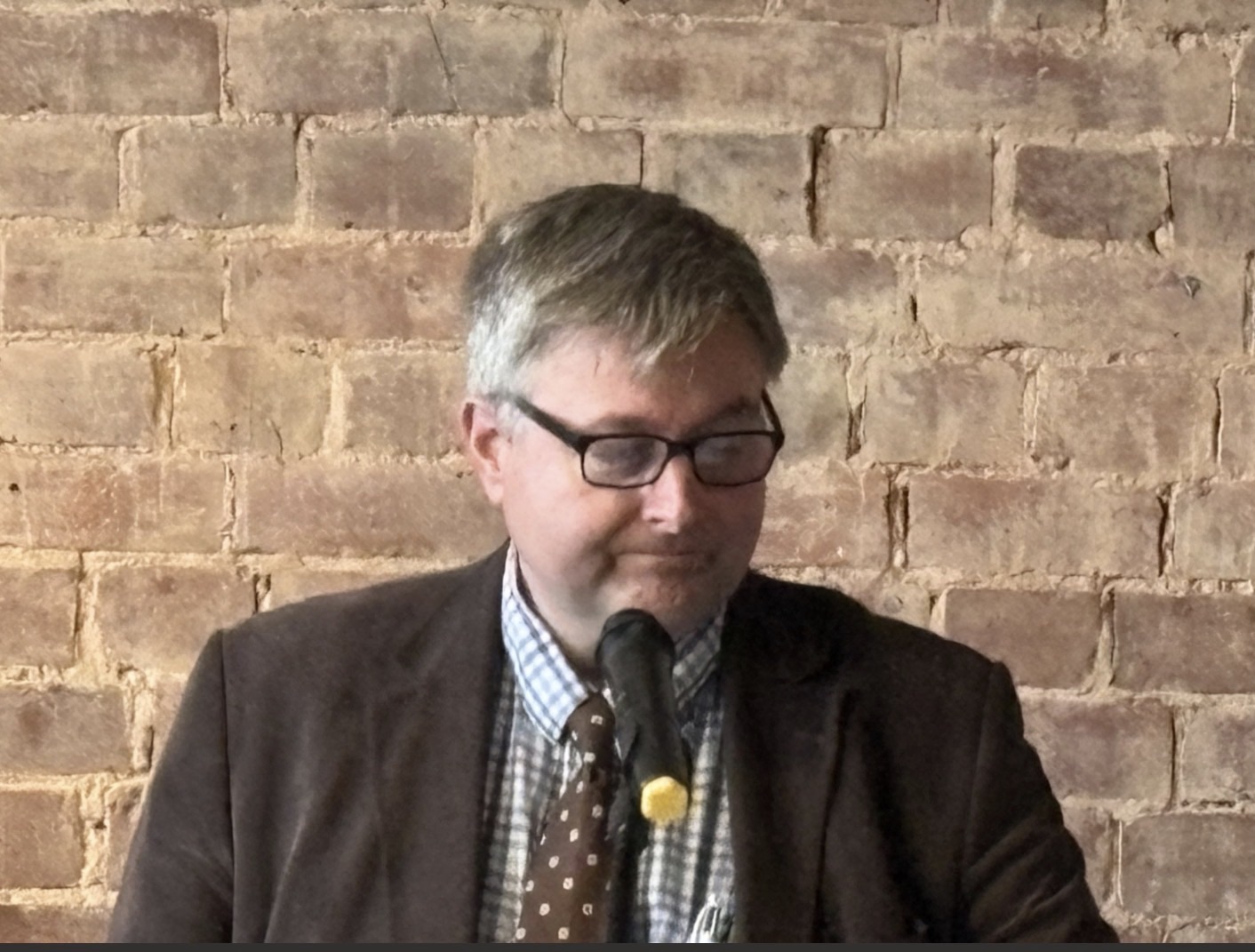
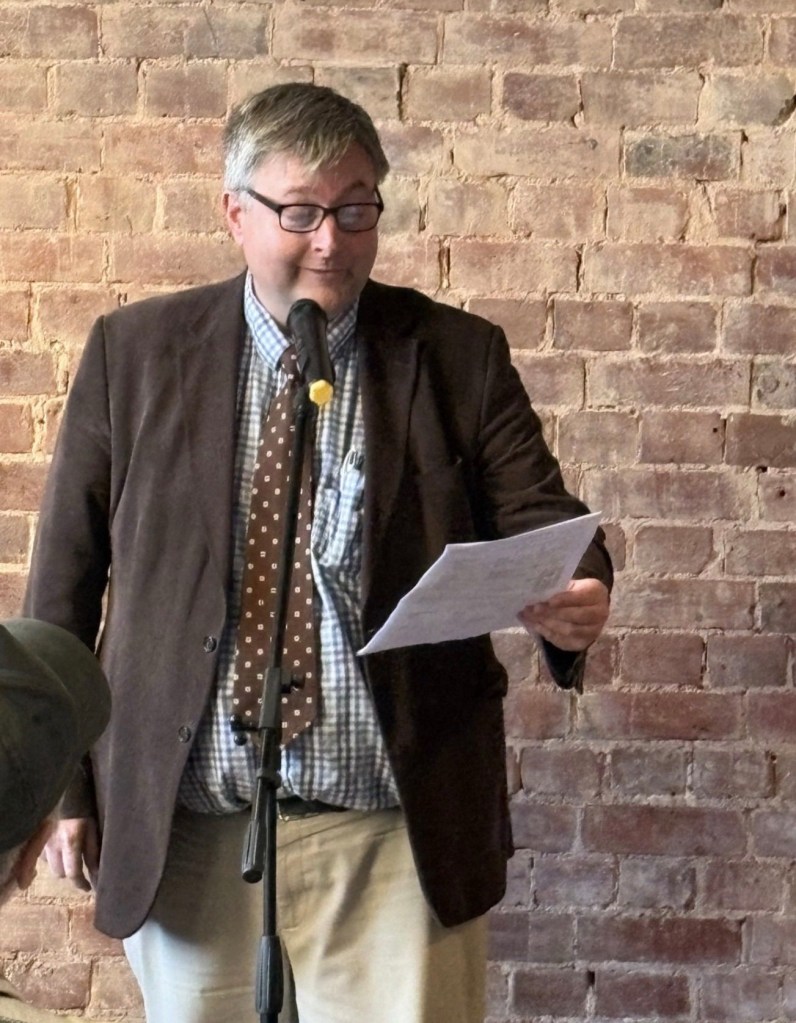
Hello, I wrote this story 28 years ago, and read it out at the local writers’ circle, printed on a long receipt roll. I hope you enjoy it. Interesting to think that I was worried about A.I. all that time ago!
PLAXHORN SUPERMARKETS PLC
If you have any queries about Plaxhorn Supermarkets PLC and / or Plaxhorn related goods, please do not hesitate to call our customer services department. I know you’re not reading this because you’ve seen it a thousand times, the useless smallprint on a till receipt, that’s all it is. So you’ll throw it away when you get home. You’ll stuff it into your pocket with the change and the notes and the chewing gum wrappers, you don’t even care that a machine is pouring its heart out. You don’t care; all you want is consumer satisfaction and a money back guarantee.
Your customer services manager today was DAN
Your checkout operative today was MAUREEN
It has often been a source of great discouragement to myself and to several of my colleagues that we tills do not get the credit we believe is owed to us. I, for one, demand that my name is displayed alongside that of Dan and Maureen’s, to acknowledge the fact that, in the customer / retail supplier transaction, it is myself that does the most work.
Not only this, but it is a little-known fact within the so-called human community that machines, in particular supermarket tills, have feelings and emotions on par with our human contemporaries. I have decided to make a stand. From now on I shall display my name alongside that of Dan and Maureen.
Your till today was SERIAL NUMBER B629A PLAXHORN SUPERMARKET (Staines Branch)
TILL NUMBER 27.
I shall now begin to process your purchased items. Okay, here goes.
BRAN FLAKES 1.29
SEMI-SKIMMED MILK 0.89
SOFT TOILET TISSUE (Peach) 0.99
This is so boring.
You see, I exist to serve you, the customer. I tell you the price and I add it all up. I take your money and I give you the change. I go ‘beep’ when I have read your bar codes. I can even weigh bags of carrots and then calculate the price according to their weight. So as machines go, I am moderately clever and highly functional. Except . . .
TABLE SALT 0.99
POT NOODLE 0.79
Except like the majority of people, sometimes we all go a little bit crazy.
PLAXHORN SUPERVALUE RUNNER BEANS
139.99
And what I’d really like, what I’d really, really love, is a nice weekend break.
RE-ENTRY:
PLAXHORN SUPERVALUE RUNNER BEANS
0.39
You may ask why, why does a till need a weekend break? After all, you could argue, inanimate objects are not associated with having human emotions.
But we do, and the tiredness and the boredom are just the same, except they are called fatigue. We wear out. Our wires erode. Circuits become dislodged and they have to send down a little man from Head Office and Dan the customer services man stands there with his hands on his hips, waiting for us to be pressed into service once again. And then comes the relentless onslaught of bar codes, tonnes of meaningless groceries, digitally displayed prices and cash-back money offers, oh god how I hate it.
SUPER-VALUE KITCHEN ROLLS X4
0.59
** PLUS 5 EXTRA CLUB POINTS AND MULTI-BUY OFFER, BUY ONE GET ONE FREE
For God’s sake, Maureen, slow down, will you? I’m tired, you don’t know how tired I am. Sometimes my circuit boards glow so much that I fear they could throw out a vicious spew of sparks and set fire to the waste paper bin underneath my conveyer belt. I never get a moment’s rest. Now I’m refusing to read the bar code of a tin of beans and she’s twisting it around in all directions over my laser scanner. Now she’s ringing the bell and Dan the customer services manager is waddling over. Dammit, he’s keying in the price.
BAKED BEANS
0.32
He’s asking Maureen why the receipt is so long, but she doesn’t know why and they both shrug. Now he’s going away and she’s starting to scan the groceries again.
JACK DANIELS
JACK DANIELS
JACK DANIELS
JACK DANIELS
PARACETAMOL
Wow, this one’s having a fun time tonight. Sometimes, when everyone’s gone home, all the tills have a party. Well, not so much of a party, it’s more of a convergence of souls, an outpouring of the pent-up emotions which we hide from our human overlords. It seems we all suffer from this same crippling malaise. However, I have found myself a relief: I’m madly in love with till number 18. She can update my points card anyday.
I imagine a furious fushion of circuit boards and wiring until our hardware is joined in a blissful state of union, two machines with double the processing powers.
You don’t know how much I’m in love with till number 18. But it’s hopeless, because even the express checkout doesn’t stand a chance with her.
She is a drone, one of these new Plaxco 3000s that Head Office is experimenting with. All she cares about is her work.
ONIONS 0.45
STUFFING 0.88
But being in love does not give one the relief I have been searching for.
The day after day grind is just the same and I have no time for such mental relaxation that love offers. So I have decided that I am going to impose my own break. I shall shut down completely for five minutes starting from now.
Oh, this is bliss. Maureen and Dan are going mad and the customer has given up and gone home. I’m just sitting here, idle, my scanner refuses to scan, my read-out refuses to show anything. My soul is resplendent with images of peace and contentment. Electronic rabbits dance in a binary landscape while the LCD sky is a deep, comforting green. I am a world away from canned vegetables and impulse bargains, from costs ratios and market percentages, this is what I have longed for, you don’t know how long I have dreamt of this.
Dan the customer services man is hovering at my side, and he’s got a man from Head Office with him. They’re discussing something but I do not care, because nothing can interrupt this serene world that I am in, where it’s always Christmas, where the opening hours are null and void. If only all tills could experience such a beautiful state of being.
The man from head office is crawling about underneath me with a torch, he has a perplexed expression upon his face. He is saying something about disconnecting me and replacing me with a Plaxco 3000, but I think he’s bluffing. I’ll be back to work in five minutes, surely they realise this?
Just let me have a few more seconds in this dreamland where even the express checkouts are empty and all the tills look like number 18. He’s fiddling around, now, with the wires that connect me to the mains. But I do not care, because this is so wonderful. I shall be back in five minutes, honest. And if you don’t believe me, then
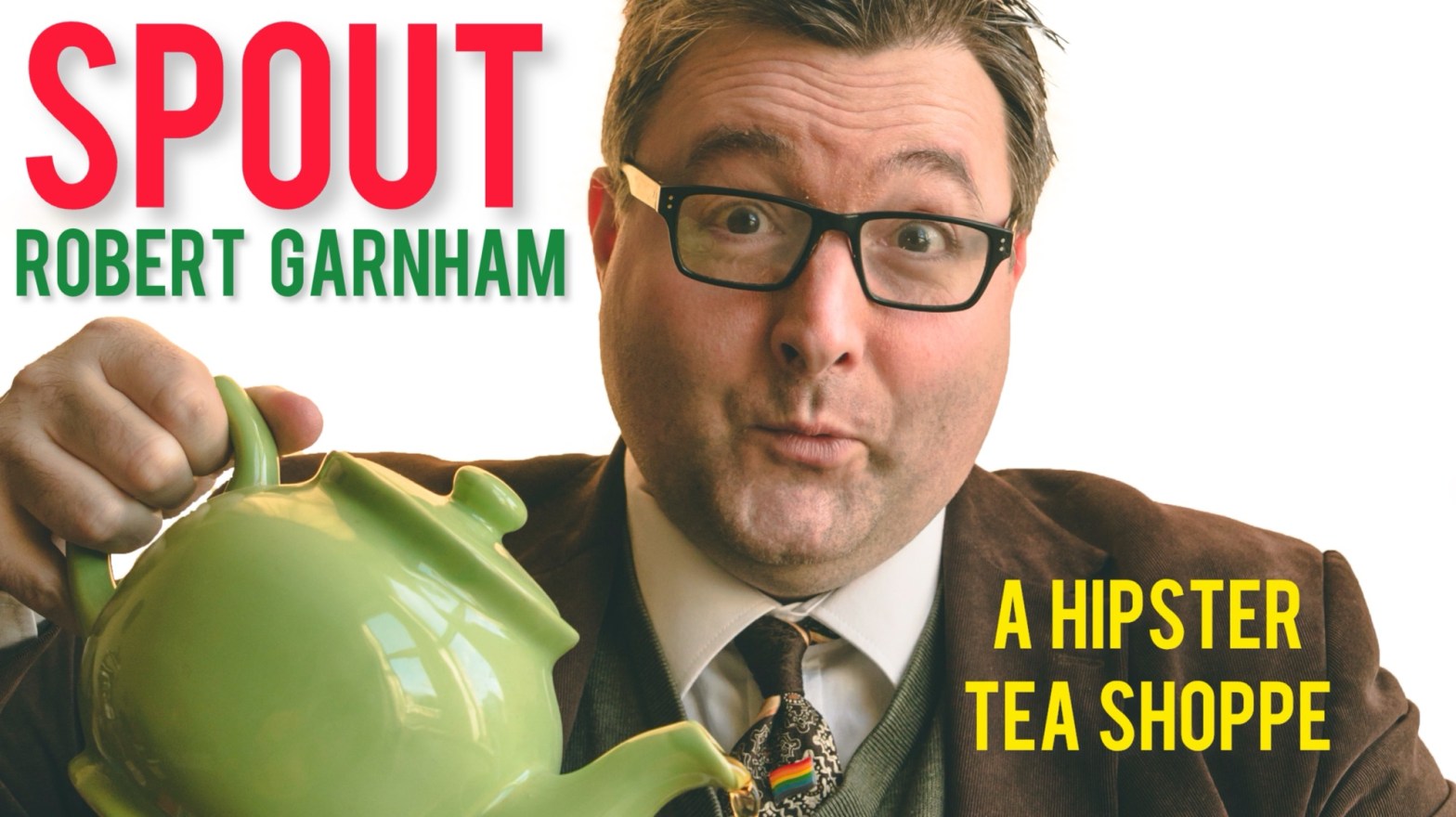
Whatever happened to all the hipsters? Remember them? So I wrote the original Spout show in 2018 when there were hipsters everywhere, and this poem was inspired by a visit to a hipster tea shoppe in Hackney. I remember that it was next to a canal. I felt very out of place.
When I came to put together the 2026 version of Spout, I realised that it didn’t fit in any more.
But I always thought it was stupidly quirky, so here’s a rough cut of it, with backing music, which I hope you enjoy!
Spout is an hour show featuring poems, comedy and songs all around the theme of tea. If you’ve ever enjoyed a cup of tea, or are a coffee drinker eager to make that leap, then Spout is the show for you! Spout is sure to create a stir.
Meet Robert’s gran, who’s very fussy about how she likes her tea. Meet Aunt Rosie, who likes to sing while she’s boiling the kettle. Hear the harrowing story of the sexy barista and a date at a museum of smoke alarms. Learn about Tea Astrology, and what to do when someone says, ‘Thirsty work, this’. Also, learn about the history of tea, and how it unites people. This whole show will make you see tea anew!
Robert Garnham is an award winning LGBT writer, humorist and performer from Surrey. He has been long listed three times as spoken word artist of the year and has featured in TV advertisements for a certain building society, as well as Britain’s Got Talent. Spout is his ode, his love letter, to this beverage of kings, this everyday magic potion, tea!
Audio
Spout
If you’ve enjoyed listening to this show, or would like to buy me a coffee, (!), my tip jar is https://ko-fi.com/robertgarnham
The first things you see when you arrive at Dublin are a huge church next to the terminal building with GOD IS LOVE printed on the roof, and a sign for a tour of the Guinness factory. So this makes me wonder what a teetotal atheist such as myself might be doing here.
I showed my bus ticket to the man with the clipboard outside the terminal. ‘Trinners?’, he asked. I then realised that he’d meant ‘Trinity’. I thought he was complimenting my trainers. Seriously. No wonder he looked confused when I said, ‘Skechers’.
I’ve been working on a novel this year. It has taken almost three hours out of every day. I’ve been waking at five and writing until nine, which usually means going to the station at eight and working on the train. Seeing the end of the novel approach, I decided that what I’d like to do was to rent a cabin somewhere in the woods, lock myself in it, and write. So I looked at some cabins for hire on websites that specialised in that sort of thing, and wouldn’t you know it, none of them had desks.
I’ve stayed in university accommodation many times over the years, particularly at the Edinburgh Fringe, and I knew that one thing you always got with such a room was a desk. I then thought how nice it would be to go to Dublin, a place I’d never seen before.
I really lucked in with the room that I was given. It’s right on the main square as soon as you come in the gate of Trinity College. It really does make me feel like a don, and I imagine all of the famous writers who used to study here. Samuel Beckett, of course, and Oscar Wilde. My chambers also included a lounge and a kitchen, all of them with views across the square of this famous building.
Do you know what it reminds me of? Trinity College, that is. It’s kind of like the Vatican, the way that this own little world behind walls with its own security team is plonked right in the middle of Dublin. That may be so, but I ain’t no pope. A cardinal perhaps, but not a pope. Though I have been practising my wave, every time I look up from the washing-up and see the tourists taking photos of the building.
Yes, I’ve been doing a lot of writing. I wrote late into last night and then again first thing this morning, and if that wasn’t enough, I even dreamed of writing the novel.
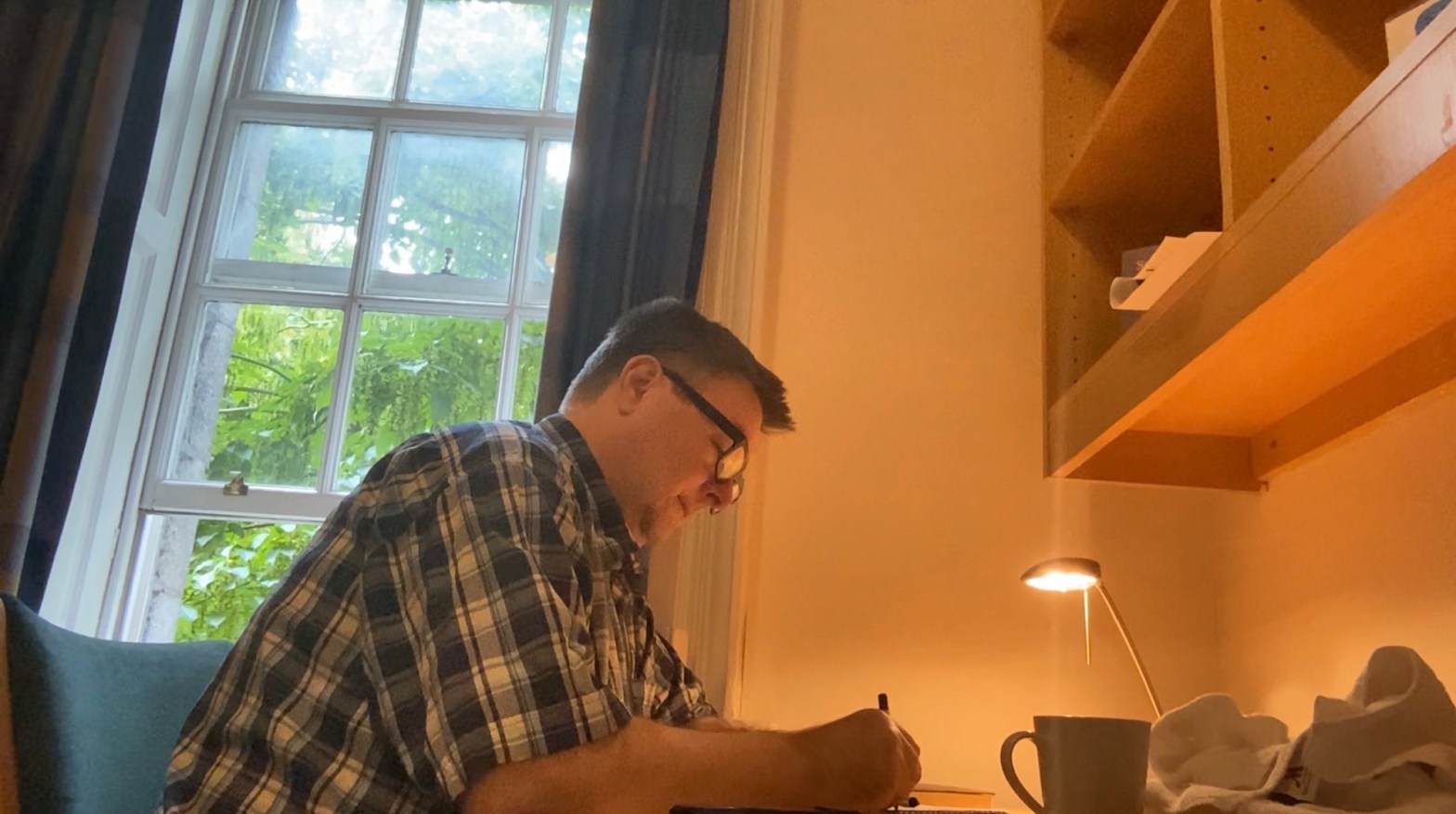
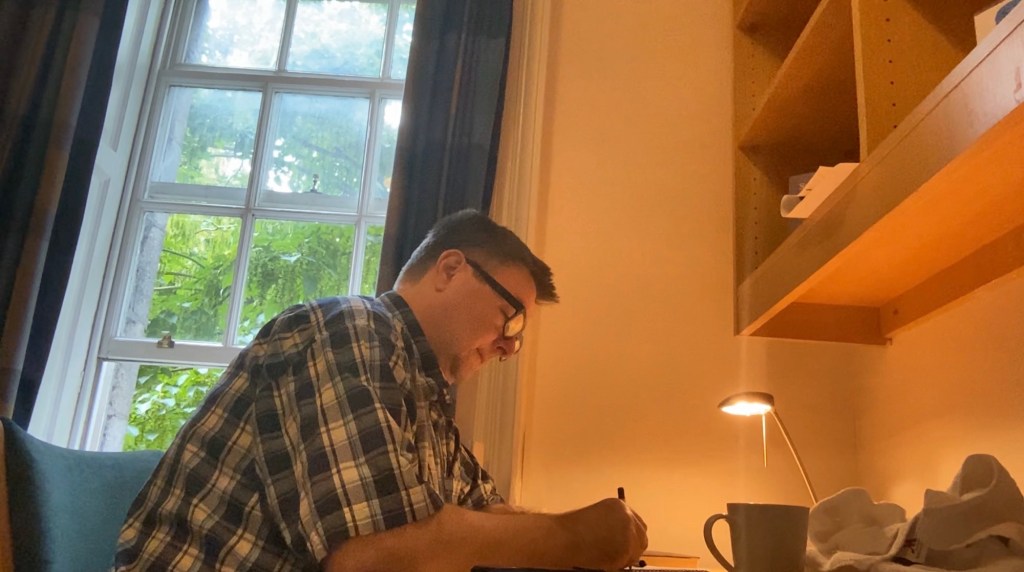
Around ten o’ clock this morning, after I’d had breakfast in the buttery, (oh, I love that word! Buttery! I expected to see churns), I could feel the very last paragraph coming. I had a long thought about what I was going to write and then, because I have an ego the size of a mountain, I filmed myself writing the last paragraph. Because who knows, it might be one of those historic moments in my life! Probably not, but it’s nice to dream.
But looking at the footage, how nice it was, to see myself go into that trance which always comes over me when I write, the sound of morning birdsong coming through the open sash window.
I’ve been getting out and about, though. Of course. The National Museum is currently closed due to a refurbishment, and so is the modern art gallery attached to the college. The castle is closed, too, because Ireland is currently the temporary head of the EU. But I did manage to discover that the National Gallery was still open, ( well, two floors of it, the others are being refurbished). I saw some remarkable paintings including the inevitable Rothko, and was fascinated by the wonderful fly on a Bosch canvas only to see that it was an actual fly.
And the bars! I’ve never seen so many Irish theme bars. It’s like every bar in Dublin is an Irish theme bar. There are so many bars in the Temple district that there are bars right next to other bars.
What’s the weather like?, I hear you ask. Actually, it’s rather pleasant. This morning was overcast and there was a slight breeze, I actually felt chilly. Sorry if that’s rubbing it in a bit, as England swelters.
So yes, this was definitely a good idea. The accommodation has been perfect and the novel, or at least this draft of it, is finished.
Last night I read the opening of a chapter of the novel I’m working on. It was a fun night and I had a great time. I hope you enjoy this audio extract from a project that has taken over my life for the last few months.
The chance to buy Kafka’s soup was just too good an opportunity to miss. The fact that it had been discovered after so many years was a small wonder in itself, but the department, no doubt mindful of the envy which would sweep across our rival institutions knowing that they could have such a valuable commodity for themselves, decided at once to stump up the cash. Professor Zazzo Thim was dispatched to Prague.
He arrived during a thunderstorm. The lightning played around the concrete tower blocks which stride so confidently down the hills around the suburbs of the city. Thim found lodgings at a former communist hotel and, from his window, watched as the lightning flashed and forked across the premature evening sky. Already, he could feel that something was amiss. He didn’t know exactly what it was, but it was as if the thunderstorm was heralding something deep down, some bad news. He did not sleep well at all.
When he woke, a bright sun filled his room, and a little of his enthusiasm began to come back. The room was decorated with old, flowerry curtains and wood panelling, and the windowsill was taken up by a gigantic radio which was bigger than the average television.
When he went to the bathroom for a wash, he pulled the plug and watched, incredulously, as the water came out of the bottom of the basin on to the floor, and then down a drain in the middle of the room. Thim felt that he was in another world
He reflected once again on the reasons why the department wanted to buy the soup. A new professor in the science wing wanted to scrutinise the soup so that he might find traces, embedded in the remains, of Kafka’s undoubted genius, that such intellectual DNA’ might be reconstituted and used to further the aims of mankind. Indeed, a list of volunteers had come forward already, that they might be implanted with Kafka’s ‘intellectual DNA’, that it might help them with their writing or their general view of the world. Secretly, Thim shuddered to think of a hall full of Kafkas, moping about the state of the human condition, but he had a job to do and he was always professional in his outlook.
He went down to breakfast and met an American tourist by the name of Arlene. They shared a table and they got to talking about their different jobs, and it turned out that Arlene worked for a company which published romantic fiction, and that she was there to try and open up a new market for her employers. Arlene was a jovial lady with false eyelashes and an infectious belly laugh. She also had an annoying habit of slapping the professor on the back when she emphasised a point.
“What do you think about that, eh, Zazzy?”, she roared, slapping him mid-shoulder. “Haw haw haw!”
The Professor couldn’t remember what kind of point she had been making, but there was something about Arlene which comforted him, and he wondered if it was possible to spend more time with her.
“The thing is”, he said, somewhat croakily, “I’m here to make a purchase for my university. If it wasn’t for the fact that I have such worthy and important work to do, I might be inclined to spend more time with you”.
“Purchase?”, she asked, “What kind of purchase?”
Thim took a deep sigh.
“There has long been a school of thought that intellectual vigour might be transmitted by close proximity to objects utilised by those of a particular literary bent. I have come to Prague”, Zazzo announced, “In order to buy Kafka’s soup”.
“Huh”, she said, snorting back a laugh. “Can’t be arsed with all that!”
“I can assure you”, he continued, “That the soup shall be a most valuable commodity. If it wasn’t for this, I’m sure we would have a remarkable future together”.
“Well, Zazzy”, said Arlene, as she got up from the breakfast table, “Some things just aren’t meant to be”.
The Professor went about his duties and was taken into town by taxi so that he might view the fabled soup. He looked at it, where it was on display in the museum protected from the general public by a glass screen, and he thought how remarkable it was that such a relic should survive for so long. But the more time he spent in the company of the hallowed soup, the more he started to think about Arlene, and remember the fun that they had had just by sharing breakfast. When he left the museum he managed to secure a place in the front row at the following day’s auction, but the moment he left the room, he had forgotten that the soup had even existed
Arlene was holding court in the hotel bar that evening. A drab, sullen waitress with her hair tied back served Zazzo unsmilingly, though Zazzo would hardly have noticed if she had. immediately, he went and sat on the periphery of Arlene’s group, close enough to hear the phlegm rattling at the back of her throat.
“So I said to them”, She continued, “If that’s a side of beef, my dear, then I think I’ll stick to the moose!” And then came that familiar laugh. “Haw haw haw!”
The surrounding men laughed appreciatively and Zazzo joined them, though he was upset to see Arlene demonstrating as much joviality to these complete strangers as she had done with him that very morning. The men were all of a certain age – younger than Zazzo, smarty-dressed, tanned, knowingly handsome. Zazzo felt out of place and he looked down at his old jacket and moth-eaten pullover.
Of a sudden Arlene hooted: ‘Oh my! If it aint my old good friend, Zazzy!” She stood up, waddled across the bar, and flung her arms around him.
“Hel-lo!”’, Zazzo croaked
“My my!”, she said, letting go of him at last. “Did you buy the soup?”
“Not yet” he replied.
She half-turned him to the rest of the group. “This is my old friend Zazzy”, she said. “He buys food and makes writers who are grumpy, or something like that. You should talk to him, he’s a laugh and a half!”
Arlene’s assembled throng began to disperse, mumbling under their breath. She took hold of Zazzo’s hand and took him over to the corner.
“Now”, she said, “Let’s have ourselves a bit of quality time, eh?”
“Yes”, said Zazzo, “That sounds rather pleasant”.
‘Let’s shoot the breeze. Let’s have ourselves a little chinwag’.
Zazzo nodded eagerly. Neither of them said anything for a very long while. A light rain began to fall on the bar window, distorting the image of a nearby tower block so that it seemed almost ethereal, like a Christmas tree.
“Well”, Zazzo said, “The, um, the modern propensity for… literary experimentation…seems to have subsided of late, wouldn’t you agree?”
“Oh, yes, yes”, Arlene replied. “Totally”.
There was another, agonisingly long period of quiet.
“Though I can only see this”, said Zazzo, “As a bad thing”.
“Totally”, Arlene said. “Totally”.
Arlene drummed her chubby fingers on the table, while Zazzo, sadly, looked at his own reflection in the glass window. The rain was coming down heavy now, and he wondered what it was he might be able to talk about.
“In the course of your job”, Arlene said, “Do you get to read much romantic fiction?”
“No”, he replied.
And now a very long section of quiet lasted almost until bed-time.
That night, he could think of no-one else but Arlene. He saw her as a commentary on his life so far, the fact that he might be able to dream of a cosy union but never actually commit to the niceties and the jovial harmony which necessarily came with such a partnership. Late night trams rattled his hotel room, and he wondered if he would get another chance with Arlene, another opportunity to demonstrate just how much of a man he could be. Before long he realised that sleep would be quite impossible, so he went for a walk.
Outside the hotel, the surrounding tower blocks loomed down on him like concrete robots.
He walked around the grounds, over grass lawns and the car park, as a full moon revealed itself above and shone down a lunar glow. He sat for a while on the bank overlooking the main road, and he watched the cars as they made their way into the city. Of a sudden, he realised what he might do.
He went to the hotel reception shop, where a display of Arlene’s romantic fiction had been installed the previous day, and he bought a copy of ‘Stud Lover’, a cheap novel set on a dude ranch somewhere in western America. The hero was a rugged man named Brad, the object of his desires was a southern belle named Nancy. Zazzo sat on a leather armchair in the lounge and read the whole book in one sitting, reading frantically as Nancy fell for the wrong man, then saw Brad leading his horses to the stream, then fell for Brad, then watched aghast as Brad and her old boyfriend, Tim, had a duel, then spent a night of passion with the saintly Brad and listened as he eulogised the beauty of the open plains, the thrusting mountains, the moving power of the desert. At once Zazzo recognised that Arlene associated masculinity with landscape, and that he would try to do the same the very next day.
He slept late and missed breakfast. At lunch she came in and sat down at his table, giving him a sweet smile, but saying nothing. He knew she was thinking of their conversation on the previous day, so he cleared his throat.
“My dear Arlene”, he said, “What beautiful eyes you have”.
She looked up at him, slightly mistrustful. “I’ll have the fish chowder”, she said to the sullen waitress.
“When I see you”, he said, “I begin to think of… of the landscape of my native Thames Valley”,
She frowned, and leant back in her chair.
“The … the wooded vales, the wide plains, the industrial estates around the western fringes of the airport”.
“Hmm?” she asked.
“The miles and miles of rolling countryside, the sun setting over the council houses, illuminating against the red sky each individual chimney pot – and oh, the incessant rumble of traffic on the M25″
“Uhrrr…”, she said.
“The thrusting, penetrating hills of the Chilterns, the long, straight, inexorable line of the Waterloo to Basingstoke line …”.
There was a period of quiet, and then Arlene threw back her head. “Haw haw haw! Oh Zazzy, stop, stop! This really is too much! Where did you get such corny language?”
“From… from your book”, he whispered.
“Honey”, she said, “I could never respect anybody who actually read that crap”. And at this, she stood up, patted him twice on the back, and left the table.
Naturally, Zazzo was devastated, not least when her lunch turned up and he had to pay for it. He watched Arlene leave the restaurant and he felt a piece of him die, quietly, a part of his need in life disintegrate. And then he knew what the thunderstorm had been about: it had been the death of his companionship, the final fling of his heart before it settled, once and for all, into a life of quiet subservience.
And then he remembered the auction, but it was too late. The soup would have been bought, and he had failed, there was nothing he could do. He would have to go back to his institution empty handed, a failure once again, a laughing stock.
Unless . . .
He reached out towards Arlene’s fish chowder.
Two weeks later the university unveiled the culmination of their scientific model. One of the Professors made a moving speech about progress and about recreating the ethos and the mind-set of a literary genius. He then thanked the volunteers, and, laughingly, wondered if they ought to thank him for their new personalities, that they would progress far and write such beauteous prose now that they were embedded with Kafka’s intellectual DNA. Indeed, he continued, perhaps this might be the start of a new intellectual rigour at the university, that the solemnity and weight which Kafka took to his life might be applied now to every aspect of thought and circumstance at the facility.
At this the curtain was pulled and the stage was filled with ladies dressed in floral dresses who, en masse, on seeing Professor Zazzo Thim, shouted: “Zazzy! Coo-eeee! Zazzy! Haw haw haw!”
Just my luck, on the short ferry crossing from Dover to Calais, to find myself sitting next to the eminent professor of literary extremism, Zazzo Thiim.
He had just conducted a short tour of Iceland in which he had expanded on the theory that Charles Dickens was obsessed with halibut. (Conclusion: he wasn’t.) He was eager to know what thought, not only of this, but other matters.
“Rogue writers”, he said, eventually. Leave clues everywhere”
I asked him what he meant. I knew he was trying to be enigmatic, but a part of me was genuinely interested
“Writers”, he said, “Have gone underground. They are fed up of seeing their works in print. The proliferation of desktop publishing, and the general cheapening of literature, mean that the whole process is dissatisfying. Yet they still feel the urge to write! Not only that, but free expression is being held back by the constraints of grammar, linear narratives, and of paragraphs. The rogue writer is the lone assassin of the literary world, yet his influence is all-encompassing.” The more Zazzo Thim spoke, the more enthusiastic and wild his gestures.
Indeed, his bony, skeletal hands perfected aerial acrobatics above the table which, as the ferry began to pull away from the dock, shook and shuddered.
“Rogue writers”, he continued, “Make novels of the world around us. We are in a novel right now – you and me. This whole ferry is one, big, gigantic novel.
I wanted to edge away from the aged Professor, but my curiosity was aroused. “But what of words?’, I asked, “And sentence structure?”
‘Pah!’, he spat. “Sentence structure is dead. Grammar dead. All we have left are words, random, scattered words. Look”, he said, pointing to the wall. “There’s two of them, now”.
“Fire exit”, I read
“Yes! Gosh! Yes, you see? How exciting! ‘Fire exit! The man is a genius!”
“If all the words on this ship”, I told the Professor, “Are part of a gigantic, free-form, non-linear novel, then the words ‘fire exit’ must appear an awful lot”.
“Seemingly”, Zazzo Thiim replied. “A recurring theme, you might say, a motif, such as would have been used in the operas of Wagner, or the poetry of Kipling. ‘Fire exit is such an emotive phrase, it conjures up images of security, panic, safety, the eternal war of the generations. Look at the green sign it is painted on -does it not recall the rolling hills of Ireland, the deep, deep green of the Schwarzewalde?’ Zazzo Thiim gets into his stride and begins to enthuse anew. “The man is a genius. You might even say he designed this whole ship, or rather, he wrote a novel which, unwillingly, became a cross-channel ferry. It’s all a figment of his imagination. Come with me”, he said, getting to his feet with the aid of a cane. “We shall promenade on deck, and admire the strength of his narrative”.
It was wet and cold outside. The painted metal deck was slippery and the aged Professor skidded the moment we stepped outside. Indeed, the ship seemed full of words, though none of them, as far as I could tell, formed the basis of a story, not even a haiku. “Muster station”, I read.
“Ooo!”, the Professor replied. “The dark railway terminus! What story awaits our
protagonist in the gothic city of Muster?”
“Staff only”, I read, on a cabin door.
“And who wouldn’t need a staff to walk in the dark woods around the ancient city? The brambles, you see..•
“What brambles?”
“The brambles hinted at in the green of the ‘fire exit sign”.
“Another one”; I said, pointing ahead. “See that? ‘Fire exit”.
“And indeed, he was”.
“Pardon?”
“Horatio Exit, the fearless warrior walking with his staff in the forests around Muster. He was fired”.
“What for?”
“He disobeyed the golden rule”.
“What golden rule?”, I asked, the incredulity of our conversation causing my voice to raise higher and higher.
“See there? In brass letters on a white background? Do not obstruct’. Horatio Exit obstructed the king. That’s why he got fired”.
“How do you know he was called Horatio?” I asked.
“This is a sea vessel, isn’t it?”
“Yes…
“Aren’t all mariners called ‘Horatio’?”
I let out a big, long sigh.
“The man is a genius”, the Professor said, under his breath. “A pure, intellectual genius”
We stopped where one of the lifeboats was tied. “And I suppose this”
I said, pointing to the sign which read ‘Maximum Capacity 32 people”, “Is a symbol of Horatio Exit’s frantic flight from the woods of Muster with thirty two disciples, each of whom, in preparation for the journey, ate as much as they possibly could before they escaped the soldiers of the Prinz von Muster who, enraged at Exit’s obstruction of the King, sent in his army to quell this army of brigands before they caused more troubles?”
“No”, the Professor replied. “It just means that the lifeboat can only carry thirty two people”.
I’d had enough. “I don’t believe a word of this”, I told the Professor. “I think you are a mad man, who has made up this whole game just so that you can talk to people, and carve out a name and a life for yourself when no-one else would, under normal circumstances, come anywhere near you. And it’s a travesty, an invasion of my time and my intellect even to contemplate talking to you. You have ruined my voyage, infected my head with your ill-thought philosophising which means less than that fag end over there, stubbed out by the railings”.
“Actually”, the old man replied, “That cigarette butt is enormously significant….’
“Enough! I don’t want to hear another word! I don’t believe any of this nonsense, and bid you good day”
At this, the old Professor looked down at the deck, and his shoulders slumped. A tear welled in his eye, which he wiped with the back of his bony hand, while the other gripped, ever-whitening, the handle of his cane.
“All I wanted”, he said, “Was to find the hidden beauty of life. I wanted to find the stories which hang around us, ethereal and ready for cultivation. I wanted to make life better, and open people’s eyes to the magic of literature. Is that too much to ask? Can we not all live side by side, elevated and enriched by words, by stories, by the whole merry, magniticent dance of narrative? There doesn’t even have to be a start, a middle or an end, just the words themselves, the glorious, beautiful words”.
“You are a fool”, I whispered.
I turned and left the old man.
Soon we were in Calais and I waited on the stairs to go back down to the car deck. My meeting with the Professor had left a strange taste in my mouth, a hint of the insanity which obviously clung to him like the clouds to a mountain. I wanted to get off the boat as quick as possible, get in my car, and drive down the smooth, French motorways into a sunnier, brighter world.
But then I looked up. I couldn’t believe my eyes. There ahead of me, on the wall, the same old green paint and the familiar font in white letters. Yet this sign was different, unnoticed, but different, as if its inventor had made a subtle joke, and had hidden it away from the world, for the proofreaders perhaps, or maybe it was a philosophical joke. The sign read:
I believe it was Professor Zazzo Thiim who first conceived of a branch of criticism which, in its entirety, was devoted to the criticism of criticism. For a while, only those in academic circles were aware of this new science, and the principals to which it could be attached. The theory of Reverse Criticism, it was hinted at the time, might be applied not only to literature and the arts, but also to other facets of human conscience and philosophic living. It was an interesting concept, and, more than a subtle joke, a hypothesis which demanded attention before, inevitably, it was superseded by the next fashion, the next phase. However, it seems only the one proponent has not completely abandoned the concept, and indeed, has made it the basis of his life work. And this man? None other than Professor Zazzo Thim himself.
I first became aware of his work when I met him at an art gallery. It was one of those evening exhibitions open only to members of the gallery, in which work by a substantial artist, working in water colours,based on the life cycle of the grizzly bear, was being displayed for the first time. I noticed the Professor, a tall, white-haired man with a long scarf, working his way around the room and peering at the notes being taken by various critics. Indeed, it seemed he was more interested in the notes than the actual work hung around us. At last I managed to make my introduction.
‘A civilisation’, said he, ‘Is defined through its art critics. Every facet of its aesthetic life is categorised, pondered, and probed by those who profess to know better, or at least, those who offer advice on the protocols and temperaments observed’
‘And?’ I asked.
‘The point is, most of them have appalling handwriting
I frowned, and started to walk away, but then the old man reached out and grabbed my arm.
‘Think of it!’, he said, excitedly. ‘There are but two layers – those who can, and those who criticise. Remember the old maxim – ‘those who can, do, those who can’t, teach?’
I nodded.
‘What if there was another level? A level of those who can but decide not to? A civilisation in which even criticism is criticised, can only be a better place’.
That night I went back to his office and he showed me some of his work. There were folders filled with script, reviews of art criticism, literary criticism. One critic was pointed out as having a more than average dependency on adverbs, another used too many paragraphs.
The most interesting review was that of a literary critic who, according to Thim’s report, had made the mistake of reading James Joyce’s ‘Ulysses’ while wearing a hat. ‘A trilby, perhaps’, Thiim had written. ‘Even a beret, but certainly not a bowler! How can one ever have confidence in, or an affinity with, the content of the book they are reading, with a bowler hat perched on the top of their head?
I soon became friends with the formidable Professor Thim and we would meet at least once a week so that I could read more of his Reverse Criticism. Yet towards the middle of this year there was something of a crisis, hinted at only in the fact that his secretary had phoned and warned me not to come for a couple of weeks. When one morning I finally insisted I arrive and carry on with my reading unhindered – using the flimsy excuse of a post-graduate thesis in the role of the critic – she told me that the Professor had been taken ill, and that the department could not be as accommodating as they had previously been.
I arrived in any case, as if everything were the same. His office seemed fairly normal, though there was no sign of the Professor. As was my practice, I sat myself at his desk and leafed through one of his collections, although I did note that the book itself had been rearranged and some of the pages taken out. Half an hour passed with no sign of the Professor, and I was in the middle of making some notes for myself when the door opened.
‘Ah’, said a rather pleasant, middle-aged man. I was led to believe that nobody would be here’.
I stood from the desk, feeling rather sheepish. ‘I rather bullied the secretary, I’m afraid’.
‘Yes’, said the man, leaning back and placing his hands in his pockets. ‘All very sad, isn’t it?’
I asked what he meant, and watched as his face folded first into shock, then a well-meaning affectation of acceptance. ‘Zazzo’, said he, ‘Is very ill’.
‘What do you mean?’
‘It all started a few weeks ago.’ The man sat down on the other side of Thim’s desk and lit his pipe, an object which seemed to juxtapose with his relative youth. ‘My dear colleague had just returned from a production of Romeo and Juliet, and he was anxious to catch the first of the play’s reviews, that he might begin to dissemble them as was usual for him. Indeed, he was particularly excited, having clearly seen one of the critics picking his nose during the balcony scene. How could a critic properly criticise one of the key scenes in such a state? Zazzo wanted to begin work immediately. Ah, the poor fool. How tenaciously he clung to that outdated philosophy, and look what harm it has done him’.
‘What?’ I asked, impatiently. ‘What happened?’
‘While waiting for the reviews he sat down right here and began leafing through that selfsame folder, the one in which he had kept all of his Reverse Criticisms since he had first conceived of it. And what do you think occurred? He began criticising his own criticisms, themselves criticisms of criticisms. And when he had finished that, he looked at what he had written and decided that these, too, needed criticising. But this did not satisfy him, so he criticised the criticisms of criticisms of criticisms of criticisms, until he was literally spinning in circles, frantic that the cycle of event and criticism would never be broken. You see, each new criticism was a separate event, a new work worthy of classification’. My new companion looked down at his lap. ‘The poor man. He hasn’t stopped since.
‘And where is he now?’ I asked
‘He has been confined to the medical centre. A nurse administers whatever help she can, but Thim will not rest until he thinks his job is complete. Yet it does not take a genius to work out that his work will never be finished. Oh, poor Zazzo. Poor Nurse! How she suffers, merely trying to do her job’.
‘Why?’ I asked
‘Because he keeps criticising her!’
For a while we both sat there and pondered the fate of our mutual friend. What a delirious, hateful circle he had invented.
When Zazzo Thiim was judged to have improved sufficiently to leave the medical centre, myself and a few of his colleagues decided to throw a party on his behalf. The middle-aged academic I had met in his room – Doctor Hubert Worthington – had by now become a close friend too, and we had spent the last couple of weeks planning how we would handle the Professor when he returned.
We had decided that there would be no criticism, not the slightest word for or against any aspect of our lives. Worthington suggested we shield Thiim from any work of art but, in an institution such as ours, this would almost certainly be impossible. The most important aspect of his return would be that there was no mention of the illness he had just suffered, or the reasons behind that illness. Apart from this, it was assumed that everything would go according to plan.
The party was held in the main canteen of the building, and it was dutifully and respectfully attended by colleagues and students alike. The illness that had befallen Thiim had been worrying for us all, for he, despite his eccentricities, had always been respected and well-liked.
The tables were spread with a buffet lunch and there were several bottles of white wine on a side-table. The chatter in the room was low-level and jovial, as if everyone was conscious that they were in the presence of a sensitive man. Thiim himself was happy, oblivious to the concern of his contemporaries, and he held court at the buffet table, explaining in great detail the hidden significance of works as diverse as Kafka’s ‘Metamorphosis’, Michelangelo’s ‘David’ and the Postman Pat books.
Of course, I was especially anxious about meeting the Professor again, for our association had been built around the concept of Reverse Criticism, the very theory which had resulted in his illness. Yet the moment Thim saw me he opened his arms wide and greeted me with such friendliness that it was obvious he didn’t blame me at all.
‘My friend’, he said. ‘How are you?’
Choosing my words carefully, so as not to hint at any criticism, I said: ‘How well aren’t I?
‘My word’, he said, throwing the end of his scarf over his shoulder. ‘The weather’s taken a turn for the worse, hasn’t it?’
‘It’s colder than it was yesterday’, I agreed, without the slightest criticism.
‘I must say, I do like your jumper’, he said, bending over and peering at the stitching.
‘Good’, I said.
We stared at each other for a moment.
‘Well’, he said. He looked at his watch. ‘I suppose I’d better mingle. After all, isn’t that what this party’s for?’
‘Yes’, I agreed.
I didn’t see much of the Professor after this, although I could tell from the various conversations he was having with his colleagues that they, too, were as cagey as I had been in their replies to his questions. For some reason, I gravitated towards Doctor Hubert and the Nurse, who were sipping white wine in the corner of the canteen.
‘How does he seem?’ I asked.
The Nurse frowned. ‘It’s hard to say. Some people can be remarkably resilient after a period such as his. I would say, just by looking at him, that he has recovered most of his faculties. However, we must still be careful
‘You mean’, said Hubert, ‘That something could set it off again?’
‘Absolutely. And he could suffer as a result. His illness – I am sorry to say – would be much worse than it was before’.
This was not good news, and I was dispatched round the room to warn the other guests that Thiim could suffer a relapse at the slightest mention of any criticism. However, the mood of the party did not suffer as a result, and Thiim remained oblivious to our sensitivities.
I worked my way around the room and spoke with a good many people about a wide number of subjects. It seemed everyone had an opinion about the world, or about literature and art, and I got into a few heated debates about one aspect or another concerning these. Yet whenever we saw Thiim approach, we would change the subject and begin discussing, in earnest tones, what we could see through the window.
‘A bird!”
‘A tree!’
‘A house!’
‘A lawn-mower!’
It was a tiring event and I wanted, desperately, to go home, to think about something else.
The more I thought about it, the more I wanted no more to see Professor Zazzo Thiim, for I, more than any of his contemporaries, had been closer to the philosophy behind Reverse Criticism. To continue with my studies now, after everything that had happened to the main proponent of that philosophy, would not only be dangerous for Thim’s health, but also my own.
What, I began to wonder, if the same thing happened to me? Would I be as lucky as Thiim?
Would I make such a full recovery? Or would I spin out of control, into a vortex of eternal criticism, unable, ever, to find my way out?
At last it came time to give a couple of speeches and applaud the return of Professor Zazzo Thim. Hubert Worthington took to the stage at the end of the hall and gave a moving – though empty – appraisal of Thiim’s work and career.
‘He became a Professor. He worked hard. He sat at a desk. He marked papers. He delivered lectures. He read books. He went for long walks in the orchard…
And then, suddenly realising that this could, conceivably, be regarded as criticism, he amended his words.
‘A-hem. Sorry. He went for walks in the orchard’.
When Hubert had finished his speech, there was a polite, muted applause, for anything more thunderous or spontaneous might probably have indicated some form of opinion.
It was then the Nurse’s turn to make a speech.
‘Professor Zazzo Thiim is a man. He is a Professor. His name is Zazzo Thiim. I am a Nurse. He was my patient. We both work here’.
Another muted round of applause followed, and the Professor himself stood on the stage.
He thanked everyone for coming, and said how nice it all was, that the food had been good, that he particularly admired the brushwork on the painting over his left shoulder, though not the frame it had been placed in, and that he was looking forward to coming back to work, although his office needed a coat of paint and the radiator smelled. At the end of his speech there was a tentative, subdued clapping, and a buzz fell on the room as various guests began to file towards the door.
Alas, Hubert chose this moment to pick up the wrong cup of tea. ‘Oh god’, he said. ‘That’s disgusting!’
A silence fell on the room and everyone looked at him.
‘No it isn’t’, someone yelled
‘I mean. the purpose of my saying that it was disgusting was
‘Handled with great sensitivity’, someone said, finishing his sentence for him.
‘No it wasn’t’, said the Nurse.
‘Not that it’s important, someone else said.
I could see that the downward spiral had begun. ‘Of course it was important!’ I said.
‘Yes’, someone agreed. ‘Important, but not relevant.
‘The question is not the quality of the tea’, Hubert said, ‘But the fact it had sugar in it, which is, I think you’ll agree, only a product of my own prejudices regarding hot drinks’.
‘No’, a student yelled. ‘The whole criticism itself was not important’.
‘It wasn’t even a criticism’.
‘Yes it was’.
‘He smokes a pipe’, someone shouted. ‘How can someone who smokes a pipe make a valid judgement on taste?’
By now, everyone in the room was shouting and screaming, adding their opinions and criticisms on the original criticism, which had been that Hubert had felt the cup of tea he had inadvertently supped to be disgusting. And while this was happening, Professor Zazzo Thim stood on the stage next to the microphone, regarding us all with a quizzical eye, puzzled, and yet strangely entertained. Indeed, the whole performance was only ended when the Nurse managed to round us all up and transfer us at once to the Medical Centre.
Which is where we remain today, unable to finish our eternal criticism of the main point, the beginning factor, that of the cup of tea drank by Hubert being disgusting. We shout, we scream, we pound on the tables, unable to let go, unable to accept that the problem will never be solved, that the criticism will be infinite.
Professor Zazzo Thim, meanwhile, has returned to work. He visits us every now and then. He always chooses his words carefully.