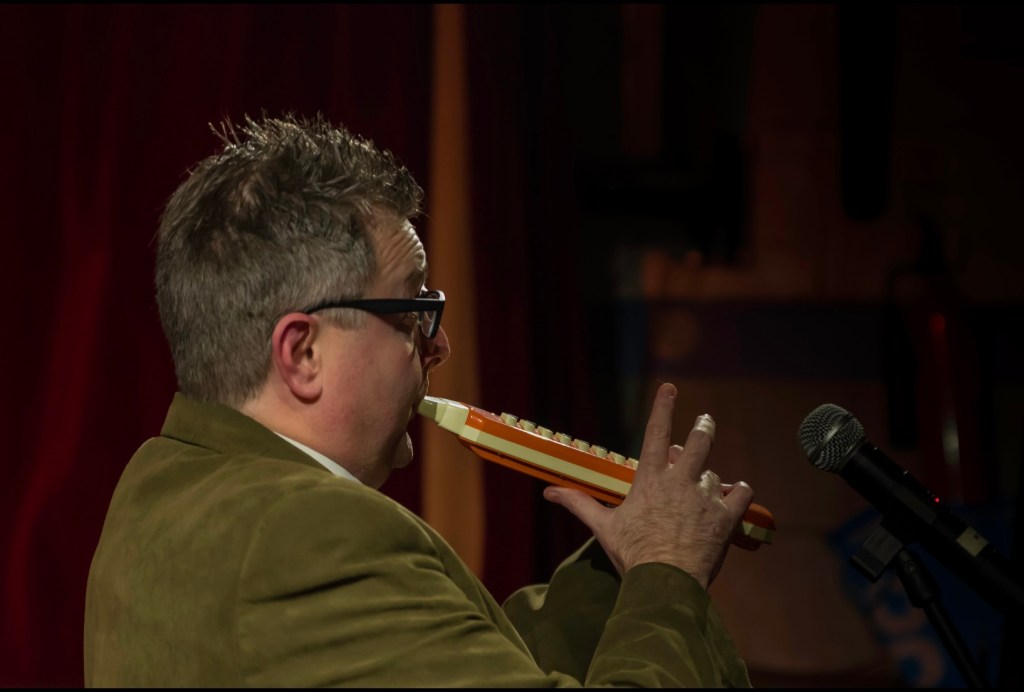
This is a poem from my new show, ‘Bouncer’. It’s about something that people say to me every time they discover that I’m a comedy performance poet. I’m sure lots of other people also get told this especially if that’s the sort of thing they do.
I hope you like it!
My new show will be coming to various places in 2023 and 2024. At the moment it is booked in for the Barnstaple TheatreFest Fringe, the Guildford Fringe, and for two weeks at the Edinburgh Fringe. I’m also hoping to do it at other places, too.
Here’s the new poem:
You Should Write a Poem About That, from ‘Bouncer’, 2023
Ink flowing from a polished nib Blotch on the paper Mrs Henderson See those letters dance Find that rhyme Slam it on the page Boom, that's a poem! Do those similies look good together? It’s a dating app for metaphors! That’s what poetry is. Any fool can do it And I’m living proof.
Oi, Professor of Whimsy! Got a poem for us? Well, so impertinent! But as it happens I’ve got a cracker! Not only a poem but A new show, A new show! Do you like poetry? Do you like Keats? I don’t even know what a Keat is. No thanks you can keep your cup of tea I’d rather have some poetry!
It’s my new show! My new show! The show I’ve just written It’s a new show! It’s a word jamming grammar scamming Rhyme scanning beat panning Big slimy monster of a show! It’s a finger licking word flicking Rhyme dictionary-picking big bad Grumbler of a show! It’s so new it’s still got the cellophane on it! It’s got that new show smell, Red wine and angst. It’s a new show! This is the show. This is the start of the show. Oooooo I can’t wait for you to see it. Oooooo I can’t wait to perform it. Oooooo did I tell you it’s a New show A new show Welcome everyone to my New show
As I did with my last show, I’ve been keeping a diary charting my progress from the very first day I started work on my new show, to the present moment. Obviously, as the show has not yet been performed before an audience, there may be spoilers here. But not many people read this blog, so that should be OK!
Bouncer diary
23.8.22
Decide on theme of show to be based around appearance on BGT
25.8.22
Write some linking material about poetry, and start work on opening poem ‘Welcome to my Show’
26.8.22
Work on ‘Welcome to my Show’ and an autobiographical poem called ‘Orange Juice’, which may or may not be used to add background character.
28.8.22
Sat in the sun in the back garden in Brixham. Worked on a new poem, provisionally titled ‘This City Never Seemed so Cruel’, the obligatory downbeat poem for near the end of the show. Also worked on some linking material about my Great Uncle, and a bit about Thundercats.
29.8.22
Back in Paignton. Heard the Squeeze song Hour Glass on the radio, and then some show tunes, and the idea for a call and response poem came, with a similar structure as the chorus of the Squeeze song. Called ‘Everyone Wants Fame!’ Jotted it down on a ticket, then home, worked on the poem. It’s the bare bones of something fun, but it really needs to be 30% funnier.
30.8.22
Worked on ‘Everyone Wants Fame!’, added two jokes.
31.8.22
Worked on ‘This City Never Seemed so Cruel’, ‘Orange Juice’ and ‘Welcome to my Show’.
1.9.22
Wrote new poem ‘You Should Write a Poem About That’, plotted the storyline and poem list for the show, then worked on a new version of ‘Fabaranza’ written from the point of view of the BGT producers.
4.9.22
In Brixham, worked on linking material. Wrote the goose joke, and then one other joke, and then thought, ahh, that’s two jokes, a good days work, let’s relax for the rest of the day.
5.9.22
Back in Paignton, more work on linking material.
6.9.22
Paignton, worked on linking material, then started to put the show together so far, right up to the Covid section.
7.9.22
Worked on ‘You Should Write a Poem About That’, then typed up all of the show so far before working on more linking material. Worried that the version of my portrayed in the show is negative, whiny, too much like a victim, and generally unlikeable.
8.9.22
Worked on rewriting linking material, added a few more jokes and funny lines. Worked on ‘You Should Write a Poem About That’, took out the line about all other poets being bastards!
9.9.22
Unexpected day off due to yesterday’s death of HM The Queen. Started work on the BGT phone call linking material.
11.9.22
In Brixham. Worked on new poem, ‘The Contestants Await’.
12.9.22
Worked on linking material and ‘The Contestants Await’.
14.9.22
Worked on the start of the BGT section. Worked also on the ‘Everyone Wants Fame’ poem.
16.9.22
Worked on the BGT hotel section. Went to a coffee shop and thought of two jokes about the contestants which made their way into the show script.
18.9.22
(In Brixham). Worked on the BGT section. Almost finished the first draft of the script, just need to write a kind of summing up section. Current word count is over 7000 so it may need editing down.
19.9.22
First draft completed!
24.11.22
Had a read through of the linking material having worked on the Cold Callers project in the intervening months. Pleasantly surprised at the cohesiveness and tone of the show.
27.11.22
Had a complete table read run through of the show at Brixham’s Sunrise Rehearsal Studio. 52 minutes, happy with that. Had a couple of rewrites to ponder: Fabaranza as a poem instead of a song, and tightening up the lyrics of the opening song Welcome to my Show. Also, does the show need the Covid section? Seems put in just to get on the one liner list! Later on, back in the Rehearsal room, rewrote the opening song ‘Welcome to my Show’.
28.11.22
Paignton. Ran through ‘Welcome to my Show’ a few times, then rewrote the song ‘Fabaranza’ as a fast-paced poem.
30.11.22
Began line learning ‘Welcome to my Show’.
1.12.22
Line learning ‘Welcome to my Show’.
2.12.22
Line learning ‘Welcome to my Show’.
3.12.22
Line learning first batch of linking material.
5.12.22
In Brixham. Ran through ‘Welcome to my Show’ several times and videoed it so see how it looked. Worked on linking material.
6.12.22
Paignton. Line learning linking material.
7.12.22
Line learning linking material and began line learning ‘Zach’. First five minutes of the show memorised.
8.12.22
Line learning ‘Zach’.
9.12.22
Line learning ‘Zach’.
26.12.22
Been ill for two weeks so unable to line learn or rehearse without erupting into coughing fits. Staying in Brixham for Christmas. Had a great line learning session in the Sunrise Rehearsal Studio, memorised the whole Zach poem and videoed it too.
27.12.22
Brixham. Worked on the Zach poem and the subsequent linking material. Started a video diary.
29.12.22
Paignton. Linking material and You Should Write a Poem, which I also rewrote.
30.12.22
Learning You Should Write a Poem
31.12.22
Learning You Should Write a Poem.
1.1.23
Brixham. Learning You Should Write a Poem, plus ran through whole show so far, about 12 minutes.
4.1.23
Paignton. Line learning You Should Write a Poem.
5.1.23
Line learning You Should Write a Poem.
6.1.23
Line learning You Should Write a Poem. Managed the whole poem with no mistakes, 3m30. Then performed the first 12 minutes of the show with no mistakes.
7.1.23
Line learning linking material.
8.1.23
Brixham. Line learning linking material (producer phone call section), then started work on a possible backing track for Welcome to my Show. Very camp.
9..1.23
Line learning linking material. Chatted to film maker John Tomkins about filming the show with an audience.
10.1.23
Line learning linking material.
11.1.23
Line learning linking material. Chatted to photographer Jim Elton about taking photos for the publicity pictures. That evening, performed two minutes of linking material at the online Woking Write out Loud gig. People laughed at the funny bits!
12.1.23
Rewrote ‘Who Wants Fame?’
13.1.23
Line learning Who Wants Fame?
14.1.23
Line learning Who Wants Fame? Chatted to photographer Emily Appleton about taking publicity photos.
15.1.23
Brixham. Line learning Who Wants Fame? Then to Paignton, to Emily Appleton’s studio, had head shots taken in various poses for possible poster designs.
16.1.23
Paignton. Line learning Who Wants Fame?
17.1.23
Line learning Who Wants Fame?, and adding some choreography.
18.1.23
Went through all the material I’d learned so far. Then line learning linking material. To Exeter, performed five minutes of material and the Zach poem at Taking the Mic. On the train home I started rewriting Fabaranza.
19.1.23
Rewriting Fabaranza.
21.1.23
Rehearsing the show so far and experimenting with different tones of voice.
22.1.23
Brixham. Line learning linking material.
23.1.23
Line learning linking material.
26.1.23
Bristol. Line learning linking material. Back to Paignton. Started learning ‘London’.
27.1.23
Line learning London.
28.1.23
Early morning session, line learning London.
29.1.23
Brixham. Didn’t get into regular Barnstaple Theatrefest so applied for an ‘alternative space’, pledging to do four shows.
30.1.23
Line learning London.
31.1.23
Line learning London. Barnstaple Theatrefest alternative space application successful!
1.2.23
Ran through all the learned show so far. Experimented with using song or different tones of voice on Who Wants Fame. Line learning linking material. Then in the evening, completely rewrote Who Wants Fame, now based on the music to Three Little Fishes, with an incredibly stupid chorus.
2.2.23
Continued rewrites of Who Wants Fame. Line learning linking material.
3.2.23
Line learning new version of Who Wants Fame.
4.2.23
Line leaning Who Wants Fame.
5.2.23
Brixham. Line learning Who Wants Fame and linking material. Also worked on the poster after Emily’s photo arrived.
6.2.23
Paignton. Line learning The Contestants Await.
7.2.23
Line learning The Contestants Await and Who Wants Fame. Then worked on the show poster.
10.2.23
Line learning The Contestants Await.
11.2.23
Line learning The Contestants Await.
12.2.23
Brixham. Line learning linking material and rewrites of Fabaranza.
13.2.23
Paignton. Line learning linking material and rewrites of Fabaranza.
14.2.23
Line learning Fabaranza.
15.2.23
Practising random bits of the memorised material so far, then line learning Fabaranza. Evening, went to Exeter and performed five minutes and Who Wants Fame?, at Taking the Mic. Fluffed one line but generally it went well and people laughed at the jokes.
19.2.23
Brixham. Line learning and practicing Fabaranza. Afternoon, went to Totnes and performed at Word Stir, tried out some linking material in front of an audience.
20.2.23
Paignton. Fabaranza more light rewrites.
21.2.23
Line learning Fabaranza.
22.2.23
Ran through all of the show so far and was very pleased at how much I remembered. Then line learning the section after Fabaranza. Good progress.
23.2.23
Line learning linking material. Also, ordered a game show style buzzer as the only prop for the show.
24.2.23
Line learning linking material at the shop before work. The buzzer arrived. Evening, performed a little of the new linking material at an event at the Little Theatre, Torquay.
26.2.23
Brixham. Line learning linking material incorporating the buzzer.
27.2.23
Paignton, Line learning.
28.2.23
Line learning linking material.
1.3.23
Line learning linking material.
2.3.23
Line learning This City Never Seemed so Cruel.
3.3.23
Line learning This City Never Seemed so Cruel.
5.3.23
Brixham. Line learning This City Never Seemed so Cruel and linking material. Made decision to read the final poem from a piece of paper during performance to accentuate the fact that it was a piece written, so therefore the line learning phase is completed. On to actual rehearsing, now.
6.3.23
Line learning This City Never Seemed so Cruel.
8.3.23
Ran through the whole show so far. 58 mins so will have to prune maybe the last poem. Also decided that the back of the piece of paper uses for the last poem will have David Walliams written on it in big letters. Email from Guildford Fringe offering a date which I accepted.
9.3.23
Rewrote ‘To the Celebrity’.
10.3.23
Rehearsing ‘You Should Write a Poem . .’.
12.3.23
Brixham. Writing the show blurb and publicity material.
So a colleague from work was chatting to me the other day. ‘I’ve seen your act’, she said. ‘You become a completely different person when you’re on stage. In fact, you seem to be much more awake’. I didn’t know if this was a compliment or not. And I remember back in 1996, when I first moved down to Devon with my parents from Surrey, and then surprising them with the announcement that I’d decided to take acting lessons at a night school run in a local theatre. ‘I suppose this means that you’ll want to grow your hair long’, my Dad replied. (Mind you, hair length was always a touchy subject with my father. He would complain about the students at the local college with their long hair and he would declare that everyone should have the same hairstyle. Dad had gone bald in his mid twenties). So it really does come as a surprise when people discover that I am a comedy performance poet. It’s like having a secret double life. It’s not like I’m the sort of person who wouldn’t say boo to a goose, but I probably would preface the boo with ‘I hope you don’t mind, but . .’, before I said it. If anything, my parents had always taught me to be polite. ‘Hang on a minute. Exactly why are you going to Milton Keynes next week?’, someone might ask. ‘I perform comedy poetry. That’s what I do’. ‘You? Really? But you’ve never said anything funny’. To which I might have responded with, yes I do, and sometimes it rhymes, but he was quite right, I never say anything funny, and by the time I’ve thought of such a witty comeback, they’ve long gone. I’m not the most outgoing person. I don’t go out much and I probably have around two or three friends. I’m not a big drinker and I hardly ever go to pubs. And yet in spite of all this, I’ve managed to make something of a career as a comedy poet who stands on stage and does outlandish things and makes people laugh. How on earth did this happen, and how did it come about? Quite by accident around twelve years ago, I started performing comedy poetry. I went along to a gig and I really liked the atmosphere and the people, and I asked the host whether it would be possible to come along and read some poems. Id always written comedy poems, only I’d never really shown any of them to other people. I still don’t know why I decided to do this, and I remember being incredibly nervous in the days before, but the night itself went well and people seemed to laugh at the right moments. After a while, people started inviting me to other gigs in other parts of the country and before long, I was zipping about all over the place to strange and erotic places like Lancaster and Swindon. I was just as surprised as anyone else. Looking back, I didn’t think it would ever be possible that I’d have the ‘guts’ to stand up in front of a group of people. For a start, I’ve always been what you might call an introvert and it’s probably still the same now. Part of working in the arts is having the confidence to put yourself forward for opportunities, and this is still an area where I struggle. I’ve never applied for funding or any other kind of sponsorship because, well, that’s not the sort of thing you do, is it? I hardly ever apply for big gigs or showcases, either. If someone asks, that’s great, and it makes me really happy for the rest of the day. But the idea of asking them gives me the willies. Another reason is my dyslexia. I just can’t handle all the forms and the paperwork and the incredibly complicated questions using big long words like community stakeholder engagement or financial budgetary management. My mind just fizzes and pops and nothing makes sense. I’ve tried to get funding on numerous occasions, like the week or so I spent filling out an Arts Council form to apply for a development grant, only for them to immediately reject it because the form I’d used was for project grants. I’m also really bad at self-promotion. I think the default setting of a comedy poet is to downplay one’s achievements. It doesn’t seem natural to talk about one’s successes, particularly if you’re having difficulty thinking of any to begin with. A friend of mine, who works in the arts in the theatre side of things, said, ‘Just make it up. They won't check’, but that would make me feel very nervous. And it’s not just me. When I put on a poetry night in Torquay and asked a comedy performance poet to headline, I was overjoyed when they said yes. I asked them to send me some publicity material and a blurb, and the blurb they sent was so self-deprecating that I don’t think anyone would have bothered coming along if I’d used it. ‘X performs poems, badly. A lot of his friends have told him to pack it all in. None of them have any literary worth. He’s won slams in places like London and Edinburgh, but only because no-one else turned up’. The version of me who appears on stage is nothing like the version of me who exists 99% of the time. The persona I’ve created is just that. I don’t even wear the same sort of clothes on a day to day basis. And this is interesting, because for the 99% of the time that I’m not performing, the very idea of it also gives me the willies. It’s not my natural environment. Again the thought comes to mind that this is not the sort of thing that should be happening to someone like me! Yet one or two people have said that there are parallels between the stage ‘Robert Garnham’, and Robert Garnham the human being. Someone once said that they kind of liked my ‘vulnerability’, and my sense of being ‘ever so slightly nervous’. Yet typically, them saying this made me even more nervous! Nevertheless, it’s rather comforting to me to know that there aren’t too many differences between the two different sides of my personality. Social media creates avatars, versions of ourselves that we want the world to see. I see poets and comedians in the real world acting more or less the same as the version of themselves that appears on stage, and to this day it makes me wonder where they find the energy. My other little rule is that I never mention my comedic poetic adventures in ‘real life ‘. I’ve never shown any of my friends any of my books or videos, and frankly, if I did, I’d feel very embarrassed indeed, and as for my family, well, I've never even mentioned it to them at all. For a start, nobody is interested. It’s like living a bizarre double life, like some kind of poetic super hero. But that’s what makes it so amazing. Right at this moment, reading this, I wonder how on earth I can possibly stand in front of strangers and not completely clam up. I go through a comprehensive sequence of preparation methods before I perform, including putting on a costume, doing my hair, changing my glasses, lying on the floor, doing breathing exercises, and then listening to very loud music. I think it’s fair to say that I’m not a natural performer! I still get very nervous indeed. Indeed, people ask me about the nerves, and I reply that perhaps it’s good that I’m so nervous. It means that I’m concentrating on what I do, and that kind of allows me to step away from the introverted version of myself. Nerves are a sign, perhaps, that I care about what I do. It still comes as a surprise, though. Often, I’ll be on a bus, or doing my laundry, or walking home from work, and I’ll think of what I’ve done and what I’ve achieved, and it really makes me smile. Sure, it feels like it’s been done by someone else, but it’s a person I know really very well. This last year I’ve worked very hard on my performance and next I need to start working on being a bit more forthcoming and what my dad would describe as ‘pushy’. I’m like the kid in the corner who wants to join in but is too scared of the big kids. I was chatting about this to another friend, who’s a poet, and she reckons it might be a class thing. I don’t have that middle class sense of entitlement that some of the bigger names might have, nor do I have the confidence that I have a voice that should be heard. I take great comfort in those who are naturally quiet, who seem to have made a successful career, and have done so through a mix of intelligence and luck, and I think, oh, I think, wow, I, too, have been really lucky!
Biscuit donkey chocolate eclair. Weston-Super-Mare. Traffic light pomegranate Yogi Bear Weston-Super-Mare. Slam dunk Bill’s big hair. Weston-Super-Mare. Almost bought a pair of trousers there. Weston-Super-Mare. Don’t look Timmy it’s rude to stare. Weston-Super-Mare. Weston-Super-Mare. Weston Super, Weston Super, Weston-Super-Mare.
Krypton-born hero talking In a Devonian accent, six across. Weston-Super-Man. He owns a horse. Weston-Super-Mare.
Guess where the villain has his secret lair. Weston-Super-Mare. Debonair kitchenware chemical warfare Weston-Super-Mare. Can I come and spend the weekend? Don’t you dare. Weston-Super-Mare. I lost my virginity there. Where? Bournemouth. Who wants to be a millionaire? Weston-Super-Mare. Afternoon tea near Bloomsbury square, Weston-Super-Mare. Don’t move you’ve got something crawling in your hair. Weston-Super-Mare. Weston-Super-Mare. Weston Super Weston Super Weston-Super-Mare.
Since you left I’ve actually tackled that Big pile of laundry We argued about. And I fixed the shelf That we argued about. So there, you see, I can do it. Ohhhh, the things I’ve done Since you left. It’s been a crazy 14 years.
I had a lovely gig in Bristol the other week. The venue was a theatre on an old lightship in the harbour. It was moored to the quay almost totally static but even so I kept lurching sideways. The boat wasn’t even rocking, it was probably just something psychological going on deep within me. Boat = movement. What a nob, I expect people thought.

I’d fretted a lot over my set for the gig. I often get Set Fret but this was something else. I wanted to do some of my old bangers, of course, but I also know that I can’t keep hold of them forever, and that the new stuff has to be unleashed on the world at some point.

But there’s also another thing going on. Over the last couple of years I’ve begun to assess what it is that I like in a performance and I’ve been trying to translate that to what I do on stage. Humour and timing, of course, are things I’ve always had an eye on, and hopefully been got at, but lately there are one or two thinks that I’ve been tinkering with because, well people change over the years, don’t they?

One of these things is volume. I’ve begun to appreciate volume. Or rather, I’ve begun to appreciate it less.

Maybe I’ve been watching too many Ivor Cutler videos. Or Bob Newhart. Or, come to think of it, almost all the people I watch for enjoyment. Laurie Anderson. Edith Sitwell. Alan Bennett. They’re all quiet, somewhat reserved, and seldom loud. Yet they’re funny and they’re clever and I want to be both of those things. I’ve been to plenty of poetry gigs where the poet - and it’s usually a young man, though I don’t want to develop stereotypes- suddenly starts bellowing into the mic halfway through a poem. That sort of thing’s not for me.  I’d feel I was bullying. If you’re going to shout, then at least stand back from the mic. I feel it also changes the dynamic of a performance from enjoyment to hostility. I know that some people may enjoy this, and may appreciate this in a performance, because a performance is what it is and what we’re all there for, but we’re all different, and hooray for that. For me, though as soon as a performer starts shouting, I feel that I want to Get Out Of There. So I come away from these performances hoping that I don’t annoy people in the same way.

So this means that I’ve been trying to adopt a more relaxed, conversational tone when delivering my linking material. And I’ve been working hard at this, because it’s hard, after a lifetime adopting something of a more performative tone. But I’ve been having a bash at it. Here’s my little secret as to how I’ve been conditioning myself to be slightly more conversational and less forced: I start my set with the words, ‘Hello, there’.  It’s impossible to be loud or forced when the first thing you have said is, ‘Hello, there’. And if I feel myself getting more forced or desperate or less conversational, then I say to myself, ‘Hello, there’.

One of the other things I’ve been concentrating on is sex. No, not in that way. I mean, the sexual content of a set and the effect that this, too, has on an audience.

In the early years of my comedy poetry career, I relied quite a bit on content of a sexual nature. Naturally, this was a comedic version of sex, performed (the poem, I mean), by someone who you’d think was probably not very good at it, and therein lay the humour. Indeed, my first collection with Burning Eye, ‘Nice’, was about relationships and more specifically, sex, in the most part. I remember someone writing in a copy of it that had found its way into a poetry library in Manchester, ‘Not nearly enough mention of sex’.

The thing is, I was in my thirties when I wrote some of those poems, and possibly just about passable enough to seem naive and comfortable with such relationships. But now I’m very nearly fifty and the idea of me being on stage talking about sex seems, well, creepy. I’m aware that many in the audience will be thinking the same thing.

I’m not alone with this idea. I was chatting with an LGBT performance poet who’s much higher up the spoken word ladder than me, and he was saying that he is going through a similar process of removing the sexual content from his sets because, as he gets older, he feels it less and less appropriate. I felt that this vindicated the unease I also feel these days of standing at the mic and talking about orgasms and the such. It also maximises the humour when I might mention something vaguely sexual during a set.

So it feels that I’m becoming much more mature as a comedy poet, and gosh, that’s taken it’s damn time. I’m more aware of the audience and more aware of what it is which makes me feel, after a performance, that I’ve done something I can be proud of. This has come about through several years of studying what it is that people laugh along with (as well as laugh at). It also means, hopefully, that I’ll not be stereotyped, just like the words written in that copy of Nice.

We all change. In fact, that was the subject of my very first solo show, ‘Static’. But right now, I’ve never felt so relaxed as a performer, and so at one with my material. Another friend of mine, the American fringe performer Dandy Darkly, once said to me that you can be as silly and as weird as you want to be, so long as you do it with conviction, and that’s definitely what I’ve been aiming for of late.
As a performance poet I believe it is exciting and perhaps even necessary to look at what has come before. In such a way you might be inspired in ways you’d never imagine. I can’t remember how I got into the sound poetry of the 1950s and 1960s, but this poem is a response to that.
Performed live at Satellite of Love, January 2023, Bristol. Photos by Marius Grose.
Had a wonderful time headlining at Satellite of Love, a poetry night in Bristol which takes place in a theatre inside a decommissioned light ship in the harbour at Bristol.
In 2018 I toured the fringes and festivals of the UK with my show ‘In the Glare of the Neon Yak’. It was something of a gamble at the time to write and rehearse an hour long poem which took me away from the comedy and whimsy and into a strange territory of myth, folk-lore, atmosphere and storytelling. The show had taken a few years to write, from around 2015, and almost a whole year to learn. I was hugely pleased with the outcome and I got the chance to perform it everywhere from Edinburgh to London, the GlasDenbury Festival to Surrey, and then with a live jazz band in Totnes. It is the piece of work which I’m proudest.

Performing the show was a weird experience. Over the Edinburgh fringe, I suddenly became aware that the characters were almost friends, and that I would look forward to performing them again when their part of the show arrived. Indeed, it was something of a shame when the run ended and I felt genuinely sad not to perform these characters for a while. Almost immediately I began to think of a possible sequel to the show, yet I knew that it would not be the same because I didn’t want to spoil the mythology that I had built up around the show. ‘

‘In the Glare of the Neon Yak’ took place on a sleeper train heading north, filled with circus performers, and stalked by the mythological entity the Neon Yak, loosely based on the folklore tales of Herne the Hunter. I decided that a follow up show would have a similar structure, (characters telling their tales), but I wanted to go deeper and move the focus of the show to the actual situations in which these characters found themselves. I wrote three new pieces and also ‘borrowed’ the long poem ‘Bulk Carrier’ from my 2018 book Zebra, and then wrote a kind of framing narrative to bind all of these together. I envisaged an LGBT astronaut, flying to Venus, being consoled throughout his long journey by stories which would remind him of the importance of his community, until the final story details his own adventure when he finally gets to the planet.

The individual sections which make up the show could easily stand alone as performance pieces: ‘Bar Code Blues’ takes place in a supermarket in the 1990s with a character who is struggling to come to terms with his homosexuality. ‘Bulk Carrier’ takes place on a container vessel in the middle of the ocean which is haunted, (Why not?), by the ghost of Marcel Proust. ‘Much Ado About Muffins’ is a modern retelling of the Shoemaker and the Elves, taking place in a bakery which refuses to make a wedding cake for a gay wedding. And the final piece, ‘Dancing with the Electric Dragons of Venus’, takes the astronaut to a planet where every desire and hope are granted.

And as a special link to its predecessor, the voice of Ground Control is none other than Tony, previously the Train Manager from ‘In the Glare of the Neon Yak’. A change of career, perhaps, but he’s lost none of his humour.

I’d hoped to perform the show all over the UK during 2020, but world events put paid to that. With a show already written for 2021 and the publication of my new book to tie in with it, I knew that Electric Dragons would probably have to be mothballed for quite some time. So this autumn I set about making it into an audio play, a monologue delivered with musical interludes and sound effects, which I might unleash on the world this Christmas.

It’s been an amazing journey working on this show. Obviously, it’s a shame that it didn’t get to see the light of day in 2020. But without the constraints of having to fit the show into an hour slot, I was able to stretch my legs a little with the audio version. I do hope you will like it, and let me know what you think of it.


00.00: Lift Off! Voyage of the Starship Poopscoop
06.23: Bar Code Blues
22.00: Bulk Carrier
33.26: Much Ado About Muffins
49.30: Dancing with the Electric Dragons of Venus
If she’s a real dentist then I’m a ring-tailed lemur. The artifice lies shrouded over her like London smog, Lab-coat shod and glasses from the props box. So earnest in her opinions, delivered Slightly to the left of the camera to a non-existent interviewer About how various experts recommend A certain leading brand, But you can see it in her eyes, There’s no passion, she doesn’t live for teeth, She doesn’t dream of cavities, Gum disease does not excite her.
And God says, ‘Lighten up.’ And she says, ‘Go pro’. And God says, ‘Lighten up’. And she says, ‘You can feel the difference’.
She’s persistent, I’ll give her that. But he’s omniscient. Her lab coat is sparkling Unbelievably white Subconsciously saying to the viewer, ‘Our toothpaste must be good. It must be. It really must be’. Not a mark on it.
God hasn’t got time for this. He’s got an earthquake to set off In twenty minutes In order to punish a small town in Italy Because parliament has been Debating gay marriage. God’s a bastard like that.
‘Ninety nine percent of dentists Recommend this brand’, She says, And God rolls his eyes because Thirty eight percent of statistics are just Someone speaking out of their arse.
Without the lab coat, she could be anyone. A soap opera background lurker, a corpse in a Detective morgue, (Not a flinch as the grizzled flatfoot Leans forward and finds a strand of hair on her chin, Breaks the case wide open, ‘We got him!’), Didn’t I once see you extolling the virtues Of equity release during the advert break on Countdown? Those silken tones and that winning smile last week Ever eager To flog J. Arthur Bowyer’s Synchro-Boost Houseplant Compost, And now apparently you’re a dentist too! God smells a rat, and he should know, He invented them.
Dazzle with brilliant whiteness thy lab coat sublime, Thou shalt not question the ways of Thy lord and master, Removes ninety percent of most plaque, Thou shalt not Covet thy neighbour’s WiFi. Oh dear god, It’s all one meaningless slogan After another.
Do you need those glasses? Or is it cultural appropriation of the near-sighted? Frames bolder than a Brian Blessed bellow, And that clipboard. Just keeping tabs on everything, eh? These are the questions I’d Ask of God, along with, Why should we worship you? Are you really so starved of attention, Affection, love, That every now and then you’ll afflict some Poor kid from the back of beyond to a horrible disease Just to receive a bounty of prayers? Are you really so sensitive? There’s a leading brand for that.
And I? I have an easily-triggered gag reflex. Just when the dentist is in up to their elbows, I start making a noise Like a clunky gear change on a Ford Escort, And you know what’s coming, That lab coat ain’t gonna stay pristine, baby. The moment I find a dentist where I don’t Start calling for Huey, They’ll probably put up a plaque.
I said to the dentist, Why do you always look So down in the mouth? At least you get to the Root of the problem. A golfer came in and said, ‘Most of my teeth are fine, But I’ve got a hole in one’. As I say, I’ve got an early-triggered gag reflex.