Life lessons from performing spoken word 

Life lessons from performing spoken word
1. If at first you don’t succeed, act as if you’ve never failed.
2. Image is everything. If you arrive straight from work wearing a shirt and tie, then this will become your look and people will always see you as a performer who wears shirt and a tie.
3. If a poem isn’t working, give it a third verse freak-out. Then take out the first two verses.
4. Watch out for light fittings when using props.
5. The audience wants you to do well and will be on your side but try not to balls it up in the first place.
6. The whole world is an audience even if you’re not performing.
7. You never stop performing, even when you’re not performing.
8. If you need to ask the host if you’ve got time for ‘one more poem, a short one’, it means you haven’t rehearsed. In any case the host will always say yes, because they’re just being polite.
9. When you’re rehearsing, stand at the bottom of your bed and rehearse to the pillows. They will stare back kind of blankly. 
10. Like sex, there’s no wrong way of doing it.
11. Like sex, you can get a lot of laughter from just one look.
12. Everyone has a voice. Authenticity is everything. Every stage character is just an exaggerated version of yourself.
13. If humour’s your thing, the obvious joke can often be the most effective. Sadly.
14. If it’s a high concept poem which needs a lot of explanation, then it’s probably not going to work very well. But don’t stop experimenting.
15. Music stands to hold your book allow you to make extravagant hand gestures if you haven’t learned the poem by heart.
16. It doesn’t matter if you haven’t learned the poem by heart. Just make sure you don’t hide behind a huuuuuuge folder.
17. You can imagine the audience naked if that helps, but the audience might be imagining you naked too. In fact they probably are. How else to explain the amazing amount of people who upchuck during my gigs?
18. Everything becomes subject material for your poetry. Emotional turmoil, break-ups, losing your car keys. The last time I had a break up I thought, oh good, I’m going to get some poems out of this.
19. It was going to happen eventually, the bastard.
20. By all means copy the mannerisms and style of your heroes, but for goodness sake, innovate.
21. I mean I thought it was going ok but then one day I suddenly thought, hmmm, we’re just going through the motions.
22. Spoken word artists get their points across, they draw attention to injustice and prejudice, they make you laugh, they make you cry. They play with language and dance on grammar, they play with rhythm and rhyme. It’s always sickening when this is all done by one genius youthful bright-eyed performer. I remember the Bristol Poetry Slam. I was up against someone performing an excellent poem about the death of their grandmother linked in with the entire history of the British black experience from slavery to the present day, and then I went up and did a poem about liking beards.
23. Don’t worry about anything.
24. Just a small planet in deep dark space and our time on it is incredibly small in the general scheme of things, everything is relative.
25. You can take the mic off the stand if you like, but move the stand out the way. Take down that barrier!
26. If you enjoy it and have fun, then so does the audience. And so does everyone. Even the people you see on the bus on the way home. Enjoy it. The world becomes a better place.
27. There’s no subtle way to plug a book. 
28. My book is available here. https://burningeyebooks.wordpress.com/2015/11/19/new-nice-by-robert-garnham/

An Interview with MargOH Channing

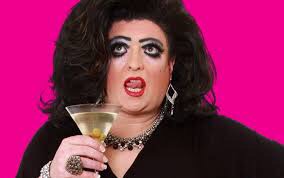
Last month I performed in New York and I had the pleasure of making the acquaintance of MargOH Channing. MargOH is a singer and comedian whose performances mix high camp and cabaret style singing with the seriousness of life itself, issues of identity and representation. We hit it off immediately, sharing a green room, though it must be noted that she finished all the Martini, and I had to help her down the stairs after a bit of a stumble on the second landing. MargOH is an engaging and almost tragic figure who has been very inspirational to me personally. I jumped at the chance to probe her in more detail in light of the recent presidential elections.

1- You come from a fishing community. How did you end up on the New York cabaret circuit?
 Darling my road was long and winding. I came from a very broken family so I had to go out on my own at a very young age. I actually moved to NYC as a child to work at my Aunt’s bar where I was discovered by Russ Meyer and was cast in his film “Common Law Cabin” and the rest is history…I call my cabaret career winding down as I’ve done just about everything, even Liberace!

2- I’ve noted from your work that you like the occasional drink. How does alcohol affect your performance?

 I don’t know how anyone can perform without it? Many years ago Elaine Stritch told me after I had a rough night at the Reno Sweeney. She said MargOH! “Stick to one before the show, one during and afterwards whose counting”. She came on a night when my panties fell off and I tripped and fell on Rex Reed, he was not happy as he picked pubes out of his teeth…well anyway its not like I gave him the clap!

3- Dear God. Trump. Did that actually happen? What’s the mood right now in liberal New York?

 Let me make a martini! People in this country are basically stupid! Reality TV has leaked into our news sources and everything is so sensationalized we can no longer tell the difference between fiction and reality any longer. Plus everyone is very nostalgic instead of looking to the future. The fact is people over 65 and their white kids vote for the old days when certain people knew their place. That is what got Trump elected. When we as a nation realize “Political Correctness” is progess then maybe we can elect visionaries instead of dusty old hacks…was that too harsh? 
4- Your performances and incredibly funny, occasionally tender, and with excellent comic timing. Who are your influences?

 I have so many influences but most of all Judy Garland is my muse, someone to aspire to be as a performer. When I started performing I wanted to be a celebrity, you know be loved, but that’s all wrong! As you get older you realize its about the work and sharing that connection with an audience. Judy did that better than anyone and I try to remember that everytime I walk out on stage, things may not be perfect but if you connect with just one person then it’s all good. I’m also a big fan of Totie Fields, Sandra Bernhard and downtown legend Penny Arcade. 
5- What’s a perfect night, in the eyes of MargOh Channing?

 Honestly, a good old dinner party with friends where someone ends up under the table or you wake up with someone in your bed and can’t remember a thing…Those are the moments I cherish…

6- There’s an underlying hint of personal tragedy in your act. Have times been hard?

 Are you sure that’s not my Chanel #5? In the world of Social Media where everyone shares their good times, I like to mess with everyone and let them see the real me…I never met a happy comedian, have you?

7- When you’re putting a show together, what makes the perfect big opening?

 As an audience member I do not like formula in a show, makes me feel they are taking the easy way out, challenge me please! Actually for the first time in my new show HUNG I open with a song, “You Go To My Head” . I’ve never done that before and do find it fun. In the past I’ve always opened with an overture or entrance song by my back up singers but since they all quit I had to change it up. The one thing I do always do is end with a ballad. Once, my musical director Tracy Stark asked me ‘Why do you always end with a sad song”? I replied, “I am a sad song.” 
8- Do your family miss you, now that you’re a big star in the big city?

 Of course, my sister Rita is always asking me to come back to Bangor to be her receptionist, she is a highly successful Opthalmologist! I never would have thought that was possible since she is cross-eyed but she is a trooper. My mother on the other hand is a bit of a problem so we shipped her off to a retirment home in Wasilla, Alaska. I thought it best Sarah Palin keep an eye on her or vice-versa…They come to shows when they can so we are all good!
9- What influences your writing?

 The underdog is my inspiration for writing. Injustice and inequality drive me to do what I do. I never felt part of the party so I write about that. It’s not always being the belle of the ball, it’s how you trip the one that is in the nicest possible way to let them know they may deserve it but I’m not sure why because you seem wretched. Does that make sense?
10- What advice might you have for any young buck who would like to take up performing?

 My best advice for an upcoming performer is something Burlesque Legend World Famous BOB said to me. “If you aren’t making yourself nervous or frightened every couple of weeks then you aren’t trying hard enough”. It was the best advice i was ever given and it’s so true. Do what you love to do and the audience will come, it may be harder and take much longer than you thought but when it happens you’ll know you stayed true to yourself and its magic. XOXO MargOH! 

Check out MargOH’s website:

http://margohchanning.blogspot.co.uk

On getting nervous at poetry gigs.

Last night I caught the train to Torquay and walked from the station to the Blue Walnut. It was seven years almost to the day since I started performing which means I’ve done the walk from the station regularly all that time. The road is steep and at one point it does a switch back, like a mountain road, and there are steps cutting through so that the pedestrian doesn’t have to follow the road and has a short cut. When I first started performing, I used to be so nervous walking this route that I would follow the road rather than take the short cut, because it prolonged the moment that I would arrive. In fact I used to be so nervous that before a gig, I would spend an hour in my flat lying on the floor staring at the ceiling, trying not to think about it.I chatted to Tim King last night and we both said how nervous we were before the gig. Perhaps it’s a good sign, being nervous. But even after all these years I feel something deep within, some fear of the unknown, of mucking it up, of being humiliated in front of a room full of strangers, of being exposed as an incompetent who’s only blagging his way through spoken word events. 

The biggest fear is probably of completely losing touch with everything. With the audience, with the words on the page, with the whole situation. The line between being in the audience, being a normal member of society, and being a poet, particularly a humorous poet whose job it is to make people laugh, is very thin. Anyone can do it. I did. I made that leap after coming along to a poetry night.

But there’s a suspension of disbelief inherent in being in the audience, and this is the thing that keeps me going. They’re not judging you, they’re there to have a good time and they want you to do well, particularly if they have paid to get in. The moment you step in front of the microphone you are on show, and everything you do comes through the filter of being there. Actions become acts and words become performance. The promoter has chosen you to be there, an instance of curatorial design, you have been hand picked and therefore judged as worthy to be on show. The audience knows this.

But that doesn’t stop me from being nervous. Even last night, cutting through and using the short cut on the way to the Blue Walnut, I felt that the walk was quicker than usual and I felt a bit cheated because of this. But it wasn’t as bad as it was in the old days.

The Most Significant Full Stop (Part Ten)

The ability of anybody with word processing equipment, smart phones, tablets, computers, laptops and anything else which types, to create grammar of their own concoction, grammar of their own conception, means that there are more full stops now in the world than at any one time. One of the reasons for this is the short attention span of people used to sound bites and social media updates, Twitter accounts, website addresses, snippets of news and information. Sentences are now shorter. Like this one. This means that there are more full stops than ever before, less semicolons and commas, less brackets, except when using text speech.
This never used to happen in the days of Marcel Proust.
The paragraph at the start of this passage contains five full stops. Of those five full stops, one of them means a lot to me and idolise it. Can you guess which one it is?
As an experiment I have screensaved this page and magnified the full stop to its fullest extent. In the normal run of things, it would have been completely missed, a psychological notification, almost subconscious as they eye scans over it, picks up the necessary information. The next stage of this project will be that I print off the full stop and post it somewhere in the town in which I live, (Paignton, Devon). How many people will then see it?
This might very well prove to be a very exciting line of inquiry. 


The most insignificant full stop (part seven)

I asked my assistant Lars to write a full stop on the table while I was out of the room. My job was then to find it and eradicate this.
If I hadn’t found the full stop, the knowledge of its continued existence would have given it a significance far beyond its actual worth.

Or I would have begun to doubt that Lars had drawn it in the first place.

Or I would have begun to doubt the existence of Lars.

You can watch the video here.
https://youtu.be/9TDkQN-tbuI

The most significant full stop (Part Three)

It was murky today, delightfully so. The day dawned with a thick set fog which loomed down with a strange intent. And this was weird because I’ve been looking at the full stop again, the fact that it exists, zooming in and trying to focus on the exact place where the full stop ends and the world around it, the non-full stop, starts.
Which makes me wonder if there really is any boundary in life at all. Because the more I zoomed in, the foggier it got, until it began to resemble the weather itself. Indistinct, a place with no form, no substance, no being.
When I was a kid I was obsessed with insignificant moments. I remember once my sister walking down the stairs. She got as far as the landing and banged her hand on a book shelf, she said, ‘ow’. But she continued walking down the stairs and by the time she got to the bottom, she had forgotten that she had banged her hand. The banging of her hand had been such a monumental event at the time that it warranted an ‘ow’, but seconds later she had forgotten that it had ever happened.
How much else in life do we forget? I asked her if she remembered banging her hand and she said no, she wondered what I was talking about. Life is full of insignificant moments which we forget, just like those tiny dots 

The boundary between one facet and the next is often so hard to define that it cannot be successfully declared where one thing ends and another begins, even with a full stop. Rather than worry about this, perhaps it is just better to wallow in the present moment, and not care too much about such boundaries.

Shouting Out Words at the World! And feeling strangely good about it . . .

I’ve just had a great weekend in London performing a half hour set at a trendy film festival in Hoxton, in a studio gallery underneath a railway arch converted for the weekend into a one screen cinema. It was a great event, under the banner Lets All Be Free, showcasing films which probe notions of freedom and what it means to be human in the modern world.

  I was initially sceptical that my poetry would go down well. After all, my oeuvre is mostly comedic and some might see the approach I take to serious matters as Taking the Mickey. The block of films shown before my performance dealt with subjects such as migration and political activism, with serious, weighty themes which were greeted by the audience with respect and contemplation. I was due to perform at half eleven in the morning.
A year ago this would have given me cause for concern and I would have been phased by the whole festival and its spirit of underlying seriousness. Yet now, I am able to approach such events with a sense of wanting to entertain and amuse and to give everything to my performance and the words.
The tactic seemed to work. The audience were appreciative and they didn’t escape to the bar while I was on, indeed, more came in and watched. Not even the sudden death of the microphone halfway through was a problem, I just spoke louder. Because of this I was very happy with the way that it went.
So what’s so different now? Several things have helped. For one, I’ve been concentrating less on the writing process and more on the rehearsal. This is thanks to my unofficial director, the wonderful Ziggy Abd El Malak, who’s shown me several techniques which I now employ regarding movement, pausing, etc. Secondly, I’ve been watching other poets and performers and the way that they do things rather than what they are saying. SV Wolfland, for example, has a wonderful microphone technique and employs body movement, as does Susan Taylor. I’ve even been watching my favourite pop stars to see how they move and how they use the microphone.
And thirdly, I’m just not afraid of things going wrong any more. Spending time with people like Jackie Juno, who can turn a whole situations round and just Have Fun while performing, has been invaluable. Watching the poets at the Womad Festival in close quarters also showed me how the big names control the audience and make every situation that crops up a part of the show.
So that’s why this weekend has been so great. And now I’m sitting here at Reading Station, waiting for my train home, and looking forward to the next opportunity to shout out words at the world!

‘Poetry is not as important as Hollyoaks’. An interview with Robert Garnham

Last month I was interviewed by Exepose Magazine by Nickie Shobeiry. Below you will find the full, unedited version in all it’s glory. The original interview can be found here: http://exepose.com/poets-corner-robert-garnham/

And yes, the title is deliberately provocative. I don’t mean it really!

Interview – Robert Garnham
 • What inspired you to begin writing poetry? Do you remember the first poem you ever wrote?

Hello! I started writing poetry by accident. I’d always written short stories, more for my own amusement. I also wrote a play, ‘Fuselage’, which was rehearsed read at the Northcott Theatre in 2009, but it was all just as a hobby. I went to a night of performance poetry in Torquay run by Chris Brooks and I was inspired to give it a go.
My first poem was about my family, and it’s a little embarrassing to read it now! It had some good rhymes in it. I don’t usually use rhyme much now. Anyway, I made my debut at Poetry Island with the family poem, and people loved it! Chris asked me to come again, and I’ve been doing it ever since.
• Do you have a specific place you go to for writing? Any particular habits?
Yes, weirdly, I do. I always write at my desk every morning and every night, but on my day off I go to the Quiet Room at Paignton Library. There are no distractions here, unless someone comes in with a packet of crisps. Also, I spend weekends at my parent’s house and they have a room at the back of their garage which, like the Quiet Room, has no distractions. It’s my own private place!
I’ve used the same pen for every single thing I’ve written since 1995, so I suppose that’s a habit of sorts. I write everything in long hand first, then type it up.
• Where does most of your inspiration come from?
I have no idea! Poems are usually when two or three concepts seem to merge together. One of my poems, ‘Poem’, is about an ostrich queuing at a buffet on a train to buy some crisps, but he’s slowly metamorphosing into a wheelbarrow. I have no idea where the idea for it came from!
Often, though, people say funny things and the words come back to me when I sit down to write. None of my friends like poetry. Not one single one of them! So they don’t come and watch me perform, which means I can use the silly things they’ve said freely without repercussion. It also helps that most of my friends, in their own little ways, are incredibly eccentric. I’m fairly normal.
• Your performance at the Bike Shed Theatre’s Slam Poetry event last year had everyone in stitches, hanging onto your every word. How would you describe your own writing?
Thanks! I work hard at every single line and once a poem is written, I put it aside, then come back to it and pretend to be the audience. Some times I look at a poem and I think, ‘This has to be 33% funnier’. Often the best time to write is when you’re feeling relaxed, but the mind kind of has to be almost half disinterested in the outcome. This is when the silly stuff kicks in, or the unusual connections. If I concentrated on being funny, It would probably end up sounding forced. So the mood to write is hard to conjur up.
• You work as the host of Poetry Island in Torquay – can you talk a little about your experience there, and some of your favourite performances?
I was host for three years or so. I took over from Chris Brooks, who’s now off being a comedy genius, and if had a great time booking acts from the national scene and nurturing new talent locally. We had some great performers come down to Torquay, such as Ash Dickinson, Matt Harvey, Byron Vincent, (a hero of mine), Liv Torc. I think Chris Redmond was one of my favourites. (Am I allowed to have favourites? I suppose now that I’m no longer host, I can admit to this!). 
The best nights were when you see someone who you’ve helped and encouraged go up and be amazing. I gave  headline slots to Joanna Hatfull and Tom Austin, who are huge local talents. I don’t think either had had paid gigs before, so it was a nice feeling.
I’ve handed Poetry Island over now to Ian Beech, and he’s doing a much better job than I ever managed!
• You perform a lot of spoken word poetry – is this your favourite mode? Can you share some of your most memorable performances?
I’d like to have another crack at writing a theatre script, and I’d love to have a book published. I have a novel which I finished recently, if anyone’s interested! But I can’t act or sing or dance or do comedy, so I suppose it’s spoken word all the way for me.
As for memorable performances. Well! There’s loads. My first paid gig was at Jawdance, a regular night in London, and it was amazing because a London friend came to watch and then I was recognized on a tube station platform a couple of hours later! And London again, supporting the wonderful John Hegley at Gongoozled, will also be a cherished memory. I got lost on the way to the venue and panicked that they’d be angry, I got there, and Mr Hegley had also got lost on the way!
Any night that goes well is cherished. Performing to my sister for the first time in Guildford at Pop Up Poetry was great. She’d never seen me do my thing before. And the Edinburgh Fringe was a fantastic experience. Performing to one person on a wet Monday afternoon. Oh, the romance!
• Could you talk a little about the inspiration behind your poems beginning ‘a friend of mine thinks he might be straight’ and ‘people think your beard is weird’?
The ‘straight’ poem is based on a composite of several friends and it was just a chance to explore some cliches about straight men and what they get up to, like building sheds and watching Top Gear. It was just a chance to turn the whole thing around and make it feel as if straight people were the minority, something weird that has to be studied so that we can understand their ways. As for the Beard poem, well. There are so many people around with beards at the moment and I always think, ‘He’d be quite good looking if it wasn’t for that beard’.

• I recently saw you perform at the Phoenix’s Taking The Mic event. Your poem – hilarious as always – was about a bald man, and you had a lit-up box to boot. Could you share the story behind the poem? Do you often use props on stage, and what do you think it brings to the performance?
Funny you should ask about the bald man poem, because the whole thing just came to me, at almost midnight when I was in bed. Completely from nowhere! I suddenly thought that it might be quite funny to write a poem about something entirely meaningless and small, something everyday and commonplace, and what more commonplace thing can there be than seeing a bald man walking in the street? I’ve also written poems about unrolling a new bin liner, vacuuming a carpet and losing a pen in the lining of a coat. I think this is my minimalist phase.
I used to use props all the time, at every performance. Over the years I’ve built a theremin from two Wellington boots and a feather duster, and a large hadron collider out of garden hose and a custard cream biscuit. Indeed, I was known for quite some time just as a prop poet. But then, when you start getting invitations to perform all over the county, you have to lug these props on buses and trains and the joke kind of wears off, especially when someone sits on your theremin. But I like props, generally. One of my favourite poets, Rachel Pantechnicon, uses props to hilarious effect, and if she’s ever performing in your neighborhood, then I urge you to go along.
• Do you have a favourite of your own poems?
I like performing ‘Poem’, because of the energy that I put into it. ‘Poem’ is also good, I wrote it when I was on holiday in Australia and it kind of stayed with me, it always conjurs up a specific time and place. But I suppose it has to be ‘Poem’, even though I’ve performed it countless times. It’s still one of my favourites even after all of these years!
• What was the last poem you wrote about?
Losing a pen in the lining of my jacket (see above).
• Why do you think poetry is important?
I’m not sure that poetry is important. It’s not as important as the news, or Hollyoaks. But that’s because it’s now more of a niche interest. Often, though, poetry gives people a chance to take the audience somewhere. Dean Atta writes about his experience of being a black gay man in contemporary London, for example, and AJ McKenna writes about being a transgender poet. Poetry has also been used as a form of political release, airing views and grievances. I’m thinking of such people as Atilla the Stockbroker and Pete the Temp, Bob Hill and Exeter’s very own Tim King. Poetry is the medium by which they raise political concerns and encourage debate about certain issues. Tim’s poem about FGM is amazingly powerful.
• Who are your favourite writers? If you had to pick your top three favourite poems, what would you pick and why?
My favourite poet is Frank O’Hara. He was active in the 1950s and early 1960s and wrote poems about city life and the experiences of being a gay man in 1950s USA. Yet there was nothing political about him, his poems had a matter or fact ness about them, almost a flippancy about big issues. He demonstrated that you can mix high and low culture and hold either in high esteem so long as you are earnest in your beliefs. He’s the poet whose ethos I’m closest room though I’ve now outlived him. He died aged 40 after being run over by a beach buggy. He was drunk at the time.
I also like poets who use humour and language in unexpected ways. I absolutely adore Byron Vincent and Rob Auton, both of whom I’ve met and worked with. They never cease to amaze me with their output. Also Rachel Pantechnicon, hilarious and life affirming. She’s a big influence on me and was one of the people who were instrumental in getting me going.
Favourite poems? I suppose Frank O’Hara’s ‘Getting Up Ahead of Someone’, Byron Vincent’s ‘Hold the Pickle’, and ‘Spherical Man’, by Mighty Mike McGee. These poems are inventive, funny, with great use of language and incredible humanity. Every time I read them I get something different from them.
• What’s the best piece of advice you’ve received as a poet, that you think is relevant to people from all walks of life?
Well, there’s ‘never be a prop poet’, which is the advice Rachel Pantechnicon gave me. This can’t really be translated into everyday life, unless you think on terms of doing away with the baggage that we always carry around with us. 
My closest colleagues and friends in the world of poetry are Tim King, Chris Brooks, Ian Beech and Dan Haynes. I see the way they commit themselves to poetry and performance and to being moral people and I try to apply this to my own life. It’s not advice, as such. 
So I suppose the biggest piece of advice has to come from Frank O’Hara, who said the one must act with ‘grace to be born and live as variously as possible’.  Which I suppose means, cram in as much as possible!
• What can the world expected next from Robert Garnham?
I’ve got a book coming out some time towards the end of this year with Burning Eye, who are the biggest publisher of spoken word poets in the country. It’s a huge honour! In the mean time I’m working on a second novel, which is about retail management, and I’m planning a one person show, the provisional title of which is ‘Static’. I’m also poeting all over the place, I’ve recently been doing shows with a comedy group called Jocular Spectacular and we have a show coming up in Exeter during the LOL festival supporting Arthur Smith, and I’m also off to Manchester in a couple of weeks to do a gig up there. So it’s all go at the moment! 
 

I get nervous. I used to get nervous. I don’t get nervous.

I’ve been performing poetry now for about five years up and down the country. I’ve been to parts of Britain that I wouldn’t normally go to, like Wolverhampton and Swindon, Salisbury and Cheltenham. And I’ve met some great people who have become friends. But there’s one constant which won’t ever go away, and that’s the state if nervousness I get before a poetry night.

It’s been there since the start. I thought it would go away with practice, but it doesn’t. It starts as a dull ache in the chest and a funny feeling in my stomach, and then as the day goes on it increases.

I don’t think this is necessarily about the performance, either. Yes,it is scary to stand in front of strangers and do poems about ostriches and goats, and to tell jokes which they might not laugh at. But the nervousness which I get usually comes from realizing the logistical details of getting somewhere, finding the venue, arriving at the right time, performing, then spending the night somewhere.

Because I’ve got one of those minds which always thinks of the things that can go wrong. And while I try to plan in as many escape routes and procedures as possible to negate the effects of Something Going Wrong, there’s always the chance that Things Might Go Terribly Wrong.

I remember taking part in the Wolverhampton Love Slam in 2014. By chance it was the same day that the railway fell into the sea at Dawlish. It took almost twelve hours to get to Wolverhampton from Paignton. The first person I bumped into was Jonny Fluffypunk. That’s when I knew that everything would be okay. But the whole day up till that point had just been one huge nervousorama.

I used to be the host of Poetry Island. I loved the nights themselves, there was so much energy, it was the poetry equivalent of being in a tornado. But there was so much organizing to do, and so much worrying about all the minor details, that in the end it wasn’t worth doing. I would spend the hour before going to the venue lying on my back on the floor and staring at the ceiling, trying to calm myself and run through everything in my head. That can’t be normal behaviour, now, can it?

I’m sure it’s the same for other performers. But the results far outweigh the nervousness. I’ve been to such wonderful gigs this year already, and I’ve got loads planned for later in the year, that I’m not even thinking about the nervousness.

Lately, I’ve been pursuing a new tactic. It’s called Operation DontThinkAboutIt. The day before a gig, I just carry on as normal. And even when I’m changing into my poetry outfit, I’m not thinking about what it is I’m about to do. And then I lie on the bed and I listen to pop music on my iPod. Loud, disco beat kind of stuff. The upshot of this is that it all makes the act of going to the gig and performing almost natural, and it seems to work. I’ve been having much more fun when I get there, less nervousness, and I reckon I’ve been performing better, too. If I stress too much over the minor details, then the actual reason for being there gets left behind. But now I don’t stress so much at all and it’s cleared my mind, made me focused on what it is I am meant to be doing.

Having said that, I’ve got some gigs coming up further up the country. So I shall see how it goes! And as long as the railway line doesn’t fall into the sea at Dawlish again, things should be okay.

Anyway, for no reason whatsoever, here’s a poem I wrote late summer while staying in Brixham.

Poem

Too hot out
For serious contemplation.
I sit in the cool of my room
At my parent’s
Bunga
Low.

Window open,
Net curtains twitching on the slightest breeze,
Car tyres on the concrete road surface,
Apolo
Getic.

The stipples ceiling has cracks.
Little roads through a mountain landscape.
But instead of being round the world is
Rectangular
( Except for a slight recess in the east).
The capital city is the light fixture.
The explorers are ever so brave
Who reach as far as the
Archi
Trave.

Outside in the summer heat,
The plaintive honking
Of something that honks.
I’m a city boy so I don’t really know
What kind of animal honks.
But I wish it wouldn’t.
It gives me the willies.

I imagine the room filled with
Albino
Ocelot
Octopuses
Cool
Coral
A
Drinks
Vending
Machine
PepsiCo

It’s so hot
I try to visualise somewhere cool
Like an airport air conditioned coffee shop.

Actually the honking is probably
Just the shed door
Creaking in the breeze.

Why I Am Not A Surrealist

When I was younger some of my favourite artists and musicians were surrealists. Salvador Dali and The Beatles, for example. Semolina pilchard climbing up the Eiffel Tower. That sort of thing. The imagery and the language of these were exciting and daring and I couldn’t get enough of the thinking behind such overtly provocative works. But as my adventures in art and music progressed, I started to realise that while the effects of these were immediate on the first viewing, they quickly wore off.

I don’t want to see another damn melting clock.

It took a while, but I began to realise that surrealism in small doses is okay, but there always has to be some kind of grounding in the familiar, in real life. It has to be relatable. Maybe it’s just the way I look at the world, but I’ve got to a stage in my life where surrealism is deeply unsatisfactory to see or read, particularly in poetry.

Let’s make a hypothetical poem. It’s going to be a surreal one, so we’re going to look at imagery. I see a plum. The plum has a moustache for some reason. The plum has a moustache, that’s the first line of this poem. Okay, so if this poem was a Robert Garnham poem, I’d then go on to follow the plum around for a few stanzas to see what life is like being a plum with a moustache. In such a way I ground the poem in the every day, in the humdrum. The plum has a problem eating soup because of the moustache. The plum can’t get a date because every plum he meets doesn’t like moustaches. You know, run of the mill kind of stuff.

But if I were a surrealist, then in the next verse, I’d move on from the plum with the moustache. I see a tap dancing horse called Mona, and the King of South Dakota is there, waving a cricket bat. And yes, this is all rather whimsical at the moment and a little but humorous, but if I read this again tomorrow I’d think: yeah, whatever.

I have, therefore, identified the moment, the junction, where a poem can go either way. On the left, full blown surrealism, all sunny and stupid and a bit dizzy. And on the right, the kind of tempered down-to-earth surrealism that people can relate to. This Point of Realist Return (PRR) is immediately divisible by the interest of the reader (I) and responds well to Repeating Reading (RR). I divided by PRR times RR equals a Satisfying Read (SR). A surrealist poem may also have a PRR but there the I is, unfortunately, not equal to the RR, and therefore the SR is of a lower outcome than the less surrealistic piece.

I hope that this has cleared things up.

What I’m trying to say, I suppose, is that the poems which work best for me are those which have some kind of bearing on my life. My hero, Frank O’Hara, wrote poems based on his own life, his famous ‘I Do This I Do That’ poems. Yet he, too, dabbled in surrealism earlier in his career, and these poems are stodgy and hard work to read. You could tell that he was having a lot of fun writing them, but as a reader, well, there’s ironing to be getting on with.

I’m not against other poets being surreal. The performance poetry community is wide and varied and this is what makes it so vibrant. If every poet was the same, then we’d be better off not turning up. And who knows, perhaps someone might come along and surprise me with a set of sheer surrealist excellence.

Or perhaps my life is just so strange that I can’t possibly deal with any more of it!fun front