Episode one of my unmade tv series, Professor Zazzo Thiim



Performance poet and Professor of Whimsy

Episode one of my unmade tv series, Professor Zazzo Thiim
Another short story from the archives.
The Arrival
A committee was set up in order to plan for the visit. A chairman was voted for, an elderly gentleman with a walrus moustache. He was then replaced with another elderly gentleman. The secretary resigned because she objected to the name of the committee. The replacement secretary used to be the treasurer, so a treasurer had to be found. The original chairman wanted to be the treasurer but the new chairman objected. Both the chairman and the prospective treasurer then resigned from the committee, so a new chairman had to be found as well as a treasurer. The positions were eventually filled with a man who used to be a car salesman, who said he knew all about planning visits. And the Treasurer was shared among the other members of the committee on a rotation basis. Just like a quiz show on TV, someone commented. The comment was recorded in the minutes.
A name had to be invented. Someone suggested the Visit Committee, but there was another committee called the Visiting Committee and it was thought that this would lead to confusion. Someone else suggested the Committee for the Visit, but this was also voted down because it sounded boring. The person who suggested it was the person who was also the Treasurer on this occasion, and she resigned. A third suggestion was to call the committee something trendy, just like a modern company, a name which would hint at science and progress in the arts. Implosion was the name that was banded around. The secretary commented that it sounded like something from The Apprentice. The person who suggested it was very upset about this and he threatened to resign, but just as he did they came in with the coffees so he stayed on for a bit. This was recorded in the minutes.
They finally decided on the Systemal Function for the Application for the Arrival of the Visitor and His Entourage. Or SFAAVHE, for short. This was recorded in the minutes.
It was then time to decide what the committee would actually plan for the visitor’s arrival. There was no doubt that he was eminent, so it was agreed by all that he should have a red carpet when he stepped out of his car. Then someone said that he shouldn’t be in his own car at all. If he was so eminent, they argued, then, surely, he should be driven? OK, then. A limousine would pick him up from his house. But he lived two hundred miles away. This was a problem. They decided they would compromise. He would drive as far as the halfway point and then the limousine would pick him up. It was generally agreed that this was a good idea and it was recorded in the minutes.
Then someone pointed out that red carpets were hard to find, and they got mucky if it rained. The under-secretary was dispatched to source a long red carpet. She asked what sourced meant and the chairman said that it meant to go and fine one. She asked why he didn’t say that in the first place, and the chairman said that it was business-speak, that’s how they said things in the world of business. The under-secretary objected to the tone that the chairman took and she resigned. A new under-secretary was then voted in and he said that he would look on the internet to find a red carpet. Ten minutes later he said that he could only find a yellow one. That will have to do, the chairman said. And all of this was recorded in the minutes.
The meeting then moved on to who would be there to greet the visitor on his arrival. One of the members suggested the head of the department, but then someone else reminded her that the head of the department was currently being investigated for fraud and it would be best that he were to stay out of the limelight. The chairman said that this was not the way to treat the head of the department and that he should be there. The treasurer then reminded the chairman that he, too, was caught up in the same scandal, so the chairman then resigned and a new one was voted in. She thanked the previous chairman for his hard work, but then she spilled coffee on her lap. She resigned, so that she could go to the bathroom and wash it off. When she got back to the room, the original chairman had been voted back in. And all of this was recorded in the minutes.
The next item for discussion was the food that would be provided for the function once the visitor had arrived. Someone suggested prawn cocktail, but they were reminded that the budget would stretch so far. Someone then suggested prawn cocktail crisps, but they were laughed out of the room. Someone suggested those funny spicy sausage things that go on sticks and you have to move them upwards with your thumb as you eat them, and they are often seen in films set in North Africa, but no-one knew what he was going on about, so someone else suggested scotch eggs. Scotch eggs it was. Then the secretary announced that he was allergic to scotch eggs, and someone said that he wouldn’t even be at the function, he wasn’t important enough. He then resigned. A new secretary was voted in, and this was recorded in the minutes.
Much discussion then centred around the manner in which the eminent guest would be introduced to the members of the department before he entertained them all with his speech. One person suggested a strict clock-wise motion around the room, someone else suggested anti-clockwise. The chairman said that the guest should be left to speak to whoever he wanted, but that the most prominent members of the department should be introduced to him slyly, subtly, so as not to provoke suspicion that the whole thing was stage managed. Someone then suggested name-badges, coloured according to the importance of the person wearing them. It’s what we did in the war, he suggested. Even Hitler wore a name badge. There was a show of hands and it was decided that there would be name badges. The discussion of whether they should be in higher or lower case went on for half an hour. And all of this was recorded in the minutes.
The meeting had almost finished and no-one had resigned for a while. The secretary was asked to read out the minutes, but he objected, so he resigned. The new secretary was then asked to read out the minutes and he did so beautifully, but in Spanish. The next secretary read out the minutes. This included the reading of the last minutes, which included the reading of the minutes before that, which included the reading of the minutes before that. This went on for some three hours. By the time he had stopped reading the minutes, everyone else had gone home. And this was also recorded in the minutes.
The secretary then resigned, but as there was no-one around to record this in the minutes, no-one actually knew about it.
The visit did not go to plan. The eminent guest was not greeted half way by limousine because he caught the bus instead. And when he arrived at the department, (climbing off the number 443), he tripped over the yellow carpet because he though it was a continuation of the pavement. The head of the department met him, but just as he did so he was handcuffed by the police and dragged away for questioning. The eminent guest was then led to the hall where, instead of meeting and greeting, and looking at name badges – (the font of which was so small he couldn’t read them anyway, and he was colour-blind), he crammed a scotch egg into his mouth and promptly choked, before asking why they had not supplied, instead, those spicy sausage things on sticks that you see in films about North Africa. And on the way to the podium to deliver his speech, he almost tripped over the end of his scarf.
‘Ladies and gentlemen’, the chairman of the welcoming committee announced in to the microphone. ‘Let me introduce to you, Professor Zazzo Thiim!’
Nobody clapped, because the committee had forgotten to send out any of the invitations. It had not been recorded in the minutes.


Another one from the archives. 2008, to be exact.
Perfection
The fact that the whole of humanity had lived for this did not trouble him in the slightest. All of thought and philosophy, all of art, everything, including warfare and religion, had gone in to the construction of this one place, this hallowed, magnificent building where he would remain, living a life of idyllic bounty in an environment of absolute perfection. It wasn’t luck, nor was it heaven : it was the result of every virtuous thought there had ever been, and he, as the most perfect human who had ever existed, had been allowed to reside within its walls.
The whole place was spotlessly white, and painted so as to appear almost clinical in the equatorial sun. Yet there was a rosy hue which permeated everything, and a smell of jasmine which lifted into the air much like the smell of a summer garden after the rain. The corridors were decorated with classical statues, finely sculpted evocations of masculine beauty and workmanship which, bathed either in the sun or in the shadows which, thrown down by the angles of the building, hide within them the joy which comes from beholding without malice the achievements of a master. The floor is tiled, pleasantly. In the centre of the building there is a courtyard garden where soft fountains sprinkle water which, in the sun, cast rainbows and prisms of light, while the foliage is home to such wondrous birds of paradise as to mesmerise the casual viewer. Cushions and seats are provided, that the scene may be contemplated from whichever angle suits him best. Through two doors at the southern end of the courtyard is the library, an old, oak affair with a running balcony and a sliding ladder on wheels, where the greatest works of literature may be read or studied. In the centre of the library are desks with brass lamps and a leather armchair angled at such a degree as to facilitate unforced comprehension. There is an art gallery further on, and a small museum. The whole place is perfect.
He, too, is perfect. He has led a life of virtuous study and concern for his fellow man. In all of his relationships and dealings with other people he has been the most trustworthy and honest character, and yet he has been careful not to appear as too pious or pompous. He has never felt the need to bury himself within a certain political or religious organisation – (he sees, quite rightly, that to do so is to cede control of his character to a pre-conceived set of ideals or beliefs) – nor has he ever been overtly charitable – (for he is not one of those who prefers, rather than doing good, to be seen as doing good). He has always dressed smartly, and yet not too smart. He has never associated himself with one particular economic group, or racial group, or artistic group, or political convention. He has never felt malice towards anyone, and he tries all the time to see both sides of an argument before speaking his mind on any subject. He has never wanted to hurt anyone. In such a way he, too, is the ideal of perfection, the culmination of humanity.
He feels no guilt at living in the house, nor does he feel any guilt at having felt no guilt. At the same time he is conscious that guilt might have been a factor in his residing there. He wanders from room to room and fills himself with the ideals of perfection with which he has been identified. The food is perfect and it is textured just so, that he might relish each mouth-full without indulging. The temperature is well-maintained and there is hardly any noise at all save for the fountain, the birds in the courtyard, perhaps some soft jazz which emanates, at night, from somewhere ethereal. He has never felt happier.
It is especially gratifying to realise that the human race has existed just for this. So many philosophies and movements in both art and design have culminated in the perfect existence. Psychologists have toiled for centuries in the hope of discovering the most perfect, well-balanced way of spending one’s time. Artists have toiled, writers have written, in order only that the libraries and galleries of the house remain stocked with the finest of their achievements. And when he becomes bored of the house, there are sandy beaches and coves in which to wander, tropical islands, luscious, dense forests in which to wander. Nor is he alone. There are people nearby, friendly individuals, learned types, amiable fellows, beautiful men and women with whom he might converse or even fall in love with, people who care for him and want the best for him. Some nights he throws parties and entertains them, and they all drink and eat and they are very merry indeed, and they dance in the moonlight, under the stars, to the soft jazz or to whatever music might suit the occasion. Everything – it bears repeating – everything is perfect.
One day he went for a walk along one of the wings of the house. He stopped for a while to admire a classical statue, and he could hardly see the marks left by the sculptor on the marble from which it was cast. Likewise, the paintings in the gallery seemed hardly touched by human hands, even though they were signed and catalogued. How wonderful the human race could be, he thought to himself. And the house itself – each angle was carefully considered that the play of light and shadow be worked in unison with something else, some mental approximation of fine living. He walked slowly. He walked, taking in the atmosphere. He could feel time itself stretching, becoming null and void. That afternoon he would sit and write haiku, he decided, and then he might call some friends and they would come round, and they would eat spaghetti Bolognese. At the end of the corridor he sat for a while on a stone bench and he closed his eyes, allowing the sun to stream in through his eyelids. It was warm, it was beautiful, it reminded him of something distant. Perfect, he said to himself. Absolutely perfect.
Very faintly, he heard a soft, stifled belch.

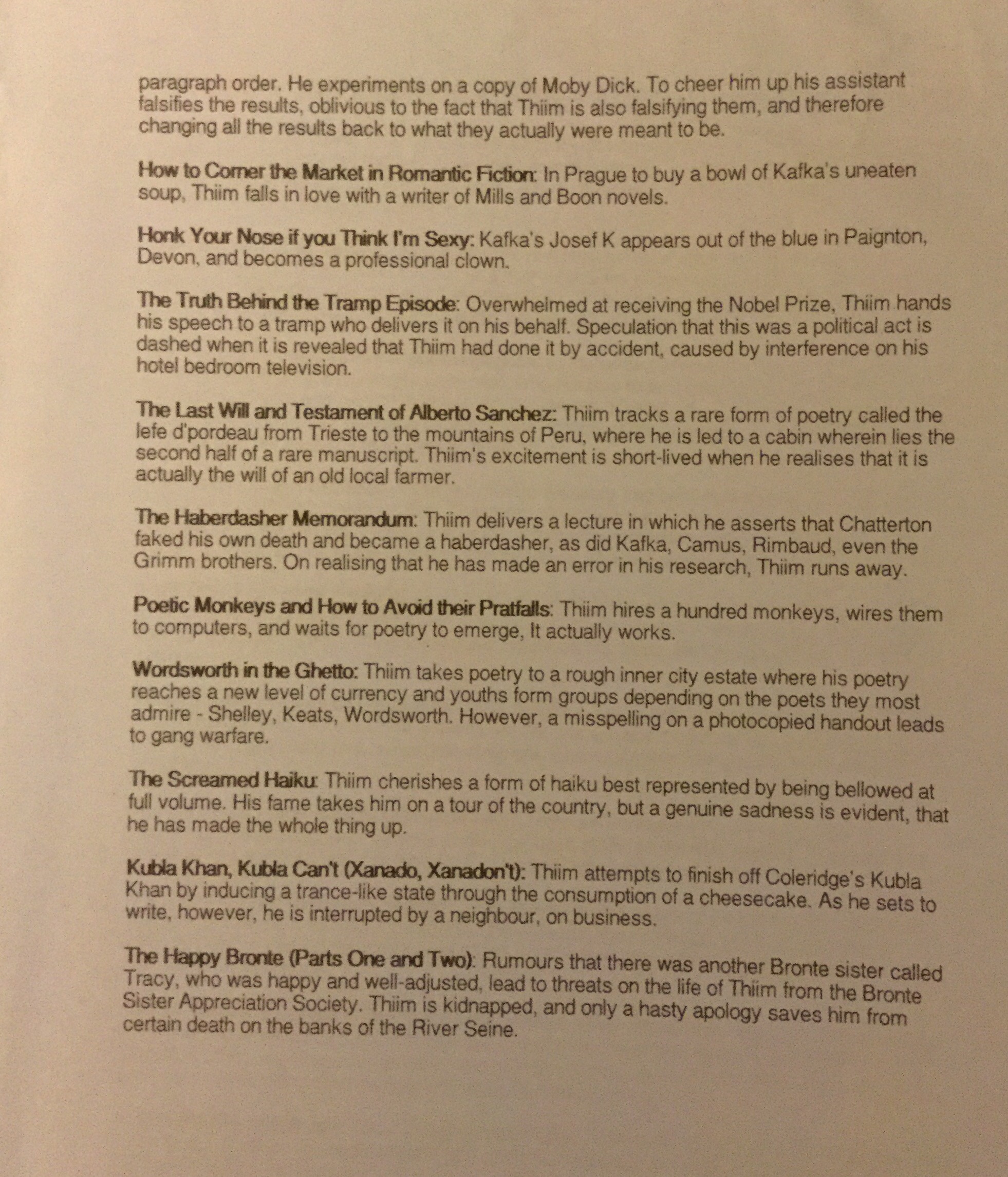
I started writing a tv series back in 2000-2002. The details of it mostly existed in my head, but I wrote a short story for every episode. I have found the notes for the imaginary season one!

It’s been a strange year for a lot of reasons. Professionally for me, it’s been a very good year with lots of opportunities and reasons to get excited about the future, some of which I can’t reveal right now. But just a few months ago it looked very different.
I was reminded of this by the retirement of Nico Rosberg, the current formula one world champion. For those uninitiated with motor racing, he won the world championship after a thrilling duel with Lewis Hamilton, reckoned by many to be the best driver in the world today, then promptly announced his retirement. It was a brave and honest move.
This summer I performed at the Edinburgh Fringe. I was only there for a week, but the usual Fringe madness was endemic, the seemingly endless cycle of promoting and leafleting, flyering, talking, then putting on a show in front of three people at the most. I was getting audiences at least, but I was not having the best of times, in a noisy venue which was very supportive and friendly and yet wholly unsuited to my show, which demanded long periods of quiet. Consequently I did not enjoy the experience. However, I did appear at a few other shows, as a guest at Stand Up and Slam, which my poetry helped the Poet team to a resounding success, and at the Boomerang Club, where I headlined on the very last day of the fringe.
By this time I was feeling a little frazzled by the whole experience. I’d also had one or two problems, such as losing my passport, so while I should’ve been flyering and leafleting, I was making phone calls and stressing about the passport, because I had a trip to New York and it was looking like I wouldn’t have a passport in time to get there. I’d also had to move accommodation for the last day of my stay due to another procedural problem. So it was all quite stressful.
On the penultimate night I thought, hmmm, why don’t I give it all up? The possibility of a promotion had come up at work, and this would mean less spoken word, perhaps I ought to go for the promotion and not do any spoken word at all, become a professional and competent retail manager instead. And as the penultimate day wore on I thought more and more that this was the right decision.
So I planned the set for the Boomerang Club in the knowledge that this might be my last ever performance anywhere. And where better to do a last performance, but headlining in Edinburgh? It would be a great story. Something to remember for the rest of my life while ploughing ahead into the beauty of a career in retail.
On the way to the gig from my new lodgings, I walked along listening to music, walked past the Courtyard, and someone recognised me from the Stand Up and Slam event, they acted as if they’d just seen a celebrity. It made me feel good.
The show went well and I finished on my poem ‘Plop’, which I normally start routines with. I did this because it was a little symbol to myself, a little nod. The show went very quickly, and I sat down and thought, well, that’s done then. And now I’m a retail manager.
Getting home to Devon took about twelve hours and when I finally arrived my mind was blank. But then something weird happened the next morning. It was like my brain had been wiped, that the whole future of spoken word seemed a blank canvas on which I could completely start again.
And instead of retiring, I found myself acting as if I was a complete newcomer. I set in motion a system of rehearsing and concentrating on performance skills. I decided to try and learn all of my new material. And I decided to have fun. Why should I stop doing the only thing I’m halfway decent at?
And I decided not to go for the promotion.
It’s a gamble that has paid off. I’ve got a few opportunities and projects which are quite advantageous, financially, and I’m even considering reducing the number of hours I do in my day job to accommodate these. This whole half year has been a complete reinvention. And of course, I had a fantastic gig in New York, once I’d sorted my passport out, winning over a cabaret crowd in Greenwich Village right next door to the Stonewall Inn.
It’s been a weird year, and I’m so glad that I didn’t Do A Nico!
Well this year’s advent calendar was a strange one. Here’s every day in it’s unusual glory.
Today’s advent calendar picture was of a duck wearing a Groucho Marx moustache, nose and glasses.
Today’s advent calendar picture is of a clown waving his big shoe at a smoke detector
Today’s advent calendar picture is of the Easter Bunny trying to keep two sides of a build-it-yourself shed upright while Marilyn Monroe reads the instructions.
Today’s advent calendar picture is of the seven dwarves waiting, angrily, at a mobile chip van, while the lady serving, who for some reason is a panda, is looking at holiday photos being shown to her by Snarf from Thundercats
Today’s advent calendar picture is of Gandalf at the self service Tesco machine
Today’s advent calendar picture is of an advent calendar
Today’s advent calendar picture is of Vladimir Putin eating a Pot Noodle
Today’s advent calendar picture is of sixteen Laurels (from Laurel and Hardy) and Sid James queuing at a self service cafeteria.
Today’s advent calendar picture is of a frog trying to push a sofa up a flight of stairs, backwards, sweating profusely.
Today’s advent calendar picture is of an igloo, a bin with contents strewn around, and a polar bear flaked out by tranquilliser dart.
Today’s advent calendar picture is of a Peruvian brown bear wearing a scarf scraping frost off the windscreen of a parked car with its engine running.
Today’s advent calendar picture is of a sneezing unicorn.
Today’s advent calendar picture is of a badger and a rabbit having a row about who gets the last chicken mayonnaise sandwich in the chiller cabinet while TV’s Victoria Coren Mitchell sneaks in and grabs it for herself.
Today’s advent calendar picture is of a stack of suspended ceiling tiles, £11 each plus postage and packing
Today’s advent calendar picture is of the nativity scene. (Bit early but there you go).
Today’s advent calendar picture is of fifteen donkeys wearing sombreros and a man at a stall trying to sell them more sombreros but the donkeys are having none of it.
Today’s advent calendar picture is of a badger getting a refund on a pair of trousers.
Today’s advent calendar picture is of Lord Byron on roller skates in a crumpled heap next to a slightly dented Ford Focus.
Today’s advent calendar picture is of a panda in a library reading a Will Self novel, double checking some of the weightier vocabulary in a dictionary.
Today’s advent calendar picture is of Mr T from The A Team at the boating lake in the park, rowing a rowing boat past some rhododendrons.
Today’s advent calendar picture is of a squid waiting in the queue for the Primark changing room with a Tigger the Tiger onesie.
Today’s advent calendar picture is of Darth Vader in a lightsabre battle with Alan Bennett.
Today’s advent calendar picture is of Michael Portillo looking very grumpy on a rail replacement bus. Oh, and why not, Skeletor from HeMan is sitting three rows behind him, eating a Pot Noodle.
Today’s advent calendar picture is of a confused ostrich.

January : An ocelot
February : A badger
March : A haberdasher
April : A lollipop lady
May : A dental hygienist
June : Jeremy Clarkson
July : Mark
August : My Aunt
September : A duck wearing a Groucho Marx moustache and glasses
October : Another badger
November : The bus driver
December : TV’s Alan Titchmarsh
Brown : is playing a trumpet.
Green : is getting a refund on some trousers.
Hazel : is sneezing.
Blue : Is looking for the tv remote
Grey : has a dodgy stomach.
Other : is fumbling for some loose change.
Eldest child : Look out,
Middle child : Get ready,
Youngest child : Eat some cake and
Only child : Hang on a sec.
Blonde : They’re coming after you next.
Brown : There’s bound to be an argument.
Red : They’ll send you a Facebook request.
Grey : run!
Black : did someone say ‘plop’?
Bald : Fetch a bucket.
Other : Put the kettle on.

Over a year ago I was asked by a magazine to write an article about the Devon performance poetry scene. They didn’t use it. So here it is in all it’s magaziney glory.
Jackie Juno is at the microphone reciting a poem. In gothic, black clothing, ankle boots and a pink feather boa, she doesn’t exactly look like the average poet. The audience is totally at her command and the room buzzes with hilarity. The poem is about Newton Abbot, and when she delivers the final line, there is laughter and thunderous applause. This is just an ordinary night at Torquay’s ‘Poetry Island’.
For the last six years I have travelled the country as a performance poet, delivering sets of whimsical and funny verse to audiences from Edinburgh to London, Wolverhampton to Swindon. Audiences everywhere tend to be enthusiastic for this niche blend of comedy, spoken word and poetry, and most cities have a certain style on the local scene which seems distinct to that area. A lot of London performers are influenced by rap, while Bristol’s thriving scene borrows the three-rhymes-per-line inflexions of hip hop. Yet I am constantly both delighted and perplexed by the diversity, flavour and creativity of the Devon performance poetry circuit.
It’s hard to pin down what it is which makes it so distinctive. Each poet is as diverse and as individual as the next without following any trend or local characteristic. As a result, the local circuit has become truly unique.
Some of these poets are starting to become recognized further afield. Ashburton’s Lucy Lepchani has recently been published by Burning Eye, the top publisher of performance poetry in the UK, and she performs regularly at festivals such as Glastonbury and Womad. Her poetry is about motherhood and nature and takes on feminist and political themes.
Tim King’s poetry is political, social and thoughtful, tackling issues such as drug addiction and child abuse, often performed with a ukulele or a loop pedal for added effect. Plymouth’s Richard Thomas has just had his second collection published by Cultured Llama Books, and his wry poetry about fatherhood and nature has seen him win praise from some of the top names in poetry. And my own oeuvre has taken me to the Edinburgh Fringe and some of the biggest poetry nights in London. We all have different styles, motivations and influences in our chosen field, yet we all come from a relatively small population spread.
What is it about the Devon scene which makes it so vibrant and diverse? For a start, there are an abnormally high number of monthly spoken word events in Devon. Because of this there are plenty of opportunities for local poets to try out new material in a supportive atmosphere. It also gives a chance for big names from further afield to visit, see the local talent, and invite them to gigs in London and Bristol.
Also, there is a culture on the local circuit of developing new talent and encouraging first time performers. Chris Brooks, the inaugural host of Poetry Island, would run workshops and courses to develop and hone the art of performance poetry, while most venues welcome new performers. The co-host of Exeter’s ‘Taking the Mic’, Tim King, is eager to give a platform to new voices.
‘Our job is to make sure they have a good experience as possible and keep coming back, learning and improving. It’s a very rare newcomer who fails to entertain at all’.
Tim reckons that the diversity and creativity of the local scene is due to the ‘tradition of openness and experimentation exhibited and encouraged by those who run local poetry events’.
Gina Sherman, the south-west coordinator for spoken word organisation Apples and Snakes says that, ‘Maybe it’s the sea air, the creative spirit and the down to earth people that make the Devon performance poetry scene so welcoming, intelligent, inclusive and witty’.
Whatever the reason, it’s clear that the local performance poetry circuit is going from strength to strength and developing an identity all of its own which has to be seen to be believed. Come along to a poetry venue yourself and you will not be disappointed!
Lately I’ve been pondering on professionalism, or more precisely, my own professionalism as a performance poet. The reason I’ve been pondering on professionalism is that I’d like to get to a stage where I can say definitely that I am a professional. And I suppose the ultimate definition of professionalism is that I get paid to be a performance poet, and that it is sustainable and economically viable.
So the thing is that I’m quite lucky at the moment on two counts. The first is that I have a job, a nine to five job in retail management. So whether I’m professional as a poet or not, I’m still going to get paid. The second lucky thing is that I get paid to perform, in the most part. I also have books to sell and workshops, and I organise poetry events, and every now and then I get commissions which also pay. So in that sense I’m professional in that it’s slightly more than just a hobby.
However, I still do things which I’m sure a ‘professional’ wouldn’t. I find myself doing lots of free gigs, and these gigs will never be economically viable. It’s all very well doing a free gig if it’s for charity, giving up ones time for a good cause. But a lot of the major gigs I’ve done over the last year have been unpaid.
I live in a very silly part of the world. Paignton is nowhere near any major urban hub. There’s no culture here, so therefore there are no major poetry gigs. The last spoken word gig in Paignton was probably when the Epicentre Cafe held one of its wonderful Word Command nights, and that’s about four years ago. And then there was my book launch on the local book shop, but that’s about it. So if I’m going get paid for a gig, it would be Bristol or London at the nearest, and that means two or three hours on a train.
So every gig that I get paid for entails expense of travel and time, and actually getting there in the first place. I’m very fortunate to have had paid gigs all over the Uk and have made a bit of money doing so. But a lot of the gigs I’ve done have been unpaid.
So why do I do them? I was pondering this last night. What are the benefits? I suppose the major one is that I meet new people and get a chance to sell them books. I see other performers and o get inspired, and it’s always great to network and meet new and exciting people. And I can use my old material and see that it still works, or try out new pieces.
If I was making a living from poetry, then this would not be a viable means of making a living. Yet we need the free gigs so that people can see us. It’s advertising, and the best kind of advertising. That’s what I always tell myself.
So I’m happy to do the free gigs if they’re doable, but I have to choose them wisely. If every performer demanded payment then the gigs wouldn’t happen. If I were to leave my job and concentrate on my art full time, (something I’m considering at the moment), then I’d have to think very hard about such events.

One of my best friends in the world of spoken word is Melanie Branton. Best friends in that we chat about things that aren’t to do with poetry or spoken word. She’s a wonderful person who I really admire, and I also think she’s one of the funniest people I know. Her poetry mixes page and performance, and is widely acclaimed. She has been published by some of the top publications and has headlined at some of the top nights in the country. Not only was she the Hammer and Tongue regional winner last year, but she came second at the Bristol Poetry Slam the year before. Only the best spoken word artists come second at the Bristol Poetry Slam. The really, really good ones who everyone loves and admire come second at the Bristol Poetry Slam.

I was so glad when Melanie agreed to be interviewed because I wanted to get to the root of what it is that makes her such a distinctive, funny and heartfelt performer.
1. Your poetry is distinctive, funny and heartfelt. How important is it to draw on personal experience in your work?
Very. It’s been both very therapeutic for me in dealing with dark moments of my life that were still casting a shadow and a way of engaging with audiences in a deeper way. If you have the courage to expose something private about yourself, if you make yourself vulnerable before an audience, they will usually connect with you.
I didn’t always write like this. I started writing traditional light verse about “funny ideas” that were very far removed from me. But, 9 times out of 10, “funny ideas” are clichés, aren’t funny, and entrench dodgy, discriminatory world views (Mothers-in-law are dragons! Menopausal women are kooky and hysterical!) and it was a way of avoiding saying anything meaningful that might expose my own personality and history to scrutiny. Spoken word forced me to open up about myself more, take greater risks and made my poetry much better.
But that’s just me – not everyone has to write like this. Ultimately poetry has to be judged on its emotional impact and the quality of the writing, not its truth: I can’t be doing with all these “scandals” where slam audiences feel “cheated” when they find out that the poet they gave 10s to for his/her heartrending personal story doesn’t really have inoperable cancer/a dead twin brother/a history of childhood abuse (delete as applicable). Judge on the quality of the work, not on who’s got the biggest sob story, then maybe people won’t feel compelled to make stuff up.
2. You have an encyclopaedic knowledge of the modern poetry scene. In terms of page poets, who are your influences, and who do you admire?
Well, it’s more of a Dummy’s Guide-ic knowledge, actually.
There are some writers I admire and would love to write like, but know I never will (e.g. Emily Dickinson, Seamus Heaney). Then there are some writers that I used to read a lot of when I was a teenager. I’m not so into their work anymore, it’s not where my taste is now, but I can still see their influence in what I write (e.g. John Betjeman, Roger McGough).But there are some writers I love whose influence on my work is obvious – Selima Hill (who’s probably my favourite living poet) being a particular case in point.
Writers I’ve been reading a lot of lately include Miriam Gamble, James Lasdun, Clare Pollard, Katherine Pierpoint, Penelope Shuttle, Philip Gross, but I have no idea if they’ve influenced me.
I lived in Poland for 4 years and I think I’m also influenced by Polish poets, from the stark attempts of Tadeusz Różewicz to construct a new poetics, after a Holocaust that had debased all that had gone before, to the playful, rather Dr Seuss-like absurdist, Konstanty Ildefons Gałczyński
If this has not already become obvious, I am totally obsessed by poetry
3. And what about performance poets?
One of the first spoken word artists I ever saw was Stacy Makishi and I am in awe of people like her, who are multidisciplinary performance artists, not just poets. Chanje Kunda has massively impressed me, in that total performance way.
It’s unfashionable to say so, but I like the traditional, rhymey-rhymey, almost music hall performance poets, like John Cooper Clarke and Pam Ayres. And people like Luke Wright, who I suppose are keeping this tradition alive.
I very much admire both Anna Freeman and Harry Baker. I think Harry’s breathtaking, ostentatious technical skill is a welcome corrective in a scene where the content cart is often put before the form-and-language horse. And I like the fact that he writes about nerdy things that no-one else does, like the vagaries of the German language and the joys of Maths.
I also very much admire you.
4. You’ve had success both in slams and in publication. What plans do you have for the immediate future?
I never have plans – I bumble along in a permanent state of vagueness. But I have a hazy aim to get a collection published in the next year or so and to get enough bookings to at least be able to convincingly pretend my job is poet on my passport. I’d also like to have a go at putting a one-hour show together, possibly on the subject of language, which seems to be a recurrent theme in what I’m writing at the moment.
5. A lot of your poems are very, very funny. How important is being funny in a performative context?
Thank you! I rarely set out to be funny (and when I do, I’m invariably not). Because I have a reputation mostly as a comic poet, audiences often want to find me funny and will laugh at poems I actually intended to be serious.
Then again, I think most really funny poetry has a serious core. I see that a lot with your stuff – the reason it’s so funny is because it touches on profound human truths and fears. Most of your poems have very serious ideas about loneliness, being afraid of not being good enough or not fitting in, or gay politics lurking somewhere behind them. Real belly laughs come, not from a clever pun or rhyme, but from people recognising something about themselves in what you’ve said.
I’ve been to some events where funny poems were clearly looked down on as being trite, unworthy, so last century, which annoys me. I think you can often make a serious point more subtly and effectively through comedy than you can through being all earnest about it. And even if it is just fluff, what’s so terrible about that? Writing effective fluff still takes a lot of skill and it makes people happy.
The poems of mine that get the biggest laughs are usually ones where I’m emotionally offloading. Like “Everything Reminds Me Of You”, which is barely a poem at all – it’s just random stream-of-consciousness. I was long-term unemployed when I wrote it, had just had a really harsh rejection letter for about the 50,000th job I’d applied for and was trying to take solace in a creepily intense, one-sided crush on a man I slightly knew and had friended on social media. It’s ostensibly about a crush, but it’s really about the thousand and one desperate, delusional ways we try to create some happiness for ourselves in a world where nothing good ever happens.
Both the best and the worst thing about funny poems is that it’s easier to gauge how well you’ve gone down. If the audience laughs very loudly, you know your poem hit the spot. If they receive it in stony silence, you know you’ve failed miserably. Whereas, with serious poems, it’s all a lot more mysterious. Is that silence the pregnant silence of an enraptured audience hanging on your every word? Or is it the silence of 200 bored people simultaneously letting their minds drift onto whether they left the gas on and whether Tesco Express will still be open when they leave the venue and if there’ll still be any cat food left?
One thing I like to do is to switch to a serious poem after a string of comic ones. Audiences usually hate this. They start off laughing, because they assume I’m still trying to be funny, then as the penny drops, the laughs start to dry up and they look deeply, deeply uncomfortable, because they can’t work out what I expect of them and they feel stupid for having laughed in the first place. And this is exactly how I want them to feel. Because if I’m doing a poem about my mental illness or having been raped, I damn well want the audience to feel uncomfortable – I don’t want them to be sitting there having a feelgood moment, smugly congratulating themselves on how right-on and compassionate they are, which I feel happens way too much in spoken word.
6. How do you rehearse and memorise your work?
I don’t rehearse enough – I spend a lot of time on trains and much of my rehearsal consists of running through lines in my head while on the Taunton to Bristol Parkway line. Or pacing around mouthing the lines sotto voce on a draughty platform.
Fortunately, I have always had a near-photographic memory, so memorisation has rarely been a major challenge (although I have dried on poems I knew well when nervous and the first outing for any poem is often a hit-and-miss affair). It helps if the poem is a narrative one, especially if it’s in chronological order, because it’s pretty obvious that C comes after B. Rhyme ought to help, but it’s also much more obvious when you get wrong.
7. What would you say was your best gig?
That’s a hard one to answer, as every gig is special in its own way (unless it goes badly, in which case it’s hideous).
The Bristol Slam in 2014, where I came second, has a special place in my heart, though, because it was about six months after I had taken up spoken word and was the first event where I felt I got taken seriously as a poet. I’d done a few slams before then and even won one of them, but I’d never felt I’d had more than a lukewarm reaction from the audience and the last couple had gone very badly (as in, I got given 6s when everybody else was getting 9s). I was on the verge of accepting that I just didn’t have what it takes and giving up. And then I turned up for one last hoorah, expecting to come last and totally humiliate myself again, and it was like a fairy tale (or, at least, a cheesy made-for-TV movie) – the audience treated me like a rock star, the expert judges gave me incredibly flattering scores and people seemed to assume I was a pro who knew what I was doing. It was the first time I really believed I might be somewhat good at this. I was so overwhelmed, I kept trying to hug the woman sitting next to me, in the emotion of the moment completely forgetting she was a total stranger.
Both times I’ve appeared at Raise The Bar have also been amazing. Danny always manages to attract an enormous audience. It’s also a very young audience – I felt a bit like Ronald McDonald – but an insanely enthusiastic one and one which really listens and thinks about what it’s heard and is open to all kinds of poetry. It’s definitely my favourite night in Bristol at the moment.
8. What would be the overriding theme of your poetry, if there is one?
I’m probably best known for my poems moaning about my epically rubbish lovelife. I do write poems about other things, but those seem to be the ones that are the most popular.
9. How do you write? Do you have a specific time and place and set of procedures, or do you wait for inspiration to strike?
No, I don’t have any kind of system. I usually just wait for inspiration to strike, but I do sometimes give it a helping hand – I attend a brilliant poetry group where we’re given a set theme every month; if I know there’s a write-in at a café near me, I’ll try to go along; and I find that nothing coaxes the muse out of hiding like a deadline, so I will look up calls for submissions and force myself to produce something by the cut-off date.
Some of my poems come very easily, others take months of agonised tinkering.
10. One of your poems is a hilarious critique of slam poetry styles. Do you see a certain dominant style at such events? Does it help to be distinctive?
People often interpret that poem as a damning critique of slam poetry, but I actually wrote it when I was preparing for a major slam and was putting myself under enormous pressure to come up with the perfect poem, that would tick all the right boxes. Of course, I produced nothing but shit during this period, as I wasn’t being myself – I was trying to manufacture poetry with cynical, mercenary intentions, and be who other people wanted me to be. That never works. It’s not so much a critique of slam poetry as a critique of my own Machiavellian ambition and cackhanded slam tactics.
That said, there are things in slam poetry that piss me off and it does come out in that poem. In particular, I hate the amount of virtue-signalling that goes on at slams – people writing safe, anodyne poetry that preaches to the converted and doesn’t attempt to tell people anything they don’t already know. Yes, there are too many racists and homophobes in the world, but by and large they don’t attend spoken word events, so if you’ve come to tell people racism and homophobia is bad, you’re probably in the wrong venue.
Going back to your question, I think it helps to be distinctive with expert judges and with promoters and publishers, who are heartily sick of seeing Tesco Value versions of Kate Tempest and Shane Koyczan and want to see people who have their own things to say.
Some slam audiences, though, really don’t want you to be distinctive. If you don’t sound like a carbon copy of every other slam poet they’ve ever heard, they think you’re doing it wrong. That’s something that frustrates me. Fortunately, though, those audiences are in the minority – most spoken word audiences are very embracing and eclectic.

Have a WordPress.com account? Log in now.

