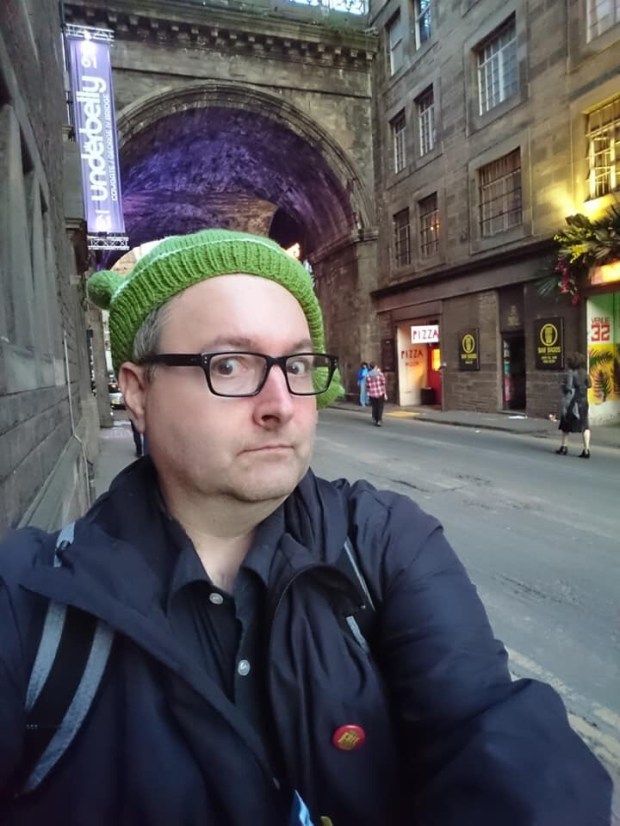
Edinburgh Fringe Diary Day Seven : A joke offered to Frank Skinner, and semi naked men.

Edinburgh Fringe Diary Day Seven

So today is already my last day at the Edinburgh fringe. As always I’m going to feel very guilty leaving tomorrow morning. Guilty knowing that so many of my friends and my new friends will still be here, working away and worrying and celebrating and commiserating and I’ll be on a train going back to Devon, hopefully. Or stuck at Preston again.

This is my sixth time at the fringe. I started out with Dan Haynes in a show called Poetry Ping Pong, and since then I’ve brought Static, Juicy, In the Glare of the Neon Yak, and of course, Spout and The Two Robbies. I also had one year doing guest spots at other people’s shows. And that was the best. It was totally worry free!

I went flyering today. And I met some very interesting people. One lady pointed at my flyer and said, ‘oh wow, it’s you!’, like this was the most amazing thing ever. And then I met a gentleman who was very excited because he had just seen Eddie Izzard walking along the street. ‘I saw Frank Skinner the other day, too’, he said. ‘And I told him a joke! It goes like this. Why shouldn’t you wear Ukrainian underpants? Because Chernobyl show. Ha ha ha! Do you get it? Chernobyl show. Yer-nob-will-show! Ha ha ha! Do you think he will use it in his act?’ I told him that he might do.

My audience yesterday was amazing. Not only was it my biggest yet, (if you include me, then it was in double figures), but a couple from Leith came along, and they had seen me last year. Indeed, they’d come especially to see me, which was totally amazing to know that I have fans in so many parts of the country. And after my show they gave me a packet of Scottish shortbread as a present. How many other performers get presents from their audience, I wondered.

As soon as my show was done I had to scoot across town to a cabaret where I was doing a guest spot. While I was doing this, the most amazing torrential rain storm erupted. I had to shelter halfway at a shop awning because the rain was so intense. I think it would have been dryer to stand in a shower, that’s how intense the rain was, and the street became flooded within less than a minute. I was joined by a party of young men who were obviously out on the razz, and as the rain intensified they took off their t-shirts as they surrounded me. And I was thinking, hello, this is a nice day at the office. I’m sure they might have taken off more had it been even wetter.

So it’s been an amazing week and as ever, I have no idea how I’m going to go back to normal civilian life. This has been a week of amazing memories and wonderful people, and apart from the train dramas at the very start, nothing has gone hideously wrong. And will I be back next year? If I can get my head around flyering, and actually enjoy it, then yes, definitely.

Edinburgh Fringe Diary Day Two : Molly the ghost and a stained glass Berlusconi

It rained, yesterday. It rained like you wouldn’t believe. And I mean that. You wouldn’t believe now much it rained in Auld Reekie yesterday. It was a relentless deluge which lasted all day, persistent and it made everything moist. As I walked into the city from my university accommodation I thought, well, there’s no way I’m flyering in this. I hate flyering at the best of times, but when you’ve got a show that has no publicity whatsoever, and is so wet that your fliers are going soggy while they’re still in your backpack, it all seems ever more unnecessary.

And yet, what other method is there of getting complete strangers to come and see a show about tea?

The town was gloomy. Like a teenager whose come on holiday with his parents. The old tenements and bridges leaned in frowning, like an old lady confused by an iPad. The rain ran in the gutters of Cowgate and actually came up from the drains. I’m sure that drains are meant to work the other way. For a short while there was a fountain in the middle of Cowgate, as the water came up and sparkled in the headlights of the taxis and ambulances.

I went and caught up with Melanie Branton and we chatted in her town centre accommodation about flyering tactics, exit flyering and street flyering, and the shows that she had seen, and it was great to spend time with her. It was also great to be out of the rain. I then went to my venue, the Bar Bados complex, and stuck up posters around the place advertising my show, which at the very least made me believe that I was achieving something tangible and proactive.

And then I tried some flyering. Jeez, it was impossible. Within minutes my flyers became a soggy mush of paper and cardboard. I gave up very easily and went to watch Sez Thomasin’s excellent and thought provoking show about diversity and representation in the NHS, and then stayed in the same room to watch Melanie Branton’s incredibly show about class and her background, delivered its passion, enthusiasm and warmth, humour and emotion.

At this point I really should have done some flyering, but instead I went for a pizza with Melanie in an Italian restaurant in Grassmarket, the most defining features seeming to be a stained glass mural representing stereotypical Italian images, such as a Vespa scooter, the Alfa Romeo logo, the colosseum, and, I swear, Sylvio Berlusconi. And the man at the table next to us had a soup and when he went to put some pepper in, the top came off and pepper went absolutely everywhere. ‘Would you like another soup?’, the waiter asked. ‘No,’ he sighed, ‘I’m fine’.

And then I did some flyering. And Melanie helped. And she was brilliant, in the torrential rain and the dim and gloomy Cowgate area, chatting and stopping people and generally showing me how to do it. I’m sure that this would have worked much better if the weather wasn’t so awful. Twenty minutes to go, I went up to my room and chatted to Jemima Foxtrot, who told me that there’s a ghost at the venue and at Banshee Labyrinth called Molly, and if you don’t get an audience, you perform your show to Molly, and she gives you good luck for the rest of the fringe. It seems a better idea than flyering.

And the show? I had an audience, which was a bonus, so no need for Molly. And I think I performed well. There’s a section in the show where I try to throw a teabag over my shoulder into a tea cup and for the first time ever, I actually managed it.

I’m writing this the next morning and it’s actually quite sunny out there. I’m looking forward to doing some flyering with dry flyers and a potential audience who haven’t got their hands full with umbrellas. It’s going to be a long week, but I’m happy to be here, and feeL privileged to be in the festival at all.

Much Ado about Muffins

A stark yellow light bends oblong from
Faux Edwardian windows
Illuminating each individual cobble of the
Pretend medieval street.
A sign hangs and creaks in the autumn breeze,
An antiquated font black on white,
Much Ado About Muffins.

Derek Dubbins is on duty, dour, he damps down
The desk with a bleach soaked dishcloth,
Rain-macked tourists huddle in the doorway
With rucksacks the wrong way round,
Derek sneers, scrubs harder, his knuckles whiten
While his regular clientele read the Daily Mail
And nod in agreement with the letters to the editor.

This is not the sort of place
Where you might ask for soya milk,
A traditional establishment
Harking back to a past that never was,
A display cabinet of scones,
Jam tarts, a framed photo of Margaret Thatcher
And another of that mad orange-faced gibbon,
You know the one,
And Derek himself, gammon red and
Incensed by subjects as diverse as breast feeding,
Health and safety regulations,
The rights of minority groups,
Croissants.
Nothing makes his blood boil more than the expression,
Live and let live.
In short, he’s a bit of a cock.

But Brad does not know this, Brad,
Eager and carefree and delicately attired
In a plain white tshirt and three quarter length trousers,
Converse all stars with no socks, Brad,
Sunny demeanour, a fervent believer
In the goodness of other souls,
Though quite possibly wearying after the
First ten minutes,
Brad lays his slender and manicured fingers
On the freshly bleached desk and says,
Would it be possible to order a wedding cake?

Why of course, says Derek,
Who’s the lucky bride to be?
Oh, replies Brad, that would be me!
Then let’s out a laugh,
Or my partner, my love, my other half,
Bradley.
What?, Derek asks.
Yes, I know, I call him Bradley
Because otherwise we’d both be called Brad
Nothing worse than shouting out your own name
During an orgasm!

No, he replies,
No, he replies,
No, no, no.
I don’t need your custom here.
I don’t need your cash.
Your ways and whims
Make a mockery of my beliefs,
Just go, just dash,
Before I call the police!
And brandishing his stainless steel cake tongs,
Derek watches
As Brad takes leave.

Silence descends upon Much Ado About Muffins.
Nervous cleared throats
And the occasional rustling
Of the Daily Mail.
All
Is as
It should be.

The dead of night.
A moonless midnight,
A silence so deep it stuns.
The kitchen refrigerator
Quietly hums.
Derek slumbers under his duvet,
Dreaming dreams of a new day
Where people know their place,
How great life would be
If everyone were like he.
He imagines a world without . . .

Fairies
Appear at the kitchen window,
Their dainty wings beat softly on the pane,
Each one emits an iridescent glow
Which sparkles, moves,
They let themselves in
And flutter round the room,
Twelve of them
Waving their magic wands,
Light as air.
Gary, Bruce, Dave, John, John, Roger,
John, Dave, Bruce, Gary, Roger and Sebastian.

They land on the marble work top.
Ok, girls, says Bruce,
You know what to do.
We’re here to celebrate
A love that’s true.
Let’s use our fairy dust
And bake with all our might
And feel proud of our efforts
At the end of the night.
Let’s get to work, let’s light the lamp,
It’s like then shoemaker and the elves
But a little more camp!

Ok, girls,
Let’s do this!

They make the base
They drain the dregs
They roll and kneed
They beat the eggs.

They laugh and joke
They take a risk
They craft and cook
They cut and whisk

They stir and mix
And prod and bake
And ice and fill
The wedding cake

And there it stands
So tall and glad,
Congratulations
Brad and Brad. Ley.

The fairies sit back and gaze at their efforts.
A triple tiered masterpiece with icing gently
Soulful like a rococo palace,
By turns baroque and stately, it stands as a
Testament to the love which
Propels the planet itself throughout its lonely orbit.
We shall bring Brad first thing, says Bruce,
Show him his cake, and then,
Our work here will be done.

At that moment the fairies hear
The trundling lollopping footsteps of Derek
On the old rickety staircase, and his
Baritone voice booming,
Fe, fi, fo, fum,
I’m off to have a dump.

Derek spies a suspicious sparkling,
Creaks open the kitchen door,
And there before him, the wedding cake
In all it’s majestic splendour,
The words Congratulations Brad and Bradley
Spiking his heart with a vengeful angst,
He goes bloody ballistic.
Tears into the fresh frosting and flings it, frantically,
Out the back door and into the yard
Where it lands next to the recycling bins.
He turns and stamps back up the stairs,
Stampy stampy stampy,
What an absolute bell-end.

Well, ladies, says Bruce,
No use standing round here all night
With a face like a slapped arse.
You know what to do, my lovelies.

They make the base
They drain the dregs
They roll and kneed
They beat the eggs.

They laugh and joke
They take a risk
They craft and cook
They cut and whisk

They stir and mix
And prod and bake
And ice and fill
The wedding cake

And there it stands
So tall and glad,
Congratulations
Brad and Brad. Ley.

Again, the fairies stand back to admire their efforts.
In divinity does the cake
Seem to defy gravity, its delicate frosting
Reminiscent of a winters forest,
And equally ethereal the finely spun sugar lacing,
Like dew on a spiders web,
As tentative and timeless as love in all it’s glory ,
Less a cake, and more a hymn to matrimony.
We shall bring Brad first things they say,
So that he can pick up his cake, and then,
Oh then, our work here is done.

At that moment, bugger me,
The trundling, lollopping footsteps of Derek
On the old rickety staircase, and his
Baritone voice booming,
Hey diddle dee dee,
I’ve come to have a wee!

A moment or so later the second cake
Joins the first in the back yard next to the recycling bins,
Which he never uses anyway,
And most of the fairies can see a pattern forming.

Alright, says Bruce,
We’ll have one last crack at this.

They make the base
They drain the dregs
They roll and kneed
They beat the eggs.

They laugh and joke
They take a risk
They craft and cook
They cut and whisk

They stir and mix
And prod and bake
And ice and fill
The wedding cake

And there it stands
So tall and glad,
Congratulations
Brad and Brad. Ley.

For a third time, the fairies stand back,
For the cake is a corpulence of crusted creams,
Daintily drizzled with delicious dustings of sweetness,
White with ice frosting, a triple layered dream
Held up with Corinthian columns, finely sculpted
Decorative dainty Daisy chains,
It stands as a hymn to love, a monument to
The deepest adoration, the passion
Which keeps us all from going insane.

A door opens upstairs,
Followed by the trundling, lollopping footsteps of Derek
On the old rickety staircase,
Tiddly om pom Pom,
I think I’ve got the runs!

There’s silence.
He pushes open the kitchen door,
He sees the cake in all it’s majesty,
Congratulations Brad and Bradley,
And just as he’s about to lunge,
Bruce, the fairy,
Suddenly appears right in front of him,
Lit up in ethereal light in the dark of the kitchen light.

Arghhhh!, says Derek.
You!, says Bruce.
Keep away!, says Derek.
What the fuck are you, I mean,
Seriously!

I am the Ghost of Christmas Past, says Bruce.
Really?, says Derek.
Naaah, says Bruce.
Keep away!, says Derek.
Keep away, keep away!
Just what do you want from me?

The fairies surround him, but there’s no menace.
The glow of their wings flits across the ceiling,
Iridescent magic reflecting back from pots and pans.
We want you to love, says Dave.
We want you to cherish life, says Jim.
We want you to open your eyes, says Bruce,
And see that there’s so much else beyond
Your faded jaded introspective worldview.

Love is a dream for many.
Love is a ludicrous nonsense.
Love is the aim of every soul.
Love should never be banished.
Love is a celebration!
Love is the glue that keeps us all sane,
Love is more than just a game.

And love does not care for labels.
Love is a miracle whenever it occurs,
A passion shared is doubled, and it spreads,
Soars, fills the world and builds it up.
There were generations who couldn’t,
The world rattled with their silent screams,
It happens today in places less free,
Hearts torn in twain by the thunder of disapproval,
Lives ruined amid the scream of self righteous bullies.
He who stands against love
Stands against life itself.

There’s a magic in the air
As Derek feels a weight lifted.
He sees the world anew, then stares
Deep into his own soul,
Shudders at what he sees,
Deafening and darkness and the Daily Mail,
Hatred dictated by front page opinions
And the need to appear big.
You’re right, he whispers,
Love shall be celebrated,
And I’d be proud to play my part.

At that moment, a lonely sunbeam
Slants through the window, signals
The dawn of a new day,
And In walks Brad, accompanied by
Gary, Roger and Sebastian.
Proudly, and with a tear in his eye,
Derek announces, here,
With all the blessings of my humble tea shop,
And with honest and newfound best wishes
For a happy life together,
Please accept this
Splendid wedding cake.

Brad smiles, and leaps for joy,
Then bends down and inspects the cake carefully.
That’s very sweet of you, he says,
And it’s a beautiful cake,
But I have a wheat intolerance
And Bradley is allergic to dairy products.

Spout, the official trailer

So yesterday I spent most of the morning on Paignton beach with film maker John Tomkins, making the official trailer for my new show, Spout. Naturally it’s not every day that you sit on a beach in a teapot hat, but I think I was very professional indeed. And the people passing by seemed to enjoy what we were doing!

Anyway, here’s the trailer. Spout debuts next week at the Barnstaple TheatreFest and then moves to Guildford, Reading, Denbury, Bristol, Torquay and Totnes before rolling into Edinburgh for the fringe.

I went to the Straight Pride Parade

I’ve just been to the straight pride parade
I gasped at the masks and the costumes that they made
I offered a salute to the striding blokes with banners
Proudly raising up their porn mags and their spanners

I’ve just been to the straight pride parade
There was a lovely beer tent though I asked for lemonade
Striding proud in line in a slouchy kind of way
Shuffling and lollopping and none of them were gay

All of them were very straight, butch and masculine
And I felt strange stirrings of something down within
To watch all these straight guys belch and march and fart
Did some very odd things to the depths of my heart

I’ve just been to the straight pride fete
All of them moustachioed and several called me mate
None of them wore sequins though a few had anoraks
And then they took their shirts off and rubbed sun cream on their backs

I’ve just been to the straight pride fair
I’d never seen so many definitely straight men there
Straight straight straight straight that was one of their chants
And then they took their clothes off and pranced around in their pants

I had a great time at the straight pride parade
Blokey blokey blokey blokey straight pride parade
Marching proud in line with the world at their feet
But Every day is straight pride day on every single street

Spout : A show about tea!

Spout is an hour show featuring poems, stories and autobiographical silliness all around the theme of tea. If you’ve ever enjoyed a cup of tea, or are a coffee drinker eager to make that leap, then Spout is the show for you! Spout is sure to create a stir.

Meet Roberts gran, who’s very fussy about how she likes her tea. Meet Aunt Rosie, who likes to sing while she’s boiling the kettle. Marvel at poems about hipster tea shops, tea-based rap songs and a group of magical fairies who specialise in baking cakes for gay weddings. This whole show will make you see tea anew!

Robert Garnham is an award winning LGBT comedy spoken word artist from Surrey. He has been long listed three times as spoken word artist of the year and has features in TV advertisements for a certain building society. Spout is his ode, his love letter, to this beverage of kings, this every day magic potion, tea!

Spout will be featuring at the Barnstaple Theatrefest, Reading Fringe, Guildford Fringe, the Glasdenbury Festival, Big Poetry and the Edinburgh Fringe, with other events to be announced soon.

Here’s an interview with the creator and writer and main performer of Spout, Robert Garnham!

I didn’t sit down to write a show about tea. I just realised one day, ‘hang on a minute. I seem to have an awful lot of poems about tea’. I think the reason behind this is that I spend a lot of time in coffee shops, invariably drinking tea, and wondering what to write about, and then looking down at the tea making paraphernalia in front of me and thinking, ‘yes, that will do’. In fact, I had so many poems about tea that some of them couldn’t possibly be squeezed into the show.

Of course, the show isn’t just about tea. In a funny sort of way, it’s probably the most autobiographical thing I’ve done. My grandmother and my aunt both feature prominently, and it was the weirdest thing, they just kind of barged their way in to the script while I was writing it. I would visit them both and invariably, out would come the tea pot and the whole ceremony of making a cuppa and having a chat. And my word, they could chat. I’d hear all the gossip about the neighbours and then they’d move on to stories about the olden days. It was always difficult getting a word in edgeways.

Working in retail, my first responsibility of every day would be to make everyone a cuppa. ‘We don’t do many miles to the cuppa’, is the saying we adopted, to explain why we would stop so often for a brew. And whenever a new recruit would start, I’d say to them, ‘are you good with technology?’ ‘Yes’, they’d reply. ‘Great, then can you go and put the kettle on’.

I don’t know about you, but I prefer mugs to cups. There’s nothing more refreshing than a strong tea made in a big thick mug. You can’t gulp tea down with a dainty cup. And there’s always the risk of accidental slurpage. A mug makes tea informal. They’re also easier for washing up, too, more robust than dainty cups. There’s a line in the show, ‘I’d rather have a dainty cup and not a builders mug’. This is pure fiction, personally speaking, and I only put the line in there because it rhymed and scanned, and not because it is true. I’m a poet and I’m allowed to do things like that.

So how would I describe Spout? It’s certainly scatalogical, a little bit weird, yet it hopefully takes the audience to places that we all know and recognise, whole simultaneously making them think about the world anew. I mean, that’s pretty lofty, isn’t it, having a show with such aims. And I hope it means that you might learn something about me, too. We’re all different, and yet we’re all the same. We are brought together by the things that we enjoy.

This show is dedicated to my grandmother Winifred, and my aunt, Mildred. Both were strong, independent women, Londoners who survived the Blitz, and helped imbue in me a love of those little stories which keep us all sane, tidbits of gossip, anecdotes, and humour in all the kinds of places where they might otherwise have been lost. They were also both prolific tea drinkers.

I hope you enjoy watching Spout as much as I’ve enjoyed writing and rehearsing it.

Gennady Yanayev : The Musical

For the last few years I’ve had an urge to write a musical. Perhaps inspired by the success of Hamilton, I, too, have pondered on a lyrical exploration of the life and times of a similar historical figure, whose story really must be told to a new generation before they sink, inevitably, into the dustbin of history.
I’ve never been the biggest fan of musicals. Whenever I’m watching them I think well, if you have something to say, just say it. No need to create a song and dance about it. I still have bad memories of the time a friend insisted we watch the classic animated film, that defining piece of art Yogi’s First Christmas. I had no idea it was a musical, and the whole thing could have been a good half an hour shorter if that characters didn’t burst into song every five minutes for no apparent reason, you know, just like people do in real life. And there was an amusing moment when the park rangers are stressing over how to get Yogi to go back to his cave and hibernate like bears are supposed to do, and I was scouting at the screen, ‘Just use a tranquilliser dart!’ Ok, so perhaps it’s wrong to diss an entire genre solely on the basis of Yogi’s First Christmas, but, unlike a lot of gay men, I’d never seen what all the fuss was about with musicals.
Until Hamilton came along. I just loved the idea of this historical biography being relayed in hip hop and rhythm, completely contemporarising the life and times of Alexander Hamilton. It made me look at the whole genre of musicals anew. And that’s when I saw how much of an exquisite art form this can be. Musicals are amazing! The songs form a bond between the subject matter and the audience, a harmony of rhythm and voice blended with words to create a shortcut to the depths of a characters soul, or merely to move the story along quickly when things get boring. And the songs, oh, the songs! Clever wordplay, sung conversations and interactions, glitz, glamour, sequins, feather boas, a celebration of choreographed movement, musicals, oh, musicals, suddenly appealed to the very depths of me!
In short, the vast majority of them are very camp.
And that’s when I decided to try and write a musical about the most un-camp person in the vast pantheon of historical figures, one of history’s losers whose story might now have been forgotten, overtaken by the urgency of current affairs.
Gennady Yanayev was the president of the Soviet Union. Yes, he was. You can look him up in the history books if you don’t believe me. He was the dictator of the largest country on the planet and one of the two big superpowers. Gennady Yanayev was he man on top. The big cheese. The head honcho of the Soviet Communist world. And like a titan, he stayed in that commanding role for almost three days. And then, just like that, he was gone.
1991. This was a time of glasnost and perestroika and the leadership of Mikhail Gorbachev. After decades of brutal rule and secrecy, paranoia and political persecution, subjugation, fierce control and the kind of mindset which meant that imminent nuclear annihilation was a normal fact of everyday life, so much so that it was factored in to making plans – ‘oh, were having a barbecue next Sunday, why don’t you come along? Unless the Russians obliterate Basingstoke in the mean time’ – the openness of Gorbachev was a refreshing breath of fresh air. He was affable and charismatic and media friendly, unlike Brezhnev, who always looked like a constipated badger, and his two immediate successors who both died within months of becoming leader. Gorbachev was smiley, open, breezy, and he saw that there was more to life than threatening to blow up the entire world.
But the hardliners didn’t like it. Well, they wouldn’t, would they. It’s what made them hard liners. They were hard to win over. They could see that Gorbachev’s policies might very well lead to the break up of the Soviet Union. Ha, as if that could ever happen! And OK, the Berlin Wall had come down a couple of years before leading to revolutions right across Eastern Europe, free movement of people and ideas, but Russia was still communist. They saw Gorbachev as dangerous. He had to go.
They waited until Gorbachev was on holiday. You can imagine the scene as he left the Kremlin. ‘Now you chaps behave yourself while I’m gone’. And off he went with his suitcase and trilby, probably whistling in a jaunty manner as he climbed aboard his limousine. And they watched as he left, running from window to window until his car was a dot in the distance.
The coup was led by the chairman of the KGB and the chief defence industry minister. They were the brains behind the operation. They thought that they had to take some kind of action to get the Soviet Union back on its true path. Hardliners both, but neither of them wanted to be the actual figurehead. So they chose the deputy president. They chose Gennady Yanayev.
Gennady was a grey, colourless bureaucrat with a stony face and thick glasses that magnified his slightly mad eyes. He had worked his way up through the party machine to be Gorbachev’s deputy. There was absolutely nothing remarkable about him. Just the sort of person who would make the excellent lead character of my hypothetical musical. He also had another quality which adds a certain depth and almost comedic bounty to his character, and that’s the fact that he was, most of time, hopelessly drunk.
So Yanayev was declared to be the acting president of the Soviet Union, in an announcement which shocked the world and plunged international politics into a frenzy of paranoia and bad karma. It seemed as if the old, bad days of the USSR were back, that the hardliners had won while Gorbachev was being held under house arrest at his holiday dacha. Indeed, the word dacha had never been heard so much on the news. The whole world was in shock, religious leaders offered prayers, strategists and defence analysts looked at their nuclear capabilities, everyone was aghast.
Until . . .
Until Gennady Yanayev hosted his first press conference.
Never had a man looked less like a leader. He sat before the reporters and the television cameras in his brown suit and thick glasses, his hands shaking uncontrollably. He was blind drunk, and he slurred his words, his voice quavering, and when a young reporter pointed out that he had staged a coup, he was unable to reply, stumbling and bumbling over an incomprehensible answer. The next day the coup was over and Gorbachev was back in power.
And what of Gennady? Sentenced to treason, he was placed in prison but within a few years he was let out again, only to become employed by the Moscow Tourist Board. The rest of his life was conducted in relative obscurity, this rather bland individual who had once, for three days, been the president of Russia.
I envisage the musical beginning in an unglamorous office. Gennady is sitting at a desk stamping documents. There’s a bank of filing cabinets behind him. And as he stamps, in a humourless manner, he’s singing a song in a throaty, guttural fashion about how he likes paperwork. There’s truth in paperwork. There’s no wrong answer. And on the wall there are posters advertising various districts of Moscow. The scene ends when one of his bosses comes in, a young lady, who’s very sharp with him. ‘Your work is awful’, she says. ‘Just what has become of you? Have you always been this shoddy?’ Gennady looks, sadly, out the window.
The next scene goes back in time, and it’s here that I might use a bit of artistic freedom. Gennady is a young man, making his way up through the ranks. Each verse details a different rank, he’s twirling and dancing as soldiers and office workers detail the meagre ranks that he passes through. And then there’s a stirring scene where he’s asked by his wife, ‘Are you blind to our love?’, and he replies, ‘No, I’m just blind drunk’.
Next comes a scene where grey, stony faced men with deep voices invite him to join the Politburo. And then a bit of fun as we are introduced to the leaders of the Soviet Union, who One by one die off on stage, collapsing on to the floor. Brezhnev! (Dead). Andropov! (Dead). Cherenyenko! (Dead). They’re all dead, they’re all dead, and who oh who oh who is this?
A young, vibrant figure leaps on to the stage, ‘I’m Gorbachev!’
Naturally, what follows will be a joyful dance routine about how much everyone loves Mikhail. ‘Glasnost! Perestroika! Glasnost! Perestroika! We are aboard the Gorbachev train! Nothing on earth will ever be the same! Glasnost! Perestroika! Glasnost! Perestroika! We all love Comrade Gorbachev! Let’s hope he sticks around and he doesn’t bugger off’.
From here on the musical will become somewhat formulaic. There will be a soulful slow number about Yanayev’s love life, his drinking, the sadness at the heart of him and possibly a song about how he wishes he were more popular. And then the showpiece of the musical, just before the break. A riproaring smash hit of a song about the coup itself, called ‘Dacha coming atcha! We are the Gorby snatchers!’ followed by a scene in which Yanayev is pressured into becoming the new president.
Oh, I can just see it now!
After the interval, we see Yanayev in his office with a bottle of vodka, too afraid to go anywhere, looking out the window and checking for bugs. He’s lonely and he’s scared. Perhaps we might concentrate on this part of the show on his drinking problem. And next must come the press conference scene. Naturally, everything here will be exaggerated for comic effect. The press make him a laughing stock, there’s lots of rhythmical laughter and pointing and things build up into a kind of maelstrom, he finally admits that he doesn’t want to be the president. The scene will end with him being arrested.
And that’s more or less how the musical will end, with his release from prison and his interview with the Moscow tourist board being told through song. But at one stage near the end he might have the chance to put down his pen and dream.
For thirty hours, the world was his, from the frozen pines of Siberia to the heat on the coast of the Crimea, from Saint Petersburg to Vladivostok, this immense nation, trans continental railways and factories, farms and roads, cities and tower blocks, airports and shops, and people, millions of people, workers, students, soldiers, families, they were all his playthings while he drinker vodka in an anonymous Kremlin office. Did he have a chance to look out of the window and see the stars in all their timeless omniscience, in the grave and cold constellations reaching down with their ancient light, that he might dare to imagine himself in league with their firmament, dizzy with the promise of political power and the aims of a just, new world, or was he absolutely blotto? And later on, in his cold prison cell, or in his drab wood panelled office with its functional decor, did he ever have cause to let his mind wander and think, for just a moment or two, I was once in charge of all this? Or again, was he absolutely blotto? And on his death bed, did he once again recall that press conference in which he was exposed to the world, a simple man, an individual representative of a bigger entity, seeing his future undone before it could even begin, or was he so blotto at he time that he remembered nothing of it? All I know is that is a story which must be retold, a stirring reminder that even the most frightening moments of international chaos have a human story at the heart of them.
You see, I recognise myself in certain aspects of Yanayevs character. I have had plenty of moments in which fortune, luck and hard work have paid off, and each time the results have been far, far less than is ever envisaged. I’ve seen my own triumphs simultaneously exciting and blurred not by alcohol, but by self doubt, fear, and good old fashioned sloppiness. I’ve felt myself surrounded by stars and high achievers only to look in the mirror and see a bland nobody staring back. And I, too, have been placed in positions of power and influence of which I was qualified not in the slightest.
I would dare to say that the story of Gennady Yanayev is a story for us all, a modern parable, and a caution from history. For no matter how much a person might achieve in life, they will always be forgotten very, very quickly.

Jean Alesi and me.

Jean Alesi

In 1989 my mother bought me a second hand black and white television for my bedroom. I was fifteen years old and until that time, had not had my own tv. In those days, of course, there were only four channels so the likelihood of there being anything on to watch was very small. My sister had had her own colour tv for a couple of years, which wasn’t fair because she was younger, and not only that, but hers had a remote control. Remote controls were new technology. Our old big tv downstairs had a remote control and if you lost it, you could change channels by rattling a bunch of keys. How nonchalantly, my sister would sit on her bed and be able to change channels without even having to move or grab a bunch of keys. And now I, too, had my own television set.
It was a cranky old thing, (the second hand tv, not my sister), short, squat and smelling ever so faintly of burning dust and electricity. And if it was switched on for too long it would get very hot and it would turn itself off at inopportune moments, a strange little button at the back popping out with a fierce click. Once it had cooled down one was able to press the button and turn it on again. If it was still hot, the button would just stay out and you’d have to sit and wait for ages, which was no good if you were watching something really important, like Columbo. And during a heat wave you’d have to wait for hours. The damn thing would just not cool down.
In the defence of my tv, though, there occasionally wasn’t anything on at all. The announcer would come on and say, well, we’ve got no programs for the rest of the afternoon, so here’s the test card. Oooooooooooooo!
One day – and it must have been a Sunday – I caught the start and opening laps of the San Marino formula one Grand Prix. It was pretty hard to decipher what was happening, what with the fact that all the cars were shown in black and white, and there was always a lot of static interference every time my sister used her hair dryer. The television set had a dial, and you had to dial in to the television channel the same way that you had to with a radio finding a station. And very shortly after the start of the race there was a very bad accident involving Gerhard Berger.
Motor racing was a part of my life from an early age, but I’d never taken much interest in it before. My childhood bedroom wallpaper was of John Watson’s Marlboro sponsored McLaren. It’s great to think that it was such an unenlightened age that cigarette sponsorship was allowed into the bedrooms of small boys. I didn’t know much about John Watson, or motor racing for that matter, or McLaren, or smoking, butmy dad was proficient in all of these, and I picked up bits along the way, enough to know that the McLarens were still sponsored by Marlboro, and that the leading drivers of the day were Senna, Prost, Mansell, Piquet, and my own favourite, Gerhard Berger. And the only reason I liked Gerhard Berger was because his second name was Berger. I liked burgers. I had no interest in taking up smoking, but eating burgers was definitely helped because of the wonders of Gerhard.
The race on my little black and white television was stopped because of Berger’s accident, and as I waited for it to restart, the inevitable occurred and my television turned itself off. I put my hand on the back of it and, sure enough, it was giving off a pretty intense heat. The strain of being turned on for almost forty five minutes was obviously too much. I knew that I wouldn’t be able to use it for a couple of hours, by which time the race would probably be finished.
So I went downstairs to the living room, and as luck would have it my parents were out gardening or something else interesting that parents do on a sunny spring morning, and I was able to watch the rest of the race on the big television in the living room. Now this television was colour, and having sat through forty five minutes of black and white, the contrast – no pun intended – was amazing. The colours were vibrant, the green grass around the track, the multicoloured cars and drivers and the McLarens looking just like they did on my bedroom wallpaper, their Marlboro branding vibrant and luxurious. I’d never seen a spectacle like this, the excitement and the intensity of motor racing revealed in all its technicolor brilliance, the primary colours, the advertising hoardings, the flags and banners in the crowd, the vibrant orange of the flames licking around Berger’s crashed Ferrari. It was probably at this moment that I fell in love with formula one Grand Prix racing.
Now it must be said that I was a weird teenager. At fifteen years old I’d already sussed that I was gay. It was obvious to myself, though not particularly so to other people. I wasn’t entirely camp and I wore the sorts of clothing that all my friends wore, so I’m sure that nobody knew, that it would remain this devastating big secret which I would carry with me to the grave. I told myself that I was very good at hiding it. I also thought that I was one of the handful of gay people in the entire world, that it was basically just me and Julian Clary. There didn’t seem to be any other gay role models. It was also the nineteen eighties. Homophobia was very popular in mainstream society and most people seemed to be very fond of it, particularly in Surrey where I lived on a council estate within earshot of the main runways at Heathrow Airport.
So I was kind of glad that I’d got in to formula one motor racing, because this was the sort of thing that the average straight man really liked, all those machines and engines and drivers and strategies and ladies in bikinis carrying large lollipops with the names of the drivers, and adverts for cigarettes and beer and after shave and spanners and motor oil, and brash egos and the roar of the engines. It was a straight person’s paradise. And the more I got in to the sport, the more I saw that this gave me an escape route should I be talking to my friends and the hypothetical question comes up, ‘Are you gay?’, to which I might reply, ‘No, and did you see the race at the weekend?’
The summer progressed. Senna, Prost, Mansell, Piquet, Berger. These titans, these gods of the sport who towered above not only formula one, but life itself. How excitedly Id tune in to catch their exploits, with their distinct personalities and their almost superhuman powers to pick me up and fly me away from gaydom into that sparkling iridescent rainbow glitter world of perpetual absolute straightness! And then, one day, along came Jean Alesi.
Imagine if you had to invent the perfect racing driver. Imagine if you were writing a novel and you realised that you needed a stereotypical barely believable cartoon character of a racing driver. What characteristics would you give them, if you were a little lazy when it came to inventing such characters? A firm jaw, dazzling blue eyes, a small stature, handsome youthfulness, sultry eyes with a faraway stare. And what kind of nationality would you give your invented racing driver? French? Italian? Well, why not a mixture of both? And what kind of name would you give your hypothetical stereotypical racing driver? Something distinctly European, yet a name which sounds fast even in its spelling and economy of letters. Jean Alesi. Four syllables, not very many letters. Oh my god, he was everything I wanted him to be!
Jean Alesi burst on the scene halfway through 1989. And all of a sudden these old towering idols of motor racing didn’t seem quite so special. Jean was in a much slower car, yet he was driving much better than them and spent most of his first race in second place before finishing fourth. He didn’t seem to care very much that there were people out there who needed these titans of motor racing to just keep going and going. Jean Alesi was like a fresh thought introduced into a tired way of looking at the world. Jean Alesi was the embodiment of excitement. Jean Alesi was the equivalent of saying, hey, you know what? There are other ways of living your life. Jean Alesi was also very good looking.
Oh my god, I liked him a lot.
And soon the exploits of Jean Alesi became the only reason that I watched formula one. Well, that and the need to appear to be the same as all the other blokes, what with formula one being so blokey. Because within this blokey structure, Jean Alesi demonstrated that there was room for something new and exciting. He held his steering wheel right at the top. He leaned his head over at crazy, exaggerated angles around the corners, it was like he was pretending to be a racing driver. It was almost, dare one say it, camp. He had no technical skill whatsoever. My nickname for him was Crazy Alesi. One of his former team mates used to call him Jean Asleazy. He seemed to run on pure enthusiasm.
I wanted to come out. I was desperate for the world to know who I was. But the world was a different place back then and the framework of support that most LGBT people in the Uk mostly have now was missing back in 1989. There were hardly any gay people on television, unless it were the basis of a joke or a cheap stereotype, and section 28 was prevalent in schools preventing teachers having serious conversations about homosexuality. The AIDS crisis was at the forefront of everyone’s mind whenever the subject of gay men was discussed. Homophobia was everywhere, in throwaway comments and the laughter of school fiends, jokes told openly, and in government policies. Being gay was a personal source of shame, a hideous joke played by nature and something which I thought I might even grow out of, or at least train myself to disregard. I just hadn’t met the right woman yet, a woman with short hair, blue eyes, no female bits and only male bits, possibly French Italian, probably called Jean. I wanted the world to change.
And Jean Alesi wanted to win a Grand Prix.
Over the next six years, Alesi found himself in another race. I was getting older, a teenager now, late teens, the early twenties beckoning, and I gave myself the target of coming out to the world as gay in a glorious burst of music and love, before Jean Alesi won his first Grand Prix. As luck would have it, Alesi soon signed to Ferrari, a team which at the time was in one of is periodic performance troughs, so the idea that Alesi might actually win a race was now almost impossible. This gave me some breathing space. I felt like a swimmer about to plunge into icy water, steeling himself, just standing there, year after year, unable to make that final move. And knowing that if I did, I’d get more than a cold shoulder. Every other week I’d sit and watch as Alesi found a new and exciting way not to win a race, and this seemed emblematic of my own struggle. Moments of promise and potential victory falling apart, and assured win undone by some minor trifle. For six long years Jean and I struggled together to get what we wanted, to make our name on history before it was too late.
And then, in 1995, when I was 21 years old, the bastard did it.
It was the Canadian Grand Prix. It was one of those races in which all the other drivers fell by the wayside. And this left Alesi out in front, victory assured. I remember those final laps, I was almost crying with delight, and yet while I felt pleased that he was actually about to do it, I also felt a sense of loathing that he should get what he always wanted, and I would be left there, alone. And as he crossed the finish line in an emotional moment of tears and celebration, I thought, well, my life hasn’t changed in the slightest.
If it’s any consolation, that would also be his last win in formula one. I did think about waiting until his second win to come out, and I’m glad that I didn’t, because there would be no second win. In fact it would be another four years until I came out to friends and family, by which time I already had had a partner. But that’s another story.
Every now and then Jean Alesi turns up on television. He’s much older now but he’s still good looking and my mother fancies him. To me he was the epitome of what a racing driver should be, but he’s always stood for more than that. He was my personal talisman, my guardian angel, he was there showing the way without him even realising that he was doing it. He showed me that you could change the order of things just by the force of sheer enthusiasm and, of course, a lot of hard work. My own coming out felt less like a fantastic victory and more like a plane crash. And perhaps Alesi had already had his coming out moment, the time he had told his parents that yes, he was a racing driver.
There are kids out there now looking for the same escape. The world is ever so slightly easier for them now. And that’s such a good thing, people seem far more open minded and people can be who they want to be. They don’t need racing drivers to show them the way. Or perhaps, they do. Perhaps we are all racing drivers now. We are all Jean Alesi.

Poem

When I was a teenager
There were only two things I desperately wanted.
To come out,
And for formula one driver Jean Alesi to win a Grand Prix.
Both of them took a long time
And relied less on skill and more
On the bad fortune of others.
The circumstances had to be just right,
And once this landmark had been reached,
The floodgates would open
And there’d be no stopping us,
Me and Jean Alesi.
There were lots of accidents in the way,
Near misses and heart stopping moments,
And in 1995, in the city of Montreal,
Jean Alesi finally took the chequered flag first,
To floods of tears and immense relief.
And yet.
Just as he crossed the finish line,
I, who was still to achieve my end,
Felt a sudden anger towards him.

Perpendicular: My new podcast

For the last few weeks I’ve been working on a podcast and it’s now ready to be unleashed on the world. Each episode is a purpose written piece featuring all kinds of whimsy. I’m hoping to release one a week but to get things going, here are two episodes.

I hope you enjoy them!

https://soundcloud.com/robertdgarnham/perpendicular-1/s-MqMu2

https://soundcloud.com/robertdgarnham/perpendicular-episode-two-elvis-impersonator-newton-abbot-station/s-MBqnS

A Night in Burnsville, West Virginia

Poem

The car is big, brash and American,
As American as a baseball game,
And just like a baseball game,
It seems to go on forever.
The size of a frigate, this thing,
Burns enough fuel to power a small city.
You be navigator, my uncle says,
Which is easy as there’s only one road
Here in the mountains of West Virginia,
Even I can’t muck this up.
I catch my reflection in the rear view mirror.
You’re a long way from Basingstoke, sonny jim.

We’re on a road trip through America.
The scenery and grandeur are simply stunning
But I haven’t had a sausage roll in ages.
A teenage lad,
Overcompensating his obvious campiness
By wearing an Arsenal football shirt,
(I have no idea who Arsenal are,
I just like the fact they’ve got
Arse in their name),
And my uncle looks like Leslie Neilsen.
No wonder that diner back there
Went very quiet the moment we walked in.

And jeez, I’ve become so terribly English.
The Americans really seem to like it,
A waitress made me read from the TV Guide
And she couldn’t stop laughing.
And no, I’ve never met Benny Hill.
Why is everyone here obsessed with Benny Hill?

A muggy, huggy, humid day.
The moment I step from the car,
Everything goes Moist.
The constant heat has led to some serious chafing.
As the sun sets the highway announces
A small town called Burnsville,
We stop for the night,
Leslie Neilsen swings the frigate off the freeway
And we book into a small motel.

The adjacent highway sighs
As if it’s all too much.
The hillsides loom,
The Neon buzzes.
Passing trucks growl and
The world smells of diesel,
Melting tarmac and decomposing weasel.
It’s gritty,
But not in a Harold Pinter sort of way,
But in the way that grit is gritty.
There’s something sticky and
Unsettling in the heat of the night,
A bit Like finding half of a frog
In a packet of Quavers.
Restless dreams in wooden homes,
This covered fold, this
Hidden valley, and I,
Jolted up from hours of driving
And awash with hormones and teenage desires,
Suddenly turned on by absolutely everything,
Which I can only quell by singing
The refrain of a tv advert for Bran Flakes.
‘They’re tasty, tasty,
Very very tasty!
They’re very tasty!’

My room is hot.
I’ve seen these places
In so many films.
A bed, a bathroom, a bible.
I open the window and the moths fly in,
Thousands of the fluttering bastards,
Moths on the Tv screen, moths
Circling the lights, moths on the window frame,
And even the bastard moths are turning me on.
I try to bat them with the bible
But the bible turns me on.
I try to shoo them out the door
But the door handle turns me on,
And the door frame,
And the door turns me on,
And I turn off the light and then
Turn it on
But even turning it on turns me on,
And I realise that I have to get away,
Oh yes,
I have to get away.
I place my hands on my head and through
Gritted teeth I sing,
‘They’re tasty, tasty,
Very very tasty!
They’re very tasty!’

It’s warmer outside, and dark, so dark.
I walk down to a dried up stream
Behind the motel,
Turn and look at the wooded valley slopes,
It’s all so quiet and ethereal but bloody hell,
After a while it starts to turn me on.
I tell myself there must be monsters here,
Gun toting wild men,
World hating survivalists,
Angry war veterans, how masculine,
How beautifully masculine,
Sensuous and masculine,
How it turns me on!
I try to look for some natural splendour,
But all I can see is a Coca Cola machine,
Humming and electric and brash
And vibrating ever so softly, like a lover,
Which turns me on.
So I walk, I walk up to the main road,
The highway, long grass crickets chirruping,
Like the springs of a bed, (impersonate),
oh god!, back to the motel,
The motel where so many slumbering naked people
Have tossed and turned,
Oh dearie me,
How dreadfully even this motel turns me on,
And just as I’m thinking I should really
Get a grip,
I see the open door to the motel laundry room.

Bright lit fluorescent glaring in the sultry night,
And two shining hot shirtless lads operating
The machines, nonchalant, slyly sexual, the
Glistening sweat causing their lithe bodies to writhe
And contort with an ethereal glow,
They’re tasty, they’re tasty,
Oh my, they’re very, very tasty,
They’re very tasty indeed.
And all of a sudden the motel is just a motel,
The moths, the crickets, the Coca Cola machine,
The doorway and the light switch,
They are what they are,
And I am what I am,
And the lads, oh mumma!
We all know what they are.
I go back to my room,
Boy oh boy,
Do I go back to my room!

Whooo!

The next morning we load
Our luggage into the frigate
And Leslie Neilsen asks me
What I’d like for breakfast.
For some reason I have
Sudden hankering for Bran Flakes.