Well what a week this has been. I arrived in Edinburgh with no luggage and no ability to put on a show. The only clothes I had were the tshirt and shorts I’d worn on the airplane. Not even Amy spare pants. I booked into my student flat feeling totally dejected. Last year I’d arrived and lost my passport and I was so sure that things would be better this year.
By the middle of the week I’d been in The Guardian, mentioned on Radio Two, and interviewed on Radio Five Live! The show had gone very well and I’d won the Hammer and Tongue slam one evening.
It’s all so different to last year. I wrote a blog earlier this year about last year. I felt so dejected that I’d even considered giving up spoken word entirely, and when I’d featured at Boomerang Club on the last day of the fringe last year, I’d gone into it convinced that this would be my last ever performance anywhere.
I also had no money. By which I mean, I have a seperate account for spoken word things, and it was completely empty. The night I went to see Dandy Darkly was the night I withdrew the last reserves. I made nine quid from the audience of my final show, though.
A year later I’ve headlined in New York, appeared on a tv advert, done a lot of corporate work, and other private gigs which have allowed me to come to Edinburgh this year better prepared. I’ve also had a lot of help from people. One of the top fringe performers from last year was generous with his time and spent a couple of hours taking me through everything about putting on shows, so long as I didn’t reveal who he was. I’ve also had technical help from Bryce Dumont with the music, directorial advice from Ziggy, and fantastic sound clips from Jackie Juno and Margoh Channing. However, the biggest support has come from Melanie Branton, perhaps my closest friend on the spoken word scene, who has been there at every step of the way showing me how to do absolutely everything, from flyering and chatting to strangers, to how to structure a show. Melanie has been a huge inspiration this last year, and it’s such a comfort in a city of strangers to see her.
Which makes tonight somewhat awkward, as I’m going head to head with her in a poetry competition!
My last shows are today and tomorrow and I’ve got loads of ideas for next year. I just need to get over my hatred of flyering!
Tag Archives: slam poetry
I’m really looking forward to Edinburgh!
Last year I went to the Edinburgh fringe with my show, Static, and lots of things happened simultaneously. I lost my passport on the first day, (I was due to fly to New York just a few weeks later), didn’t know where my accommodation was, and I had a show that depended on a lot of mime and movement and moments of silence, that was put in the corner of a noisy bar. I became very philosophical while I was there, but by the end of the run I was questioning everything and I was ready to consider giving up on spoken word. The usual fringe madness, then.
Last year was a learning experience. I went in softly with Static, an autobiographical piece which I’m still proud of. Indeed I performed the show one last time earlier this year. But on the whole the experience had been a negative one, and I wrote about it in a blog.
This year, I feel completely different. I have a brand new show, Juicy, which is a completely different beast. Rather than set out with a story and an idea, I just opened up my mind and threw everything at it. The result is a show which has the potential to be different every day, with different poems and different linking material. It’s adaptable, loud and doesn’t rely so much on props and long quiet set pieces. It’s also, I hope, very funny.
But the other thing that’s different this year is that I know more. I know exactly where my accommodation is, I know how it works, I have the travel all sorted out, and I’m pretty sure that I’m not going to lose my passport. The other difference is that my venue is more suited to the kind of show I’ve written, and I’m really looking forward to performing at Banshees Labyrinth every day. Last year, I didn’t know what my venue was like until I arrived, late, breathless, straight off the plane. This year, I know everything about the venue, and I shall be there a day before.
A lot of people helped me over he last year get the new show together, too. At the end of the fringe last year I had a breakfast meeting with one of the top fringe performers, who was good enough to impart all of his wisdom, which I have used to make this show. In particular he told me the importance of music, and this is where my long time colleague Bryce Dumont comes in. He’s helped create a soundscape for me to perform against, and made me familiar with the technology to do this. There has also been support from Melanie Branton, Jackie Juno, Margoh Channing and the mysterious fringe performer, all of whom have offered advice and their own voices for the soundscape of the show.
But the biggest difference this year is that I will know more people there. More friends than ever will be up there with their shows and I aim to see all of them, perhaps several times!
So I’m looking forward to Edinburgh this year!
What is Juicy? An interview with Robert Garnham
What’s the theme of your show?: Juicy is a scatalogical mishmash of comedy poetry, spoken word shenanigans, serious and deep explorations of loneliness, LGBT rights, songs and a comedy monologue about lust at an airport departure lounge. I suppose if it has a theme, then that would be finding love. Different characters throughout the show find love, or dream of finding love.
What’s new or unique about the show?: Juicy is a free form entity, different every night, with no definitive order. It’s upbeat and funny one moment, contemplative the next. It looks at some serious issues, too, behind the fun and the hilarity, such as gay rights in places such as Uganda and Russia, loneliness, isolation, longing.
How did the show come into being?: the show just kind of evolved outwards from several different places simultaneously, somehow, in a kind of spoken word osmosis, meeting in the middle. It started with a few ideas, which were improvised, then these ideas led to other ideas.
Describe one of your rehearsals.: The show is in three parts so rehearsals were conducted in fifteen minute sessions in a shed at the back of my parents garage in Brixham, Devon. This is real home grown stuff! There’s a big mirror along one wall where I can watch myself practising. I play around a lot with word order and tone and movement and hey presto, the show started to come into being.
How is the show developing?: One of the important aspects was the adoption of music. I worked with some talented musicians and sound artists, which really helps with the tone and the delivery. And then I was privileged enough to work with Margoh Channing, one of the funniest cabaret drag artists of the New York scene, and she recorded some words for the end. I just knew that the end would have to fit in with her words!
How has the writer been involved?: The writer has been involved since the start. I’m the writer. I’ve been there for every rehearsal.
How have you experimented?: As I say, the music was the key to the show. I’ve performed all over the UK and New York for years, but never used music before. Most of my experimentations were actually with the technology necessary to get the music backing just right. I’ve also never done a long monologue before, so this was kind of scary. I was influenced by another New York friend of mine, the storyteller Dandy Darkly.
Where do your ideas come from?: I wish I knew! They just seem to arrive. Like being hit in the face by a kipper. You can be in a sauna or swimming pool or on a bus about to get off and suddenly, oh yeah! A badger that wants to be in EastEnders!
How do your challenge yourself or yourselves?: I watch other performers and see how they do it. And then I try to be as good as them. I’m really influenced by cabaret artists, even though I’m a spoken word artist. The sense of fun and naughtiness is irresistible.
What are your future plans for the show ?: Juicy will be going to GlasDenbury Festival near Newton Abbot, the Guildford Fringe, and then the Edinburgh Fringe, where I’ll be at Banshees Lanyrinth.
What are your favourite shows, and why?: Margoh Channing’s Tipsy, for the humour and the pathos. Dandy Darkly’s Myth Mouth. Paul Cree, Ken Do. All these people invent characters and invest them with humour, and take you to new places almost effortlessly. I’ve seen them all at various fringes. Also Melanie Branton’s new Edinburgh Show, she’s such a good writer and performer.
Show dates, times and booking info: 29 June at 5pm, 1st June at 650pm, 2nd June at 330pm, all at the Golden Lion in Barnstaple, tickets available on the Barnstaple TheatreFest website.
Then the Keep pub, 9 July at 730pm, Guildford Free Fringe, tickets available, again, from their website.
And finally at Banshees Labyritnth, every day at 1230pm, 13th to the 19th August, at the Edinburgh Fringe.

On memorising.
So lately I’ve been trying to memorise my new Edinburgh show, Juicy. This would be quite an undertaking for me, as I’ve never successfully memorised anything I’ve ever written, and to be jones I probably won’t manage it. I can memorise whole Bob Dylan songs, all fourteen minutes of Desire, but I’m quite hopeless at anything I myself have written.
I did a scratch performance of Juicy at the Bike ashes Theatre in May. It was a daunting experience because I was surrounded by theatrical types, and to be honest I think they were looking at what I was doing more in the context of a theatrical piece than a set of poems. The feedback afterwards unanimously suggested that I should learn the whole thing, because this is what theatre is. Some of the feedback suggested I move around more. Which was quite funny on two counts, firstly because some of the feedback also said how nice it was to see someone who doesn’t move sound all the time, and also because the director I used for my last show told me to stand dead straight for the whole hour. And he was a theatrical director.
So I’ve set to work trying to learn Juicy, and after two months I’ve managed to learn six pages of it. Out of thirty. Now this may not seem like much, but for me, this is a small triumph. I’ve never managed to learn anything before, so six pages of Juicy is the ultimate achievement.
Last week I went to a gig in Totnes and I spoke to a fellow performer who I have lots of respect for. I told her about learning my show and she replied, ‘Why?’
And that got me thinking, why indeed? Ok, so if you’ve learned your lines you can move around more and have a deeper connection with the audience. But on the other hand I’ve always performed with a book, and it is a part of my whole repertoire. I look up from the book, glare at the audience, look at them all in turn. Which should be quite easy at the Edinburgh Fringe. In fact, I know the words, I just can never remember in which order the verses fall.
Make no mistake, it’s good to learn poetry and adds to the performance. And the fact that I’ve memorised six pages of the show means that now I can apply this to the three minute poems, and hopefully grow my performance. But I think I shall just relax on the memorising at the moment and concentrate just on the performance. That’s the main thing. It’s performance poetry, after all!
Ant – A solemn investigation
It has been apparent for some time that a solemn investigation were needed into the effects, physical and psychological, of an ant crawling on someone’s hat. Seeing it as upon myself, (the theme, not the ant), I set out, in a somewhat grave manner, and yet bravely, into such an investigation.
The manner this investigation took soon revealed itself to be poetical in nature, and within a couple of hours I had completed a poem based on the theme of having an ant crawl on someone’s hat. Yet this did not fully satisfy me, and a further poem was written.
At this time, I was bitten by the bug, (again, not the ant), and more poems began to arrive. The theme of an ant on a persons hat soon took over my life and all of my creative output, until such a time arrived that I could think of little else. Indeed, the poems began to resemble a Groundhog Day syndrome, the same repeated themes, the same story with different outcomes, different languages and tones, until within a month I had thirty such poems.
The good people at Mardy Shark publishing soon recognised their worth and a pamphlet was soon produced, titled, simply, Ant.
Ant stands as the zenith of my creativity, a full flow measure of poetic and literary sensibility, all inspired by the horror and the bizarre situation of having an ant crawl on ones hat.
You can download the Kindle version of Ant herehttps://www.amazon.co.uk/Ant-Robert-Garnham-ebook/dp/B071JDZJ7X/ref=sr_1_1?ie=UTF8&qid=1497201234&sr=8-1&keywords=Robert+Garnham+Ant
Or you can send off for the physical version here http://www.lulu.com/shop/robert-garnham/ant/paperback/product-23218401.html
An Interview with Melanie Branton
One of my best friends in the world of spoken word is Melanie Branton. Best friends in that we chat about things that aren’t to do with poetry or spoken word. She’s a wonderful person who I really admire, and I also think she’s one of the funniest people I know. Her poetry mixes page and performance, and is widely acclaimed. She has been published by some of the top publications and has headlined at some of the top nights in the country. Not only was she the Hammer and Tongue regional winner last year, but she came second at the Bristol Poetry Slam the year before. Only the best spoken word artists come second at the Bristol Poetry Slam. The really, really good ones who everyone loves and admire come second at the Bristol Poetry Slam.

I was so glad when Melanie agreed to be interviewed because I wanted to get to the root of what it is that makes her such a distinctive, funny and heartfelt performer.
1. Your poetry is distinctive, funny and heartfelt. How important is it to draw on personal experience in your work?
Very. It’s been both very therapeutic for me in dealing with dark moments of my life that were still casting a shadow and a way of engaging with audiences in a deeper way. If you have the courage to expose something private about yourself, if you make yourself vulnerable before an audience, they will usually connect with you.
I didn’t always write like this. I started writing traditional light verse about “funny ideas” that were very far removed from me. But, 9 times out of 10, “funny ideas” are clichés, aren’t funny, and entrench dodgy, discriminatory world views (Mothers-in-law are dragons! Menopausal women are kooky and hysterical!) and it was a way of avoiding saying anything meaningful that might expose my own personality and history to scrutiny. Spoken word forced me to open up about myself more, take greater risks and made my poetry much better.
But that’s just me – not everyone has to write like this. Ultimately poetry has to be judged on its emotional impact and the quality of the writing, not its truth: I can’t be doing with all these “scandals” where slam audiences feel “cheated” when they find out that the poet they gave 10s to for his/her heartrending personal story doesn’t really have inoperable cancer/a dead twin brother/a history of childhood abuse (delete as applicable). Judge on the quality of the work, not on who’s got the biggest sob story, then maybe people won’t feel compelled to make stuff up.
2. You have an encyclopaedic knowledge of the modern poetry scene. In terms of page poets, who are your influences, and who do you admire?
Well, it’s more of a Dummy’s Guide-ic knowledge, actually.
There are some writers I admire and would love to write like, but know I never will (e.g. Emily Dickinson, Seamus Heaney). Then there are some writers that I used to read a lot of when I was a teenager. I’m not so into their work anymore, it’s not where my taste is now, but I can still see their influence in what I write (e.g. John Betjeman, Roger McGough).But there are some writers I love whose influence on my work is obvious – Selima Hill (who’s probably my favourite living poet) being a particular case in point.
Writers I’ve been reading a lot of lately include Miriam Gamble, James Lasdun, Clare Pollard, Katherine Pierpoint, Penelope Shuttle, Philip Gross, but I have no idea if they’ve influenced me.
I lived in Poland for 4 years and I think I’m also influenced by Polish poets, from the stark attempts of Tadeusz Różewicz to construct a new poetics, after a Holocaust that had debased all that had gone before, to the playful, rather Dr Seuss-like absurdist, Konstanty Ildefons Gałczyński
If this has not already become obvious, I am totally obsessed by poetry
3. And what about performance poets?
One of the first spoken word artists I ever saw was Stacy Makishi and I am in awe of people like her, who are multidisciplinary performance artists, not just poets. Chanje Kunda has massively impressed me, in that total performance way.
It’s unfashionable to say so, but I like the traditional, rhymey-rhymey, almost music hall performance poets, like John Cooper Clarke and Pam Ayres. And people like Luke Wright, who I suppose are keeping this tradition alive.
I very much admire both Anna Freeman and Harry Baker. I think Harry’s breathtaking, ostentatious technical skill is a welcome corrective in a scene where the content cart is often put before the form-and-language horse. And I like the fact that he writes about nerdy things that no-one else does, like the vagaries of the German language and the joys of Maths.
I also very much admire you.
4. You’ve had success both in slams and in publication. What plans do you have for the immediate future?
I never have plans – I bumble along in a permanent state of vagueness. But I have a hazy aim to get a collection published in the next year or so and to get enough bookings to at least be able to convincingly pretend my job is poet on my passport. I’d also like to have a go at putting a one-hour show together, possibly on the subject of language, which seems to be a recurrent theme in what I’m writing at the moment.
5. A lot of your poems are very, very funny. How important is being funny in a performative context?
Thank you! I rarely set out to be funny (and when I do, I’m invariably not). Because I have a reputation mostly as a comic poet, audiences often want to find me funny and will laugh at poems I actually intended to be serious.
Then again, I think most really funny poetry has a serious core. I see that a lot with your stuff – the reason it’s so funny is because it touches on profound human truths and fears. Most of your poems have very serious ideas about loneliness, being afraid of not being good enough or not fitting in, or gay politics lurking somewhere behind them. Real belly laughs come, not from a clever pun or rhyme, but from people recognising something about themselves in what you’ve said.
I’ve been to some events where funny poems were clearly looked down on as being trite, unworthy, so last century, which annoys me. I think you can often make a serious point more subtly and effectively through comedy than you can through being all earnest about it. And even if it is just fluff, what’s so terrible about that? Writing effective fluff still takes a lot of skill and it makes people happy.
The poems of mine that get the biggest laughs are usually ones where I’m emotionally offloading. Like “Everything Reminds Me Of You”, which is barely a poem at all – it’s just random stream-of-consciousness. I was long-term unemployed when I wrote it, had just had a really harsh rejection letter for about the 50,000th job I’d applied for and was trying to take solace in a creepily intense, one-sided crush on a man I slightly knew and had friended on social media. It’s ostensibly about a crush, but it’s really about the thousand and one desperate, delusional ways we try to create some happiness for ourselves in a world where nothing good ever happens.
Both the best and the worst thing about funny poems is that it’s easier to gauge how well you’ve gone down. If the audience laughs very loudly, you know your poem hit the spot. If they receive it in stony silence, you know you’ve failed miserably. Whereas, with serious poems, it’s all a lot more mysterious. Is that silence the pregnant silence of an enraptured audience hanging on your every word? Or is it the silence of 200 bored people simultaneously letting their minds drift onto whether they left the gas on and whether Tesco Express will still be open when they leave the venue and if there’ll still be any cat food left?
One thing I like to do is to switch to a serious poem after a string of comic ones. Audiences usually hate this. They start off laughing, because they assume I’m still trying to be funny, then as the penny drops, the laughs start to dry up and they look deeply, deeply uncomfortable, because they can’t work out what I expect of them and they feel stupid for having laughed in the first place. And this is exactly how I want them to feel. Because if I’m doing a poem about my mental illness or having been raped, I damn well want the audience to feel uncomfortable – I don’t want them to be sitting there having a feelgood moment, smugly congratulating themselves on how right-on and compassionate they are, which I feel happens way too much in spoken word.
6. How do you rehearse and memorise your work?
I don’t rehearse enough – I spend a lot of time on trains and much of my rehearsal consists of running through lines in my head while on the Taunton to Bristol Parkway line. Or pacing around mouthing the lines sotto voce on a draughty platform.
Fortunately, I have always had a near-photographic memory, so memorisation has rarely been a major challenge (although I have dried on poems I knew well when nervous and the first outing for any poem is often a hit-and-miss affair). It helps if the poem is a narrative one, especially if it’s in chronological order, because it’s pretty obvious that C comes after B. Rhyme ought to help, but it’s also much more obvious when you get wrong.
7. What would you say was your best gig?
That’s a hard one to answer, as every gig is special in its own way (unless it goes badly, in which case it’s hideous).
The Bristol Slam in 2014, where I came second, has a special place in my heart, though, because it was about six months after I had taken up spoken word and was the first event where I felt I got taken seriously as a poet. I’d done a few slams before then and even won one of them, but I’d never felt I’d had more than a lukewarm reaction from the audience and the last couple had gone very badly (as in, I got given 6s when everybody else was getting 9s). I was on the verge of accepting that I just didn’t have what it takes and giving up. And then I turned up for one last hoorah, expecting to come last and totally humiliate myself again, and it was like a fairy tale (or, at least, a cheesy made-for-TV movie) – the audience treated me like a rock star, the expert judges gave me incredibly flattering scores and people seemed to assume I was a pro who knew what I was doing. It was the first time I really believed I might be somewhat good at this. I was so overwhelmed, I kept trying to hug the woman sitting next to me, in the emotion of the moment completely forgetting she was a total stranger.
Both times I’ve appeared at Raise The Bar have also been amazing. Danny always manages to attract an enormous audience. It’s also a very young audience – I felt a bit like Ronald McDonald – but an insanely enthusiastic one and one which really listens and thinks about what it’s heard and is open to all kinds of poetry. It’s definitely my favourite night in Bristol at the moment.
8. What would be the overriding theme of your poetry, if there is one?
I’m probably best known for my poems moaning about my epically rubbish lovelife. I do write poems about other things, but those seem to be the ones that are the most popular.
9. How do you write? Do you have a specific time and place and set of procedures, or do you wait for inspiration to strike?
No, I don’t have any kind of system. I usually just wait for inspiration to strike, but I do sometimes give it a helping hand – I attend a brilliant poetry group where we’re given a set theme every month; if I know there’s a write-in at a café near me, I’ll try to go along; and I find that nothing coaxes the muse out of hiding like a deadline, so I will look up calls for submissions and force myself to produce something by the cut-off date.
Some of my poems come very easily, others take months of agonised tinkering.
10. One of your poems is a hilarious critique of slam poetry styles. Do you see a certain dominant style at such events? Does it help to be distinctive?
People often interpret that poem as a damning critique of slam poetry, but I actually wrote it when I was preparing for a major slam and was putting myself under enormous pressure to come up with the perfect poem, that would tick all the right boxes. Of course, I produced nothing but shit during this period, as I wasn’t being myself – I was trying to manufacture poetry with cynical, mercenary intentions, and be who other people wanted me to be. That never works. It’s not so much a critique of slam poetry as a critique of my own Machiavellian ambition and cackhanded slam tactics.
That said, there are things in slam poetry that piss me off and it does come out in that poem. In particular, I hate the amount of virtue-signalling that goes on at slams – people writing safe, anodyne poetry that preaches to the converted and doesn’t attempt to tell people anything they don’t already know. Yes, there are too many racists and homophobes in the world, but by and large they don’t attend spoken word events, so if you’ve come to tell people racism and homophobia is bad, you’re probably in the wrong venue.
Going back to your question, I think it helps to be distinctive with expert judges and with promoters and publishers, who are heartily sick of seeing Tesco Value versions of Kate Tempest and Shane Koyczan and want to see people who have their own things to say.
Some slam audiences, though, really don’t want you to be distinctive. If you don’t sound like a carbon copy of every other slam poet they’ve ever heard, they think you’re doing it wrong. That’s something that frustrates me. Fortunately, though, those audiences are in the minority – most spoken word audiences are very embracing and eclectic.
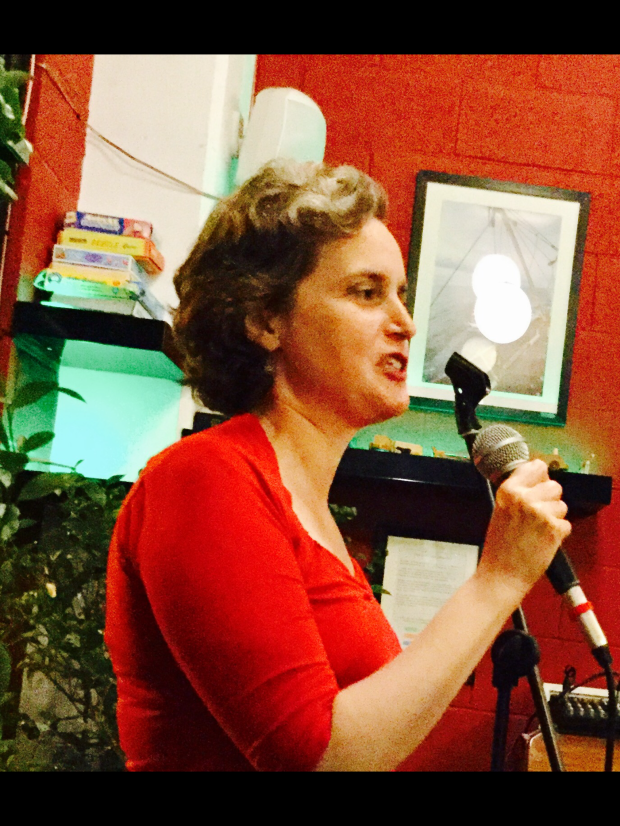
Why I’m no longer going to compete in slams. Possibly. Well. Maybe just one or two more.
Last night I was at Hammer and Tongue in Brighton, supporting The Antipoet, and I had a great time in front of an enthusiastic audience. It was the first time that I’d performed in Brighton, and everyone made me feel very welcome.
One element of the evening, and a large part of the night, was the slam competition. Naturally, I wasn’t in it, because I was already on the bill. And in any case, I had made a solemn declaration to myself never to enter any more slams.
Why is this? I think it’s because I have recently started to realise that slam competitions do not show off the best of spoken word. A three minute crowd-pleasing rant is very entertaining and skilful and often performed incredibly well, but does this translate to a twenty minute set? How can an artist keep up with the energy of such a piece over a longer period? And is there a risk that in a slam situation, everyone seems to act more or less the same?
This is what I was thinking last night. I’d come up with a solution, in my mind, of a slam competition in which the poet gets ten minutes to do a selection of poems, of varying styles and topics, so that the audience can get a better sense of who they are and what they have to say about the world. I’ve had great fun in the past with slams, doing my finest comedy poems which I have practised, but these are only a part of my overall oeuvre.
I know that a slam competition is a very definite art form and a very specialised event. Slam poetry is a style, like jazz or hip hop. The idea I propose of something longer is more of a spoken word pilot show, a chance for an audience to judge, in a playful manner, a longer set. And people would still play to the crowd, no doubt. More skills would come to the forefront, such as props and movement, which are usually frowned on in slam circles.
Anyway, that’s my idea.
But then last night, the slammers were excellent and varied. There was a young lady who did a Kate Tempest-esque piece which was mesmerising, and there were one or two comedy poets who used the language of stand up and mime. In fact, every poet had their own style and method, which made it all the more enjoyable.
Which kind of leaves me in two minds. Should I forego competing in slams? I’ve had great fun in the past and won prizes here and there, and the exposure is great. Maybe I shall do one more. Just one more little slam somewhere, and see how I feel about it. I mean, what harm can it do? When introducing me last night, Sally Jenkinson told the audience about the first time she had seen me, which was at the Bristol Slam. If I hadn’t competed there and done quite well, then she would never have known me from Adam.
So yes. Maybe one more. One more little slam, and then no more.
Although, I’d like to do the Bristol one again . . .
An Interview with Scott Tyrrell
Last month I spent an enjoyable four days in a tent in the pouring rain in Malmsebury at the Womad Festival. The whole site was filled with exotic foodstuff stalls and examples of world music, and lessons where you could learn to play yak skin drums. I spent all of my time at the poetry tent, marveling at the artistry and dedication of some of the finest performance poets in the UK. One of them was Scott Tyrrell.
I’d heard that he was both very good and very funny, a multiple slam winner and the current Anti-Slam Champion. Nothin quite prepared me for how good and how funny he actually was. He was very good indeed, and very funny indeed. Hilarious, animated, his wit and wordplay precision crafted for maximum effect. I was immediately captivated. So it was not a surprise when he won the BBC Poetry Slam at the Edinburgh Fringe a couple of weeks ago, meaning that he is now officially both the best and the worst slam poet in the country.
One of the reasons I celebrated his win was that as a comic poet myself, I have often come second at slams having been beaten by someone really incredibly serious and worthy. My poem about being envious of beards was completely obliterated in the final of the Bristol poetry slam by Stephen Duncan’s excellent piece about the history of black culture from slavery to the present day. Scott Tyrrell’s win showed me that you can be funny and still win slams.
This cheered me up a lot. But then it also depressed me, because it meant that I just need to be funnier.
I decided I would interview Mr Tyrrell as soon as possible to find out more about him, and to share in his amazing accomplishments.
– You use the craft of comedy to good effect in your poetry and I believe you had a background in stand up. How did you get in to performance poetry?
I actually started writing poetry before standup. I was 26 and it just happened one day. I wrote 3 poems in a row. No reason, I was inexplicably compelled. And they weren’t complete shit – well one of them was pretentious drivel but the other 2 were reasonably crisp and funny for first goes. I had a very pushy flatmate at the time called Leila who pushed me into going along to an open mic night at a pub in Byker, Newcastle called the Fighting Cocks (None of these names inspired confidence if I’m honest). Despite my legs actually shaking I got through a 4 poem set – with laughs in the right places and a pint at the end of it. I was hooked and I kept going back every week (wearing baggy jeans so no one would see my legs shaking) and that’s where the Poetry Vandals formed – 4 of us initially – Jeff Price, Aidan Halpin Annie Moir and me. To be followed later by Karl Thompson and Kate Fox.
We toured a bit round the country and did the Prague Fringe 2 years in a row and it was great fun. Then I moved to Manchester and chanced my arm doing actual standup – with poems – but soon learned that if one is introduced as a comedy poet in a comedy club one is met with groans before a word is uttered. So I prised the two disciplines apart and did straight standup in comedy clubs and tried writing poetry with a little more depth for poetry nights. It was while living in Manchester that I was invited to Bristol to compete in my first poetry slam representing Newcastle/Gateshead at the Capital of Culture Slam and was (much to my own surprise as well as everyone else) the winner – against the likes of a young Luke Wright and Julian Ramsey-Wade.
I pursued the comedy a bit more but despite winning a Manchester new act competition I was becoming disillusioned and bitchy as a comic. I’d become the comedy cliché of complaining about why so-and-so managed to get a weekend at the Store (he must be sucking up to Don Ward or manufacturing his reviews, etc.)
I met my future wife about this time on a trip back up to Newcastle and she has a daughter who neither of us wanted to uproot so I knocked the comedy on the head, moved back to Newcastle and went back to my first vocation as a graphic designer. But the need to write wouldn’t leave me alone so I continued with the poetry. There were a few wilderness years but I hit a stride again a few years back. I was talking to James Mckay (fellow poet who started in Newcastle the same time as me) that the secret to success is to just not go away.
– Who are your poetry heroes?
Spike Milligan was my first but there’s sometimes over-sentimentality and shallowness that puts me off his poetry now. John Hegley was the real revelation. He was silly, poignant, but with a melancholy that hinted at such ache under the surface. He still blows me away, both in the subtlety of his writing and his performance. He just has to flinch an eyebrow or sigh and you’re in the palm of his hand. Contemporaries I respect that come to mind are Elvis McGonegall, Kate Fox, Ann Porro, Anna Freeman, AF Harrold, Vanessa Kisuule, Jonny Fluffypunk, Erin Bolens and Megan Beech. There are loads that have me ache at the skill they employ. I feel like such a cheeky poor cousin to some of these guys.
– And who are your comedy heroes?
Late eighties Billy Connolly, early nineties Eddie Izzard, the Pythons, Milligan, Tommy Cooper, Vic and Bob, Eric Morcambe, Julie Walters and Victoria Wood, early Richard Curtis and Ben Elton, Rik Mayall and Ade Edmondson, early Mel Brooks, Graham Linehan, Dylan Moran. People with a distinctive uncompromising voice that exude real warmth and intelligence.
– What kind of a strategy do you adopt for slam competitions?
Show range. If it’s a 3 rounder I try to have a solid funny one, a deeper serious one and one that tries to combine a bit of both. But in what order I perform depends entirely on the order you’re picked and what has been previously performed. I try to contrast with what has just gone. You have to forget it’s a competition. You just have to focus on giving your best performance and feel a responsibility that the audience have come to have a good time. You’re not there to impress or prove how clever you are or preach a gospel. As soon as you get behind a mic you’re an entertainer.
– Where do you get your inspiration? Your Trip Advisor poem is just genius!
Aww cheers. That was one of those serendipitous occasions where a natural juxtaposition happened. It was close to Christmas and I just happened to be piecing together the supposed chronological events of the nativity with a colleague from what we remembered from school on a coffee break (must have been a slow day). I joked that Joseph and Mary must have been really pissed off that night as they’d travelled all the way from Nazareth whilst Mary was in the final stage of pregnancy on an uncomfortable donkey only to be offered no accommodation, just a shit-strewn stable with loads of weird strangers turning up while you’re giving birth. On the way back to my desk someone had Trip Advisor open on their machine, so I put the two together. I then made Joseph into a grumpy Geordie and that was it. Most of my ideas come from my family. I could literally (and may yet) write a book about all the weird shit my 7 year old son comes out with.
– How do you go about writing a poem for an anti-slam?
Pick your character first. Give them a basic backstory. Then either place them out of their comfort zone or let them spill their beans about something. Malcolm Odour (my Anti-slam character) more or less wrote the poem himself. He’s me if I’d never had sex and never moved away from home – a complete awkward loner who believes he’s had many girlfriends because he has a vivid imagination and has in fact stalked most of them.
– What is your rehearsal method?
It’s changed over the years. I used to be able to retain my material so easily when I was younger. 2 or 3 readings and it was in. However, since having kids I’ve found it harder as I have all the stuff they’re likely to forget about stashed in my brain corridor along with whole episodes of the Power Puff Girls and the words to every Julia Donaldson and Michael Rosen book. I have method now. I record myself doing an exaggerated version with over emphasis on rhythms and words, then play it back in the car while driving so I can remember it musically.
– How important are regional accents in extruding comedy from material?
As important as the emphasis you place on them. If the writing demands it, do it, but I’ve never been drawn to one accent or another with comedy. It’s all about the writing and whether the point comes across for me. Saying that, when Julie Walters performs Mrs. Overall saying “Coconut Macaroooon, Miss Babs” I snort.
– What advice do you have for other slam poets?
It’s just a bit of fun. It’s an arbitrary competition in which a bunch of people judge the most subjective art form there probably is for the purposes entertainment. A few poetry lovers give you 0.3 more than the next poet and hey, you’re a winner! It’s absurd, but people are strange creatures that have invisible shelves in their brain for you and your capabilities. And an award puts you on a higher pretendy shelf. Them’s the crazy rules.
– How does it feel to be the BBC champion!
See previous answer – plus kinda great despite that 😉
– What next for Scott Tyrrell?
Some nice gigs coming up on the back of the BBC Slam. Doing a headline spot at the Bare Knuckle Poetry Slam at Northern Stage, Newcastle November 5th. Doing gigs that haven’t been officially announced yet in Leicester, Southampton and Yorkshire over the coming months. Especially looking forward to representing the UK along with Sophia Walker, Toby Campion and Paula Varjack at a slam in Boston USA next July. A hugely respected gig has been offered to me next year that I can’t announce yet. And this Saturday (12th September) I’ll be joining old comic friends in a fund-raiser for Syrian refugees at the Stand, Newcastle – organised by Jason Cook, writer of BBC2’s Hebburn.


