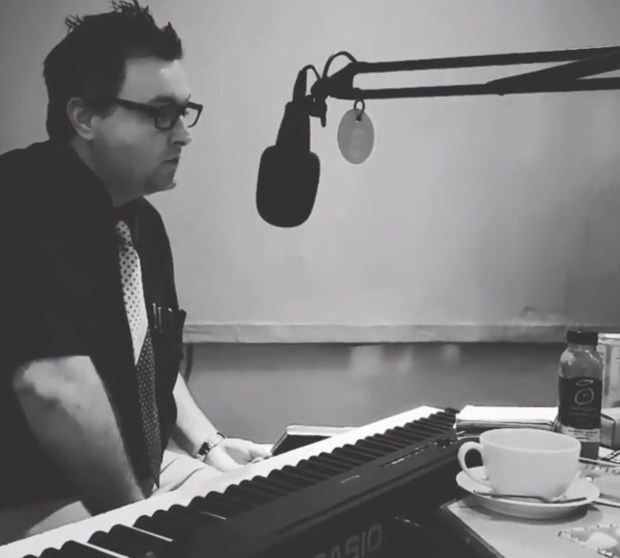
Edinburgh Fringe Diary Day Four

So I’m over halfway through my run now at the Edinburgh Fringe and it’s been the usual case of highs and lows, though the highs are not as high as last year (with that whole Guardian joke lost Thing) and the lows are not as low (I arrived with all of my luggage). I’ve had good audiences and bad audiences. I had a day with low attendance but the audience was incredibly enthusiastic and generous with their donations. I’ve had a day with a sizeable audience who just sat there in a stony silence.

As ever it is the camaraderie which makes the fringe. My venue is a complex of seven stages and in other rooms are magicians, actors and comedians, and we all meet up in the room where we store our fliers, and chat about how it’s going. One of them told me that he spends eighty pounds a day hiring four flyerers and then gets audiences of sixty, which more than pays for them, it’s simple economics, he says. He’s a magician. Others are more philosophical and say, well, whatever happens, happens. Going on the advice of the magician, I hired a flyerers for an hour. It didn’t seem to make much difference.

I’ve seen some amazing shows, so far, and I’m aiming to get out today and see some more. In fact I might hold back on the flyering and enjoy a day in Edinburgh. The best thing I’ve seen so far is my favourite spoken word artist, Dandy Darkly, and his show All Aboard, a rip roaring cabaret style digression on politics and social issues delivered in brash camp storytelling. It was utterly transfixing and Dandy remains of the finest performers I’ve ever seen. Fay Roberts show The Selkie was a quieter mystical study of myth and nature.

The other day while I was flyering, someone asked me if there was dancing in my show. I shall only come along, she said, if there’s dancing. Someone else asked me what the weather forecast was, and when I said I didn’t know, she got very angry. It takes all sorts, I suppose.

So I have three more shows to go and a couple of guest spots here and there. And each night I come back to my student flat, cook dinner, drink red wine and ponder on how it has gone. And of course, I think about next year. What can I do next year? Now, what can I do?

Edinburgh Fringe Diary Day One

I’m currently on a train heading north towards Edinburgh for the fringe. This is my sixth year as a performer, and my eighth in all, so I’m starting to feel like an Edinburgh veteran. Yet for some reason it seems in inconceivable that I’m going at all this year. I suppose the main reason for this is that I feel more prepared than I have done for years, with a show that I have rehearsed and polished and written specifically for the fringe, rather than a collection of greatest hits. I have also done more promotion work behind the scenes, and worked with a director. My whole year, in fact, the last two years, have been leading up to this, and yet, now I’m on the way, I can hardly believe it.

I stayed in London last night, in a hotel that I’ve been staying in on and off for twenty years. There’s something labyrinthine about the place, with rooms and corridors decorated as if from 1970s Czechoslovakia. There’s a complicated system of dials and knobs next to the bed to work the radio. The bed is surrounded by tongue and groove pine panelling. Every morning for the last twenty years, a man who looks like Leonard Cohen rules the breakfast restaurant with an iron fist, but he wasn’t there this morning. I felt cheated. I hoped that he was okay. It just didn’t seem the same without him.

The madness starts tomorrow, with my first show, and appearances at other events. I also want to see as much as possible when I get there, particularly cabaret and comedy as well as spoken word. And this is the first year that everything has gone ok. I haven’t lost my passport like I did the year before last. My luggage hasn’t got lost, like it did last year. And I won’t be staying in a tent or a flat with no roof, like I have done in years past, but in the same university flats that I’ve used for the last couple of years. Auld Reekie awaits, and I can’t wait!

A Brief History of the Thing on my Ear

About a month ago I noticed a lump on my earlobe which shouldn’t have been there. It wasn’t there before but it was there now. I knew that it was something dodgy so I went to the Doctor and she agreed. She explained that it was caused by exposure to UV light and this was a direct result of the hole in the ozone layer. I don’t want you to worry, she said, but we need to treat this seriously.

So of course, I did worry, but I decided also not to tell anyone because that would just spread the worry. I became aware of the lump at all times and regular Robheads will have noticed a slight reduction in selfies at this time. I continued with preparations for Edinburgh and zipped about all over the UK performing my new solo show. Barnstaple, Bristol, Guildford, Denbury, Torquay, Newcastle. Yet at the same time there was this nagging doubt in my head, that I couldn’t really enjoy any of these experiences because of the Thing On My Ear.

The ironic thing is that generally, I do not go out into the sun. I work indoors and the only time I go outside is to queue for a train or to walk to the rubbish bins. Nevertheless, I undoubtedly had a Thing On My Ear and it must have come from somewhere. Every time I shaved, I saw the Thing On My Ear. Every time I made plans for anything beyond Edinburgh, I thought of the Thing On My Ear. And every time I heard that someone had died, I thought of the Thing On My Ear.

The other weird thing that happened was that I worked really, really hard. I rehearsed every spare minute, and wrote the best I’ve ever written, and I put everything into every performance, particularly Totnes and all of my Yak shows. It was like I was trying to say something to the Thing On My Ear.

Today I got my emergency hospital appointment. I arrived early and a nurse asked me to go in a room and take off all my clothes. ‘But it’s on my ear ‘, I pointed out. ‘Yes, but we will need to see all of you’.

I duly undressed and seconds later, the door opened, and in came prominent Bristol poet and artist Hazel Hammond. Well, I thought, what kind of a sick joke is this? But she wasn’t Hazel, of course. She was the doctor, a wonderfully eccentric German lady who told me to lie on the bed. She then went over every inch of me, humming every now and then, flicking at various bits like one of the judges on British Bake Off looking at a meringue. She then looked at my ear. ‘Ah yes’, she said. ‘That is skin cancer. Now put your clothes back on’.

I did so, and I felt pretty down. The last time I dressed like this while feeling down was after that night of passion I spent with my ex just before I was dumped. She came back in the room.

‘You know, it is a very common form. It has a technical name, but it’s better known as a rat lesion. It’s not nasty though we will have to remove it at some point. This won’t be for a long time, in fact, you might think we’ve forgotten all about you. But rest assured, Mr Garnham, we haven’t forgotten.’

‘So it’s not . . A really bad one?’

‘No, it’s not. It’s a rat lesion. You have fair skin, Mr Garnham. You have the same sort of skin that ginger haired people have. Keep away from the sun. Go out, Mr Garnham, and do some shopping. And enjoy your afternoon. But keep away from the sun. Here are some leaflets. And on the day of your operation, bring a book to read. There will be lots of waiting around ‘.

So I’m back home, now. And the future suddenly looks much brighter, at least, with one less thing to worry about. Edinburgh now beckons, and so do many other exciting projects, and I’ve got a sudden urge to do two things. The first is to become more active in looking an environmental issues, which means, alas, I might have to start doing poems about recycling and sustainable energy. And the second is to reread some of my Hazel Hammond poetry books.

The moral of all this is, of course, that we should all cover up more in the sun. One of the leaflets says that it’s best to wear hats and use sunscreen. The bus home took me past Torquay sea front where semi naked people were frolicking in the sun, and I felt bad for them. Other people won’t be so lucky and we should perhaps do all that we can to make sure that we lessen the risks.

Was that the best I’ve ever performed? Is it all downhill from here?!

I’ve been very fortunate in having some amazing gigs this year with great audience reactions, but last night in a pub in Totnes really was rather special. It was a night of poetry and music set up by the amazing Julie Mullen and I was so pleased to be asked to headline, yet at the same time, fairly nervous. The problem with headlining is that there is nowhere to hide, and if you are slightly below par or not performing on all cylinders, then you can appear weak and unprepared. And it was an eclectic night of fantastic performances : Japanese style drummers, acapella singers, a jazz band, and comedy performance poets such as Brenda Hutchings, Shelley Szender and Samantha Boarer, all of whom are very accomplished and comedy oriented.

On top of that, a last minute venue change meant that the gig took place in a very crowded pub on a Friday night, the stage area set up right next to where people go outside to the pub garden and the toilets, so there was a constant footfall of customers and their dogs, walking from the bar to the garden or the bogs. So all of this conspired to make me feel even more nervous than normal before the gig and worried that audience fatigue would set in, for it was also incredibly hot.

But I needn’t have worried, as my set went down incredibly well and the audience were incredibly responsive. The sheer lunacy of the Beard Envy poem served well to accustom the audience to my style, and then the rest of the set, with its short, sharp, funny poems, was received rather well indeed. Indeed, such was the unusual location of the stage area that i was able to interact with the people walking past. During the Beard poem, a man with the most amazing rampant beard came in through the door behind me, and the place just fell about. And then during the Little House poem, just as I’m talking about the sexy handyman, a rather good looking young man appeared from nowhere right at a critical moment as if he were an extra in a play, and again, the place fell about, as I walked after him with my hand out as if he were a lover, leaving me.

I couldn’t have asked for a better response. And it was hot in there, and I was wearing my jacket, feather boa, sequinned hat, and the sweat was rolling down my face, yet it didn’t matter because a strange force had taken hold, something ethereal, I felt like Ayrton Senna on a pole position lap at Monaco, I really felt I couldn’t do any better or that things had never been better. I was dancing along to my poems, walking around, jumping up and down at one point, everything combined in a way that it never normally does, and then it seemed over too soon. I even did the one thing I’ve learned from others, always to do slightly less than the time you’ve been allocated, and leave them wanting more.

Not all gigs are like this. Not all audiences are like this. An audience is a fluid thing, only good for one small brief moment in history, and this was a good audience. A drunk Liverpudlian later told me that he thought I was hilarious, and that made my night. It’s these small connections that help.

This is the last time for a while that I’ll be performing that particular set. It’s next scheduled appearance is in New York, and I have no idea how it will go. But I got home last night and I thought, hmmm, was that the best I’ve ever performed? I’m still smiling about it now!

Robert Garnham’s Rules for Living an Harmonious Life

1. No one is ever worth writing a poem for, though every now and then you’ll meet someone who’s worth a limerick, particularly if they come from Chard.

2. If someone tells you that they love you, it’s not always a test, it’s an affectation of the status quo, a joy delivered in the beauty of a relationship which actually works, so it’s best not to answer with, oh, that’s good.

3. Shrimp will always give you raging guts ache.

4. Hold on to your nostalgia, otherwise you’ll have nothing to be nostalgic about, except possibly for the time you used to be nostalgic about things, so maybe you can be nostalgic about that.

5. Look at your life. Isolate your fears, your demons, and anything else that gives you the willies. Engage with them and dance, and banish them with a smile and a wave and a cheer. Unless, of course, the thing that scares you the most is crushing loneliness.

6. It’s never too late to learn. It’s never too early to forget.

7. Only concentrate in that which requires no thought.

8. You might not ever mention the elephant in the room, but you can certainly wonder how it got through the door, and up the stairs.

9. Look at the mirror every morning and say, I am loved, I am loved, I am loved. At least this way you’re prepared for any other bullshit that comes along.

10. Everyone you see or meet or talk to has been born. Even Avril Lavigne. And if you think being born was difficult, try getting a mortgage.

11. Go on, help yourself to the last cake in life. Living is all about grabbing the last cake. Go on, have it. Enjoy it. The dog licked it.

12. Get up early one morning, when the dew is still on the grass, and go for a walk barefoot in the park. Let me know when you’re doing this so that I can come round and borrow your vacuum cleaner.

13.Do something that excites you every day. Subvert the rules. Turn things on their head. Naturally this does not apply if you’re an airline pilot.

14. How do we know that opening an umbrella indoors is bad luck? Who was the first person to discover this? How many similar things do we do which are good or bad luck without us knowing? Brandishing a vase on a Thursday? Sitting on a pouffe just after lunch? The mind boggles, Mrs Henderson, the mind boggles.

15. Give as much joy to the small things in life as you do to the large. Which is why me and my ex split up.

16. If at first you don’t succeed, then maybe catching bullets with your teeth isn’t the job for you.

17. If you don’t think you can get it out, don’t put it in there in the first place

Poem written at the Lit and Phil., Newcastle

Amidst the balconies, galleries and catacombs,

Ornate and functional with a weight

Other than history,

Worn wood seats and tables battered

With a century’s elbows,

I came to escape the thrum and sit

Surrounded by philosophical insight,

Such that a building should exist partly

For my own inclusion,

Partly for my imagination,

Partly so as I can say I’ve now been here.

Let its spirit and geniality,

It’s learning and it’s beauty,

Infuse into me a certain earnestness.

The first thing that happens is

I can’t fit my fat arse into the wooden armchair seat.

And then I get a crick in my neck

Trying to read what the man next to me

Is writing

And then I bang my knee on the underside of the table

And the resulting jog

Spills the coffee of the man across from me,

Who sighs,

Mops it up with a handkerchief,

Doesn’t say anything at all,

How northern.

I skim above the surface of potential intelligence.

I have the glasses, the pens, and even the haircut

Of a man who aims to probe the mysteries

Of the human condition,

But I just googled the fastest route to the

Nearest Tesco’s Metro.

Tick, goes the old Victorian clock.

Tick, and indeed, tock.

How many times has it ticked and it tocked

It’s inevitable onerous tick tock

As amateur learners write margin notes,

And fuss over spilled coffee?

Often e Crave the journey more

Than the destination.

They serve tea here in borrowed mugs.

The intricate coving and architectural embellishments

Gaze down on Sunday supplements.

I dribbled bottled water on my shorts

And it looks like I’ve wet myself.

The old man next to me chuckles

At a passage in his book on ethical Christianity.

If I stay still long enough

I will discover myself,

That I, a loose conglomerate of

Atoms, molecules and thought processes,

Should stand for more than

The repetition of my name.

Closure in the anonymity,

Physical presence, location, time.

If I stay still long enough . . .

These things may come.

And if I can’t get my arse out

From this seat wherein it is wedged,

This may happen

Sooner rather than later.

Why identity is powerful and necessary in spoken word.

Whenever I do any sort of work promoting myself in the spoken word community, invariably, I plough through photos and pictures that I’ve had taken specifically for the purposes of giving the audience a flavour of who I am. In such a way I hope to create a definite identity. Yet the more I do this, the more the created stage character who stands as an avatar for the real me moves further away from who I actually am.

For years now I have worn the same types of clothing and glasses when performing. These are not the sort of clothes I wear on a daily basis. They create an image, a kind of slightly less fussy Alan Bennett, except with thick frame glasses and perhaps a sequinned hat. And perhaps even, if you’re lucky, a feather boa.

Identity is a very important aspect of the spoken word community. Through words and images, poets assert themselves, their beliefs, their backgrounds and characters. Their promotional photos tell potential audiences the kind of thing they might expect from their work. Performance poetry and spoken word are the vessels many poets use in telling their stories, or asserting their right to be individual, different to whatever the norm might be.

This was something that I’d never encountered before I got into writing and performing. As a young gay man living first in suburban Surrey, and now the south of Devon, I was always aware that I was not an average person and did not fit into the heteronormative definition. Yet a part of me wanted to quell whatever difference there might be, hide it behind layers of what I assumed were respectability. Just because I was a gay man, I did not necessarily want the world to know this, an odd hang up from a childhood lived in the 1980s, before a time of gay pride, when Section 28 was legislation, and homophobia was both normal and expressed often.

The world has changed since then, or at least, British society has changed. Things are still not perfect, but it’s much easier now to assert a certain divergence from the norm. Or perhaps the norm itself has been exposed as a lie.

The last few months I’ve been having several conversations with myself about gay content in my poetry, and gay imagery in my presentation of it. Every now and then I have a tendency to write a poem in which I purposefully hide my sexuality, and I have no idea why this is. Naturally, there are a lot of poems I’ve written and performed in which LGBT issues are not the main focus, or even touched on. But then I tell myself off, and remind myself that it is my duty as an LGBT poet to help normalise a marginalised community, and that I owe it not only to my LGBT heroes who came before and did so much to help us get in to this situation, but also to the many other poets, performers and writers who assert their identity and do so with pride.

So there’s this social editor at the back of my mind which intrudes often, and the best material invariably comes when he is banished or ignored. So yes, I’ve been censoring myself, but from who? I tell myself off, and remind myself that the fight is not over, and that there are places in the world where the freedoms I enjoy are not taken for granted, or even permissible. In spite of everything, I, and many of my spoken word colleagues, am still an outsider. Identity is a powerful thing.

On not being in it for the money.

The moment I go on stage, I know what the audience are thinking. They’re thinking. now theres a man with a smug demeanour. There’s a man who’s not in it for the money.

There’s a man who forsakes the capitalist system and does not perform poetry for personal monetary gain.

Well let me tell you, I got books for sale.

I tried to write a poem about an old photocopier last night. It just wouldn’t scan.

I don’t need contraception. Poetry is my contraception. My poetry has helped me not sleep with more people than you can imagine.

So, what is poetry? Percy Bysshe Shelley said that poets are the ‘unacknowledged legislators of the world’. I suppose the ‘acknowledged legislators ‘ would be governments and town councils.

To be honest, I don’t think it would work. Have you ever seen a group of poets trying to solve a planning dispute?

I suppose it depends if they work in rhyme or blank verse.

Well, I think we’ll put the school next to the pool. And perhaps also the church hall.

The shopping centre. Hmmm, can’t think of where to put the shopping centre. I know! Let’s call it a mall, and then it can go with the school and the pool and the church hall!

The library. Hmm, has this town got an aviary?

The food waste refuse anaerobic digestion chamber . . . What the hell?

Mind you, judging by the high street in Swindon, it looks like the surrealists have already been at work.

So I’m a poet, and I get all kinds of weird commissions. Sometimes I think that my career is going nowhere. Sometimes I don’t.

I’ve recently been working as a Poet in Residence at a paper clip factory. It really is stationery.

I was supposed to do a workshop for a fear of commitment support group, but nobody put their name down.

The other night I was double booked, I was also meant to be at a gig for a group of amnesiacs. So what I’ll do is I’ll go along next week and remind them how good I was.

I’m actually looking for ways out into other lines of work and I think I’ve come up with a winner. I’ve decided to start up assertiveness training courses.

Because if it doesn’t work, nobody’s going to ask for a refund. They won’t be brave enough.

And if anyone does ask for a refund . . .

I can just say, well. There you go.

But poetry for me is a lot like sex. When it’s good, it’s very, very good and you wish it would never stop.

And when it’s bad, it’s just plain embarrassing. Although I do get roughly the same number of laughs.

The thing I like best about poetry is that it’s not all about profit and personal gain, it’s not a hugely capitalist enterprise, people aren’t in it to make a quick buck. And by the way, I’ve got books for sale.

A short speech on reading

Here’s the transcript of a short speech which I shall be giving tomorrow at a college.

When I was asked to give a speech on the importance of Reading, I was immediately enthused by the subject matter, as Reading is one of my favourite towns in Berkshire. I checked with the organiser and he said, no, reading. Not Reading. Ironically, the start of my essay on reading had been confused by a case of misreading. So you see the irony, there.

I’ve always read books. When I was a kid, my mother used to take my sister and I to the library after shopping on a Friday afternoon. The kids books were all kept in a wooden tray which you had to flip through. My sister liked all kinds of fantasy books about caterpillars that could speak and grizzly bears that could speak and even as a child I thought that there was something a little naff about this. Animals didn’t speak. Not even Tony the Tiger. I preferred the Gumdrop books, about an old, blue car. It didn’t speak or have any personality, it was just a car. I recently gave some Gumdrop books to my nephew and he said that they were boring. In any case, he’s probably too busy to read Gumdrop books, what with his postgraduate studies.

My mum had a bookcase at the top of the stairs on the landing, when we were kids. It had a glass sliding window as if all the books within were incredibly valuable. Most of them wee Jilly Cooper paperbacks but they all had similar spines and this kind of fascinated me, I dreamed of a time when I, too, would have my own books published with their spines all showing my name. Every now and then my mother would let me look at some of her books, they seemed so precious and this got me in to reading.

The bookcase was recently broken up by my father so that he could use the wood as a mount for his darts board. True story.

As a kid, mum would read books to me. She would try and miss out pages but I would always know. She then got bored of this, so she bought a tape machine and recorded herself reading books. Instead of sending me off to sleep, this actually freaked me out and I couldn’t possibly sleep, what with her disembodied voice oozing from the darkness, and I had nightmares for a month the day that the tape got chewed up.

As soon as I was old enough to read, I’d read with an unusual passion, and I’d read anything. Enid Blyton gave way to Jack London, and a book about the discovery of the St Lawrence River, for some reason, became my favourite childhood read. A book for kids by the astronaut Michael Collins called Flying to the Moon became another firm favourite, shortly followed by anything to do with Doctor Who. I read Douglas Adams at an early age, and Pam Ayres, which my mother would occasionally read to me. And I tried reading Watership Down, but as ever, was put off by the nonsensical idea of rabbits talking.

By the time I was a teenager, I’d read anything. My favourite writer became Franz Kafka and I became obsessed with the idea of existentialism, as you do when you’re young and you can’t get a date. Camus and Borges became, in my mind, my personal friends, and Gabriel Garcia Marquez was the weird uncle. I even liked Will Self, who was kind of like my successful older brother. I was the only teenager who held a party to celebrate finishing Marcel Proust, although no one came.

Reading brings me a weird sense of joy, every time I open a book, wondering where the author, in coordination with my imagination, will take me. I did a degree in English Literature and this almost put me off reading for life, what with all that Dickens and Shakespeare, but it did introduce me to the poetry of Frank O’Hara, who has become one of my favourite poets. And now I’m older, I read for recreation. Haruki Murakami takes me to some very strange places, David Mitchell, Geoff Dyer, David Sedaris. Reading has been with me all of my life and I don’t think I would ever be without it.