Autobiography of a performance poet

How the dickens did I get to become a performance poet? This is a question that many people have asked me. So I’ve written an essay in two parts which answers that exact question. And for you, gentle listener, I have managed to probe exactly what it means to be me, Robert Garnham.

A two part piece of autobiographical writing about my life and what led me to becoming a spoken word artist and performance poet.

This essay takes me from childhood in Surrey and my first attempts at writing, through school, college and my first jobs, and finally to discovering performance poetry in 2009.

I hope you enjoy it!

Part One

Part Two

Flexible Jim

Flexible jim
Oh flexible jim
It’s really so incredible
He’s flexible within
He can stand in the hallway
And look in the kitchen
That’s perfectly normal
If you’re flexible Jim

He’s a double jointed fella
He’s a yoga kinda guy
He can peek round corners
And nobody knows why
Flexible jim
Oh flexible Jim
So much complexity
With his flexibility

What is Jim?
Flexible!

I want to chat
To flexible jim
Find out for myself
What secrets lie within
Hey there jim
Let’s meet up and see what’s what
And Jim replied
I can’t do Tuesdays.

Static

A show about going nowhere, a show about life, a show about growing up LGBTQ in a suburb of Surrey in the 1980s.

Performance poet Robert Garnham takes the audience on a journey from a time where everything seemed to stand still.

In the Glare of the Neon Yak

In the Glare of the Neon Yak is a riproaring piece of spoken word storytelling set on a sleeper service in the middle of winter. A train full of circus performers are being stalked by a mysterious entity which seems to mean more than just its eerie manifestation. A portent, an omen, the Neon Yak symbolises dark times. Will our hero find love? Will Jacques, the tight rope walker, get back together again with his ex, the circus clown? Does the secret of the Neon Yak lie in the hands of a randy old lady? Has the buffet car run out of sausage rolls? Will Tony the Train Manager find where they’ve put Carriage F? An hour show combining poetry, storytelling and music, In the Glare of the Neon Yak is the sparkling new show from spoken word artist, Robert Garnham.

Error
This video doesn’t exist

Juicy

https://youtu.be/KUP7KC3r-ZY

This is the show that I was supposed to have toured the U.K. with this year. Alas, it was not to be.

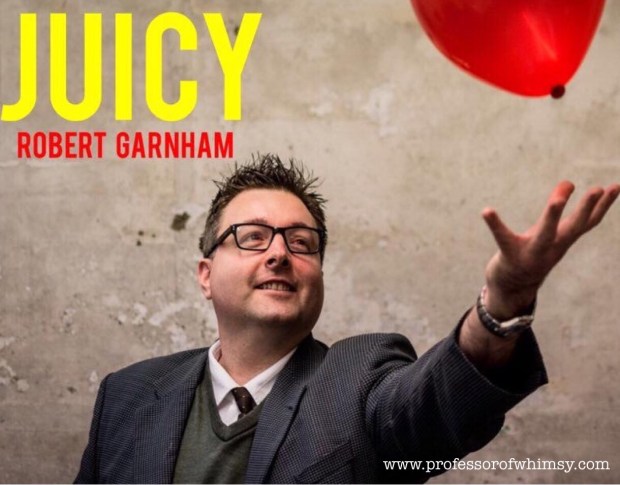
Life can be so juicy at times. Juicy like a sweet apple, filled with goodness. It’s the small things that make it so ripe for exploration, for prodding and poking. Robert Garnham’s new show is an hour or so of performance poetry and spoken word, comedy rhymes and whimsy by the bucket full.

With poems about life, LGBT issues, being envious of beards and the pitfalls of fancying a surfer, Juicy culminates in an extended theatrical piece about love and lust set at an airport departure lounge.

Multiple slam champion and longlisted as Spoken Word Artist of the Year in 2016 and 2017, Robert has performed everywhere from the Womad Festival to London Gay Pride. He has recently featured in a tv advert campaign for a U.K. bank.

Robert Garnham’s 17 Golden Rules for Getting the Most Out of Life!

Robert Garnham’s Words of Advice

1. No one is ever worth writing a poem for, though every now and then you’ll meet someone who’s worth a limerick, particularly if they come from Chard.

2. If someone tells you that they love you, it’s not always a test, it’s an affectation of the status quo, a joy delivered in the beauty of a relationship which actually works, so it’s best not to answer with, oh, that’s good.

3. Shrimp will always give you raging guts ache.

4. Hold on to your nostalgia, otherwise you’ll have nothing to be nostalgic about, except possibly for the time you used to be nostalgic about things, so maybe you can be nostalgic about that.

5. Look at your life. Isolate your fears, your demons, and anything else that gives you the willies. Engage with them and dance, and banish them with a smile and a wave and a cheer. Unless, of course, the thing that scares you the most is crushing loneliness.

6. It’s never too late to learn. It’s never too early to forget.

7. Only concentrate on that which requires no thought.

8. You might not ever mention the elephant in the room, but you can certainly wonder how it got through the door, and up the stairs.

9. Look at the mirror every morning and say, I am loved, I am loved, I am loved. At least this way you’re prepared for any other bullshit that comes along.

10. Everyone you see or meet or talk to has been born. Even Avril Lavigne. And if you think being born was difficult, try getting a mortgage.

11. Go on, help yourself to the last cake in life. Living is all about grabbing the last cake. Go on, have it. Enjoy it. The dog licked it.

12. Get up early one morning, when the dew is still on the grass, and go for a walk barefoot in the park. Let me know when you’re doing this so that I can come round and borrow your vacuum cleaner.

13.Do something that excites you every day. Subvert the rules. Turn things on their head. Naturally this does not apply if you’re an airline pilot.

14. How do we know that opening an umbrella indoors is bad luck? Who was the first person to discover this? How many similar things do we do which are good or bad luck without us knowing? Brandishing a vase on a Thursday? Sitting on a pouffe just after lunch? The mind boggles, Mrs Henderson, the mind boggles.

15. Give as much joy to the small things in life as you do to the large. Which is why me and my ex split up.

16. If at first you don’t succeed, then maybe catching bullets with your teeth isn’t the job for you.

17. If you don’t think you can get it out, why the hell did you put it in there in the first place?

Poetry has no relevance.

Poetry has no relevance. That’s what I hear a lot. Oi, knobhead! Your poetry has no relevence! That’s a hell of a heckle. From my publisher.

But it does. Poetry is useful. Honestly.

I was in an airport. Just minding my own business. Just browsing. Hanging around the arrivals gate with a sign reading JUSTIN BIEBER, you know, just on the off chance. When all of a sudden is call comes up. ‘Is there a poet in the building? This is an emergency! We need a poet!’

Turns out this plane was in trouble. The pilot had collapsed at the controls having had an allergic reaction to a Pot Noodle. And then the co pilot, on hearing that the plane was full of zither players on the way back from a zither convention, succumbed to an undiagnosed zither phobia and became a gibbering, incoherent wreck.

So I’m up in air traffic control and they’ve got a zither player in the cockpit and I’m relaying to him the types of controls that he should be operating.

The aerilon speed flaps are the colour of fine Devonshire cream in the early evening sun.

The throttle control knobs are kind of shaped like a veteran Shakespearean actor stooping to pick up a 20p coin

The rudder pedal is broad and flat like a clumsy child’s first attempt to draw a map of Utah.

The undercarriage lever looks like ennui.

And we did it, we landed that plane, between us, soothing it down to a very smooth landing lulled by sonnets and iambic pentameter, just a classy addition of enjambement on its glide slope, we landed it, oh yes, we did, and everyone was saved!

And at that moment I saw the potential of poetry in all its glory to affect the world as a power to be used for the greater good, elevating ordinary souls above the gods and deities, for are we not all messiahs of the modern age, we poets, we brave poets, pens aloft like spears of triumph!

Poetry. Is. Useful.
Hooray!

And then I got home to my normal life of crushing loneliness.

Things I think about when I’m working on a project.

Things I think about when I’m working on a project.

Lately I’ve been putting a show together. In the old days it was simple, it was a process known as ‘putting a show together’. Now it’s called ‘project management’. I’ve been to plenty of meetings where I tell people I’m putting a show together and they say, ‘oh, you’re project managing?’ And some even say, ‘Oh, you’re a theatre maker?’, which is something I’d not heard before and I had to go and look it up. But apparently I’m in project management now and the one rule for project management is that I shouldn’t lose sight of the bigger picture.

The second rule, apparently, is that I can’t just see the bigger picture.

You’ve got to narrow down and focus. But if you narrow down and focus then you lose sight of the bigger picture. So you’ve got to have one eye on the bigger picture while at the same time you narrow down and focus. Often though you may not even see the bigger picture, so you forget what the bigger picture looks like because you’ve been narrowing down and focussing, or perhaps the bigger picture has become another picture entirely while you were narrowing down and focussing, and now that it’s big picture which doesn’t even include the bits that you’ve been narrowing down and focusing on, and the bits that you’ve been narrowing down and focusing on are now out of the picture.

And then you get bogged down in too much detail. Is the bigger picture even a picture? Is the bigger picture portrait or landscape? Why am I faffing about with the narrowing down when the bigger picture needs attention too? And how big is the bigger picture and how much wider is it than the narrowing down? And if I narrow down how far can I narrow down before narrow becomes too narrow? And anyway, who’s checking on all this?

It’s at times like this that I just decide to give up and go and make a cake.

The Tea Philosopher

(Poem written for my show, Spout, but ultimately not used)

The tea philosopher

The tea philosopher arrived
And sat himself down in the middle
Of the tea shop.
Dressed entirely in black,
With a beret too,
Just like the philosophers you see on tv,
He was only charging five hundred quid
For a full days philosophising,

We kept the tea coming,
Of course,
Because that’s why he was there.
Here you go, we would say.
Socrateas.
He didn’t laugh.
And he sipped it contemplatively,
And every now and then,
Jotted something down in his notebook.

At opportune moments he would
Hold his forefingers in the air,
As if to say, quiet,
The truth is almost upon me.
And we dared hardly breathe.
And we crowded in.
And we watched as he worked
And pondered
And probed the human condition
And we could scarcely believe it
At the end of the day
When he put down his pen,
Stood up, and cleared his throat
And said,

Without the spout,
The tea
Will just stay in the pot.

He then
Gathered his belongings,
Took his pay check,
And left.

That was worth it,
Then.