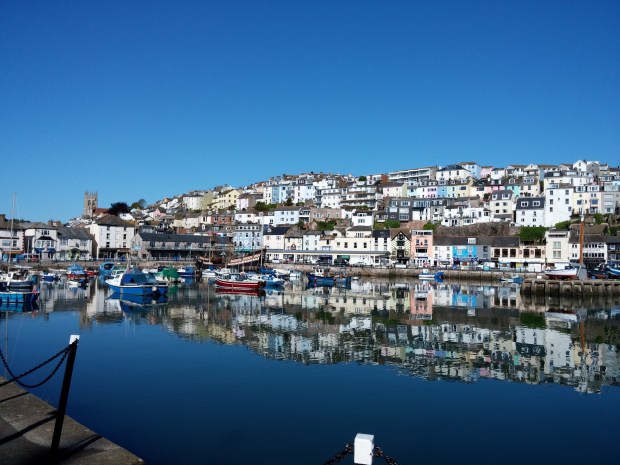
All-night humming at the ice factory

One of the most unsettling things of living in Brixham is the presence of a perpetual hum. Not everyone can hear it and these hums have also been heard in other places around the world. Some people reckon that this is a supernatural manifestation. And while I’m not discounting that, the most likely explanation for Brixham is that it is the ice factory down on the quay, manufacturing ice for the trawlers to use for their catch.

All-night humming at the ice factory

At night I dream of the ice factory
Manufacturing glittered frost under corrugated iron,
Snow on cue, sleet on demand,
I dream as it chills the night for me
And glaciers the dawn.

Three in the morning, in sweated sheets
Flung aside!
Windows open and not a breath of air,
There’s a humming noise coming from the quay.
What could that purring
Possibly be?

I’d like a snowdrift, please,
And ice so fine you can
See right through it!
I want to see my breath
In the trawler lights!

The sweat is rolling down my face,
And the hum, that’s just adding to the
Intensity of it all,
And a throb of engines too,
The sweat is rolling down my face.
Don’t tease me.
Freeze me.
be my icy queen!

Get me through this night!

At night I dream of the ice factory,
An ice conveyer belt and iced up workers,
Hauling ice and shovelling ice
And moaning about the cold.
Snow on cue, sleet on demand,
Blizzarding the morning as the sun rises
Over the trawler basin
And I moan and sweat as a clock strikes three.

Squidbox

Today’s poem is the title poem of this whole Squidbox project, I suppose!

Squidbox

Of all the buckets,
Containers, plastic tubs,
Amid forklift reverse hooters,
Shouting, throbbing
Trawler engines, plastic
Yellow coats, wellies,
High viz,
Of all the buckets
Of the aforementioned
None can be more repulsive
Than
The squidbox.

Deep sea dreams and
Night time beam trawlers
Dipping down on wave vales
Off the coast of Wales
With sonar and shouting,
Excitable as the net is
Brought up dripping
For commerce, there
Is no sport in this

And thence homewards
With a belly full of tubs trays
Buckets boxes profit gain
And rusty flanks from dripping nets
The loving embrace of a concrete
Breakwater.

The squidbox
Under fluorescent lights stark.

Thirty years man and boy

I chatted to a trawlerman who’d done nothing else since leaving school. All he ever wanted to be was a fisherman.

Thirty years man and boy

For the sea creates sublime the mystery into which
A sprinkling of science and good knowledge of
Fish behaviour, patterns, historical trends and tides,
Like magicians, I am unable to divulge
The secrets at the heart of it lest less
Moral skippers may learn my methods;
Nonetheless let it be said that I often point my craft
Away from the fleet, tap into knowledge and
Then return with bigger loads; are you
Familiar with the methodology? And of course,
A hint of guesswork.

Thirty years man and boy, I’ve not done anything else,
Got my sea legs but even I spent the first six months
Spewing into a bucket, had to hide it,
Didn’t want the others to think I was soft or
Not cut out for this, but the sunrise over the
Eastern sea when you stare up the Channel that,
Oh, that can lift you and it lasts all day, a
Bright sun over a flat calm sea and you just know
It’s going to be a good haul.

In the dead of night in fluorescent glare I
Toil amid the flung sea spray salt lipped
In the inky boiling mass whose mystery is a
Locker that even the bravest dare not ponder,
Treacherous death washed with every foam-topped wave,
The craft itself rocking, you really don’t want
To think of the dynamics as the nets slung each side
Reach down ever so into oblivion, there are
Mechanics at work here that can be
Truly frightening, you just don’t want to think.

In a bed-warm slumbers my wife and kids and
While I envy their comfort, my toil makes it so,
Industry and sweat into eiderdown and a full fridge,
While those loving arms propel me forwards, further,
More exuberant, before beckoning me home that I
May regain my strength on the sofa surrounded by love.
What kind of amnesiac goes back?
But as I say, thirty years man and boy, and
The sea – oh, it runs through my veins.

Rough

We ride up,
Hold it there just for a second,
Then drop down, down,
Tingle in your stomach,
A grey angry foam-dotted wall,
The vehemence of nature,
How small we are.

I find comfort in the smallest things.
The sweep of the windscreen wiper.
No matter how precarious,
It keeps on sweeping.
It still does its job.

After a while you get into the rhythm,
Become at one with the sea.
It sets out its rules, and you obey,
Though every now and then
A freak wave, some dissonance,
A jarring note to make sure
You’re paying attention.

And the old trawler, she
Creaks just like ships on films,
Juddering, straining, throbbing.
Hold on, here comes a big one.

You OK down there, cook?
He’s bashing out an omelette.
I don’t know how he does it.

Mum ruled the roost

I had a lovely chat with a trawlerman who comes from a family whose connection to the Brixham fishing industry goes back to the 1500s. It was always assumed in his family that the kids would work on the trawlers. His dad was a fisherman and would be away from home for weeks at a time.

Mum ruled the roost

Mum ruled the roost.
Dad could be gone for up to ten days,
Chasing the fish and earning a wage,
She was strong.
Three of us to look after,
I don’t know how she did it.

It was kind of assumed that we’d follow him,
Become trawlermen, and indeed we did.
We hardly saw Dad through our childhood,
Though I was the youngest,
I probably saw him more than the others.
He’d learned, by then.
And I tried it too, the trawlers.
Didn’t like it.

There’s a photo somewhere of my
Great-great-grandfather,
Selling fish down by the Prince William,
My Grandfather
In his wet fish shop,
My other Grandfather,
He came down from Rye.
Since the 1500s we’ve been
Making our living this way.

Imagine what it’s like for a moment.
Beneath the hard exterior,
When the storms roll in there must be
Genuine fear, a husband
And sons at sea,
At mercy to the waves and the tides,
The inexplicable,
Good fortune, those twin propellers
Churning the water,
Miles and miles from land.

Mum ruled the roost.
Dad was always gone
And we knew he’d come home and spoil us,
Make up for it any way he could,
But it would be only too brief.
A couple of days,
And he’d be gone again.

I like it here

I like it here

They cling to the hills like multicoloured limpets,
Slate tile roofs shining, fish scales reflecting
Sodium streetlights, the salt air
Curling in from a dark abyss.

This whole place is yours, right?
No, just two rooms on the second floor.

And is either of those a private cinema?
No, but you can get nextdoor’s wifi in the khazi.

I like it here.
This corner of the universe.
I dream of escape
But I’ll never leave.

I like it here.
It matches my soul
The centuries fold in
They embrace me.

I like it here.
So cosy here.
It feels I’m the century’s daughter
Though I feel like a fish out of water.

I like it here.
I feel no fear.
I can be me here.

I like it here,
This is my home.
If only I didn’t
Feel so . .

(Get a proper place)
I like it here
(Move on to another town)
I like it here
(Buy a mansion in the Hollywood hills)
I like it here
(Let me show you the world!)
I like it here
I like it here
I like it here

They cling to the hills like multicoloured limpets,
Slate tile roofs shining, fish scales reflecting
Sodium streetlights, the salt air
Curling in from a dark abyss.
I like it here.

Solo skipper

As a part of the ongoing Squidbox project, I spent an enjoyable half hour or so on a trawler in the harbour owned by a wonderful chap called Tristan, who told me all about his job as a solo skipper on the smallest boat in the Brixham fleet.

Solo skipper

Just for a moment, when you’re out there
With the sun and the gulls and the sea,
If you have time, you let out a sigh
And think,
‘I am my own boss, master of my destiny.
I have grabbed the day and made it mine!’

I may be a solo skipper,
A crew of one on the smallest boat in the fleet,
But I’m part of something larger,
A passion that is in my blood and in the souls
Of everyone in this town whose livelihoods
And dreams are at one with the tides.

It doesn’t really matter what I catch
So long as it’s got eyes and an arsehole,
It’s caught by me, from sea to shore and sold by me,
A lonely dot on the wild wide sea,
From net to quay,
Yes, master of my destiny!

Through winter squalls and the squawk of gulls
To the slap of waves on the bow and the hull,
Through summer sun and autumn fogs
To the warm embrace of this rock-clung port,
This sixty year-old sturdy machine
Purrs and throbs like a living thing.

When tides are rough and times are tough
And the day is an ache and you’ve had enough,
Tomorrow will be different,
The sea less belligerent,
And though I’m always vigilant I’ll feel that sweetness
Deep inside enmeshed in belief
And the usual, eternal pride.

Squidbox : Homecoming

This week I embarked on a new project, writing a sequence of poems about the Brixham fishing industry, with the help of Torbay Culture and the Arts Council. Fishing is a major part of Brixham life and has been so for hundreds of years, and the town has the biggest fishing fleet in the UK. I thought this would be a great opportunity to get to know exactly what it is that makes people want to go out on the high seas and risk their lives week after week.

This is the first poem from what, hopefully, will become a sequence. Homecoming is inspired by watching the trawlers come back home after a long stint at sea.

A lonely dot on a wild wild sea,

A nestle of rigs and beams, a mess

Of rust with nets slung low,

Giant spools and ropes slack dripping brine.

The hairpin concrete bend of jutted brick breakwater,

Of faded dead slow lettering, a test of time,

Scratched and blotched this tub sides a-slap

With the remnants of a sea bed scoured,

Hauled loads from sonar technology blips. At night

Each bunk holds dreams or high sea murmurs

As plastic macks drip dry, this metal tin

Of deckhand muscle, winches, graft, sweat.

They gain their sea legs, these sons and daughters.

A throb of diesel purrs the shuddering deck

And slantwise rain in a spotlight’s glare,

Bow break waves and quayside forklifts, home, home.

An Interview with Becky Nuttall

Becky Nuttall is a staunch supporter of the arts scene in Torbay. A painter whose work explores themes of religious iconography, relationships and memory, she’s also a poet whose work looks at similar themes. Her first collection, Nick’s Gift, has just been published. Becky lives in Brixham and organises the Stanza Extravaganza poetry nights at the Artizan Gallery in Torquay. She is also a member of various local cultural boards and committees and as such works tirelessly to promote local art.

It is a pleasure to know her and to listen to her poetry on a regular basis. Becky has often involved local poets in some of the events and exhibitions that she has curated at places such as Torquay Library, Torbay Hospital, and the Artizan Gallery.

I was glad that she met me ask her a few questions.

Hi Becky. How did you get in to writing poetry? Has it been something you’ve always done?

My dad was a playwright. He had his first play broadcast on television not long after I was born in the late Fifties. It starred Dame Flora Robson as Edith Cavell and its success enabled him to get an agent and become a professional writer. He worked from home. His studio at that time was downstairs and we could hear him tapping on the typewriter. It was his job and we absorbed it and its rules . I had access to an endless supply of paper. In those days everything was in duplicate and I had the thin paper for the carbon copy. I was my father’s child, I instinctively understood the importance of his work. He was a pioneer of television screenwriting in the Sixties. He was also a film screen writer and novelist. I wrote poetry and drew pictures constantly. I didn’t know any other child that was writing like I did, none of my local friends did. It was all solitary. Dad and some of his friends would read it and encourage me.

You came from a very artistic family. What kind of environment, artistically, did you grow up in?

My parents friends were artists and writers. Dad went to what is now The Royal West Academy in Bristol and came to Brixham after he married my mum, Jenny. They founded Milton Head Pottery in 1950 and sold it in 1959. Their friends were an enormous influence on me. They compounded my belief, that the creative life was hard and a mystery. However it is a vocation. My parents didn’t have much money when we were young children but the house was full of art by dad and the people we knew. My dad had links with Dartington because he was a founder member of the Devon Guild of Craftsmen with Marianne de Trey.

You are also a fantastic painter who uses lots of religious iconography, yet you’re not a religious person. How did this come about?

At nine years old I said I was going to go to art school. My parents took it seriously and that’s what I did when I left school. However I had a very traditional education from seven years old. We were taught the classics. Dickens was the author read out to us in class. We were taught the Greek myths and Roman culture, Shakespeare and Chaucer. It was very dry and closed. No discussion of modern social or world context. I loved it though. The problem was it was a convent. We stood out from other students because of our background, we were Church of England and I was seen as disrespectful for questioning the oddness of a religious life. I was scruffy because I wore my two older sisters’ hand down school uniform. I went on the bus to school from seven years old, I was bullied to and from school including by the bus conductors. I have no idea why my parents thought it was a good idea to send me there, I hated it. The alternative must have been worse. However religious art is the foundation for what follows in art history. I plunder it gleefully. It’s revenge for the emotional abuse I received from some particular nuns and Catholic teachers.

Your poetry is very autobiographical. What are your other influences?

All work is autobiographical and all art is a self-portrait – it’s just the different means we use to cover up or expose it.
As well as writing poetry from about seven years old, I starting reading it too, we were taught poetry in school and how to write it. My dad wrote poetry and my mum’s father wrote poetry in the Second World War. Rupert the Bear stories rhymed. There are obvious influences like Edward Lear, Hilaire Belloc, Christina Rossetti. Then I asked for Thom Gunn and Crow by Ted Hughes, for my 13th birthday. I made a leap, probably influenced by stuff lying around at home and some seriously good television programmes in the Sixties. I had The Poets Manual and Rhyming Dictionary for Christmas ( not a success). I wrote and drew equally, one influencing the other. I loved pop and rock music, for a while lyrics were my main influence. At art school , and for my degree, I studied Modernist art and writing and the work of Dada, the Surrealist artists and writers. I loved Gertrude Stein. I read Huysman’s Against Nature. I absorbed it all. What society saw as a counter culture seemed perfectly acceptable and natural to me. I’d given up children’s books at about eleven and raided my parent’s bookshelves. We weren’t censored.

You are a very stanch supporter of the local artistic scene. How would you describe the state of art and culture in Torbay at the moment?

I support the local art heritage because of my dad and his connection to Torbay. I wanted to honour our own heritage. Although growing up in such creative privilege was influential, it was a period of time that passed and became forgotten. It wasn’t idyllic growing up with an artist, it was messy and dysfunctional and I moved on and beyond. Gradually I came to understand the context of mid twentieth century culture and that my family had lived it. There is a move to recognise Torbay’s place in this and I wanted to help. It happened that the community, in Torbay and the South West, I first saw doing the most for the arts when I ventured out again was, and still is, poets. It was the kindness of poets that encouraged me to support the arts in any way I can. Contemporary art suffers because it is led by money and gate kept with value judgements. Torbay is slowly, I hope, starting to break this cycle by bringing back into the community.

How did it feel to read or perform for the first time?

I first read and performed poetry when I was at junior school, it was mandatory to stand on a stage and sight read. I think the school thought it was character building to make me perform as I had a lisp, a problem with Rs, a gap in my front teeth, naturally scruffy and a mild stammer. They under estimated how much I was a show off, entitled and a contrary pain in the neck so I loved it. I performed my own poetry at art school at student events. I was mentored by the creative writing tutor so the showing off was moderated. The next time I performed was in 2016 after sneaking in the back of poetry performances for a while. It was exhilarating and addictive, bouncing off the talent in the room.

Who are your favourite poets or artists?

I thinks is easier to come to my house and look at my bookshelves…

What is your process for writing a new poem?

Research and more research. I’m driven by the academic and art in equal measure. I treat every poem and every picture as a small thesis.
For instance, the poem ‘Spaceflight’ is essentially about the moon
I find the idea, most of mine are rooted in my past, a memorable occasion, a memorable person.
The influence of recent visits, The Museum of Witchcraft in Boscastle, Spellbound at the Ashmolean, Certaine Wytches at The Devon Guild of Craftsmen; another poem I’d written, Nick’s Gift.
Remembering fleeting friendships in gloomy bus stations. The isolation if you were different
Text my daughter about her thoughts on the themes as she visited Boscastle with me. Connect it subliminally to Robert, who asked me to perform with him.
Research symbols attached to the objects in the poem, cultural and religious influence on people, objects and places drafted in the poem.
Research the language and roots of words.
Print off all the research and collate it.
Type the beginning, print it and hand write on it mind maps, lists of a chronology of events, the message, the character in the poem who carries the message, the sadness, the universal at the core of the poem over it. Compose and type it.
Listen to rock music, David Bowie, research childhood stories on the theme of the moon and witches. Turn it on its head, change the title to change the perspective, music. Compose and type it. Edit and edit, read it out loud, change the punctuation, change the page format for reading.
Proof read it

How would you describe your book, Nick’s Gift?

I grew up as a teenager in the Seventies. Between 14 and 16 years old I absorbed everything I could out of the sight of my family. I was against the patriarchal authority and society that said what was acceptable for teenagers. Mostly it was wonderful, sometimes it was horrible. The stars aligned though and here I am. Nick’s Gift is mostly about those influences, now moderated by the love of good people.

What does the future hold for the poet and artist Becky Nuttall?

After my twenties I still thought my achievements had be validated by a third party, that acceptance by a ‘better’ person was a high achievement, that I had to be shown, repeat, copy. The negative experiences far outweighed anything positive, I didn’t respect the ones I chose to teach me. I had grown up with better artists and tutors whose influence could sustain me and I was more than capable of finding out the rest by osmosis. I had to get on with it, stop procrastinating and thinking there was some formula for success held by a snake-oil salesman, some power/status merry go round; find my own voice.
Now I’m much older I still don’t need validation. If you like it, great. If you don’t, I don’t care and I move on. I develop my craft on my own, like I did when I wrote poetry as a child. I’ll carry on because it’s in my genes. It’s my journey and my heritage I see reflected back and there’s some way to go yet.

You can find out more about a Becky and her work, and order her book Nick’s Gift, here http://www.beckynuttall.com

One week, two very different gigs!

I’ve been very lucky over the last few years and had some gigs with some very big audiences. This doesn’t always happen. Last weekend I did a gig in a florist in Brixham to eight people. It was a private affair so I knew what I was letting myself in for, and I did my usual routine. The demographic was, well, the youngest person there was seventy five and the oldest was eighty three. I’m not being ageist, as I work with older people and I know that they enjoy a laugh as much as the next person. However the fact that there was only eight of them made it very hard to elicit anything beyond a mild chuckle.

And then four days later, I performed to three hundred young people in a theatre in Bristol.

The whole dynamic was so different. I did the exact same poems and they were greeted so wonderfully that I felt kind of relieved, as if I had lost something along the way. The gig at the florist had made me wonder if I was just some weird bloke who had been dragged off the street into someone’s private function, which actually come to think of it, was pretty much near the truth. I’d been invited to perform after the owners of the venue had seen me walking with my family on Boxing Day and had asked me, on the spur of the moment, to come and do this private gig for them. So the whole set up was already a big weird!

To add to the weirdness, I was given my own dressing room at the florist, which was a small room filled with flowers. I’m certainly glad it wasn’t the allergy season. There was a stool in the middle of the room on which I could sit and prepare myself for the performance, and that’s where I spent most of the night, sitting on that stool going over my set and wondering how it would go. And as I say, eight people.

But Bristol. Wow. I was supporting the wonderful Dizraeli, a huge name on the Bristol scene, and as a result they had sold out and the theatre was packed. I was on near the start of the evening and I really felt that the night had a potential of going completely up the Spout. Would all these trendy young people find my work amusing? Would I cock it up completely, and forget my words? Would they not find my humour funny and start playing with their phones, or dabbing, or flossing, or fidget spinning, or whatever it is that young people are in to these days? But from the start of the set, it was completely magical. The room laughed. Indeed, they laughed a lot. They laughed at bits that audiences don’t normally laugh at. They were listening intently and with enthusiasm. The first poem usually takes two and a half minutes but it was almost a minute longer than normal because of all the laughing.

And what an amazing feeling it was to perform to so many people. The big stage, the space, the fact that all of these people were concentrating on me, made me think that anything if possible, and also that anything I wrote intending to be funny, actually was funny. Indeed, it made me feel invincible!

It was an amazing gig, and when I left the venue I was greeted by a group of these young people, who started quoting bits of my poetry at me. It was such a great moment. And then, because I’m so rock and roll, I decided to go to the local supermarket and get some groceries, only to meet some more young people next to the display of bagels, one of whom flung her arms around me and thanked me for making her laugh. I assume she had been to the gig!

So two amazing bookings in two very different places. And as I caught the train home the next day, I thought how amazing it would be if every gig were a sold out crowd of three hundred people, and how wonderful it would be if I could command such interest on my own.