Ruminations of an Accidental Poet Part One: How I Became a Performance Poet


There’s not much to do in Virginia Water once the lights are off. In fact there’s not much to do when the lights are on, either, unless you are one of the millionaires whose villas dot the woods and thickets of this strange commuter-belt town, the summer air thick with pungent earthy aromas, honeysuckle, fleshy rhododendrons, a sudden rain shower sounding like polite theatre applause as it falls on jungle vegetation. Nothing to do at all. Even less if you happened to live in one of the small cottages, one of the two-up two-down workman’s houses which still survived into the 1990s before they were all bulldozed to make way for mansions bought by supermarket magnates and glam rock superstars. And even less yet again if you lived in one of these cottages and it was the mid seventies, and it was a period of rolling black-outs and you and your young wife lived in the top bedroom, and the other three rooms of the house were owned and occupied by the in-laws. There’s absolutely nothing to do under these circumstances.
          I was born the following January.
          There are things that I can still remember from a very early age. I can remember the hideous flowery purple and pink bedspread on my parents bed. I can remember the hideous flowery yellow and brown curtains over their window. I can remember the woods, the ominous, black, dense woods that would pull in the darkness amid their gnarled trunks like a lonely miser gathering in the eternal emptiness and oblivion which awaits us all. And I can remember the hideous flowery blue and white polyester dress that my grandmother used to wear.
          I can remember my Grandad, too. My Grandad had brown buttons on his cardigan and I would play with them whenever he held me. He wore big, thick rimmed glasses, the kind I’d see on television comedians. With just a word or two, my grandfather could reduce a room into peals of laughter. I suppose what I’m trying to say here is that I kind of take after him a little bit, that’s the inference. I even wear the same type of glasses.
          My Grandad had a large shed at the bottom of the garden, a corrugated hut which looked like something from the Alaskan gold rush. Inside the shed were lathes and drills and all kinds of incredibly intricate machines which he would work over late into the night inventing tools and other equipment. There were shelves of tobacco tins full of nuts and bolts, rolled up blueprints and official patent letters tucked away amid the paint tins and the boxes. It was no place for a toddler, but I would stand in the doorway and watch as he operated his machinery, transfixed by the way he’d dance from one machine to the other. Years later I’d do the same, escaping to a shed or an outbuilding to work on manuscripts and poems, books, short stories, enmeshed in my own little world away from everyone else. So there I go, comparing myself to him again.
          At this stage of my life, I didn’t have a sister yet, nor was I a spoken word artist. Nothing in my demeanour hinted that I would be a spoken word artist, and to be honest I didn’t really have the vocabulary. I did used to like putting buckets on my head, though, and there are plenty of photos of me with a bucket on my head. The fact that I’ve made a career out of very silly hats possibly stems from this.  I can’t even remember how this came about. I’ve just got other people’s word to go on and, as I say, photographs. Perhaps I just liked making people laugh. As I say, it was Virginia Water and it was the 1970s, so there wasn’t much else going on. A toddler with a bucket on his head obviously passed for light entertainment back then.
          The sporadic power cuts continued and two years later my sister was born.
          The thing is, I can’t remember seeing my sister for the first time, yet I remember the day itself vividly. The reason for this is that I was with my Dad and my Uncle in Staines High Street, and they had just bought me a red pedal car, and the fact that it came in a big box and was obviously for me, made me feel very special indeed. It didn’t even occur to me at that stage that the red pedal car was a consolation prize for no longer having everyone’s undivided attention. In fact, the next time I would ever have everyone’s undivided attention would be on the stage as a spoken word artist. It’s something I would never experience again for quite some time, and even during sex, people would just close their eyes and think about someone else. Anyway, I had a red pedal car, which my mother, for some reason, christened Bertie, and a sister who, because we were not a religious family, wasn’t christened at all, but was named Angela.
          And oh, what a vicious thing she was. Aunts and Uncles would cower in fright. If anyone were foolish enough to pick her up, she’d bite a chunk out of their shoulder. From a very early age she’d boss me around, and in these crucial years of my own development as a human being, she taught me the valuable lesson that it’s sometimes not worth the effort because other people will always kick up a bigger fuss than you. Whenever we’d play games, my mother would whisper to me, ‘for goodness sake, let her win’. Which was another lesson I learned at a very early age. It’s not the winning or the losing that counts, it’s making sure that your opponent doesn’t throw a tantrum. At least I got a pedal car out of it.
          I can’t remember the age at which I would begin to mythologise my past and my upbringing. I think it was probably just after my fourth birthday. We moved out of my grandparents and away from Virginia Water to a council house in the Surrey suburbs on an estate on a hill a couple of miles from the end of Heathrow’s runway. There are those who believe that homosexuality is a result of home conditions and human relations, the psychological environment of our formative years, and while I do not agree with some parts of this hypothesis, I understand that such people would probably point to the fact that I had spent most of my time up to this point with three generations of strong-willed women in my grandmother, mother and baby sister, as definitive proof. My grandfather was usually in his shed inventing things, and my dad was invariably at work in his job as a civil servant. On top of that, the Queen was a woman and so was the prime minister, and every single one of my teachers would be a woman until I was ten years old. I would dream of a time when men were allowed to make decisions and be in charge of things, perhaps then there would be no warfare or violence.
          As I say, I do not agree with the environmental thesis of homosexual development, but I remember thinking from a very early age that something was amiss. (Not that I knew it was necessarily amiss. I thought my behaviour was perfectly normal. I couldn’t understand why people would get so uppity when I showed no interest in football, soldiers or motorbikes). I wanted a handbag, just like Mum’s. My two teddy bears, Fred and Jumbo, were both male and yet in my imagination they were also a couple. And most weirdly of all, the engraved pattern of my grandmother’s sideboard looked, to my young eyes, like a man’s bare legs and boots, a pattern repeated on both doors of the sideboard so that it looked for all the world like two men flat on their backs with their trousers off and their boots in the air. I found it weird that nobody else had ever noticed this or even commented on it, and also the fact that whatever they were doing, they’d decided to keep their boots on. To this day, I’ve always had a thing about legs.
          I can’t remember much from the age of three.  Perhaps times were hard and I was affected by the certain malaise or ennui easily associated with those who feel their lives are going nowhere. At the age of four I started school and I discovered that other people existed outside of my own family group. I found it inconceivable that people could have birthdays on a day that wasn’t the second of January. In a bizarre quirk of fate, I shared my birthday with my dad, my uncle, my great uncle and my grandfather, and it didn’t help matters that  one of the first friends I met in school  also had his birthday on the same day. In a deep and philosophical moment I might even be tempted to say that this deconstructed the obvious and laid the foundations for a variance in all things, souls dancing in the overbearing consciousness of the mind of a four year old who would later revel in difference and the position of the outcast, but what it actually meant was that it was always someone’s birthday other than my own. And when my own did come around, I had to share the cake.

The other major thing that I discovered at school was writing. From the age of six I became somewhat precious, at all times aware that I was a tortured genius and that I had literature pulsing through my veins. Or at least, I thought it was literature. I started writing because I wanted to have a book published like the books that my mother had in the case on the landing at the top of the stairs. I wanted to see my name next to those who’d written the books which she cherished and held forever in semi-reverence behind the sliding glass door of the MFI cabinet which dad had swore profusely while putting together one weekend. The volumes within seemed to have their own aura and mystique, and I knew that truth and reality were kept behind their slightly crumpled spines. I wanted to be treasured as much as these titans, these philosophers, that my mother would, ever so proudly, hold me in as much esteem as she held Jilly Cooper. I could feel the literature within me, or at least, I thought it was literature. In actual fact there was probably hardly anything of any literary worth until I was around ten. Each day my mother would drag me off to school and I would only ever be truly happy if it was raining, because rain meant that we could stay indoors during break time and not run around the school playground. We were given paper on which to draw, but I found that I filled up the paper much more effectively if I wrote instead. I’d use a turquoise felt tip pen. And as the rain beat against the plate glass window of our county first school, my head would be transported to all kinds of places, my imagination fascinated with the possibility that the characters I’d invented could do absolutely anything. It rained a lot that year, and before long I had a novel.
          My school was very religious and we had Bible readings every day and double Bible readings on a Thursday. In my mind the adventures of the characters in the Bible were easily comparable to the adventures of the characters in my novel, and if the Bible was an example of storytelling, believability, authenticity and gritty reality, then I knew that I’d got it spot on. For this reason I decided to call my first novel ‘Bible 2: Revenge of the Bible’, but my deeply religious teachers seemed to be dead against this idea.
          ‘You can’t call it that!
          ‘Why not? It’s just as good as the first one’.
          ‘The Bible is the word of God! It’s a sacred text! A lot of people could become very offended’.
          ‘Well, Bible 2 is the word of me!’
            ‘How dare you!’
            ‘And it’s got dogs in it!’
          Because all of the characters were dogs, for some reason.
          ‘It’s the word of dog!
          A comment which did not go down too well In the event I settled on a far less provocative, though oddly postmodernist and even minimalist title, calling the novel ‘R’, because ‘R’ was the first letter of my name and, therefore, quite important indeed.
          It is true to say that my career stagnated for the next four years or so and it wasn’t until middle school that my writing started to flourish in any meaningful way. In the meantime I’d continued writing and I would spend almost all of my spare time concocting stories and short works and there was a brief flurry of excitement when I was eight and, possibly to shut me up, my mother sent a manuscript to Penguin Books. I couldn’t see how they could possibly reject the works I’d sent, but alas the editors  didn’t quite see how my manuscript could fit in with their publishing strategy and the novel never came about. It is true to say that I saw a niche in the market for novels about dogs flying through space and solving crimes, it’s only a shame that Penguin Books failed to share my excitement.
          One person who did share my excitement was my teacher, Mister Shaw. There were two things amazing and astounding about Mister Shaw. The first was that he was a man. This was the first time I’d ever seen a man in a position of power and there was something liberating about this. It didn’t matter that he was as camp as Christmas, (as my Dad described him), or that he walked as if he had a roll of lino under his arm (as my Dad described him), what mattered was that he was a symbol for equality and made me believe that anything was possible. I’d imagine him each night going home to his wife and telling her about his day, and she being ever so supportive of his achievements. The second amazing thing about Mister Shaw was that he was the first person who took my writing seriously
          Yes, I know that my mother wrote to Penguin Books. (Come to think of it, I’ve never seen any actual proof that she ever did). But Mister Shaw saw in me a talent which would one day envelope the world and make me synonymous with deep, powerful and engaging literature. He also saw that my career had been stagnating and was the first person to suggest that perhaps I might like to have human beings as the protagonists of my work rather than dogs. This was one of the most shocking things that had ever been said to me, but that night I went home and wrote a novel about a man called Bill, who was an Olympic skier who solved crimes in his spare time. The next day I took it back in to school and Mister Shaw asked me to read it out to the class
          ‘Really?’
          ‘Yes, Go for it. What’s the point in writing if you’re never going to have an audience?’
          A performer was bom that day, dear reader With the rapt attention of Class 4, in the cosy confines of our prefabricated classroom hut on the edge of the school playing field, I read the stories of Bill the crime solving Olympic skier, and his comedy sidekick Ed, and Ed’s incredibly fierce wife Lenda. And I put everything into my performance, using different voices for the characters and the narrator, and the class watched on both aghast and unable to disguise their mirth that a comedy
performance genius studied each day among them. It was a reading worthy of note, as engaging as it was shocking and the whole hut resounded to my sonorous tones as each one of my classmates sat on the edges of their chairs, barely able to contain the excitement. And when my two minutes was up, Mister Shaw announced that this would be a daily occurrence.
          And so it continued until the novel was done, until the end of the term by which time, to cater for the class and its insatiable appetite for more Bill and Ed stories,(which certainly did not lead me to getting beaten to a pulp each break time), I’ d written several more volumes. Bill and Ed became mini celebrities, and I longed for each day when I could, for just a short period, have everyone’s full attention. Even my closest friends would show their support and remark on my achievement with phrases such as, ‘Wow, you’ve certainly written quite a lot of these’, and, Please, tell me how the novel ends’, and, ‘How many more of these are you going to write?’

Little did I know that these would be the glory years, as far as my writing was concerned. Never again would I feel the undiluted support of my peers or the critical acclaim of my own literary output. By the time I left middle school I felt, what with having fifty two novels under my belt, that I was now to be regarded as something of a veteran of the literary scene. ‘Prolific’ does not even come close to describing the work that I churned out during this period, working on novels scratched in exercise books at every spare moment I could find. I can remember a family holiday in Hastings, walking back to the caravan park with my parents down a narrow country lane, feeling a new exercise book in my hand and the excitement of all the adventures that my characters would have. I must have been insufferably boring.

Going to secondary school could very well have ended my writing career. There was far too much going on now: homework, studying, the giddying swirl of hormones that suddenly necessitated appearing as ‘cool’ as the most pressing matter of every single moment, the bruises and psychological torture of getting beaten to a pulp every break time for not appearing ‘cool’, and a growing fascination with the same gender. My secondary school was huge, a factory for learning placed in a dank suburb of west London fed by the smaller middle schools of the surrounding area, a sprawling network of buildings and tower blocks, sports halls and annexes home to well over two thousand pupils, most of whom are currently now in prison. This sudden influx of new faces meant that I was surrounded by hundreds of young men of my own gender who were, overwhelmingly, much better looking than any of the losers I’d been to middle school with.  Yet throughout the mental strain of trying to be cool while at the same time being beaten up for not being cool and concurrently trying to act cool about being beaten up for not being cool, I still wrote. I thought, misguidedly as it would seem, that it would make me cool.
          The whole of my first year there was a dizzying splurdge of self-realisation and deep loathing. How wonderfully would this have been as inspiration for my writing, had I not still been ploughing ahead with the Bill and Ed stories and their adventures as crime-fighting Olympic skiers. Perhaps this constant writing might even have taken my mind off the sudden throbbing lust I felt for certain classmates, the agony of spending so much time with them and yet incapable of letting anyone know lest I should be revealed to be that most despised individual, a homosexual. For this was the nineteen eighties, and the only representative media depictions of my own self were as comedy high camp with humorous punchlines, or dangerous subversives threatening the very moral stability of society itself.
          The regular break time beatings began to subside after the first year. The boys who beat me up could see that there really was no sense to it, no enjoyment in these daily pummellings, because something had changed in me. I’d discovered comedy. It’s all very well demonstrating your prowess to various friends and onlookers by repeatedly punching a first year student in the face, but this seems less attractive when that first year student says something so incredibly funny, truthful and personally hurtful that your various friends and onlookers burst out laughing at your expense.
          In a bizarre twist of fate, I’d discovered New York stand up comedy and I would memorise routines and one-liners, quips and put downs that seemed to play very well to the breaktime bully crowd. ‘Don’t stop’, I’d yell, ‘I’m almost at an orgasm!’, even though I didn’t yet know what an orgasm was. ‘I’d say pick on someone your own size, but the nearest gorillas are in the zoo’. ‘I knew you were coming, I could hear your knuckles dragging’. That would take another thirty years. I had nothing to lose, it’s impossible to get beaten up while already being in the process of getting beaten up. And the reason I’d discovered New York stand-up was because I’d been given a long distance radio by my uncle and I could tune in to radio stations from anywhere in the world. I’d found a comedy station by accident and would listen to it to try and help me sleep.
          Armed with a sudden love of comedy writing and emboldened by my first ever successful application of this for pure personal gain, buoyed also by the feeling of playing to an audience and getting laughs, and then adding homosexuality to the mix, I would write. And I wrote, and wrote, and wrote, and wrote, and wrote.

          If you thought I couldn’t possibly get any more annoying at this stage with my writing, then you’d be wrong, as fortune decreed that I would be able to do just that. My grandparents gave me an old 1950s Olivetti typewriter, a chunky, clunky old metal box of a thing on which you’d have to press down each key really, really hard to get any sort of mark on the page. The silent pursuit of writing in pen in an exercise book now became an activity which all of the family could enjoy, as the act of composition was now such a cacophonous affair, a byproduct of this metal behemoth of a machine being that the whole house shook, creaked and rumbled every time I did any amount of typing. Within a few weeks I’d taught myself to type with two fingers and become seriously addicted to the smell of correction fluid. The letter E was the worst, it would stick every time I used it, so much so that I would set some of my novels in Wales just because the place names didn’t use so many vowels. Even now, thirty years later while typing on an iPad or a computer keyboard, I still press down harder on the letter E than any of the others. The adventures of Bill and Ed continued, though Ed had now been replaced with Justin.
          I’d spend hours with that typewriter. The thing was built to last. Indeed, it still works today and I use it often in residencies and as part of art projects. Even at the end of the nineteen eighties it was outdated and finding ribbons for it was a tricky business, a simple writing session would leave me covered in black ink and absolutely physically exhausted. The typewriter was so loud that people would complain. Pedestrians walking past would wonder if there was someone in the house with a machine gun. Pictures would swing back and forth on the wall. My solution to this was that I’d go out and type at a wallpaper pasting table in the garage, but first the wallpaper pasting table broke, and then the neighbours would complain. How was I to know that they were running an illegal minicab business from the adjacent garage?
          By the time I left secondary school and went to sixth form, Bill had retired as an Olympic skier and was now a detective. (Why not?). I had a collection of GCSEs good enough to scrape into doing my A-Levels, though it was probably obvious to everyone but myself that I’d never be good enough for university. The lads I’d fancied from school were far from bright and I’d never see most of them again, only hearing about their exploits through mutual friends or the prosecution court reports in the local paper. By now they were boozy, car obsessed and mostly had girlfriends, though even some of the school bullies would greet me with a cheerful wave, the ones who weren’t now in politics or petty crime.

Sixth form college seemed to pass very quickly. To the outside observer it must have looked like I was very industrious indeed. In fact I was so industrious that I didn’t once have time to fall in love, nor did I have time to concentrate on my writing career. I focussed fully and exclusively on my studies with the idea of escaping from the suburban blandness of my upbringing to some far flung university, where I would get a qualification and then have lots of sex. As it was, I failed miserably in most of my subjects, left college, and got a job cleaning toilets at the local supermarket.
          This at least gave me time to concentrate on my writing. How evocative, the sultry night neon, working the late shift and spending twenty minutes in the staff room working on yet another Bill and Justin adventure. The supermarket was huge, a purpose built facility with twenty aisles and a basement car park. At least I didn’t bring my typewriter with me. I kept a notebook with me at all times on my cleaners trolley, just next to the chlorine tabs and the bleach, this being a period well before health and safety. My refuge away from the world, just like my grandfather’s shed, turned out to be the mop cupboard under the stairs next to the chiller cabinets, a bolt hole away from the busyness of the supermarket where I could write unhindered before the fumes took over and I became lightheaded.
          It was around this time that two things happened which would send me off in a completely new literary path. The first was that I discovered the writings of Frank Kafka. This was, on the whole, a bad thing, because it opened my mind to several miserable possibilities and taught me that it’s all very well and good being funny, but a damn good mope will get you all the attention you need. How enamoured I became at the writings of this modernist insurance clerk with his manic stare and the preoccupation with never quite getting into things. I became obsessed with the very image of him more than I did his actual work. How I wanted to be him! How I wanted to be that the lonely, pale, existentialist icon beavering away on his manuscripts in an almost mystical trance, sat at his desk looking out over the slate tile rooftops of Prague. I wanted to be the new Kafka, coming home after a hard day scrubbing urinals and mopping up god knows what from the wazza floor, to create the most amazingly miserable short stories in which all hope has been long obliterated. In such a manner I took down my bedroom net curtains and turned my desk around so that I might similarly work while gazing upon the urban sprawl of my own imaginary ghetto. Yet the view from my window was not of cobbled lanes or the close packed tenements of the Prague old town, but of back gardens, barbecues, trampolines, conservatories, compost heaps and garden sheds.
          How assiduously did I mimic Kafka’s style, discarding all traces of comedy for dense paragraphs, non-standard punctuation and visionary allegorical hints verging on the mystical. ‘The Bus’ was an early classic, a short novel set on a bus ticking over at a bus stop but never actually going anywhere. Then I wrote ‘The Train’, about a train which pulls into the station but never leaves. I then wrote a novel called ‘The Ticket’, about a man who, without actually having done anything wrong, gets a parking ticket. Then I wrote ‘Metaphorisis’, a novel about a fly who wakes up one morning to find that he is a travelling salesman. In a further rash development, I decided that I didn’t even need capital letters, (which were always problematic with my old typewriter), and once a novel was finished I’d send it to a literary magazine, and they’d wrote back very quickly to ask if I was aware that it didn’t have any capital letters.
          The other thing that happened was that my grandfather died. He’d had a series of strokes and had been recovering in a nursing home, and appeared to be on the way to a brilliant recovery. Indeed, he seemed to be enjoying the nursing home, and he was in remarkable spirits whenever I’d visit. One day he was told that he was now well enough to go back home and live with my grandmother again the next day, and he died that very night.
          Sometimes, the coroner told us, people just give up all hope.
          My father and I cleared away his shed. It was a sacred place for me, and to see it torn down felt more symbolic, as if there were one less place to hide in the world. Yet even at this moment me head was full of Kafka, almost as if I should embrace the sadness and the hopelessness of life. As a day out and a pleasant change from cleaning toilets, my parents took me to the coroner’s office to sign the official death certificate, which was done by a very eccentric official wearing a multi colored bow tie and with a moustache that I can only describe as exuberant. He signed the paperwork with a fountain pen, his handwriting as artistic and as lurid as his facial hair, and that very afternoon I bought a fountain pen for myself. I have used it to write every single creative piece ever since.
          By the time I was twenty, then, I was a completely different writer and success seemed just round the corner. I had a pen and a typewriter and a head full of dreams and a view of the world that was entirely unique, (except that some Czech writer from the beginning of the century had had one or two similar ideas). Success and literary greatness seemed just round the next corner. I was going to be a famous writer!
       
Not much happened for the next twenty years.

          It seemed inconceivable that none of the great publishing houses wanted any of my experimental Kafkaesque pieces. After all, weren’t these the same publishing houses that were falling over each other for such material in the 1930s? Couldn’t they see that I was just as innovative as these existentialist titans, and that really, no progress had been made in literature at all in the following eighty years? The people that ran these publishing companies couldn’t possibly be as well read as me. I’d read all of Kafka’s stories and I understood well over half of them, and I’d not even spotted a single spelling error in any of them. And my novels came with the added bonus of invented punctuation, no capitalisations and, in the one novel which I knocked up over a frenzied weekend while the snooker was on, not one single letter M. Nevertheless the enthusiasm stayed with me, and when my parents decided, supposedly on a whim, to move out of the suburbs and off to the provinces. I decided, like many a displaced writer before me, to come along with them.

          By now I was no longer a sullen youth. No more the emotional despondency of early adulthood, for I had brightened considerably, adopting all the nuance of the urban moper. Transposed to the provinces and a small town in the middle of nowhere, I became a Londoner, a mysterious metropolitan outsider to whose drab outer garments the fog of the capital still lingered, even if I actually came from the suburbs west of the airport and had probably only been on a tube train six times. The way of life in the sticks was much slower, and the attitudes of the locals tended towards the more conservative. I felt that I had made a mistake. I also felt, or at least, had a nagging doubt, that I would ever make anything from my writing. One particularly anonymous morning I put my pen to paper to begin a new novel about a man who would never make it into the local cinema where he was queuing, and would simultaneously metamorphose into a badger, when I suddenly thought, well, really, what’s the point?

          And I put the pen down.

          I found a job in retail management. I went through several fashions and styles. Surfer dude, skater boy, sports jock, gentleman, hipster, chap, chav, businessman, loafer. My hair varied from mullet to curtains, side parting, centre parting, down at the front and spiked at the back, spiked at the front and down at the back, dyed blonde, dyed grey, dyed red. It was a busy six months. I cannot keep track of all these personalised metamorphoses.

          By now I lived in my own rented flat over a shop in a seaside town. It suited me just fine, and I felt very content being there, apart from the boredom and the loneliness and the meaningless of my existence and the lack of opportunity and the lack of any kind of companionship and the inherent lingering suspicion that life was running away from me. I decided that maybe I needed some culture, something beyond the strange fungus that grew on the walls of the adjacent bus station. I needed something intellectually stimulating.

          I went to a performance poetry night in a small arts cafe in the next town. I found my intellectual fulfilment. A variety of poets, primarily men, spewed comedy verse about baked beans or cricket or the pitfalls of putting together flat pack furniture, and while it didn’t rhyme or seem particularly poetic, the audience loved it and applauded enthusiastically. It seemed as funny as the stories I’d written all those years before at middle school. There were some amazing lines and some good rhythms, and it all felt very familiar because this is the sort of thing I’d been writing until I’d become all Kafkaesque, and the audience were appreciative and amazed. A poem about sending a naughty text message to the vicar by mistake went down very well and the audience went wild and clamoured for more. A lifetime of writing and a thousand rejection slips melted from my mind to be replaced by a new thought, that I could do this! How long would it take to write something like this? Ten minutes? And look at the audience, bent over double in tears of laughter at the words that someone else had written. I could do this!

          ‘Yeah, sure’, the MC said, at the end of the night when I asked him for a slot at next month’s event. ‘I’m always willing to give a slot to a newcomer’.

           ‘Actually, I’ve been writing for . . .’, I replied, then cut my answer short. ‘I mean, thanks, Thanks so much!’

Gom – An Experimental Sound Poem

As someone at the cutting edge of poetic expression, I thought I’d share this sound poem which, I believe, will tear apart poetry and poetry performance in such a manner that life will never be the same again.

My poetry has often brought people to tears. It’s nice to know that it has such an emotional response.

Yo-Yo : Ruminations of an Accidental Poet – Collected Essays

Yo-Yo: Ruminations of an Accidental Poet, published by Puddlehopper, is now available to purchase! Telling stories from fifteen years as a performance poet. Festivals, fringes, fleeting appearances on TV, filming, faffing around with props, flopping at slams, it has it all! Essays from Write Out Loud, Chortle, Litro Magazine and and Torquay Museum’s lecture series, and some written specifically for this collection. Plus one new poem! Details on how to order this book will be revealed shortly.

Here’s the blurb:

In 2008 Robert Garnham thought he’d give performance poetry a try, having never heard of it before. What followed was to be fifteen years of crazy poetry adventures in all sorts of different venues. These collected essays describe, with humour and warmth, gigs in every part of the UK (and further afield), shenanigans at music festivals, angst at the Edinburgh Fringe and every conceivable type of poetic misadventure.

‘As Robert Garnham has been a huge influence on me as a comedy spoken word artist, I read this collection of essays with great anticipation. It didn’t disappoint! A wonderfully entertaining read’. (CLIVE OSEMAN).

You can order the book from this link:

https://robertgarnham.bigcartel.com/product/yo-yo-ruminations-of-an-accidental-poet

Bad Pint

Bad pint 

‘To be honest’, he says, ‘I really can’t remember getting home last night ‘.

         And there he is, standing in the doorway of my flat, and he’s saying this with what almost amounts to a hint of jubilation in his voice. It’s New Year’s Day. And he obviously did get home last night.

          ‘Didn’t your brother give you a lift?’

          ‘He might have done, yeah, but . . . You know, I’m never drinking again. Well, not for a bit. Time for a dry January’.

          It’s four in the afternoon and he’s obviously just got up.

          ‘I must have had a bad pint or something’.

          ‘There’s no such thing as a bad pint. It’s just an urban myth’.

          ‘Mum used to say all the time, whenever I got like this, that it’s a bad pint. That’s what does it. Ask anyone’.

          ‘It’s a euphemism’.

          ‘A new what?’

           ‘Euphemism’.

           ‘They should get Health and Safety to look into these breweries. All these bad pints. Oh, my head!’

          He comes in and sits down in my armchair.

          ‘Ohhh, I think I’m going to be . .’.

          I hold the waste paper bin under his nose.

          ‘It’s ok’, he says. ‘I’ve swallowed it’.

          ‘Dear god!’

          I look at him, sitting there. He’s wearing his t-shirt and shorts, the clothes that he wears when he’s in bed. At least he had time to change out of the clothes that he had been wearing. I look at him, with his features that look like the face of a teenager has been grafted on to the frame of a sixty year old.

          ‘Can you remember midnight?’ I ask.

          ‘No’.

          ‘The fireworks woke me up’.

          ‘You were asleep?’

          ‘Yes’.

          ‘Jeez. You’re such a party animal’.

          ‘But you had a good time, though?’

          ‘I can’t remember’.

          I look out of the window. It was a mild, overcast afternoon. I can see people walking past to the park at the end of the street. I live in the ground floor flat directly beneath his. I knew that he was asleep because I couldn’t hear him moving around. I couldn’t hear his television, either.

          ‘Do you want something to eat?’

          ‘Urghhhhh’.

          He puts his hand right over his eyes.

          ‘Never drinking again. Too many bad pints’.

          His brother also lives in the same building. When the fireworks had started at midnight, his brother had gone outside and started up his car, and then he had just sat there for a bit, watching the fireworks from behind his windscreen. His rear brake lights had lit up my flat an otherworldly red as the new year came in. I must have gone back to sleep just after he had driven away.

          ‘I think maybe it might be a good idea for you to go off the booze for a little while’, I say to him.

          ‘I told you! It was a bad pint! And anyway, I’m doing the dry January thing. Not that I need it. Don’t you listen?’

          ‘I know, but you’re never serious about these things’.

          ‘Bucket’, he says.

          I reach for the waste paper bin again.

          ‘Swallowed’.

          His mother had thought we were lovers. I’ve never told him this, because I knew he’d go off on one. And when I’d told her that we weren’t, at the time that she was seriously ill and only a few days away from dying, she had told me that I should look after him. Make sure that he was okay. And I’d said, yes, I will. And that’s why I’d had been relieved, the night before at midnight, when I’d heard his brother get in the car at midnight.

          ‘I was thinking of going for a walk’, I say.

          ‘Urghhhhh’.

          He clamps his hand right over his eyes, tightly.

          ‘Work, tomorrow’, I whisper.

          ‘I know’, he says. ‘Bad pint . . .’.

          He gets up and shuffles towards the door.

          ‘Let me know if you need any food’, I tell him.

          ‘Yeah’, he says.

          ‘Yeah, you do, or yeah, you don’t?’

And then he’s gone, and it’s a happy new year, and the kids are going past on their bicycles and skateboards to the park at the end of the road, and the sun is already beginning to set, and his brothers car is still there where he’s parked if the night before, after he had brought him home.

On the Silken Breath of a Penguin in Repose – The Best Example of Antarctica Literature ever written.

ON THE SILKEN BREATH OF A PENGUIN IN REPOSE

When I heard that the great literary extremist Professor Zazzo Thiim was holding a symposium on the use of alliteration in Antarctic literature, I knew I just had to attend.

      I knew that getting to the venue in the first place was in itself was a hard enough job; the convention was to be held in a remote hotel in the mountains which, in the middle of winter, would be cut off from the world by snow drifts, and sure enough, when the week of the convention came, the only way to get to the hotel was by walking the last two miles. As the darkness gathered around me, and large

fiakes of snow began to fll from the black, black sky, I gripped the handle of my suitcase and made my way up the track into the wilderness.

          It must have taken a couple of hours to make the journey, and when I arrived at the hotel I was feeling irritable and uncharitable to say the least. My eyes were blinded by the motion of the snow as it had flown across my vision, and my fingers numbed from gripping the case for so long. The first thing I did was to dump my bags next to the reception desk and sit next to the roaring fire, in order that I may thaw my aching bones and curse my stupidity at having set out on such a journey in the first place. Yet only the one thought, of any substance, kept coming to me as I sat there in the orange glow: after all this effort, this had better be worth it.

          I soon became aware that an old man was sitting next to me and, after a while, he asked if I was there to see Zazzo Thim.

          “Yes”, I replied, “Though I am now beginning to wonder if I have made a mistake.”

          The old man wrapped his scarf tighter around his neck and gave a chuckle. “I can assure you that the convention will be well-managed and adequately attended for my needs, for I, myself, happen to be Zazzo Thiim”.

          “What makes you so sure that it will be so well-attended?” l asked. It was snowing heavily outside now, and the hotel did not seem to be bursting with guests.

          “The subject in itself”, the old man said, smiling gleefully. “Who could fail but be enchanted by such a subject? Antarctic literature, let me remind you, is an expanding genre. I expect there shall be quite a rush tomorrow morning for seats”. 

          At this, he looked first left, and then right, and then whispered to me in a severe, confidential tone: 

          “It’s quite possible that some people might not be allowed in’.

          At once l felt bad. How close l had been in deciding not to come, yet others might not have been so foolhardy. I knew that there would probably be a limited attendance as it was, yet Thiim was sure that there would be more. I felt a sinking sensation inside of me, the dejection he might feel on walking into the conference centre that next morning only to see myself sitting there.

          “I can assure you”, I told the old man, “That we shall all be thoroughly enlightened”

          I went to my room and changed for dinner. I decided that I would enjoy myself, and I ordered the most expensive item on the menu, yet the restaurant was virtually empty, with the exception of a table on the far side of the room where Professor Zazzo Thiim slurped, quite noisily, his soup. Every now and then I would look over at him and feel a well of pity deep in my stomach, and I soon decided that something would have to be done. But what could I do? As the waiters kept moving past, as if gauging whether or not we had finished, a plan began to formulate in my mind that I could, somehow, interest other people in the subject of Antarctic literature and perhaps even bribe them into attending. But the plan seemed hopeless, even fanciful.

          After dinner I went for a walk outside in the snow. The mountains loomed, black shapes and shadows in the night sky, while gentle flakes fell from above, illuminated by the lights from the hotel. A frost was setting in, and the ground crunched with each footstep. At last l came to one of the chalets, and I was just about to turn around and head back to the main building when the door opened and Zazzo Thiim himself emerged.

          “Ah!”, he said. “It’s you! Come in, come in, we shall discuss literature!” Feeling awkward at this sudden invitation, I tried to formulate some reason why I might go back, when all the time I advanced towards his cabin. “What a brave, hardy soul”, he said, “To be out on a night like this!” He held the door open for me and I entered the chalet.

          It was warm inside and a fire blazed in the hearth. He motioned that I sit down, and before long he was telling me about his interest in Antarctic literature.

          “I have always been interested in a young writer of Norwegian descent, Petter Jansen, a writer of such talent and deftness of touch. He would describe the harsh winters of his homeland and the very essence of being in the snow, a subject I would find most glamorous in comparison to my lowly upbringing. As soon as I could I decided I would seek out Jansen and learn from him the craft of story-telling, of descriptive language and other literary ideals. Only, according to those who worked in the book industry, Jansen was working in the Antarctic, at a research station near the South Pole”.

          “Armed only with protective clothing and a set of his works, I joined an expedition by ski-mobile in the middle of the Antarctic summer. The nights were cold and the days long, the sun never seemed to leave the sky, and all the time I was filled with so many questions, so much I wanted to ask. His characters, you see, were fragile beings, brittle, like flowers left too long in the frost, and I wanted to find out why he spent more time describing the weather than he did the emotions and sensibilities of his characters. There were other questions, too: why he

should have spent all his life in cold places, when surely he could have lived anywhere on the royalties from his volumes, and why he had given up writing fiction only to work as a research scientist in the South Pole.

          “On the tenth day we reached the Norwegian research station and I was privileged enough to meet Jansen. He was not what l had expected; of course, in the years since he had been published he had become an old man, and he sported the most wondrous beard, which almost reached down to the middle of his chest. He had a gruff accent, a dismissive way of sharing information, and a healthy dislike of anyone, including myself. I followed him as he worked, and watched as he drilled holes in the ice, sank instruments down into packed snow, took readings on electronic devices. He was monosyllabic, non-committal, and despite

everything, I started to wonder if I should have been there at all.

          But that night we went to his tent and he shared a bottle of vodka with me. ‘And now’, he said, ‘The real work begins’. Imagine my surprise when he produced from a wooden chest a large manuscript, several thousand pages long, and a pen, whose ink kept freezing and he had to warm by candle-light. ‘What is this?, I asked. He turned to me, wearily, his face lit by oi lamps and the candles, and he said: “This is the finest Antarctic novel ever written. Indeed’, he continued, This is the only Antarctic novel ever written’.

          I watched, silently, as he wrote. And with what devotion! He forsook everything in the outside worid, every distraction, and bent his head over the manuscript, writing with a bare hand, the fingers gripped tightly around the nib. For two hours he wrote, diligently, painstakingly, until his alarm clock buzzed and, of a sudden, he put the pen down, gathered the pages, and placed them back in a wooden chest.

          The next day followed the same routine: scientific work in the daytime, an evening of vodka, then writing by table light. He didn’t seem to mind the fact that I was there with him – indeed. he almost welcomed my company and the interest I showed in his writing. Finally it came time for me to leave, for my colleagues were due to start the hazardous journey back to the coast, and I decided I would revel in his company for the last time.

          “When he began writing I tried to watch the words as they were formed, but he kept shying away from me, positioning his body in such a way that I could not read what he was writing, and when the alarm clock rang to signal the end of his writing shift, he placed the pen down, the manuscript in the box, and he said to me: “That’s it now. Scram. The experiment is over!’

          ‘How crestfallen I was! It was as if I had been stabbed in the back. I returned to my tent that night feeling hurt, abused, and with a general dissatisfaction not only with Petter Jansen, but with all writers everywhere. That night I could not sleep, and a fierce wind blew up, which rattle the tent and moaned across the barren lands. In the midst of this delirium one thought came and it would not go – that possibly I might sneak into Jansen’s tent and read the manuscript for myself.

          ‘Two hours later the idea still lived with a bizarre logic. I could take the strain no more, and, as the first rays of the sun began to peek over the continental mountains, I left my lodgings, walked across the snow, and let myself into Jansen’s tent. He slept well, and I had managed to let myself in without him hearing. With the wooden box right below me, I had no choice but to open it up and read the manuscript right then and there.

          ‘Oh, the power! “The Silken Breath of a Penguin in Repose’ is a work the likes of which I shall never forget! The intense truth, the humanity on display, the concern for a world forever spoiled by man’s eternal folly! The language seemed to ooze like honey poured on from a spoon, and yet the prose was sparse, the words as economical as ice. The book was set in the future, or very slightly in the future, and Jansen himself was a character, a fortune teller who was never wrong. And the final scene, where the mad explorer wipes away a frozen tear to think of the harm his fellow man has done, almost reduced me to an insensitive and indiscriminate howl

of anguish. When I glanced up, I noticed that Jansen was staring right at me.

‘What treachery is this?’, he asked. ‘My private words, spoiled for all time! What is this but an invasion of the lowest order! How dare you spoil these most sacred pages!’

          ‘I had no choice’, I replied. ‘And in any case, such a wondrous work needs an audience. There is much here that might change the world. How selfish can you be if you keep this from those who need it the most? What I have just read is the most intelligent, the most poetic work ever created’.

          ‘You have ruined my work!’, Jansen continued. ‘You have ruined me! We had a trust, you and me, a friendship . . .’.  .. And then he looked at me for a while. ‘Did you really think it was that good?’

          “So we came to an arrangement, right then and there, that I would tell the world about his work, but only if I choose locations and places that would guarantee the audience would be small. And that’s why l’m here now, in the mountains, in the middle of winter, about to host a conference on alliteration in Antarctica Literature. I mean, what kind of sad person would possibly venture all the way out here for such a thing?’

          I looked at the old man and smiled. Professor Zazzo Thiim then cleared his throat. 

          “Apart from you, that is”.

Alas, the conference did not work out exactly as he had planned. I had left messages and notes to most of the staff and the guests of the hotel that the old man needed support, that he would be crestfallen if the conference was overly attended, and that they should do everything within their powers to put off potential attendees, and yet, that next morning, when Professor Zazzo Thiim took to the stage, he was confronted by a hall completely filled with people.

          “Well …”, he said, laughing feebly into the microphone, then wincing as the feedback screeched round the hall. He activated the overhead projector to show a picture of a penguin, which then hung on the wall behind him, solemn, ethereal.

          “There is . .”, he stuttered, “There is, in the power and beauty of.  .  .Huh-huh”.          

          Pleadingly, he looked at me, as if asking that I should remember the reasons why he had decided to hold the conference at this particular hotel. So what else could I do?

While no-one else was looking, I leaned behind me and activated the fire alarms. Everyone got up from their seats and the hall was evacuated in seconds.

On performing new material

If you go on Netflix you’ll find a comedy documentary called Jerry Seinfeld : Comedian. This film highlights the differences between a comedian just starting to make a name for himself, and an established comedian, Jerry Seinfeld, trying out new material having decided to ditch everything he’d performed, to great success, up to that point.

          It’s a fascinating film because it shows the process Jerry went through of learning new lines, trying them out, occasionally forgetting his words, occasionally having a bad gig, and you can really tell that this was something that he was putting a lot of work into. And it’s also something which I can, to a lesser extent, relate to.

          I’ve been performing comedy poetry now since 2008 and during that time, whenever I’ve been asked to headline or feature somewhere, there have been a certain canon of poems which I utilise, having perfected these over the years and knowing, more or less, what the audience response might be. It’s been something of a comfort, having these poems : Beard Envy, Plop, Badger in the Garden, Little House, Jellyfish, etc. The only times I’ve varied this set has been the addition of a poem or two from whatever hour show I’ve been working on. The Tea Rap, and High Tea, both came from my show Spout and found their way into my usual headline set.

          However, using this method resulted in a strange feeling which I’m sure is not unique to me as a performer and as a writer. I started to become jealous of the version of me who existed when I wrote these poems. I was jealous of the version of me who existed when I started rehearsing these poems. I was jealous of an earlier version of myself. And because of this, I’d tell myself that I couldn’t write or perform this way any more. That the best years were already behind me.

          In 2020 I started work on a new show, Yay : The Search for Happiness, which was all new material, though I’d been working on some of these poems since around 2016. The new show was the perfect vehicle for some of the poems which had never made their way into a headline set before, such as Sideburns, or Instructions for my Funeral.  For me, there were two ‘stand out’ poems from the show, Shakka Lakka Boom, and Seaside Soul. Both can be performed with gusto and Shakka Lakka Boom has a catchy refrain that people can join in with. Hooray!, I thought. Two new ‘bangers’ which might make their way into hypothetical headline sets.

          At the same time as writing Yay, I was also working on a project with the fishermen of Brixham, which eventually became a sequence of poems called Squidbox. Most of these poems were earnest and dealt with serious subjects such as wartime refugees, family history or the rigours of deep sea trawling, but I did include one poem ‘just for myself’, a very silly performance piece called Seagrasses. I performed this a couple of times at events to publicise Squidbox organised by Torbay Culture or Brixham Museum, and this too became another ‘potential banger’.

          Once the pandemic quietened down a bit and normal life began, so too did gigs and offers of paid slots, and that’s when the idea came that possibly, just possibly, I might try and start performing only new material whenever the chance arose. This idea seemed both foolish and a little scary, because I’d held on to some of the old poems for so long that people told me they could recite them almost word for word. The trouble with this was that I didn’t have nearly enough potential material to fill a paid slot.

          My philosophy when putting a set together has always been variety. A poem with singing, some dancing, a poem with music, a slam poem, a rhyming poem . .  I always wanted to vary things up so that audiences did not become too bored, and doing away with what had become a carefully honed and varied set seemed a huge risk.

          I sat down last year and started work on new poems. Yet this was fraught. There’s nothing worse, when writing, of having a preconceived idea of what the poem should sound like. The process should be organic, and some of these early poems suffered through trying to force a particular style or method of delivery. Yet even so, I kept the underlying ideas and put them to the rear of my mind.

          I’ve always said that when you’re writing, the best performance pieces come where two ideas suddenly collide head on. It was a case of thinking, sometimes, ‘Hmm, what else can I throw at this poem?’ An early example was Do Wacka Do, which had a very pleasing rhythm. I then thought, actually, wouldn’t it be great to drive a truck straight through that rhythm, and completely change the direction and beat of the poem halfway through? I was very happy with this, but it still needed . .  Something. One day I was mucking around with some choreography when I remembered a Scouts disco I went to in the early 1980s, where one of the Venture Scouts was disco dancing and every now and then he would flick imaginary insects from his arms. And that’s when I thought, well, what about if I did that during the Do Wacka Do poem? Along with a strange forwards pointing motion that a friend of mine does. So all of these combined to create a new performance piece, which only takes about a minute to perform, but I was really happy with it.

          Another poem was called Dreamscraper. I was fairly happy with this but it didn’t seem to be going anywhere, until I began to experiment with my voice during the poem, starting off at a high tone at the beginning of every stanza, and lowering my voice until the last line of each stanza where, inevitably, the punchline of that verse might be. And I don’t know why, but this sounded both exasperated, and funny, like it was really paining me to perform the poem. I performed this once at an open mic in Exeter and it went down really well.

          I’d been working on a short poem called My Friend Cliff is a Zombie, too. Again, mucking around during rehearsing this poem, I discovered that I could sing the refrain, which became more of a chorus. I then developed more choreography, which relied on the use of jazz hands and a manic straight ahead stare, but even this didn’t seem enough, until I realised that I could just start the poem with the melodica, echoing the tune of the refrain. Almost done . . Until I thought, wouldn’t it be funny to end the poem with a line which changes the whole focus of it? I wont say what this change is, but boom! My Friend Cliff is a Zombie was ready to be performed.

          There are other experimental poems I’ve been playing with, which I don’t want to give away. ‘Gom’ is a sound poem, which I have a lot of fun performing. ‘The Nature Reserve’ is a new poem which starts out sounding deeply serious, but then slowly becomes more and more silly with lots of quirky noises. Again, I don’t want to spoil the surprise, but I was rehearsing this poem just a couple of days ago and I ended up having to stop because I was laughing so much.

          So these are the new poems I’m working on, and there are others. I’m keeping with my philosophy of having as much variety as possible. My tribute to Dame Edith Sitwell, ‘Coffee Shop Coffee Shop’, has been performed at a couple of places and is possibly the fastest paced poem I’ve ever learned. It’s not exactly a comedy piece, though it’s experimental and uses voice and rhythm in an interesting way. ‘Bill’ is a very Ivor Cutler-esque piece which I was really happy with, detailing a man thinking about a hypothetical conversation and then getting upset with the replies that the person he was having the hypothetical conversation was coming out with, but the audience seemed to think that the hypothetical conversation was actually taking place, so this poem may need to be retooled.

So on the whole, I’m rather happy with the new poems I’ve been working on, and the work I’ve been doing during rehearsals. It’s true that none of them are exactly ‘bangers’ just yet, because I’m not sure what parts of them an audience might like until I’ve performed them live a few times. But it really does feel like I’ve turned a corner and that the old poems can be rested for a bit. In fact, it really does feel like I’m just starting out again as a performer! And that’s no bad thing. There are other poems I’m still working on and playing with, and I really can’t wait to see which way they end up going!

Reflections on my 2022 Edinburgh Fringe

Reflections on my 2022 Edinburgh Fringe

Looking back on my Edinburgh Fringe this year, I’m astounded at how little went wrong this time. It’s weird, but every one of my visits to Edinburgh can be recalled through what went disastrously wrong. For example, in 2015, I lost my passport during the flight up to Edinburgh, and I would need it again a month later for a trip to New York. In 2016, I arrived in Edinburgh but my luggage went to Honolulu, so I had to do the first two days with the same clothes I’d worn on the plane, and none of my props. In 2017, things actually went quite well but I’d accidentally booked not enough days at my accommodation and had to find two more nights to stay somewhere in the city. In 2019, my train only got as far as Preston and had to turn back because the line was flooded, and then when I arrived in Auld Reekie I discovered that my show wasn’t listed in the PBH brochure. (My fault, I should have checked). And then on the train home, someone stole my luggage!

So I suppose all of these were damn good learning experiences, and this year I had flights sorted, accommodation booked, I’d double checked the PBH brochures, I had my favourite venue, (Banshee Labyrinth), and I had a show without any props, so if something happened to my luggage, then the show could still go on.

There were other things I did differently this year which seemed to work. For a start, I listed the show in the main Fringe brochure under comedy rather than spoken word. This was the first time I’d done this, (mainly because I knew I had a show which had a fair amount of comedy in it, unlike 2015’s Static, or 2017’s In the Glare of the Neon Yak). And I think this did lead to a slightly higher number of audience members. The idea of this came from a little research I did where it transcribed that a lot of people who get the Fringe brochure only ever look at the sections which interest them. Theatre, for example, or comedy. My own interest is comedy, for example.

The other thing I did was to include my name in the show title. For a long time the show was called ‘Yay! The Search for Happiness’, but I decided that this sounded too much like a motivational speech, and the title itself hinted that it ought to come with some kind of trigger warning. I decided on ‘Robert Garnham, Yay!’, which I think really worked.

Another thing which was different this year was my whole attitude. In years past I’d take a show to Edinburgh and feel as if all of my eggs were in one basket. If this failed, then I was a failure too by extension. And also, it has to be admitted, I was never as sure as my shows in the past, never one hundred percent convinced that I was writing or performing to the maximum of my (possibly limited) abilities. This year, with a show which had no props or music to hide behind, I had made sure that I knew the show inside out. I’d been rehearsing the thing since early 2020 and I felt that I knew every nuance of it. As a result, I felt much more relaxed while talking to people about my show. If an audience came, well, then it came. If it didn’t, then at least I knew I’d done my maximum.

And also, I had my writing, now. I wasn’t just a comedy performance poet. By the time I got back to Edinburgh in 2022, several things had changed in my career. I was now a published writer, humorist, newspaper columnist as well as a comedy performance poet. This helped me to see what I was doing the context of someone who wasn’t putting all of his hopes and dreams into one show. If the show was a flop, (a show I;d given everything to), then at least I had short stories in magazines, and people reading my newspaper columns. All would not be lost!

This all helped me be incredibly more relaxed in Edinburgh. It’s only taken about ten years, but I felt I was negotiating the fringe with some degree of knowledge which I could fall back on. I even started to enjoy flyering.

Yes, you read that right. Traditionally, I hate flyering. Dyslexia manifests itself with me with an inability to speak to strangers or say things on the spur of the moment. I cannot improvise to save my life and a witty comeback is a three hour process. I find engaging with other human beings to be absolutely exhausting, yet this year, I had something I could describe very easily. ‘A search for happiness on the high seas. Poet in residence on a fish factory ship!’ My eye-catching flyers helped tremendously, too.

And finally, I decided that this would all be an adventure. If it all went tits up, then it would be something to write about. After the last two years where nothing much happened, it really did feel like the most daring thing in the world to go to another city, another country, and bring a show with me. I knew that in the dark days of winter, I’d sit back and ponder on the people I met, the places I went, the lovely audiences I had.

Will I be back next year? In all likelihood, yes. And here are my highlights:

1. The young Scottish couple who came to my show and chatted afterwards about seaside towns. I’d pulled them in to the show at the last minute and worried that they wouldn’t like it. They did, and they bought a book. They told me the name of the Scottish town where they lived. I had to ask three times because I didn’t understand the answer. Abercernichnie? Aberlakichnee?

2. The lady who came to my show and flung her arms around me at the end, and then, much to my surprise, so did her husband!

3. The man who said that my show should be on Radio Four. But it was noisy in the bar and I thought he’d said he was from Radio Four and I got unnecessarily excited!

4. Gecko came to my first show and seemed to really like it, he laughed at all the funny bits and this helped the rest of the audience laugh too.

5. Ditto Alexander Woody Woodward, who it was a thrill to meet in the flesh.

6. The fight which took place during my penultimate show in the audience. Yes, you read that correctly. An audience member took exception to the noise coming from the bar of the Banshee. She went and told them to be quiet, in a very feisty manner. Next thing I know, she was laying into them! I had a great audience that night and it seemed to bind us all together as a shared adventure.

7. The wonderful audience I had at the last show, which included my good friend Elizabeth McGeown and also my regular ‘Robheads’ from Leith, who brought me a lovely present to open on the way home.

8. The tourist who took a selfie with me, and then another tourist who asked for my autograph, I suppose, just assuming that I was famous because I had a show!

9. The taster session I did at St Andrew’s Square during which I had a very big audience, a lot of whom were filming me on their mobile phones.

10. Selling loads of books!

11. Getting home that night and thinking, oh my god, was there really a fight tonight?!

You can read the blog I wrote in Edinburgh this year right here:https://professorofwhimsy.com/2022/08/21/thoughts-from-the-edinburgh-fringe-2022-2/

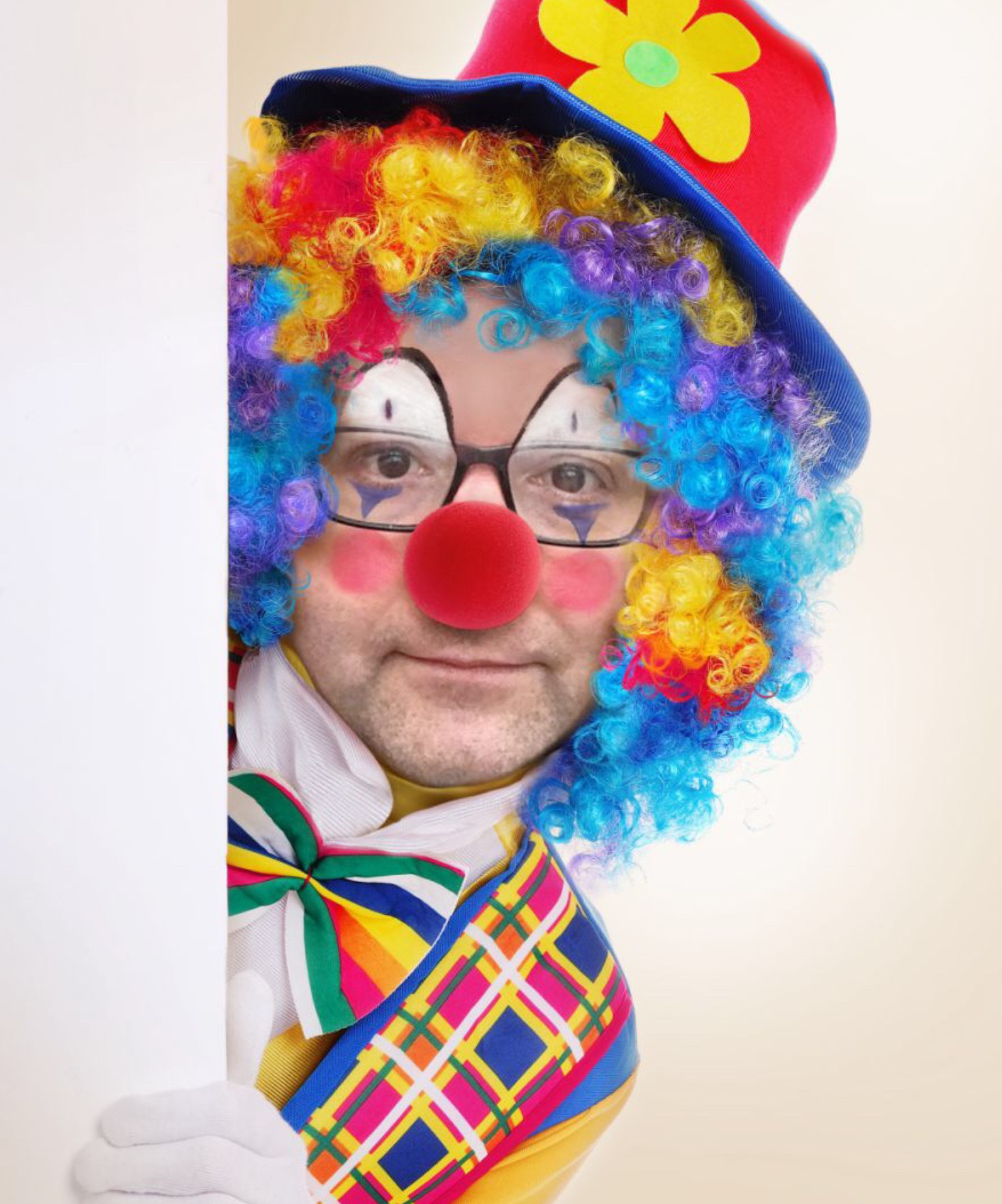
On how I became a clown

On how I became a clown.

1.

I suppose I've always been a little bit clumsy. Affecting a demeanour each day of professional detachment, a manner almost sullen were it not for those moments in which human discourse were necessary, affecting an amiability, an openness, an expression of eager understanding and a willingness to compromise, only to have my belt suffer a sudden and catastrophic malfunction and my trousers fall around my ankles. A hand outstretched for a businesslike greeting, a shoe accidentally scraped against the skirting board, a sudden lurch sideways into a pot plant. Oh, I do apologise! And then later on, noticing the skirting boards around my office marked and scuffed by the numerous other times that I have stumbled.
Hey, hey, your flies are undone. Again.
And due to my body shape, I concede that my trousers have always been a little bit baggy.

2.

The trill of the alarm clock had interrupted a dream in which I was trying to get a giraffe to go up the stairs of a double decker bus. The giraffe had been stubborn and no amount of tugging or enticing could tempt it up to the first floor, and once underway, it got wedged firmly, its fat buttocks blocking the stairwell, much to the consternation of my fellow passengers. It's the usual recurring anxiety dream. The long neck of the giraffe allowed it to peer up to the top deck, grinning like a bastard, while I pushed and shoved and swore from behind. Buzz buzz buzz buzz! I got up, showered, shaved, made some toast and pondered in the coming day, only to glance at my watch and discover that it was four in the morning. And then I recalled that the trill of the alarm clock had been a part of the dream. For the giraffe and I had been returning from a trip to the shops where we had purchased an alarm clock.
I set to work at my desk, organising various work-related files on my laptop and trying not to think about my giraffe dream. I watched as the sun came up and lit the neighbouring houses a brilliant red, secretly resplendent as it rewarding me and others like me for getting up so early. I stopped for a few moments to look out at the sky, feeling if only for a short while the majesty of the planet in its eternal rotation, this celestial dance of time and fate, when the alarm clock sounded, this time for real. Buzz buzz buzz buzz! Had anyone been with me, no doubt, I would have at least given a smirk or acknowledgement of the humour in this, but as I was on my own, the only emotion I felt was one of deep annoyance. I got up from my desk and I switched the alarm clock off. The only comfort came from the fact that the new trousers I was wearing were significantly roomier than had been my previous pair.

3.

I was never
The class clown.
When I think of this
It gets me down.
The popular kids
Would mess around.
But me?
I wouldn't
Make a sound.

4.

I had a meeting with my boss today. I've written down everything that was said and I've made it into a short theatrical piece, which I call 'Bulbous'.

SANDRA stares at ROBERT from behind her desk.

SANDRA - I suppose you know why I've asked you here.
ROBERT - To be honest, no, I don't.
SANDRA - I've had an official complaint from one of your colleagues.
ROBERT - Oh?
SANDRA - It's about the meeting you chaired yesterday, on Effective Time Management.
ROBERT - Yes, yes, I'm so sorry that it overran.
SANDRA - No, it's not that.
ROBERT - What . . what is it?
SANDRA - (Sighs). Robert, is everything okay at home?
ROBERT - Yes, absolutely.
SANDRA - And you're not drinking heavily, or anything?
ROBERT - No. In fact, I hardly drink at all.
SANDRA - The complaint was actually about your appearance. Did you realise that your flies were undone the whole time?
ROBERT - No, I didn't.
SANDRA - So the message of the meeting, in which you were meant to instil in your colleagues a certain business-oriented professionalism, would probably have been received unquestioningly had you not got your foot stuck in the waste paper bin.
ROBERT - Yes, that was rather unfortunate.
SANDRA - And when you tried to pull it off, you sat on a desk, and the desk . . . Collapsed.
ROBERT - Again, I apologise.
SANDRA - And your nose. You see, Robert, it's becoming awfully red, and bulbous. That's why I asked about the drinking.
ROBERT - As I say, I can only apologise. And I shall make an effort to act from now on in a more businesslike manner.
SANDRA - Thank you, Robert. Please, for me, see that you do.

ROBERT gets up from his chair, shakes SANDRA's hand, then stumbles sideways through a glass partition wall.

5.

Walking home through the silence of the park, I could hear a soft squeak, squeak, squeak with each footstep.

6.

‘I've just had it with clowns’, Josh said. ‘I need a man I can respect’.
We'd met online and he suggested we have a date at that new cream flan and custard pie restaurant that had just opened in the middle of the town. It seemed the sort of place where nothing could go wrong. The seating was comfortable and so was the decor, warm and inviting. We sat at a table for two at the rear of the premises.
‘That is very important to me’, Josh continued. ‘Love, yes. Love is up there. And physicality, of course, but respect. Respect is the most important of them all. It seems to me these days that everyone is a comedian, so you get that sense, too? Where's the depth? It's all artifice, isn't it? It's like we've become avatars, covered in layers of glitz and showy nothingness’.
‘You can depend on me’, I told him. ‘I treat each moment with absolute and utter seriousness’.
‘I just don't know why people feel the need to fool around’, he said, ‘in every sense of the word’.
‘I think people just want to be noticed ’, I reply. ‘That's what's happening in this modern age. We all seem to want to get a kick out of making other people uneasy. The nuance of yesteryear is gone. Subtlety is missing from all of our lives. I blame the internet and social media. People can't even be bothered to wait for the punch line, any more. They want immediate gratification, whether it be sexual or comedic’.
‘I can tell’, Josh said, ‘That you are a thinker’.
‘I try to be’.
I looked at him, and he looked at me. I could see the small candle on the table between us reflected in his eyes.
‘Do you ever feel tempted’, he asked. ‘To become like all the other men? I mean, brash, and obvious, and only in it just for a laugh?’
‘No’, I replied. ‘I try to play the long game. Strip away the surface and this world that we live in is a very serious place. And how else might one approach the act of living itself, but through the contemplation of philosophical and existentialist inquiry? In such a way, I forsake the easy option and the expediency of a cheap laugh in order to probe the searing heaviness of our own manifestation’.
‘You know what?’, Josh said, ‘I think I've finally met a man who I can respect’.
At that moment the cream flan and custard pie conveyor belt around the serving desk suffered a sudden malfunction, sped up, and propelled its load, one after another, at such an angle and velocity across the room as to connect squarely with my own face, one after another in a perfect rhythm to the accompanying laughter from all the other customers. By the time the eleventh and last cream pie had been delivered with a forceful splat, and I was scooping the filling out from my eyes, Josh had long since gone.

7.

I never realised before how small my bicycle was until I glanced sideways at my reflection in a shop window, my knees out at a crazy angle, dwarfed by the buses, the cars, the lorries.

b. I never realised quite how tatty my old jacket had become, so tatty that I tried to draw attention away from its tastiness by putting a plastic yellow flower in the lapel.

c. And I shouldn't have gone swimming and then dyed my hair. The hair dye had a chemical reaction with the chlorine from the pool and turned my hair bright green. Still, what can you do?

d. And as I filled in the official documentation online to tell my work colleagues my preferred name and pronouns, my computer’s predictive spelling changed my name from Robert to Parsnip.

e. Sandra, my boss, has for some reason pulled me from delivering a seminar on Modern Business Etiquette.

8.

With the power of his intellect and his encyclopaedic knowledge of contemporary stand-up comedy, my school friend Hasan could reduce the entire class into fits of laughter. And the laughter would drive him on, and he'd say something else that was funny, and the class would laugh some more. But Hasan was canny, he'd leave his best material for the end of the sequence, leading us up blind alleyways of silliness before delivering his punchline. Boom. As a result, this rather nerdy individual became one of the most popular people in school and I must admit to feeling rather jealous of his command of a room.
My teachers would always tell my parents at parents evening that I was always serious, unsmiling, intense. They said that I wouldn't join in with the other kids, and would bury myself in my work. Perhaps they were worried that something would give, that I'd snap one day and have some sort of life-changing episode, go beserk and tell the other kids exactly what I thought of them. Humourless, is the exact word that was used on more than one occasion. But I carried on in much the same manner and took my exams.
I left school with average marks.
Hasan became a marketing executive for a company that manufactures airline meals.

9.

To be mocked, and come out fighting with humour, is never a position in which I have ever found myself. Steady as she goes has always been my motto. I have rarely left myself open to ridicule by using the simple tactic of blending in to the background. And during those moments in which I have found myself in the limelight, I have adopted the simple strategy of being as intense and as dry as I possibly could.
‘You're too intense’, Steven had said to me, on what was to be the last night we'd spent together.
‘Just because I don't go down the street, laughing hysterically . . .’.
‘It's not that. It's more your tendency to over analyse everything. We can't even watch television comedies because you point out that certain things would never actually happen’.
‘All I was pointing out was that in real life, Tom would simply catch and eat Jerry . . ‘.
‘You see! You're too much of a realist. In all the time that we have been together, I never once heard you laugh. It's all buttoned up inside of you, isn't it? That's where you keep it. It has to be somewhere’.
‘Life itself is the ultimate ridicule’, I pointed out.
‘What does that even mean?’
The two of us are silent for a while.
‘I'd just like to find’, I tell him, ‘A well adjusted and content tarot card reader’.
‘What the hell are you talking about?’
‘A happy medium’.
Steven thinks about it for a few seconds.
‘OK. So admittedly, that was quite amusing. But it's too late, Robert. I'm sorry, but it's too late’.
Steven bent down and picked up his suitcase, walked through the door, and slammed it shut behind him.
The oil painting of a clown on the wall above the sofa wobbled for a bit, then fell off and landed right on top of me, my head tearing through the canvas, the frame of the picture now hanging around my neck.

10.


Emerging from the supermarket on the corner, the busy street glistening with a damp drizzle which fell from the overcast sky, smudged neon into the road surface. I stood there in my jacket, my loose fitting trousers, my green hair, my Parsnip name badge, my squeaky shoes, my lapel flower. I decided that I would give up on trying to understand the world, and how good it felt! I didn't need Steven or Josh or even Sandra, I didn't need any of them. Life is filled with organisms and mechanisms too complex ever to make sense of,
A small, battered car screeched to a halt right next to me and a gentleman in baggy, multicoloured clothing jumped out. Then another, then one more, then two more, then six of them, seven, twelve in all, until I was surrounded, and without saying anything I understood that there was a home for me. It didn't even need analysing. Life just becomes obvious, sometimes.

Blimp – Live in Bristol

You can now download a recording of my gig in Bristol last month. This was an amazing evening at the Wardrobe Theatre in front of a lovely audience.

I did a few old poems, a few new ones, a cover version and a really old poem from when I was about 4!

You can stream the album for free, or download it for a fiver. I hope you enjoy it!

https://robertgarnham.bandcamp.com/album/blimp-live-in-bristol-2022