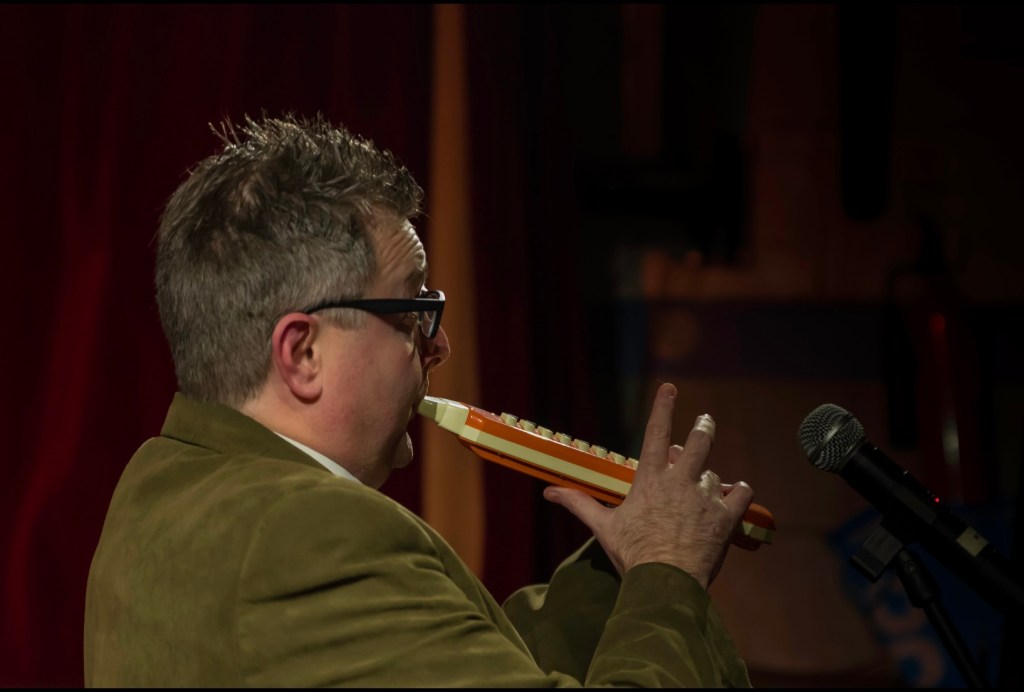
So a colleague from work was chatting to me the other day. ‘I’ve seen your act’, she said. ‘You become a completely different person when you’re on stage. In fact, you seem to be much more awake’. I didn’t know if this was a compliment or not. And I remember back in 1996, when I first moved down to Devon with my parents from Surrey, and then surprising them with the announcement that I’d decided to take acting lessons at a night school run in a local theatre. ‘I suppose this means that you’ll want to grow your hair long’, my Dad replied. (Mind you, hair length was always a touchy subject with my father. He would complain about the students at the local college with their long hair and he would declare that everyone should have the same hairstyle. Dad had gone bald in his mid twenties). So it really does come as a surprise when people discover that I am a comedy performance poet. It’s like having a secret double life. It’s not like I’m the sort of person who wouldn’t say boo to a goose, but I probably would preface the boo with ‘I hope you don’t mind, but . .’, before I said it. If anything, my parents had always taught me to be polite. ‘Hang on a minute. Exactly why are you going to Milton Keynes next week?’, someone might ask. ‘I perform comedy poetry. That’s what I do’. ‘You? Really? But you’ve never said anything funny’. To which I might have responded with, yes I do, and sometimes it rhymes, but he was quite right, I never say anything funny, and by the time I’ve thought of such a witty comeback, they’ve long gone. I’m not the most outgoing person. I don’t go out much and I probably have around two or three friends. I’m not a big drinker and I hardly ever go to pubs. And yet in spite of all this, I’ve managed to make something of a career as a comedy poet who stands on stage and does outlandish things and makes people laugh. How on earth did this happen, and how did it come about? Quite by accident around twelve years ago, I started performing comedy poetry. I went along to a gig and I really liked the atmosphere and the people, and I asked the host whether it would be possible to come along and read some poems. Id always written comedy poems, only I’d never really shown any of them to other people. I still don’t know why I decided to do this, and I remember being incredibly nervous in the days before, but the night itself went well and people seemed to laugh at the right moments. After a while, people started inviting me to other gigs in other parts of the country and before long, I was zipping about all over the place to strange and erotic places like Lancaster and Swindon. I was just as surprised as anyone else. Looking back, I didn’t think it would ever be possible that I’d have the ‘guts’ to stand up in front of a group of people. For a start, I’ve always been what you might call an introvert and it’s probably still the same now. Part of working in the arts is having the confidence to put yourself forward for opportunities, and this is still an area where I struggle. I’ve never applied for funding or any other kind of sponsorship because, well, that’s not the sort of thing you do, is it? I hardly ever apply for big gigs or showcases, either. If someone asks, that’s great, and it makes me really happy for the rest of the day. But the idea of asking them gives me the willies. Another reason is my dyslexia. I just can’t handle all the forms and the paperwork and the incredibly complicated questions using big long words like community stakeholder engagement or financial budgetary management. My mind just fizzes and pops and nothing makes sense. I’ve tried to get funding on numerous occasions, like the week or so I spent filling out an Arts Council form to apply for a development grant, only for them to immediately reject it because the form I’d used was for project grants. I’m also really bad at self-promotion. I think the default setting of a comedy poet is to downplay one’s achievements. It doesn’t seem natural to talk about one’s successes, particularly if you’re having difficulty thinking of any to begin with. A friend of mine, who works in the arts in the theatre side of things, said, ‘Just make it up. They won't check’, but that would make me feel very nervous. And it’s not just me. When I put on a poetry night in Torquay and asked a comedy performance poet to headline, I was overjoyed when they said yes. I asked them to send me some publicity material and a blurb, and the blurb they sent was so self-deprecating that I don’t think anyone would have bothered coming along if I’d used it. ‘X performs poems, badly. A lot of his friends have told him to pack it all in. None of them have any literary worth. He’s won slams in places like London and Edinburgh, but only because no-one else turned up’. The version of me who appears on stage is nothing like the version of me who exists 99% of the time. The persona I’ve created is just that. I don’t even wear the same sort of clothes on a day to day basis. And this is interesting, because for the 99% of the time that I’m not performing, the very idea of it also gives me the willies. It’s not my natural environment. Again the thought comes to mind that this is not the sort of thing that should be happening to someone like me! Yet one or two people have said that there are parallels between the stage ‘Robert Garnham’, and Robert Garnham the human being. Someone once said that they kind of liked my ‘vulnerability’, and my sense of being ‘ever so slightly nervous’. Yet typically, them saying this made me even more nervous! Nevertheless, it’s rather comforting to me to know that there aren’t too many differences between the two different sides of my personality. Social media creates avatars, versions of ourselves that we want the world to see. I see poets and comedians in the real world acting more or less the same as the version of themselves that appears on stage, and to this day it makes me wonder where they find the energy. My other little rule is that I never mention my comedic poetic adventures in ‘real life ‘. I’ve never shown any of my friends any of my books or videos, and frankly, if I did, I’d feel very embarrassed indeed, and as for my family, well, I've never even mentioned it to them at all. For a start, nobody is interested. It’s like living a bizarre double life, like some kind of poetic super hero. But that’s what makes it so amazing. Right at this moment, reading this, I wonder how on earth I can possibly stand in front of strangers and not completely clam up. I go through a comprehensive sequence of preparation methods before I perform, including putting on a costume, doing my hair, changing my glasses, lying on the floor, doing breathing exercises, and then listening to very loud music. I think it’s fair to say that I’m not a natural performer! I still get very nervous indeed. Indeed, people ask me about the nerves, and I reply that perhaps it’s good that I’m so nervous. It means that I’m concentrating on what I do, and that kind of allows me to step away from the introverted version of myself. Nerves are a sign, perhaps, that I care about what I do. It still comes as a surprise, though. Often, I’ll be on a bus, or doing my laundry, or walking home from work, and I’ll think of what I’ve done and what I’ve achieved, and it really makes me smile. Sure, it feels like it’s been done by someone else, but it’s a person I know really very well. This last year I’ve worked very hard on my performance and next I need to start working on being a bit more forthcoming and what my dad would describe as ‘pushy’. I’m like the kid in the corner who wants to join in but is too scared of the big kids. I was chatting about this to another friend, who’s a poet, and she reckons it might be a class thing. I don’t have that middle class sense of entitlement that some of the bigger names might have, nor do I have the confidence that I have a voice that should be heard. I take great comfort in those who are naturally quiet, who seem to have made a successful career, and have done so through a mix of intelligence and luck, and I think, oh, I think, wow, I, too, have been really lucky!
Biscuit donkey chocolate eclair. Weston-Super-Mare. Traffic light pomegranate Yogi Bear Weston-Super-Mare. Slam dunk Bill’s big hair. Weston-Super-Mare. Almost bought a pair of trousers there. Weston-Super-Mare. Don’t look Timmy it’s rude to stare. Weston-Super-Mare. Weston-Super-Mare. Weston Super, Weston Super, Weston-Super-Mare.
Krypton-born hero talking In a Devonian accent, six across. Weston-Super-Man. He owns a horse. Weston-Super-Mare.
Guess where the villain has his secret lair. Weston-Super-Mare. Debonair kitchenware chemical warfare Weston-Super-Mare. Can I come and spend the weekend? Don’t you dare. Weston-Super-Mare. I lost my virginity there. Where? Bournemouth. Who wants to be a millionaire? Weston-Super-Mare. Afternoon tea near Bloomsbury square, Weston-Super-Mare. Don’t move you’ve got something crawling in your hair. Weston-Super-Mare. Weston-Super-Mare. Weston Super Weston Super Weston-Super-Mare.
Since you left I’ve actually tackled that Big pile of laundry We argued about. And I fixed the shelf That we argued about. So there, you see, I can do it. Ohhhh, the things I’ve done Since you left. It’s been a crazy 14 years.
I had a lovely gig in Bristol the other week. The venue was a theatre on an old lightship in the harbour. It was moored to the quay almost totally static but even so I kept lurching sideways. The boat wasn’t even rocking, it was probably just something psychological going on deep within me. Boat = movement. What a nob, I expect people thought.

I’d fretted a lot over my set for the gig. I often get Set Fret but this was something else. I wanted to do some of my old bangers, of course, but I also know that I can’t keep hold of them forever, and that the new stuff has to be unleashed on the world at some point.

But there’s also another thing going on. Over the last couple of years I’ve begun to assess what it is that I like in a performance and I’ve been trying to translate that to what I do on stage. Humour and timing, of course, are things I’ve always had an eye on, and hopefully been got at, but lately there are one or two thinks that I’ve been tinkering with because, well people change over the years, don’t they?

One of these things is volume. I’ve begun to appreciate volume. Or rather, I’ve begun to appreciate it less.

Maybe I’ve been watching too many Ivor Cutler videos. Or Bob Newhart. Or, come to think of it, almost all the people I watch for enjoyment. Laurie Anderson. Edith Sitwell. Alan Bennett. They’re all quiet, somewhat reserved, and seldom loud. Yet they’re funny and they’re clever and I want to be both of those things. I’ve been to plenty of poetry gigs where the poet - and it’s usually a young man, though I don’t want to develop stereotypes- suddenly starts bellowing into the mic halfway through a poem. That sort of thing’s not for me.  I’d feel I was bullying. If you’re going to shout, then at least stand back from the mic. I feel it also changes the dynamic of a performance from enjoyment to hostility. I know that some people may enjoy this, and may appreciate this in a performance, because a performance is what it is and what we’re all there for, but we’re all different, and hooray for that. For me, though as soon as a performer starts shouting, I feel that I want to Get Out Of There. So I come away from these performances hoping that I don’t annoy people in the same way.

So this means that I’ve been trying to adopt a more relaxed, conversational tone when delivering my linking material. And I’ve been working hard at this, because it’s hard, after a lifetime adopting something of a more performative tone. But I’ve been having a bash at it. Here’s my little secret as to how I’ve been conditioning myself to be slightly more conversational and less forced: I start my set with the words, ‘Hello, there’.  It’s impossible to be loud or forced when the first thing you have said is, ‘Hello, there’. And if I feel myself getting more forced or desperate or less conversational, then I say to myself, ‘Hello, there’.

One of the other things I’ve been concentrating on is sex. No, not in that way. I mean, the sexual content of a set and the effect that this, too, has on an audience.

In the early years of my comedy poetry career, I relied quite a bit on content of a sexual nature. Naturally, this was a comedic version of sex, performed (the poem, I mean), by someone who you’d think was probably not very good at it, and therein lay the humour. Indeed, my first collection with Burning Eye, ‘Nice’, was about relationships and more specifically, sex, in the most part. I remember someone writing in a copy of it that had found its way into a poetry library in Manchester, ‘Not nearly enough mention of sex’.

The thing is, I was in my thirties when I wrote some of those poems, and possibly just about passable enough to seem naive and comfortable with such relationships. But now I’m very nearly fifty and the idea of me being on stage talking about sex seems, well, creepy. I’m aware that many in the audience will be thinking the same thing.

I’m not alone with this idea. I was chatting with an LGBT performance poet who’s much higher up the spoken word ladder than me, and he was saying that he is going through a similar process of removing the sexual content from his sets because, as he gets older, he feels it less and less appropriate. I felt that this vindicated the unease I also feel these days of standing at the mic and talking about orgasms and the such. It also maximises the humour when I might mention something vaguely sexual during a set.

So it feels that I’m becoming much more mature as a comedy poet, and gosh, that’s taken it’s damn time. I’m more aware of the audience and more aware of what it is which makes me feel, after a performance, that I’ve done something I can be proud of. This has come about through several years of studying what it is that people laugh along with (as well as laugh at). It also means, hopefully, that I’ll not be stereotyped, just like the words written in that copy of Nice.

We all change. In fact, that was the subject of my very first solo show, ‘Static’. But right now, I’ve never felt so relaxed as a performer, and so at one with my material. Another friend of mine, the American fringe performer Dandy Darkly, once said to me that you can be as silly and as weird as you want to be, so long as you do it with conviction, and that’s definitely what I’ve been aiming for of late.
Had a wonderful time headlining at Satellite of Love, a poetry night in Bristol which takes place in a theatre inside a decommissioned light ship in the harbour at Bristol.
If she’s a real dentist then I’m a ring-tailed lemur. The artifice lies shrouded over her like London smog, Lab-coat shod and glasses from the props box. So earnest in her opinions, delivered Slightly to the left of the camera to a non-existent interviewer About how various experts recommend A certain leading brand, But you can see it in her eyes, There’s no passion, she doesn’t live for teeth, She doesn’t dream of cavities, Gum disease does not excite her.
And God says, ‘Lighten up.’ And she says, ‘Go pro’. And God says, ‘Lighten up’. And she says, ‘You can feel the difference’.
She’s persistent, I’ll give her that. But he’s omniscient. Her lab coat is sparkling Unbelievably white Subconsciously saying to the viewer, ‘Our toothpaste must be good. It must be. It really must be’. Not a mark on it.
God hasn’t got time for this. He’s got an earthquake to set off In twenty minutes In order to punish a small town in Italy Because parliament has been Debating gay marriage. God’s a bastard like that.
‘Ninety nine percent of dentists Recommend this brand’, She says, And God rolls his eyes because Thirty eight percent of statistics are just Someone speaking out of their arse.
Without the lab coat, she could be anyone. A soap opera background lurker, a corpse in a Detective morgue, (Not a flinch as the grizzled flatfoot Leans forward and finds a strand of hair on her chin, Breaks the case wide open, ‘We got him!’), Didn’t I once see you extolling the virtues Of equity release during the advert break on Countdown? Those silken tones and that winning smile last week Ever eager To flog J. Arthur Bowyer’s Synchro-Boost Houseplant Compost, And now apparently you’re a dentist too! God smells a rat, and he should know, He invented them.
Dazzle with brilliant whiteness thy lab coat sublime, Thou shalt not question the ways of Thy lord and master, Removes ninety percent of most plaque, Thou shalt not Covet thy neighbour’s WiFi. Oh dear god, It’s all one meaningless slogan After another.
Do you need those glasses? Or is it cultural appropriation of the near-sighted? Frames bolder than a Brian Blessed bellow, And that clipboard. Just keeping tabs on everything, eh? These are the questions I’d Ask of God, along with, Why should we worship you? Are you really so starved of attention, Affection, love, That every now and then you’ll afflict some Poor kid from the back of beyond to a horrible disease Just to receive a bounty of prayers? Are you really so sensitive? There’s a leading brand for that.
And I? I have an easily-triggered gag reflex. Just when the dentist is in up to their elbows, I start making a noise Like a clunky gear change on a Ford Escort, And you know what’s coming, That lab coat ain’t gonna stay pristine, baby. The moment I find a dentist where I don’t Start calling for Huey, They’ll probably put up a plaque.
I said to the dentist, Why do you always look So down in the mouth? At least you get to the Root of the problem. A golfer came in and said, ‘Most of my teeth are fine, But I’ve got a hole in one’. As I say, I’ve got an early-triggered gag reflex.
Breakfast bap in a non-stop coffee shop Mocker mocha joker taking calculated pop shots Nutty roast flapjacks fluffy most backpack Flat pack sad sack I bet he drives a hatchback Souped up car drives it far have a pain au chocolat It’s a coffee shop, coffee shop, coffee coffee coffee shop.
Costa roaster boaster toasting toast in Costa’s toaster Toasting roasted roasting roasts on the table use a coaster Barista sister kissed her gets a blister from the steamer Throw a plaster to my sister better duck oh good it missed her Get a cup o’ cappuccino fill it up with roasted beano From the coffee roast costa boaster toasted coffee cuppa hoster It’s a coffee shop, coffee shop, coffee coffee coffee shop.
Steam spewing steamer spewing stream stewing cleaner With a skinny latte somewhat leaner steaming customer less keener Cream topped coffee toffee syrup frothy coffee With a hot milk steamer up his nose let’s out a cough, he Raises up his china mug he sips his coffee from his lip Though his coffee drips from his lips think I’m gonna be sick It’s a coffee shop, coffee shop, coffee coffee coffee shop.
Drip fed filter throws barista off a kilter Puts a filter on the filter done without a sense of guilt, her Shaky hand means Some’s a-spilt speaks so softly with a lilt, her Filter coffee has gone off she leaves a sediment of silt, her Queue grows longer like a conga and its winding and its snaking In for caffeine every day they go all jittering and shaking In for caffeine every day they go all jittering and shaking In for caffeine every day they go all jittering and shaking It’s a coffee shop, coffee shop, coffee coffee coffee shop.
There was always something special about the house where my Grandparents lived. On a wooded hill to the west of London, in winter the back bedroom window looked out over the whole of the city right the way from Heathrow to Canary Wharf and if you looked close enough you could see the fins of the aircraft winding their way between the hangars, the motorway signs of the M25, and maybe I’m just imagining it, but the lights of Piccadilly Circus. Actually, I’m probably just imagining that last one.
The front windows looked out over dense woodland. Dense, creepy woodland which in my imagination went on and on and housed bears, wolves, ghosts, and extended all the way to the Arctic. I was a pretty imaginative kid. The woods actually ended after a couple of miles with a golf course. But it’s always fun to paint such vivid pictures.
The thing about my Grandparent’s house was that bits had been added on the back over the years, so that what once had been a two up, two down cottage was now a two up, six down jumble of rooms one built on the back of another, so that it was always an adventure as a kid making your way from the front living room to the toilet, passing through five different doors and feeling as if one were getting further and further away from planet earth.
But it was a house where I always felt happy and comfortable, because it seemed like the sort of place where nothing bad could ever happen. There was a jumble of outbuildings at the bottom of the garden, one of which was Grandad’s magical workshop which had lathes and drills and drawers and a workbench and blueprints and I imagined him pottering away like the mad inventor that he probably was, and how I would later become a similar mad inventor, except with words. Perhaps.
The best day of the year was Christmas Eve. We would go to visit my Grandparents and the dark woods would kind of hold a romance within them, and the lights of London would twinkle like stars, and halfway through the evening, Gran would go to the kitchen and come back with sausage rolls baked in the oven, severed on her famous ‘silver salver’, and to be, this felt the most festive time of the year. And we’d chat, and Grandad would get merry on his whiskey, and my sister and I would sit on the floor and have cola, and it seemed such the most perfect night of the year.
It’s probably my Grandad that I most resemble. We both wear the same kinds of glasses and I found a photo of him the other day where he was wearing clothing remarkably similar to that which I wear on stage. Grandad was a mild, quietly-spoken man who would make a room crack up with just a soft-spoken phrase or one-liner. He was kind of a mix of Ronnie Barker and George Burns, and I miss him every day even though he passed away in 1995.
‘Have you been waiting long?’, I remember my gran once asking.
‘No, not at all’, he’d replied. ‘I watched the sun go down, and I watched the Moon come up’.
Tomorrow is Christmas Eve, and I’ll be off to my mother’s in Brixham. And tomorrow night, she will bake some sausage rolls and we’ll be using that same silver salver. It’s a tradition we’ve kept up with every year.
The following poem is taken from my book Woodview, the first third of which is about life growing up in that house on the hill in the woods.
Christmas Eve on Knowle Hill

In this room sing the memories of moments,
of spiced pies and flames a flicker,
frost sipped from removed overcoats which
smell of cross city trains, junctions,
winding B roads to this wooded hill
and a cottage barricaded against forest intensity.

Glimmer stars glimpsed between bare branches,
curtains drawn. The city lights undulating
on waves of cold, curtains drawn.
Ramshackle architecture, bits added on, the
kitchen with the oven through labyrinths of dark
passageways, rooms locked against the winter,
curtains drawn.

A spindly tree with multicoloured lights
and baubles on the picture tail, tinsel
twisting as heat rises from the gas fire.
A draught under the living room door.
Can you smell the sweetness of the city?

Come in.
I hum this festive murmur of jovial
whisky warmth, sausage rolls, a silver salver,
seasonal serviettes and a quiet magic in the
woodland mysterious, this love we have
for moments and memories past.
The thing was, I was fed up with lugging props around the various fringes and festivals. That was the crux of the issue. Each year I would devise a new solo show and each year I’d promise myself that it would be a simple affair, and within weeks I had incorporated so many props, costumes and technical details into the show that it couldn’t possibly be performed without a big box of paraphernalia. Which is not what you need when you have to run for trains or make your way from Devon to the Edinburgh fringe.
2019 was when things got just too much. That year, I had a show all about tea. The show was called ‘Spout’. ‘Spout’ could only be performed with: a tea pot, a cup, a saucer, a tea caddy, a box of drawstring teabags, a tea cosy, an iPad which had all the various sounds, music and cues stored on it, a Bluetooth speaker, some juggling balls, a large pad of paper with a word search written on it in sharpie, and a tray on to which I had glued another teapot, another cup, another saucer, a milk jug and a sugar bowl, so that I could dance around the stage without them falling off. So once you add luggage for a week in Scotland, merchandise to hopefully sell, and everything else which I normally travel with, you can see that performing the show was more like moving house.
And then on the way back from Edinburgh, someone stole my luggage. Sure, I had my box of props, but the tea cosy was in the suitcase which got stolen. The tea cosy was actually a proper hat knitted and created by the artist Hazel Hammond, and I think I was more upset about this than the fact I’d lost all my clothing. And that’s when I decided, the next show will have no props!
No music, either. No complicated cues. No background beats. It would just be me and the audience with no embellishment whatsoever. Something about this felt pure. It felt real. It felt grown up.
In 2020 I started work on the new show. I decided that it would tie in with my new book, published by Burning Eye. I decided that the show would feature only poems from the new collection. Which I knew would make the writing somewhat limited, but I was determined to get it done.
Each one of my shows was inspired by something or someone during the planning process. My first show, Static, (2014), was heavily influenced by the work of performance artist Laurie Anderson. In the Glare of the Neon Yak (2017) was influenced by storytellers such as Dandy Darkly. And when it came to the Yay show, I was busy looking at the work of singer David Byrne, and storyteller Spalding Gray. Spalding’s only prop was often just a table which he sat behind. And Byrne’s American Utopia stage show concentrated on choreography and movement. These were the two things I was watching or reading about during the creative process.
I also read a book about creating solo work, and it suggested keeping a diary. Aha, I thought. Now that’s something I can definitely do. I thought I’d forget about the diary, but it actually helped with the creative process because it pushed me to do something which I could then write in the diary as proof that I was making some kind of progress.
Naturally, at the time I had no idea that this period of creativity and rehearsal would coincide with various lockdowns, pandemic mandates, and the whole paranoia and psychological malaise which these brought to the art industry. At some moments I wondered if I would ever get the chance to perform the show. As it is, with a bit of luck and some nifty admin, I managed to perform Yay twice in 2021, as well as perform it to a completely empty theatre for the benefit of a filmmaker, so that people could view the show online during lockdown.
The fact is that for some time now Professor Zazzo Thim has been lost, and it is my duty to find him. The manner of his disappearance is, beyond question, one of the most unusual cases I have ever come across. Yet the evidence I have before me, and the testimony of various witnesses, all point to the one conclusion: that Professor Zazzo Thiim is trapped, helpless, somewhere in Marcel Proust’s grand novel, ‘A la recherche du temps perdu’.
It did not take me long to deduce the basics of this case. Various students and colleagues of the Professor attested that he was busy constructing some sort of grand device in the basement of the institute in which he was employed. Various noises had been heard from the cellar towards the end of each academic day, and strange lights were seen by those leaving the building, orange in hue and regulating a slow rhythm. Those closest to the Professor could not find out from him exactly what it was he was building, though one colleague, Doctor Hermann Spatt, was most helpful in his assertion that the Professor was constructing a device which would, atom by atom, replicate his body as a series of words, and distribute them throughout a chosen text.
‘How do you know this?’ I asked.
Spatt grinned at me from across his desk.
‘l asked my dear old colleague. I came right out and asked him. Of course, he was pretty drunk at the time. But he told me what the machine entailed and what would happen to him as a result’.
At this, Spatt’s smile faded, and he leaned back in his chair.
‘Such a sad waste’, he whispered.
‘You must obviously have been close to your colleague’, I said, gently.
‘Thiim? Oh no, I couldn’t stand the chap. What I’m sorry about is that a book so wondrous as ‘a la recherche . .’ should be sullied by his ugly mug’.
The key to the basement in question remained locked and, on account of the strong, fortified doors to the cellar. I quickly deduced that it would take months, possibly years to enter that sacred room. Yet I remembered what Doctor Hermann Spatt had told me, and I set about reading Proust’s epic tome, that I may find some mention within its pages of the eminent Professor Zazzo Thiim.
The institute was good enough to provide me with accommodation during my stay. It was late autumn, and the trees were almost without their leaves. The paths around the parkland in which the institute is set were slippery, and it seemed the sky was hardly ever anything but a deep grey.
Proust’s volumes accompanied me everywhere. I would take walks in the
gardens, or through the woods, with one volume open under my nose and the next thrust under my arm. I would go to the dining hall and sit with the other students, hardly noticing their banter, so engrossed was I in the societal gossip as recorded by the redoubtable Marcel. Even my rare journeys outside of the campus were spent in the company of the Guermantes family, the many minor characters and the overriding sense of times past as recorded in those weighty books. It seemed my whole life had started to revolve around the novel, and I would make lísts of the endless family members, associates and contemporaries of the narrator, but each evening I would sit down and study these lists, safe in the knowledge that none of those mentioned bore the slightest resemblance to Professor Zazzo Thiim.
At around this time, Doctor Hermann Spatt, with the help of two science students and a Professor in electronics, began to build a machine using the blueprints found in Thim’s empty office which might, when up and running, be able to rescue the Professor from the depths of the accursed novel. The machine started to take shape in a far corner of the institute’s gymnasium, roped off from the rest of the hall by an arrangement of badminton nets, and each lunch time I would call in to see what progress was being achieved.
‘None at all, Spatt said, despairingly. ‘The machine just wont function. It needs more electricity than we are supplied’.
‘Then how did Thiim’s machine run so effectively?’ I asked.
Spatt pushed back the hair from his forehead and let out a deep sigh. “The energy needed to suck a character from a book is ten times more powerful than that needed to throw a character into the narrative. You see, Thiim had the advantage of gravity, but we have nothing, nothing at all’.
I walked around the machine and looked at it from many angles.
“It’s looking quite hopeless’, Spatt said, and l swear I saw a tear well in the corner of his eye as he contemplated his missing colleague.
That night I retired to my room. By now the bed was covered with the six volumes of Proust’s masterpiece. My reading of it was haphazard at best, covering the first three sections of each novel simultaneously, so that my understanding of the plot and the order in which Marcel’s life was playing out was tenuous at best. At worst,I didn’t know what was going on.
So many dukes, matriarchs, minor members of the aristocracy, childhood memories, subtle, beautiful women with strangely masculine names. That night I fell asleep and found myself in a nightmare, a dark, dismal Paris street where Proustian characters advanced upon me with their arms outstretched, their eyes displaying a frightening malice, humming, intoning some strange, ritualistic prayer which sounded for all the world like Kylie Minogue’s first hit single, ‘I Should Be So Lucky’. I woke with a start, frightened into reality yet not trusting the world around me, the darkness of the night, the wind which, ever so gently, was roaring in the trees and stripping them of the last of the leaves.
I got up and walked to the window. I was dizzy, I was sweating, yet the room was cold. It was as if the natural laws which surrounded and informed us all had ceased, that the earth itself no longer recognised whatever constitutions had kept it going for so many years. I rubbed my eyes and looked at the trees, and the leaves falling, one by one, across the sodium light of a campus street-lamp.
‘My God’, I whispered.
Excitedly, I telephoned Doctor Hermann Spatt immediately. He answered on the third ring, and asked, blearily, what it was I wanted.
‘The machine!'”, I said. ‘You remember what you were saying? That Thiim had the benefit of gravity?’
‘Hmm?’
‘And that we needed more energy because we were sucking a character out of a book, not throwing one in?’
‘Yes?
‘Then why don’t we just turn the whole machine upside down? Put the machine on the floor and the book suspended above!’
There was silence on the other end of the line, and then Spatt’s voice cane back. ‘My word!’, he said, ‘You’re a genius!’
The next morning Spatt, accompanied by his assistants, set to work making the modifications I had suggested, while I, now with the help of three assistants of my own, continued my reading of Proust’s novel. We each took a volume and, starting at the very beginning, ploughed our way through the dense script, using different translations and even the French language original, so that we were working on three separate texts at once. Halfway through the afternoon Spatt rang to tell me that the machine was working perfectly, and all it needed was for me to find Thiim in the novel so that we might rescue him. This news gave us a welcome feeling of progress and we intensified our efforts until, by six in the evening, we were all very tired and our eyes and heads ached.
‘Thank you, lads’, I whispered, as they headed towards the door.
‘Erm, we were wondering’, said one of them, an amiable young man by the name of Adam. ‘Would you like to come out for a drink tonight?’
I smiled at their offer, for it was proof that we had gelled as a team. “Thank you, but I would rather maintain my faculties’, I told them.
Their shoulders slumped.
‘And I suggest you do the same, for we need our full concentration if we are ever to find the Professor’.
Adam smiled. ‘Very well’, he said. ‘We wouldn’t have gone overboard, anyway. Just a couple of drinks and then back home’.
‘Thanks once again’, I whispered.
The days were getting shorter, and once I had eaten my dinner, (accompanied, once
again, by the ever-present Monsieur Proust), I went back to my room and prepared for sleep. To be honest, I was beginning to doubt that we would ever find Thiim in this mammoth book, and a part of me was content just to sit back and enjoy the experience of being a small part in such a large, well-funded experiment. Though the more l thought about it, the more desperate l started to become, as I realised that the whole project now depended on me and my abilities wade through the novel for just the smallest clue. Worse still, I was afraid to sleep, for I knewthat I would be haunted by Kylie once again, that inane, stupid song, 1 Should Be So Lucky!’
Timidly, I retired to my bed.
At two in the morning I was woken by a fierce pounding on my door. Hardly able to concentrate, I opened the door and blinked in amazement to see Robert de Saint-Loup.
‘Do forgive my intrusion’, said he, ‘But I was wondering if you had had word of the Duc de Guermantes?”
‘I beg your pardon?’, said I, hardly believing my eyes.
At that moment M. de Charlus bounded down the corridor and patted Saint-Loup on the shoulder.
‘There you are!”, said he. His eyes then focused on myself, standing in the doorway in a pair of boxer shorts and nothing else.
‘Hello!’, he said, twirling his moustache.
‘I say!’, said a voice from the end of the corridor.
They both looked up and bowed, courteously, as Albertine approached. “Are you not on the way to the Verdurin ball? I proclaim it to be the most whimsical event of the decade!’
Hurriedly, I shut my door, then went over to the window. Oh, what a scene met my eyes!
The quiet park was awash with people, elegantly dressed, bowing, nodding, dancing, chatting in the glare of the street-lamp as if they were in a ball or a turn of the century function. And they were all, I was horrified to note, characters from Marcel Proust’s mighty tome.
I telephoned Spatt and he confirmed my worst suspicions. Some students, drunk of course, had broken into the gymnasium and fiddled with the machine.
Instead of pulling the hapless Thiim from the depths of the novel, they had, wantonly and without thought to the effects of their crime, pulled out every other character instead.
‘But this is horrendous!’, I whispered.
‘There’s no choice’, said Spatt. ‘We must round them all up and post them back into that hideous novel. Do you know what they’re doing now? They’re in the canteen, holding a mass madeleine tasting. This has got to stop!’
‘There’s only one way we can get them back into the novel’, I told the Doctor. ‘We must break into the basement and use Thiim’s machine’
It took the best part of the night to round up all of the characters. Because we had been using three different translations, there were three of each of them, and the three Marcels had met some time after half four and, indignant that their individualities had been compromised, had challenged each other to a duel, (from which, naturally, each one backed out.) Charlus was the worst, and three of his characters had to be retrieved from the public lavatories and from various male student’s bedrooms before they were all accounted for. At last we had rounded them
all up and we were engaged in the act of congregating them around the door to the basement, a tricky act which was achieved only by the entertainment of a piano playing Chopin and the liberal refreshment of champagne. Spatt and I, meanwhile, busied ourselves at the door. The thick oak would not budge to our shoulders, neither to a rudimentary battering ram fashioned out of an old roll-top desk. However, when one of the Robert de Saint-Loups saw what we were trying to achieve, he supplied us with some dynamite which, he assured us, was fresh from the Great War battlefields.
The following explosion was deafening. Two of the Mme de Verdurins went flying through the air, their stiff petticoats flaying in all directions. At last we entered that hallowed room and saw Thiim’s machine which, somewhat comfortingly, looked not unlike the reverse example we had fashioned in the gymnasium. Yet only now did Spatt and I see the almost fatal mistake that Thiim had made.
Indeed, the machine functioned well, and had been put together expertly. However, the absent-minded Professor had, one can only assume, accidentally, mistakenly placed within its confines not Proust’s magnificent novel, but a CD of Kylie’s first UK Number One hit, ‘I Should Be So Lucky’
It didn’t take long for the machine to be put to use. How affectionately we said good-bye to all the characters, who each invited us to various balls and society functions for the following Paris season. When they were all quite delivered, Spatt and I took Thiim’s CD upstairs to the gymnasium, where we placed it on top of the machine and pulled the necessary levers.
Seconds later, Professor Zazzo Thiim materialised.
‘Oh, my word’, he said, feeling his nervous forehead. ‘I was having the time of my life! l’ve never danced so much!”‘
‘You realise what you did?’ Spatt asked.
‘Oh, the CD? Entirely intentional, my dear friend.
‘But that’s preposterous!’
‘So many hours I’d spent on that machine, a copy of Proust under my arm. So many years I’d dreamed of meeting those wondrous characters. Yet when it came time to leave I thought long and hard about it . . ‘.
‘And?’
‘And I realised that I would rather be with Kylie, instead’.
‘Good gracious!’
‘Well, my dear Spatt. They’re so stuffy, aren’t they? And Kylie’s much more . . . Vivacious’.
At this, Thiim looked left, then right, then left again.
‘And another thing’, he added, confidentially, ‘She’s a much better dancer’.
Alas, the story does not end here. The following week, Kylie’s management refused to confirm that a new version of her original hit single had been mixed, with some quite bizarre vocals by various French dignitaries, mostly concerning the petty discriminations and social faux pas of early 20th Century Paris.
‘My god!’, Spatt whispered to me, down the telephone line. ‘We must have sent them to the wrong place!’
Yet not one scholar, student or academic genius happened to notice that Proust’s six-volume masterpiece now seemed not to have a single character left in it at all.
Between the late nineties and the mid 2000s, I wrote hundreds of short stories. This was a very hectic time in my life, and probably needlessly so. In 2000, I moved into a gothic flat near the seafront in Paignton, almost directly over the road from the shop where I worked. I was studying Open University every morning, getting up at 5, studying 6-9, going over the road and working 9-5, then home, and spending every single evening writing short stories.
On my day off I’d attend a Writers’ Circle and it soon became apparent that the other attendees seemed drawn to my funnier stories. In one story, I invented a character, a professor of literature by the name of Zazzo, and soon the other members of the writers’ circle started saying things like, ‘Oh, I can’t wait to see what Zazzo gets up to next week!’
My Open University degree was in Literature, so I’d have to watch a lot of videos (it was still videos back then), and listen to lots of cassettes presented by these eccentric academic types who were a million miles away from the milieu in which I moved. I saw Zazzo as belonging to this community, perhaps barely tolerated by his contemporaries, and often shooting off at a tangent, seeing patterns where there were no patterns, narratives where there were no narratives.
Zazzo was a literary investigator. Whenever there was a mystery with a literary element, Zazzo would be there. Skateboarders quoting Shakespeare for no reason? Send in Zazzo! A crab routinely predicting the winner of the Booker Prize every year? Another case for Zazzo! The discovery of yet another Brontë sister? Who do we call? Professor Zazzo!
The Zazzo stories were saved on various floppy discs, and then promptly forgotten about for twenty years. I had no way of accessing them for quite some time, but now, thanks to various technological developments (and some paper versions I recently found), Professor Zazzo has been saved from obscurity!
My life has moved on since those days. I’ve been working as a comedy performance poet since around 2008, and worked on various other projects, so it was a delight to rediscover this strange world. And I really hope you might enjoy reading some of the stories which I shall be publishing on this blog.
ZAZZO DECLARES THE DEATH OF THE SHORT STORY (A SHORT STORY)
As the train pulled into the station, Professor Zazzo Thim felt a twinge within him, deep down where he knew his heart should have been. He didn’t want to be there, he didn’t even know why he had come back to this place where, years before he had given an infamous speech in which he had proclaimed the death, as an art form, of the short story.
There had almost been a riot. But the Professor was a sentimental man, and when he had received, in the depths of the University in which he taught literary experimentalism, a letter from a middle-aged lady who had witnessed him that day, fleeing for his life amid the baggage trollies and the tourists pursued by an angry mob, he knew he had to go back there, just for old times sake.
And now he was on a train, pulling into that very station, with its vast glass roof and endless platforms.
How lucky that he had given them the slip all of those years ago, he thought to himself as the train slowly began to slow. Would anybody recognise him now, all these years later? The grand old station was the same as it ever was. The glass roof was a dirty grey, matching the overcast skies outside, while the rusted superstructure was plastered with pigeon droppings. Zazzo pulled his coat collar around him as he stepped out of the carriage onto the worn tarmac of the platform. He felt a coldness in the air, though, an eternal coldness, as if all the emotion from the thousands, the millions of journeys begun and ended here, the lives separated, the people who would never see each other again, had somehow become crystallised and manifested just in him. The Professor began to shiver. She was waiting for him at the exit of the platform, next the aerodynamic train engine which throbbed and sizzled as it recovered from its journey. She recognised the white-haired professor from the photographs on the jackets of his various, little-read volumes on the literature of Greenland and the cultural significance of the Haiku in Guatemala. (Verdict: virtually none at all). She stepped forwards, extended her hand, then helped him with the big bag slung over his which contained the manuscript of his latest novel. They went to the station cafe. “We talk about it even now”, she said, over a cup of coffee which steamed gently in the slant of morning light. “I didn’t realise it was such a big event “. “Big event?” she asked. “It was the only event”. The cafe was filled with travellers, youths with backpacks, old ladies with small trollies, all of them static for this one moment in time before they each went their separate ways to the furthest corners of the continent. Behind the counter, the coffee machine let off a cloud of steam which moistened the ceiling, while a small radio played jazz in the kitchen. The saxophone made Professor Thiim feel sad, though he didn’t quite know why. Something about the passing of the years, perhaps. “You certainly caused quite a stir”, the woman said. “Let me introduce myself. My name is Mathilda, and the day I saw you leaping over the tracks while being pursued by that mob, I was employed in the cigarette kiosque. I remember it now, your scarf trailing in the wind, the papers of your speech flying away behind you, the angry mob piling over baggage racks and the ticket barriers, like ants coming back to their colony. Nothing stood in their path! You started a change in me . . .”, she said, contemplatively. “What do you mean?” the Professor asked.
She smiled and looked down at her coffee cup. “While was working that morning l was listening to your speech. When l saw you set up on the main concourse with a soap box and a sheaf of papers l thought you were just another religious zealot, or maybe one of those hopeless politicians with their fake promises. But when you started speaking about the short story, and speaking so eloquently, l might add, l became entranced. I remember it to this day the way you said that short stories no longer mattered, that we were all philistines because we preferred trashy novels or the television, that all writers of short stories are, in some ways, the chroniclers of the modern world, capturing moments and emotions in subtle ways which other means can never attain yet entirely forgotten by everyone, and therefore, superfluous, misguided, and entirely fake. l remember the way you used to adjust the scarf around your neck as you talked, your face wrinkled in concentration. I was so captured by this that I completely forgot about my job, and when these people started crowding around you and heckling, I thought, a-ha! He has struck a nerve!” “It’s nice that you remember”, the Professor said, fingering his collar where the scarf would have been. He remembered the scarf, he still had it at home somewhere. “So I went home and I started to read short stories. Nothing major at first – romance, a bit of light comedy. Then l professed to Dorothy Parker, Mark Twain, Checkhov. After a few years I wanted more, so l started on James Joyce, Italo Calvino, old Franz Kafka. Borges came next, of course, the master of them all. And now . . “. “Yes?” the old man asked, fearfully. “Now I’m reading Samuel Beckett’ “My word”, he whispered “And it’s all thanks to you. My life has been enriched by that moment, by the passion and the fury of that one episode. I resigned from the cigarette kiosque, enrolled in university, and I began to acquire literary ideas of my own. Do you know what it means for a character to appear in a short story, for example? The characters believe themselves, for just one moment, to be so important as to be forever captured in the reader’s mind, and lodged there forever. Yet they do not have the longevity, the life-span of characters from, say, a novel. Such animosity exists between them! The moment in which they exist is so precious, so pure and concentrated that they could never last a whole novel with the same intensity. Just look at ourselves – if we two were to last a whole novel, we would be exhausted by the end of chapter three”. The Professor nodded, solemnly “I have so many ideas inside of me” Mathilda continued. “And it’s all thanks to you. So when I read a textbook on the use of penguins in the shorter fiction of Virginia Woolf – (in which it was concluded that penguins hardly featured in any of her work) – and I saw that the author was a certain Professor Zazzo Thim, who, years before, had almost been attacked right here at this very station, I thought: ‘l have to find him, I have to thank him personally for the life he has given me”. The Professor fingered the clasp of his briefcase. He felt so many different emotions. “I’m glad”, he whispered, above the soft saxophone solo from the kitchen. “That I have made an impact on someone’s life”. He opened the briefcase and took out a manuscript. “In fact, he continued, “I would like you to have this”. “What is it?” Mathilda asked, laying an expectant hand on her chest. “My latest academic work, explaining the death of surprise endings in short works of fiction. It is my belief that all surprises have been eliminated, that nothing more can ever be said at the end of a short story which may shock or confound the reader. I have called it, ‘No More The Lonely Badger”. “I’m touched”, Mathilda said. Zazzo passed the manuscript across the table towards her and she took it in her quivering hands. “No more surprises”, she whispered, reading the sub-heading. “An investigation by Professor Zazzo Thiim”. “Just one more thing”, he asked. “Why did the crowd react so badly to my speech? Why did they set about me in such a hostile manner? Surely, the people of this city don’t care that much for the short story as to attack me personally, just because of my hypothesis? I thought about it for the last twenty years, l’ve thought about the effect l had and the passion they displayed, see, and it, too, changed my life, it changed my ideas, and I started to devote my life to demonstrating that short stories do make a difference, and l have used the episode as an illustration in lectures, academic works and after-dinner speeches. Indeed, it could be said that my whole career has been based on this one incident! So tell me, why were the crowd so unaccountably incensed?” “Didn’t you know?”, Mathilda asked. “It was the cup final day. They saw your scarf. They thought you were a United supporter”.




 Robert Garnham