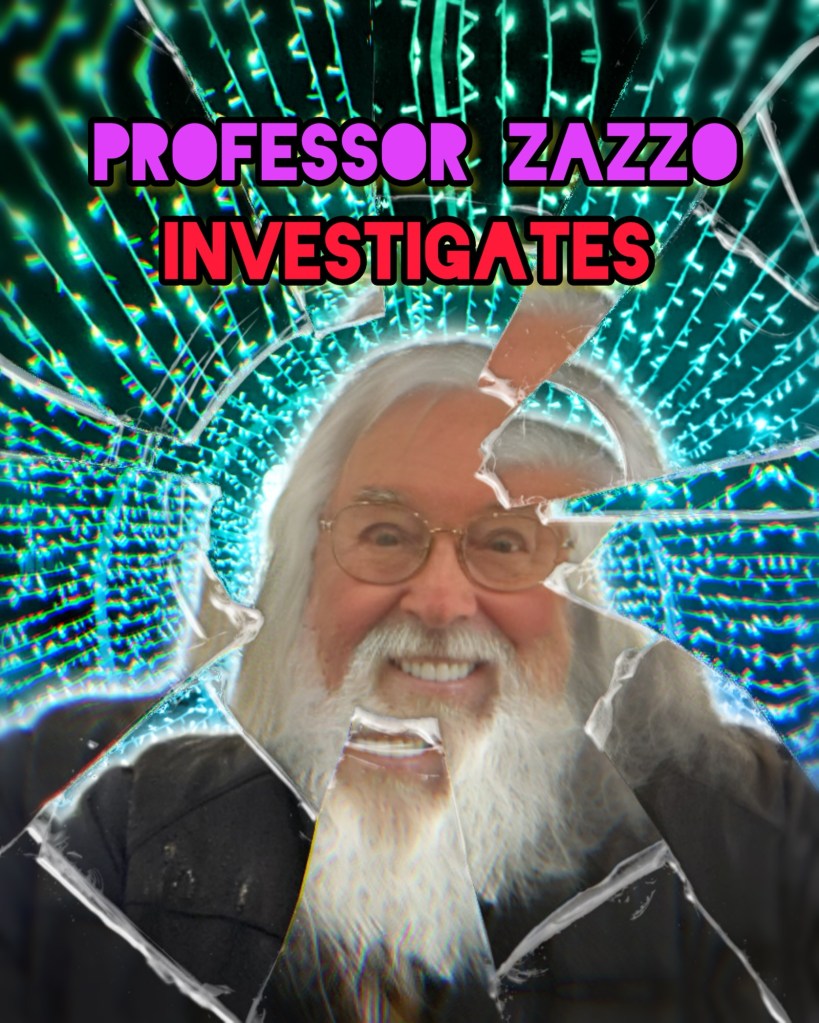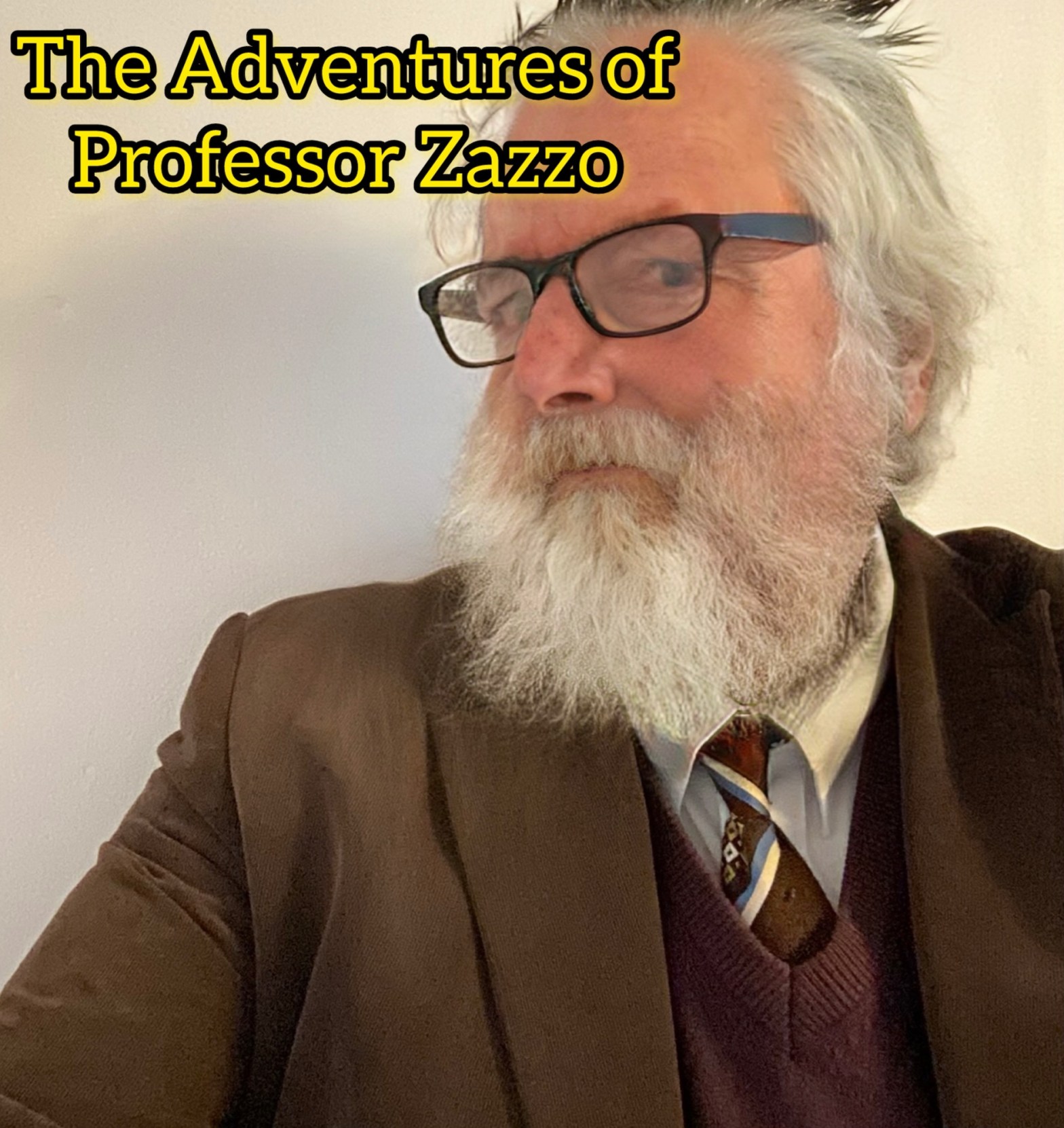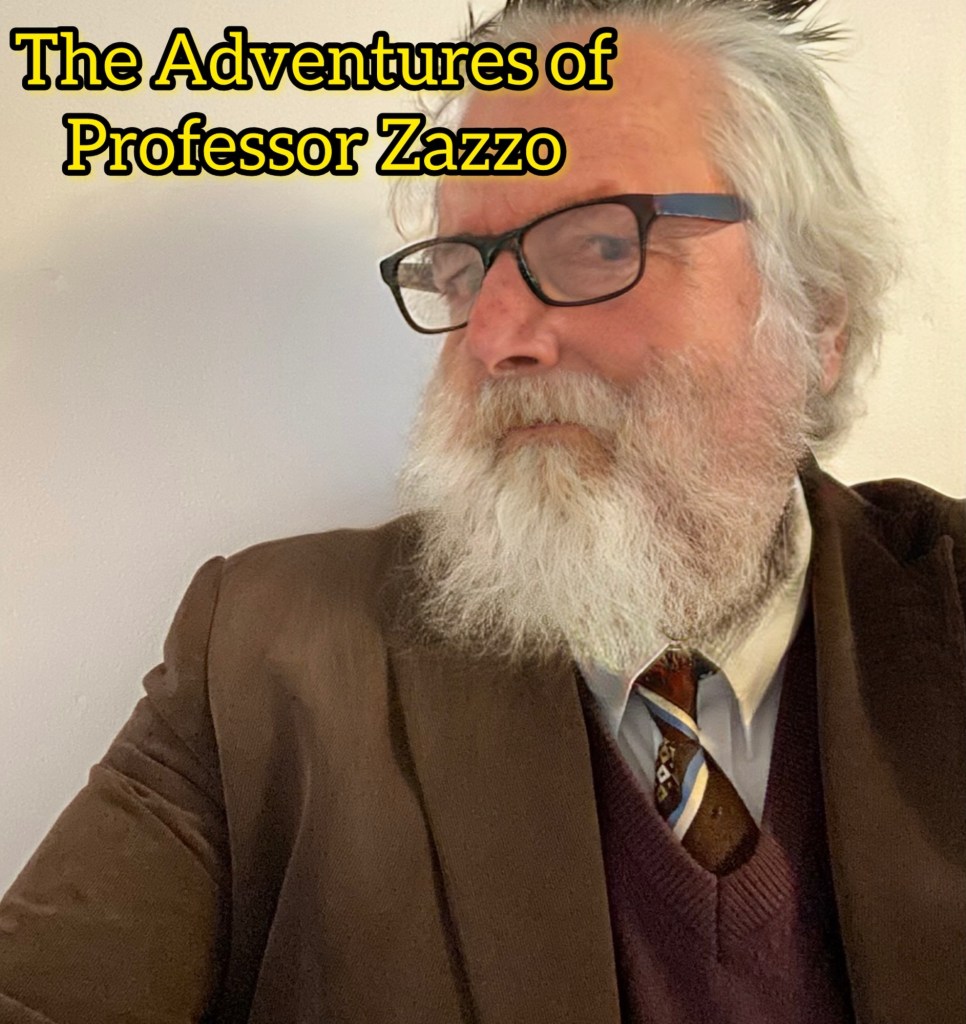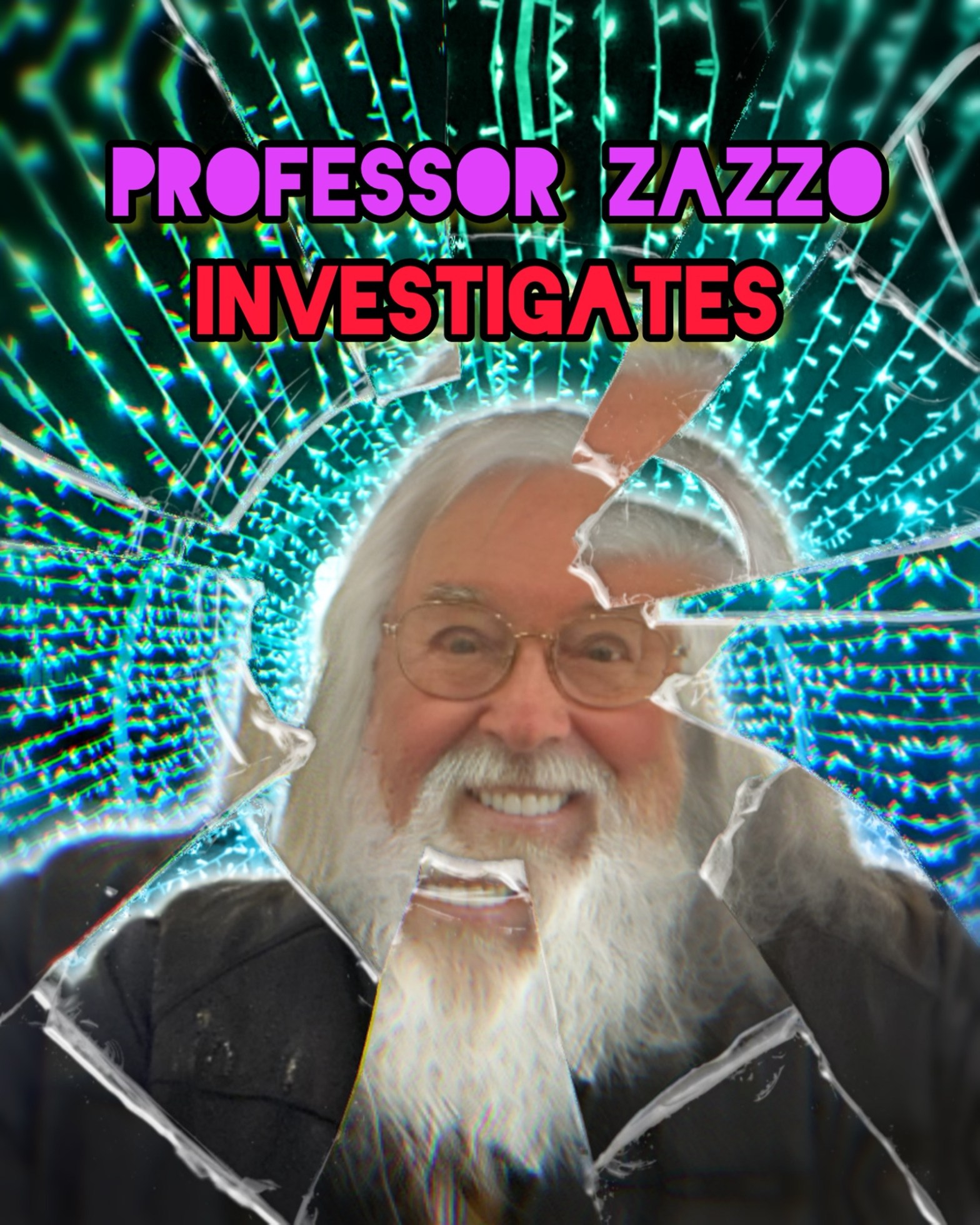
Professor Zazzo Investigates – 1. Zazzo Declares the Death of the Short Story

Between the late nineties and the mid 2000s, I wrote hundreds of short stories. This was a very hectic time in my life, and probably needlessly so. In 2000, I moved into a gothic flat near the seafront in Paignton, almost directly over the road from the shop where I worked. I was studying Open University every morning, getting up at 5, studying 6-9, going over the road and working 9-5, then home, and spending every single evening writing short stories.
On my day off I’d attend a Writers’ Circle and it soon became apparent that the other attendees seemed drawn to my funnier stories. In one story, I invented a character, a professor of literature by the name of Zazzo, and soon the other members of the writers’ circle started saying things like, ‘Oh, I can’t wait to see what Zazzo gets up to next week!’
My Open University degree was in Literature, so I’d have to watch a lot of videos (it was still videos back then), and listen to lots of cassettes presented by these eccentric academic types who were a million miles away from the milieu in which I moved. I saw Zazzo as belonging to this community, perhaps barely tolerated by his contemporaries, and often shooting off at a tangent, seeing patterns where there were no patterns, narratives where there were no narratives.
Zazzo was a literary investigator. Whenever there was a mystery with a literary element, Zazzo would be there. Skateboarders quoting Shakespeare for no reason? Send in Zazzo! A crab routinely predicting the winner of the Booker Prize every year? Another case for Zazzo! The discovery of yet another Brontë sister? Who do we call? Professor Zazzo!
The Zazzo stories were saved on various floppy discs, and then promptly forgotten about for twenty years. I had no way of accessing them for quite some time, but now, thanks to various technological developments (and some paper versions I recently found), Professor Zazzo has been saved from obscurity!
My life has moved on since those days. I’ve been working as a comedy performance poet since around 2008, and worked on various other projects, so it was a delight to rediscover this strange world. And I really hope you might enjoy reading some of the stories which I shall be publishing on this blog.

As the train pulled into the station, Professor Zazzo Thiim felt a twinge within him, deep down where he knew his heart should have been. He didn’t want to be there, he knew what was waiting for him. It was here, this very place where, years before – decades before! – he had given his infamous speech in which he had proclaimed the death, as an art form, of the short story. There had almost been a riot.

          But the Professor was a sentimental man, and when he had received, in the depths of the University in which he taught literary experimentalism, a letter from a middle-aged lady who had witnessed him that day, fleeing for his life amid the baggage trollies and the tourists, pursued by an angry mob, he knew he had to go, just for old times sake. How lucky that he had given them the slip on platform sixteen, he thought to himself, as the train slowly navigated the last few inches of the track. Would anybody recognise him now, all these years later?

          The grand old station was the same as it ever was. The glass roof was a dirty grey, matching the overcast skies outside, while the rusted superstructure was plastered with pigeon droppings. Zazzo pulled his coat collar around him as he stepped off the train on the worn tarmac of the platform. He felt a coldness in the air, an eternal coldness, as if all the emotion from the thousands, the millions of journeys begun and ended here, the lives separated, the people who would never see each other again, had somehow become crystallised and manifested just in him. The Professor began to shiver.

          She was waiting for him at the exit of the platform, next to the aerodynamic train engine which throbbed and sizzled as it recovered from its journey. She recognised the white-haired professor from the photographs on the jackets of his various, little-read volumes on the literature of Greenland and the cultural significance of the Haiku in Guatamala. (Verdict: virtually none at all). She stepped forwards and extended her hand, then helped him with the big bag slung over his shoulder which contained the manuscript of his latest novel. They went to the station cafe.

          “We talk about it even now”, she said, over a cup of coffee which steamed gently in the slant of morning light.

          “I didn’t realise it was such a big event”.

          “Big event?” she asked. “It was the only event”

          The cafe was filled with travellers, youths with backpacks, old ladies with small trollies, all of them static for this one moment in time before they each went their seperate ways to the furthest corners of the continent. Behind the counter, the coffee machine let off a cloud of steam which moistened the ceiling, while a small radio played jazz in the kitchen. The saxophone made Professor Thim feel sad, though he didn’t quite know why. Something about the passing of the years, perhaps.

          “You certainly caused quite a stir” the woman said. “Let me introduce myself. My name is Mathilda, and the day I saw you leaping over the tracks while being pursued by that mob, l was employed in the cigarette kiosk. I remember it now : your scarf trailing in the wind, the papers of your speech flying away behind you, the angry mob piling over baggage racks and the barriers like ants coming back to their colony. Nothing stood in their path! You started a change in me…”, she said, contemplatively.

          “What do you mean?” the Professor asked.

          “While I was working that morning I was listening to your speech. When I saw you set up on the main concourse with a soap box and a sheef of papers I thought you were just another religious nut, or maybe one of those hopeless politicians. But when you started speaking about the short story, and speaking so eloquently, I might add, I became entranced. I remember it to this day – the way you said that short stories no longer mattered, that we were all philistines because we preferred trashy novels or the television, that all writers of short stories are, in some ways, the chroniclers of the modern world, capturing moments and emotions in subtle

ways which other means can never attain. I remember the way you used to adjust the scarf around your neck as you talked, your face wrinkled in concentration. I was so captured by this! I couldn’t concentrate on my job, and when these people started crowding around you and heckling, I thought – a-ha! He has struck a nerve!”

          “It’s nice that you remember” “, the Professor said, fingering his collar where the scarf would have been. He remembered the scarf, he still had it at home, somewhere.

          “So I went home and I started to read short stories. Nothing major at first – romance, a bit of light comedy. Then I progressed to Dorothy Parker, Mark Twain, Chekov. After a few years I wanted more, so I started on James Joyce, Italo Calvino, even dear old Franz Kafka. Borges came next, of course, the master of them all. And now…”

          “Yes?” the old man asked, fearfully.

          “Now I’m reading Samuel Beckett”

          “My word” , he whispered

          “And it’s all thanks to you. My life has been enriched by that moment, by the passion and the fury of that one episode. I resigned from the cigarette kiosque, enrolled in university, and I began to acquire literary ideas of my own. Do you know what it means for a character to appear in a short story, for example? The characters believe themselves, for just one moment in time, to be so important as to be forever captured in the reader’s mind, and lodged there forever. Yet they do not have the longevity, the life-span of characters from, say, a novel. Such animosity exists between them! The moment in which they exist is so precious, so pure and concentrated that they could never last a whole novel with the same intensity. Just look at ourselves – if we two were to last a whole novel, we would be exhausted by the end of chapter three”

          The Professor nodded, solemnly.

          “I have so many ideas inside of me”, Mathilda continued. “And it’s all thanks to you. So when I read a textbook on the use of penguins in the shorter fiction of Virginia Woolf – (in which it was concluded that penguins hardly featured in any of her work) – and I saw that the author was a certain Professor Zazzo Thim, who, years before, had almost been lynched right here at this very station, I thought: T’ have to find him, I have to thank him personally for the life he has given me'”.

          The Professor fingered the clasp of his briefcase. He felt so many different emotions. “I’m glad”, he whispered, above the soft saxophone solo from the kitchen. “That I have made an impact on someone’s life”.He opened the briefcase and pulled out a manuscript. “In fact”, he continued, “I would like you to have this . .”.

          “What is it?” Mathilda asked, laying an expectant hand on her chest.

          “My latest academic work, explaining the death of surprise endings in short works of fiction. It is my belief that all surprises have been eliminated, that nothing more can ever be said at the end of a short story which may shock or confound the reader. I have called it, ‘No More the Lonely Badger'”

          “I’m touched”, Mathilda said. Zazzo passed the manuscript across the table towards her and she took it in her quivering hands. “No more surprises”, she whispered, reading the sub-heading. “An investigation by Professor Zazzo Thiim”.

          “Just one more thing”, he asked. “Why did the crowd react so badly to my speech? Why did they set about me in such a hostile manner? Surely, the people of this city don’t care that much for the short story as to attack me personally, just because of my hypothesis? I’ve thought about it for the last forty years, I’ve thought about the effect I had and the passion they displayed, you see, and it, too, changed my life, it changed my ideas, and I started to devote my life to demonstrating that short stories do make a difference, and I have used the episode as an illustration in lectures, academic works and after-dinner speeches. Indeed, it could be said that my whole career has been based on this one incident! So tell me, why was the crowd so incensed?”

          “Didn’t you know?”, Mathilda asked. “It was your scarf. They thought you were a United supporter.

On the Silken Breath of a Penguin in Repose – The Best Example of Antarctica Literature ever written.

ON THE SILKEN BREATH OF A PENGUIN IN REPOSE

When I heard that the great literary extremist Professor Zazzo Thiim was holding a symposium on the use of alliteration in Antarctic literature, I knew I just had to attend.

      I knew that getting to the venue in the first place was in itself was a hard enough job; the convention was to be held in a remote hotel in the mountains which, in the middle of winter, would be cut off from the world by snow drifts, and sure enough, when the week of the convention came, the only way to get to the hotel was by walking the last two miles. As the darkness gathered around me, and large

fiakes of snow began to fll from the black, black sky, I gripped the handle of my suitcase and made my way up the track into the wilderness.

          It must have taken a couple of hours to make the journey, and when I arrived at the hotel I was feeling irritable and uncharitable to say the least. My eyes were blinded by the motion of the snow as it had flown across my vision, and my fingers numbed from gripping the case for so long. The first thing I did was to dump my bags next to the reception desk and sit next to the roaring fire, in order that I may thaw my aching bones and curse my stupidity at having set out on such a journey in the first place. Yet only the one thought, of any substance, kept coming to me as I sat there in the orange glow: after all this effort, this had better be worth it.

          I soon became aware that an old man was sitting next to me and, after a while, he asked if I was there to see Zazzo Thim.

          “Yes”, I replied, “Though I am now beginning to wonder if I have made a mistake.”

          The old man wrapped his scarf tighter around his neck and gave a chuckle. “I can assure you that the convention will be well-managed and adequately attended for my needs, for I, myself, happen to be Zazzo Thiim”.

          “What makes you so sure that it will be so well-attended?” l asked. It was snowing heavily outside now, and the hotel did not seem to be bursting with guests.

          “The subject in itself”, the old man said, smiling gleefully. “Who could fail but be enchanted by such a subject? Antarctic literature, let me remind you, is an expanding genre. I expect there shall be quite a rush tomorrow morning for seats”. 

          At this, he looked first left, and then right, and then whispered to me in a severe, confidential tone: 

          “It’s quite possible that some people might not be allowed in’.

          At once l felt bad. How close l had been in deciding not to come, yet others might not have been so foolhardy. I knew that there would probably be a limited attendance as it was, yet Thiim was sure that there would be more. I felt a sinking sensation inside of me, the dejection he might feel on walking into the conference centre that next morning only to see myself sitting there.

          “I can assure you”, I told the old man, “That we shall all be thoroughly enlightened”

          I went to my room and changed for dinner. I decided that I would enjoy myself, and I ordered the most expensive item on the menu, yet the restaurant was virtually empty, with the exception of a table on the far side of the room where Professor Zazzo Thiim slurped, quite noisily, his soup. Every now and then I would look over at him and feel a well of pity deep in my stomach, and I soon decided that something would have to be done. But what could I do? As the waiters kept moving past, as if gauging whether or not we had finished, a plan began to formulate in my mind that I could, somehow, interest other people in the subject of Antarctic literature and perhaps even bribe them into attending. But the plan seemed hopeless, even fanciful.

          After dinner I went for a walk outside in the snow. The mountains loomed, black shapes and shadows in the night sky, while gentle flakes fell from above, illuminated by the lights from the hotel. A frost was setting in, and the ground crunched with each footstep. At last l came to one of the chalets, and I was just about to turn around and head back to the main building when the door opened and Zazzo Thiim himself emerged.

          “Ah!”, he said. “It’s you! Come in, come in, we shall discuss literature!” Feeling awkward at this sudden invitation, I tried to formulate some reason why I might go back, when all the time I advanced towards his cabin. “What a brave, hardy soul”, he said, “To be out on a night like this!” He held the door open for me and I entered the chalet.

          It was warm inside and a fire blazed in the hearth. He motioned that I sit down, and before long he was telling me about his interest in Antarctic literature.

          “I have always been interested in a young writer of Norwegian descent, Petter Jansen, a writer of such talent and deftness of touch. He would describe the harsh winters of his homeland and the very essence of being in the snow, a subject I would find most glamorous in comparison to my lowly upbringing. As soon as I could I decided I would seek out Jansen and learn from him the craft of story-telling, of descriptive language and other literary ideals. Only, according to those who worked in the book industry, Jansen was working in the Antarctic, at a research station near the South Pole”.

          “Armed only with protective clothing and a set of his works, I joined an expedition by ski-mobile in the middle of the Antarctic summer. The nights were cold and the days long, the sun never seemed to leave the sky, and all the time I was filled with so many questions, so much I wanted to ask. His characters, you see, were fragile beings, brittle, like flowers left too long in the frost, and I wanted to find out why he spent more time describing the weather than he did the emotions and sensibilities of his characters. There were other questions, too: why he

should have spent all his life in cold places, when surely he could have lived anywhere on the royalties from his volumes, and why he had given up writing fiction only to work as a research scientist in the South Pole.

          “On the tenth day we reached the Norwegian research station and I was privileged enough to meet Jansen. He was not what l had expected; of course, in the years since he had been published he had become an old man, and he sported the most wondrous beard, which almost reached down to the middle of his chest. He had a gruff accent, a dismissive way of sharing information, and a healthy dislike of anyone, including myself. I followed him as he worked, and watched as he drilled holes in the ice, sank instruments down into packed snow, took readings on electronic devices. He was monosyllabic, non-committal, and despite

everything, I started to wonder if I should have been there at all.

          But that night we went to his tent and he shared a bottle of vodka with me. ‘And now’, he said, ‘The real work begins’. Imagine my surprise when he produced from a wooden chest a large manuscript, several thousand pages long, and a pen, whose ink kept freezing and he had to warm by candle-light. ‘What is this?, I asked. He turned to me, wearily, his face lit by oi lamps and the candles, and he said: “This is the finest Antarctic novel ever written. Indeed’, he continued, This is the only Antarctic novel ever written’.

          I watched, silently, as he wrote. And with what devotion! He forsook everything in the outside worid, every distraction, and bent his head over the manuscript, writing with a bare hand, the fingers gripped tightly around the nib. For two hours he wrote, diligently, painstakingly, until his alarm clock buzzed and, of a sudden, he put the pen down, gathered the pages, and placed them back in a wooden chest.

          The next day followed the same routine: scientific work in the daytime, an evening of vodka, then writing by table light. He didn’t seem to mind the fact that I was there with him – indeed. he almost welcomed my company and the interest I showed in his writing. Finally it came time for me to leave, for my colleagues were due to start the hazardous journey back to the coast, and I decided I would revel in his company for the last time.

          “When he began writing I tried to watch the words as they were formed, but he kept shying away from me, positioning his body in such a way that I could not read what he was writing, and when the alarm clock rang to signal the end of his writing shift, he placed the pen down, the manuscript in the box, and he said to me: “That’s it now. Scram. The experiment is over!’

          ‘How crestfallen I was! It was as if I had been stabbed in the back. I returned to my tent that night feeling hurt, abused, and with a general dissatisfaction not only with Petter Jansen, but with all writers everywhere. That night I could not sleep, and a fierce wind blew up, which rattle the tent and moaned across the barren lands. In the midst of this delirium one thought came and it would not go – that possibly I might sneak into Jansen’s tent and read the manuscript for myself.

          ‘Two hours later the idea still lived with a bizarre logic. I could take the strain no more, and, as the first rays of the sun began to peek over the continental mountains, I left my lodgings, walked across the snow, and let myself into Jansen’s tent. He slept well, and I had managed to let myself in without him hearing. With the wooden box right below me, I had no choice but to open it up and read the manuscript right then and there.

          ‘Oh, the power! “The Silken Breath of a Penguin in Repose’ is a work the likes of which I shall never forget! The intense truth, the humanity on display, the concern for a world forever spoiled by man’s eternal folly! The language seemed to ooze like honey poured on from a spoon, and yet the prose was sparse, the words as economical as ice. The book was set in the future, or very slightly in the future, and Jansen himself was a character, a fortune teller who was never wrong. And the final scene, where the mad explorer wipes away a frozen tear to think of the harm his fellow man has done, almost reduced me to an insensitive and indiscriminate howl

of anguish. When I glanced up, I noticed that Jansen was staring right at me.

‘What treachery is this?’, he asked. ‘My private words, spoiled for all time! What is this but an invasion of the lowest order! How dare you spoil these most sacred pages!’

          ‘I had no choice’, I replied. ‘And in any case, such a wondrous work needs an audience. There is much here that might change the world. How selfish can you be if you keep this from those who need it the most? What I have just read is the most intelligent, the most poetic work ever created’.

          ‘You have ruined my work!’, Jansen continued. ‘You have ruined me! We had a trust, you and me, a friendship . . .’.  .. And then he looked at me for a while. ‘Did you really think it was that good?’

          “So we came to an arrangement, right then and there, that I would tell the world about his work, but only if I choose locations and places that would guarantee the audience would be small. And that’s why l’m here now, in the mountains, in the middle of winter, about to host a conference on alliteration in Antarctica Literature. I mean, what kind of sad person would possibly venture all the way out here for such a thing?’

          I looked at the old man and smiled. Professor Zazzo Thiim then cleared his throat. 

          “Apart from you, that is”.

Alas, the conference did not work out exactly as he had planned. I had left messages and notes to most of the staff and the guests of the hotel that the old man needed support, that he would be crestfallen if the conference was overly attended, and that they should do everything within their powers to put off potential attendees, and yet, that next morning, when Professor Zazzo Thiim took to the stage, he was confronted by a hall completely filled with people.

          “Well …”, he said, laughing feebly into the microphone, then wincing as the feedback screeched round the hall. He activated the overhead projector to show a picture of a penguin, which then hung on the wall behind him, solemn, ethereal.

          “There is . .”, he stuttered, “There is, in the power and beauty of.  .  .Huh-huh”.          

          Pleadingly, he looked at me, as if asking that I should remember the reasons why he had decided to hold the conference at this particular hotel. So what else could I do?

While no-one else was looking, I leaned behind me and activated the fire alarms. Everyone got up from their seats and the hall was evacuated in seconds.