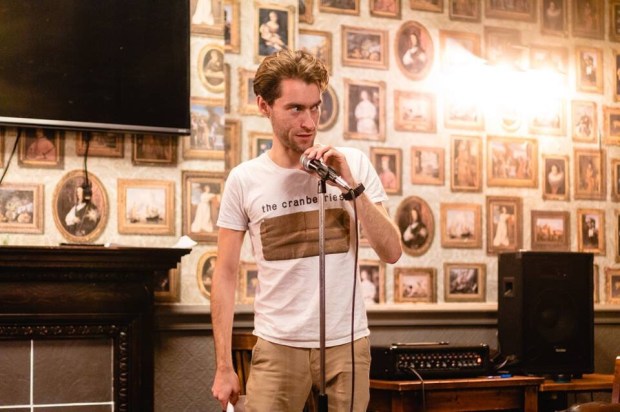
Today I interview Laurie Eaves. Laurie is one of my favourite poems and he was due to be one of our headliners this year at the night I run, Big Poetry. Alas, the lockdown worked against that.
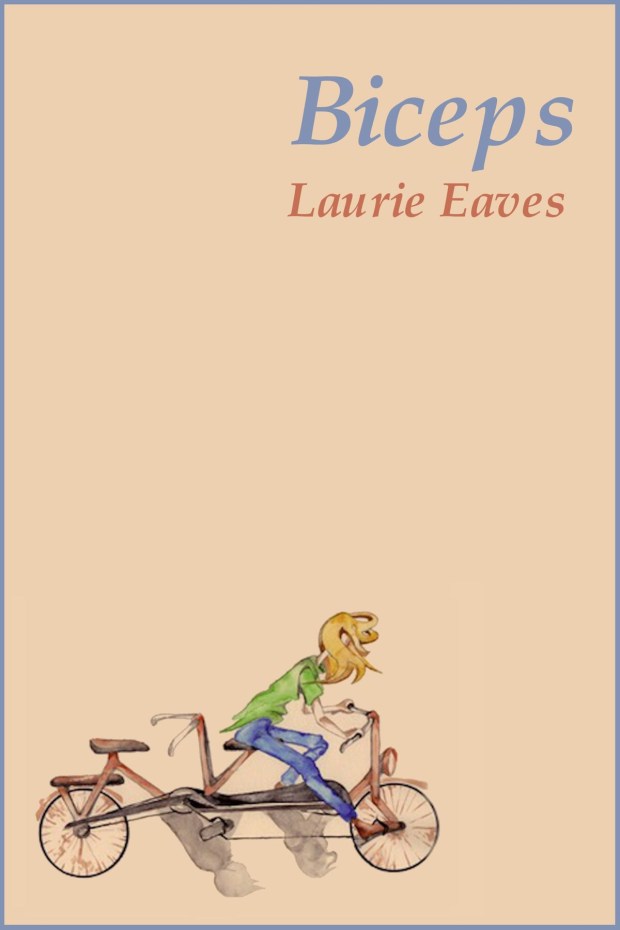
I’ve seen Laurie perform plenty of times on my trips to London and I was always struck by his mix of life, emotion, humour and the sensitivity and power of his words. His collection Biceps was recently published by Burning Eye and it’s an absolutely absorbing poetic description of a romance from start to end, a stunning piece of autobiographical poetry whose light touch belies the deep emotion behind its subject matter. It is a beautiful work.
I’m hoping still to have Laurie visit Torquay at some point, but for now, here’s an interview with him.
How did you get in to writing and performing poetry?
I started writing poetry way back in secondary school. My first one was called ‘Elephants Can’t Do Press-Ups’ and it was pretty awful – most of my poems at the time were just silly novelty rhymes that I mumbled too fast. In 2009 I moved to Norwich and found a very warm spoken word community. That’s where I first started performing proper gigs. At the time I did a lot of heavily rhythmic rap-style poems but over time I’ve moved further and further away from that – the new book, Biceps, couldn’t really be a lot further from that starting point. It’s very still, non-rhyming and more “pagey”.
Who were or are your major influences in poetry and performance poetry / spoken word?
I think my influences have shifted a lot over time. When I started out, I was mostly doing a semi-decent John Cooper Clarke impression. I was also thinking a lot more about the rhythms of my poetry than the meaning then and drew a lot on music for that. I was listening to a lot of hip-hop like Dream Warriors, Public Enemy and Kate Tempest back then but also nicking rhythms from prog bands like Tool, Dream Theater and Porcupine Tree and trying to emulate them with my mouth.
Music still hugely informs my writing, but in a very different way. Around the time I started writing Biceps, I got into a lot of US hardcore punk – bands like Minor Threat, Black Flag and the Minutemen whose songs each barely last a minute. You wouldn’t necessarily get that from reading the book, because tonally it’s not exactly raging punk… but the idea of trying to get an idea across efficiently and quickly is definitely there – very few of the poems go over one page.
Tonally, I’d say the book is closer to writers like John Osborne, Laurie Bolger or even Jarvis Cocker. The story is very intimate, soft and pretty kitchen sink. Caroline Teague described the book as “heartwarming and heartbreaking” which pretty much nails what I was going for.
How do you write? Do you have a specific method for writing? Do you write at specific times and places?
I do have a specific way of writing these days but it took me a very long time to discover it. I used to “make time” for my writing. I’d tell myself “ok, on Sunday you’ve got a couple of hours – let’s put that aside for writing.” Then Sunday would come and I wouldn’t do it. Something else would come up or I wouldn’t be in the mood or I’d just not do it. I didn’t have a lot of discipline around it. And after a while I realised I needed to snap myself out of that…
So in August 2017 I bought a tiny pocket notebook from Flying Tiger and started writing in it as a diary. I’d carry the book with me at all times and just write down what I was up to, anything unusual I saw, what I was eating – just anything. I burnt through the notebook in about a month and bought another. I’ve now got a big shelf full of those notebooks and I’ve written in them every day for nearly three years (except for three days when I was ill).
I know that 99% of what I write in the notebooks is rubbish. But there’s 1% in there that’s good and which I would have lost if I hadn’t written it down. So now when I do “sit down to write” or go to a workshop, I flip back over the latest notebook, see what I’ve written in there and use it as a jumping off point. The pen feels lighter because I’ve been writing anyway and I already have an idea to write about.
When did you decide to make a themed collection?
2018 was a year with a lot of change for me. On New Year’s Day, my partner and I broke up after seven years together. And my reaction to that was to write about it. A lot. It was a lot cheaper than therapy.
By April, I was still writing a lot. Not poetry really, just a lot of long free-writes, trying to process this new change in my life and starting to work out who I wanted to be in the world now. Then one Sunday, I went and had a pub lunch with my friend Laurie Bolger. I told her about all this writing I was doing. At the time I had no idea what this writing was – whether it was a play, a novel, a spoken word show, I just didn’t know.
Laurie said it sounded like it might be a poetry book and that I should go home, print out all these bits of writing and lay them out on my bedroom floor. So I did. Over the next few weeks I started to see the connections between all the pieces and that they basically fell into three categories: poems about making a relationship, poems about the relationship breaking up and poems about starting to rebuild as a new individual person. I started sorting them into those three piles “Make”, “Break” and “Build” and that structure stuck through to the final book. It’s your classic beginning-middle-end structure. Once I realised that, it became clear that I was writing a narrative poetry collection. It was very organic – I never sat down at the start and decided that’s what I was doing, I just stumbled into it.
Were the poems in Biceps written at around the same time, or over a number of months and years?
Of the 44 poems in the book, there are maybe four or five that existed in some form before 2018. By the time I consciously sat down to write the collection, the first poem “The Story’s Better When You Tell It” was a few years old. I knew I wanted that one in there because it fit the narrative and was also the first “page poem” where I felt I’d really nailed it. That’s why the collection starts there.
But the vast majority of the book was written in the first six months of 2018. It’s a very weird way to write a first collection. I think a lot of poets use their debut as a sort of “Greatest Hits”, which Biceps definitely isn’t. It felt risky – I know a lot of people who’ve seen me perform might expect a book of novelty rhyming poems – but I think the book is better because I pushed myself out of my comfort zone and focused on writing new material in a very different style.
Do you do a lot of rewriting?
Definitely. Honestly, I feel more like an editor than a writer at heart – I love pulling apart writing, seeing how it works, diagnosing problems and sticking it all back together. I love to edit for other writers and think it gives you a better understanding of how to improve your own work.
For me, the best writing communicates the thoughts in the author’s head into the reader’s head as clearly and concisely as possible. As I mentioned earlier, a lot of the Biceps poems started as rambling free-writes, so they needed a lot of work to cut down. The poem “Hull” started out as a three or four A4 page piece. That worked fine for a three minute slam, but made for a pretty boring read.
So the first big challenge for me was boiling the pieces down – making them more condensed and getting the language to be more efficient. We touched on it earlier, but I was listening to a lot of hardcore punk around that time. I was really fascinated by the way those bands would create songs that communicated a lot, often in less than a minute, and wanted to apply that same philosophy to my writing. “Why waste words?” was definitely a motto.
About three months after the infamous pub lunch, I had a draft that I was happy for other people to look at. I sent it to four poets I love and used their feedback to start redrafting. I worked on the manuscript pretty consistently until November 2018, working on it most days, before submitting it to Burning Eye. By the time I sent the manuscript I’d been through 10 full redrafts and about 30 “mini-redrafts”. I’m definitely not the most talented poet I know, but I like to think I make up for that through hard work.
Burning Eye took the book on in early 2019. That year I worked on it a lot less: I wrote 6 new poems to go in, but mostly focused on touching up the way it looked on the page. Form and layout definitely aren’t my strong suits, but I had some amazing advice from Roger Robinson and Amy Acre that helped pull it up a few notches.
All of which to say: yes, I do a lot of rewriting.
Did any poems on the same theme not make it in to the collection?
Yes, there are a few poems that didn’t make it in. At one point I was toying with the idea of doing a pamphlet called “More Poems About Break-Ups and Tidying” with some of the off-cuts… but the poems I cut were all for good reason. Either the idea wasn’t quite there yet or they were too similar to poems that did make the cut.
I originally had a run of three poems near the end of the book that just didn’t quite fit the story. When I first started the book, I thought those three were the best examples of page poems I had, but because of that I didn’t push them as hard on the rewrites. So by the time I really had to make decisions about the book’s direction they were suddenly the weakest poems and didn’t really fit at all. They had to go to make the book stronger overall.
There’s a prose poem in the book called “Check”, which almost didn’t make the cut. It took me a long time to write that piece – I couldn’t quite work out how to make it work, but knew it was an important beat in the story. It went through a lot of variations – at one point it was a sonnet, then a pantoum… it went everywhere. Eventually I realised: I was writing about quite a dark part of the relationship. I was writing about behaviour that was ugly and that I wasn’t proud of. Trying to force an ugly theme into a lovely poetic form wouldn’t work, so it needed to be prose. I’m really glad I managed to eventually make that one work – it pushed me and I think the book is better for it.
How did you feel once the collection was complete? Was it a therapeutic experience to talk about the relationship?
Was it therapeutic? Yes. I definitely feel like writing the book gave me a sense of closure and thankfulness about the relationship. But also I think it’s very easy to write badly about a relationship after it’s broken up – it was really important to me that the book felt like it was coming from a loving place and not feel spiteful or nasty about the other person.
The very first line of the book is “the story’s better when you tell it”, acknowledging that this is only one side of the narrative. There’s another, better version of the story waiting to be told. And the final poem in the book ends on a sense of thankfulness for the relationship, which was very important to me.
As for how I feel about the collection being complete… I don’t know. The book released a week before the UK lockdown, so I’ve not been able to tour it and hear what people think of the poems live yet. In a way it’s still not complete and I’m not sure it ever will be…
What has the reaction been to the collection?
So far people have been really positive about it. I’m really glad that it seems to be connecting with people – I’ve even had a few people who don’t really read poetry tell me that they enjoy it which is a real compliment to the work.
It’s funny to see which bits of the book people enjoy most – poems that aren’t necessarily my favourite seem to speak a lot to other people and that’s beautiful to see.
What are you currently working on, and what is your next project?
I have a few projects going on right now outside of trying to re-schedule the Biceps tour.
I’ve just recorded all the poems from Biceps as audio and have put them out on a shiny red cassette tape over on my Big Cartel page https://laurieeaves.bigcartel.com That’s been really fun to put together – I set up a record label for it called Buried Vinyl and I’m starting to think about a second release. I’m planning on doing a vinyl compilation album of poets I love for the next release, so I’m starting to put that together right now.
I’ve also started some “pre-production” work on a second collection which for now I’m calling “Get Human!” I have a few ideas I’m playing with for that at the moment, but I doubt it’ll be quite the “poetry concept album” that Biceps is.
The other big ongoing project I’m always working on is Dead Darlings Podcast which I co-host with Rebecca Cooney and Hannah Chutzpah. It’s a monthly poetry podcast with interviews, writing tips, book reviews and event shout-outs, which you can get wherever you get your podcasts. We’re coming up on our first anniversary and our latest episode has an interview with RikTheMost, who’s an incredible poetry tour de force.
I’m also starting to take on more editing work again at the moment – both for individual poems and manuscripts. If anyone’s reading this and is looking for an editor they can drop me a line on https://www.laurieeaves.com for a chat.






 Robert Garnham