Over the last ten years I have had the privilege of performing all over the UK (and Berlin and New York), at some of the biggest performance poetry nights in the country, as well as fringes, festivals and theatres. And during this time, invariably, I have recorded my set, except for the times when I was too nervous and I forgot to press the on button. (Which usually happens on a night where things have gone amazingly!)
Like every other performer in the country, I have really missed going out and about and standing on stages this year, so I’ve used the time as an opportunity to plough through all of these recordings and find the very best ones. With the help of Bryce Dumont, I’ve crafted these into an album named after my show, Juicy.
While I was putting the album together, I realised not only how much I missed performing, but also how wonderful some of these nights had been, which I probably didn’t recognise at the time due to my usual performance nervousness. Nerves was the reason why I forgot to press play during my gig in New York, but it did go very well indeed. You’ll have to take my word for it!
Featured on the album are a couple of amazing recent gigs. The first was at the Arnolfini in Bristol, supporting Disraeli at Raise the Bar. There was an audience of over two hundred and they seemed to like what I did. Indeed, rock and roll animal that I am, after the gig I went to a 24 hour supermarket to do my shopping and met some audience members in the bread aisle, who were very complementary.
Another cracker of a gig included on the album is Scribal Gathering in Milton Keynes, a big audience who were very reactive and welcoming. However perhaps the most special gig was in my home town of Brixham, at the theatre. It was a rainy night and when I walked out on stage, there were two hundred people. It went amazingly well.
Right now, in the depths of the Covid crisis, performing on a stage in front of people seems a long way off and something that happened in a previous life. I can’t wait for things to get back to normal again so that I can be up there once more.
And just a word on the title. ‘Juicy’ was my solo show from 2017 which I took all round the UK and to the Edinburgh Fringe where it received lots of press and radio attention because one of the lines from it being mentioned in the Guardian as one of the funniest of the fringe. And yes, that line is included on this album.
The album is a tribute to those comedians who I used to listen to when I was growing up, their vinyl albums conjuring a world which I wished I were a part of. Bob Newhart, Steve Martin, Shelley Berman.
There has been talk lately in spoken word circles of the direction that the movement has been taking over the last decade and how it has shifted away from the scene that existed in the 2000s and before. Many have cited the influence of slams and American slam culture, others have pointed out that spoken word has become more literary and closer to page poetry, with the emphasis very much on words and use of language. And while neither of these are bad things – (my own philosophy being that it is what it is) – I do ponder every now and then on how it used to be.
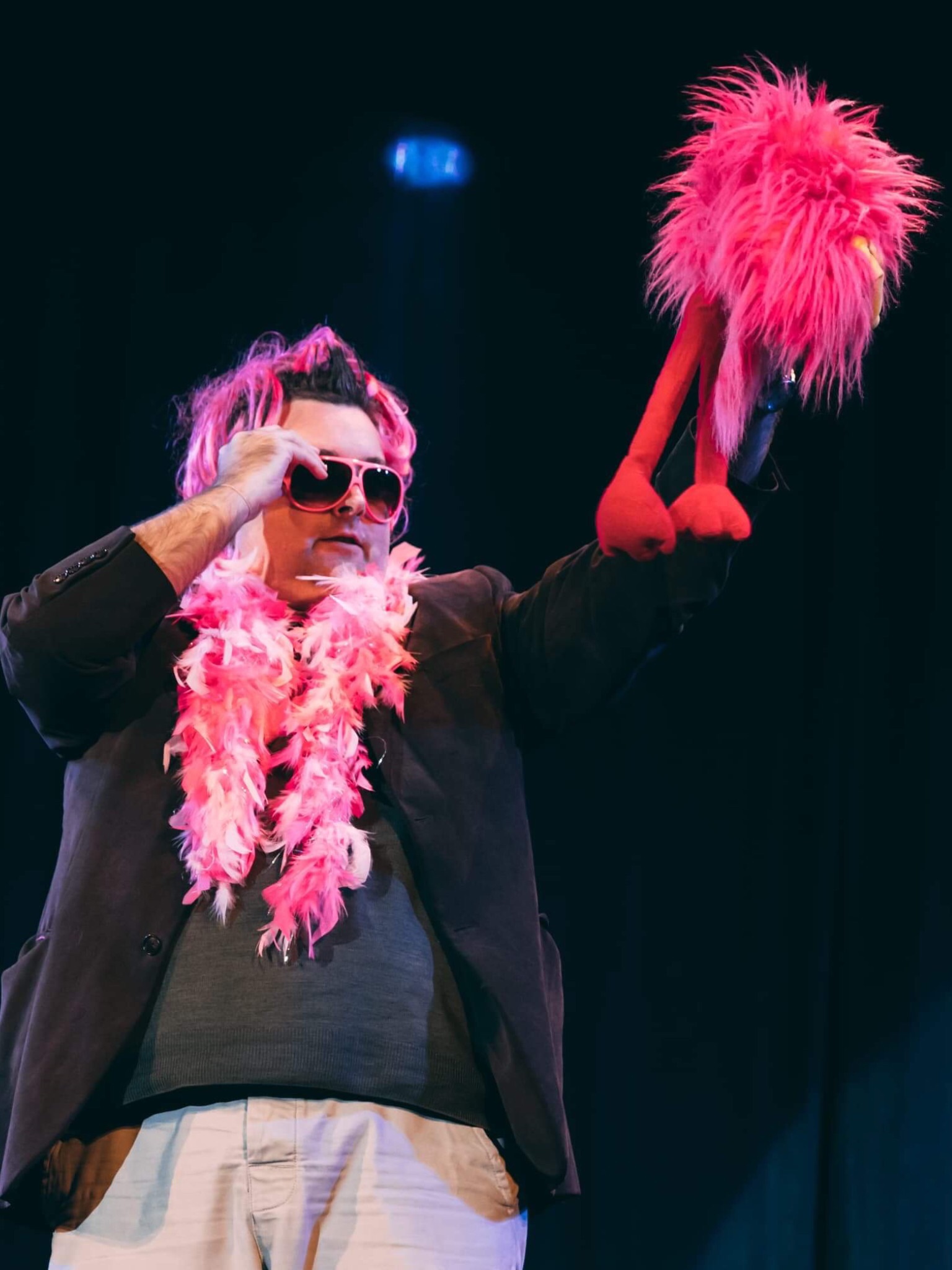
I’ve spent the last twelve years or so performing all over the UK and during this time I have honed my regular ‘set’ down to what seems to work best on stage. My poems are mostly humorous, and rely on conventions of stand-up comedy and a certain approximation of what poetry should be contrasted with what my poetry actually is. There’s a bit of prop work and an awful lot of silliness. And some awful silliness. And people seem to like it.
As Pete Bearder pointed out in his wonderful book about the spoken word scene, ‘Stage Invasion’, ‘Many older poets I have spoken to have lamented the loss of diversity in British performance poetry that was previously known for its humour and cabaret quirk’. He goes on to mention performers such as Rachel Pantechnicon, Chloe Poems and AF Harrold, who were at the top of their game back then and were the zenith of the performance poetry scene. Reading between the lines, the question seems to be, ‘when did performance poetry get so serious?’
Over the last year I’ve been working on a spoken word / music collaboration called Croydon Tourist Office, led by my friend Bryce Dumont, who used to run the Epicentre Cafe in Paignton where there was a monthly spoken word night. It was at this time that the spoken word scene was still heavily influenced by a cabaret style where anything went, where most performed created a character on stage, and authenticity wasn’t as important as it has now become. Or indeed, maybe the creation of stage personas actually accentuated the authenticity of the performer. Who knows?
Anyway, Bryce had been diligently recording every set that I performed back then and he emailed me a link to all of the material. Several things struck me. First of all, the poems weren’t as good as I remember them, but hey, I was only just starting. Secondly, my linking material was much better than I remember it being. Thirdly, my performance voice was much, much slower than it is now. (This was before I’d even heard of poetry slams and the necessity of cramming everything into under three minutes). And fourthly, wow, I certainly did some weird things on stage!
When I first started performing back in the late 2000s, the local scene was heavily influenced by comedy and surrealism in south Devon, and I soon joined in with a bizarre mix of my own, of prop-based avant gard and whimsical verse which, at the same time, mocked the whole idea of poetry performance. And for a while, this was my Unique Selling Point. And although I wore seemingly normal clothes on stage, I was very much a persona, the Professor of Whimsy, an exaggeration of my actual self.
So here are some of the incredibly bizarre things that I did back in those formative years, 2008-2012:
1. Used a mobile phone to deliver my set from a cubicle in the toilets.
This was fun. I set up a mobile phone I’d borrowed from a friend behind the mic. I put it on speaker phone and then called in my set while pretending to have raging stomach ache from the toilet at the rear of the premises.
2. Built a cardboard robot called Robot Garnham on stage and let him do my performance.
This was also fun. I operated the robot via a fishing rod from the side of the stage. And then at one moment I sat down and read the paper while the robot performed. It was really weird. People were facing the robot and laughing.
3. Phoned a friend halfway through a set to ask him what my next line was.
I had no idea if this was going to work. Again I used the speaker phone. A friend was at home with a copy of my poem. He fed me the lines down the phone.
4. Performed a set of Pam Ayres poems through the window from the street.
So the premise of this was that I’d orchestrated a row with Bryce. I said that I was going to perform some Pam Ayres poems and he pretended to physically throw me out of the cafe. I then proceeded to do a whole set of Pam Ayres poems through the glass windows from the darkened street. And people were walking past and I’d interrupt my performance to say hello to them.
5. Pretended to drink Pam Ayres urine after pretending to choke on a cream cracker.
Just the usual performance. I’d started the set by announcing that I’d gone to the doctors and Pam was in the waiting room, and that she had misunderstood when I said that I was a fan of her work. She got in a mood and left, but accidentally left behind her urine sample. I then performed a poem while eating a cream cracker and halfway through faked that I was choking. Of course, the only thing to hand was the Pam Ayres urine, and down it went in one gulp. The audience reaction was amazing. It was actually cold tea.
6. Performed a whole set with a tea bag sellotaped to my forehead.
Still no idea why.
7. Performed the same poem twice in a row with no explanation.
Which was fun but then at a gig a few years later one of the performers was so drunk that she actually did this, so now I’m a little embarrassed. Perhaps I should perform the same poem three times?
8. Tried to get inanimate objects to race each other.
OK, so this was my performance art piece, ‘Static’. I’d start by tuning a radio to static, and then placing these objects in a line on a table. I’d line them up and then wave a flag while keeping my finger on a stopwatch. Obviously the objects did not move. I tried this three times, then removed the objects, turned off the radio, and went and sat down in my seat.
9. Built a large hadron collider on stage.
Taking a length of garden hose, and a custard cream on a saucer. I’d eat half the biscuit, then pick up a crumb, and blow it through the garden hose, putting the two ends together and then taking a photo with a digital camera. I’d repeat this three times, and then use my laptop to show pictures of the atoms smashing together.
10. Got a poet to dress as a spaceman and pretend to interrupt my set as visitors from the future intent on making sure my rise from obscurity did not occur,
You read that right.
11. Got an eminent and well respected page poet to perform Lady Gaga’s Bad Romance as a poem.
That was a beautiful evening. James Turner was the well respected poet. He did his research thoroughly and even sent me a critique of Lady Gaga’s lyrics.
12. Stood behind another poet as he performed and ate crisps, noisily, while staring straight ahead.
Not much else to add here.
13. Performed while standing on a hip exercise swivel disc.
That was fun, because the more I swivelled, the more I turned around to face the rear, so I kept having to frantically swivel to face the audience again. I’m still not sure why.
14. Performed through an iPad which I held up to my face while wearing a large box on my head.
The box was covered with fairy lights and tin foil. The iPad was showing a video but it was just my face. It was surprisingly effective. I’ll have to do this again some time.
15. Dressed as a crocodile, which had nothing to do with my set.
Nor did I refer to it during my set.
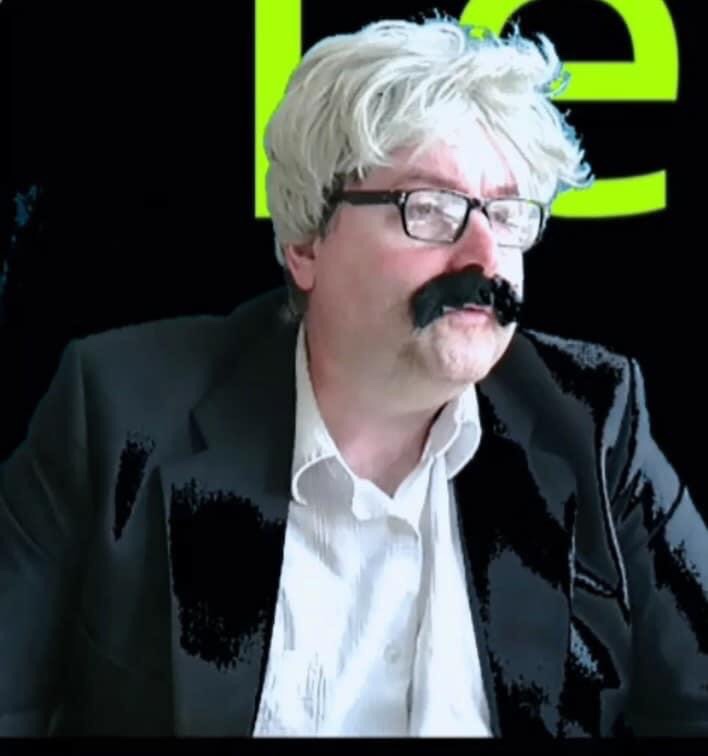
16. Wore a fake moustache which slowly moved around my face.
Halfway through the set I took out a large piece of paper and held it up and subtly moved the moustache every time I hid behind the piece of paper, which I was pretending to read from, and then pretending that I didn’t know why the audience were laughing every time I looked out from behind the big piece of paper.
17. Performed the Pet Shop Boys song Two Divided By Zero on a talking calculator.
You’ll find this funny if you know the song.
18. Used an Elefun toy game to blow small pieces of crepe paper with poems written on them into the air.
This worked amazingly well. Elefun is a plastic toy elephant that has a fan in it so it blows pieces of paper out of its long tubular trunk. And it was fun because the pieces of paper blew up out of the toy elephant’s trunk quicker than I could read them, plus I was catching them in a small net so most of the time was spent flailing around with this tiny net trying to catch and then read the small pieces of paper on which the poems were written.
19. Hired out my five minute set to another poet who wasn’t on the bill.
Inspired by a ‘gallery within the gallery’ which used to be at Tate Modern, if you’re interested. I can’t even remember who the poet was. I mean this was back in the day, so it wasn’t like anyone had come just to see me. But you should have seen the look on the host’s face. Plus I made ten quid.
20. Read a poem from an incredibly large piece of paper.
And I mean, really, really big. Which meant I’d spent the previous evening sellotaping together six incredibly large pieces of paper to form one huge humongous piece of paper.
Maybe I should be more adventurous and go back to these days. It certainly was fun. When I first started performing I received a lot of wisdom, advice and encouragement from Rachel Pantehcnicon and she told me that if she could change anything about her career, it would be that she would have less props that she had to lug around the UK. I suppose this was struck home for me when I had the pleasure and honour of supporting John Henley at a gig in London. Indeed, it would be just the two of us all evening. Willing to make a good impression, not only did I cart up on the train the biggest box of props you’ve ever seen, but also a table to put them on, which I then had to transport across London on the tube! After the gig I was so knackered that I just left it backstage at the theatre. I wonder if they ever wondered where their extra table had come from . . .
As I say, times have moved on, and maybe that’s not a bad thing. Or maybe it is. Who am I to judge? I do pine for the days when an evening out at a performance poetry gig (as they were called back then, no ‘spoken word’), could entail anything from performers getting absolutely naked to reciting poetry while standing in a paddling pool filled with jelly. Both of which, incidentally, I’ve seen. It was all a little rough around the edges, and most of the performers had stage names, and everyone was absolutely unique in their own quirky way, and the emphasis really was on comedy and spectacle, and at the end of the night you knew you’d seen something amazing. Audience expectations may be different these days. I just hope I somehow remain myself as a kind of bridge between the past and the present.
Feel free to support the work I’m doing by leaving something in my tip jar or buying me a coffee right here https://ko-fi.com/robertgarnham
On a drizzly, wet and windy day the week before last, I went down to Brixham harbour with film-maker John Tomkins and my producer Clare Parker, and we filmed general scenes of the harbour and myself reading some of the poems from my Squidbox collection. This really was a case of suffering for my art! Wearing two coats, and soaking wet, and with the rain rolling down my neck, I was filmed in a variety of locations around the harbour. Just another crazy poetry adventure!
It’s been a wonderful summer being paid to write poems, which is not something that normally happens. I’d like to thank Torbay Culture for the opportunity, and the Arts Council who provided the funding. It was fascinating learning all about the history and culture of Brixham and the importance that the fishing industry has on the town and the people who live and work there.
Comedy performance poet Robert Garnham spent the summer of 2020 getting to know the town of Brixham and its fishing industry, and what that industry meant to the people of this evocative Devon port. Meeting people whose lives and livelihoods depended on the catching of fish, and learning about historic events, Robert used his trademark humour to draw out the unique character of an iconic town.
Slain McGough Davey asked earlier this week why certain people feel compelled to make art and gave some reasons of his own, and this got me thinking about what I do and the reasons why. And then a couple of days later an article appeared in The Guardian which suggested that comedy is not seen as artistic or as worthy as more serious fare, and pointed out that it should be held in the same esteem, as the effort gone into making funny comedy is just as strenuous and as hard as so-called ‘high’ culture.
My one aim whenever I sit at a desk or stand in a rehearsal space is to make something that will make people laugh and enjoy themselves, and take them away from their normal daily concerns. Indeed, there can be no more rewarding sound than that of an audience laughing along with a poem or some humorous linking material or on-stage buffoonery.
I remember my first ever gig, in 2009. I was incredibly nervous, and I had spent the month before writing a couple of ‘humorous’ poems, which I’d typed out on big sheets of paper. I remember my hands shaking as I read the poems out, but the nervousness seemed to disappear once it became apparent that the audience was laughing at all the parts of the poems that I had thought were funny. It was a life-changing moment, because it meant that the sense of humour which I’d thought was unique to myself could be translated into laughs from an audience.
I look at the poems now and cringe, because they weren’t as fully formed or as realised as the ones that I now perform. In other words, parts of them went on and on for a bit. They were badly in need of editing, but those nuggets, those golden lines and phrases which had the audience laughing, still exist.
These days I work on poems for weeks, months at a time, before they are unleashed on an audience. In a way there’s more pressure now, because the audience expects to laugh and I have to live up to that expectation. I have a phrase I use whenever I’m writing, ‘This poem needs to be 33 percent funnier’. I don’t know where I got the figure of ’33 percent’ from, but it’s a good mantra to have at the back of my mind whenever I’m writing.
The poem really comes alive during the rehearsal process. It is at this time that I have a pen on hand, going over lines and refining them, making them funnier, adding attitude and tags to maintain the laughter, or build up the suspense only to pop it.
Regular attendees of my gigs will know that there’s always a serious undercurrent to a lot of my poetry. Indeed, comedy performance poet is the ideal manner in which to address certain subjects such as gender representation, heteronormativity and, in my most recent new slam poem, homophobic abuse. Taking the audience by the hand and guiding them through tough subject matter while making jokes, (and not punching down or being mean or unkind), and then getting a laugh or two along the way, as an immensely satisfying feeling.
It’s true that I’ve been told, only by a couple of people over the last few years, that comedy performance poetry isn’t as worthy or as well-crafted as the more serious end of the spoken word spectrum. And this is a shame, as one of those comments came from a poet who I really admire. In the context of a gig or even a slam, a poem which encourages a laugh from the audience is somehow seen as ‘cheating’, while comedy performance poems are just slung together with no artistic merit. The truth is, as any comedy performer will tell you, a lot of work goes into placing the words in the exact order to elicit that response, and a lot of work also goes into the rehearsal of those words, movement, facial expression, emphasis. If art is judged by the amount of hours that goes into its creation, then comedy performance poetry is right up there with anything else.
And because of this, I only ever perform a tiny amount of what I actually write. When it comes to being performed, my poems probably have a one in ten chance of ever making it in front of an audience. Those that don’t are prodded, poked, re-worked, or sometimes simply torn apart, the juicy, funny lines being extracted and popped into other poems.
So, why do I do what I do? For a start, it’s probably the only thing I’m halfway decent at. I can’t cook a quiche to save my life, or put a fuse in a plug, or even catch a bus on a good day without causing absolute bloody mayhem. But I can write and perform comedy poems that make an audience laugh.
And secondly, there’s no greater feeling than getting off a stage with an audience clapping and cheering because you’ve just made their evening. I remember Bristol last year, performing at the Arnolfini Theatre and then, rock and roll monster that I am, I found a late night twenty four hour Tesco and did my shopping. In the bread aisle I came across a couple of people who had been in the audience and they thanked me for making them laugh and cheering them up. And that, oh, that was probably the highlight of my year!
Feel free to support the work I’m doing by leaving something in my tip jar or buying me a coffee right here https://ko-fi.com/robertgarnham
Welcome to my Ted Talk
(My clicker isn’t working)
Welcome to my Ted Talk
(My clicker isn’t working)
How are we going to solve
Various big big things?
Three golden rules!
(Shame about my clicker)
Coming in to the coffee shop
I’m the bastard looking for
A power socket
Charging up my laptop
Charging up my laptop
Charging power to power my
Power point presentation
I have the power!
If I do this
(:::::::::::::;;;:;;)
You’ve just witnessed me doing it
And that’s an example of
POSITIVE THINKING!
Three golden rules!
1. Achieve the continuous
2. Apply it like a haberdasher
3. Can be split into twenty four subheadings
(This clicker is not working!)
If I put my hand in my pocket
And wander around
It makes me look more relaxed!!!
You’ve got to understand
That people
Always make
The wrong decisions.
Welcome to my Ted Talk!
Smug!
Life hacks!
(Fourteen different subheadings)
You can usually work out EXACTLY where
The bus will stop
And this will save you
TIME and ENERGY
There are eight different things I learned
SMUG BASTARD
When I lost my luggage while backpacking
(This clicker is just not working)
If I do this
(;;;;;;;;;;;;;;;;;;;;;;;)
It’s an example of sonic dissonance.
Madam, when did you last knowingly
Have spaghetti?
MY BOAT SANK!
And I didn’t even get slightly wet
My life is charged with a new purpose
I learned twelve new things!
Twelve new LIFE HACKS
LIFE HACKS
LIFE HACKS
LIFE SUCKS!
(This clicker is getting on my tits)
1. Technology
2. Murdering people is generally frowned on.
3. The power of positive thinking!
4. This clicker this clicker this clicker this clicker
5. I know six people called Ted and they all talk
Power point presentation validate it
Power point presentation validate jr
Let’s just validate if shall we?
This is an aha moment
Here’s a silly poem about going to Paris and having a miserable time and trying to break up with someone but you can’t because the metro is too noisy, and by the way, I’m using a salad spinner to mimic the sound of the metro. Apart from that, normal poem.
In 1996 I moved with my parents from Surrey to Brixham. My parents had come down to Brixham during the 1960s for various holidays and they had always loved the place and its people. They had always said that they wanted to retire there. I came with them, and the whole place felt like a different world. I immediately fell in love with the history of the fishing industry and the traditions of those families who had a long association with the sea.
I moved away from Brixham in the year 2000, but I have continued to visit every single weekend, using the room at the back of my parent’s garage as a makeshift rehearsal room as my career as a comedy performance poet grew. When the chance came to write some poems on a themed idea, funded by Torbay Culture through the Arts Council, I jumped at the chance to learn more about the Brixham fishing industry and the people who work within it.
With the help of Clare Parker, my producer, I was able to infiltrate this world. I spent a little bit of time on a trawler, (in the harbour, though; we didn’t go anywhere!), and I interviewed trawlermen and people associated with the industry, as well as locals to get their view on what the fishing industry meant to them. I was also able to go behind the scenes at Brixham Museum and chat with Anna Kisby Compton, the curator, about the role that women played in the history of the fishing industry. I was also deeply inspired by Samantha Little’s book, ‘Battling Onwards : The Brixham Fishing Fleet 1914-1918’, published by Brixham Museum. I also spent some preparation time chatting with John Hegley, a much more accomplished comedy performance poet, who gave me some ideas on how to approach the project, and who suggested poems I might read or listen to by way of inspiration. Finally, I chatted with Maggie Duffy, Brixham-based singer and songwriter, whose extensive knowledge and understanding of the town and its people were invaluable.
I have recently published these poems in the form of a pamphlet which, for now, you can order from Amazon. The whole project has been an incredible learning experience for me and has left me with an increased understanding and affection for the town of Brixham.
I’ve had a great month (and summer) getting to know the people of Brixham and writing poems about their fishing industry, its importance, history and culture.
We are Brixham
Amid the pontoons and jetties, the wind whistle
Through yacht mast rigging,
The stone breakwater a loving arm,
The harbour calm.
Amid the trawler bustle and diesel throb, the hum,
The roar, the continual movement,
Night-lights of long-distance trawlers
In their humdrum heroic return,
We are Brixham.
Amid the labyrinthine narrow lane cottages kissing
Face to face over alleyway cobbles,
Amid the crafty cats and shoals of sprats,
And bearded trawlermen in blue cloth caps,
Amid the grind and wheeze of autumn’s first breeze,
Of chilled fingers numbed by winter’s first freeze,
We are Brixham.
Amid the rust and plants and smuggling haunts
And quayside pubs where sea legs find their own solidity
On the moving deck of life itself,
Amid the gift shops and chip shops and ship hulls
And sea gulls and old father time his
Beard soaked in brine,
We are Brixham.
Amid the local lore, the drunk pub bore,
The concrete remnants of the Second World War,
The plastic floats, the high-viz coats,
The loaded totes from chugging boats,
The sea serene, the sea-scape scene, the holiday dreams
Of vanilla ice cream, the trawler beams,
The harbour walls, midnight pub brawls,
The pirate ghost ghouls, the mechanic with his tools,
The people, the town, the community and life,
We are Brixham.




 Robert Garnham