I’m only happy when it rains.

I’m writing this on a very rainy morning. It’s a Saturday. I’m writing this at my desk which is next to my window, with the windows open a little bit. The rain is beating against the window and I can hear the gutters gurgling and the remaining leaves in the tree roaring in the wind. It’s dark, murky, and misty. The surrounding hills are shrouded in mist as the rain pummels this little seaside town.
And do you know what? I absolutely love it. And I always have done.
Rainy days have always felt special for me. Ever since I was a kid, I knew that a rainy day would be a day when you didn’t have to go outside at lunch time at school, that you would be able to sit inside and be creative with bits of paper or, in my case, write stories. I loved writing stories when I was a kid and a day which passed without the opportunity to do this was always a sad day. Rainy days were special.
And as I’ve grown up, a really horrible rainy day has still felt special, even though I’ve worked in shops for years and rainy days are bad news for the retail sector. Every time it gets gloomy and starts raining, I feel an urge deep in myself to sit at a desk next to a window and just write. It’s what I’m doing right at this very moment.
I’ve often wondered why this is. I was never an athletic child, so I never felt the need to go and run around a playground, or play football, or to be all manly and masculine with all the usual accoutrements of the sporting elite. For me, true prowess came with a pen and paper and the imagination, and the rain helped me to do this. I’m like one of those formula one drivers who always does well when it rains, I felt. A rainy day has always been a special day.
I’ve always had an affinity with the rainforest. I’ve always wanted to visit that place in Venezuela where they have thunderstorms every afternoon. Not for me the holidays spent in the sun lying on a beach, I’d much rather be somewhere rainy, like when we were kids and we’d go down to Bognor and sit in a car on the edge of the beach, with the windscreen wipers wining, looking out at the angry sea as the rain fell. The rain pummelling on the car roof. Those were ideal holidays.
So that’s why I writing this. Because it’s raining. And soon it will brighten up, which is a shame. One of the songs I’ve always hated is that one which goes ‘I can see clearly now the rain has gone’. I’ve always found that a really depressing song.
  

On having a sofa phobia.

During a performance in Plymouth the other night, the host encouraged the poets to talk about fear and what it was that each was afraid of. Ever since I was little I’ve had an irrational fear of sofas.

I have no idea why this is. The look of a sofa, to me, is really quite disgusting, so much so that it becomes a hindrance especially when people want you to come round their house. I do not have a sofa of my own and I doubt that I ever will, and I can’t even watch a sitcom or a soap opera if there is a sofa present on screen.

I go around to visit friends and I just kind of linger. Either that, or I sit on a kitchen chair. The worst thing about dinner parties is that, eventually, the host will say something like, ‘Let’s all go and sit in the living room’, and sure enough they will have a sofa, looming there with all its evil intent, and I will shudder inside and try to summon up some courage. It’s why I don’t go to many dinner parties.

I cannot describe how disgusting sofas are. It’s the cushions, primarily, and the fact that they are so big and cumbersome, and that people sit on them and eat and generally live their lives on sofas. The worst thing of all – and this really does give me the willies – is when you are on a train and you see abandoned sofas in people’s back gardens. It really does make me feel quite queasy.

At the moment my favourite art gallery in Torquay is having an exhibition of abstract art, the centrepiece of which is a giant sofa covered in graffiti, and there is no way that I will be going there until after the sofa has gone. I saw a picture on the internet and it was like being slapped in the face.

My sister thinks that this bizarre phobia goes back to when we were kids, and there was a particularly nasty sofa at a relative’s house, sitting on which felt like you were being eaten by a big cushiony fabric-covered monster. This might be true, but I think the real reason is that even before this, when I was a baby, I remember having jelly and dropping some on the sofa at my Uncle’s house. I remember being upset because the site of that jelly on the sofa was so disgusting, and I remember people fussing around reassuring me that I would have some more jelly, and me trying to explain that this was not what I was freaking out about. I’ve always hated jelly, too.

Coffee shop sofas are okay so long as I sit directly in the middle of them. So is the sofa at Tim’s house, a good friend and poetry colleague. Again, so long as I sit directly in the middle, equidistance from the arm rests. (Just typing this is making me feel sick).

So there I was on stage in Plymouth the other night, talking about my sofa phobia, and the audience was laughing, when a woman said that yes, she completely understood, and that she, too, had a sofa phobia. ‘Is it the cushions?’, she asked. Yes, I replied.

Because of that I feel able to write about this now. It’s an unusual affliction and quite humorous to the uninitiated, but it’s real, and I thank you for your support in sharing this with you.

I’m going to go for a lie-down, now.


What did I learn from my two and a half days at the Edinburgh Fringe?

What did I learn from my two and half days at the Edinburgh Fringe?
Unlike my friend Mark, who’s bald, Edinburgh Festival has a humdinger of a fringe. Every year I go along and every year I’m astounded not only by the variety and the general craziness of the place, with every nook and cranny turned into a performance area, and every footpath filled with flyers, barkers, publicists, posters and people, but also by the intense hard work put in by those who have shows there.
I was in a show this week. It wasn’t my show. I was a guest in someone else’s, and that kind of meant that I didn’t have to do any flyering. The guilt I felt at not doing this seemingly simple chore was far outweighed by the relief that I didn’t have to spend all morning standing in the Royal Mile speaking to complete strangers, or leafleting similar shows, and talking, talking, talking about it.
You see, that seems to be the knack. If you can summerise your show in just three or four words, then you can save your breath and get everything out as the tourist walks straight past. ‘Its a show about a man who realizes halfway through his driving lesson that the whole world is counterfeit and that he is just a figment of the imagination of a dog owned by his brother in law’, won’t do. Better to say, ‘Imaginary dog show with fart jokes’.
I went along to a few shows and three in particular stood out, not only because of their subject matter, but also because of the work put into them to promote and engage with the audience. AJ McKenna’s Howl of the Bantee affected me deeply, it really is one of those shows which changes the way you think. Excellent performed, thought provoking, incredibly well-written, I could not fault it. The only problem seems to be that it has been put in a venue a little outside of the city centre in the new town area. The show is timely, honest, angry, looking at the media portrayal of transgender issues and the dangerous labeling of anti-trans thought as ‘banter’. You will learn something from this show.
The second show which affected me was Dominic Berry’s Up Your Game : The Downfall of a Noob. A comedy / music / poetry show about Dominic’s self realization through gaming and computer games, I was hooked throughout due to the humor, the energy, the storyline and the promise that Dominic might get his kit off. (Actually, I only discovered the nude part of the show afterwards, and it just happened to be the night I came that Dominic had decided to drop that element from his show). Funny, philosophical, wise and sexy, the show spoke to me and stayed in my head for days afterwards.
There are other good shows, too, of course, in the spoken word bracket. Rob Auton’s Water Show is a highly polished, funny, thoughtful piece, as you would expect from a performer for whom I have the most incredibly respect. Tina Sederholm’s show is mighty, thoughtful and incredibly well put together. I’m so totally in awe of her performance style and general oeuvre, and I’m glad that it was she who was crowned Swindon Poetry Slam Champion all those years ago beating me in the final! She oozes talent and class.
I came back too soon. I’m so glad that I went along. I really don’t think I could manage the whole three weeks, unless I were financially secure and had help from others. It’s this help which seems to be a part of the spoken word community at the fringe, with all the poets and performers seemingly sticking together and helping each other out. I spent a very fine afternoon in the bar with Matt Pernash, aka Monkey Poet, chatting and laughing, drinking and writing silly poems, drinking and listening to music, drinking and chatting about all kinds of stuff, and drinking. Indeed, the highlight of the fringe for me was persuading him to perform the outside of a crisp packet. Actually, he didn’t need much persuasion. I could have spent the day just listening to him talking about his poetry adventures!
So, what did I learn from the fringe? That it’s the hard working poets who seem to achieve the most success. Which, I suppose, is a way of telling myself that if I want to go next year, I’d better start working on it now! 


On being a poet at Womad. An ode to Wellington boots!

The Maori log drummers kept me awake last night. I mean, they might not have been Maori log drummers, but that’s what they sounded like. Womad does strange things to you. Yesterday, as I was walking through the campsite, I thought I heard a new Tibetan wind instrument made from yak’s horns and twigs belting out some kind of rhythmic shamanic hymn to life itself. Only it turned out to be some bloke pumping up his inflatable bed.
I think I’ve gone native. This morning, I almost went to tai chi. Instead I went to a tea shack. The pelting rain hammered on the canvas roof. I was surrounded by tea lights, lanterns, rugs, shabby chic tables and chairs. The radio was playing Leonard Cohen. I pondered on what a death trap the place might be if the tea lights got too close to the Mongolian fabrics draped in each corner.
I knew nothing of Womad before I came, except they it sounded like Gonad. And how incredibly grateful I was to be asked. For the last three days I’ve spent time with some of the finest performance poets in the country. Vanessa Kisuule, Matt Harvey, Scott Tyrrell, Chris Redmond, Jonny Fluffypunk. I arrived with Lucy Lepchani and we immediately ran into difficulty trying to erect her tent. Mr Fluffypunk came over, took one look, hammered a few tent pegs, and the whole thing looked much better. That’s the spirit of camaraderie in the poetry camp.
The poetry tent is listed last in some of the Womad promotional material. And my name is listed last in the poetry tent promotional material. Every morning, when it walk into the main arena area of the festival and see the massive stages and the tents and the flags and the stalls I think to myself, ‘I am the lowest ranking performer here. And it feels great!’ There’s probably far less pressure than being the headliner.
Yesterday’s poetry headliner was MC Dizraeli. He’s someone I wanted to see for a long time since listening to him on a cd about ten years ago. And the highlight of my festival so far has to be that he performed his hour long set in front of a crowd of about three hundred people while sitting on MY camping chair. In fact, as I type this, I’m sitting in it right now. It’s a story to tell my grandchildren. If I hadn’t brought the camping chair with me, then MC Dizraeli would have had to stand.
I’ve spent every day so far in the poetry tent, watching the performers. My own sets have been well acclaimed, and I’ve been stopped by several people who have seen me perform and liked it. That’s what makes a difference to a performer, the knowledge that someone has been touched, no matter how briefly. It was sunny yesterday and we performed outside in the ‘arboretum’. They laughed in all the right places and I felt that I could have taken on the world!
It’s raining again today. I’m not going to be wearing a jacket and tie, like the last couple of days. I shouldn’t have worn cream colored trousers, that mud is just not going to come out. The Wellington boots are just about the best thing ive bought in ages. I was watching Bellowhead the other day, they were performing on the main stage, but all I could think was, ‘I’m so glad I bought these Wellington boots’. When I get back to the real world later on, I probably won’t wear them until the next festival. But right now they are everything. Mainly because my sneakers are buggered after all that rain the day before yesterday.

I’m a poet and I’m not at Glastonbury.

Hello.I’m a poet, and I’m not at Glastonbury.

Not many poets are at Glastonbury so it’s really not a surprise that I’m not there, and to be honest, I’m not sure if I want to be there because it’s all on tv anyway. It’s a bit like going to a motor race. You miss most of it if you actually go, and then there’s the traffic jams to contend with, and the last time I went to a motor race the person in front of me kept smoking a pipe.

But afterwards I was able to tell everyone that I’d been, and there was something about the sounds of the cars that made it all worthwhile.

Glastonbury comes round every year. And the tv schedules fills up with coverage and there are some damn good bands but most of them I’ve never heard of. That’s probably because I’m getting old, and Ken Bruce only plays certain types of music these days. I’m rather excited about FFS performing on Sunday, but I expect they won’t put it on tv.

The thing is, though, there’s a poetry stage there, and the poets who get picked are always seen as the cream of the crop, the best of the best, the up and coming and the big names, and part of me wants to be listed among them even though another part of me knows that I probably aren’t as good as they are. They’re all young and trendy and enthusiastic and I’m only one of those things, or they’re older and more established and worshiped and I’m only one of those things, too. 

So they haven’t asked me to go and perform at Glastonbury. They wouldn’t even let me be the person who says ‘One two one two’ before the proper poets come on. Because apparently that counts as a poem.

So I’m caught in this weird mix of not wanting to be there at all, and wanting to be there. I know that if I was there, I’d probably show no interest in the music or the camping or the activities or the subculture or the alcohol or the whole ethos of it, though I probably would make a handy reference map for the other performers of where the best burger vans are. Is probably just mooch around the poetry area like a ghost. Muttering under my breath. 

I’m not at Glastonbury this year. In fact, I’m at work tomorrow, and I’ve got to do the Saturday figures and there’s loads of stuff needs doing in my day job, and I think there’s some motor racing on tomorrow on ItV4.

I’m not at Glastonbury.

But I went past it on the train, once.

Builders in Sicily found these ancient texts. You wouldn’t believe what happened next!

As you know, I have always seen myself as something of an innovator in the field of poetry. Aided by the eminent Professor Zazzo Thiim, I have explored the heights and the depths not only of poetry but also spoken word. Interpretative methods and matters of composition have been prodded and poked, rattled and dissected until there’s nothing left but random punctuation and a hell of a mess all over the dining table.

But now this inquisitive mind of mine has dived deep into the past and ushered by Thiim and a few of my local poetry colleagues, I have not only discovered, but resurrected a form of poetry long lost.

In a farm in Sicily recently there were excavations linked to the famed missing pearl necklace seemingly the inspiration for that worn by Marge in The Simpsons. Two teams of competing bounty hunters dug day and night around the barn and next to the cattle shed but no pearl necklace was found. However, one of them dug up some ancient manuscripts, and opining, quite rightly, that these weren’t nearly as exciting as the pearl necklace, flung them on the compost heap.

Yet these manuscripts contained the world’s first scribblings in the long forgotten poetic style, the decadocahedronic double quatrain.

By means of donkey and a backhander to their boss, these manuscripts were obtained by Thiim, who verified them as work of Ivan ‘Papa’ Capello, the eleventh century monk and scribe whose poetry also resulted in the invention of the sonnet, and also, in culinary circles, the egg whisk.

The decadocahedronic double quatrain is relatively simple in construction and the rules for their composition are easy to remember. The rhyme scheme is ABAB BABG. Where the G comes from is anyone’s guess, but Capello was known to be a maverick at a time when most mavericks were burned at the stake. The meter is iambic, of course, because anything other then iambic pentameter was thought to cause madness in goats. It is the syllable stipulations where the decadocahedronic quatrain comes into it’s own.

1st line 5 syllables

2nd line 6 syllables

3rd line 16 syllables

4th line 11 syllables

5th line 2 syllables

6th line 18 syllables

7th line 63 syllables ‘or as closeth as one might reasonably fathom’

8th line 3 syllables.

Capello is known only to have ever written one poem in this style, the famous ‘Ode to the Rear End of my Prize Cow’. But he added one other stipulation, and this is that the decadocahedronic quatrain must always mention someone called Mandy somewhere in it’s content.

The fact that he only ever wrote one decadocahedronic double quatrain provokes many in the poetic community to conjecture that he only came up with the syllable count once his own poem was finished so that it automatically conformed, and that then he just couldn’t be arsed to write any more. Alas, due to copyright reasons and a promise of a knuckle sandwich from the curator of the British Museum, I cannot publish here the ‘Ode to the Rear End of my Prize Cow’. But fret not, for I have had a bit of a bash at writing a decadocahedronic double quatrain myself.

So sit back, and let this remarkable verse take you once again to Sicily, and the genius of Ivan ‘Papa’ Capello.

Poem


I shall go to Kent.

It is a place I like.

It’s about time I pulled my finger out and packed my bags and went.

I shall then ask my really good friend Mike

Or Brent

If they would like to go to this magical place and ride a motorbike

Because I’ve often wished it would be beneficial to many in the wider artistic community to gather ones objects and belongings and make a pilgrimage to a place where small annoyances are, and stay in a two man tent.

Or not.

Ok, so I’ve only just realized that I missed out the obligatory mention of Mandy. But it’s not bad for a first attempt and Thiim himself said that it brought a tear to his eye. He’s off for a lie down, now. I hope this becomes viral. I’ve got washing up to get on with.


‘Poetry is not as important as Hollyoaks’. An interview with Robert Garnham

Last month I was interviewed by Exepose Magazine by Nickie Shobeiry. Below you will find the full, unedited version in all it’s glory. The original interview can be found here: http://exepose.com/poets-corner-robert-garnham/

And yes, the title is deliberately provocative. I don’t mean it really!

Interview – Robert Garnham
 • What inspired you to begin writing poetry? Do you remember the first poem you ever wrote?

Hello! I started writing poetry by accident. I’d always written short stories, more for my own amusement. I also wrote a play, ‘Fuselage’, which was rehearsed read at the Northcott Theatre in 2009, but it was all just as a hobby. I went to a night of performance poetry in Torquay run by Chris Brooks and I was inspired to give it a go.
My first poem was about my family, and it’s a little embarrassing to read it now! It had some good rhymes in it. I don’t usually use rhyme much now. Anyway, I made my debut at Poetry Island with the family poem, and people loved it! Chris asked me to come again, and I’ve been doing it ever since.
• Do you have a specific place you go to for writing? Any particular habits?
Yes, weirdly, I do. I always write at my desk every morning and every night, but on my day off I go to the Quiet Room at Paignton Library. There are no distractions here, unless someone comes in with a packet of crisps. Also, I spend weekends at my parent’s house and they have a room at the back of their garage which, like the Quiet Room, has no distractions. It’s my own private place!
I’ve used the same pen for every single thing I’ve written since 1995, so I suppose that’s a habit of sorts. I write everything in long hand first, then type it up.
• Where does most of your inspiration come from?
I have no idea! Poems are usually when two or three concepts seem to merge together. One of my poems, ‘Poem’, is about an ostrich queuing at a buffet on a train to buy some crisps, but he’s slowly metamorphosing into a wheelbarrow. I have no idea where the idea for it came from!
Often, though, people say funny things and the words come back to me when I sit down to write. None of my friends like poetry. Not one single one of them! So they don’t come and watch me perform, which means I can use the silly things they’ve said freely without repercussion. It also helps that most of my friends, in their own little ways, are incredibly eccentric. I’m fairly normal.
• Your performance at the Bike Shed Theatre’s Slam Poetry event last year had everyone in stitches, hanging onto your every word. How would you describe your own writing?
Thanks! I work hard at every single line and once a poem is written, I put it aside, then come back to it and pretend to be the audience. Some times I look at a poem and I think, ‘This has to be 33% funnier’. Often the best time to write is when you’re feeling relaxed, but the mind kind of has to be almost half disinterested in the outcome. This is when the silly stuff kicks in, or the unusual connections. If I concentrated on being funny, It would probably end up sounding forced. So the mood to write is hard to conjur up.
• You work as the host of Poetry Island in Torquay – can you talk a little about your experience there, and some of your favourite performances?
I was host for three years or so. I took over from Chris Brooks, who’s now off being a comedy genius, and if had a great time booking acts from the national scene and nurturing new talent locally. We had some great performers come down to Torquay, such as Ash Dickinson, Matt Harvey, Byron Vincent, (a hero of mine), Liv Torc. I think Chris Redmond was one of my favourites. (Am I allowed to have favourites? I suppose now that I’m no longer host, I can admit to this!). 
The best nights were when you see someone who you’ve helped and encouraged go up and be amazing. I gave  headline slots to Joanna Hatfull and Tom Austin, who are huge local talents. I don’t think either had had paid gigs before, so it was a nice feeling.
I’ve handed Poetry Island over now to Ian Beech, and he’s doing a much better job than I ever managed!
• You perform a lot of spoken word poetry – is this your favourite mode? Can you share some of your most memorable performances?
I’d like to have another crack at writing a theatre script, and I’d love to have a book published. I have a novel which I finished recently, if anyone’s interested! But I can’t act or sing or dance or do comedy, so I suppose it’s spoken word all the way for me.
As for memorable performances. Well! There’s loads. My first paid gig was at Jawdance, a regular night in London, and it was amazing because a London friend came to watch and then I was recognized on a tube station platform a couple of hours later! And London again, supporting the wonderful John Hegley at Gongoozled, will also be a cherished memory. I got lost on the way to the venue and panicked that they’d be angry, I got there, and Mr Hegley had also got lost on the way!
Any night that goes well is cherished. Performing to my sister for the first time in Guildford at Pop Up Poetry was great. She’d never seen me do my thing before. And the Edinburgh Fringe was a fantastic experience. Performing to one person on a wet Monday afternoon. Oh, the romance!
• Could you talk a little about the inspiration behind your poems beginning ‘a friend of mine thinks he might be straight’ and ‘people think your beard is weird’?
The ‘straight’ poem is based on a composite of several friends and it was just a chance to explore some cliches about straight men and what they get up to, like building sheds and watching Top Gear. It was just a chance to turn the whole thing around and make it feel as if straight people were the minority, something weird that has to be studied so that we can understand their ways. As for the Beard poem, well. There are so many people around with beards at the moment and I always think, ‘He’d be quite good looking if it wasn’t for that beard’.

• I recently saw you perform at the Phoenix’s Taking The Mic event. Your poem – hilarious as always – was about a bald man, and you had a lit-up box to boot. Could you share the story behind the poem? Do you often use props on stage, and what do you think it brings to the performance?
Funny you should ask about the bald man poem, because the whole thing just came to me, at almost midnight when I was in bed. Completely from nowhere! I suddenly thought that it might be quite funny to write a poem about something entirely meaningless and small, something everyday and commonplace, and what more commonplace thing can there be than seeing a bald man walking in the street? I’ve also written poems about unrolling a new bin liner, vacuuming a carpet and losing a pen in the lining of a coat. I think this is my minimalist phase.
I used to use props all the time, at every performance. Over the years I’ve built a theremin from two Wellington boots and a feather duster, and a large hadron collider out of garden hose and a custard cream biscuit. Indeed, I was known for quite some time just as a prop poet. But then, when you start getting invitations to perform all over the county, you have to lug these props on buses and trains and the joke kind of wears off, especially when someone sits on your theremin. But I like props, generally. One of my favourite poets, Rachel Pantechnicon, uses props to hilarious effect, and if she’s ever performing in your neighborhood, then I urge you to go along.
• Do you have a favourite of your own poems?
I like performing ‘Poem’, because of the energy that I put into it. ‘Poem’ is also good, I wrote it when I was on holiday in Australia and it kind of stayed with me, it always conjurs up a specific time and place. But I suppose it has to be ‘Poem’, even though I’ve performed it countless times. It’s still one of my favourites even after all of these years!
• What was the last poem you wrote about?
Losing a pen in the lining of my jacket (see above).
• Why do you think poetry is important?
I’m not sure that poetry is important. It’s not as important as the news, or Hollyoaks. But that’s because it’s now more of a niche interest. Often, though, poetry gives people a chance to take the audience somewhere. Dean Atta writes about his experience of being a black gay man in contemporary London, for example, and AJ McKenna writes about being a transgender poet. Poetry has also been used as a form of political release, airing views and grievances. I’m thinking of such people as Atilla the Stockbroker and Pete the Temp, Bob Hill and Exeter’s very own Tim King. Poetry is the medium by which they raise political concerns and encourage debate about certain issues. Tim’s poem about FGM is amazingly powerful.
• Who are your favourite writers? If you had to pick your top three favourite poems, what would you pick and why?
My favourite poet is Frank O’Hara. He was active in the 1950s and early 1960s and wrote poems about city life and the experiences of being a gay man in 1950s USA. Yet there was nothing political about him, his poems had a matter or fact ness about them, almost a flippancy about big issues. He demonstrated that you can mix high and low culture and hold either in high esteem so long as you are earnest in your beliefs. He’s the poet whose ethos I’m closest room though I’ve now outlived him. He died aged 40 after being run over by a beach buggy. He was drunk at the time.
I also like poets who use humour and language in unexpected ways. I absolutely adore Byron Vincent and Rob Auton, both of whom I’ve met and worked with. They never cease to amaze me with their output. Also Rachel Pantechnicon, hilarious and life affirming. She’s a big influence on me and was one of the people who were instrumental in getting me going.
Favourite poems? I suppose Frank O’Hara’s ‘Getting Up Ahead of Someone’, Byron Vincent’s ‘Hold the Pickle’, and ‘Spherical Man’, by Mighty Mike McGee. These poems are inventive, funny, with great use of language and incredible humanity. Every time I read them I get something different from them.
• What’s the best piece of advice you’ve received as a poet, that you think is relevant to people from all walks of life?
Well, there’s ‘never be a prop poet’, which is the advice Rachel Pantechnicon gave me. This can’t really be translated into everyday life, unless you think on terms of doing away with the baggage that we always carry around with us. 
My closest colleagues and friends in the world of poetry are Tim King, Chris Brooks, Ian Beech and Dan Haynes. I see the way they commit themselves to poetry and performance and to being moral people and I try to apply this to my own life. It’s not advice, as such. 
So I suppose the biggest piece of advice has to come from Frank O’Hara, who said the one must act with ‘grace to be born and live as variously as possible’.  Which I suppose means, cram in as much as possible!
• What can the world expected next from Robert Garnham?
I’ve got a book coming out some time towards the end of this year with Burning Eye, who are the biggest publisher of spoken word poets in the country. It’s a huge honour! In the mean time I’m working on a second novel, which is about retail management, and I’m planning a one person show, the provisional title of which is ‘Static’. I’m also poeting all over the place, I’ve recently been doing shows with a comedy group called Jocular Spectacular and we have a show coming up in Exeter during the LOL festival supporting Arthur Smith, and I’m also off to Manchester in a couple of weeks to do a gig up there. So it’s all go at the moment! 
 

Edinburgh Fringe, days three and four

Well I’m starting to get into the swing of it now. The rhythm. Leaflet and smile. Leaflet and smile. Poetry death match, madam? Leaflet and smile. And then go to someone else’s venue and leaflet and smile. Poetry death match, sir? And then get to your own venue and hope they damn well turn up.

‘Yes. Sounds great. I’m busy today but I will definitely come along tomorrow’. That’s what they say. But then they hear that there’s an act at the same time involving tightrope walking badgers. How can poetry possibly compete against tightrope walking badgers?

We had our best audiences over the last two days, six at a time. Yesterday was weird, though. Two of them left before the end, and one of them fell asleep. That’s never a good sign, is it? Mind you, she looked absolutely pooped. And I know how she feels. Festival fatigue set in yesterday and I just had to go to a book shop for a bit and pretend I was elsewhere. Just for a bit.

I’ve seen some really good comedy, though. Ever since last year I’d wanted to watch John Kearns, and sure enough he was brilliant, funny, inventive, harmless and likeable, and I was very glad that I went even though everywhere I go I have to lug around a big cardboard envelope containing the shows props. You have to stow it, you see. Stow it in the corner whenever you get to someone else’s show.

But the funniest thing I’ve seen is a comedy motivational show by Ken Do. Hilarious stuff, physical, character driven comedy which made me laugh like nothing else I’d seen for months. I wanted it to go on for much longer than it did even when Ken invited me up to help him illustrate some of his confidence building measures.

Everyone should go and watch this show, it’s at Pivo at seven each day.

Been performing elsewhere, too, at an event called Jibba Jabba. The audience is generally bigger than ours. It’s a confidence thing, you see.

There’s something weird happening, too. I mean, weirder than walking round in a tshirt which has a picture of your own face on it. People keep saying, ‘I’ve seen you before, were you here last year?’ And someone asked me if I was married to Sarah Millican. I’m not. I did a Google picture search on ‘Sarah Millican’s husband’. It was scary. Try it.

One day to go, now. I feel for my fellow poets who are here for the month. Jack Dean, Rob Auton, Tina Sederholm, Dominic Berry, it must be so, so tiring and emotionally draining. On the plus side, they’re probably not staying in a tent. Forty year old and I’m camping. Never again!

Home tomorrow. I’m typing this at a picnic bench on a campsite at seven in the morning. How I long for simple comforts, like doors and a roof!

20140808-073325-27205347.jpg

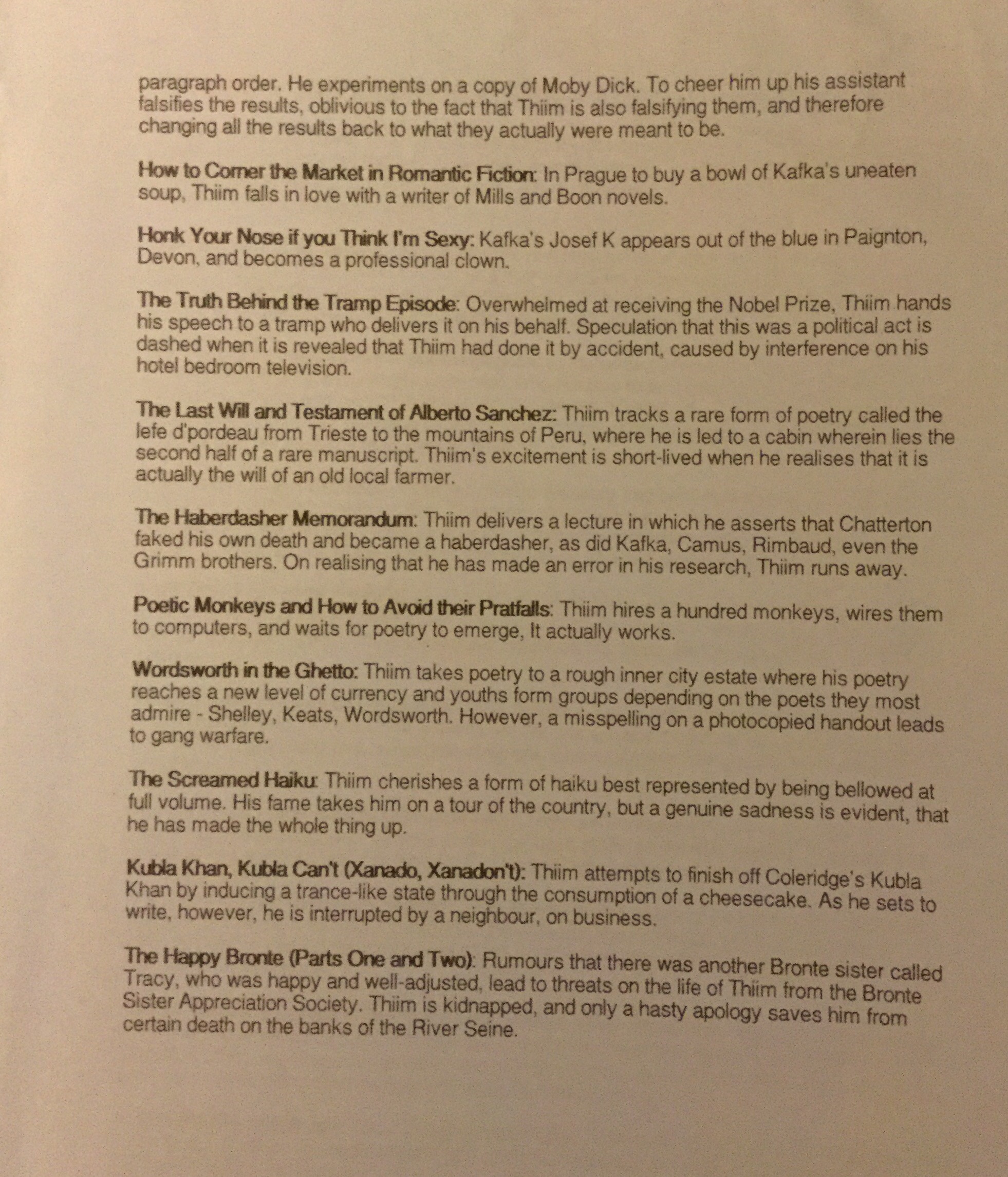
My hero: Professor Zazzo Thiim

20140722-171009-61809097.jpg

I’ve been writing poetry now for the best part of ten years. Yet my foray into the world of ‘comic’ verse did not come completely by accident.

There is one man who came before who showed me that performance poetry was a real art form and worthy of investigation. Indeed, when people ask who my influences are, (which, come to think of it, has only ever happened once), I often reply ‘Frank O’Hara, but to a greater extent, Professor Zazzo Thiim’.
Who is Professor Zazzo Thiim? Notwithstanding several attempts by many in the Californian poetry community to attribute the invention of performance poetry to their particular clique, or the claims of those within the British poetic movement to assign invention of this genre to those from various diverse backgrounds both cultural and symbolic, there remains a theory within the English departments of some major university establishments that the invention of ‘performance’ poetry can be traved to the moment in June 1953 when Professor Zazzo Thiim accidentally sat on a harpsichord while reciting the works of Tennyson. Indeed, it was seen as the most whimsical and amusing moment of the Basingstoke literary season, mainly on account of the audience reaction – (sheer disbelief mixed with a fair amount of loathing) – and the apparent embarrassment not only of Thiim himself, but also the Mayor, and Arthur Miller, to whom the harpsichored belonged.

There were immediate appeals for a repetition of Thiim’s groundbreaking (and harpsichord-breaking) work. Indeed, he was asked to perform it on the radio (to general acclaim), and before the Ambassador to the United States, (who turned out to be just a man in a hat who was passing by). Performance poetry was born. Thiim was astounded by the fact that he had invented an entire new genre. He began writing his own verse, which he would perform either sitting on a harpsichord, astride a harpsichord, while playing a harpsichord, while lying on a harpsichord, and finally, while lying underneath a harpsichord. This lasted for six years, until a colleague is said to have inquired of him, ‘What is it with you and all these bleeding harpsichords, anyway?’ He turned up at the next poetry event with a mouth organ.

Throughout this time, not only did Thiim write poems to fit in with his harpsichord smashing regime, but he also began to dissemble and play around with the poetic form. Working in unison with the University of Staines, he looked at poems in more detail than any other literary practitioner until he acquired a reputation as a literary and poetic experimenter. Poems were shot from cannons. Poems were jumped up and down on. One poem was whispered to the Queen, who was asked to ‘pass it on’. (She didn’t). One poem, entitled ‘Frank (23 ½ Seconds of Silence)’ was performed as twenty three and a half seconds of silence. And another, ‘Frank (23 ½ Seconds of Silence with a Brief Interlude)’, was an extended version of the first but with a slight clearing of the throat in the middle. ‘Frank’ was a poem performed with a tambourine with the eminent professor repeating the word ‘scones’ over and over, finally ending the consuming of a whole scone live on stage, while ‘Frank’ consisted of the Professor shouting out the words ‘I do not believe in Aberystwith’ while pouring yoghurt over his head. One of his most famous poems, ‘Frank’, received some notoriety when it was discovered that it had been the last work read by Tony Blackburn before his debut on Radio One. And of course, who can forget the stirring moment when one of his better known poems, ‘Frank’, was included in the first space probe sent out by the Belgians?

There has been of course some question as to why the Professor should have entitled all of his poems ‘Frank’. But as the good professor has pointed out on numerous occasions, all titles are essentially meaningless and spoil the anticipation of a poem or a work of art. Just look at ‘Last of the Summer Wine’. ‘Frank seemed as good a name as any. Do we enoy the Professor’s poems today? Naturally. As the performance poetry scene goes from strength to strength, the work of Professor Zazzo Thiim has been cited by many, including myself, as their main inspiration for taking to the stage. In areas where performance poetry is popular, there has also been a marked increase in sales of harpsichords, and there can be no other reason why this is so than the enduring legacy of Professor Zazzo Thiim.