This is a poem about a man who’s obsessed with his record collection. Taped live at Exeter’s Taking the Mic, November 2023. I hope you like it.
Rekkuds
Rekkuds

I like my rekkuds
I’ve got one or two
Playing my rekkuds
Is something I do.

They’re mostly jazz,
The rekkuds I play.
Whenever I listen
The world melts away.

I went to the rekkud shop and I said to the chap in there, I said,
I thought you liked jazz?, and he said, I do like jazz,
And I said, if you like jazz so much,
Then how come you ain’t bought any of these rekkuds?

I like my rekkuds.
33 rpm
I go home at night
I’m surrounded by them.

I went to this party and this bloke says to me, got any
Kylie Minogue?
I said, bugger off with your Kylie Minogue.

I like my rekkuds.
They’re mostly jazz.
I play them loud
So I can hear them
When I’m having a wazz.

I went to the hardware shop the other day and I bought a bucket,
Just a plain ordinary bucket, and when I paid for it,
The bloke behind the counter looked at my bucket
And he said, ‘Enjoy’.
How the bloody g hell am I meant to enjoy a bucket?

I like my rekkuds.
Of that I’m quite certain.
I play Frank Sinatra in the shower.
I face the vinyl curtain.

I saw a friend of mine, I asked him what job he had now,
He said, beefeater. He meant the restaurant but I said, oh,
You mean the Tower of Lunnon? Nobody laughed.
Why didn’t you laugh, I asked my mates, you miserable lot.
They said,
We would have done, if we’d have known it was funny.

I like my rekkuds.
I left a Thelonious Monk rekkud in the car.
Someone broke in
And added two more.

I treat my body like it’s a temple.
Shame it’s been
Converted into a Wetherspoons.

I like my rekkuds.
I like this poem.
I’ve made it to the end, for once.
Must be some kind of
Rekkud.
It’s not the countryside, he protested. Just an enclave of the city. The actual city. London, he said, Like I had to be reminded which city. It might look green but we got that Big city vibe going on, Urban infrastructure, neon, Oyster cards. What about all the tractors?, I asked. What tractors?, he said. And at that moment, a tractor chugged past.
That’s highly unusual, he said. We don’t often get tractors here, Because this is the city. I’m as shocked as you are. Chug chug chug chug chug went Another passing tractor. There goes another tractor, I said. I didn’t see one. Are you sure it wasn’t a double decker bus? And then another tractor chugged past.
It’s the pulsing throb of metropolitan energy I like, He said, Looking wistfully at a cow shed. And a tractor chugged past. You can even see Canary Wharf If you go on the roof And then climb into a hot air balloon And go up and bring a telescope. It’s right there, Canary Wharf, That’s how urban this place is. That thatched roof gets a bit slippery if it’s Been raining. And then another tractor chugged past.
The traffic is so bad, he said. The other day I ordered a pizza. The Deliveroo cyclist took nine hours. He had to sleep on my sofa. His big Deliveroo box frightened the hens. Hens?, I said. City hens, he said. And then another tractor chugged past.
I thought to myself, (Because you can’t think to other people), I thought to myself, I’ll let him enjoy his delusion, For geographically he may be nearer Yeovil, But at heart he’s a city boy And he’s got that city life And he’s got that city buzz And sure, he swears blind that the sign on the bus stop Which reads Farmers Market Every Tuesday Is actually graffiti in rhyming slang for Darren Is A Tosser In a new kind of rhyming slang That’s so modern that it Doesn’t even rhyme, But he’s a city boy.
And then another tractor chugged past. And another tractor chugged past. And then two tractors chugged past. And then a combine harvester chugged past. And then a tractor chugged past. And I asked, What’s with all these tractors? And he said, I don’t know, it’s weird, isn’t it? Let’s go and make out in the turnip field.
I suppose I've always been a little bit clumsy. Affecting a demeanour each day of professional detachment, a manner almost sullen were it not for those moments in which human discourse were necessary, affecting an amiability, an openness, an expression of eager understanding and a willingness to compromise, only to have my belt suffer a sudden and catastrophic malfunction and my trousers fall around my ankles. A hand outstretched for a businesslike greeting, a shoe accidentally scraped against the skirting board, a sudden lurch sideways into a pot plant. Oh, I do apologise! And then later on, noticing the skirting boards around my office marked and scuffed by the numerous other times that I have stumbled. Hey, hey, your flies are undone. Again. And due to my body shape, I concede that my trousers have always been a little bit baggy.
2.
The trill of the alarm clock had interrupted a dream in which I was trying to get a giraffe to go up the stairs of a double decker bus. The giraffe had been stubborn and no amount of tugging or enticing could tempt it up to the first floor, and once underway, it got wedged firmly, its fat buttocks blocking the stairwell, much to the consternation of my fellow passengers. It's the usual recurring anxiety dream. The long neck of the giraffe allowed it to peer up to the top deck, grinning like a bastard, while I pushed and shoved and swore from behind. Buzz buzz buzz buzz! I got up, showered, shaved, made some toast and pondered in the coming day, only to glance at my watch and discover that it was four in the morning. And then I recalled that the trill of the alarm clock had been a part of the dream. For the giraffe and I had been returning from a trip to the shops where we had purchased an alarm clock. I set to work at my desk, organising various work-related files on my laptop and trying not to think about my giraffe dream. I watched as the sun came up and lit the neighbouring houses a brilliant red, secretly resplendent as it rewarding me and others like me for getting up so early. I stopped for a few moments to look out at the sky, feeling if only for a short while the majesty of the planet in its eternal rotation, this celestial dance of time and fate, when the alarm clock sounded, this time for real. Buzz buzz buzz buzz! Had anyone been with me, no doubt, I would have at least given a smirk or acknowledgement of the humour in this, but as I was on my own, the only emotion I felt was one of deep annoyance. I got up from my desk and I switched the alarm clock off. The only comfort came from the fact that the new trousers I was wearing were significantly roomier than had been my previous pair.
3.
I was never The class clown. When I think of this It gets me down. The popular kids Would mess around. But me? I wouldn't Make a sound.
4.
I had a meeting with my boss today. I've written down everything that was said and I've made it into a short theatrical piece, which I call 'Bulbous'.
SANDRA stares at ROBERT from behind her desk.
SANDRA - I suppose you know why I've asked you here. ROBERT - To be honest, no, I don't. SANDRA - I've had an official complaint from one of your colleagues. ROBERT - Oh? SANDRA - It's about the meeting you chaired yesterday, on Effective Time Management. ROBERT - Yes, yes, I'm so sorry that it overran. SANDRA - No, it's not that. ROBERT - What . . what is it? SANDRA - (Sighs). Robert, is everything okay at home? ROBERT - Yes, absolutely. SANDRA - And you're not drinking heavily, or anything? ROBERT - No. In fact, I hardly drink at all. SANDRA - The complaint was actually about your appearance. Did you realise that your flies were undone the whole time? ROBERT - No, I didn't. SANDRA - So the message of the meeting, in which you were meant to instil in your colleagues a certain business-oriented professionalism, would probably have been received unquestioningly had you not got your foot stuck in the waste paper bin. ROBERT - Yes, that was rather unfortunate. SANDRA - And when you tried to pull it off, you sat on a desk, and the desk . . . Collapsed. ROBERT - Again, I apologise. SANDRA - And your nose. You see, Robert, it's becoming awfully red, and bulbous. That's why I asked about the drinking. ROBERT - As I say, I can only apologise. And I shall make an effort to act from now on in a more businesslike manner. SANDRA - Thank you, Robert. Please, for me, see that you do.
ROBERT gets up from his chair, shakes SANDRA's hand, then stumbles sideways through a glass partition wall.
5.
Walking home through the silence of the park, I could hear a soft squeak, squeak, squeak with each footstep.
6.
‘I've just had it with clowns’, Josh said. ‘I need a man I can respect’. We'd met online and he suggested we have a date at that new cream flan and custard pie restaurant that had just opened in the middle of the town. It seemed the sort of place where nothing could go wrong. The seating was comfortable and so was the decor, warm and inviting. We sat at a table for two at the rear of the premises. ‘That is very important to me’, Josh continued. ‘Love, yes. Love is up there. And physicality, of course, but respect. Respect is the most important of them all. It seems to me these days that everyone is a comedian, so you get that sense, too? Where's the depth? It's all artifice, isn't it? It's like we've become avatars, covered in layers of glitz and showy nothingness’. ‘You can depend on me’, I told him. ‘I treat each moment with absolute and utter seriousness’. ‘I just don't know why people feel the need to fool around’, he said, ‘in every sense of the word’. ‘I think people just want to be noticed ’, I reply. ‘That's what's happening in this modern age. We all seem to want to get a kick out of making other people uneasy. The nuance of yesteryear is gone. Subtlety is missing from all of our lives. I blame the internet and social media. People can't even be bothered to wait for the punch line, any more. They want immediate gratification, whether it be sexual or comedic’. ‘I can tell’, Josh said, ‘That you are a thinker’. ‘I try to be’. I looked at him, and he looked at me. I could see the small candle on the table between us reflected in his eyes. ‘Do you ever feel tempted’, he asked. ‘To become like all the other men? I mean, brash, and obvious, and only in it just for a laugh?’ ‘No’, I replied. ‘I try to play the long game. Strip away the surface and this world that we live in is a very serious place. And how else might one approach the act of living itself, but through the contemplation of philosophical and existentialist inquiry? In such a way, I forsake the easy option and the expediency of a cheap laugh in order to probe the searing heaviness of our own manifestation’. ‘You know what?’, Josh said, ‘I think I've finally met a man who I can respect’. At that moment the cream flan and custard pie conveyor belt around the serving desk suffered a sudden malfunction, sped up, and propelled its load, one after another, at such an angle and velocity across the room as to connect squarely with my own face, one after another in a perfect rhythm to the accompanying laughter from all the other customers. By the time the eleventh and last cream pie had been delivered with a forceful splat, and I was scooping the filling out from my eyes, Josh had long since gone.
7.
I never realised before how small my bicycle was until I glanced sideways at my reflection in a shop window, my knees out at a crazy angle, dwarfed by the buses, the cars, the lorries.
b. I never realised quite how tatty my old jacket had become, so tatty that I tried to draw attention away from its tastiness by putting a plastic yellow flower in the lapel.
c. And I shouldn't have gone swimming and then dyed my hair. The hair dye had a chemical reaction with the chlorine from the pool and turned my hair bright green. Still, what can you do?
d. And as I filled in the official documentation online to tell my work colleagues my preferred name and pronouns, my computer’s predictive spelling changed my name from Robert to Parsnip.
e. Sandra, my boss, has for some reason pulled me from delivering a seminar on Modern Business Etiquette.
8.
With the power of his intellect and his encyclopaedic knowledge of contemporary stand-up comedy, my school friend Hasan could reduce the entire class into fits of laughter. And the laughter would drive him on, and he'd say something else that was funny, and the class would laugh some more. But Hasan was canny, he'd leave his best material for the end of the sequence, leading us up blind alleyways of silliness before delivering his punchline. Boom. As a result, this rather nerdy individual became one of the most popular people in school and I must admit to feeling rather jealous of his command of a room. My teachers would always tell my parents at parents evening that I was always serious, unsmiling, intense. They said that I wouldn't join in with the other kids, and would bury myself in my work. Perhaps they were worried that something would give, that I'd snap one day and have some sort of life-changing episode, go beserk and tell the other kids exactly what I thought of them. Humourless, is the exact word that was used on more than one occasion. But I carried on in much the same manner and took my exams. I left school with average marks. Hasan became a marketing executive for a company that manufactures airline meals.
9.
To be mocked, and come out fighting with humour, is never a position in which I have ever found myself. Steady as she goes has always been my motto. I have rarely left myself open to ridicule by using the simple tactic of blending in to the background. And during those moments in which I have found myself in the limelight, I have adopted the simple strategy of being as intense and as dry as I possibly could. ‘You're too intense’, Steven had said to me, on what was to be the last night we'd spent together. ‘Just because I don't go down the street, laughing hysterically . . .’. ‘It's not that. It's more your tendency to over analyse everything. We can't even watch television comedies because you point out that certain things would never actually happen’. ‘All I was pointing out was that in real life, Tom would simply catch and eat Jerry . . ‘. ‘You see! You're too much of a realist. In all the time that we have been together, I never once heard you laugh. It's all buttoned up inside of you, isn't it? That's where you keep it. It has to be somewhere’. ‘Life itself is the ultimate ridicule’, I pointed out. ‘What does that even mean?’ The two of us are silent for a while. ‘I'd just like to find’, I tell him, ‘A well adjusted and content tarot card reader’. ‘What the hell are you talking about?’ ‘A happy medium’. Steven thinks about it for a few seconds. ‘OK. So admittedly, that was quite amusing. But it's too late, Robert. I'm sorry, but it's too late’. Steven bent down and picked up his suitcase, walked through the door, and slammed it shut behind him. The oil painting of a clown on the wall above the sofa wobbled for a bit, then fell off and landed right on top of me, my head tearing through the canvas, the frame of the picture now hanging around my neck.
10.
Emerging from the supermarket on the corner, the busy street glistening with a damp drizzle which fell from the overcast sky, smudged neon into the road surface. I stood there in my jacket, my loose fitting trousers, my green hair, my Parsnip name badge, my squeaky shoes, my lapel flower. I decided that I would give up on trying to understand the world, and how good it felt! I didn't need Steven or Josh or even Sandra, I didn't need any of them. Life is filled with organisms and mechanisms too complex ever to make sense of, A small, battered car screeched to a halt right next to me and a gentleman in baggy, multicoloured clothing jumped out. Then another, then one more, then two more, then six of them, seven, twelve in all, until I was surrounded, and without saying anything I understood that there was a home for me.
There’s a divine madness about the fringe. It’s so big that it brings out the despair in us all. How can one possibly compete with all of the other shows that are on at the same time? At the last reckoning, possibly six hundred going on at any one moment. Or was it six thousand? It couldn’t have been six million, though at times it seems it.
The venues are tucked anywhere throughout the city. If you stand still for long enough, you become a venue yourself. Underbelly have already contacted me about using space inside my backpack. It’s a new stage which they want to add to their roster, and advertise as The Cow Bag, and then rent it out to theatre companies. But then I moved, and they lost all interest.
There’s a piece of wasteland outside my student accommodation. It’s overgrown with vegetation and bushes and I stopped and looked at it and I thought, yes, there it is. The last place in Edinburgh which hasn’t been turned into a venue or a bar or a festival village. And just as I was standing there looking at it, someone tried to flyer me.
Because that’s what Edinburgh is all about. The flyering. You can have the best show ever written, and you can perform the best anyone has ever performed, but it’s the flyering which ensures people get in to see it, and it’s the flyering that ensures that the show is a success. Which is great if you have a passion for flyering, or if you have a theatre troupe filled with sixteen incredibly enthusiastic and young performers from middle class universities, with floppy hair and high cheekbones and winning smiles, but when you’re a lone operator doing it all yourself, from a seaside town in Devon, then the odds are already stacked against you.
Which is to say that I hate flyering. People scare me. The general public are frightening. I want to be polite at all times, but the moment I steel myself to smile and say hello, some young buck with an improvised opera jumps in and flyers the person that I’m just about to flyer. It’s a dog eat dog world. And also, my brain doesn’t move as quickly as some. I see someone coming and the words kind of tumble out in a nonsensical jumble. You wouldn’t think that I’m a performance poet! ‘Hello there. Yes, what it is, you see, I’ve written this show, and . . .’, by which time they’ve already walked away.
Consequently, I didn’t have much of an audience for the first couple of shows. One person turned up for each, and I knew each person. They were friends. I think my show is good, but they probably would have come even if it was just an hour of me on the stage doing armpit squelch farts. But there’s a guy from Cambridge University who’s already doing that, and he’s winning rave reviews.
I decided I needed a flyerer. I had no idea that you could just hire a flyerer. I thought only the good shows had a flyerer, because why would a flyerer want to flyer for something that nobody had heard of? But I went online and I made contact with a couple of flyerers. The first two didn’t turn up, on consecutive days. But the third did. And she’s wonderful.
I’ve had an audience ever since. She really knows how to bring in the people. I don’t know how she does it and I don’t really want to ask. Naturally, I was worried that she would take my leaflets and walk off and dump them in a recycling skip, but I actually saw her at work several times, and it really did fill me with glee.
We got chatting one day, my flyerer and I. She’s actually getting married in a couple of days. She’s getting married right on the Royal Mile. I even thought about popping along, or at least exit flyering the service. That’s how grateful I am at all of the flyering that she’s been doing.
The show is going well. In fact, the show is going really well. The last three shows have been absolutely wonderful. Great audiences, and I’m so comfortable with my performances. I know it inside out and I’m very happy with it. I think it’s the most accessible show I’ve done at Edinburgh, (which is code for the fact that this is my first show which doesn’t have an LGBTQ theme or gratuitous references to sex). It has: three costume changes, some choreography, a song, a high note which I try to sustain for twenty seconds, and I get to do a lot of acting, too. So yes, I’m very happy with it. From an artistic point of view.
I have a little post-show routine, now. If it’s a good show, I go to my favourite place at the fringe, which is the bar of the Circus Hub on the Plains, and I sit and have a cola and just relax. It’s a great place, because it doesn’t get as busy as the rest of Edinburgh and I can just take in the sunshine and listen to whatever’s going on inside the Big Top. There’s also a stall nearby which sells, quite frankly, the best sausage rolls I’ve ever seen.
So that’s how things are going, as I enter week number two. What will this week bring? Will audience numbers go down a bit, now that the weekend is out the way? Who will I get to do the flyering when my flyerer gets married? How does my show stack up against the six hundred that are also on at the same time? (Someone the other day called it ‘light and lovely’, which I kind of like). And at the end of the day, does any of this mean anything?
They always say that you should ask yourself why you’re coming to the fringe. Is it to get noticed? Is it to refine a piece of work? Is it to meet new fans? To be honest, I’m not sure why I’m here. I think it’s just the challenge of putting on a show, and writing it, and memorising it, and all of those other things. Or perhaps I’m just here to join in this merry dance, to at least say I gave it a bash.
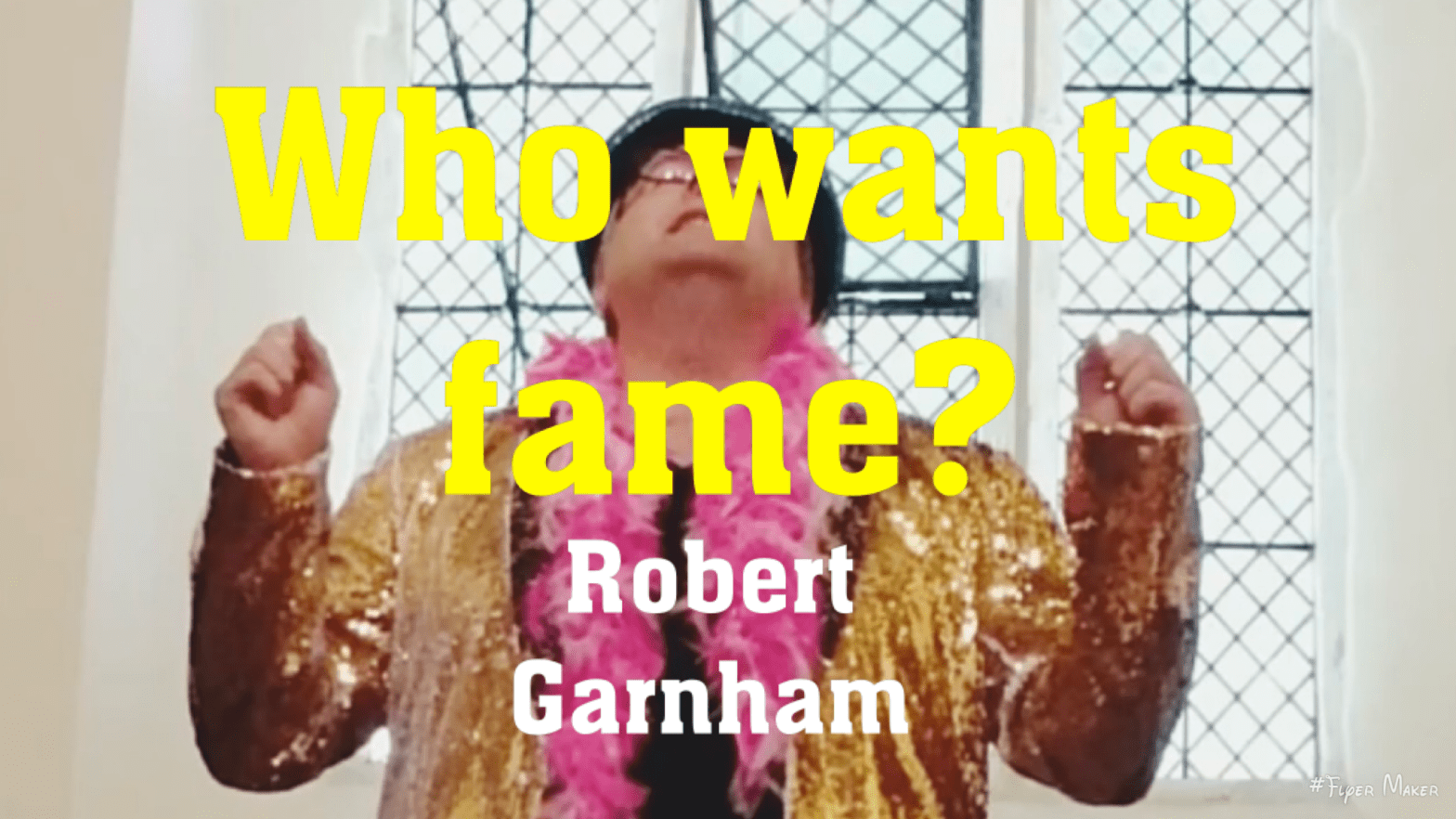
Hello, here’s Who Wants Fame?, a silly song from my new show. Interestingly, the visuals are from a rehearsal session in my venue in Barnstaple during the Theatrefest Fringe, the audio is from a live gig in Withernsea. So this video was made about three hundred miles apart!
Oh my god. I can't move.
          I dreamed of static. A television tuned to static, distant radio waves, echoes of the Big Bang.
          Bloody hell, my back is killing me.
          And there is no static, just the steady splatter of rain on the canvas roof of my tent.
          I try to get up. My back makes a creaking sound, pins and needles shoot up and down my leg. I gasp, try to move, stretch out my leg. I get on all fours, like a dog, and the pain begins to subside. I bang my head on the side of the tent and I hear water rolling down, puddling. This is no life for a poet.
          What is this madness?
          The big bag of unsold poetry books served well as a makeshift pillow all night, until about four o'clock in the morning, once the cold had kicked in and, in my feverish shivering, I cricked my neck.
          I’m regretting every moment of this. Hating it. Why on earth did I say yes to this?

I was at a music festival, where I had been asked to perform poetry. Apparently it was something of an honour to be asked, and I was glad that the organiser had thought so highly of my work and judged me able to entertain a festival audience. Another poet had brought me in her car, and as we got closer to the bit of countryside where the festival was going to be held, a deepening sense of doom manifested itself deep within me. The rain didn’t help. I’d never seen such rain, and when we parked the car in what can only be described as a swamp, the sense of gloom rose within me and began to devour me whole.
          It was the whitest, most middle class place I had ever been. And this is saying something, because I grew up in Surrey. There were stalls where you could buy wicker baskets, or have your tarot read, or buy crystals, or tie-dye clothing. There were clay pots, or expensive rugs woven from yak. There were more yurts than I’d ever seen in my life, and if that wasn’t enough, you could actually order a flat-picked yurt to take away home with you. There was a stall selling pickle, twelve pounds a jar. There was a stall selling spraghi. I don’t even know what a spranghi is. I’ve googled it, and I still don’t know.
          Don’t get me wrong, I’m all for a knees-up.  And some world music can be kind on the ears. But at the end of the day, I’m the product of a council-estate upbringing who lived in a tiny one room flat over an amusement arcade in an impoverished seaside town. I had no money in my bank account. And not for the first time in my life, I felt truly alien to everything around me. I was not in the mood for a knees-up. If anything, I was more in the mood to go home.
          I remember texting a friend in Swindon. Don’t worry, mate, he said, if you really don’t like it, you can come and stay here, we’re only half an hour away. And this really touched me, and seemed much more genuine than all of the hoo-hah around, the plaintive yodelling, the exotic percussions, the families with children called Tarquin and Mathilda. Four days, I told myself. It’s only going to be four days.

I knew that I should have felt privileged, being here at this festival, and being paid to entertain people, that those who bought tickets had spent their hard-earned cash to attend and that I should snap out of whatever misery was holding me back, take a step back, and look at the wider picture. Who else do I know who is fortunate enough to have made a career which allows them to travel, and meet new people, and have new experiences, and all that bullshit? On the other hand, the festival was achingly middle class and wryly excluding. I knew that I had to make something out of the day.
          I shelter under the awning of a huge marquee. At the end of it is a small stage. There's an old man playing the tin whistle on the stage and in front of him are about sixteen people, watching, or else playing with their smartphones. At least he's got a larger audience than I had, last night. Ordinarily I would have been inclined to get the hell out of there, but a sudden shot of philosophical awareness paints him in a new light. Are we not both performers? He has his tin whistle, and I have my poems. Are we really so different?
          I close my eyes.
          The sound of the tin whistle is simple, plaintive, hardly overwhelming. It speaks of loss, and innocence, and something timeless. The simple notes draw me in. Liam with his bluster may have been crowd pleasing, if not a touch self indulgent, but this little old man with his tin whistle speaks of a deeper truth. The old man wears a shirt, jeans, and Wellington boots. He's so ordinary, and yet his music is pastoral, its high notes somehow speaking of the futility of existence and all of human endeavour. He's an artist, pure and simple, not a showman. There's no artifice here, no ego. We could be brothers, me and this little old man.
          At this moment, a marching band walks on stage. Four trumpet players, trombone, euphonium, then a marching drummer, then a saxophone player, and the crowd roars, and people run in from the rain attracted by the razzmatazz, and then two scantily clad dancers, and the little old man with the tin flute puts it down and picks up an electric guitar, and the crowd goes wild, and I go away and leave him at it, the bastard.

The soil at the festival is a dull red colour and it splatters over everything. The canvas sides of the stalls selling their Yak fleece blankets and yurt construction manuals get hidden beneath a layer of red clingy slime, and so do my trousers. I'd worn my finest cream chinos and one of the first people I'd seen that morning had said, ‘Good luck keeping those clean’.
          I find a cafe set up inside a tent, Himalayan blankets and rugs spread across the floor with rows of bare wood tables, the kind that look as if they could give you a nasty splinter, and I buy a cup of tea for four times the price it might have been on the high street, and sit in the corner, the rain pounding on the canvas roof above and making a dripping sound which makes me want to go to the toilet even when I don't. I find my soggy notebook and I start work on a poem, feeling the need, if anything, to grab something back from what is turning into being a really naff day.
          All poets exist because they have a voice. Language is their plaything, of course, but content and feeling come from the soul. My mug of tea cools untouched as a torrent of words arrive as if from the ether, that mysterious place wherein one mosh capture free form images and themes as they flit and dance, pinning them to the page as they slot perfectly, holding hands with their neighbours to create a sudden magic. I can hear them in my head as I jot them in my notebook, each line arriving with an ease that I have not felt in a long time. And this, this makes up for everything. I may not be the flavour of the month, the new saviour of the spoken word scene, but my poems are written with intent and have made plenty of people laugh. I occasionally intersperse my own output with true feeling, emotion and greatness. You can beat an audience into submission, but not everyone can then reach in and save them, coax them back out with the tender dance of language.
          I can only describe it as a trance. Everything around me dissipates, becomes meaningless, until the whole of existence is concentrated on the nib of my pen, the atoms within the flow of ink. The page of my notebook fills until, oh, until I can write no more. How exhausted I feel as I replace the cap of my pen, take a sip of freezing cold tea, and feel that pounding thump in my chest which only comes when I know that I have written something that might be truly remarkable.

I think part of the problem stemmed from the fact that the festival was so very serious. It was earnest, sickly earnest with its emphasis on experience and culture. My own culture was a mishmash of pop and New York comedy, humour, drag queens and cabaret, snooker, science fiction, sitcoms and sex. The festival was about as funny as Winchester Cathedral and about as sexy as Worcestershire. If it was any more earnest then it would probably have toppled over under its own weight. I felt like an interloper, too broke to afford anything other than the fish finger sandwiches which were ironically churned out from a van shaped as a fish finger, for eight quid a pop, which included a serviette and a paper plate.

The poem is a meditation on the futility of existence. It uses the metaphor of the image of an eyeball floating in a glass of red wine, (Merlot), as a commentary on the internal struggles we all face to justify an enjoyment we might gain from our own amusements. It uses the language of chance to tell the simple tale of a widow in her dacha on the outskirts of the Russian town of Omsk, who pines not only for that one western indulgence - a glass of red wine - but also for her lost youthfulness, ravaged by time and the harsh winters. For her whole life she pines, pines, pines, for the wine, wine, wine, underneath the evergreen pines, pines, pines, so that she can emulate the decadence of the people she sees on her television and in films, that she can hold a glass of wine. And the moment she finally gets a chance to do so, the man in the dacha next door is accidentally vaporised in a freak gas explosion, and his eyeball falls down her chimney and lands, plop, in her glass of wine. It is a stirring and heartbreaking image which says so much about the human condition, and I realise, as I sit there in that lowly festival tea shack, that it's probably one of the best things I've ever written.
          And this puts me in something of a good mood for the remainder of the afternoon. In spite of the rain, in spite of the discomfort, the ceaseless dripping, the intense damp, the pungent and pervasive aroma of mould and bad hippy breath, the endless queues for the chemical toilets and the dissatisfaction of not having had a good dump in days, in spite of all of this, the new poem puts me in a very good mood.
          I leave the tea shack and wander in a happy daze, slowly, carefully, so as not to get any of the red mud on my cream chinos. I submit to the rain. Just like the old lady in her dacha, I let life and circumstance overtake me.

Oh jeez, I really need to go to the loo.
          I'm at a stall selling privet saplings. This is the only musical festival I've been to where someone might decide, hmm, let's go and buy some privet saplings. I'm at the stall not because I am particularly interested in privet saplings myself, but because I've just seen one of the other poets, let’s call her Jade Finch, flouncing like a ghost in the drizzle, all flowing scarves and wistfulness, almost angelic in the pouring rain, and I don't want her to see how damn miserable I am. So I hop into the privet sapling tent and pretend to admire the privets in order to let her past but now someone has stopped to talk to her. I can hear them, even under the heavy thudding of rain on the canvas roof, telling her how mystical her poetry, and how they could all go out some time and buy some crystals together, and perhaps do some incantations and chants, and Jade seems up for it. And if I emerge now from the privet tent, then things would get very embarrassing. And now I need to go to the loo.
          'Can I help you?'
          'No, I'm fine, thank you'.
          'Let me know if you need any help'.
          'Thanks'.
          'Are you in to topiary?'
          'I'm sorry?'
          'Topiary?'
          'Is that like origami?', I ask.
          'No, sir'.
          'I once booked myself some origami lessons at a community college. It folded'.
          'How very unfortunate, sir'.
          'It's a, erm, it's a joke'.
          The pressure in my bladder is building up. Jade is still nattering away. At some point I am just going to have to face her. But the embarrassment of her seeing me wet and miserable in the middle of the day at this sodding festival mitigates against making a sudden exit.
          'The humble hedge is making something of a come back', the salesman continues. 'Privet is a very versatile species.'
          'Have you got a rear entrance?'
          'I'm sorry?'
          'Is there a way out of here that doesn't involve going out the front?'
          'No, sir'.
          Because Jade Finch has never seen the real me. None of the other performers have. The version of myself which stands on the stage is nothing like the real version of myself that I have to live with. I might be jovial and funny and comedic once I'm behind the mic, but when I'm at home or on my own, or particularly in the middle of the day, I'm a miserable bugger. It's why I wear specific clothes in which to perform, it's like putting on a costume and becoming another person. And right now, I'm the genuine Roland Garnier. I don't want Jade to see me.
          And on top of everything else, I really need to go to the loo.
          Rain drips from the sides of the privet sapling tent. It's not a comfortable sound.
          'I'm sorry about this ', I say to the gentleman in charge of the stall. 'I really am'.
          I crouch down on all fours and pull up the side of the tent, wrenching the canvas away from one of the Guy ropes, and I slide myself flat on the damp floor, underneath the canvas, and out into the fresh air. I might even have knocked over a couple of privets.
          'Hey!'
          Bladder full, I run to the row of chemical toilets. Oh, how I imagine the relief of getting there and relieving myself! It becomes the most important thing in the world, and as I run and slide around in the mud and see the faces of the other people, I feel that they must know why I'm running. I'm not running to escape. I'm not even running from myself. I'm running for the one purpose that running was probably invented for. I turn the corner and stop in my tracks.
          There's a queue. It's a long, long queue. It stretches from the chemical toilets right past the shamanic lawyers and the new age holistic car mechanics, right as far as a small stage where there's currently a choir of men dressed in flowing robes, humming in perfect unison. It's too late. I know that I can't queue for this long, and the pressure is building up in a way that probably doesn't happen with the middle classes. There's nothing for it but to head straight for a copse of leafy, verdant rhododendrons just behind the log drummers workshop tent.
          Nobody is looking. I merge myself into the leafy vegetation, it's like a piece of thick rainforest jungle transposed, and suddenly, I feel myself alone amid the fleshy leaves and the roots. The further I move into the thicket, the more the overhanging branches shield me from the worst of the rain. I shuffle myself as far as I can from the prying eyes of the other festival goers, into a small clearing where the noise and the movement seem less pronounced. And then, in absolute solitude, I unzip my fly and begin to urinate.
         And the bliss. Oh, the blessed relief! I close my eyes, and for the first time in ages I feel myself relaxing. Everything bad about the day melts away, even my back pain, and I start to think, well, maybe this isn't such a bad place after all.
          'Oh my god!'
          I look up. Three people, right there in front of me! And there's no disguising what I'm doing. Indeed, steam rises from my pee stream as if accentuating my purpose. The lady in front is carrying a clipboard. The two behind are a woman and a young man. And she's wearing a very purposeful hat.
          ‘Afternoon’, I say, in a very cheery tone.

The cheapest option seemed to be to spend the rest of the day sitting in the spoken word tent. At least here I’ll not be tempted to buy anything. I’ve brought my own fold-up chair with me, and it seems the most exuberant luxury possible to be able to sit down somewhere that wasn’t damp or muddy. During the night, when my back had been at its worst, I’d set up the fold-up chair inside the tent and sat down, my head touching the canvas roof, just for the sheer blessed relief of not having to lie down. My fold-up chair seemed to be my only friend in the entire place.
          The spoken word tent was a medium-sized marquee with a stage at one end. It wasn’t as big as the other marquees. In fact, it wasn’t even as big as those that you might see in people’s back gardens from the railway line. The spoken word stage was the last item listed on the poster that advertised the festival, and as my name was the last listed on the spoken word tent’s own poster, which meant that officially I was probably the bottom of the bill for the entire festival. I didn’t mind that at all. All the pressure was off. The audience would have their expectations automatically lowered.
          So I sat there, and chatted with the other performers, most of whom were incredibly happy to be there, and they regailed me with stories of acts that they had seen, and how they’d stayed up till the small hours partying and drinking and having a fantastic time, and woken to the morning with yak’s milk and a sudden desire to take up the bongos. And I nodded and said that it all sounded wonderful, and that I’d enjoyed everything I’d seen so far, which was a lie, because I’d spent most of my time in my tent watching Netflix.
          Every day at the spoken word stage, there would be a big name, a headline act. Today’s headline act was scheduled for just after the lunchtime break. I left my fold up chair at the side of the marquee and placed my poetry notebook on top of it, then went for a wander in the rain, wondering why I just couldn’t find any enjoyment in the festival. My back was still hurting. Everyone I met just seemed so fake, and I wondered if the problem was with me. Why didn’t I have the capability to enjoy myself? Was I actually a snob, preferring the comforts of a bed and a hotel room to the rawness of camping? Was I using my working class background as an excuse to suspect all of the other festival goers as faking whatever enjoyment they seemed to be getting from the event? Should I have been more grateful? Well, yes.
          I wondered about the new poem. Should I perform the new poem, when I did my set? It’s always bad news at a poetry gig when someone performs something that they’ve only just written, but on the other hand, not all of these people are geniuses like me. The new poem had been the only good thing to have happened at the festival, although I did have the seeds of an idea for a new poem in the phrase which kept coming to my lips. Festival wankers.
          I queued for a bit for a fish finger sandwich, to match the fish finger sandwich which I’d had for breakfast, and the fish finger sandwich I’d had for dinner the night before. But my cash supply was dwindling. Would they let me have half of a fish finger sandwich? I then decided to save some money and go back to the spoken word marquee, where there were free bottles of water for the performers.
          I was surprised when I got back to see that the place was packed out. A crowd had gathered to watch the big name headliner, and the crowd was so big that they’d had to open up one side of the marquee to let them see in. There must have been about four hundred people at that marquee. A-ha, I thought, at least I have my fold-up chair in there. I rummaged through the crowd, apologising profusely but telling everyone that I was one of the performers, that I just had to get there. But when I got to the front of the stage area, my fold-up chair was gone. The poetry notebook was on the floor. But the chair was gone.
          What the hell, I thought. Has one of these festival wankers made off with my fold-up chair? And that’s when I saw it. The fold up chair was on the stage, and the big name headliner was sitting on it, tuning his guitar. The big name headliner, who was so famous that his name was actually on the main festival poster, was sitting on my fold-up chair.
          I lingered for a bit, of course. But then I wandered out, into the rain, to the rear of the crowd who were gathering eagerly, some standing on tiptoes. The big name headliner started his set, brought the microphone close, and told the assembled crowd that he felt safe there, that he was going to tell us something he’d never told anyone before, not even his closest friends. He was bisexual, he said, and it was such a great weight lifted from his shoulders to tell the world this. There was a small gasp from the audience, and then a ripple of applause, and then the applause became thunderous, and I applauded too, and it seemed a magnificent and wonderful moment because, apart from anything else, this big name headliner had just come out to the world while sitting on my fold-up chair.

I performed the first of my two sets that afternoon. By then the crowd had gone, dissipated back into the drizzle. The overbearing thrum of someone else's music pulsated through the canvas walls of the spoken word marquee from one of the main stages. I had an audience of about five to begin with, and then three left, and then people who were wandering past came in, and I ended up with a very respectable eight. Four of these were a young hippy-ish couple and their two kids.  The kids had kept running around and I had to shout, because the band on the main stage was so loud. One of the kids spilled my wine. And the parents kept shouting at the kids while I performed. The kids were called Aria and Esher. I know this because I kept hearing, Aria, will you stop fiddling with that mic stand? The poor man is trying to speak,  or, Esher, stop that will you, Esher? That’s not nice.
          I hastily amended my set. I’d wanted to do my poem about Orgasms, and my poem about odd shaped penises, and my poem about snogging an aardvark, but I couldn't, what with the kids there. Who on earth brings their kids to a world music festival, and then to the poetry stage of that festival?  And the moment I finished my set - inevitably, with the Beard Poem - the crowds started coming in on the way back from the main stage where the band had just finished. Random inquisitive souls pumped up by the throat singing and the techno sheltering from the rain in the poetry tent. They poured through the entrance just in time to hear me say, 'Thank you so much, everyone! My name is Robert Garnham, thank you for flying with me!’
          I handed over to the next poet, who now had an audience of about a hundred and fifty.
          ‘Cheers’, he said. ‘Nice one’.
          I’d wanted to perform the new poem. But the more I’d thought about it, the more I realised that it was terrible, it was too conceptual, and apart from anything else, I couldn’t read my own writing. When I finished performing, I stood by a small table where there were a selection of my poetry books for sale. Nobody was interested. Some of the books had probably got wet. I packed away the books, folded up my chair and walked back to my tent. I didn’t even feel like a fish finger sandwich.

The next morning dawned a little brighter, as did my mood. Maybe this was because there were now glimmers of blue sky amid the occasional showers. Or maybe it was because I was now one day closer to going home.
          The occasional showers persisted as I stood underneath my tartan umbrella in the queue for the chemical toilets. Jade Finch was in the queue in front of me, all unnecessarily bubbly and wide eyed and as fluffy as her poetry.
          'Did you see XXX last night? Oh my goodness, I didn't even know he was on the bill', she says.
          XXX was yesterday’s headliner at the spoken word marquee, the chap who had come out as bisexual while sitting on my fold-up chair.
          ‘No, unfortunately, I didn’t. I mean, I saw the start of his set, but there were too many people there and . .  Someone had taken my chair’.
          'He's the best, isn't he?'.
          'He's good'.
          There's nothing worse than toilet queue chit chat, and in any case, I was dying for a dump.
          'He did that poem last night, oh, you know the one, about the importance of recycling. Only halfway through you realise he's actually talking about his ex. And then he really racked up the emotion and the energy, and you'll never guess what . .'.
          'I was there'.
          'He started bodysurfing. I'd never seen such a large crowd at a poetry stage. He started bodysurfing the crowd! Like a rock god genius, and all the time he still had the mic and he carried on with the poem! Can you believe it?'
          'I was there'.
          'They're giving him an extended headline set tonight'.
          'HAAAAH!'
          'What is it?'
          'Sorry. My back just gave a twinge'.
          'I mean, we are just privileged to be on the same bill as him, that's what I say'.
          She was probably right. And thankfully, two cubicles opened up at the same time, so we went our separate ways. Having felt imposter syndrome at the best of times, this was merely another reminder just how low down the pecking order I was in the performance poetry community. But it didn’t matter, because I was determined to have a good day, and a good day started with a good dump.


I thought about having a fish finger sandwich for breakfast, or maybe a trip to the tea yurt and ordering whatever the cheapest drink happened to be on their menu. Instead I went back to my tent and ate half a packet of crisps that I’d found in my backpack. I looked once again at the poem that I’d written the day before and I couldn’t believe how bad it was. But not even this could dampen my increasingly good mood. Indeed, the only thing that could possibly dampen my increasingly good mood was the actual damp.
          I set up the coming-out fold-up chair inside my tent and I started work on the Festival Wankers poem. I couldn’t think of a good rhyme for entitlement. I decided that whatever might happen, the Festival Wankers poem should probably not be debuted at an actual festival, which seemed to make it all the more subversive that it should be written right here, right now. I wrote a whole verse around the subject of disposable income, having seen someone the previous day purchasing a wicker bedside cabinet.
          There was something of a spring in my step as I eventually went outside into the main part of the festival. I went to the tea yurt, but unfortunately, owing to a build-up of maggots in its rafters, the place had been closed down. This, the barista assured me, was merely a temporary setback, and he cited the bad climate along with the natural materials used in its construction as a possible reason why there had been a build-up of maggots. ‘It proves at least’, he explained, ‘That no chemicals had been used in the building process’.
          I went to the fish finger sandwich van and ordered a cup of tea in a polystyrene cup for five quid, then sat on the edge of a dance stage to enjoy it as a light drizzle was reflected in a rather sheepish sun. I took a deep breath and could feel the goodness of the countryside purring its way into me. Things can never be so bad, I thought, as they felt at the time when they were their worst. And just at the moment when you think life will probably get worse, well then, that’s the moment when things have already turned a corner.
          I went to the spoken word marquee. I’d decided that this would be where I’d spend the entire day. I didn’t care about the world music stages, I didn’t care about the stalls, I didn’t care about the expensive food or the fact that my wallet now had nothing in it. I would sit there, and I would watch every single act, and I would damn well enjoy it.
          And that’s exactly what I did. I sat there, for every act. And I felt relaxed, for the first time since I’d arrived at the festival. And the sun was out. They opened the side of the marquee again, just like they had when XXX had performed, and this seemed to draw people in who were walking past. Hello, they said, what’s going on here? They came in and they watched the poets, and they enjoyed it, and the more the sun shone, the more people started to enjoy it.
          It was about this time that I started to realise how wonderful people were. Not just festival people, but all kinds of people. I was there, and I felt a part of the whole show, and this was in spite of the fact that I had been a complete and utter misery the day before, perhaps noticeably so. By the time that it was my turn to perform, the sun was persisting enough for the actual stage itself to be moved outside, which meant even more people were stopping to watch. I had quite a sizeable audience, and they laughed at all the parts that they were meant to laugh along with, and I was brave enough to jump off the stage at one point, and go wandering with the mic, and people laughed at this and there were smiling faces everywhere, and it was so different to the day before. I finished my set to an applause which was far more enthusiastic than I’d probably deserved, but it didn’t matter, because it put me on a high, and even standing beside the table piled high with my poetry books which nobody then showed any interest in didn’t faze me in the least. The applause had felt so sweet. I may have been the very last name on the bill for the whole festival, but right at that moment, I didn’t feel like it.

I’m not a natural performer. People have often said that I change completely the moment that I get on stage. Which is to say, reading between the lines, that when I’m not on stage, then the vibe I give off is of a miserable so-and-so. The Robert Garnham who exists when he’s performing is totally different to the Robert Garnham who exists the majority of the time. The nerves go away and the world brightens, and something weird occurs deep down. And when I stop performing, the old me comes back fairly quickly, but some remnant of the performer version of myself still exists.
          I sat back down after my set, and my abortive attempt to flog some poetry books, and I could feel the warmth of the world. Somewhere on the main stage, drums were sounding, and they did so with a rhythm which filled my heart with a sudden goodness. Oh my god, I thought, I’m starting to enjoy this festival. What on earth has become of me?
          The other poets performed. Jade Finch performed. XXX performed, and, maybe it was just my memory, but he didn’t really seem as ‘on it’ as he had done the day before. And with an hour to go before the day’s schedule for the spoken word marquee was done, the poet who had driven me to the festival whispered, ‘We’ll be leaving in an hour’.
          This was news to me. I’d assumed that I would be staying the next night and packing up the next morning. But now I realised that I only had an hour left at the festival. An hour to pack up my tent, an hour to pack my bags, an hour to endure the rain and the mud and the continual damp smell of canvas tents and incense sticks.
          ‘Fantastic!’, I whispered.
          ‘You can stay if you like . .’.
          ‘No! Just try and stop me’.
          I was off back to my tent and I think I managed to take it down in about six minutes flat. I stuffed it back into its bag, and I grabbed my backpack and my fold-up chair and my unsold poetry books, and I was ready to get the hell out of there.
          And that’s when I heard the drums again. The same band was still on the main stage. Those same drums that had thrummed into my soul just half an hour before, and filled me with a sudden goodness. And just for that second back then, I’d thought I was enjoying the festival. But I wasn’t, really. I’d actually just become resigned to it. Because the moment an escape route had opened, boom, I’d gone for it. What a fake I was! That just for that short period of time, just right then and there, I had become a Festival Wanker.
The key to mindfulness, he said. Imagine you’re floating on a lilo. Feeling the waves undulating Underneath because you’re on a lilo. The key to mindfulness, he said. Floating on the sea on a lilo. All your worries drift away And takes your mind away from that which harms you. They key to mindfulness he said Floating so free upon a lilo. But it made me so very very scared, Imagining that I was on a lilo. What if I float out to sea? What if I don’t come back? What if I end up in the busy international shipping lanes? What if they have to call the lifeboat? What if I’m never seen again? It makes me so very very stressed.




 Robert Garnham