In 2010, on the way back from Australia, I stopped in Tokyo for a few days, arriving at midnight. I’d booked a hotel but they lost my booking and so began a strange few days of existentialist angst when I started asking, who am I? What is my history? Do I exist? I started writing this novel.
A few weeks later, of course, once the novel was finished, the tsunami hit, so reading this novel again always gives me a strange sense of foreboding.
Twenty years ago, I wrote a novel. And some of that novel had material in it from fifteen years before that. It’s lived at the bottom of a drawer for most of that time. Thanks to technology, I can now bring this to you. I will be sharing a chapter a week.
Here is a brief synopsis:
A comedy novel set at His Nibs, a fictional shop at a seaside town which sells only pencils. Assistant manager Robert once had a steamy and passionate romance with his colleague Matt. Matt is now with Clarissa, and it must be serious because they have got a cat. Meanwhile someone has burned down the pier, which means there are no tourists, and the shop is not making its targets. It rains a lot. Manager Carol has gone off the rails and harks back to the glory days of pencil retail. Robert is determined to win Matt back, or at least recreate the romance with someone else, while area manager Mona is determined to turn things round at the shop. Standing in their way are mystery shoppers, angry refunders, the company auditor, weird customers, light-fingered gang members, the local protection racket, increasingly bizarre memos from head office and the joys of the twice-annual stock take.
Chapter One
The Stock Take
We haven’t sold a pencil in hours yet we’re not supposed to start counting them until six o‘clock. It’s quite worrying that we haven’t sold a pencil in hours because the whole shop exists just to sell pencils. It’s a pencil shop. Pencils and the very minimum of pencil accessories. Pencil sharpeners. Pencil erasers. Pencil cases. And pencils. If we sold some pencils then there would be less to count, obviously. If we sold two pencils in the last hour then that would be two less pencils. The shop has probably got thirty thousand pencils in it. We will find out in the next six or seven hours. How long does it take to count one pencil?
But that’s life. The tills are all computerised now and if we were to sell a pencil after the stock take had started, then it would bugger everything up. The count would be wrong and we’d have gaps in the stock list where more pencils should be. And the area manager, Mona, she would get awfully sarcastic and make us do it all over again. And a part of me would understand the world a little better while simultaneously bemoaning its perpetual unpleasantness. A part of me would wish that the world would have less pencils in it. A part of me would want to be at home luxuriating in the freedom associated with a man who does not have to do a stock take. For some reason the company likes to know how many pencils it has.
‘Right, I’m off home’, Carol says. ‘Let me know how it goes’.
Carol’s the boss, the Manager. Carol is a canny operator. Carol has come up with a theory that when it comes to a stock take, it’s more accurate to have two people doing it instead of three. Two people can easily get on and do it. Three people would just complicate things. That’s what Carol says. And she lives furthest from the shop, so it only makes sense that she be the one to forego such nocturnal delights.
The door closes behind her. She locks it on the way out.
I’m not looking forward to it, obviously. One pencil starts to look like another after a while. There’s really been no innovation in the pencil industry for quite some time. Some have got rubbers on the end and some haven’t and that’s really the only source of variety, otherwise they’re all straight and made of wood and they’ve all got a pointy end which draws or writes. I’ve been working in pencils for over ten years and I still don’t know what the pointy end which draws or writes is called. I mean, the technical term. It’s easy to lose enthusiasm for pencils when you’re around them for as much as I am.
I’ve got Matt helping me with the stock take, though. That’s something, at least. I like Matt for a number of reasons. The first reason that I like Matt is that he’s accurate and occasionally conscientious. The second reason that I like Matt is that we’d sometimes stop counting for a bit and lose ourselves to the simmering sexual tensions that have existed between us since the very first day he walked into the shop with his CV and his boyish grin and his impetuosity and his fashionable hair and his love of life and the rumbling sense of innate masculine ecstatic oblivion I feel whenever I’m in his company which makes each nerve tingle and the air itself crack with hormonal longing. The third reason I like Matt is that he lifts some of the heavier boxes.
Alas, the chemistry between us has been somewhat depleted these last few months.
‘How’s Clarissa?’ I ask.
Because it’s only polite to ask.
‘She’s great’, he replies. ‘She’s perfect. We‘re thinking of buying a cat.’
Which is disappointing, because as well as being conscientious, masculine and impetuous, Matt is also alarmingly moral. Our stock-room trysts, foibles and peccadilloes are now a thing of the past. Clarissa is his life. A cat only compounds that.
‘Let’s start this thing’, he says, picking up a pen and a clipboard. (Carol doesn’t like us using pencils during a stock take for fear of accidentally using shop stock). ‘Let’s put this baby to sleep!’
It’s an unusual metaphor. This baby wont be asleep for another six or seven hours just yet.
Dextrously, Matt’s fingers pour over boxes of stock. His large brown eyes – the eyes of a particularly obedient puppy, eyes which have always seemed far, far too big for the rest of him – concentrate on the task at hand. One pencil, two pencils, et cetera. There’s no guess work, no cutting corners with Matt. He always goes for the maximum. If he wants it, he gets it. He does things properly.
I think back to a couple of years before, when Matt brought a sudden burst of romance into my life. Perhaps he was drunk on the wooden smell of all the pencils. He couldn’t control himself. What started out as a gentle re-organisation of the pencil case shelf in the stock room blossomed into full-blown rumpy pumpy. He became a floppy love machine, curling himself around me and oozing warmth and sensuous impossibility, it was all I could do to put down the pricing gun.
This happened again the next night, after Carol had seen the reorganised pencil case shelf in the stock room and told us to put it all back again. And then it happened once more the night afterwards, though we didn’t touch the pencil case shelf or reorganise anything, and Matt had brought some whipped cream along with him, you know, for some added pizzazz. It was only on the eighth night that we began to ask ourselves why we were using the stock room of a pencil shop when we could easily just go back to my flat and use the bedroom.
It kind of slowed down a bit after that.
But every now and then, perhaps excited by the sight of so many pencils in a kind of as yet undiagnosed drawing implement fetish, Matt and I would give vent to all kinds of ingenious desires, until Carol got suspicious at all the time we were spending together and thought that we were only doing it for the overtime. Then Clarissa sauntered in one day looking for a pen, (seriously!), and Matt didn’t seem to get quite so excitable around me any more.
‘1147367’.
‘HB hexagonal shaft blue with a white stripe?’
‘Six’.
‘1147374’.
‘HB hexagonal shaft red with a white stripe’.
‘Nine’.
It took us two hours to work out that all of the numbers started with ‘1147’. The stock count started to go a little bit quicker after this.
‘479’.
‘HB hexagonal shaft yellow with rubber’.
‘Seven’.
Matt is seemingly unflustered by the fact that we shared so many intimate moments in this very room. Yet I cannot get over the lack of passion he now shows. I pretend to count, gazing up from the boxes of pencils, and I cannot envisage anything beyond the madness to which we would willingly succumb. There are seven pencils in the box but I manage to lose count, and he makes me do it again. Two years before, we would have been all over one another. There’s nothing more sensual than a box of pencil sharpeners when you’re both naked and gagging for it. His new-found professionalism is an affront to the memory of our passion. If only a switch might be activated ensuring his sudden interest in matters other than the rigours of a damn good stock take.
But there’s no let up in his demeanour. Never before have I seen anyone so intent on the counting of pencils. It’s not that he wants to finish the job any quicker, though. It’s almost as if he relishes the opportunity to lose himself in stationery. This cheers me up for a little while, repays some of the faith that I have previously lost in the human spirit. But then I realise that he’s probably concentrating so intently so as to ward off some of the emotion he might otherwise feel on returning to the scene of our many romantic escapades.
‘45, er . . .’.
‘Yes?’
The thought has jarred me a little.
‘458. No. 459’.
‘So what is it?’
‘459’.
‘There is no 459’.
‘Ah. It’s 458. There was a bit of dandruff or something on the code number. It made the eight look like a nine’.
‘How many?’
‘I don’t suppose it matters’, I tell him. ‘There’s only one. And it’s snapped in half’.
‘It’s still got to be counted’.
‘But it’s snapped. It’s either one, or two halves. It wont make any difference in our overall figure whatever we decide to do with it’.
‘We will have to write it off. But first we need to count it. The Damaged Stock Form will arrive at head office after the stock take, so it’s officially still a part of the stock’.
‘I can fill out the Damaged Stock Form now and send it this moment. Then we wont have to count it at all’.
‘But it would be wrong’.
‘It’s one pencil’.
‘You know the procedure’.
‘It will cost more in postage and work hours filling out the form than the worth of the pencil’.
‘Procedures must be adhered to’.
‘Why don’t I just buy the pencil?’
‘The shop isn’t open. So therefore the pencil is officially part of the shop’s stock at the time of the stock take’.
Matt does not appear very happy for someone with a girlfriend and the chance of getting a cat.
As the evening wears on I feel the insanity of our chore become ever more evident until I cannot see the world except through the subtle variations and design of the pencils that we are counting. Chair legs, skirting boards, anything straight or wooden or both present themselves to my mind which then, automatically, starts looking for a serial code. Another hour and life itself – nay, existence – seems secondary to the task of counting all the pencils in the shop. 1147001, big bang, celestial detonation : one. 1147002, universe, (expanding), infinite : one. I start to wonder if counting the universe in our stock take might automatically nullify the need to carry on with the stock take, but Matt says no. It has to be done. It is the reason why we are here. It is our aim and our purpose. Without the stock take, we are as nothing.
And then a secondary madness takes over in which it becomes obvious, or at least, it feels obvious, that those at His Nibs head office damn well knows how many sodding pencils we have and that this is all some kind of cruel test or punishment inflicted on us just because we had the temerity to work for their company. And the company, oh, how it becomes in our minds so powerful and so all-consuming, directing us with its bulletins and conducting the whole shape of our lives with the list of items that we, us mere mortals, have to count, through the fabled, legendary stock take sheets. There’s no room for error, no room for improvisation. How deliriously do our managers sit in their offices compiling this list, laughing at themselves as they envisage the mayhem that it will bring to our lives! Oh, great and mighty stock-take co-ordinator, oh, you saintly powerful all-knowing New Goods department, how we aim to please you with our pitiful late-night counting!
A couple of years before Matt had been a completely different person. There had been something sly about him. It was as if he were throwing subtle hints all the time. I would catch them in the way that he would look at me at certain moments, or the way he’d brush a stray hair away from my shoulder while we were making a display of pencils, or perhaps it was the fact that whenever we were alone he’d run his hands under my shirt and beg for ten minutes of ecstatic human physical companionship as if enraptured by the pounding, constant sensuality conferred on all like-minded sexed-up individuals. Such subtlety. But things are much different now. There’s nothing.
I find myself looking at him as we embark into our fourth hour of counting. The clock on the wall nudges inexorable towards midnight. He opens boxes of pencils and spends a couple of seconds running his fingers lovingly through the stock within, and it is the first sign I’ve seen of him wavering from his professionalism. He’s almost mesmerised by the pencils. He used to be mesmerised by me. But this was all before Clarissa and the promise of a kitty.
‘Are you OK?’, I ask.
‘Often’, he says, ‘I get a feeling of . . .’.
An achingly long gap. He doesn’t say anything. Oh, the emotion, it must weigh heavily on his soul. My heart pounds with excitement.
‘Yes?’
He puts down the clipboard. This alone is significant. And all of a sudden I can feel the last two years peeling away. This is how we used to be, so eager to share our private feelings and comfortable in each other’s emotional presence. He was so unsure of himself back then, so driven by the needs of the moment. He needed guidance in the ways of the world and I was always there for him. The night starts to feel slightly different. It’s as if Clarissa and the cat don’t exist at all. I can feel that he wants to say something significant, yet the new version of himself that he has created over the past couple of years would never be so forthcoming.
He lets out a big sigh.
‘There are things in this life’, he says, ‘That I’m really not sure of’.
‘Such as?’
Silence again.
‘You can tell me’.
Much silence.
Emotional silence is all very well, but this is bordering on plain rude. At last, he says:
‘Have you ever looked at the world and thought that it’s been put together just ever so slightly askew? And that certain components of it were – how do I put this? – meant for some other plain of existence, and used in a kind of half-hearted attempt to cobble the world together – and by ‘the world’ I mean the way that we live our lives, the philosophies and strictures which we adopt to govern our behaviour?’
It’s not the most coherent question I’ve ever been asked.
‘What I mean is, do you often think there’s more to living than just this?’
Not going so well with Clarissa, then, I feel like saying.
‘Well . . .’.
‘Because for a while I’ve thought that even though I’ve got all the things I’ve always wanted, I’ve still been missing out on . . .’.
‘Yes?’
‘Life’.
It’s not the sort of thing that I’d been expecting him to say. I’d seen him become a machine over the last couple of years, a unit designed for living normally. And yes, I want to agree wholeheartedly with his sentiments. He’d gone chasing after the life that culture has told him to live, quite forgetting that he would still be the same person underneath.
‘Do you remember how it used to be?’ I ask. ‘The fun we used to have? Do you remember?’
‘To be honest’, he replies, ‘Not entirely’.
‘All those nights reorganising the pencil case shelf?’
‘Doesn’t ring any bells’.
‘And you’d say, gosh, it’s so hot, do you mind if I take my shirt off?’
‘Doesn’t sound like the sort of thing I’d say.’
He’s right, of course. It doesn’t. Not any more.
‘And anyway, what’s that got to do with . . With what I’ve just said?’
‘I’m just trying to remind you of the times that we used to have together, the fun and the physical nature of our relationship, and how you used to live for the nights and you’d come in to work and you’d whisper to me, hey, let’s reorganise the pencil case shelf tonight, and all day long I’d be longing for the moment when Carol went home and we could lose ourselves to the absolute bliss of each other’s company, and some times we got so into it that we’d finish reorganising the pencil case shelf and then start all over again, and the world seemed right and the night stretched before us with all its promise, and we’d be both so incredibly happy that we’d had the fortune to find each other, that the world should be a place where constant adventure could happen right here, right here, in this crappy little town’.
‘To be honest, I don’t remember any of that’.
‘You don’t remember?’
‘Not in the slightest’.
‘It was the highlight of my year!’
His eyes narrow.
‘If you must know’, he says, ‘It sounds a bit far-fetched’.
Far-fetched. I can remember every second of our many encounters. Emblazoned as they are on my memory in all of their vivid detail, there can be nothing more real than the exquisite mix of heart-felt longing and rampant masculinity, blending as they did into a fine madness into which we both so willingly succumbed. And yet, yes, he’s right. It does all sound magnificently far-fetched.
‘Often’, he says, ‘When something is very horrific, the mind shuts it out completely’.
‘But you must remember some of it’.
‘Well . . .’.
More silence.
‘What has all this got to do with what I was saying? I trust you enough to delve right down to the deepest part of my soul and you highjack the moment just to concoct some bizarre story about us having a relationship which I can’t even remember. It can’t have been that special, really. That’s what I’m thinking. It probably wasn’t even with me, was it? I don’t go around shagging work colleagues in the store room of a pencil shop. And just at the moment when I need some help in trying to understand the world, you go and make it even more complicated. Well, thanks. Thanks for that.’
‘So you don’t remember any of it, then?’
‘The only thing I remember is . . .’ He stops for a second. ‘Did you hear something?’
‘We need to talk about this. I don’t think you understand how important this is to me’.
‘Can you hear it? Movement, out the back. And it sounds very much like . . .’.
Please, no. Of all the times.
‘Bin robbers!’
‘You said yourself, Matt. You said that you weren’t sure about life. You said it just now, that there was something else. Well, there was. And you don’t remember any of it. I showed you what it was that you were missing. I showed you, two years ago, but . . .’
‘Bin robber!’
They come every night, the bin robbers. They rummage, standing on upturned milk crates in order to delve deeper into the mysterious delights of the pencil shop skip. They’re looking for pencils, obviously, or anything else that may have been thrown away during the day. It’s a wonder they find anything amid the boxes and the packaging and the assorted detritus of a pencil shop skip, but every now and then they find what they’re looking for. Pencils. Only the pencils have been broken in half, as per company guidelines. Go to any car boot sale and you’ll find a stall of short stubby pencils, sharpened, perhaps, at both ends. Discontinued lines from pencil shop skips, pencils with health and safety issues now illegal to trade, dug out from the bottom of pencil shop skips and sold by shady looking gentlemen with stubble and inappropriate piercings. Some of these gentlemen might even have tattoos. There’s money in pencils, obviously. The internet hasn’t killed everything.
But they’re nasty, too. There’s many a report of bin robbers threatening shop staff, managers holed up in their offices on the phone to the police or, god forbid, violence against any hapless employee who should go out after dark to empty a waste-paper bin and come across a bin robber. Territorial, occasionally hyped up on various concoctions, there are even stories of rival bin robbers fighting each other in front of bemused His Nibs shop staff. They leave a mess behind them and throw the non-pencil-related skip contents across the back yard in order to get to their bounty. Sometimes they even turn the bin upside down and empty it, which is no small task what with it being made from solid steel and as large as a small car. They threaten anyone who tries to stop them. Many a time a lowly His Nibs shop employee has had to call the old bill because a particularly nasty bin robber has promised some admittedly quite inventive form of personal injury while filling up their pockets with faulty pencil sharpeners or pencil cases that have been withdrawn from sale due to copyright issues. Illegally mass-produced Scooby Doo pencil cases that head office have bought cheaply and sold at quite a mark up until threatened with court action by the intellectual property owners of the Scooby Doo franchise, now filling up the Lidl’s carrier bags of the common bin robber. It’s a vicious circle.
It’s recycling, at least.
And tonight’s is a fine specimen. In his woollen cap and bomber jacket, he looks every inch the scrote. We watch through the back door as he sets up a powerful torch, climbs on his milk crate, then dives into the bowels of the skip, his army boots sticking out as he has a good rummage. You might think that it would be safe just to let him get on with it, but there are moral forces at work, a sense of personal violation which comes from seeing such an atrocity, particularly in the private enclosure of the back yard. Indeed, as the police have pointed out, each pencil sold by a bin robber feeds violence and drug abuse, underhand dealings, and the powerful local organised crime syndicates, and that it is our duty to prevent all further bin incursions. The police have better things to do.
Matt’s fingers reach for the door handle.
‘It’s not safe’, I tell him. ‘He might get violent’.
‘He’s upside down in a bin. We’ve got the tactical upper hand at the moment’.
‘He might have an accomplice’.
‘It’s a chance we have to take’.
‘We don’t have to. We’re not here to fight crime’.
The bin robber throws a sack of waste paper over his shoulder. It lands on the ground and scatters everywhere.
‘If we don’t make an effort’, Matt says, ‘Then it will just carry on’.
‘He might be armed, and dangerous . . .’
‘What better way is there to go?’
I can think of several other options rather than being knifed by a bin robber next to a rubbish skip out the back of a pencil shop at two ‘o’ clock in the morning in a deserted seaside town. It’s not an iconic death. But Matt is starting to open the door now.
‘Matt!’
‘Tell my parents that I love them’.
‘And what about Clarissa?’
‘Yeah, her to’.
I can only assume that the worst will occur. The bin robber will lunge at him, perhaps shouting, perhaps incomprehensible, no doubt far too stoned for any rational response other than shooting at us with a concealed weapon, or perhaps a bow and arrow. (The mind does funny things during moments of stress). And already I can envisage having to phone Matt’s parents and telling them the bad news, the police helicopter hovering overhead with spotlights trying to track down the ruthless bin robber, the whole thing conveyed live to local television.
‘Hey!’, Matt says, whipping the back door open.
‘All right?’, the bin robber asks.
‘What you doing?’
‘I’m robbing your pencils’.
‘From the bin?’
‘Yeah’.
‘But they’re broken’.
‘That’s the thing with pencils’, he replies. ‘They’re never really broken. You just sharpen the jagged ends and you’ve got yourself two new pencils. Hey. My name’s Dave’.
Dave holds out his hand and, amazingly, Matt shakes it.
‘That’s all very well’, Matt says, ‘But then you’ll end up with stumpy pencils’.
‘I know’.
‘What good’s a stumpy pencil?’
‘There’s a lot of people out there with SFS. Horribly afflicted. They can’t handle full sized pencils. They’re crying out for shortened pencils. I’m only happy to help them’.
‘SFS?’
‘Stumpy Finger Syndrome’.
‘You know, you really can’t do that. It’s stealing’.
‘But you’re throwing them away’.
‘It’s still stealing. That’s the law. And I’m here to uphold the law.’
‘It’s recycling. That’s what I’m doing. Otherwise it would all go into landfill, and do you know how long it takes for a pencil to biodegrade? I‘m saving the planet, my good friend, that’s what I’m doing’.
‘Go on’.
‘What?’
‘How long does it take for a pencil to biodegrade?’
‘Hey, I’m too busy bringing hope and comfort to those with SFS to worry about minor details like that’.
Dave takes out two more pencils from the bin and holds them up to the light.
‘Right, then. I’ll wish you two gentlemen a pleasant evening’.
He closes the lid of the bin and saunters away. Matt watches him leave for a couple of seconds.
‘Well’, he says, ‘I don’t think he’s going to mess with us again’.
This whole night has been profoundly confusing.
We count through the night. The Earth spins round one more time. The count is completed by five in the morning, the last pencil located in a plastic display case next to the till area at the front of the shop. What mystical powers that one pencil holds! I place it back in its case feeling a sense of ceremonial duty, for now we have completed our task. Yet the world seems just the same. I look out the plate glass window at the front of the shop floor at the dark, deserted street, the sodium lighting and the parked cars, the fascias of the other shops unlit, silent fashion shop dummies just standing there like memories of parties past, and it all looks like hardly anything has changed at all.
‘We are free’, I whisper.
Two hour’s sleep, and a new day starts.
It’s just as well that my tiny flat is over the road from the shop itself. It’s a constant joy to open the curtains each morning and see the little shop sitting there, taunting me with its pencils and its sense of constant dread. I dream of bin robbers screaming through several surrealist situations, none of which I can particularly remember within seconds of waking.
One of the eternal mysteries of retail is the stock count. The head office New Goods department has a figure which is supposed to match the number of pencils held in stock. In all likelihood, the shop will have this figure with a slight margin of error. Yet it all depends on how great this margin of error is. If it’s a lot more or a lot less, then there will have to be an investigation and it will be assumed that the stock has gone missing, somehow. If there are three thousand less pencils in stock than the paperwork says, then it means that someone has come in and robbed the shop of three thousand pencils. And this is rightly seen as an example of gross misconduct on behalf of the shop staff. But if the figure is, say, out by fifty or so, then that’s seen as officially All Right. It could easily be a mis-count. Fifty-one or more and there’s a problem. The area manager will demand that we do it all over again.
Our total is out by two hundred and fifty six.
This is when it’s wise to begin a subtle manipulation of the paperwork. The first thing to do is to look at the last Breakages list and assume that it hasn’t got to Head Office just yet. So if there’s eight pencils on the Breakages list, then these can be added to the stock count, therefore making it out only by two hundred and forty eight.
Then one has to look at the other stock that has been written off. Out of date pencils, deleted pencils, pencils that have been recalled due to various health and safety investigations. If a child somewhere gets a splinter from a pencil, then the pencil is withdrawn from sale. If an artist on a remote island artist’s community puts a pencil in their mouth and has an allergic reaction to the paint, then the pencil is withdrawn from sale. This can usually add another twenty or thirty to the final figure. And then there’s the stock that has been transferred to another branch. If shop A phones up shop B and asks for a box of two hundred HB red and white striped pencils, they will often be so relieved to receive the stock that they might quite forget to process the paperwork that comes with it until a couple of months later when it’s found at the bottom of the in-tray next to a mouldy bacon sandwich, the one that’s been funking up the office for the last few weeks. So these transfers, also, and quite cunningly, are added to the grand total of the stock count.
But Head Office gets its revenge. The stock count sheets themselves are incredibly long, a concertina of computer print-outs. A fully unfolded stock count sheet will stretch from here to halfway down the street. On each page are fifty serial codes of the different types of pencil held in stock, and there are three columns which must be filled in: stock in shop [A], stock in store room [B], and total stock [C]. Easy enough, you might think. But for a start, column [A] and [B] must add up to column [C], and each column must add up to the sub total at the bottom of each page, and then each page must add up to the grand total.
There are so many serial numbers that most of them will not be carried by the shop in question. Therefore, the total for each column will be zero. Except Head Office doesn’t like the number zero. They say that it can easily be mistaken for a six, especially if written hurriedly. Every time a zero occurs in the paperwork, the word ‘zero’ has to be written in the space allocated, rather than the number. A typical row will therefore read ‘zero zero zero’, which means that most of a stock count is taken up not with counting, but by writing the word ‘zero’ a couple of thousand times.
Oh, the unique joys of the stock take.
There’s always the dread of the familiar on arriving back at work, whatever the circumstances. The shop seems just to sit there over night, ostensibly inanimate yet filling itself with more reasons for you to hate it. There’s a crushing sense of obligation in every detail as if it’s playing with you, saying, ‘Forget any hopes and dreams you might once have had, forget anything else which might seem important in your life, because you exist for me now, and nothing else’. And while some might argue that in the modern economic climate it might be seen as advantageous and perhaps even privileged to have a job at all, there’s also something emasculating about putting so much energy and thought and worry and paranoia and everything else which makes us human and makes us function as individuals into the selling of pencils. As if to compound the delirium, there are emails from Mona.
She does a good line in sarcasm.
Indeed, it seems a pre-requisite that an area manager should dabble in the black art of sarcasm. Perhaps they teach it at Area Manager School. And like any art movement, it’s not just dependent on content, but also the circumstance and the delivery. An Area Manager standing in the doorway of a shop and saying ‘it looks like a herd of bulls has rampaged through this place’, seems to have a greater effect than merely, ‘Looks like you might need to tidy up in here’. Or then there’s the old classic ‘am I speaking a foreign language? Do you want me to provide a translation?’ This one works especially well when the simplest command has been seemingly ignored, Mona once again standing there with her hands on her hips, demonstrating that as well as being an expert in retail management, sales patterns and category space analysis, and all those other minutiae which make such middle managers feel important in the grand scheme of things, she is also something of a comedian. This morning’s email is profound with such literary shenanigans.
‘Yet again it would seem that most simple of tasks – counting stock – is beyond your capabilities’, is the cheerful phrase she uses to begin her message. I imagine her sitting at home, a plate full of cream buns next to her laptop and Wagner playing on the stereo, firing off this latest communication. ‘It’s not hard to keep a tally. Maybe I should run a seminar on it. Or perhaps not. Go into any good book shop and they will have a volume on simple mathematics’. She then has the sense to end the email with the phrase, ‘kind regards’.
Carol has called in sick. She always calls in sick the day after a stock count, you know, just in case. We open the shop. Matt goes on the till and fumes to himself for the whole of the morning. We have one customer in the first hour, getting a refund on a 25p pencil sharpener that she bought in another branch. Matt is somewhat abrupt with her. Then he’s somewhat abrupt with me when I quip that this is one more pencil sharpener that we will have to count. The fluorescent lights make my eyes hurt.
By midday we have come up with a plan to do the count again that night.
‘We’ll have to be more methodical’, Matt says. ‘Every time we count a box, I will attach a yellow sticky notelet to the side of it so that we can gauge where we have been and what has been counted’.
‘Oh yes, so that’s going to be the answer to everything, is it?’
‘I can’t see you coming up with any better suggestions’.
‘To be honest, I’m beyond caring’.
‘A sticky yellow notelet. And then we will write on all of these notelets, ‘counted’, which will act as a double check’.
I yawn.
‘You’re right’, I tell him. ‘That will be the answer to everything. Problem solved. Every problem the world has ever had, solved, just like that. Sticky yellow notelets’.
‘And they have to be yellow. No other colour will show up in the dark confines of the stock room’.
‘Another night together, then’.
He smiles.
The prospect of spending it in such a way fills me not with dread, but with a rising sense of excitement, especially as the afternoon rolls on. It’s all I can do to stop my heart from beating, seeing him there and knowing that we will be together again. Maybe it’s sleep deprivation, but the world seems suddenly filled with promise and excitement. Because last night, oh yes, last night, Matt came so close to admitting the truth. So incredibly close. And if he doesn’t do it again tonight, I might just sabotage the result myself just to make sure that it all goes in to a third night.
‘Yellow’, I repeat, ‘Notelets’.
Early evening, I find a box of two hundred and fifty pencil erasers in the kitchen microwave. I decide to hide them. Often it’s best not to admit to such things.
As 2025 lumbers to a wimpering snuff, many of us see a world that seems almost unrecognisable to the one we’ve always known. Division and hatred, thinly veiled racism, outright transphobia, and the prevalence of the ego have combined to create a cultural environment in which core principles of neighbourliness and humanity have taken a back seat. Other and better writers have written about this and to much greater effect. It’s hard not to see our lives, dominated as they are by so many distractions, and consumed mostly by looking at a screen or a mobile phone, as being the primary reason for this. But I’m not a psychologist. Nor an analyst. I just believe that it’s so much easier to tell a lie than it is to disprove it. And quicker, too. Do I despair of the world? All I can say is that people get bored very quickly. They want instant gratification, and now. The shock of the new.
As for me, 2025 has been, well, unnecessarily interesting. I’d had a good life for the last fifteen years, writing and performing poems while working in my job, in retail management at the same branch of a charity for almost thirty years. 2024 was marked by the drug dealers who lived in the flat above my shop. There were frequent fights, arguments, knives, needles, gangs of ne’erdowells to contend with, all happening right above the shop. I thought it couldn’t get any worse, and then, all of a sudden, it did. In February of this year, the drug dealers upset someone, (an ex-girlfriend, apparently), who then announced on social media that she was going to burn down their flat that very evening. (Incidentally, this was Valentine’s Day. How symbolic). So the drug dealers did the right and humane thing, and moved out for the night taking their possessions with them. I watched them go through the security peephole in our back door. They loaded their possessions into a car. I hope they don’t burn the place down, to cover their tracks, I thought. So it was no surprise when I got a phone call first thing the next morning to say that the shop had burned down.
Yes, it was arson. But now I found myself in a tentative position. Would I still have a job, especially in the current financial climate? What would happen to my staff, would they still have a job? The company could very well have ‘let us go’ then and there, but they were understanding. I was made into a floating manager. My job was now to travel through the south west and cover at any branch where a manager was absent. Over the course of 2025, I worked in almost every town you can think of between Bournemouth and Cornwall. Some of them I thought they’d just made up. (Midsomer pNorton?!). I spent a lot of 2025 living in hotel rooms and eating buffet breakfasts. So yes, I still had a job.
But it was my performing which suffered. I could not commit to gigs because I never knew where I was going to be staying or working. I could not rehearse, because I used to use the shop to rehearse every single morning while I was getting the place ready. I couldn’t learn lines, especially in a hotel room. I had a few wonderful gigs which I had to book time off for, including Penzance, and a quick trip to Edinburgh. I had a good enough time.
The one thing I did, though, was to work on a novel. I’d already written the first draft when I applied to Curtis Brown Creative, and amazingly, I was let on the course. Over the summer we developed the novel, and it’s looking very good indeed. I am now tinkering with it and hoping that an agent or a publisher sees enough in it to accept it. I’m very happy with it, indeed.
This last month, I was made temporary manager of the shop in Torquay. This is much closer to home, and all of a sudden, I have time now to rehearse again. It feels like things have turned a corner. They’re even due to begin building work on my old shop, (the landlord died over the summer and nobody owned the place, thereby everything came to a shuddering halt). Which is to say, I’m starting to feel like my old self again. The whimsy is returning.
So what did I get out of 2025? A lot of memories meeting people all over the south west, and a novel, and the benefit of the tutelage of Suzannah Dunn, (who really liked my novel), and a huge amount of time sat on trains. (Working in TIverton for three months meant five hours on trains and buses a day). And time to look at my fellow passengers, all watching TikTok.
The world will not change and I cannot make it. I just know that there are civil people out there, concerned for humans and humanity, opposed to stupid wars and political bullying, opposed to toxicity, big business, politics in general. Sometimes it is better to whisper than it is to shout, but I only say this because I’ve never felt entitled to shout, and that there are others who are much better at it than me.
It may not have escaped your notice that I’m quite gay. I’m steeped in gayness, ensconced in homosexuality, which I wear like a coat which sparkles iridescent in my undeniable queerness. I’m gay in the same way that Donald Duck is a duck. Daffy, too. I’m massively gay. It is my identity and I’m incredibly comfortable with it, though this has not always been the case. And it has often been the subject of my poems.
When I was younger I was downright embarrassed by my evident homosexuality and I’d get all hot and sweat thinking that at any second I’d be unmasked and that this would result not only in deep humiliation, but also the possibility of a slapping, because the world was a different place when I grew up in the 1980s. The AIDS crisis was in the news and it seemed to give the more discerning homophobe a presumably tangible reason to accelerate whatever hate their puny minds could muster. But they had public opinion of their sides, and the government, too. Section 28 was prevalent, and it was illegal even to ‘publicise’ homosexuality, whatever that meant. There were no adverts for it on television. Tabloid newspapers continually outed pop stars in the crudest of languages. Brave soap storylines were mocked. Gay accents were impersonated by prime time hack comedians. School bullies shouted, ‘Backs against the walls, lads!’, which always got a laugh. No wonder I didn’t want the world to know.
And in my council house bedroom, I tried to make sense of it all. I reasoned that it was something I’d soon grow out of. Suburbia was a place of endless bland business-orientated culture-deprived outlets, roads, infrastructures, tower blocks, office buildings, slipways, airports, train stations, noise, pollution, homophobes, and a sense of Just Getting On With Things, and it all seemed very straight. Only the M25, which is far from straight. My school didn’t have a drama department, but we were taught German because it was assumed that all future business would be conducted with Germany, and we had something called Enterprise Week every year, which was nothing to do with Star Trek. We had to start up small businesses and try to make money. Survival of the fittest, dog eat dog, backs against the walls, lads. It was in this incredibly drab world that I spent my formative years, knowing deep down that there was something amiss.
Because the sight of a bloke with his shirt off would get me all a-quiver. Not that we had many shirtless blokes in the suburbs. I now live at the seaside, where they’re two a penny during the summer, but it was much different in suburban Surrey. The only place where it seemed even remotely likely was at the amateur football matches where one could hang around after the final whistle and see what happened, though these were inhabited almost overwhelmingly by the straight male community. And once the football season ended, the cricket season would be in full swing, and cricketers are usually less prone to spur-of-the-moment shirt removal. But whatever the sport, I’d come over all ‘unnecessary’ and retreat to the sanctuary of my bedroom and ask myself, irritably, when this damn heterosexuality was going to kick in.
Naturally, I had to come out to myself. And the thinking behind it went something like this:
I don’t seem to find the opposite gender attractive.
Most people find the opposite gender attractive.
There’s nothing wrong with these people.
There must be something wrong with me.
Society (and the Bible, for I went to a very religious Church of England school) dictates that there’s nothing wrong with those who find the opposite gender attractive.
But it’s not like I chose this. I am a product of both society and (according to my school), God. But what if –
What if
What if society (and the Bible) (and God) are wrong?
Isn’t God meant to be all-knowing?
They’re obviously wrong because I know that I didn’t choose to find my own gender attractive, which means that there is no god.
I’ve looked deep within myself and I really cannot get excited by boobs.
Gosh, I’m quite gay.
The weird thing is, I can remember exactly where I was when I worked through this whole process.
It was a sunny Sunday afternoon in 1986 just a couple of weeks before leaving middle school and going to secondary school. I was in the bath, and my parents were gardening. Mum was mowing the lawn. The noise of the lawn mower came in through the bathroom window. And just like Archimedes yelling ‘Eureka!’, I felt that I’d figured out an incredibly complex scientific equation and, as a byproduct, also happened to prove the non-existence of god. I was 12 years old. The world had suddenly exploded.
Naturally, this complex equation is something that every LGBTQ person has to go through. And perhaps it’s slightly easier these days because the world does seem a genuinely more accommodating place, and a lot of the working out has already been done. Perhaps it isn’t so easy. That’s why pride is important.
For me, the shame came shortly after making this momentous realisation, of course. The pride wouldn’t kick in until around 1999, which was also when I would have my first boyfriend. And in any case, there was so much else in life that I liked. The comedy of Bob Newhart, the writings of Douglas Adams, the music of the Pet Shop Boys, Formula One motor racing, civil aviation, late night jazz, travel, Doctor Who, and my cat, Lucy. This new-found gayness was only a small part of my identity and of what made me tick. Sure, there’s something hugely exciting about a good looking bloke with his shirt off, but the same could be said for the sight of a Boeing 747. But the shame was deep and it was real, and I couldn’t understand why I had been cursed with this weird affliction which, as far as I knew, only affected two other people in the entire world. It was just Peter Tatchell, Ian McKellan, and myself. I decided that it was best to keep it under my hat,
For 13 years.
Coming out was the predictable car crash. Apparently I was significantly more homosexual than my loved ones had been expecting. This had also coincided with my first relationship and, being 1999, the pre-Millenium angst which seemed to colour the world as a place of flux. If the ultimate state of the universe is chaos, then this at least made me feel better about the cupboard under the stairs.
As I explored this – to my mind – totally unsurprising aspect of my personality, mixed as it was with the slightly more surprising fact that I’d managed to snag myself a boyfriend, I realised that I would never be able to look at the world or, indeed, myself, the same way. The world was very slightly evolving, yet the act of ‘coming out’ still felt like a political statement rather than a personal necessity. The biggest mistake certain people made at this time was the assumption that my honesty, and my declaration of who I was, had been undertaken more to upset the status quo and to be purposefully reacting against society, rather than just stating a simple fact.
But this was, and remains, a necessary and final part of the process.
I might as well confess here and now that I was not one of the world’s greatest lovers. I was with my first boyfriend, Jamie, for over a year. And even though he was a few years younger than me, he had the onerous task of showing me the basics. But we didn’t have much in common. He liked clubs and dancing and raving and I remember going out clubbing with him and asking at the bar for a nice cup of tea. My next partner was a Lithuanian who worked in a Cornish pasty factory, and while my technique in the bedroom had certainly improved, he did insist on playing Lithuanian pop music at random moments. I then went out with a nurse called Paul, and then even more bizarrely, once we’d broken up, another nurse also called Paul, which certainly made things complicated. My next boyfriend wasn’t even ‘out’, so everything had to be kept hush hush, though we were together almost ten years. And when that was done and dusted, I went back to Jamie for a bit.
I’ve now been successfully single and celibate for a few years. Obviously, I do ask myself every now and then whether this disqualifies me from the Gay Club. I don’t know what I have to do to renew my membership, but as I said, homosexuality only ever felt like a very small part of me. I have other things going on, you see. Because, (and I’m still not sure how this happened), I became a performance poet.
It took a few years before I started mentioning LGBTQ themes and queer identity in my poetry. When I first started, my poems were fun and silly, but safe and non-threatening, and to be honest a lot of them make me cringe now. I think every new artist or performer goes through a learning stage in which they’re just finding their feet, working out their voice and their technique, and for me this seemed to take quite a while. Sure, some people found me hilarious and I was offered gigs here and there on the basis of poems which I’d perform while reading from a piece of A4 paper which trembled with my nervousness. And the poems were badly in need of editing.
In truth, I didn’t really take performance poetry that seriously, at the start. It’s just something I did every other week, and I’d bash out a poem, not read it until the night in question, and then throw it away immediately afterwards. But the laughter, oh, when you write something funny and the audience laughs, that’s the best feeling in the world, and I started to realise that I wanted this to happen every time. I wanted that laughter. It was like a drug, making people laugh. But the laugher only felt good if there was some purpose behind it. And my poems were mostly about other people.
I decided that it I were to sustain this laughter and be taken seriously as a performance poet, (because it was still called performance poetry in those days), I would have to study what other people did. So I’d go on this new website that had come out called ‘You Tube’, and there were one or two ‘slam poems’ on there. (At this stage I had no idea what a ‘slam’ was). These poems would be performed in front of huge audiences, who went wild and laughed at all the funny lines.
At the time, I’d just finished a distance learning university degree in literature, so analysing content, syntax, grammar, intent and meaning were second nature to me. I applied this to the poems I was watching and I discovered that the best ones all had something in common. They were all about identity.
This was another Eureka moment, and I wasn’t even in a bath. And once again, I remember exactly where I was. It was a sunny day (again!), and I was in the living room of my parents’ bungalow (in Devon, for we had moved ten years earlier), and I was watching You Tube on my dad’s laptop. And I remember writing in my notebook, IDENTITY, and then underlining it. And that afternoon, I wrote my first ever LGBT poem.
The thing I liked about what I’d called ‘The Straight Poem’, was that it was the first poem I’d written where I became aware of its internal rhythm, and the economy with which I could defer the funny lines. I structured it like a wave, allowing the funny moments a chance to breathe, and the audience space where they could laugh. But this was only half of what was going on.
Because this was the first time that I’d written a poem which not only addressed my identity, but played around with the whole theme making homosexuality the norm, and applying the way that straight people look at gay people but the other way around. During the poem, I’m amazed that a friend has just ‘come out’ as straight. It’s a silly idea, but it visits several straight cliches and ends with an absolute stinger of a last line which never fails to get a laugh. It felt new and it felt innovative, because I’d never seen another performer address LGBT issues in such a way back then in 2010, though I’m sure that one or two existed.
There would be one or two criticisms of the poem. A well-known performer at the time, (who I’d just beaten in a poetry slam, back in the days when I could beat people in poetry slams), said that there was nothing new about the poem. Another poet, (straight, male), said that the poem was incredibly prejudiced against straight males. Perhaps he had a point, but it’s not like I was punching down.
I did quite well with the Straight Poem. It helped me come second in the very first poetry slam that I entered, in Bristol, 2013. And then it helped me (joint) win the Exeter poetry slam. This was followed up with second places in Swindon and London, and a fourth in Wolverhampton. This was a totally surprising development for me, and while I have since come to loathe slam competitions with a passion that you can only dream of, they certainly helped put my name on the performance poetry map. Or ‘spoken word’, as it was now starting to be called.
I decided quite early that the best way to help make a difference in the promotion of LGBTQ lifestyles with my poetry was to normalise such identities. Which is top say, that the humour should be based not on homosexuality as the traditional 1970s stereotypical punchline, but as almost incidental to the evident homosexual content. In other words, the poems I was writing could (hopefully) be equally funny if they’d been written from the hereonormative position. My two poems The First Time, and Orgasms, were both about sex, only the sex contained within those works just happened to be gay sex. But it didn’t matter, anyone could have been doing it, and if the sex being described were straight sex, then the jokes would still have worked just fine. Sure, the gay content added to the building tension necessary for the explosion of relief which comes with the punchline in live performance situations, but the fact remains that so many of my poems from this period were about sex because I had recently stopped doing it on a frequent basis. This had given me the ability to stand back and see sex as the bizarre act that it is. Even educated fleas were doing it, but not me.
When my first collection, Nice, came out in 2014 published by Burning Eye, a couple of copies were bought by a poet who was a workshop facilitator working with youths in an arts centre in Manchester. She put the copies in her poetry library which everyone was welcome to browse when they were looking for inspiration. One day she sent me an email with a photo attached of what someone had written inside the front cover of one of my books. ‘Not nearly enough poems about sex’, someone had written.
Also in 2014, I started work on my first solo show, Static. I decided that Static would be autobiographical, telling the story of how I came to be comfortable in my identity, but it means that I would have to write some autobiographical poems to perform amid the prop-based performance art set pieces that I had, for some reason, decided to pepper throughout the show. The poem ‘2 Abbey 1’, (which was the name of my secondary school tutor group), was about being a closeted kid in a class full of (presumably) heterosexual lads, and it was set just a couple of months after that Eureka bath moment. The poem is also about my first infatuation with a fellow classmate, (or anyone, come to think of it), who would also be the subject of a poem called Cocky, in my 2021 collection Yay!.
‘2 Abbey 1’ felt like a milestone of my poetry writing career, because it was my first purely autobiographical piece and it made me realise that my own life, ostensibly so boring as it was, could be fair game for both poetic and comedic inspiration. It’s as the first time that I had seen myself as a character in my own work, and because of this, it seemed instantly recognisable. Because we’ve all been to school, right? Amid the jokes of ‘2 Abbey 1’, there’s also this sense of underlying sadness, that this was 1986 and the world was a different place, really not quite so accepting or as accommodating as it now seems.
‘Not Flamboyant’ was also written at this time, and it’s about people not realising I’m gay, written from the imagined perspective of one of those kids in my tutor group. ‘Why didn’t you tell me?’, the poem asks. But in actual fact I couldn’t tell anyone. I’m sure they all knew, though. That said, I enjoyed performing this poem because it made the (presumably predominant) straight audience a little uncomfortable, more so that it sounded as if I were about to skewer gay stereotypes, only once again for there to be some kind of ‘sting’ at the end of the poem which changed everything around.
It was probably about this time that I realised I was turning into some kind of ‘safe’ gay performer for straight audiences. The issues I was touching on were universal and serious, but they were not being done in a preachy kind of way. Audience members could therefore enjoy the jokes as well as the subtext, and I felt pretty good about this. That’s not to say that things always went well.
Sometimes they went too well. I remember performing at a very bizarre private gig in, of all places, a florist, where they’d decided to invite some friends round, cook them a meal and then have me come on as the after-dinner entertainment. The hosts knew all about my act, having seen me perform at a local theatre. By the time it came for me to perform, the audience was very tipsy and one chap in particular had decided that he would heckle. They weren’t nasty heckles, and afterwards he announced that he rather liked the gay stuff, even though he wasn’t gay. The next thing I knew, he was hugging me tightly and kissing me on the cheek, because, well, I think he assumed that this is the sort of thing that I would like. It was a little uncomfortable and I shudder to think that he would also have done this if I had been a female performer. I suppose he just assumed that he was the epitome of male beauty and that I should have been grateful for his unwarranted attention!
The poem ‘Jamie’ was about my first romance. It was not exactly a nostalgic piece, though there were touches of pathos in between the jokes and the one-liners, and writing the poem made me realise that I could mythologise certain moments from my own past. By the time I wrote the poem, it had been 18 years since I’d been with Jamie, and that relationship was definitely something I looked back on with immense fondness. In fact, once again, there was nothing overly preachy or political about the poem, it just depicted a relationship which just happened to be homosexual, and the subject of the poem was not that in itself, but the usual memories and fondness – and break-ups – which anyone goes through, LGBTQ or not. Around the same time I wrote a poem called ‘Kate’, which detailed a failed romance I’d had with a fellow student in 1991, hoping that having a girlfriend would magically make me straight or, at the very least, prove to the world that I was, when in fact I wasn’t. The self-mythologising of these two poems, I believe, certainly made me more confident as a writer.
Writing such poems did feel more like therapy than the creation of art. I’d spent the first adult years of my life unsure of what my motives had been and how I should have acted, and having this chance to stand back and write about them with the benefit not only of hindsight, but of the justification which came through performing these to an audience, helped me to feel more at ease with my own past. By this stage of my life I was starting to feel old, and a little overtaken by the succeeding generations. I had been late to love, late to ‘coming out’, late to living life as myself, late to the party, and this had been entirely due to the culture in which I had been brought up. Suburbia, the 1980s, the AIDS crisis, my own constitution as a human being, they’d all held me back or discouraged me in ways which, hopefully, no longer hinder those who want to be who they actually are. And this is definitely the kind of world I want to be a part of, where transgender people can live their own lives and come home to themselves, and gay people no longer need the ‘coming out’ process, or those Eureka moments, because such lifestyles are accepted the same way that hetereornormative assumptions are readily accepted.
By the late 2010s, it felt like the spoken word community had changed. When I’d first started performing, it had resembled more a cabaret in which invention, props, characters, dancing and costumes had been as much a part of the spectacle as the words themselves. The fact that I was an LGBTQ performer was often seen as part of this cabaret atmosphere, a justification for its existence. I wore a sequin top hat and a pink feather boa and I did so much crazy stuff with props that I would have to lug around with me a bulging bag full of wigs and gold-embossed bric a brac. In fact, often the words themselves were secondary, as I once performed a poem with no words in it at all. And it wasn’t just me, it was almost every performer, and it was flipping wonderful.
The scene now is dominated by the ubiquitous slam style, in which authenticity and emotional truth are key. My own performances have evolved along with this. I no longer turn up at gigs with boxes full of props, though the clothes that I wear are still very much a costume. There are many more LGBTQ poets now, and this is something which I inwardly celebrate, though the emphasis at spoken word events seems less like a cabaret in which spectacle is key, and more the sort of place where lifestyles and opinions are validated. Spoken word is a platform where people can assert themselves and their beliefs, their politics, their truth, preach hope and aim to change the world, and I flipping love it. Though I do get nostalgic for the old days.
You see, I’d always tried to depict my identity as incidental to the bigger themes going on within my poems. But I realised that I would very much like to assert a level of pride. Perhaps this was because I’d always felt a little outside of the gay community, without realising that I was slap bang right in the middle of it. Perhaps it was because most of my friends are straight. Perhaps it was the political situation in the world in the late 2010s, where it felt like the world was lurching suddenly to the right. Perhaps it was because I wanted to show some kind of solidarity to the transgender community.
I started work on a new batch of poems, which would ultimately become my collection and show, Yay!, again published by Burning Eye. I wanted the poems to be upbeat and celebratory, touching not only on identity, but also issues of mental health. ‘The Queer Express’, was written as a celebration of LGBTQ history and mentions Stonewall and freedom fighting, with lines such as, ‘Our history is one of pride and those who dared to stand / And fight the law and rise above, let’s shake them by the hand’. I had real fun writing this poem, not to mention a feeling of real emotion as the rhythms of the piece seemed to lead me on to other images and ideas which gave the piece an inexorable logic. I’ve performed this poem at pride events both online and in the actual world. It’s the first poem in which I have declared belonging to a community, and celebrating that community, and it is, I reckon, the gayest poem I could possibly have written.
‘To the Car full of Youths . .’, is another celebratory LGBTQ banger from the Yay!collection, though this is based on a true incident in which I was the subject of homophobic abuse while waiting to cross the street in Edinburgh one year. I didn’t think much at the time this happened, though afterwards it got me thinking: how had they known? The poem which resulted from this starts with a little fun as I try to work out how someone could identify me as LGBT just from my appearance, and then becomes a life-affirming pride-filled roller coaster in a similar sort of vein to ‘The Queer Express’, again ending on a very Garnhamesque ‘stinger’ with a killer of a last line. Tackling as it does the theme of homophobia, this is one of the few poems I perform which needs a content warning.
‘Nathan Went for a Walk in the Rain’, is a poem about mental health. It’s one of the few serious poems from the book and I’d written it after seeing the depression suffered by a friend of mine, and how this can easily lead to suicidal thoughts. The poem is a third person piece, and the imagined character within the poem, Nathan, feels bullied by the assumptions that people make about straightness and how he approaches the world. In my mind as I wrote the poem was the idea that Nathan was LGBTQ, though this is not asserted in concrete words, and the poem works whatever Nathan’s sexual persuasion.
So I was very pleased with Yay, both the book and the show. These were written and rehearsed during 2020, (we all know what happened in 2020, but needless to say I had a lot of free time), and the show was performed between 2020 and 2022.
In late 2022, it dawned on me that I’d been performing LGBTQ material for over ten years, and that it might be something of a challenge to work on some projects which had no LGBTQ content at all. Naturally, not all of my poems are about gay issues. (In fact probably only about 20 percent rely on their being gay-based). But every single one of my shows and books had such content in them, and I felt that the world might like to see what I could do if I were to concentrate on other things.
I came back from the Edinburgh Fringe in late August and immediately started thinking about my next show. The truth is, I wanted to do something mainstream. This isn’t to say that, in spite of my poems about pride and being comfortable with who I was, that I wasn’t comfortable with who I was. It was more about the challenge of writing a new show which found its laughs or its motivations elsewhere, just to prove to myself that I could do it. After much pondering and prevarication, I wrote a show about my ill-fated appearance on Britain’s Got Talent.
This is not to say that I have abandoned LGBTQ content in my work, or that I have turned my back on who I am. Far from it. While feeling, every hour of every day, distinctly and overwhelmingly gay, the need for actual sex – and indeed, male companionship – has dissipated over the last few years. I’ve always ever felt myself to have many identities and interests beyond those defined through my sexual orientation and gender, and as I’ve got older, the need to find love or to explore this part of me has been subsumed beneath the daily pressures of Just Getting On With Things. Sure, I wear a rainbow badge and I fill in my sexual preferences on forms and paperwork whenever it asks me, and I’m not about to go scurrying off back into the closet, but I feel somehow . . . Less gay than before.
Typically, I’ve written a new poem about this very subject. ‘Not As Gay As I Used To Be’, is a poem very much from an older perspective than those I performed over ten years ago. Tongue in cheek, it mocks my current – some might say, celebate – lifestyle, and I can’t wait to start performing this poem on stage. Bemoaning the fact that my gay radar is not as finely calibrated as it once was, the poem is a more or less accurate depiction of how I genuinely feel at the moment. And of course, it ends with something of a ‘sting’.
I often wonder what the young version of myself would make of me, today. I have loved and lost, and pined, and lusted, and made love, and enjoyed loving relationships, and I’ve done everything that I ever wanted to do when I was a young man who was still trying to figure out the world. And perhaps this is the biggest thing of all, the fact that I feel that I genuinely have been able to figure out the world. I know who I am and I know my place in the grander scheme of things, and I’ve performed silly poems in front of large audiences and I’ve made strangers laugh, and I’ve spoken with honesty and with a pride which didn’t exist when I was growing up. But most of all, I’ve seen new communities and groups gain the recognition they need to help make the world a more understanding place. And I believe that it’s happening, albeit very slowly, and more so in some places than in others.
I’m also aware that even though I often bemoan the circumstances of my upbringing as a young gay man, there are people in other places in the world where things are much worse off. My poem ‘The Doors’, which appears in my collection Zebra, was written after reading an article in Time Magazine about the situation of homosexuals in places such as Uganda and Russia, places where it is not possible, and often life-threatening, to live lives as comfortably as I have managed. I have lived a life of such incredible privilege compared to these people, that I’m truly thankful.
There’s not much to do in Virginia Water once the lights are off. In fact there’s not much to do when the lights are on, either, unless you are one of the millionaires whose villas dot the woods and thickets of this strange commuter-belt town, the summer air thick with pungent earthy aromas, honeysuckle, fleshy rhododendrons, a sudden rain shower sounding like polite theatre applause as it falls on jungle vegetation. Nothing to do at all. Even less if you happened to live in one of the small cottages, one of the two-up two-down workman’s houses which still survived into the 1990s before they were all bulldozed to make way for mansions bought by supermarket magnates and glam rock superstars. And even less yet again if you lived in one of these cottages and it was the mid seventies, and it was a period of rolling black-outs and you and your young wife lived in the top bedroom, and the other three rooms of the house were owned and occupied by the in-laws. There’s absolutely nothing to do under these circumstances. I was born the following January. There are things that I can still remember from a very early age. I can remember the hideous flowery purple and pink bedspread on my parents bed. I can remember the hideous flowery yellow and brown curtains over their window. I can remember the woods, the ominous, black, dense woods that would pull in the darkness amid their gnarled trunks like a lonely miser gathering in the eternal emptiness and oblivion which awaits us all. And I can remember the hideous flowery blue and white polyester dress that my grandmother used to wear. I can remember my Grandad, too. My Grandad had brown buttons on his cardigan and I would play with them whenever he held me. He wore big, thick rimmed glasses, the kind I’d see on television comedians. With just a word or two, my grandfather could reduce a room into peals of laughter. I suppose what I’m trying to say here is that I kind of take after him a little bit, that’s the inference. I even wear the same type of glasses. My Grandad had a large shed at the bottom of the garden, a corrugated hut which looked like something from the Alaskan gold rush. Inside the shed were lathes and drills and all kinds of incredibly intricate machines which he would work over late into the night inventing tools and other equipment. There were shelves of tobacco tins full of nuts and bolts, rolled up blueprints and official patent letters tucked away amid the paint tins and the boxes. It was no place for a toddler, but I would stand in the doorway and watch as he operated his machinery, transfixed by the way he’d dance from one machine to the other. Years later I’d do the same, escaping to a shed or an outbuilding to work on manuscripts and poems, books, short stories, enmeshed in my own little world away from everyone else. So there I go, comparing myself to him again. At this stage of my life, I didn’t have a sister yet, nor was I a spoken word artist. Nothing in my demeanour hinted that I would be a spoken word artist, and to be honest I didn’t really have the vocabulary. I did used to like putting buckets on my head, though, and there are plenty of photos of me with a bucket on my head. The fact that I’ve made a career out of very silly hats possibly stems from this. I can’t even remember how this came about. I’ve just got other people’s word to go on and, as I say, photographs. Perhaps I just liked making people laugh. As I say, it was Virginia Water and it was the 1970s, so there wasn’t much else going on. A toddler with a bucket on his head obviously passed for light entertainment back then. The sporadic power cuts continued and two years later my sister was born. The thing is, I can’t remember seeing my sister for the first time, yet I remember the day itself vividly. The reason for this is that I was with my Dad and my Uncle in Staines High Street, and they had just bought me a red pedal car, and the fact that it came in a big box and was obviously for me, made me feel very special indeed. It didn’t even occur to me at that stage that the red pedal car was a consolation prize for no longer having everyone’s undivided attention. In fact, the next time I would ever have everyone’s undivided attention would be on the stage as a spoken word artist. It’s something I would never experience again for quite some time, and even during sex, people would just close their eyes and think about someone else. Anyway, I had a red pedal car, which my mother, for some reason, christened Bertie, and a sister who, because we were not a religious family, wasn’t christened at all, but was named Angela. And oh, what a vicious thing she was. Aunts and Uncles would cower in fright. If anyone were foolish enough to pick her up, she’d bite a chunk out of their shoulder. From a very early age she’d boss me around, and in these crucial years of my own development as a human being, she taught me the valuable lesson that it’s sometimes not worth the effort because other people will always kick up a bigger fuss than you. Whenever we’d play games, my mother would whisper to me, ‘for goodness sake, let her win’. Which was another lesson I learned at a very early age. It’s not the winning or the losing that counts, it’s making sure that your opponent doesn’t throw a tantrum. At least I got a pedal car out of it. I can’t remember the age at which I would begin to mythologise my past and my upbringing. I think it was probably just after my fourth birthday. We moved out of my grandparents and away from Virginia Water to a council house in the Surrey suburbs on an estate on a hill a couple of miles from the end of Heathrow’s runway. There are those who believe that homosexuality is a result of home conditions and human relations, the psychological environment of our formative years, and while I do not agree with some parts of this hypothesis, I understand that such people would probably point to the fact that I had spent most of my time up to this point with three generations of strong-willed women in my grandmother, mother and baby sister, as definitive proof. My grandfather was usually in his shed inventing things, and my dad was invariably at work in his job as a civil servant. On top of that, the Queen was a woman and so was the prime minister, and every single one of my teachers would be a woman until I was ten years old. I would dream of a time when men were allowed to make decisions and be in charge of things, perhaps then there would be no warfare or violence. As I say, I do not agree with the environmental thesis of homosexual development, but I remember thinking from a very early age that something was amiss. (Not that I knew it was necessarily amiss. I thought my behaviour was perfectly normal. I couldn’t understand why people would get so uppity when I showed no interest in football, soldiers or motorbikes). I wanted a handbag, just like Mum’s. My two teddy bears, Fred and Jumbo, were both male and yet in my imagination they were also a couple. And most weirdly of all, the engraved pattern of my grandmother’s sideboard looked, to my young eyes, like a man’s bare legs and boots, a pattern repeated on both doors of the sideboard so that it looked for all the world like two men flat on their backs with their trousers off and their boots in the air. I found it weird that nobody else had ever noticed this or even commented on it, and also the fact that whatever they were doing, they’d decided to keep their boots on. To this day, I’ve always had a thing about legs. I can’t remember much from the age of three. Perhaps times were hard and I was affected by the certain malaise or ennui easily associated with those who feel their lives are going nowhere. At the age of four I started school and I discovered that other people existed outside of my own family group. I found it inconceivable that people could have birthdays on a day that wasn’t the second of January. In a bizarre quirk of fate, I shared my birthday with my dad, my uncle, my great uncle and my grandfather, and it didn’t help matters that one of the first friends I met in school also had his birthday on the same day. In a deep and philosophical moment I might even be tempted to say that this deconstructed the obvious and laid the foundations for a variance in all things, souls dancing in the overbearing consciousness of the mind of a four year old who would later revel in difference and the position of the outcast, but what it actually meant was that it was always someone’s birthday other than my own. And when my own did come around, I had to share the cake.
The other major thing that I discovered at school was writing. From the age of six I became somewhat precious, at all times aware that I was a tortured genius and that I had literature pulsing through my veins. Or at least, I thought it was literature. I started writing because I wanted to have a book published like the books that my mother had in the case on the landing at the top of the stairs. I wanted to see my name next to those who’d written the books which she cherished and held forever in semi-reverence behind the sliding glass door of the MFI cabinet which dad had swore profusely while putting together one weekend. The volumes within seemed to have their own aura and mystique, and I knew that truth and reality were kept behind their slightly crumpled spines. I wanted to be treasured as much as these titans, these philosophers, that my mother would, ever so proudly, hold me in as much esteem as she held Jilly Cooper. I could feel the literature within me, or at least, I thought it was literature. In actual fact there was probably hardly anything of any literary worth until I was around ten. Each day my mother would drag me off to school and I would only ever be truly happy if it was raining, because rain meant that we could stay indoors during break time and not run around the school playground. We were given paper on which to draw, but I found that I filled up the paper much more effectively if I wrote instead. I’d use a turquoise felt tip pen. And as the rain beat against the plate glass window of our county first school, my head would be transported to all kinds of places, my imagination fascinated with the possibility that the characters I’d invented could do absolutely anything. It rained a lot that year, and before long I had a novel. My school was very religious and we had Bible readings every day and double Bible readings on a Thursday. In my mind the adventures of the characters in the Bible were easily comparable to the adventures of the characters in my novel, and if the Bible was an example of storytelling, believability, authenticity and gritty reality, then I knew that I’d got it spot on. For this reason I decided to call my first novel ‘Bible 2: Revenge of the Bible’, but my deeply religious teachers seemed to be dead against this idea. ‘You can’t call it that! ‘Why not? It’s just as good as the first one’. ‘The Bible is the word of God! It’s a sacred text! A lot of people could become very offended’. ‘Well, Bible 2 is the word of me!’ ‘How dare you!’ ‘And it’s got dogs in it!’ Because all of the characters were dogs, for some reason. ‘It’s the word of dog! A comment which did not go down too well In the event I settled on a far less provocative, though oddly postmodernist and even minimalist title, calling the novel ‘R’, because ‘R’ was the first letter of my name and, therefore, quite important indeed. It is true to say that my career stagnated for the next four years or so and it wasn’t until middle school that my writing started to flourish in any meaningful way. In the meantime I’d continued writing and I would spend almost all of my spare time concocting stories and short works and there was a brief flurry of excitement when I was eight and, possibly to shut me up, my mother sent a manuscript to Penguin Books. I couldn’t see how they could possibly reject the works I’d sent, but alas the editors didn’t quite see how my manuscript could fit in with their publishing strategy and the novel never came about. It is true to say that I saw a niche in the market for novels about dogs flying through space and solving crimes, it’s only a shame that Penguin Books failed to share my excitement. One person who did share my excitement was my teacher, Mister Shaw. There were two things amazing and astounding about Mister Shaw. The first was that he was a man. This was the first time I’d ever seen a man in a position of power and there was something liberating about this. It didn’t matter that he was as camp as Christmas, (as my Dad described him), or that he walked as if he had a roll of lino under his arm (as my Dad described him), what mattered was that he was a symbol for equality and made me believe that anything was possible. I’d imagine him each night going home to his wife and telling her about his day, and she being ever so supportive of his achievements. The second amazing thing about Mister Shaw was that he was the first person who took my writing seriously Yes, I know that my mother wrote to Penguin Books. (Come to think of it, I’ve never seen any actual proof that she ever did). But Mister Shaw saw in me a talent which would one day envelope the world and make me synonymous with deep, powerful and engaging literature. He also saw that my career had been stagnating and was the first person to suggest that perhaps I might like to have human beings as the protagonists of my work rather than dogs. This was one of the most shocking things that had ever been said to me, but that night I went home and wrote a novel about a man called Bill, who was an Olympic skier who solved crimes in his spare time. The next day I took it back in to school and Mister Shaw asked me to read it out to the class ‘Really?’ ‘Yes, Go for it. What’s the point in writing if you’re never going to have an audience?’ A performer was bom that day, dear reader With the rapt attention of Class 4, in the cosy confines of our prefabricated classroom hut on the edge of the school playing field, I read the stories of Bill the crime solving Olympic skier, and his comedy sidekick Ed, and Ed’s incredibly fierce wife Lenda. And I put everything into my performance, using different voices for the characters and the narrator, and the class watched on both aghast and unable to disguise their mirth that a comedy performance genius studied each day among them. It was a reading worthy of note, as engaging as it was shocking and the whole hut resounded to my sonorous tones as each one of my classmates sat on the edges of their chairs, barely able to contain the excitement. And when my two minutes was up, Mister Shaw announced that this would be a daily occurrence. And so it continued until the novel was done, until the end of the term by which time, to cater for the class and its insatiable appetite for more Bill and Ed stories,(which certainly did not lead me to getting beaten to a pulp each break time), I’ d written several more volumes. Bill and Ed became mini celebrities, and I longed for each day when I could, for just a short period, have everyone’s full attention. Even my closest friends would show their support and remark on my achievement with phrases such as, ‘Wow, you’ve certainly written quite a lot of these’, and, Please, tell me how the novel ends’, and, ‘How many more of these are you going to write?’
Little did I know that these would be the glory years, as far as my writing was concerned. Never again would I feel the undiluted support of my peers or the critical acclaim of my own literary output. By the time I left middle school I felt, what with having fifty two novels under my belt, that I was now to be regarded as something of a veteran of the literary scene. ‘Prolific’ does not even come close to describing the work that I churned out during this period, working on novels scratched in exercise books at every spare moment I could find. I can remember a family holiday in Hastings, walking back to the caravan park with my parents down a narrow country lane, feeling a new exercise book in my hand and the excitement of all the adventures that my characters would have. I must have been insufferably boring.
Going to secondary school could very well have ended my writing career. There was far too much going on now: homework, studying, the giddying swirl of hormones that suddenly necessitated appearing as ‘cool’ as the most pressing matter of every single moment, the bruises and psychological torture of getting beaten to a pulp every break time for not appearing ‘cool’, and a growing fascination with the same gender. My secondary school was huge, a factory for learning placed in a dank suburb of west London fed by the smaller middle schools of the surrounding area, a sprawling network of buildings and tower blocks, sports halls and annexes home to well over two thousand pupils, most of whom are currently now in prison. This sudden influx of new faces meant that I was surrounded by hundreds of young men of my own gender who were, overwhelmingly, much better looking than any of the losers I’d been to middle school with. Yet throughout the mental strain of trying to be cool while at the same time being beaten up for not being cool and concurrently trying to act cool about being beaten up for not being cool, I still wrote. I thought, misguidedly as it would seem, that it would make me cool. The whole of my first year there was a dizzying splurdge of self-realisation and deep loathing. How wonderfully would this have been as inspiration for my writing, had I not still been ploughing ahead with the Bill and Ed stories and their adventures as crime-fighting Olympic skiers. Perhaps this constant writing might even have taken my mind off the sudden throbbing lust I felt for certain classmates, the agony of spending so much time with them and yet incapable of letting anyone know lest I should be revealed to be that most despised individual, a homosexual. For this was the nineteen eighties, and the only representative media depictions of my own self were as comedy high camp with humorous punchlines, or dangerous subversives threatening the very moral stability of society itself. The regular break time beatings began to subside after the first year. The boys who beat me up could see that there really was no sense to it, no enjoyment in these daily pummellings, because something had changed in me. I’d discovered comedy. It’s all very well demonstrating your prowess to various friends and onlookers by repeatedly punching a first year student in the face, but this seems less attractive when that first year student says something so incredibly funny, truthful and personally hurtful that your various friends and onlookers burst out laughing at your expense. In a bizarre twist of fate, I’d discovered New York stand up comedy and I would memorise routines and one-liners, quips and put downs that seemed to play very well to the breaktime bully crowd. ‘Don’t stop’, I’d yell, ‘I’m almost at an orgasm!’, even though I didn’t yet know what an orgasm was. ‘I’d say pick on someone your own size, but the nearest gorillas are in the zoo’. ‘I knew you were coming, I could hear your knuckles dragging’. That would take another thirty years. I had nothing to lose, it’s impossible to get beaten up while already being in the process of getting beaten up. And the reason I’d discovered New York stand-up was because I’d been given a long distance radio by my uncle and I could tune in to radio stations from anywhere in the world. I’d found a comedy station by accident and would listen to it to try and help me sleep. Armed with a sudden love of comedy writing and emboldened by my first ever successful application of this for pure personal gain, buoyed also by the feeling of playing to an audience and getting laughs, and then adding homosexuality to the mix, I would write. And I wrote, and wrote, and wrote, and wrote, and wrote.
If you thought I couldn’t possibly get any more annoying at this stage with my writing, then you’d be wrong, as fortune decreed that I would be able to do just that. My grandparents gave me an old 1950s Olivetti typewriter, a chunky, clunky old metal box of a thing on which you’d have to press down each key really, really hard to get any sort of mark on the page. The silent pursuit of writing in pen in an exercise book now became an activity which all of the family could enjoy, as the act of composition was now such a cacophonous affair, a byproduct of this metal behemoth of a machine being that the whole house shook, creaked and rumbled every time I did any amount of typing. Within a few weeks I’d taught myself to type with two fingers and become seriously addicted to the smell of correction fluid. The letter E was the worst, it would stick every time I used it, so much so that I would set some of my novels in Wales just because the place names didn’t use so many vowels. Even now, thirty years later while typing on an iPad or a computer keyboard, I still press down harder on the letter E than any of the others. The adventures of Bill and Ed continued, though Ed had now been replaced with Justin. I’d spend hours with that typewriter. The thing was built to last. Indeed, it still works today and I use it often in residencies and as part of art projects. Even at the end of the nineteen eighties it was outdated and finding ribbons for it was a tricky business, a simple writing session would leave me covered in black ink and absolutely physically exhausted. The typewriter was so loud that people would complain. Pedestrians walking past would wonder if there was someone in the house with a machine gun. Pictures would swing back and forth on the wall. My solution to this was that I’d go out and type at a wallpaper pasting table in the garage, but first the wallpaper pasting table broke, and then the neighbours would complain. How was I to know that they were running an illegal minicab business from the adjacent garage? By the time I left secondary school and went to sixth form, Bill had retired as an Olympic skier and was now a detective. (Why not?). I had a collection of GCSEs good enough to scrape into doing my A-Levels, though it was probably obvious to everyone but myself that I’d never be good enough for university. The lads I’d fancied from school were far from bright and I’d never see most of them again, only hearing about their exploits through mutual friends or the prosecution court reports in the local paper. By now they were boozy, car obsessed and mostly had girlfriends, though even some of the school bullies would greet me with a cheerful wave, the ones who weren’t now in politics or petty crime.
Sixth form college seemed to pass very quickly. To the outside observer it must have looked like I was very industrious indeed. In fact I was so industrious that I didn’t once have time to fall in love, nor did I have time to concentrate on my writing career. I focussed fully and exclusively on my studies with the idea of escaping from the suburban blandness of my upbringing to some far flung university, where I would get a qualification and then have lots of sex. As it was, I failed miserably in most of my subjects, left college, and got a job cleaning toilets at the local supermarket. This at least gave me time to concentrate on my writing. How evocative, the sultry night neon, working the late shift and spending twenty minutes in the staff room working on yet another Bill and Justin adventure. The supermarket was huge, a purpose built facility with twenty aisles and a basement car park. At least I didn’t bring my typewriter with me. I kept a notebook with me at all times on my cleaners trolley, just next to the chlorine tabs and the bleach, this being a period well before health and safety. My refuge away from the world, just like my grandfather’s shed, turned out to be the mop cupboard under the stairs next to the chiller cabinets, a bolt hole away from the busyness of the supermarket where I could write unhindered before the fumes took over and I became lightheaded. It was around this time that two things happened which would send me off in a completely new literary path. The first was that I discovered the writings of Frank Kafka. This was, on the whole, a bad thing, because it opened my mind to several miserable possibilities and taught me that it’s all very well and good being funny, but a damn good mope will get you all the attention you need. How enamoured I became at the writings of this modernist insurance clerk with his manic stare and the preoccupation with never quite getting into things. I became obsessed with the very image of him more than I did his actual work. How I wanted to be him! How I wanted to be that the lonely, pale, existentialist icon beavering away on his manuscripts in an almost mystical trance, sat at his desk looking out over the slate tile rooftops of Prague. I wanted to be the new Kafka, coming home after a hard day scrubbing urinals and mopping up god knows what from the wazza floor, to create the most amazingly miserable short stories in which all hope has been long obliterated. In such a manner I took down my bedroom net curtains and turned my desk around so that I might similarly work while gazing upon the urban sprawl of my own imaginary ghetto. Yet the view from my window was not of cobbled lanes or the close packed tenements of the Prague old town, but of back gardens, barbecues, trampolines, conservatories, compost heaps and garden sheds. How assiduously did I mimic Kafka’s style, discarding all traces of comedy for dense paragraphs, non-standard punctuation and visionary allegorical hints verging on the mystical. ‘The Bus’ was an early classic, a short novel set on a bus ticking over at a bus stop but never actually going anywhere. Then I wrote ‘The Train’, about a train which pulls into the station but never leaves. I then wrote a novel called ‘The Ticket’, about a man who, without actually having done anything wrong, gets a parking ticket. Then I wrote ‘Metaphorisis’, a novel about a fly who wakes up one morning to find that he is a travelling salesman. In a further rash development, I decided that I didn’t even need capital letters, (which were always problematic with my old typewriter), and once a novel was finished I’d send it to a literary magazine, and they’d wrote back very quickly to ask if I was aware that it didn’t have any capital letters. The other thing that happened was that my grandfather died. He’d had a series of strokes and had been recovering in a nursing home, and appeared to be on the way to a brilliant recovery. Indeed, he seemed to be enjoying the nursing home, and he was in remarkable spirits whenever I’d visit. One day he was told that he was now well enough to go back home and live with my grandmother again the next day, and he died that very night. Sometimes, the coroner told us, people just give up all hope. My father and I cleared away his shed. It was a sacred place for me, and to see it torn down felt more symbolic, as if there were one less place to hide in the world. Yet even at this moment me head was full of Kafka, almost as if I should embrace the sadness and the hopelessness of life. As a day out and a pleasant change from cleaning toilets, my parents took me to the coroner’s office to sign the official death certificate, which was done by a very eccentric official wearing a multi colored bow tie and with a moustache that I can only describe as exuberant. He signed the paperwork with a fountain pen, his handwriting as artistic and as lurid as his facial hair, and that very afternoon I bought a fountain pen for myself. I have used it to write every single creative piece ever since. By the time I was twenty, then, I was a completely different writer and success seemed just round the corner. I had a pen and a typewriter and a head full of dreams and a view of the world that was entirely unique, (except that some Czech writer from the beginning of the century had had one or two similar ideas). Success and literary greatness seemed just round the next corner. I was going to be a famous writer!
Not much happened for the next twenty years.
It seemed inconceivable that none of the great publishing houses wanted any of my experimental Kafkaesque pieces. After all, weren’t these the same publishing houses that were falling over each other for such material in the 1930s? Couldn’t they see that I was just as innovative as these existentialist titans, and that really, no progress had been made in literature at all in the following eighty years? The people that ran these publishing companies couldn’t possibly be as well read as me. I’d read all of Kafka’s stories and I understood well over half of them, and I’d not even spotted a single spelling error in any of them. And my novels came with the added bonus of invented punctuation, no capitalisations and, in the one novel which I knocked up over a frenzied weekend while the snooker was on, not one single letter M. Nevertheless the enthusiasm stayed with me, and when my parents decided, supposedly on a whim, to move out of the suburbs and off to the provinces. I decided, like many a displaced writer before me, to come along with them.
By now I was no longer a sullen youth. No more the emotional despondency of early adulthood, for I had brightened considerably, adopting all the nuance of the urban moper. Transposed to the provinces and a small town in the middle of nowhere, I became a Londoner, a mysterious metropolitan outsider to whose drab outer garments the fog of the capital still lingered, even if I actually came from the suburbs west of the airport and had probably only been on a tube train six times. The way of life in the sticks was much slower, and the attitudes of the locals tended towards the more conservative. I felt that I had made a mistake. I also felt, or at least, had a nagging doubt, that I would ever make anything from my writing. One particularly anonymous morning I put my pen to paper to begin a new novel about a man who would never make it into the local cinema where he was queuing, and would simultaneously metamorphose into a badger, when I suddenly thought, well, really, what’s the point?
And I put the pen down.
I found a job in retail management. I went through several fashions and styles. Surfer dude, skater boy, sports jock, gentleman, hipster, chap, chav, businessman, loafer. My hair varied from mullet to curtains, side parting, centre parting, down at the front and spiked at the back, spiked at the front and down at the back, dyed blonde, dyed grey, dyed red. It was a busy six months. I cannot keep track of all these personalised metamorphoses.
By now I lived in my own rented flat over a shop in a seaside town. It suited me just fine, and I felt very content being there, apart from the boredom and the loneliness and the meaningless of my existence and the lack of opportunity and the lack of any kind of companionship and the inherent lingering suspicion that life was running away from me. I decided that maybe I needed some culture, something beyond the strange fungus that grew on the walls of the adjacent bus station. I needed something intellectually stimulating.
I went to a performance poetry night in a small arts cafe in the next town. I found my intellectual fulfilment. A variety of poets, primarily men, spewed comedy verse about baked beans or cricket or the pitfalls of putting together flat pack furniture, and while it didn’t rhyme or seem particularly poetic, the audience loved it and applauded enthusiastically. It seemed as funny as the stories I’d written all those years before at middle school. There were some amazing lines and some good rhythms, and it all felt very familiar because this is the sort of thing I’d been writing until I’d become all Kafkaesque, and the audience were appreciative and amazed. A poem about sending a naughty text message to the vicar by mistake went down very well and the audience went wild and clamoured for more. A lifetime of writing and a thousand rejection slips melted from my mind to be replaced by a new thought, that I could do this! How long would it take to write something like this? Ten minutes? And look at the audience, bent over double in tears of laughter at the words that someone else had written. I could do this!
‘Yeah, sure’, the MC said, at the end of the night when I asked him for a slot at next month’s event. ‘I’m always willing to give a slot to a newcomer’.
‘Actually, I’ve been writing for . . .’, I replied, then cut my answer short. ‘I mean, thanks, Thanks so much!’
Let me catch it, pass it to you. Intense rain rolling down the windscreen of the bus, caught by the wipers, pass it over, the windscreen wipers, just for a few seconds, clearing the windscreen of the rain, halting its downward flow, the torrents of rain on the bus windscreen, two wipers, one on either side, working in unison, let me catch it, pass it to you. These mundane and helpful robots entrance me, mesmerise me, I hope the driver doesn’t see me staring in his rear view mirror and think I am staring at him, let me catch it, pass it to you, back and forth they swing, back and forth, as the bus passes through deep puddles, hear the water in the wheel wells, it’s absolutely torrential, let me catch it, pass it to you, let me catch it, pass it to you.
I have vivid memories of being a child on the back seat of my parents car, which would have been an Austin 1100 or a Austin 1800, there were no seat belts in those days, no buckles, and the seats felt like leather but probably weren’t, they were comfortable, the seats, I remember being in the back seat with my parents in the front and we were probably driving from my uncles house near the airport home along the dual carriageway, because it had rows of streetlights which I recall so vividly, these streetlights lit in the dusk and lined up like robot soldiers, they looked so pretty, these street lights, and there were electricity pylons with electricity lines slung one to the next, and they had these ceramic separators to stop the lines from touching, and when I was a kid in the back seat of that Austin 1100 I’d look at these ceramic separators and it looked like they were moving along the electricity line, it looked like they were moving back and forth, back and forth. The streetlights would curl away following the route of the dual carriageway. And then it would rain, and the rain would tumble from the sky as if flung down, and dad would put on the windscreen wipers and I would stare at them, let me catch it, pass it to you, let me catch it, pass it to you. And the rain on the windscreen would smear the view, spoil the symmetry and the order of the row of streetlights, the ceramic separators moving along their electricity cables, that these mundane and helpful robots would do their best to clear a view so that I could see the ceramic separators doing their own thing and the streetlights like soldiers protecting us from whatever was gathering in the autumn dusk, on this rainy day, near the airport of one of the busiest cities on the planet, and it’s no wonder that I’ve always found beauty in the urban environment, it’s no wonder that I’ve been able to assign personalities to inanimate objects.
Let me catch it, pass it to you. I wonder if the bus driver thinks I am staring at him. He’s sitting there safe in his cab concentrating on the road in front of him. He doesn’t know that I am thinking of my dad.
Today I went and sat on the terrace of a restaurant / bar on the seafront, at a picnic table, with a book and a Coca-Cola that I had ordered from the bar. I was reading the book and drinking the Coca-Cola, which had been my intention when I’d decided to go to the restaurant / bar. It was a bit breezy, and I was worried either the glass of Cola, or the tin that they’d given me, would blow away, but both were heavy enough not for this to occur.
But the more I drank the Cola, and kept tipping it into the glass from the tin, the more likely it became that the tin would blow away in the breeze. The trouble was that I was also reading the book, which meant that I didn’t have a spare hand to hold the tin while also turning the pages of the book, and if I let go then the pages would flutter in the breeze and I’d lose my place. I had my bag on the table, which I tried to use as a rudimentary wind-break, but this was insufficient, and the Cola tin, now that it was less full, kept wobbling in a worrying manner.
When I decanted the last of the Cola into the glass, the tin was now prone to rolling off and clattering on the floor of the terrace, and I didn’t want this to happen because I’d have to put down the book I was reading. I thought about putting the tin into my bag, but I considered that this might look odd to the other customers and to the staff, even though there was a logical explanation. It was a lovely sunny day, but it felt chilly in the breeze, and I hadn’t brought a jacket.
The book was an account of an Arctic expedition to measure the sea ice and it had some fascinating passages about the way that the ice flows around the Arctic Ocean, and another section which detailed the way that the magnetic North Pole has moved over the years, wandering from the far north of Canada in an easterly direction. I must admit that I am not entirely sure what the magnetic North Pole is or why this is important. When there’s no wind, I can read the pages uninterrupted without having to worry about losing my place in the book. I am drawn to books or documentaries which take as their subject the frozen North and I wonder if this is because of something primal deep within me, and a need for exploration, or maybe I just like being away from other people. The nose tusk of the narwhal is slightly off-centre because it isn’t a tusk, but a very long tooth. I learned this from the book about Arctic exploration, the one that I was reading on the terrace of the restaurant / bar, while also worrying about the cola tin.
'Let's just slink through here', I suggested, gesturing to the rhododendrons. A hot tropical night. The sweat was pouring down my face. Out to sea there was thunder, lightning flashing, but here on the beach, fairy lights and candles threw multicoloured light and shadows which danced. 'Slink?', Jack asked. The scent of jasmine and honeysuckle hung in the Caribbean night. The sky was dark and starless. 'There's a storm coming'. 'It's just . . The choice of word'. Others on the beach were standing at the water's edge, looking out at the storm. It was obviously getting closer. 'Are we just going to stand her end argue about a word?' 'It's better than arguing about whether we should argue about a word, which is even more pointless than arguing about a word'. 'OK, let's just ignore that and shimmy into the rhododendrons'. 'Shimmy?' 'Oh, for heaven's sake!' There was a rumble of thunder, and fat lazy drops of rain began to fall from the sky. They thudded into the sand as perfect darkened circles like sudden coins. We penetrated the outer fringes of the rhododendron and found ourselves surrounded by branches cross-crossing, and roots, and a sandy, springy earth. We could hear the rain falling on to the fleshy, heavy leaves around us, as if the world were applauding our efforts. It was cooler within the foliage. 'This might not be the time to tell you', Jack said, 'But I'm a member of the RSPCR'. 'What's that?', I asked, ducking to avoid a low branch across the face. 'The Royal Society for the Prevention of Cruelty to Rhododendrons'. 'Bloody hell, what are the chances?' 'We also cover hydrangeas and certain types of buddleia'. 'Well, we're not exactly being cruel, are we?' 'The constitution has several definitions . . .'. 'You're making this up!' 'I might be'. But he had a point. I hardly knew him. We'd met at the backpackers hostel the night before. He'd let me use his spork. 'There will be spiders in here'. 'GAH!' 'And snakes, probably'. I'd not thought about either of these scenarios. Thunder boomed and the whole earth shook. Neither of us said anything for a while, and then, of a sudden, we entered into a tiny clearing surrounded in all four sides by rhododendron bushes and tall palm trees, sheet lightning behind the overcast swirling clouds. I took a step, and spluttered, wiping a spiders web from my face. He emerged behind me and we stood there, feeling the heavy drops of rain on our shoulders. 'Amazing', he whispered. And then the storm begun in earnest, ripping the sky with vicious lightning bolts, the rain thudded down with increasing intensity, we sheltered under the dripping leaves of the vegetation, his warm body pressed close to mine as the thunder boomed and crashed and roared around us. 'Do you think', I asked, 'that this is a sign from the universe? That we should be together forever?' Because all of a sudden, I was caught up in the sheer magic of the moment. And at that second, a bolt of lightning hit one of the palm trees right in front of us, a vicious spew of sparks tearing off one of its branches with incredibly ferocity 'Not really', he said.
2.
Amid the midnight neon and the motorway flyovers of Tokyo, the incessant thrum of feet on the busy pavements, the night itself an electric pulse of brash branding, logos, cartoon charms and corporate magic, I found the doorway to the capsule hotel, the Paracetamol, between a gaming arcade and a brightly lit vending machine selling live koi carp. The front desk was automated and I booked in using my credit card, taking a lift up to the fifth floor, where a sign on the wall, accompanied by an over-the-top cartoon caricature of a hotel porter who also happened to be a giant panda, reminded me to be quiet, respectful to the other guests, and to take care of my own personal hygiene. My backpack almost didn't fit in the locker provided, and then I realised that the locker that I was trying to cram it in to was actually my room for the night. A mounded plastic bunk into which had been added a television, the bed, control panels for the heating, some robes. I put on the robes and went wandering around the corridors of the Paracetamol. As well as showers, bathrooms and a row of vending machines, (instant noodles, books, lanyards, and what looked like weasels), there was a small lounge right in the very corner of the building, looking down on one of the busy intersections below in all its neon glory. There was only one other person in the lounge. I sat down on one of the soft cushioned sofas and I looked out the plate glass window at the intensify and madness of the city. I then looked at the other person and I let out a gasp. 'Jack!' 'Yes?' 'Remember me?' He kind of frowned. 'Paya de los Aquafresh? We hid in the rhododendrons during the thunderstorm that time!' His face lit up. 'Yes! I remember! My god! We sheltered in the rhododendrons . . . And that lightning bolt took a branch off a tree right next to us!' 'What are you doing out here?' 'I'm in a business meeting with the RSPCRHB'. 'I thought that was a joke . .'. 'Deeply serious'. 'What are the two extra letters?' 'They've let in hydrangeas and certain types of buddleia since I last saw you'. 'I can't believe you're here!' He got up and joined me on the sofa and sat right next to me. And it felt good, his being there. In our robes, loose fitting and comfortable, it felt almost as if we were naked. How amazing! Two souls, coming together in spite of all the odds. 'I often think about that night', I tell him. 'Really? I can't remember much about it'. 'The storm, and the rain . . . And being with you'. He smiled. We were both speaking softly now, hushed tones in case we were to wake any of the other people staying at the Paracetamol, but the hushed tones could very well have been the purred small talk of love. 'You said slink, remember that?' 'I did' 'And then shimmy'. 'That's right'. I was so happy. I felt like putting my arm around his shoulders. 'You see, I would have said something different. Plunge, perhaps, or even hide. Or shelter. Let's shelter in these rhododendrons. But the way you said it . .'. 'Yes?' 'It hinted at something different'. 'This is a very weird conversation'. 'Is it?' 'A conversation about a conversation, and that conversation itself was mostly about the conversation that we were having'. 'I don't see why you've had to bring this up now'. 'Well, it's not like we're going to be meeting up again, is it?' 'Why not?' 'I . . . Don't know'. ‘Do you think', I asked, 'that this is a sign from the universe? That we should be together forever?' Because all of a sudden, once again, I was caught up in the sheer magic of the moment. He was quiet for a couple of seconds, and maybe it's my imagination, but he kind of snuggled towards me on the sofa, his body getting ever so slightly closer to mine. And at that moment, a sudden bolt of lightning was hurled from the overcast sky, lighting up the traffic intersection and the lounge with incredible ferocity, hitting the neon sign directly opposite from us of a cartoon duck advertising some local brand of shampoo. And before our eyes the cartoon duck sizzled, smoked and swung on its screws, turning upside down, unlit, where it pendulumed from side to side. 'Not really', he said.
3.
By my third day in the tiny Arctic community, I’d already worked out that there wasn't really much to do. The small huts, shacks and prefabricated homes sat shivering in the snowdrifts by the frozen sea, and it was dark by two in the afternoon. Once I'd visited the Museum of Permafrost and had a look around the art gallery built to resemble the tusk of a walrus, I'd more or less run out of activities. My only solace was the town library, a quaint prefabricated structure whose tiny lit windows created elongated squares in the fallen snow. I'd found a quiet corner, in between Arabic Numerology and Paranormal Studies, where I could sit near a radiator and read the hours away. And this is what I was doing, one never ending afternoon after dark, when I looked up and . . .oh, for heaven's sake. 'Jack?!' 'You!', he said. And he just kind of stood there for a bit in his big Arctic survival suit, and I stood, and we faced each other across the town library. 'What are you . . .'. 'Rhododendrons ', he replied. 'The feasibility of Arctic growth'. 'And?' 'None'. 'I can't believe it's you!' His face relaxed, and he came over and sat next to me. The tiny window between us began to be speckled by another snow shower, each fleck illuminated by the library lights. 'The last time we met . . in Tokyo . . Do you remember?' 'Yes'. 'We had a conversation about having a conversation about the conversation we'd had in Paya de los Aquafresh, in which the conversation had been about the conversation'. 'And now we're having a conversation about those conversations'. 'Yes', I laughed, 'we so tend to have a lot of conversations'. 'No fear of any lightning today', he said, 'though it's just started snowing again'. 'It's so good to see you'. 'You too'. 'Thanks for letting me use your spork'. 'Yeah, no problem'. And then the conversation kind of ran out of steam for a while, and we just sat there, listening to the sound of water in the heating system, the crunched footsteps of people walking in the snow. It was good to see him. The padded layers of his Arctic survival suit gave him a sudden cuddly physicality. I could hardly believe that he was there, that e we're together yet again, but it had happened twice before and yet again I could feel the planet turning, the magic of existence itself funnelling down, very much like the aurora borealis itself, and this isolated community. I looked past him, to the reception area of the library where Librarians were busying themselves, and a poster warned of the drawbacks of trying to pet a polar bear. The same old question seemed to press itself up from deep within me, into my vocal chords before it got a chance to be processed by my brain. ‘Jack’, I said. He gulped. ‘Do you think . . .’. ‘I'll have to stop you right there’, he said. The two of us smile at each other. In the pallid fluorescent glow of the Arctic community library, he looked serene, playful. I could hear someone moving bins outside and it sounded like thunder, but it wasn't. ‘I think I'll saunter out in a bit’, I say to him, ‘and see if I can get any dinner’. ‘Saunter?’ ‘Yes? What's wrong with that?’ ‘Nothing, it's just . . A very strange word’. ‘What should I have said? Mooch? Jimmy?’ ‘I don't know, it's just . . .I mean, of all the words you could have chosen . .’ The snow was coming down increasingly heavy now and piling up on the little windowsill. ‘I'll come with you, though’, he said, after a short while.
In 1992 I was 18 years old and wanted ever so desperately to be a writer. I was inspired by anyone who could make me laugh. Douglas Adams and Clive James were both very important in my writing aspirations.
It was incredibly fun to write and I enlisted the help of various friends and classmates. My friend Damian designed the cover, and I included quotes from various friends throughout the novel.
The story was very slim. Bill and Justin go undercover at a sixth form college to stop criminal activity. The plot was just secondary to the endless jokes and wordplay, a lot of which, looking back, weren’t very clever at all.
So here are some of the pages of that pivotal work!



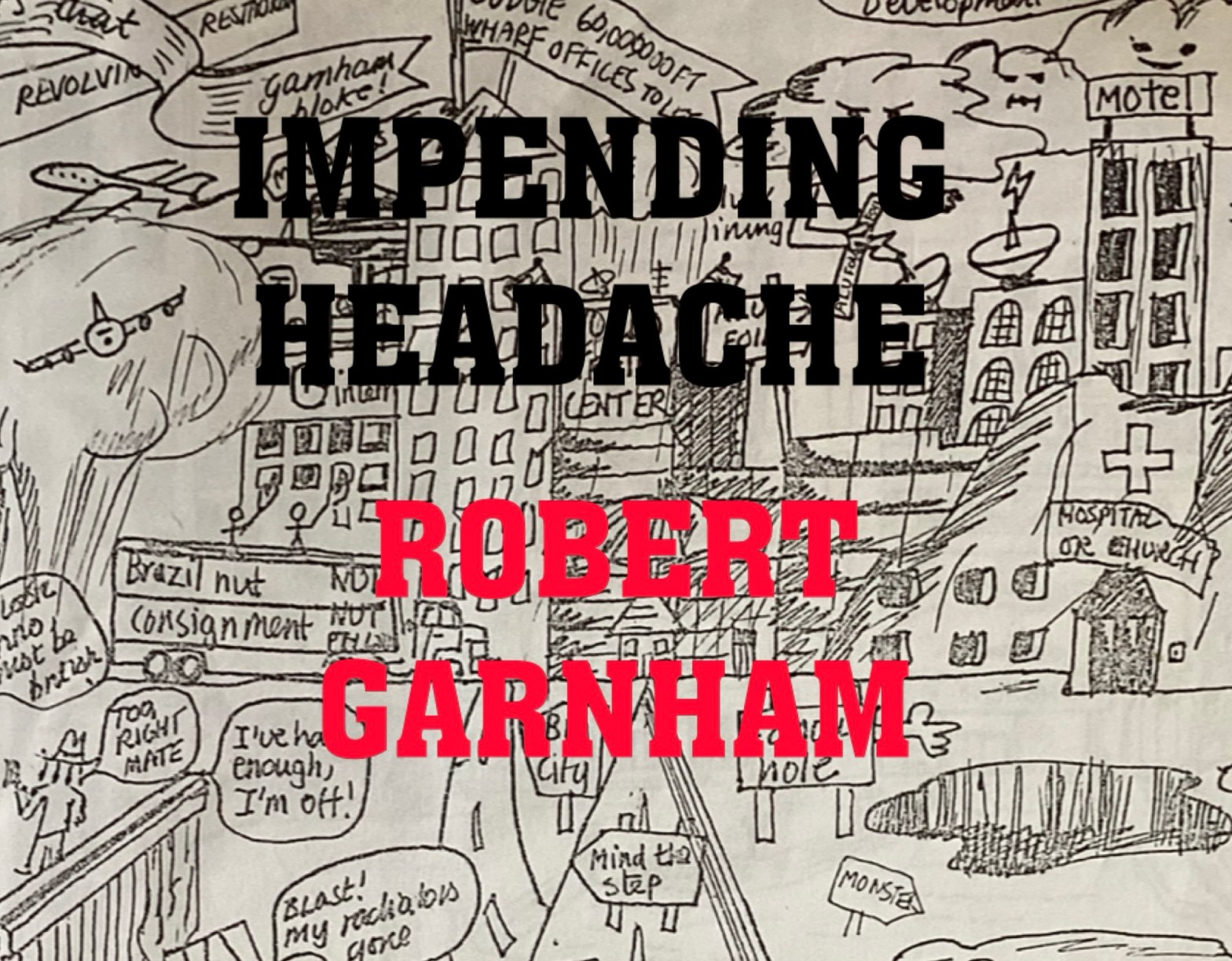


 Robert Garnham