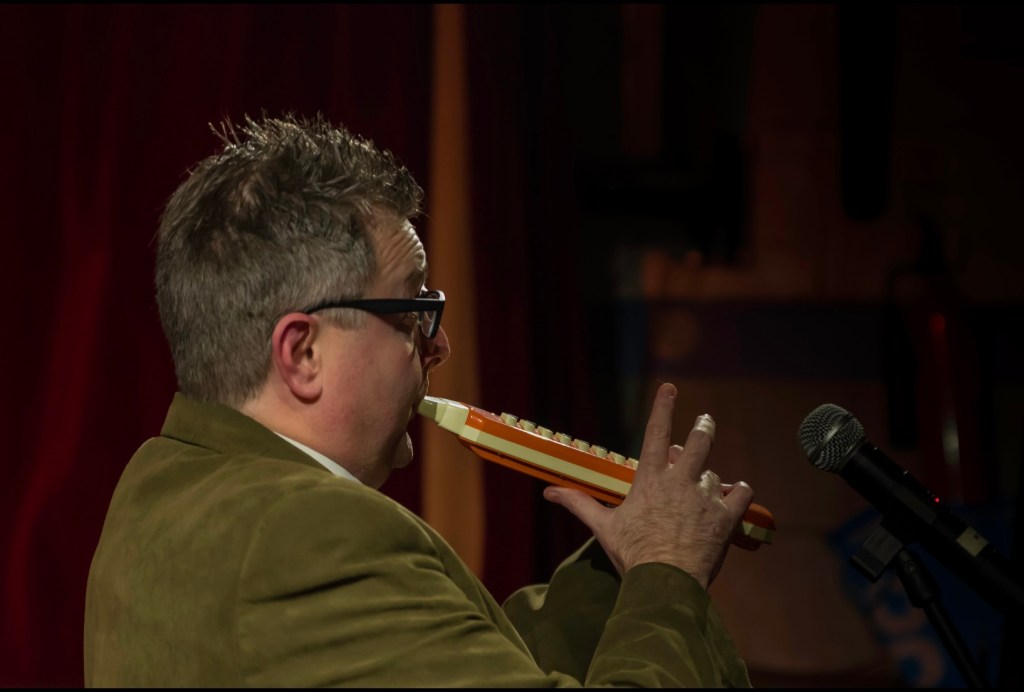
The thing was, I was fed up with lugging props around the various fringes and festivals. That was the crux of the issue. Each year I would devise a new solo show and each year I’d promise myself that it would be a simple affair, and within weeks I had incorporated so many props, costumes and technical details into the show that it couldn’t possibly be performed without a big box of paraphernalia. Which is not what you need when you have to run for trains or make your way from Devon to the Edinburgh fringe.
2019 was when things got just too much. That year, I had a show all about tea. The show was called ‘Spout’. ‘Spout’ could only be performed with: a tea pot, a cup, a saucer, a tea caddy, a box of drawstring teabags, a tea cosy, an iPad which had all the various sounds, music and cues stored on it, a Bluetooth speaker, some juggling balls, a large pad of paper with a word search written on it in sharpie, and a tray on to which I had glued another teapot, another cup, another saucer, a milk jug and a sugar bowl, so that I could dance around the stage without them falling off. So once you add luggage for a week in Scotland, merchandise to hopefully sell, and everything else which I normally travel with, you can see that performing the show was more like moving house.
And then on the way back from Edinburgh, someone stole my luggage. Sure, I had my box of props, but the tea cosy was in the suitcase which got stolen. The tea cosy was actually a proper hat knitted and created by the artist Hazel Hammond, and I think I was more upset about this than the fact I’d lost all my clothing. And that’s when I decided, the next show will have no props!
No music, either. No complicated cues. No background beats. It would just be me and the audience with no embellishment whatsoever. Something about this felt pure. It felt real. It felt grown up.
In 2020 I started work on the new show. I decided that it would tie in with my new book, published by Burning Eye. I decided that the show would feature only poems from the new collection. Which I knew would make the writing somewhat limited, but I was determined to get it done.
Each one of my shows was inspired by something or someone during the planning process. My first show, Static, (2014), was heavily influenced by the work of performance artist Laurie Anderson. In the Glare of the Neon Yak (2017) was influenced by storytellers such as Dandy Darkly. And when it came to the Yay show, I was busy looking at the work of singer David Byrne, and storyteller Spalding Gray. Spalding’s only prop was often just a table which he sat behind. And Byrne’s American Utopia stage show concentrated on choreography and movement. These were the two things I was watching or reading about during the creative process.
I also read a book about creating solo work, and it suggested keeping a diary. Aha, I thought. Now that’s something I can definitely do. I thought I’d forget about the diary, but it actually helped with the creative process because it pushed me to do something which I could then write in the diary as proof that I was making some kind of progress.
Naturally, at the time I had no idea that this period of creativity and rehearsal would coincide with various lockdowns, pandemic mandates, and the whole paranoia and psychological malaise which these brought to the art industry. At some moments I wondered if I would ever get the chance to perform the show. As it is, with a bit of luck and some nifty admin, I managed to perform Yay twice in 2021, as well as perform it to a completely empty theatre for the benefit of a filmmaker, so that people could view the show online during lockdown.
When I heard that the great literary extremist Professor Zazzo Thiim was holding a symposium on the use of alliteration in Antarctic literature, I knew I just had to attend.
I knew that getting to the venue in the first place was in itself was a hard enough job; the convention was to be held in a remote hotel in the mountains which, in the middle of winter, would be cut off from the world by snow drifts, and sure enough, when the week of the convention came, the only way to get to the hotel was by walking the last two miles. As the darkness gathered around me, and large
fiakes of snow began to fll from the black, black sky, I gripped the handle of my suitcase and made my way up the track into the wilderness.
It must have taken a couple of hours to make the journey, and when I arrived at the hotel I was feeling irritable and uncharitable to say the least. My eyes were blinded by the motion of the snow as it had flown across my vision, and my fingers numbed from gripping the case for so long. The first thing I did was to dump my bags next to the reception desk and sit next to the roaring fire, in order that I may thaw my aching bones and curse my stupidity at having set out on such a journey in the first place. Yet only the one thought, of any substance, kept coming to me as I sat there in the orange glow: after all this effort, this had better be worth it.
I soon became aware that an old man was sitting next to me and, after a while, he asked if I was there to see Zazzo Thim.
“Yes”, I replied, “Though I am now beginning to wonder if I have made a mistake.”
The old man wrapped his scarf tighter around his neck and gave a chuckle. “I can assure you that the convention will be well-managed and adequately attended for my needs, for I, myself, happen to be Zazzo Thiim”.
“What makes you so sure that it will be so well-attended?” l asked. It was snowing heavily outside now, and the hotel did not seem to be bursting with guests.
“The subject in itself”, the old man said, smiling gleefully. “Who could fail but be enchanted by such a subject? Antarctic literature, let me remind you, is an expanding genre. I expect there shall be quite a rush tomorrow morning for seats”.
At this, he looked first left, and then right, and then whispered to me in a severe, confidential tone:
“It’s quite possible that some people might not be allowed in’.
At once l felt bad. How close l had been in deciding not to come, yet others might not have been so foolhardy. I knew that there would probably be a limited attendance as it was, yet Thiim was sure that there would be more. I felt a sinking sensation inside of me, the dejection he might feel on walking into the conference centre that next morning only to see myself sitting there.
“I can assure you”, I told the old man, “That we shall all be thoroughly enlightened”
I went to my room and changed for dinner. I decided that I would enjoy myself, and I ordered the most expensive item on the menu, yet the restaurant was virtually empty, with the exception of a table on the far side of the room where Professor Zazzo Thiim slurped, quite noisily, his soup. Every now and then I would look over at him and feel a well of pity deep in my stomach, and I soon decided that something would have to be done. But what could I do? As the waiters kept moving past, as if gauging whether or not we had finished, a plan began to formulate in my mind that I could, somehow, interest other people in the subject of Antarctic literature and perhaps even bribe them into attending. But the plan seemed hopeless, even fanciful.
After dinner I went for a walk outside in the snow. The mountains loomed, black shapes and shadows in the night sky, while gentle flakes fell from above, illuminated by the lights from the hotel. A frost was setting in, and the ground crunched with each footstep. At last l came to one of the chalets, and I was just about to turn around and head back to the main building when the door opened and Zazzo Thiim himself emerged.
“Ah!”, he said. “It’s you! Come in, come in, we shall discuss literature!” Feeling awkward at this sudden invitation, I tried to formulate some reason why I might go back, when all the time I advanced towards his cabin. “What a brave, hardy soul”, he said, “To be out on a night like this!” He held the door open for me and I entered the chalet.
It was warm inside and a fire blazed in the hearth. He motioned that I sit down, and before long he was telling me about his interest in Antarctic literature.
“I have always been interested in a young writer of Norwegian descent, Petter Jansen, a writer of such talent and deftness of touch. He would describe the harsh winters of his homeland and the very essence of being in the snow, a subject I would find most glamorous in comparison to my lowly upbringing. As soon as I could I decided I would seek out Jansen and learn from him the craft of story-telling, of descriptive language and other literary ideals. Only, according to those who worked in the book industry, Jansen was working in the Antarctic, at a research station near the South Pole”.
“Armed only with protective clothing and a set of his works, I joined an expedition by ski-mobile in the middle of the Antarctic summer. The nights were cold and the days long, the sun never seemed to leave the sky, and all the time I was filled with so many questions, so much I wanted to ask. His characters, you see, were fragile beings, brittle, like flowers left too long in the frost, and I wanted to find out why he spent more time describing the weather than he did the emotions and sensibilities of his characters. There were other questions, too: why he
should have spent all his life in cold places, when surely he could have lived anywhere on the royalties from his volumes, and why he had given up writing fiction only to work as a research scientist in the South Pole.
“On the tenth day we reached the Norwegian research station and I was privileged enough to meet Jansen. He was not what l had expected; of course, in the years since he had been published he had become an old man, and he sported the most wondrous beard, which almost reached down to the middle of his chest. He had a gruff accent, a dismissive way of sharing information, and a healthy dislike of anyone, including myself. I followed him as he worked, and watched as he drilled holes in the ice, sank instruments down into packed snow, took readings on electronic devices. He was monosyllabic, non-committal, and despite
everything, I started to wonder if I should have been there at all.
But that night we went to his tent and he shared a bottle of vodka with me. ‘And now’, he said, ‘The real work begins’. Imagine my surprise when he produced from a wooden chest a large manuscript, several thousand pages long, and a pen, whose ink kept freezing and he had to warm by candle-light. ‘What is this?, I asked. He turned to me, wearily, his face lit by oi lamps and the candles, and he said: “This is the finest Antarctic novel ever written. Indeed’, he continued, This is the only Antarctic novel ever written’.
I watched, silently, as he wrote. And with what devotion! He forsook everything in the outside worid, every distraction, and bent his head over the manuscript, writing with a bare hand, the fingers gripped tightly around the nib. For two hours he wrote, diligently, painstakingly, until his alarm clock buzzed and, of a sudden, he put the pen down, gathered the pages, and placed them back in a wooden chest.
The next day followed the same routine: scientific work in the daytime, an evening of vodka, then writing by table light. He didn’t seem to mind the fact that I was there with him – indeed. he almost welcomed my company and the interest I showed in his writing. Finally it came time for me to leave, for my colleagues were due to start the hazardous journey back to the coast, and I decided I would revel in his company for the last time.
“When he began writing I tried to watch the words as they were formed, but he kept shying away from me, positioning his body in such a way that I could not read what he was writing, and when the alarm clock rang to signal the end of his writing shift, he placed the pen down, the manuscript in the box, and he said to me: “That’s it now. Scram. The experiment is over!’
‘How crestfallen I was! It was as if I had been stabbed in the back. I returned to my tent that night feeling hurt, abused, and with a general dissatisfaction not only with Petter Jansen, but with all writers everywhere. That night I could not sleep, and a fierce wind blew up, which rattle the tent and moaned across the barren lands. In the midst of this delirium one thought came and it would not go – that possibly I might sneak into Jansen’s tent and read the manuscript for myself.
‘Two hours later the idea still lived with a bizarre logic. I could take the strain no more, and, as the first rays of the sun began to peek over the continental mountains, I left my lodgings, walked across the snow, and let myself into Jansen’s tent. He slept well, and I had managed to let myself in without him hearing. With the wooden box right below me, I had no choice but to open it up and read the manuscript right then and there.
‘Oh, the power! “The Silken Breath of a Penguin in Repose’ is a work the likes of which I shall never forget! The intense truth, the humanity on display, the concern for a world forever spoiled by man’s eternal folly! The language seemed to ooze like honey poured on from a spoon, and yet the prose was sparse, the words as economical as ice. The book was set in the future, or very slightly in the future, and Jansen himself was a character, a fortune teller who was never wrong. And the final scene, where the mad explorer wipes away a frozen tear to think of the harm his fellow man has done, almost reduced me to an insensitive and indiscriminate howl
of anguish. When I glanced up, I noticed that Jansen was staring right at me.
‘What treachery is this?’, he asked. ‘My private words, spoiled for all time! What is this but an invasion of the lowest order! How dare you spoil these most sacred pages!’
‘I had no choice’, I replied. ‘And in any case, such a wondrous work needs an audience. There is much here that might change the world. How selfish can you be if you keep this from those who need it the most? What I have just read is the most intelligent, the most poetic work ever created’.
‘You have ruined my work!’, Jansen continued. ‘You have ruined me! We had a trust, you and me, a friendship . . .’. .. And then he looked at me for a while. ‘Did you really think it was that good?’
“So we came to an arrangement, right then and there, that I would tell the world about his work, but only if I choose locations and places that would guarantee the audience would be small. And that’s why l’m here now, in the mountains, in the middle of winter, about to host a conference on alliteration in Antarctica Literature. I mean, what kind of sad person would possibly venture all the way out here for such a thing?’
I looked at the old man and smiled. Professor Zazzo Thiim then cleared his throat.
“Apart from you, that is”.
Alas, the conference did not work out exactly as he had planned. I had left messages and notes to most of the staff and the guests of the hotel that the old man needed support, that he would be crestfallen if the conference was overly attended, and that they should do everything within their powers to put off potential attendees, and yet, that next morning, when Professor Zazzo Thiim took to the stage, he was confronted by a hall completely filled with people.
“Well …”, he said, laughing feebly into the microphone, then wincing as the feedback screeched round the hall. He activated the overhead projector to show a picture of a penguin, which then hung on the wall behind him, solemn, ethereal.
“There is . .”, he stuttered, “There is, in the power and beauty of. . .Huh-huh”.
Pleadingly, he looked at me, as if asking that I should remember the reasons why he had decided to hold the conference at this particular hotel. So what else could I do?
While no-one else was looking, I leaned behind me and activated the fire alarms. Everyone got up from their seats and the hall was evacuated in seconds.
The fact is that for some time now Professor Zazzo Thim has been lost, and it is my duty to find him. The manner of his disappearance is, beyond question, one of the most unusual cases I have ever come across. Yet the evidence I have before me, and the testimony of various witnesses, all point to the one conclusion: that Professor Zazzo Thiim is trapped, helpless, somewhere in Marcel Proust’s grand novel, ‘A la recherche du temps perdu’.
It did not take me long to deduce the basics of this case. Various students and colleagues of the Professor attested that he was busy constructing some sort of grand device in the basement of the institute in which he was employed. Various noises had been heard from the cellar towards the end of each academic day, and strange lights were seen by those leaving the building, orange in hue and regulating a slow rhythm. Those closest to the Professor could not find out from him exactly what it was he was building, though one colleague, Doctor Hermann Spatt, was most helpful in his assertion that the Professor was constructing a device which would, atom by atom, replicate his body as a series of words, and distribute them throughout a chosen text.
‘How do you know this?’ I asked.
Spatt grinned at me from across his desk.
‘l asked my dear old colleague. I came right out and asked him. Of course, he was pretty drunk at the time. But he told me what the machine entailed and what would happen to him as a result’.
At this, Spatt’s smile faded, and he leaned back in his chair.
‘Such a sad waste’, he whispered.
‘You must obviously have been close to your colleague’, I said, gently.
‘Thiim? Oh no, I couldn’t stand the chap. What I’m sorry about is that a book so wondrous as ‘a la recherche . .’ should be sullied by his ugly mug’.
The key to the basement in question remained locked and, on account of the strong, fortified doors to the cellar. I quickly deduced that it would take months, possibly years to enter that sacred room. Yet I remembered what Doctor Hermann Spatt had told me, and I set about reading Proust’s epic tome, that I may find some mention within its pages of the eminent Professor Zazzo Thiim.
The institute was good enough to provide me with accommodation during my stay. It was late autumn, and the trees were almost without their leaves. The paths around the parkland in which the institute is set were slippery, and it seemed the sky was hardly ever anything but a deep grey.
Proust’s volumes accompanied me everywhere. I would take walks in the
gardens, or through the woods, with one volume open under my nose and the next thrust under my arm. I would go to the dining hall and sit with the other students, hardly noticing their banter, so engrossed was I in the societal gossip as recorded by the redoubtable Marcel. Even my rare journeys outside of the campus were spent in the company of the Guermantes family, the many minor characters and the overriding sense of times past as recorded in those weighty books. It seemed my whole life had started to revolve around the novel, and I would make lísts of the endless family members, associates and contemporaries of the narrator, but each evening I would sit down and study these lists, safe in the knowledge that none of those mentioned bore the slightest resemblance to Professor Zazzo Thiim.
At around this time, Doctor Hermann Spatt, with the help of two science students and a Professor in electronics, began to build a machine using the blueprints found in Thim’s empty office which might, when up and running, be able to rescue the Professor from the depths of the accursed novel. The machine started to take shape in a far corner of the institute’s gymnasium, roped off from the rest of the hall by an arrangement of badminton nets, and each lunch time I would call in to see what progress was being achieved.
‘None at all, Spatt said, despairingly. ‘The machine just wont function. It needs more electricity than we are supplied’.
‘Then how did Thiim’s machine run so effectively?’ I asked.
Spatt pushed back the hair from his forehead and let out a deep sigh. “The energy needed to suck a character from a book is ten times more powerful than that needed to throw a character into the narrative. You see, Thiim had the advantage of gravity, but we have nothing, nothing at all’.
I walked around the machine and looked at it from many angles.
“It’s looking quite hopeless’, Spatt said, and l swear I saw a tear well in the corner of his eye as he contemplated his missing colleague.
That night I retired to my room. By now the bed was covered with the six volumes of Proust’s masterpiece. My reading of it was haphazard at best, covering the first three sections of each novel simultaneously, so that my understanding of the plot and the order in which Marcel’s life was playing out was tenuous at best. At worst,I didn’t know what was going on.
So many dukes, matriarchs, minor members of the aristocracy, childhood memories, subtle, beautiful women with strangely masculine names. That night I fell asleep and found myself in a nightmare, a dark, dismal Paris street where Proustian characters advanced upon me with their arms outstretched, their eyes displaying a frightening malice, humming, intoning some strange, ritualistic prayer which sounded for all the world like Kylie Minogue’s first hit single, ‘I Should Be So Lucky’. I woke with a start, frightened into reality yet not trusting the world around me, the darkness of the night, the wind which, ever so gently, was roaring in the trees and stripping them of the last of the leaves.
I got up and walked to the window. I was dizzy, I was sweating, yet the room was cold. It was as if the natural laws which surrounded and informed us all had ceased, that the earth itself no longer recognised whatever constitutions had kept it going for so many years. I rubbed my eyes and looked at the trees, and the leaves falling, one by one, across the sodium light of a campus street-lamp.
‘My God’, I whispered.
Excitedly, I telephoned Doctor Hermann Spatt immediately. He answered on the third ring, and asked, blearily, what it was I wanted.
‘The machine!'”, I said. ‘You remember what you were saying? That Thiim had the benefit of gravity?’
‘Hmm?’
‘And that we needed more energy because we were sucking a character out of a book, not throwing one in?’
‘Yes?
‘Then why don’t we just turn the whole machine upside down? Put the machine on the floor and the book suspended above!’
There was silence on the other end of the line, and then Spatt’s voice cane back. ‘My word!’, he said, ‘You’re a genius!’
The next morning Spatt, accompanied by his assistants, set to work making the modifications I had suggested, while I, now with the help of three assistants of my own, continued my reading of Proust’s novel. We each took a volume and, starting at the very beginning, ploughed our way through the dense script, using different translations and even the French language original, so that we were working on three separate texts at once. Halfway through the afternoon Spatt rang to tell me that the machine was working perfectly, and all it needed was for me to find Thiim in the novel so that we might rescue him. This news gave us a welcome feeling of progress and we intensified our efforts until, by six in the evening, we were all very tired and our eyes and heads ached.
‘Thank you, lads’, I whispered, as they headed towards the door.
‘Erm, we were wondering’, said one of them, an amiable young man by the name of Adam. ‘Would you like to come out for a drink tonight?’
I smiled at their offer, for it was proof that we had gelled as a team. “Thank you, but I would rather maintain my faculties’, I told them.
Their shoulders slumped.
‘And I suggest you do the same, for we need our full concentration if we are ever to find the Professor’.
Adam smiled. ‘Very well’, he said. ‘We wouldn’t have gone overboard, anyway. Just a couple of drinks and then back home’.
‘Thanks once again’, I whispered.
The days were getting shorter, and once I had eaten my dinner, (accompanied, once
again, by the ever-present Monsieur Proust), I went back to my room and prepared for sleep. To be honest, I was beginning to doubt that we would ever find Thiim in this mammoth book, and a part of me was content just to sit back and enjoy the experience of being a small part in such a large, well-funded experiment. Though the more l thought about it, the more desperate l started to become, as I realised that the whole project now depended on me and my abilities wade through the novel for just the smallest clue. Worse still, I was afraid to sleep, for I knewthat I would be haunted by Kylie once again, that inane, stupid song, 1 Should Be So Lucky!’
Timidly, I retired to my bed.
At two in the morning I was woken by a fierce pounding on my door. Hardly able to concentrate, I opened the door and blinked in amazement to see Robert de Saint-Loup.
‘Do forgive my intrusion’, said he, ‘But I was wondering if you had had word of the Duc de Guermantes?”
‘I beg your pardon?’, said I, hardly believing my eyes.
At that moment M. de Charlus bounded down the corridor and patted Saint-Loup on the shoulder.
‘There you are!”, said he. His eyes then focused on myself, standing in the doorway in a pair of boxer shorts and nothing else.
‘Hello!’, he said, twirling his moustache.
‘I say!’, said a voice from the end of the corridor.
They both looked up and bowed, courteously, as Albertine approached. “Are you not on the way to the Verdurin ball? I proclaim it to be the most whimsical event of the decade!’
Hurriedly, I shut my door, then went over to the window. Oh, what a scene met my eyes!
The quiet park was awash with people, elegantly dressed, bowing, nodding, dancing, chatting in the glare of the street-lamp as if they were in a ball or a turn of the century function. And they were all, I was horrified to note, characters from Marcel Proust’s mighty tome.
I telephoned Spatt and he confirmed my worst suspicions. Some students, drunk of course, had broken into the gymnasium and fiddled with the machine.
Instead of pulling the hapless Thiim from the depths of the novel, they had, wantonly and without thought to the effects of their crime, pulled out every other character instead.
‘But this is horrendous!’, I whispered.
‘There’s no choice’, said Spatt. ‘We must round them all up and post them back into that hideous novel. Do you know what they’re doing now? They’re in the canteen, holding a mass madeleine tasting. This has got to stop!’
‘There’s only one way we can get them back into the novel’, I told the Doctor. ‘We must break into the basement and use Thiim’s machine’
It took the best part of the night to round up all of the characters. Because we had been using three different translations, there were three of each of them, and the three Marcels had met some time after half four and, indignant that their individualities had been compromised, had challenged each other to a duel, (from which, naturally, each one backed out.) Charlus was the worst, and three of his characters had to be retrieved from the public lavatories and from various male student’s bedrooms before they were all accounted for. At last we had rounded them
all up and we were engaged in the act of congregating them around the door to the basement, a tricky act which was achieved only by the entertainment of a piano playing Chopin and the liberal refreshment of champagne. Spatt and I, meanwhile, busied ourselves at the door. The thick oak would not budge to our shoulders, neither to a rudimentary battering ram fashioned out of an old roll-top desk. However, when one of the Robert de Saint-Loups saw what we were trying to achieve, he supplied us with some dynamite which, he assured us, was fresh from the Great War battlefields.
The following explosion was deafening. Two of the Mme de Verdurins went flying through the air, their stiff petticoats flaying in all directions. At last we entered that hallowed room and saw Thiim’s machine which, somewhat comfortingly, looked not unlike the reverse example we had fashioned in the gymnasium. Yet only now did Spatt and I see the almost fatal mistake that Thiim had made.
Indeed, the machine functioned well, and had been put together expertly. However, the absent-minded Professor had, one can only assume, accidentally, mistakenly placed within its confines not Proust’s magnificent novel, but a CD of Kylie’s first UK Number One hit, ‘I Should Be So Lucky’
It didn’t take long for the machine to be put to use. How affectionately we said good-bye to all the characters, who each invited us to various balls and society functions for the following Paris season. When they were all quite delivered, Spatt and I took Thiim’s CD upstairs to the gymnasium, where we placed it on top of the machine and pulled the necessary levers.
Seconds later, Professor Zazzo Thiim materialised.
‘Oh, my word’, he said, feeling his nervous forehead. ‘I was having the time of my life! l’ve never danced so much!”‘
‘You realise what you did?’ Spatt asked.
‘Oh, the CD? Entirely intentional, my dear friend.
‘But that’s preposterous!’
‘So many hours I’d spent on that machine, a copy of Proust under my arm. So many years I’d dreamed of meeting those wondrous characters. Yet when it came time to leave I thought long and hard about it . . ‘.
‘And?’
‘And I realised that I would rather be with Kylie, instead’.
‘Good gracious!’
‘Well, my dear Spatt. They’re so stuffy, aren’t they? And Kylie’s much more . . . Vivacious’.
At this, Thiim looked left, then right, then left again.
‘And another thing’, he added, confidentially, ‘She’s a much better dancer’.
Alas, the story does not end here. The following week, Kylie’s management refused to confirm that a new version of her original hit single had been mixed, with some quite bizarre vocals by various French dignitaries, mostly concerning the petty discriminations and social faux pas of early 20th Century Paris.
‘My god!’, Spatt whispered to me, down the telephone line. ‘We must have sent them to the wrong place!’
Yet not one scholar, student or academic genius happened to notice that Proust’s six-volume masterpiece now seemed not to have a single character left in it at all.
Between the late nineties and the mid 2000s, I wrote hundreds of short stories. This was a very hectic time in my life, and probably needlessly so. In 2000, I moved into a gothic flat near the seafront in Paignton, almost directly over the road from the shop where I worked. I was studying Open University every morning, getting up at 5, studying 6-9, going over the road and working 9-5, then home, and spending every single evening writing short stories.
On my day off I’d attend a Writers’ Circle and it soon became apparent that the other attendees seemed drawn to my funnier stories. In one story, I invented a character, a professor of literature by the name of Zazzo, and soon the other members of the writers’ circle started saying things like, ‘Oh, I can’t wait to see what Zazzo gets up to next week!’
My Open University degree was in Literature, so I’d have to watch a lot of videos (it was still videos back then), and listen to lots of cassettes presented by these eccentric academic types who were a million miles away from the milieu in which I moved. I saw Zazzo as belonging to this community, perhaps barely tolerated by his contemporaries, and often shooting off at a tangent, seeing patterns where there were no patterns, narratives where there were no narratives.
Zazzo was a literary investigator. Whenever there was a mystery with a literary element, Zazzo would be there. Skateboarders quoting Shakespeare for no reason? Send in Zazzo! A crab routinely predicting the winner of the Booker Prize every year? Another case for Zazzo! The discovery of yet another Brontë sister? Who do we call? Professor Zazzo!
The Zazzo stories were saved on various floppy discs, and then promptly forgotten about for twenty years. I had no way of accessing them for quite some time, but now, thanks to various technological developments (and some paper versions I recently found), Professor Zazzo has been saved from obscurity!
My life has moved on since those days. I’ve been working as a comedy performance poet since around 2008, and worked on various other projects, so it was a delight to rediscover this strange world. And I really hope you might enjoy reading some of the stories which I shall be publishing on this blog.
ZAZZO DECLARES THE DEATH OF THE SHORT STORY (A SHORT STORY)
As the train pulled into the station, Professor Zazzo Thim felt a twinge within him, deep down where he knew his heart should have been. He didn’t want to be there, he didn’t even know why he had come back to this place where, years before he had given an infamous speech in which he had proclaimed the death, as an art form, of the short story.
There had almost been a riot. But the Professor was a sentimental man, and when he had received, in the depths of the University in which he taught literary experimentalism, a letter from a middle-aged lady who had witnessed him that day, fleeing for his life amid the baggage trollies and the tourists pursued by an angry mob, he knew he had to go back there, just for old times sake.
And now he was on a train, pulling into that very station, with its vast glass roof and endless platforms.
How lucky that he had given them the slip all of those years ago, he thought to himself as the train slowly began to slow. Would anybody recognise him now, all these years later? The grand old station was the same as it ever was. The glass roof was a dirty grey, matching the overcast skies outside, while the rusted superstructure was plastered with pigeon droppings. Zazzo pulled his coat collar around him as he stepped out of the carriage onto the worn tarmac of the platform. He felt a coldness in the air, though, an eternal coldness, as if all the emotion from the thousands, the millions of journeys begun and ended here, the lives separated, the people who would never see each other again, had somehow become crystallised and manifested just in him. The Professor began to shiver. She was waiting for him at the exit of the platform, next the aerodynamic train engine which throbbed and sizzled as it recovered from its journey. She recognised the white-haired professor from the photographs on the jackets of his various, little-read volumes on the literature of Greenland and the cultural significance of the Haiku in Guatemala. (Verdict: virtually none at all). She stepped forwards, extended her hand, then helped him with the big bag slung over his which contained the manuscript of his latest novel. They went to the station cafe. “We talk about it even now”, she said, over a cup of coffee which steamed gently in the slant of morning light. “I didn’t realise it was such a big event “. “Big event?” she asked. “It was the only event”. The cafe was filled with travellers, youths with backpacks, old ladies with small trollies, all of them static for this one moment in time before they each went their separate ways to the furthest corners of the continent. Behind the counter, the coffee machine let off a cloud of steam which moistened the ceiling, while a small radio played jazz in the kitchen. The saxophone made Professor Thiim feel sad, though he didn’t quite know why. Something about the passing of the years, perhaps. “You certainly caused quite a stir”, the woman said. “Let me introduce myself. My name is Mathilda, and the day I saw you leaping over the tracks while being pursued by that mob, I was employed in the cigarette kiosque. I remember it now, your scarf trailing in the wind, the papers of your speech flying away behind you, the angry mob piling over baggage racks and the ticket barriers, like ants coming back to their colony. Nothing stood in their path! You started a change in me . . .”, she said, contemplatively. “What do you mean?” the Professor asked.
She smiled and looked down at her coffee cup. “While was working that morning l was listening to your speech. When l saw you set up on the main concourse with a soap box and a sheaf of papers l thought you were just another religious zealot, or maybe one of those hopeless politicians with their fake promises. But when you started speaking about the short story, and speaking so eloquently, l might add, l became entranced. I remember it to this day the way you said that short stories no longer mattered, that we were all philistines because we preferred trashy novels or the television, that all writers of short stories are, in some ways, the chroniclers of the modern world, capturing moments and emotions in subtle ways which other means can never attain yet entirely forgotten by everyone, and therefore, superfluous, misguided, and entirely fake. l remember the way you used to adjust the scarf around your neck as you talked, your face wrinkled in concentration. I was so captured by this that I completely forgot about my job, and when these people started crowding around you and heckling, I thought, a-ha! He has struck a nerve!” “It’s nice that you remember”, the Professor said, fingering his collar where the scarf would have been. He remembered the scarf, he still had it at home somewhere. “So I went home and I started to read short stories. Nothing major at first – romance, a bit of light comedy. Then l professed to Dorothy Parker, Mark Twain, Checkhov. After a few years I wanted more, so l started on James Joyce, Italo Calvino, old Franz Kafka. Borges came next, of course, the master of them all. And now . . “. “Yes?” the old man asked, fearfully. “Now I’m reading Samuel Beckett’ “My word”, he whispered “And it’s all thanks to you. My life has been enriched by that moment, by the passion and the fury of that one episode. I resigned from the cigarette kiosque, enrolled in university, and I began to acquire literary ideas of my own. Do you know what it means for a character to appear in a short story, for example? The characters believe themselves, for just one moment, to be so important as to be forever captured in the reader’s mind, and lodged there forever. Yet they do not have the longevity, the life-span of characters from, say, a novel. Such animosity exists between them! The moment in which they exist is so precious, so pure and concentrated that they could never last a whole novel with the same intensity. Just look at ourselves – if we two were to last a whole novel, we would be exhausted by the end of chapter three”. The Professor nodded, solemnly “I have so many ideas inside of me” Mathilda continued. “And it’s all thanks to you. So when I read a textbook on the use of penguins in the shorter fiction of Virginia Woolf – (in which it was concluded that penguins hardly featured in any of her work) – and I saw that the author was a certain Professor Zazzo Thim, who, years before, had almost been attacked right here at this very station, I thought: ‘l have to find him, I have to thank him personally for the life he has given me”. The Professor fingered the clasp of his briefcase. He felt so many different emotions. “I’m glad”, he whispered, above the soft saxophone solo from the kitchen. “That I have made an impact on someone’s life”. He opened the briefcase and took out a manuscript. “In fact, he continued, “I would like you to have this”. “What is it?” Mathilda asked, laying an expectant hand on her chest. “My latest academic work, explaining the death of surprise endings in short works of fiction. It is my belief that all surprises have been eliminated, that nothing more can ever be said at the end of a short story which may shock or confound the reader. I have called it, ‘No More The Lonely Badger”. “I’m touched”, Mathilda said. Zazzo passed the manuscript across the table towards her and she took it in her quivering hands. “No more surprises”, she whispered, reading the sub-heading. “An investigation by Professor Zazzo Thiim”. “Just one more thing”, he asked. “Why did the crowd react so badly to my speech? Why did they set about me in such a hostile manner? Surely, the people of this city don’t care that much for the short story as to attack me personally, just because of my hypothesis? I thought about it for the last twenty years, l’ve thought about the effect l had and the passion they displayed, see, and it, too, changed my life, it changed my ideas, and I started to devote my life to demonstrating that short stories do make a difference, and l have used the episode as an illustration in lectures, academic works and after-dinner speeches. Indeed, it could be said that my whole career has been based on this one incident! So tell me, why were the crowd so unaccountably incensed?” “Didn’t you know?”, Mathilda asked. “It was the cup final day. They saw your scarf. They thought you were a United supporter”.
If you go on Netflix you’ll find a comedy documentary called Jerry Seinfeld : Comedian. This film highlights the differences between a comedian just starting to make a name for himself, and an established comedian, Jerry Seinfeld, trying out new material having decided to ditch everything he’d performed, to great success, up to that point.
It’s a fascinating film because it shows the process Jerry went through of learning new lines, trying them out, occasionally forgetting his words, occasionally having a bad gig, and you can really tell that this was something that he was putting a lot of work into. And it’s also something which I can, to a lesser extent, relate to.
I’ve been performing comedy poetry now since 2008 and during that time, whenever I’ve been asked to headline or feature somewhere, there have been a certain canon of poems which I utilise, having perfected these over the years and knowing, more or less, what the audience response might be. It’s been something of a comfort, having these poems : Beard Envy, Plop, Badger in the Garden, Little House, Jellyfish, etc. The only times I’ve varied this set has been the addition of a poem or two from whatever hour show I’ve been working on. The Tea Rap, and High Tea, both came from my show Spout and found their way into my usual headline set.
However, using this method resulted in a strange feeling which I’m sure is not unique to me as a performer and as a writer. I started to become jealous of the version of me who existed when I wrote these poems. I was jealous of the version of me who existed when I started rehearsing these poems. I was jealous of an earlier version of myself. And because of this, I’d tell myself that I couldn’t write or perform this way any more. That the best years were already behind me.
In 2020 I started work on a new show, Yay : The Search for Happiness, which was all new material, though I’d been working on some of these poems since around 2016. The new show was the perfect vehicle for some of the poems which had never made their way into a headline set before, such as Sideburns, or Instructions for my Funeral. For me, there were two ‘stand out’ poems from the show, Shakka Lakka Boom, and Seaside Soul. Both can be performed with gusto and Shakka Lakka Boom has a catchy refrain that people can join in with. Hooray!, I thought. Two new ‘bangers’ which might make their way into hypothetical headline sets.
At the same time as writing Yay, I was also working on a project with the fishermen of Brixham, which eventually became a sequence of poems called Squidbox. Most of these poems were earnest and dealt with serious subjects such as wartime refugees, family history or the rigours of deep sea trawling, but I did include one poem ‘just for myself’, a very silly performance piece called Seagrasses. I performed this a couple of times at events to publicise Squidbox organised by Torbay Culture or Brixham Museum, and this too became another ‘potential banger’.
Once the pandemic quietened down a bit and normal life began, so too did gigs and offers of paid slots, and that’s when the idea came that possibly, just possibly, I might try and start performing only new material whenever the chance arose. This idea seemed both foolish and a little scary, because I’d held on to some of the old poems for so long that people told me they could recite them almost word for word. The trouble with this was that I didn’t have nearly enough potential material to fill a paid slot.
My philosophy when putting a set together has always been variety. A poem with singing, some dancing, a poem with music, a slam poem, a rhyming poem . . I always wanted to vary things up so that audiences did not become too bored, and doing away with what had become a carefully honed and varied set seemed a huge risk.
I sat down last year and started work on new poems. Yet this was fraught. There’s nothing worse, when writing, of having a preconceived idea of what the poem should sound like. The process should be organic, and some of these early poems suffered through trying to force a particular style or method of delivery. Yet even so, I kept the underlying ideas and put them to the rear of my mind.
I’ve always said that when you’re writing, the best performance pieces come where two ideas suddenly collide head on. It was a case of thinking, sometimes, ‘Hmm, what else can I throw at this poem?’ An early example was Do Wacka Do, which had a very pleasing rhythm. I then thought, actually, wouldn’t it be great to drive a truck straight through that rhythm, and completely change the direction and beat of the poem halfway through? I was very happy with this, but it still needed . . Something. One day I was mucking around with some choreography when I remembered a Scouts disco I went to in the early 1980s, where one of the Venture Scouts was disco dancing and every now and then he would flick imaginary insects from his arms. And that’s when I thought, well, what about if I did that during the Do Wacka Do poem? Along with a strange forwards pointing motion that a friend of mine does. So all of these combined to create a new performance piece, which only takes about a minute to perform, but I was really happy with it.
Another poem was called Dreamscraper. I was fairly happy with this but it didn’t seem to be going anywhere, until I began to experiment with my voice during the poem, starting off at a high tone at the beginning of every stanza, and lowering my voice until the last line of each stanza where, inevitably, the punchline of that verse might be. And I don’t know why, but this sounded both exasperated, and funny, like it was really paining me to perform the poem. I performed this once at an open mic in Exeter and it went down really well.
I’d been working on a short poem called My Friend Cliff is a Zombie, too. Again, mucking around during rehearsing this poem, I discovered that I could sing the refrain, which became more of a chorus. I then developed more choreography, which relied on the use of jazz hands and a manic straight ahead stare, but even this didn’t seem enough, until I realised that I could just start the poem with the melodica, echoing the tune of the refrain. Almost done . . Until I thought, wouldn’t it be funny to end the poem with a line which changes the whole focus of it? I wont say what this change is, but boom! My Friend Cliff is a Zombie was ready to be performed.
There are other experimental poems I’ve been playing with, which I don’t want to give away. ‘Gom’ is a sound poem, which I have a lot of fun performing. ‘The Nature Reserve’ is a new poem which starts out sounding deeply serious, but then slowly becomes more and more silly with lots of quirky noises. Again, I don’t want to spoil the surprise, but I was rehearsing this poem just a couple of days ago and I ended up having to stop because I was laughing so much.
So these are the new poems I’m working on, and there are others. I’m keeping with my philosophy of having as much variety as possible. My tribute to Dame Edith Sitwell, ‘Coffee Shop Coffee Shop’, has been performed at a couple of places and is possibly the fastest paced poem I’ve ever learned. It’s not exactly a comedy piece, though it’s experimental and uses voice and rhythm in an interesting way. ‘Bill’ is a very Ivor Cutler-esque piece which I was really happy with, detailing a man thinking about a hypothetical conversation and then getting upset with the replies that the person he was having the hypothetical conversation was coming out with, but the audience seemed to think that the hypothetical conversation was actually taking place, so this poem may need to be retooled.
So on the whole, I’m rather happy with the new poems I’ve been working on, and the work I’ve been doing during rehearsals. It’s true that none of them are exactly ‘bangers’ just yet, because I’m not sure what parts of them an audience might like until I’ve performed them live a few times. But it really does feel like I’ve turned a corner and that the old poems can be rested for a bit. In fact, it really does feel like I’m just starting out again as a performer! And that’s no bad thing. There are other poems I’m still working on and playing with, and I really can’t wait to see which way they end up going!
Three hundred or so low guttural individual voices Combine into a cohesive whole, a chorus of Feral anticipation as custard coloured titans Skip on to the pitch, the first among them kind of Punches limply through a paper hoop Emblazoned with their team sponsor's logo, J. Arthur Bowyer's Synchro-Boost Houseplant Compost, Three half-hearted palm slaps and then the paper gives way, These athletic specimens of masculinity and matching socks, Shiny blue polyester shorts a-gleam under the spotlights, Back slaps and star jumps, half-hearted jogging, While the opposing team, who must have had an Awfully long bus ride, kind of slouch on to the field, Mooching along the sides of the pitch like slugs around lettuce.
I'd brought a book to read assuming there would be seats. Instead I was pressed up against the lanky frame of an Ever so friendly thought unusually potty-mouthed A rote of a lad who replica custard coloured shirt Had last year's sponsor, McClintock's Polystyrene Coving Ltd., And who suggested at top column that the home team Might like to consider breaking the fucking legs of the opposition. Someone then tried to start a chant going, 'Oh we do like to beat them beside the seaside! We're gonna beat you by two or three!' But it kind of got drowned out To a chant of 'Put them all in intensive care! Put them all in intensive care! Put them all in intensive care! Captain Ollie's got great hair!'
I have come with a friend who's there for the football But also to show me the football and he Made a kind of grimace when I said I'd brought a book. The home team did some warm up exercises. 'They're dancing!' I said, 'it's all a bit camp, isn't it?' Number 32 is just my type, bleach blond hair, stubble, Long legs and snake hips. 'Coooo-eeeee! Over here! Yoooo-hooooo!' My pal said, 'He's on loan from Bournemouth'. I said, 'That's okay, I'd give him back in one piece'.
The stadium announcer extols the virtues of both teams And attests to the veracity of J. Arthur Bowyer's Synchro-Boost Houseplant Compost, And the game begins, number 32s elegant fingers splayed As he dribbles the ball, like he's a ballet dancer, Or a gymnast balancing on a beam, though even The home team audience yells that he's a useless Time wasting tossbag who gets the ball and does fuck all, Go back to Bournemouth you useless waste of space. He's got lovely eyes.
The ground rumbles and thuds as they race from one end To the other, kicking up clods of grass and winning The applause of the audience who shout encouragement, These lads in custard who aim at the goal at the other end, Someone misses a sitter, someone else scuffs it, And then the ball goes in the corner and two opposing players Prance and dance around it like Torville and Dean. My eyes kind of wander off to the other side Where twenty or so or the away team supporters chirrup And you can just make out the faded lettering of Last years sponsor showing through under a new coat of paint, McClintock's Polystyrene Coving Ltd. is better than any competition. Only the word 'tit' is still showing.
My pal has already told me in advance The skill of number 10, whose speciality is Less the sublime and precocious nature of his craft, More his knack for falling over at just the right moment, Now he goes down like a sack of spuds and the Audience erupts, apparently this is a good thing, He's allowed to aim a ball at the keeper and boom, In it goes, I almost spill my cup of tea As I'm jostled and the lad next to me flings His arms around my neck, jumps up and down, the Tea oscillates as I breathe in his Lynx Africa antiperspirant, I must say I enjoy it a lot. And now I want number 10 to fall over again.
Wouldn't you know it, he does, never fails to disappoint, Fortune smiles twice in the low setting sun, Achilles in his death throes, Icarus mid melt, Our hero is downfallen and rolling in the mud like a hippo, The ref's cheek bones prominent as his blows his whistle. Boom, scores! The audience is enraptured once again, Another clingy embrace of Lynx Africa, I'm a cuppa carrying eucalyptus and he's my own personal koala, Number 32 looks down wistfully as if jealous, I hope, Oh, I hope, of me and my new found tame delinquent Who sips a surreptitious beer from a paper bag and Chinks against my half spilled Darjeeling, cheers! Caught up in the joy of the moment I attempt to start a chant Based on the third movement of Beethoven's Pastoral Symphony But it doesn't take hold.
Really, I'm only here for my pal who's brought me along. This is his culture and I'm an interloper. But I want to show that I understand life Beyond the cliche, broaden my mind and experience Every nuance of our shared cultural history. 'We're winning ', he says during the interval As we queue for pies sold from a shed Next to the unoccupied press box. 'Well, they are', I point out, 'We're just watching'. I'm taking him to a drag show next weekend.
And then the announcer wants us all to sing happy birthday For Little Liam, whose favourite player is number ten. And Little Jimmy, whose favourite player is number ten, And Little Jack, whose favourite player is number ten, And he reminds us that we can all vote for the J. Arthur Bowyer's Synchro-Boost Houseplant Compost Man of the Match, which is usually won by number ten. 'I'd like to vote for number 32', I say, perhaps too loudly, And everyone around me laughs and says how funny, They love my sense of humour.
Two more goals soon after the interval. Perhaps the audience has tired itself out, I'm the only one who seems excited, and my new friend In the McClintock shirt hardly seems inclined at all To repeat his usual celebratory hijinx, no doubt Enervated by his previous exertions and the two litre bottle of cider Stuffed down the front of his trackie bottoms, And when the ref calls a halt to the show I pat My pal on the back and ask whether four nil in some kind Of club record. It was two all, he says, they switched ends. They what? Why didn't the announcer explain this Before I got excited over nothing?
Oh, this communal kickabout, this colossal crowd clapping This unified oneness this matey definitely not homoerotic bonding, This celebration of the hunter's skill this All-encompassing rough and tumble this slippery sport a spurt With spurious curiosities this worship of the physical This proof of prayer this spectacle this weird excuse To suddenly bellow 'Nice tackle!' and no one bats an eyelid This playing out of certain urges but would they ever let me Join in? No, probably not, and number ten has got mud all over him.
What did you think?, my pal asks As we file like clocked off factory workers Into the adjacent streets, not that he's interested really, Immediately he then adds, shall we get some chips?
I think of number 32 Isolated In the dressing room.
The tiny single-engine aircraft was just a dot at first, hovering on the horizon above the fir trees. ‘You got everything?’, Justin asked. ‘Everything’, I replied. I meant it, too. Condensed into a silver canister which shone in the low sunset. We watched the aircraft land, kicking up dust from the unmade runway surrounded by deep forest. It came to a rest in front of us. The pilot hopped down. ‘You boys ready?’, she asked. ‘Yup’. ‘You got everything?’ I held up the silver canister. ‘Ah’, she said. ‘You’re one of those modern sorts . . .’. We climbed up, Justin and I. There wasn’t much room inside, just as well I had the silver canister. If you didn’t know any better you’d have thought that I was carrying someone’s ashes. Our pilot walked a long way from the aircraft and had a cigarette next to the periphery of the makeshift airfield. ‘I hope she doesn’t set the forest alight with her cigarette butt’, Justin pointed out. ‘The undergrowth is tinder dry . .’. I’d let him sit up front, in the co-pilot’s seat. I was strapped in, the silver canister on the seat next to me, with our bags and backpacks. Of course, we could have easily left our equipment indoors, in the living room just next to the front door, before condensing them. But there were certain things that we might need on the four hour flight. Our pilot walked around the aircraft and checked all of the flaps and the rudder and the wings, and then she hopped on board and started the engine. The old craft shook and throbbed. ‘You got everything?’ she asked. ‘Canister!’, I yelled. She turned us around and we took off with a kick of acceleration, up over the tops of the trees and into the low setting sun. She put on a pair of sunglasses. ‘Dark matter compression?’ she asked. ‘Yes!’ I yelled. I’d forgotten how noisy aircraft can be. ‘So what do you do with it, just plug it in?’ ‘I know it sounds silly’, I yelled, ‘but you add cold water’. ‘It’s amazing what they can do these days’. ‘What?’ ‘I said, it’s amazing what they can do these days!’ ‘Certainly beats camping’, I shouted, as we banked over a winding blue river. ‘It’s great, too, you know? Sleeping in your own bed every night, even if you’re thousands of miles from home’. ‘Sure’, she said. She was silent for a bit. ‘The canister . . .’, she said, ‘its watertight, isn’t it? Wouldn’t want it to . . You know . . pop open up here’. Justin changed the subject. ‘Do you know if there’s a florist near the airport?’ he asked. ‘I have to get a bunch of flowers for my mother. It’s something I always do. I promised her, as soon as we landed I would get her some flowers’. ‘Birthday?’ ‘No, just a regular gift’. ‘What a thoughtful son you are’. ‘Got to keep her happy’. The little aircraft’s engine let out a reassuring constant tone. I reached down and rummaged in my rucksack for a plastic bottle of water. Some of it leaked the moment that I took the cap off. ‘For goodness sake!’, our pilot yelled, ‘be careful back there!’
All I said was, Why is it so draughty in here? And you gave me one of those looks Like the tosser that you are, Sprawled akimbo half on the sofa, Half on the pouffe, You sports vest attired shag bunny You king of pungency masked in Lynx Africa You gymnasium dumbbell botherer whose limbs Look like the spare parts left over when Mother Nature has tried to make its first gibbon, You text speak Netflix modern day lothario Looks more like Onslow Whose only cultural refinement is the ability to Belch the theme tune to Countdown You harbinger of sloppy sex whose bedroom technique Feels more like conducting an oil change on a Ford Transit van, Said, I can't feel a draught.
And I was apt to point at the curtains The net curtains the fine lace net curtains Which were lifting ever so gently away From the window frame gently swaying net curtains And I said What's causing this, what's causing this, eh? Is it the ghost of Liberace trying to make a grand entrance? And you didn't get my cultural reference And thinking back I didn't know what it meant either.
And furthermore I insisted persisted that Should I stand there with feather next to the Obviously ill fitting window frames A feather whether the feather should Demonstrate by means of its bristles undulating Sensuously Like a naked James Bond opening titles dancer See them undulating these bristles Like a naked James Bond opening titles dancer Who ironically Would almost certainly feel a draught.
And did I not impinge the possibility That the curtains should billow so Undulating billowing curtains ballooning curtains Swishing whistling billowing curtains Right in front of the TV screen That we might Billowing curtains billowing curtains Fluttering across the TV screen Lose sight of the bigger picture?
And thence did I not utter a silent prayer A private invocation a spell a trance Hands clasped flat palm on palm Eyes screwed tight shut palm on palm Prayer pious prayer eyes shut prayer While you Scooped up and consumed Honey roasted nuts?
And did I not expostulate And did you not lie there Half slouched with your bronzed muscles That put me in mind of the cheap handbags in Primark With your shorty shorty shorty shorty denim shorts Which when you take them off just kind of Maintain the same shale put a book across the top Use them as a makeshift coffee table With your bleached blond blond blond blondie blond Sandy beach bleached hair short spiked Like the stubbly pasture grass around the steaming cowpat Of your bald patch With your face that looks like the top half was incredibly surprised That the bottom half had grown a beard And now it was off to go and join A much more successful face With your tattoo of Marilyn Monroe that had got so wrinkled She now looked like Sid James Did you not lie slumped there and suggest I sit at the other side of the room Sit at the other side of the room? No I replied, I ain't no draught dodger.
I stepped into a tropical bar. Simon Reeve was there in a slow dance, And I lost myself to his floppy fringe Whose sweat-soaked flappy fronds would Tickle my blushing cheeks, Whose stubble scraped at the twilit skies Like a cat’s claws on anaglypta, Whose come-to-bed eyes betrayed none Of the entitlement of his classical features But a yearning for a sweetness so virile That he could have been a treacle tart And I ached, how I ached, To be the custard.
Backpack merely decorative, Naive tone a faux Theroux, Poor man’s Palin, Cargo-trousered doyen of sand dunes And jungle trains, No armchair droner he, Riven with Reevisms, river crossings, Barrier reef rovings, Now gyrating for my pleasure in the aptly named Club Flamingo.
Simon Reeve whose dimpled smile Hauls in the night like a Titicatan net-lobber, Whose unblemished skin betrays the Goodness of various restorative unguents, Whose manly chin is jutted like the Bulbous bow of a speeding Shinkansen And probably twice as purposeful, Whose sensitive eyebrows are seldom parabolic, Yet neither do they quiver intense for Reevsie is an empathic soul, Whose backpack is admittedly superfluous, Whose torso is Michaelangeloian in its Sculpted accommodation of his lean yet Muscular frame on whose bounty I would Willingly consume a quadruple-decker cheeseburger Dipping a chip in a reservoir of mayonnaise Stored for convenience sake in his belly button.
Action man for aunties. Secret poet banging sand out his boots. Earnest and eager though neither over with either. Mortal enemy of Professor Brian Cox. No world-weary Whicker he, but a clamorous compassion And the kind of face That would make even Vladimir Putin Contemplate a five minute fumble In the broom cupboard.
Simon Reeve, whose tousled locks hold Within their definitely un-dyed verdantness A vitality that would put Dwayne ‘The Rock’ Johnson to shame, Whose rich deep Colombian coffee coloured eyes Might penetrate x-ray-like beneath layers so effectively As to pass right through the earth’s core every time He bends down to pat a puppy. Whose nostrils hardly flare. Whose afterthought goatee clings on like A countryside hilltop copse stunted By the choking emissions from a nearby pig farm Yet in whose branches barn owls berate the night With their haunted warbling, Whose luscious lips have tempted many a plastic surgeon To bemoan the artifice of their own creations And now before is delicate tongue-moistened plumpness, Whose sturdy shoulders in their perfect powerful paralleogramatic Precision Would easily raise a live rhinoceros clear out Of the Serengeti mud hole Into which it had stumbled probably distracted By the beauty of Simon Reeve’s face in the first place.
And I, Simon Reeve, I am that rhinoceros And this ain’t no mud hole, It’s the Club Flamingo And our song has now ended And our dance has now ended And you’ve picked up your backpack Which definitely doesn’t contain Just a couple of pillows to make it look full for the cameras, And off you go.
Last year I became the Bard of Exeter. During this time I’ve been working on various poems about Exeter, written often during visits to the city. You can read them below, they’re not in any kind of order. I really do like the city of Exeter and I’ve enjoyed my time as the Bard.
Robert Garnham, writer and humorist
Poem
The River Exe Reminded me Of my ex. One has a sinewy Snaking nature And a big marsh Where wild things live, The other Is the River Exe. (You must have seen That one coming, Dear reader). One would turn Several times a day And often Not realise it. The other Is the River Exe. (Tidal, you see).
Poem
Oh, Exeter Airport. From the front You look Like a primary school. Your departure gates Are numbered Gate One and Gate Two. Your duty free shop Is more of a shelf. ‘You don’t hear many planes’, A friend observed As we sat there in the Living room of your Departure lounge. ‘That’s because’, I quipped, ‘There aren’t any’.
Poem
She said, ‘Take me to your favourite place, Restaurant, bar, tavern, Eatery, joint, cafe, Bistro, bistro, bistro, Any place we can get food, It doesn’t matter where, So long as we’re together. We can look into each other’s eyes Amid the ambience, And fill our souls with sustenance Of two different kinds’.
Next to the vending machine On platform three at Exeter St Davids, She said, ‘I think we should See other people’.
Poem
I’m Bard of Exeter, I said. More like, barred from Exeter, my friend replied. Ha ha ha ha ha. Yeah, funny.
I’m Bard of Exeter, I said. More like, barred from Exeter, my cousin replied. Ha ha ha ha ha. Yeah, funny.
I’m Bard of Exeter, I said. What’s that?, my friend Bill replied. It’s an honorary position, I explained. No, he said, I meant what’s Exeter?
I’m Bard of Exeter, I said. More like, barred from Exeter, my neighbour said. Ha ha ha ha ha. Yeah, funny.
This is why I don’t Tell many of my friends What I’m up to.
Poem
There’s a view of the Cathedral, The B and B owner said, From your window. And she was right. She had blue tacked it To the wall of the shed.
Poem
Let’s picnic in the grass, he said. In front of the medieval cathedral Whose precious beauty has tempted Many a passing tourist to drop to their knees And feint at its buttresses. The rain Made my pork pie soggy.
Poem
Is there a ram In the RAMM? A ramp To put the ram In the RAMM? A van to carry The ram to the ramp To put it in the RAMM? A man to drive the van To carry the ram to the ramp To put in the RAMM? No, But there’s a giraffe.
Poem
I contacted my sister, I texted her To say we’d arrived In Exeter. She didn’t know we were going, It perplexed her.
Poem
From Telegraph Hill The lights of Exeter Twinkle in the distance Like private stars in a constellation Of one. I’m lost in that timeless beauty Once again.
And then we drive Round and round The multi storey car park. The poetry Has long since evaporated.
Poem
As Splatford Split approached I still didn’t know Which way you would go. I watched your hands on the wheel. Lazily, you turned the car to the Left hand lane And I did a little air fist pump, Then held on, Ready for the rocket boost Of Telegraph Hill. Quicker this way, you said. Mmmm, I replied, And I wanted to kiss you.
Poem
The next stop is Exeter St. Thomas. To the uninitiated, they panic, Bloody hell, we’re here much sooner Than we thought. It’s OK, I think to myself, relaxing, you’ve still got Another five minutes until Exeter St. David’s. But it must be disconcerting Nonetheless. Similar names, you see.
That night, before I went to sleep, I thought, Oh, Perhaps some people Actually do want to get off at Exeter St. Thomas. The universe Is a cosmic joke.
Poem
I went for a walk Down to the quay By the river In the sun. I’d bought a chocolate milk From M and S Food Hall, Sat on a planter on the cobbles, Necked its fine rich nectar. Such fun. Although I was the only one there When I get up to put the bottle in the bin, I took my bag with me, Because, you know, You can never be too sure. My friend James is in his 70s and recently Had his very first pickled egg, So you never know what’s coming. Anyway. The quay. It was nice.
Poem
I was in the men’s section At Exeter Primark When the tannoy announcer said, ‘Could security Please be aware That Mister Strange Is in the men’s section. That’s Mister Strange In the men’s section.’ I looked around But I couldn’t see him.
Poem
I always look Too deeply Into things. Where others See objects I see Atoms.
Poem
I like the sunshine Too much To be an Overnight success.
Poem
While he was in the queue Getting their coffee She found a table and Pushed two chairs in, Pulled out one for herself, And one for the one She wanted him to sit in.
Poem
(In an Exeter coffee shop I overheard someone complaining about their neighbour who apparently spent most of the day sieving his gravel).
The gravel siever has a cluttered attic. He’s out there now, He’s out there every day Sieving his gravel, And by all accounts he’s got a cluttered attic, Cluttered with boxes, The boxes he had when he moved into the bungalow Whose gravel needed sieving.
Does he ponder on those boxes as he Sieves his gravel? Does he ponder on sieving his gravel as he Pokes his head in the loft Like a Jack in the Box Regards the clutter and lets out a mutter? There’s no single performing. There’s no shingle uniformity. There’s so much going on in the world But only two things going on in his.
Poem
I went to the ticket office. The man behind the counter asked, ‘Single?’ Is it really so obvious? I sat in my seat on the train. The notice above me said, Available. Is it really so damn obvious?
The A303 isn't as long as it used to be (It shrunk)
In prehistoric times, Apparently, The A303 Didn't stop at Exeter, But kept on going.
Continental drift played a part, Of course. Dinosaurs, and then The Romans Used it to go to Present day Nova Scotia. There were tea rooms, so peaceful, Very pleasant. Mind you, no Motorways in those days.
Genghis Khan Got stuck behind a tractor. Emperor Napoleon Got stuck behind a tractor. The Earl of Effingham Got stuck behind two tractors. And I bet he was Effingham.
The Moon was slightly closer back then. Stone Age man Worshipping cats eyes gleaming Brighter on account of the Moon glow Not quite so far For Armstrong and co to go.
Cowboys in the layby, And the hunter gatherer clans of Wiltshire Refused to welcome outsiders. Mostly we just Left them to their own Devizes.
Poem
There once was a man from the A303 Who wanted to go to Honiton via the B353 He took the A3033 And then the B453 And then the B353 itself but he ended up in Chard.
Poem
I'm a trainspotterspotter. There were two fine examples In Exeter St David’s last night. I spotted both of them Lurking amid the passengers With their notebooks and their cameras And their anoraks. But then I noticed that I had been Spotted by a trainspotterspotterspotter And that he was being spotted By a trainspotterspotterspotterspotter And that he was being spotted By a trainspotterspotterspotterspotterspotter And so on Until the time it would take to Explain all of this would be more time Than there is in the whole of existence More than all of the grains of sand on earth Or stars in the universe So it's just as well that They kept the buffet open late.
Poem
My cousin Phil Slipped at the top of Telegraph Hill Bounded end over end In a never ending cartwheel Right from the very top, Then straight through the middle Of a loving couple's picnic, Damaging a sausage roll And two scotch eggs Virtually beyond repair Falling at such a velocity His shoes flew off And one of them clouted a nun Who shook her fist at him. Phil Still managed To blend into the left hand lane Of the motorway.
About 25 years ago I used to work in a shop In Sidwell Street And at lunchtimes in the summer Sunbathe on the flat roof, From where You’d be able to see The cars snaking up Telegraph Hill. Probably wouldn’t have been able To see Phil, though, Because he would have been too small And he didn’t exist, really.