An Interview with Melanie Branton

One of my best friends in the world of spoken word is Melanie Branton. Best friends in that we chat about things that aren’t to do with poetry or spoken word. She’s a wonderful person who I really admire, and I also think she’s one of the funniest people I know. Her poetry mixes page and performance, and is widely acclaimed. She has been published by some of the top publications and has headlined at some of the top nights in the country. Not only was she the Hammer and Tongue regional winner last year, but she came second at the Bristol Poetry Slam the year before. Only the best spoken word artists come second at the Bristol Poetry Slam. The really, really good ones who everyone loves and admire come second at the Bristol Poetry Slam.


I was so glad when Melanie agreed to be interviewed because I wanted to get to the root of what it is that makes her such a distinctive, funny and heartfelt performer.
1. Your poetry is distinctive, funny and heartfelt. How important is it to draw on personal experience in your work?
Very. It’s been both very therapeutic for me in dealing with dark moments of my life that were still casting a shadow and a way of engaging with audiences in a deeper way. If you have the courage to expose something private about yourself, if you make yourself vulnerable before an audience, they will usually connect with you.

I didn’t always write like this. I started writing traditional light verse about “funny ideas” that were very far removed from me. But, 9 times out of 10, “funny ideas” are clichés, aren’t funny, and entrench dodgy, discriminatory world views (Mothers-in-law are dragons! Menopausal women are kooky and hysterical!) and it was a way of avoiding saying anything meaningful that might expose my own personality and history to scrutiny. Spoken word forced me to open up about myself more, take greater risks and made my poetry much better.
But that’s just me – not everyone has to write like this. Ultimately poetry has to be judged on its emotional impact and the quality of the writing, not its truth: I can’t be doing with all these “scandals” where slam audiences feel “cheated” when they find out that the poet they gave 10s to for his/her heartrending personal story doesn’t really have inoperable cancer/a dead twin brother/a history of childhood abuse (delete as applicable). Judge on the quality of the work, not on who’s got the biggest sob story, then maybe people won’t feel compelled to make stuff up.

2. You have an encyclopaedic knowledge of the modern poetry scene. In terms of page poets, who are your influences, and who do you admire?

Well, it’s more of a Dummy’s Guide-ic knowledge, actually.

There are some writers I admire and would love to write like, but know I never will (e.g. Emily Dickinson, Seamus Heaney). Then there are some writers that I used to read a lot of when I was a teenager. I’m not so into their work anymore, it’s not where my taste is now, but I can still see their influence in what I write (e.g. John Betjeman, Roger McGough).But there are some writers I love whose influence on my work is obvious – Selima Hill (who’s probably my favourite living poet) being a particular case in point. 

Writers I’ve been reading a lot of lately include Miriam Gamble, James Lasdun, Clare Pollard, Katherine Pierpoint, Penelope Shuttle, Philip Gross, but I have no idea if they’ve influenced me.
I lived in Poland for 4 years and I think I’m also influenced by Polish poets, from the stark attempts of Tadeusz Różewicz to construct a new poetics, after a Holocaust that had debased all that had gone before, to the playful, rather Dr Seuss-like absurdist, Konstanty Ildefons Gałczyński

If this has not already become obvious, I am totally obsessed by poetry

3. And what about performance poets?

One of the first spoken word artists I ever saw was Stacy Makishi and I am in awe of people like her, who are multidisciplinary performance artists, not just poets. Chanje Kunda has massively impressed me, in that total performance way.

It’s unfashionable to say so, but I like the traditional, rhymey-rhymey, almost music hall performance poets, like John Cooper Clarke and Pam Ayres. And people like Luke Wright, who I suppose are keeping this tradition alive.

I very much admire both Anna Freeman and Harry Baker. I think Harry’s breathtaking, ostentatious technical skill is a welcome corrective in a scene where the content cart is often put before the form-and-language horse. And I like the fact that he writes about nerdy things that no-one else does, like the vagaries of the German language and the joys of Maths.

I also very much admire you.

4. You’ve had success both in slams and in publication. What plans do you have for the immediate future?
I never have plans – I bumble along in a permanent state of vagueness. But I have a hazy aim to get a collection published in the next year or so and to get enough bookings to at least be able to convincingly pretend my job is poet on my passport. I’d also like to have a go at putting a one-hour show together, possibly on the subject of language, which seems to be a recurrent theme in what I’m writing at the moment.

5. A lot of your poems are very, very funny. How important is being funny in a performative context?

Thank you! I rarely set out to be funny (and when I do, I’m invariably not). Because I have a reputation mostly as a comic poet, audiences often want to find me funny and will laugh at poems I actually intended to be serious. 

Then again, I think most really funny poetry has a serious core. I see that a lot with your stuff – the reason it’s so funny is because it touches on profound human truths and fears. Most of your poems have very serious ideas about loneliness, being afraid of not being good enough or not fitting in, or gay politics lurking somewhere behind them. Real belly laughs come, not from a clever pun or rhyme, but from people recognising something about themselves in what you’ve said.
I’ve been to some events where funny poems were clearly looked down on as being trite, unworthy, so last century, which annoys me. I think you can often make a serious point more subtly and effectively through comedy than you can through being all earnest about it. And even if it is just fluff, what’s so terrible about that? Writing effective fluff still takes a lot of skill and it makes people happy.

The poems of mine that get the biggest laughs are usually ones where I’m emotionally offloading. Like “Everything Reminds Me Of You”, which is barely a poem at all – it’s just random stream-of-consciousness. I was long-term unemployed when I wrote it, had just had a really harsh rejection letter for about the 50,000th job I’d applied for and was trying to take solace in a creepily intense, one-sided crush on a man I slightly knew and had friended on social media. It’s ostensibly about a crush, but it’s really about the thousand and one desperate, delusional ways we try to create some happiness for ourselves in a world where nothing good ever happens.
Both the best and the worst thing about funny poems is that it’s easier to gauge how well you’ve gone down. If the audience laughs very loudly, you know your poem hit the spot. If they receive it in stony silence, you know you’ve failed miserably. Whereas, with serious poems, it’s all a lot more mysterious. Is that silence the pregnant silence of an enraptured audience hanging on your every word? Or is it the silence of 200 bored people simultaneously letting their minds drift onto whether they left the gas on and whether Tesco Express will still be open when they leave the venue and if there’ll still be any cat food left?

One thing I like to do is to switch to a serious poem after a string of comic ones. Audiences usually hate this. They start off laughing, because they assume I’m still trying to be funny, then as the penny drops, the laughs start to dry up and they look deeply, deeply uncomfortable, because they can’t work out what I expect of them and they feel stupid for having laughed in the first place. And this is exactly how I want them to feel. Because if I’m doing a poem about my mental illness or having been raped, I damn well want the audience to feel uncomfortable – I don’t want them to be sitting there having a feelgood moment, smugly congratulating themselves on how right-on and compassionate they are, which I feel happens way too much in spoken word.

6. How do you rehearse and memorise your work?

I don’t rehearse enough – I spend a lot of time on trains and much of my rehearsal consists of running through lines in my head while on the Taunton to Bristol Parkway line. Or pacing around mouthing the lines sotto voce on a draughty platform. 
Fortunately, I have always had a near-photographic memory, so memorisation has rarely been a major challenge (although I have dried on poems I knew well when nervous and the first outing for any poem is often a hit-and-miss affair). It helps if the poem is a narrative one, especially if it’s in chronological order, because it’s pretty obvious that C comes after B. Rhyme ought to help, but it’s also much more obvious when you get wrong.

7. What would you say was your best gig?
That’s a hard one to answer, as every gig is special in its own way (unless it goes badly, in which case it’s hideous).
The Bristol Slam in 2014, where I came second, has a special place in my heart, though, because it was about six months after I had taken up spoken word and was the first event where I felt I got taken seriously as a poet. I’d done a few slams before then and even won one of them, but I’d never felt I’d had more than a lukewarm reaction from the audience and the last couple had gone very badly (as in, I got given 6s when everybody else was getting 9s). I was on the verge of accepting that I just didn’t have what it takes and giving up. And then I turned up for one last hoorah, expecting to come last and totally humiliate myself again, and it was like a fairy tale (or, at least, a cheesy made-for-TV movie) – the audience treated me like a rock star, the expert judges gave me incredibly flattering scores and people seemed to assume I was a pro who knew what I was doing. It was the first time I really believed I might be somewhat good at this. I was so overwhelmed, I kept trying to hug the woman sitting next to me, in the emotion of the moment completely forgetting she was a total stranger. 

Both times I’ve appeared at Raise The Bar have also been amazing. Danny always manages to attract an enormous audience. It’s also a very young audience – I felt a bit like Ronald McDonald – but an insanely enthusiastic one and one which really listens and thinks about what it’s heard and is open to all kinds of poetry. It’s definitely my favourite night in Bristol at the moment.
8. What would be the overriding theme of your poetry, if there is one?

I’m probably best known for my poems moaning about my epically rubbish lovelife. I do write poems about other things, but those seem to be the ones that are the most popular.

9. How do you write? Do you have a specific time and place and set of procedures, or do you wait for inspiration to strike?

No, I don’t have any kind of system. I usually just wait for inspiration to strike, but I do sometimes give it a helping hand – I attend a brilliant poetry group where we’re given a set theme every month; if I know there’s a write-in at a café near me, I’ll try to go along; and I find that nothing coaxes the muse out of hiding like a deadline, so I will look up calls for submissions and force myself to produce something by the cut-off date.

Some of my poems come very easily, others take months of agonised tinkering.

10. One of your poems is a hilarious critique of slam poetry styles. Do you see a certain dominant style at such events? Does it help to be distinctive?

People often interpret that poem as a damning critique of slam poetry, but I actually wrote it when I was preparing for a major slam and was putting myself under enormous pressure to come up with the perfect poem, that would tick all the right boxes. Of course, I produced nothing but shit during this period, as I wasn’t being myself – I was trying to manufacture poetry with cynical, mercenary intentions, and be who other people wanted me to be. That never works. It’s not so much a critique of slam poetry as a critique of my own Machiavellian ambition and cackhanded slam tactics.
That said, there are things in slam poetry that piss me off and it does come out in that poem. In particular, I hate the amount of virtue-signalling that goes on at slams – people writing safe, anodyne poetry that preaches to the converted and doesn’t attempt to tell people anything they don’t already know. Yes, there are too many racists and homophobes in the world, but by and large they don’t attend spoken word events, so if you’ve come to tell people racism and homophobia is bad, you’re probably in the wrong venue.
Going back to your question, I think it helps to be distinctive with expert judges and with promoters and publishers, who are heartily sick of seeing Tesco Value versions of Kate Tempest and Shane Koyczan and want to see people who have their own things to say.

Some slam audiences, though, really don’t want you to be distinctive. If you don’t sound like a carbon copy of every other slam poet they’ve ever heard, they think you’re doing it wrong. That’s something that frustrates me. Fortunately, though, those audiences are in the minority – most spoken word audiences are very embracing and eclectic.


 

The Most Significant Full Stop Part Fourteen

I went to New York. And while I was in New York I thought about the significance we place in very tiny objects. Or the lack of significance. And as I wandered around Manhattan I thought of the tiny dot on the floor of Manchester Airport that I had seen earlier in the year, and how I might find some dot in Manhattan equally representative of travel and the sheer size of the planet.
Only a part of me knew that this would be impossible because I had already concentrated on a meaningless dot on the floor of the airport at Manchester, so really there was no need to imbue another insignificant dot with the same amount of significance.
I went to the Museum of Modern Art, and as I looked at the galleries and the exhibits, I pondered on the reasons why it wouldn’t be the same this time round. There would be something artificial in looking for an insignificant dot. Manchester was just a freak of circumstance, my eye happened upon it without looking. So looking for a dot in Manhattan would be counter to the whole idea of the project.
I then decided that the only way out of this would be to find a dot which had significance. And with all of this famous art around me, I would certainly find a significant dot. I looked at the pointillist work of Seurat and Pissarro but there were too many dots and they had their own combined insignificance sacrificed to the greater whole. I was pondering on Damien Hirst, but there were no Hirsts in the MoMa collection.
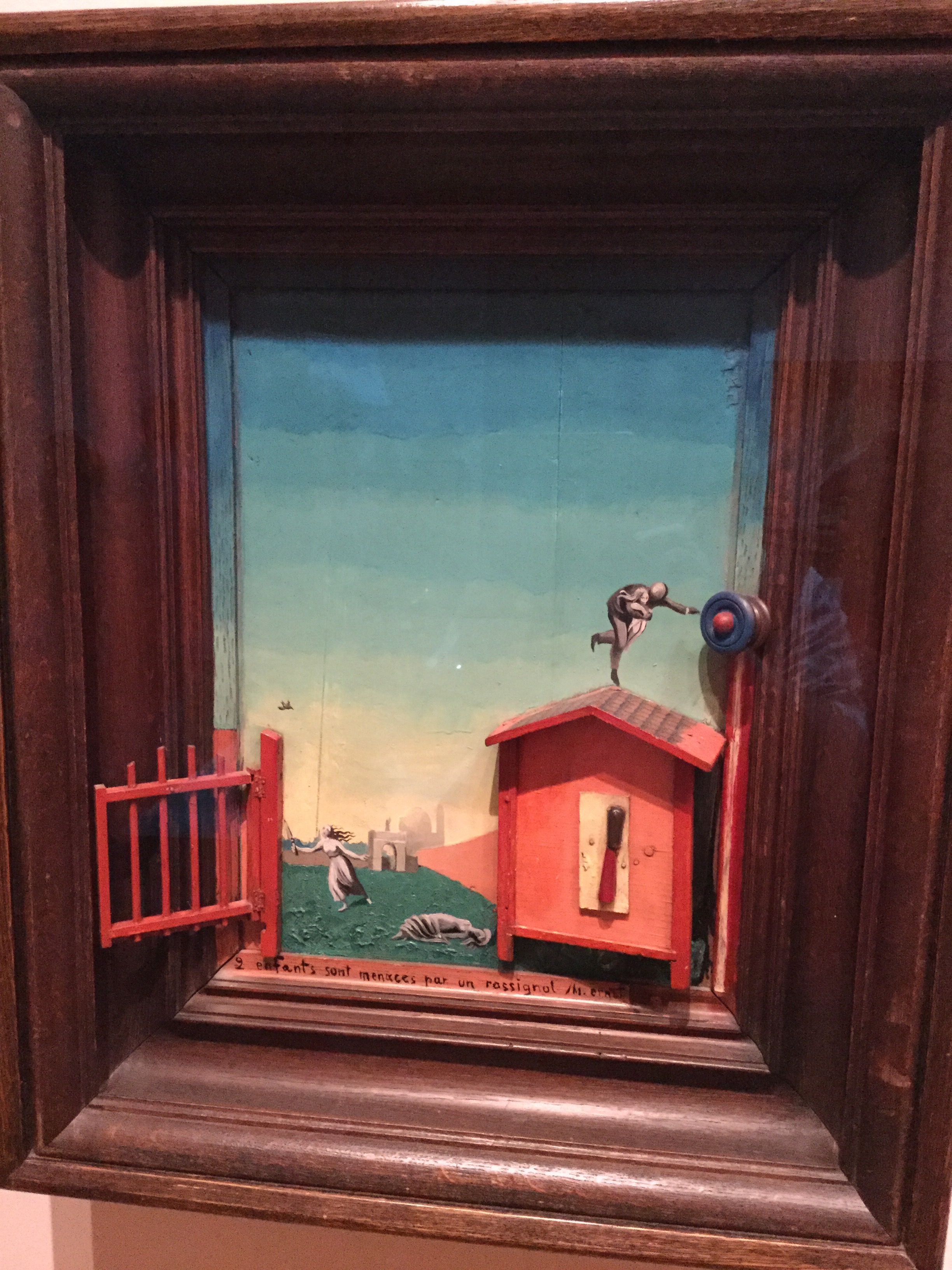
I then stumbled on a work by Max Ernst, ‘Two Children Are Threatened By a Nightingale’, and I was rather taken by he wooden frame, even if I did not particularly like the work itself. The artist had written the title of the work on the wooden frame and had used a full stop. This full stop, therefore, was insignificant in the context of the work, yet had been viewed and photographed millions of times without ever being seen.
This tiny dot, this punctuation written by Max Ernst, this conglomeration of paint on wood, varnished, would, I decided, be my own piece of New York. My whole personality and urges, motivations and longings would be represented by that tiny dot. And now here I am thousands of miles away from it, and at this moment I am probably the only person in the entire world thinking of that dot. Perhaps I am the only person on the world this year, this decade, who has pondered on that tiny dot. In fact, apart from this one moment here, in a coffee shop in Paignton, Devon, on the twenty second of October, the last time that this dot had any significance at all was when Max Ernst wrote it. And even then he probably did it without thinking.
Instead of me imbuing the dot with significance, the opposite is therefore occurring. The dot is imbuing me with significance. And this is a turn of events in my project which I am a little surprised about. I feel strangely elevated, even honoured by my association with the dot in question. And long may this continue.


New York Poems 

New York 1.
They say that Manhattan is a state of mind

But I’ve looked on the map

And it’s definitely there.
It doesn’t stop,

Not even in the dead of night,

The rumbling, the growl,

Inexorable,

No wonder they look so angry.
I went into Starbucks at five in the morning

And there was already a queue.

Shuffling jittery city dwellers,

The insomniacs and the early risers,

The boy who cannot sleep in

The city that never sleeps,

Nothing more offputting than a

Mardy pre-caffeine New Yorker.
Don’t take coffee, I take

Well actually I do take coffee,

Thanks for asking,

And maybe one of those tarts.

I’m English, you know.
Sitting in the window and watching

The cyclists,

Weaving, open-mouthed.

Stop lights mean nothing to them,

Life seems so tentative,

These two-wheeled mosquitoes,

How many of them end up 

Plastered on the front of those

Big-assed delivery trucks that you see,

Or some nobhead’s Humvee?
I thought the barista was only being nice

When he asked me for my name.

He repeated it with a smile, all

Rhotic on the consonants,

Elongating the vowels in a way

They don’t normally get pronounced,

Making my heart all fluttery

Until I notice he’d written it on my cup.
It’s the familiar things 

That make me feel at home.

Crushing disappointment,

And the fact that they

Also have McDonalds over here.
New York 2.
I need one with a shot of espresso.

You’re the newbie, you’ll need this.

There’s a whole bunch of confidence there.

She never told anyone

But she likes attention.

She’s like that with every guy, trust me.

And then she can cut him out, say uh-oh,

It’s like oh, it’s bad, she’ll go far,

She got green locker room doors,

She won’t try to apologise.

I don’t have an issue with her.

Every time I told her she gave me the one two.

I used to consider you a friend

And I was your friend whatever.
(Found poem, three NYPD police women chatting in a coffee shop at the next table).
New York 3.
The way he’s sitting

And what he’s wearing

And his hair

Those are the definites.

His sensitive eyes

His long eyelashes and the

Way he just looked 

At that jogger,

Those are the peripheries.

And the hoodie,

American Dance Theatre,

Alvin Ailey,

Whatever that is.

(I will google it later).

It’s all mostly symbolic

I feel

I know him.
New York 4.
She took my hand and danced with me

Amid the noise and clamour and cacophony 

Of Times Square 

As the skyscrapers whirled in their

Concrete and glass delirium,

She yelled

Above the engines and the horns and the

Shouting and the hooters and the sirens and the roar

And the buzz and the energy and the excitement

And the rush and the glee and the pulsing rhythms

Of the city in all its brash omnipotence,

Sorry,

I thought you were my husband.
New York 5.
(Amid the Abstract Expressionists, MoMa)
He, who isn’t here

Would have haunted these

Very pictures,

Broken nose to canvas

And a ready opinion.

Losing himself

In the Pollock

And it’s intricate action,

Felt a spark of the very now,

And would have known everyone

On first name terms.

Jasper. Jackson. Elaine. Robert. Mark.
The boy with the red trainers,

A sly flitting nonchalant phantom

Who will blond my dreams

With his purposeful demeanour

Right now here and

F would have approved.
New York 6.
I’ve only got one joke about denim.

A one liner about crinoline.

I’ve only got a couple of puns about nylon

And a quip about silk

Basically,

I’ve run out of material.
New York 7.
(Written in Tom’s Diner)
I wasn’t sitting near the window.

I was at the counter.

But it was still the diner on the corner

And the burger was mighty fine

On a drizzly Manhattan Saturday.
And there’s a ball game on the tv screen,

Notre Dame are playing NC State

And I’m not sure what the sport is

But they’ve all got helmets and shoulder pads.
There’s a picture from a magazine

Of Jerry Seinfeld on the wall and he’s

Kind of looking at me imperiously

As I eat my burger which,

As I said, is mighty fine.
I’ve got that tune in my head now,

You know the one.

The Seinfeld tv theme music.

I probably wouldn’t have come here

If it wasn’t for, you know,

These two things.
New York 8.
The Staten Island ferry 

Everyone is merry

They’re all waving at me!

Am I a celebrity?

Have I been recognised?

Am I famous here?

No, they’re

Wiping mist from the windows

Of the inside seating area.

I’m depressed now.
New York 9.
She purred

Hold on there, honey,

I’ll just put you through

On to line number three.

There was barely a click.

No static.

She’s such a

Smooth operator.
New York 10.
I want to go out with Rhys.

I want to have a date with Rhys.

I want to spend quality time with Rhys.

I want to get to know Rhys.

I want to be with Rhys.

I want to make out with Rhys

I want to express my love for Rhys

I want to have relations with Rhys

I want to be at peace 

With Rhys.
I say to Rhys

Please

Rhys

Please

Rhys

Please please please

Rhys Rhys Rhys

Rhys

Come on

Don’t be a tease

Put me at my ease

I haven’t got flees

You are the bees

Knees

Rhys
Rhys

What do you say?

Rhys

What of it, Rhys what of it, Rhys what do you reckon?

You and me Rhys please Rhys what do you think Rhys

Me and you Rhys you and me Rhys us together Rhys 

Rhys

Us together Rhys us together Rhys us us us

Together together together 

Rhys

Rhysie babes.

Please
Oh dear!

Rhys has gone walking off.

Rhys has gone walking off.

Rhys has gone walking off.

Rhys has gone walking off.

Rhys has gone walking off.

Rhys has gone walking off.

Rhys

Has called the police.
New York 11.
The big pancake. The big muffin.

The big nausea. The big nothing.

The broad one. The tall one.

The big fella. The concrete devotional.

The prostrate giant. The cosmopolitan.

The metropolitan. The big breakfast.

The all day lunch. The concrete funnel.

The distorted mirror. The seismic cherry.

The license to chill. The delicatessen.

The bad boy. The big bad boy,

Cavernous potholes so deep you’ll 

Lose yourself for a week.

The big dependable. The three-way delicious.

The exuberant fruit. The hungry papa.

The pumping beehive. The big badger.

The big glacial. The big crazy.

The big security. The big despicable.

The big beat. The big Apple.
New York 12.
No ghost dance

On these gentle hills

Nor ceremonial gatherings

On the granite outcrops, 

Central Park no wilderness,

Just the whisper of

Other people’s conquests

Too rooted in the now

To wander successfully.
New York 13. 
Melissa loves her new boyfriend

She was telling me 

He’s got it all and she’s fallen for him

And love is a tentative thing,

It makes her heart sing

That just a glimpse of him

Makes her all tingly inside.

Tell me more, said I.
His name is

Bruce.
It’s amazing,

It’s true love.

We haven’t actually been on a date,

But we shared the taxi home

From a Eurovision Song Contest party

And he was so nice.

He didn’t even touch me.

What a gentleman.

I’ve already changed my

Facebook relationship status.
He’s not like other men.

He doesn’t try to impress you

With a list of all the blokey masculine 

Macho things he’s done.
He’s ever so retro.

He likes antiques.

Old things. Ancient things.

He loves Cher.

He has a big droopy moustache

The kind that women in the seventies

Used to love.
He works on boats.

You never see him without his sailor’s cap.

But he also likes the countryside,

He loves camping.

And cottages.
He’s so manly

Yet he’s not afraid to show his emotions.

Just the opening chords of I Will Survive 

Has him in floods of tears.

He has the soul of a rebel,

And a connoisseurs appreciation

Of the female form

In all it’s beauty.

Lady Gaga, Kylie Minogue, 

Liza Minnelli, Judy Garland

Barbra Streisand.

Cher.

He’s a punk demon tearing up the road with his

Motorbike,

Which I haven’t seen

But he wears lots of leather 

And he says there’s nothing better than a 

Big one throbbing between his legs.

He’s the man for me!
He’s so caring.

He doesn’t want to upset whoever 

Gave him the Tshirt that reads,

It’s Raining Men.

But he wears it all the time.

And on the back it says

Hallelujah.
He’s coming round tomorrow night,

I’m going to tell him the way I feel

Over quiche.

He says he’ll do my nails

And watch a box set of the Golden Girls.

I might put the football on.

He was telling me

How much he likes footballers.

And ball sports in general.

He’s the man for me!
I’ve got him some whiskey.

He says he likes a stiff one 

Before bed.
So what do you think?
And I said, well,

First the good news is

I can’t see any problem looming with his

Red blooded masculine urges,

And the whole time you’re together

He won’t even look at another woman.

He’s not the sort of man

Who’ll force himself on you

Unless you’ve got the latest issue of Vogue,

And he’ll make your flat spotless.

You’ll be up to date with all of the

Latest celebrity gossip

And he’ll be genuine interested

In how much you hate your work colleagues.
And now for the bad news.

There will be no kids

I can guarantee it.

Try as you might

You’ll never break his heart.

And be prepared to meet a lot of

Impossibly handsome young men who have all

Inexplicably missed the last bus home,

One by one, on consecutive nights.
It’s not going to happen, sister.

It’s not going to work.

Take your mind off this man, this

Aesthetically pleasing man, this sensitive

Teasing perfumed perfect

Moisturiser tube squeezing

Eyebrow tweezing 

Salad seizing

Wit so cold it’s

Almost freezing man

For whom the dance of life

Is to dance all night

With the kind of type

He likes to like

Which I’m afraid, honey,

Is not you.
That’s a shame, she said,

He’s coming round tonight to pick up his 

Black and Decker Angle Grinder.

Oh, I said,

In that case I take it all back.
Poem
I met a wizard, a sage,

A man of his age

Whose wage was to lift

His spells from the page,

Engage with souls and enrage 

As if locked in a cage,

Mix emotions, persuade, rampage,

Oh, how I would gauge

With a hint of outrage

As I performed on the stage,

He was an old man

So he wasn’t teenage,

His name was Adrian

But his friends called him Adge.
I said,

Wise man,

Tell my why people are suffering,

For when my heart is fluttering

I hear a low muttering,

It’s happening right now

Over the coughing and spluttering,

Like a YouTube clip

That won’t stop buffering.
Why is this world filled with hate and with

Torture, and hunger and greed,

People who don’t get what they need,

It’s like hatred has planted a seed

Which won’t go away

Until we are freed,

Plus a lot of people

Routinely lose their car keys,
And soldiers,

Dressed in their khakis,

So glib their humour, so sarky,

So cold outside, it really is parky,

It’s a lark, see.

Oh wise man, I beseech thee,

You could teach me,

I’m out of reach, see.

If I was a germ you could bleach me.

Oh wise man, unleash me.
He opened his mouth to speak, see,

Thought about it deeply,

Cleared his throat and said,

Well
And I said,

Give me all your learnings, I’m yearning

To feel that burning

And the world turning,

Life is unfurling

Like ideas thrown in the air

I’m hurling

Concepts at ya,

What philosophy can we capture,

Or otherwise enrapture.

Tell me wise man,

Have you got it beat?

Is the street your retreat to make

Your life complete

Like a celebrity reTweet

Tell us why

Life ain’t so sweet.
He pondered and said,

The trouble is
And I said,

I crave the truth quell the horror in my brain,

The souls I fear who die in their millions,

The humanity of which we are all a part,

I no more fear the truth, let it blaze like a bonfire

As it wells from deep within, for I cannot help but cry

At all the lies that blind us,
And he said, the thing is

And I said,

Blinded by the clap trap,

I’d rather eat a flapjack,

Drive around in a hatchback,

Wear a backpack,
And he said, if I might interject

And I said 

Back catch

Sack crack

Hackensack

Crackerjack

Luggage rack

Quarter back

Pontiac

Anorak

Piggyback 
And he just walked off. 

At the Duplex on a Friday night.

I’ve never felt gayer than I did on Friday night. Well, obviously I have. I mean, the times I’ve been doing gay things, you know, the really gay things, but this was more symbolic. Because the gig was at the Duplex in Christopher Street, the gayest road in the world, quite possibly, opposite the Stonewall pub and the gay rights memorial. And right outside the venue, with all of this gayness, was a poster with my face on it. And it’s been there for weeks!
I arrived and met up with Mark Wallis and his partner Bart Greenberg. I’d known Mark for a few years when he still lived in England, and even then he was performing as I Am Cereal Killer, a kind of camp punk spoken word artist with bright red hair and face make up. His partner Bart is a playwright and has an encyclopaedic knowledge of the New York cabaret scene.
Also there were a couple of actors who Bart had hired to do a rehearsed reading of his new play, and then two very familiar and wonderfully flamboyant characters arrived. First was Margoh Channing, drag queen and cabaret artist with her giant hair and costume, her new show, Hung, about to be performed in New York, and then Dandy Darkly, the drag clown spoken word storyteller, with his pointed shoulder pads and sequinned one piece cat suit. I felt very plain in comparison.

We were shown upstairs to the green room, which is a fully functioning flat over the venue, and I did a mic test on stage with the actors, it all felt so professional and very real. And as always happens in these situations, a camaraderie emerged between the performers as we prepared ourselves in the apartment upstairs with its views down on to the small park where the gay rights statues attract tourists.

I couldn’t have asked for a better audience for my New York debut, and it felt a real privilege to headline with these acts. I’d seen Dandy before in Edinburgh and I have always been a huge fan, and I’d seen I Am Cereal Killer, but Margoh Channing was a revelation, hilarious and touching, tender, human and very funny. Nancy Stearns sang a fantastic song about being in love with a young gay man, and Bart’s wonderful play was about a gay relationship.

I think I purposefully downplayed my performance because there was no way I could compete with all of the others, but people were very kind and they laughed in all the right places, and I had to change the set order on stage as I’d meant to do a couple of serious poems. However, the audience were up for laughter and a momentum had built up. So many people wanted to chat afterwards and amazingly I sold out of the books I’d brought with me!
We went back to the green room apartment, where I felt guilty at just sitting on the sofa as the others showered and changed into their civilian clothes. But as I sat there I pondered on how amazing the gig had been, and how it could possibly even be my best one yet. I was most relieved that my humour seemed to translate well to the American audience, and that the crowd were very definitely on my side and intent on enjoying themselves.
But most of all it was the cabaret scene that I loved the most. I think I fitted in because I was, in a way, the straight man, with his shirt, tie and jacket. Drag queens, drag clowns, cabaret acts and singers, they all made me feel so welcome and I’ve made a whole load of new friends. I’d love to see them all again some time. Perhaps this should be a regular thing?

An Interview with Hannah Teasdale

Hannah M. Teasdale’s collection ‘Laid Bare’ is a beautiful selection of autobiographical poems built around themes of love, loss, longing, physicality, the body, motherhood and relationships. The book tells the story of the poet’s relationships with her family, with a lover, and with herself. And as such it is a powerful work, deeply honest and frequently mesmerising in its use of language.
I’ve known Hannah for a couple of years and her performances are equally assured and honest. She connects with the audience with a measured insistence that feels easy, allowing us to glimpse the human within. 

Your poetry is very autobiographical. How useful is writing poetry in order to explore your own feelings and emotions?
 The emotion is already there. The writing of it comes as a natural process, as a consequence; it is simply a way of ‘setting the emotion free’ from my mind – and to some extent, my body. The only way I can manage my feelings is to pour them out onto a page. 

That said, I enjoy writing commissioned pieces where I am given permission to use language without the blood-letting.

The entirety of Laid bare was written ‘in the moment’ – some of the pieces, when they came to editing, I had barely any memory of writing. I estimate I wrote around 500 pieces in a six month period. Clearly, only a small selection made the final cut. 

Clive Birnie was very clear from the outset that he wanted the book to follow a narrative, a natural arc. Therefore, I chose poems that followed this brief and could take the reader on a ‘journey’. I hope that it has been successful in creating a story that readers can follow, in a similar way to a short novel but also that the poems can stand alone, in their own right. There are poems, that for their literary quality, I wanted to keep, but knew they would take the reader off-course from the story. By the same token, I have included pieces that helped to knit the narrative together. I never censor myself during the process of pen to page, however, there are pieces that will never see the light of day due to their potential impact on other people. When I was a child, I wrote a story about my best friend’s family and was completely baffled why she didn’t speak to me for a month after I read it to her. I haven’t completely learned from that experience as sometimes, I have overstepped the mark, but I do put out a clear caveat to anyone who might become intimately involved with me, that I do have a tendency to speak my truth…


Some of the pieces were written for performance, and editing them for the page, was difficult. I began as a writer for page, screen and theatre. It was only after my first pamphlet was published, that I began to read my own work out loud. It has been an almost excruciating process and even at my first book launch, I couldn’t read my own work – I had friends ‘perform’ my poetry.


I learnt the ‘art’ of performing by watching others and understanding the need for flow and rhythm in my writing. This has stood me in good stead with other genres of writing and I am now more competent at both writing and performing. When it comes to answering the question, ‘which poem has received the biggest response?’, I think it would be true to say that sometimes, a poems such as ‘How not to say you love me’ and ‘Simply enough’ , have always been enjoyed by an audience but maybe for their lyrical quality and the ease at which I can perform them. However, there are other pieces that I don’t generally perform, like ‘Torn’ and ‘The Phone Call’ that I receive positive feedback for when people have read the book.
Do you write specifically for performance?

 I do keep in mind whether a piece of writing is intended for performance to a live audience, or to be read on the page by the reader. This debate over ‘performance’ and ‘page’ poetry is a palpable hot potato currently and one that causes so many unnecessary divides at a time, when as writers, we should be embracing the art as a whole and not seeking to label and divide. It was said to me by a Professor of Poetry that ‘poetry is not meant to be accessible’, that it requires intellect to analyse and unpick. Others have argued the very opposite and have found great solace in discovering a genre that is not reminiscent of their claustrophobic school-days texts. Some have said that ‘Laid Bare’ dares to attempt to bridge that gap, but I am sure there are many critics who would argue against that.


Who are your literary influences?

My literary influences are broad in genre and writing style. I am naturally drawn to writers who speak a truth about human existence in a way that hits you in the stomach. Deborah Kay Davis consistently surprises me with her succinct use of lyrical but slicing language. She hits ‘that spot’ so effortlessly. Ted Hughes will always provide me with a come-back-to point of reference. If I am ever ‘stuck’, I open Birthday Letters and perhaps find a couple of words to write from. I will always be awestruck by his ability to draw upon the natural world to express the human consciousness. And it goes almost without saying, Dorothy Parker is a complete stand-alone in her ability to pull strands of light through the darkest of black.

What projects are you currently working on?

 Over the past year, I have been working on a third collection that consists of much shorter poems dissecting the psychological and physical impact of brief sexual encounters. I hope that it pushes even further through the uncomfortable boundaries of the sexually taboo – without being too explicit. 

 Recently, I have been involved in a number of creative art’s projects – working with young people and vulnerable adults as a creative writing facilitator but also with artists on collaborations. 
What advice would you have for aspiring poets?

 I don’t know if I feel qualified to be giving aspiring writers or performers ‘advice’ as it is such a personal journey; what may be right for one person, is not for another. There is a fine line between pushing yourself just far enough out of your comfort zone to grow as an artist but keeping yourself safe and sane enough to keep going, without destroying yourself in the process. A very fine line indeed…
A
 

I’ve started wearing anoraks.

Sure, there were times when I was quite trendy. Fashions and celebrity obsessions would come late to me, I was never at the cutting edge when I was a teenager, but I made an effort and I even spent a couple of years wearing a baseball cap. Every fad and fashion seemed to have its effect on me particularly in my teenage years. I had a mullet at one point. I had curtains. (They would get in my eyes as I cycled and I would have to keep brushing them out of my eyes). I had short hair, long hair, a side parting, a middle parting. I wore all kinds of luminous t-shirts in the 1990s and cut off jeans. I had trainers so big that the tongue of them came almost up to my knees. I was trendy.
In the mid 1990s I’d use so much gel that it stung my eyes whenever it rained. These were also The Thin Years. I looked all right.
In the year 2000 I adopted a spiked hair style. By this time I had concluded that I wasn’t going bald, like many of my contemporaries. The spiked hair style marked me out from other people because it wasn’t quite trendy any more. It was at least distinctive. In fact it even looked a bit retro, which I complimented by wearing tweed jackets, Converse All Star sneakers, tank tops, ties. This is the look that I’ve been adopting ever since.
But last week something horrific occurred and it’s still having an effect this week, and for the foreseeable future. I’ve bought a rain mac. Fed up with arriving at places damp in the rain, I’ve gone out and purchased the most functional rain mac you’ve ever seen. It’s plastic and it’s cosy and I don’t care that I now look like one of the men from Last of the Summer Wine. I’m rocking the rain mac look and I don’t care.
I hang around with trendy people. As a spoken word performer, my friends are rappers and musicians, trendy types with facial hair and beards, who say things like sick when they mean good, and they wear baseball caps in much more inventive ways than i ever could. How privileged that I should be permitted among their vibrant youthfulness and yet, bloody hell, I’ve bought a rain mac.
Is this the end? Is this the start of the great decline? I’m in a coffee shop as I write this and they’ve got the air conditioning on. And I’m wearing my rain mac to keep warm. I don’t care how I look and I don’t care if one of my trendy young contemporaries comes in. They probably wouldn’t think it’s very sick.
They’ve forecast rain for later. And you know what? I’m quite looking forward to it.

I got heckled twice this week. Weirdly.

So something weird happened the other day, and the weird thing that happened was that I got heckled. And then two days later something weird happened again and that was that I got heckled. And the weird thing about this weird thing that happened was that this happened with the same poem. And another weird thing about this weird thing was that the heckles were both so dissimilar even though they happened during the same poem.
It’s a new poem which I use as an introduction to myself. I wrote it in Edinburgh and I performed it for the first time at the Boomerang Club when I co-headlined there. One of the inspirations for writing it was watching the wonderfully powerful performers in Edinburgh such as Dandy Darkly and Matt Panesh, people who I really admire and use language effectively. It also uses highly literary language for comic effect, accentuating the traditional idea of a spoken word poet from Shakesperian times.
So the second time I performed it was in Exeter in Sunday night, and because it’s a poem which introduces me and my oeuvre, it’s the first poem of my set. So I performed it and someone shouted out, ‘I like that!’
Which is a nice heckle. I did a stand up comedy course a few years ago and one of the sessions was all about heckling. The course instructor told us that there are several types of heckle: just helping out, saying something nice, being drunk, or showing off. So this was a saying something nice heckle, the correct response to which is, ‘thanks’. But like a deer caught in a car headlights, I just said, ‘muhhhh’.
The rest of the set went very well.
And the second time I performed the poem was in Swindon two days later. At the end of it someone shouted out, ‘That doesn’t rhyme’. 
Of course it doesn’t rhyme. It doesn’t have to rhyme. Poems don’t have to rhyme. Ok, there was a lot of rhymey poetry at the gig where I was performing, but my own stuff seldom rhymes. Perhaps this was a ‘just helping out’ kind of heckle, and my response to it was, ‘thanks’. Which I suppose is a delayed reaction to the heckle from the last gig.
So there we have it. I’m looking forward to performing the poem again because it seems to elicit a response of sorts. Or maybe it’s just a wacky coincidence. I don’t know. I have no idea what’s going on. 

10 Exciting Things You Might Not Know About Me (Number Eight will shock you!)

1- I used to babysit for Chesney Hawkes’ next door neighbour.
A long time ago, when I was studying for my A Levels, I used to babysit for a Dutch couple in a very posh house in Sunningdale. Which meant sitting in a strangers living room studying. Except there was a season of Neil Simon films on and I’d watch those instead. Anyway, when the couple came back one night they revealed that Chesney Hawkes lived next door. Perhaps I should have invited him round for a cuppa. I never saw him.
2- I used to date Michael Caine’s niece
Yes, shocking, isn’t it? I won’t reveal anything else about her except that we were good friends and I would love to get back in contact with her. Actually she might have been his cousin, but ‘niece’ sounds better. She was from Guyana, a place which I’ve felt a special affinity to ever since.
3- I was in Japan a couple of weeks before the tsunami.
The tsunami affected me deeply because all I could think about was the people I’d met and how much I’d loved Tokyo.
4- Elton John used to walk his dog past my grandparents house.
Apparently. Before he was mega famous. This would have been the early seventies before he moved to Old Windsor. I never saw him, but my sister did work experience in a book shop in Virginia Water. One day Elton John came in and bought four hundred quids worth of books. He saw another in the window that he wanted and my sister laddered her tights climbing in to get it for him. All she would go on about was her tights and I was thinking, wow, you met Elton John!
5- Danny la Rue once held the newsagents door open for me.
He was doing the summer season in Torquay and he’d popped in to the newsagents in Brixham to buy a paper. I said thank you and he smiled very sweetly at me.
6- I was almost on the David Letterman Show.
The last time I stayed in New York I stayed in a hotel next to the theatre where his show was filmed. They started the new season the day I arrived and I saw a queue, so I joined it. There were people in the queue from all over the US. You had to apply for a ticket. I got to the front of the queue and the lady on the desk said, ‘Where are you from?’ ‘England’, quoth I. ‘Hang on’, she said, ‘I’ll call the producers’. A couple of men came down, wearing Letterman baseball jackets, and we chatted, and I said I just wanted to see how the show was put together. They asked for a phone number so I gave them my mobile. I said guys I was staying next door. The producer said that his name was also Robert. They seemed very keen that I should come and watch the show but they never called. They never called.
7- I’ve seen UFOs but still don’t believe in them.
Growing up near Heathrow, you get used to aircraft and lights in the sky. One night there we two bright lights just hovering over the airport. It was kind of spooky. They then zipped to the other side of the sky and just hung there. While this was happening, there were no planes taking off or landing. I’ve got my theories, including satellites and surveillance, but if was certainly spooky. The other thing I saw was when I was at middle school, there was something metallic and pyramid shaped high up in the sky, just sat there. I have no idea what it was, but it was real, and I don’t think there were any aliens in it. What’s so fascinating about Staines that you’d travel from the other side of the Galaxy?
8- I was in a plane that ran out of fuel over the Atlantic.
Air Transat, bless them. The pilot said, ‘Personally, I think we can make it, but my first officer advises me that we should stop and take on more fuel’. We landed at Goose Bay military base in Newfoundland. A couple of years later another Air Transat plane ran out of fuel and had to glide to the Azores. Look it up. It’s an amazing story.
9- Two generations of my family were suspected of spying.
During the war, and a blackout during the blitz, my Grandmother in London accidentally let a bonfire flare up again in the back garden. An air raid warden arrested her and she had to appear at court where she swore blind that she wasn’t a German spy.
In the 1970s my dad worked abroad for the Ministry of Defence and when he flew back my mother and his brother went to the military base to wait for him. They decided to wait on the perimeter fence with a pair of binoculars. They were escorted away by the military police. They swore blind that they weren’t Russian spies.
10- My dad, uncle, grandfather and myself, (three generations), all had birthdays on January 2nd.
January 2nd, if you must know.

Rhythm, rhyme and memorising poetry.

I’ve been doing spoken word at people for five years or so now and during that time I’ve felt s slow progression and a steady ease with which I communicate the pieces I’m performing. By which I mean, I’ve kind of fallen into a rut. I write a piece, take it to a spoken word night, stand at the microphone and read it to a room full of strangers.
In the most part this is quite a comfortable method of performing. But lately I’ve been asking myself, is it performing? Over the last couple of years I’ve been to a lot of spoken word nights and I’ve seen poets and performers who are compelling and energetic, who communicate the ideas of their work to an appreciative audience.
I’ve started a regime of rehearsals, taking the pieces I wish to perform and memorising the text, which I’ve previously been loath to do. I’m doing it one poem at a time, concentrating on the new material initially. For the last two weeks I’ve been doing my darnedest to memorise a poem which I call ‘Broccoli Philosophy’, and it will get its debut tonight in Exeter. I’ve still not memorised it fully but it gives me much more scope to be more performative with the piece. I have two more pieces which I shall be concentrating on during the next couple of weeks.
But during this process I have learned a valuable lesson, and that’s the realisation that not every piece needs to be learned. A lot of comic potential comes from having the book in my hand, and pretending to be just as surprised as the audience. Therefore I have split my poetry into two definite performance brackets: book and no book. The fact I’m holding a book reinforces the idea that I am supposedly a poet, and this works for poems such as ‘Orgasms’, in which every verse has a humorous pay off. ‘Broccoli Philosophy’ has a much more Bristol style rhythm and rhyme and that works best memorised.
Which brings me to another thing.
You know all that hoo-hah when Dylan went electric? I’ve kind of done that lately with my poetry. I’ve been watching all the young poets, and listening to radio shows such as Laurie Bolger’s excellent Roundhouse Radio show, and analysing what makes a compelling piece. Those which hold the attention, performatively, have a definite rhythm and internal rhyme. ‘Broccoli Philosophy’ makes use of this. And I’ve been taking some old poems which were passable yet not part of my official canon, and rewriting them to give them the same rhythm and rhyme. This also helps me memorise them.
So that’s how things are at the moment. Rhythm and rhyme aid memorisation. This allows me to concentrate on gesture and emotion. Which is what I’ve been working on with my director, Ziggy. It’s an ongoing project and it’s going to take a few months, but right at this moment, I’m really enjoying the process! 

Edinburgh Fringe Blog Part Nine

I’m back in real life, now. The Edinburgh Fringe is just a dim memory. A strange thing that happened. Of course, I was only there for a week, my friends and colleagues were mostly there for three whole weeks. How must it feel for them? How does it feel for me?
It took a while to adjust to normal life. When I got back to Paignton I kept thinking that the festival was still going on. Whenever I saw crowds of tourists at the chip shop I’d think they were queuing for a show. Posters in the library weren’t for upcoming Free Fringe shows. And it felt weird, walking through the holiday crowds and not handing them flyers.
I came away from Edinburgh with so much. The first thing I came away from with was a headache, but that’s just the eleven hour train ride to get home. The second thing I came away with was an appreciation that not everything that you plan for ever occurs. I didn’t realise the performance space would be so noisy! It was the corner of a very busy bar, not the quiet room that my director and I had assumed during rehearsal. Static has lots of quiet moments and subtlety. It’s hard to be quiet and subtle when there’s a stag party in the room. The other acts were fantastically loud and it was the second day that I decided to concentrate on volume.
But the biggest inspiration came from seeing other shows and talking to the other performers. I’ve got so many ideas for next year now that I’m really looking forward to developing something amazing, with less props. Carrying props around Edinburgh is not fun. Why did they have to build the city on the side of a mountain?
The other idea I had is to apply to have a venue at next year’s fringe. And for the venue to be in Paignton. Imagine how fun that would be! To have the Edinburgh Fringe happen in Paignton. Obviously there would be the question of travel and logistics, but imagine the symbolism.
So I’m back here in civilian life. I miss the camaraderie and the support. The Pilgrim venue staff were excellent and so were the other performers. I made so many new friends, and I’m full of gratitude for the help and advice that they gave me along the final week.