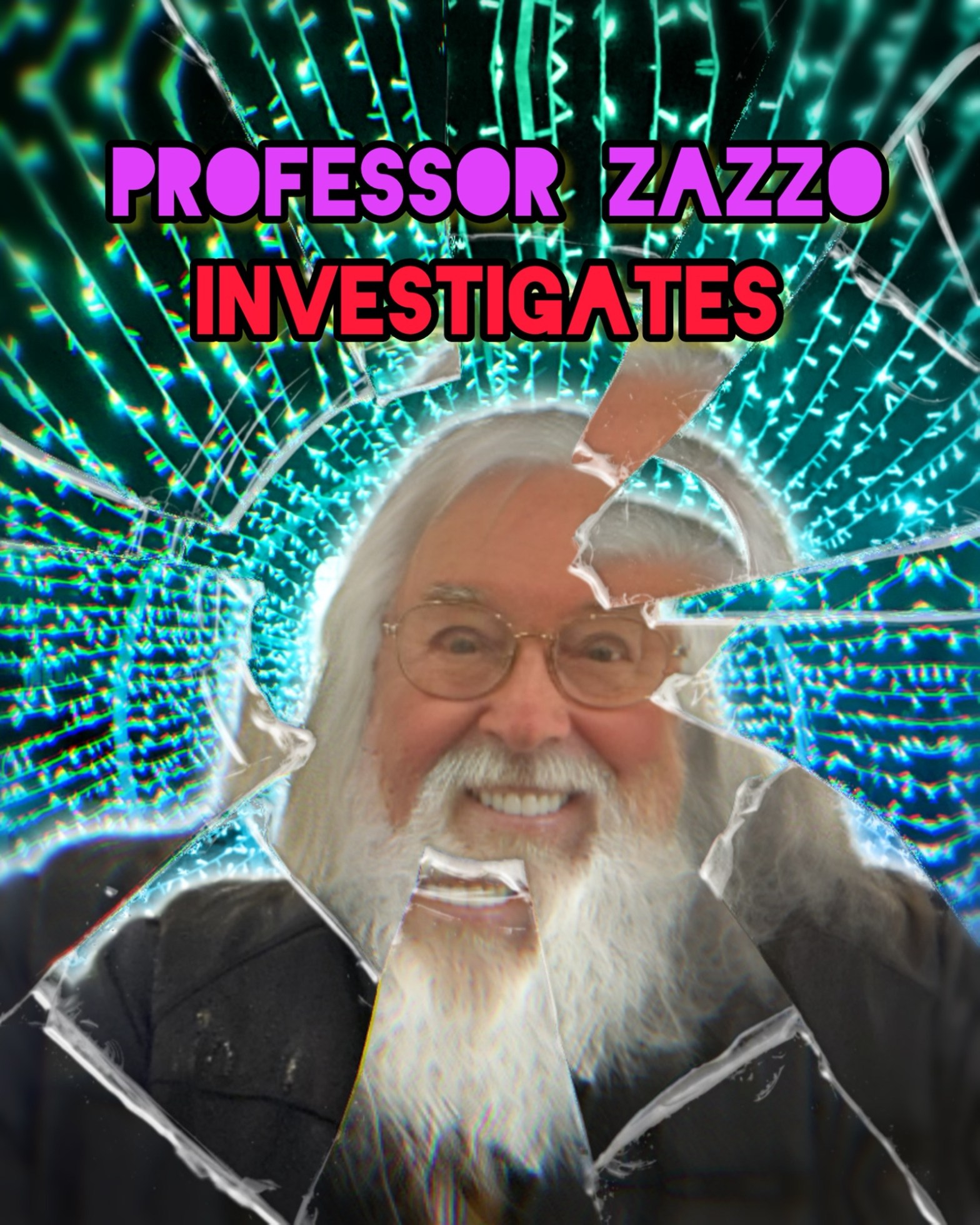
I believe it was Professor Zazzo Thiim who first conceived of a branch of criticism which, in its entirety, was devoted to the criticism of criticism. For a while, only those in academic circles were aware of this new science, and the principals to which it could be attached. The theory of Reverse Criticism, it was hinted at the time, might be applied not only to literature and the arts, but also to other facets of human conscience and philosophic living. It was an interesting concept, and, more than a subtle joke, a hypothesis which demanded attention before, inevitably, it was superseded by the next fashion, the next phase. However, it seems only the one proponent has not completely abandoned the concept, and indeed, has made it the basis of his life work. And this man? None other than Professor Zazzo Thim himself.
I first became aware of his work when I met him at an art gallery. It was one of those evening exhibitions open only to members of the gallery, in which work by a substantial artist, working in water colours,based on the life cycle of the grizzly bear, was being displayed for the first time. I noticed the Professor, a tall, white-haired man with a long scarf, working his way around the room and peering at the notes being taken by various critics. Indeed, it seemed he was more interested in the notes than the actual work hung around us. At last I managed to make my introduction.
‘A civilisation’, said he, ‘Is defined through its art critics. Every facet of its aesthetic life is categorised, pondered, and probed by those who profess to know better, or at least, those who offer advice on the protocols and temperaments observed’
‘And?’ I asked.
‘The point is, most of them have appalling handwriting
I frowned, and started to walk away, but then the old man reached out and grabbed my arm.
‘Think of it!’, he said, excitedly. ‘There are but two layers – those who can, and those who criticise. Remember the old maxim – ‘those who can, do, those who can’t, teach?’
I nodded.
‘What if there was another level? A level of those who can but decide not to? A civilisation in which even criticism is criticised, can only be a better place’.
That night I went back to his office and he showed me some of his work. There were folders filled with script, reviews of art criticism, literary criticism. One critic was pointed out as having a more than average dependency on adverbs, another used too many paragraphs.
The most interesting review was that of a literary critic who, according to Thim’s report, had made the mistake of reading James Joyce’s ‘Ulysses’ while wearing a hat. ‘A trilby, perhaps’, Thiim had written. ‘Even a beret, but certainly not a bowler! How can one ever have confidence in, or an affinity with, the content of the book they are reading, with a bowler hat perched on the top of their head?
I soon became friends with the formidable Professor Thim and we would meet at least once a week so that I could read more of his Reverse Criticism. Yet towards the middle of this year there was something of a crisis, hinted at only in the fact that his secretary had phoned and warned me not to come for a couple of weeks. When one morning I finally insisted I arrive and carry on with my reading unhindered – using the flimsy excuse of a post-graduate thesis in the role of the critic – she told me that the Professor had been taken ill, and that the department could not be as accommodating as they had previously been.
I arrived in any case, as if everything were the same. His office seemed fairly normal, though there was no sign of the Professor. As was my practice, I sat myself at his desk and leafed through one of his collections, although I did note that the book itself had been rearranged and some of the pages taken out. Half an hour passed with no sign of the Professor, and I was in the middle of making some notes for myself when the door opened.
‘Ah’, said a rather pleasant, middle-aged man. I was led to believe that nobody would be here’.
I stood from the desk, feeling rather sheepish. ‘I rather bullied the secretary, I’m afraid’.
‘Yes’, said the man, leaning back and placing his hands in his pockets. ‘All very sad, isn’t it?’
I asked what he meant, and watched as his face folded first into shock, then a well-meaning affectation of acceptance. ‘Zazzo’, said he, ‘Is very ill’.
‘What do you mean?’
‘It all started a few weeks ago.’ The man sat down on the other side of Thim’s desk and lit his pipe, an object which seemed to juxtapose with his relative youth. ‘My dear colleague had just returned from a production of Romeo and Juliet, and he was anxious to catch the first of the play’s reviews, that he might begin to dissemble them as was usual for him. Indeed, he was particularly excited, having clearly seen one of the critics picking his nose during the balcony scene. How could a critic properly criticise one of the key scenes in such a state? Zazzo wanted to begin work immediately. Ah, the poor fool. How tenaciously he clung to that outdated philosophy, and look what harm it has done him’.
‘What?’ I asked, impatiently. ‘What happened?’
‘While waiting for the reviews he sat down right here and began leafing through that selfsame folder, the one in which he had kept all of his Reverse Criticisms since he had first conceived of it. And what do you think occurred? He began criticising his own criticisms, themselves criticisms of criticisms. And when he had finished that, he looked at what he had written and decided that these, too, needed criticising. But this did not satisfy him, so he criticised the criticisms of criticisms of criticisms of criticisms, until he was literally spinning in circles, frantic that the cycle of event and criticism would never be broken. You see, each new criticism was a separate event, a new work worthy of classification’. My new companion looked down at his lap. ‘The poor man. He hasn’t stopped since.
‘And where is he now?’ I asked
‘He has been confined to the medical centre. A nurse administers whatever help she can, but Thim will not rest until he thinks his job is complete. Yet it does not take a genius to work out that his work will never be finished. Oh, poor Zazzo. Poor Nurse! How she suffers, merely trying to do her job’.
‘Why?’ I asked
‘Because he keeps criticising her!’
For a while we both sat there and pondered the fate of our mutual friend. What a delirious, hateful circle he had invented.
When Zazzo Thiim was judged to have improved sufficiently to leave the medical centre, myself and a few of his colleagues decided to throw a party on his behalf. The middle-aged academic I had met in his room – Doctor Hubert Worthington – had by now become a close friend too, and we had spent the last couple of weeks planning how we would handle the Professor when he returned.
We had decided that there would be no criticism, not the slightest word for or against any aspect of our lives. Worthington suggested we shield Thiim from any work of art but, in an institution such as ours, this would almost certainly be impossible. The most important aspect of his return would be that there was no mention of the illness he had just suffered, or the reasons behind that illness. Apart from this, it was assumed that everything would go according to plan.
The party was held in the main canteen of the building, and it was dutifully and respectfully attended by colleagues and students alike. The illness that had befallen Thiim had been worrying for us all, for he, despite his eccentricities, had always been respected and well-liked.
The tables were spread with a buffet lunch and there were several bottles of white wine on a side-table. The chatter in the room was low-level and jovial, as if everyone was conscious that they were in the presence of a sensitive man. Thiim himself was happy, oblivious to the concern of his contemporaries, and he held court at the buffet table, explaining in great detail the hidden significance of works as diverse as Kafka’s ‘Metamorphosis’, Michelangelo’s ‘David’ and the Postman Pat books.
Of course, I was especially anxious about meeting the Professor again, for our association had been built around the concept of Reverse Criticism, the very theory which had resulted in his illness. Yet the moment Thim saw me he opened his arms wide and greeted me with such friendliness that it was obvious he didn’t blame me at all.
‘My friend’, he said. ‘How are you?’
Choosing my words carefully, so as not to hint at any criticism, I said: ‘How well aren’t I?
‘My word’, he said, throwing the end of his scarf over his shoulder. ‘The weather’s taken a turn for the worse, hasn’t it?’
‘It’s colder than it was yesterday’, I agreed, without the slightest criticism.
‘I must say, I do like your jumper’, he said, bending over and peering at the stitching.
‘Good’, I said.
We stared at each other for a moment.
‘Well’, he said. He looked at his watch. ‘I suppose I’d better mingle. After all, isn’t that what this party’s for?’
‘Yes’, I agreed.
I didn’t see much of the Professor after this, although I could tell from the various conversations he was having with his colleagues that they, too, were as cagey as I had been in their replies to his questions. For some reason, I gravitated towards Doctor Hubert and the Nurse, who were sipping white wine in the corner of the canteen.
‘How does he seem?’ I asked.
The Nurse frowned. ‘It’s hard to say. Some people can be remarkably resilient after a period such as his. I would say, just by looking at him, that he has recovered most of his faculties. However, we must still be careful
‘You mean’, said Hubert, ‘That something could set it off again?’
‘Absolutely. And he could suffer as a result. His illness – I am sorry to say – would be much worse than it was before’.
This was not good news, and I was dispatched round the room to warn the other guests that Thiim could suffer a relapse at the slightest mention of any criticism. However, the mood of the party did not suffer as a result, and Thiim remained oblivious to our sensitivities.
I worked my way around the room and spoke with a good many people about a wide number of subjects. It seemed everyone had an opinion about the world, or about literature and art, and I got into a few heated debates about one aspect or another concerning these. Yet whenever we saw Thiim approach, we would change the subject and begin discussing, in earnest tones, what we could see through the window.
‘A bird!”
‘A tree!’
‘A house!’
‘A lawn-mower!’
It was a tiring event and I wanted, desperately, to go home, to think about something else.
The more I thought about it, the more I wanted no more to see Professor Zazzo Thiim, for I, more than any of his contemporaries, had been closer to the philosophy behind Reverse Criticism. To continue with my studies now, after everything that had happened to the main proponent of that philosophy, would not only be dangerous for Thim’s health, but also my own.
What, I began to wonder, if the same thing happened to me? Would I be as lucky as Thiim?
Would I make such a full recovery? Or would I spin out of control, into a vortex of eternal criticism, unable, ever, to find my way out?
At last it came time to give a couple of speeches and applaud the return of Professor Zazzo Thim. Hubert Worthington took to the stage at the end of the hall and gave a moving – though empty – appraisal of Thiim’s work and career.
‘He became a Professor. He worked hard. He sat at a desk. He marked papers. He delivered lectures. He read books. He went for long walks in the orchard…
And then, suddenly realising that this could, conceivably, be regarded as criticism, he amended his words.
‘A-hem. Sorry. He went for walks in the orchard’.
When Hubert had finished his speech, there was a polite, muted applause, for anything more thunderous or spontaneous might probably have indicated some form of opinion.
It was then the Nurse’s turn to make a speech.
‘Professor Zazzo Thiim is a man. He is a Professor. His name is Zazzo Thiim. I am a Nurse. He was my patient. We both work here’.
Another muted round of applause followed, and the Professor himself stood on the stage.
He thanked everyone for coming, and said how nice it all was, that the food had been good, that he particularly admired the brushwork on the painting over his left shoulder, though not the frame it had been placed in, and that he was looking forward to coming back to work, although his office needed a coat of paint and the radiator smelled. At the end of his speech there was a tentative, subdued clapping, and a buzz fell on the room as various guests began to file towards the door.
Alas, Hubert chose this moment to pick up the wrong cup of tea. ‘Oh god’, he said. ‘That’s disgusting!’
A silence fell on the room and everyone looked at him.
‘No it isn’t’, someone yelled
‘I mean. the purpose of my saying that it was disgusting was
‘Handled with great sensitivity’, someone said, finishing his sentence for him.
‘No it wasn’t’, said the Nurse.
‘Not that it’s important, someone else said.
I could see that the downward spiral had begun. ‘Of course it was important!’ I said.
‘Yes’, someone agreed. ‘Important, but not relevant.
‘The question is not the quality of the tea’, Hubert said, ‘But the fact it had sugar in it, which is, I think you’ll agree, only a product of my own prejudices regarding hot drinks’.
‘No’, a student yelled. ‘The whole criticism itself was not important’.
‘It wasn’t even a criticism’.
‘Yes it was’.
‘He smokes a pipe’, someone shouted. ‘How can someone who smokes a pipe make a valid judgement on taste?’
By now, everyone in the room was shouting and screaming, adding their opinions and criticisms on the original criticism, which had been that Hubert had felt the cup of tea he had inadvertently supped to be disgusting. And while this was happening, Professor Zazzo Thim stood on the stage next to the microphone, regarding us all with a quizzical eye, puzzled, and yet strangely entertained. Indeed, the whole performance was only ended when the Nurse managed to round us all up and transfer us at once to the Medical Centre.
Which is where we remain today, unable to finish our eternal criticism of the main point, the beginning factor, that of the cup of tea drank by Hubert being disgusting. We shout, we scream, we pound on the tables, unable to let go, unable to accept that the problem will never be solved, that the criticism will be infinite.
Professor Zazzo Thim, meanwhile, has returned to work. He visits us every now and then. He always chooses his words carefully.
With a sonnet so perplexing as this, there only seemed the one course of action: to call in the literary investigator, Professor Zazzo Thim.
He asked for accommodation on the second floor, where he might afford a view of the lawns and the sculptured hedgerows. He said he wanted to see a peacock. He said he had never seen a peacock, not a real one. I reminded him of the bad sonnet, that he had a duty to perform. I want to see the peacocks first, he replied, dropping his bags in the hall and rubbing his hands together with glee.
I reminded our guest that he had a job to do, that he had been promised a quite substantial sum to analyse the sonnet we had uncovered in our renovating of the library.
“Yes”, he said. “Yes, of course, how silly of me to forget. I am here for a specific reason and your hospitality should not be taken for granted”
The old man was taken to his room and I repaired to the library, expectant of his appearance therein. It was a crisp autumn morning and a mist rolled in from the vales across the lawn in front of the french windows. As a devotee of literature in all its forms, I had been intrigued to discover the sonnet in a notebook hidden in a crevice between two shelves and I was anxious that the work be scrutinised. that any literary merit might be deduced from its faded pages. Upon inquiry as to who might best carry out this investigation, I was told that Professor Zazzo Thim was at the very top of the profession, and I spared no expense at securing his services. I looked out on the mist-shrouded gardens with my hands behind my back, expectant and looking forward to the knowledge that he would impart, only to see his decrepit form ambling across the eastern lawn in hot pursuit of a peacock, waving his arms in the air, and hooting with delight.
Over dinner he showed no sign of his exertions. He leaned his padded elbows on the edge of the table and grinned at me. “You know”, he said, “This whole place exudes a certain atmosphere. I can tell that there might be more to it than just the one sonnet. I fear, my friend, that this whole building might conceal a wealth of literary surprises”.
“How so?”, I asked
“It has a certain feel to it, the same sensation I get when I walk into a library for the first time, or museum, or even a bookshop, and sense that words have been played with here, that language has been exerting itself, contorting into new and uncomfortable positions for the benefit of general entertainment”. He then grinned, and leaned closer. “And another thing”, he said. “You’ve got peacocks here”
“And what of it?”
“Peacocks congregate around places where sonnets have been written. It is a well known fact in the literary community. Wherever you see peacocks, there have been works of great power created. The peacock, you see, operates on the premise of sonic reverberations, and, in particular, the beat created by iambic pentameter. Mark my words, young sir, there are sonnets in this house!”
That next morning we met in the library and I showed him the notebook I had found during the renovations. He sat down next to the fire and, with a quizzical expression on his face, began to examine it in detail with a magnifying glass. The wood crackled and spat, and I stood there, awkwardly, with my hands behind my back. The old man was a sight in himself, every facet of his aged countenance concentrated upon the page, his thin, bony legs crossed at the knee, the long, slender fingers holding the magnifying glass daintily, as if he might lose all thread of his conscience if he were to hold the handle too tightly. At long last he turned to me and he said:
“It’s a sonnet”.
“I know! I know!” I could not help the tone of exasperation in my voice, for I had long imagined this moment.
“Ah”, he said. “You mean, you want me to analyse it in some greater depth?”
“Yes!”
He gave a great sigh and leaned his head back in the chair. “That could take some time”, he said.
“Is this not what I am paying you for? You may have all the hospitality you need, but I want a thorough dissection of this poem so that we might know exactly what it is about, where it came from, and what it means for the history of this house”.
“Fine”, he said. “Give me ten minutes”
I went for a walk around the gardens. The winter chill bit into me and I pulled the coat around my shoulders. The old man was plainly mad and I wondered if he really knew what he was doing. The university department, it is true, had seemed glad to be getting rid of him for a while, or at least, that was the impression I had received from their eagerness to unload him on me. Yet he had not come without his plaudits. I had entered his name on a search engine to find a list of credible achievements in the field of literary extremism, as well as several spoof web sites in which his methods were derided and mocked by affectionate ex-students. The more I thought about him, the more I told myself that he was a gentle man, an eccentric devotee of literature who would, I was now certain, get to the bottom of the mystery of the sonnet.
At this moment I heard a strange hooting sound. I turned a corner to see Professor Zazzo Thim, his arms outstretched, inches behind a peacock, which appeared to be running for its life.
We met again that night over sherry in the grand hall. “I must say”, he told me, “I was surprised and enthused by the sonnet. It is a peculiar work, but it fits all the criteria of a Petrarchan sonnet, with a rather perplexing turn and a couple of cheekily-placed caesura, and a rhyme scheme which lends it a certain credibility. Yes, my friend, you have a sonnet and I think you should be proud of it”
“I am glad”, I replied. “I feared it may have been nothing but a cheap imitation”.
“It is a fine work, which, within its lines, compares the love of a simple country boy for a young milk maiden, for the simple joy a cow feels upon milking. Some of its imagery could be seen as quite daring for its time.”
“Such as?”
And now the Professor quoted, “How joyously, betwixt thumb and forefinger, the teet is squeezed”.
“I see”
“But my friend, there are greater mysteries here, are there not?”
“What do you mean?”
“The peacocks, I note, are particularly agitated in my presence”
“Perhaps that’s because you keep chasing them all over the place”.
“I’m sorry?”
“Nothing”.
As I was saying, the peacocks , perhaps knowledgeable of my literary credentials, are loath to let me into certain pars of the garden as if they are protecting something. Have, you ever noticed this before?”
“I can’t say that I have”.
“It is a quite odd manifestation, and I think it should be investigated at this moment. You see, it is my prognosis that the peacocks are protecting another sonnet, perhaps one of such magnificence that its iambic pentameter powers them and keeps them agile in these autumnal frosts. Surely, by now they should be deep in their hibernation”.
“Peacocks do not hibernate!”, I told the old man.
“Then you see, they are being energised by something beyond our control.”
At this, Professor Zazzo Thim pulled on his jacket and slugged back the last of his sherry. “Come, he said, “We shall investigate this moment!”
Indeed, his enthusiasm was infectious. We left the grand hall and, by way of the main front door, entered the grounds of the house. Zazzo led the way, despite the cold, and a frost which had already begun to form on the lawns, a sparkling white which lent an ethereal splendour to the night. How strange that the peacocks should still be so restless, and not confined to their winter hut. For the first time I started to believe that the Professor might even be correct in his assessment, that the peacocks were hiding something, that they didn’t want us to proceed any further.
The gravel paths crunched under our footsteps and the lawns were hard with frost. The Professor was fearless as he pushed his way through the peacocks, their tails fanned as if in some attempt to halt our progress. And it was so cold, down in the hollow where the ornamental gardens were laid, a strong coldness which gripped my body and chilled me right to the bone. Our breath turned to vapour in the light from the torch, while the peacocks followed us down the hill, constant footsteps in our wake. At last we turned a corner to find a barrier of them blocking our path, their tails fanned, an impenetrable wall.
“What should we do?”, I asked, now fully reliant on the old man.
“We must do as they want”
“But we might risk the whole project!”
The beady eyes of the peacocks bore down on us, and, as one, they started to call, their shrill exclamations bouncing back at us from the shrubbery, from the trees and the bushes of the ornamental garden. A cacophonous moment, both frightening and sublime, and, with a force I had never seen before, they guided us, gently but persistently, into the entrance of the maze.
We were running now, running with them right behind us. We couldn’t stop, there would have been no option but to be pecked to death by their beaks. We turned corner after corner in the maze, the scampering feet of the peacocks just inches behind us, until, as if they had guided us, we were in the very centre, the small statue of my great, great uncle which marked the epicentre of the maze.
And there we saw them, hundreds of them. Peacocks lined around the hedges, as if in parliament, and were in the middle of them, just us and the statue.
“This is it”, I whispered, “This is the end”.
“On the contrary”, the Professor replied.
He bent down and began to wipe his hand along the wording on the plinth of the statue.
With a beating heart, I saw as the moss and the dirt began to be flaked off, and a poem be revealed to us, centuries old perhaps, yet persistent in its survival. The peacocks began to crowd around. The stone letters, so regular and formal in the light from our torches, archaic in their construction, their sentence structure.
“A sonnet!”, I breathed.
But the Professor was frowning. He crouched down and worked his way around the plinth, reading as he went. “It has a rhyme scheme”, he said. “And a ceasura, and a definite turn between the sixth and seventh lines. Yes, a sonnet, but….
By now, the peacocks were crowded in on us, as if they, too, were trying to read.
“But what?”
“There’s a syllable missing in the ninth line”.
“Read it to me!” I urged The Professor bent closer.
‘And yet my old heart it be not saved””.
“Nine syllables”, I whispered, counting them on my fingers.
The peacocks were pushing against us now, evil in their intent, crowding around, and they could surely have crushed us if they had the inclination.
At this, the Professor reached into a pocket and pulled out a chisel. And then, using a rock to hit the top of it, carved a small accent over the ‘e’ of ‘saved’ to transform it into ‘savèd’.
The result was instantaneous. The peacocks drew back, satisfied, then began to file out of the exit, allowing us to follow them into the cold night, from where they went back to their winter hut for hibernation.
The Professor and I returned to the Grand Hall and helped ourselves to another sherry.
He left the next morning and I was more than happy to cough up the extra money he demanded from his extra investigations. How happy we both were, to have solved a little mystery and put right the travesty of a bad sonnet. I thanked him once again as he clambered into the taxi, and as it pulled away he rolled down the window and he waved, smiling. His last words to me were:
“The peacocks shall bother you no more”,
I went back to the library and looked once again at the poem l’d found, the old notebook, now so faded as to be hardly recognisable.
I counted down the lines. “Hang on”, I said, to myself. ‘This isn’t a sonnet! It’s for fifteen lines!”
When I heard that the great literary extremist Professor Zazzo Thiim was holding a symposium on the use of alliteration in Antarctic literature, I knew I just had to attend.
I knew that getting to the venue in the first place was in itself was a hard enough job; the convention was to be held in a remote hotel in the mountains which, in the middle of winter, would be cut off from the world by snow drifts, and sure enough, when the week of the convention came, the only way to get to the hotel was by walking the last two miles. As the darkness gathered around me, and large
fiakes of snow began to fll from the black, black sky, I gripped the handle of my suitcase and made my way up the track into the wilderness.
It must have taken a couple of hours to make the journey, and when I arrived at the hotel I was feeling irritable and uncharitable to say the least. My eyes were blinded by the motion of the snow as it had flown across my vision, and my fingers numbed from gripping the case for so long. The first thing I did was to dump my bags next to the reception desk and sit next to the roaring fire, in order that I may thaw my aching bones and curse my stupidity at having set out on such a journey in the first place. Yet only the one thought, of any substance, kept coming to me as I sat there in the orange glow: after all this effort, this had better be worth it.
I soon became aware that an old man was sitting next to me and, after a while, he asked if I was there to see Zazzo Thim.
“Yes”, I replied, “Though I am now beginning to wonder if I have made a mistake.”
The old man wrapped his scarf tighter around his neck and gave a chuckle. “I can assure you that the convention will be well-managed and adequately attended for my needs, for I, myself, happen to be Zazzo Thiim”.
“What makes you so sure that it will be so well-attended?” l asked. It was snowing heavily outside now, and the hotel did not seem to be bursting with guests.
“The subject in itself”, the old man said, smiling gleefully. “Who could fail but be enchanted by such a subject? Antarctic literature, let me remind you, is an expanding genre. I expect there shall be quite a rush tomorrow morning for seats”.
At this, he looked first left, and then right, and then whispered to me in a severe, confidential tone:
“It’s quite possible that some people might not be allowed in’.
At once l felt bad. How close l had been in deciding not to come, yet others might not have been so foolhardy. I knew that there would probably be a limited attendance as it was, yet Thiim was sure that there would be more. I felt a sinking sensation inside of me, the dejection he might feel on walking into the conference centre that next morning only to see myself sitting there.
“I can assure you”, I told the old man, “That we shall all be thoroughly enlightened”
I went to my room and changed for dinner. I decided that I would enjoy myself, and I ordered the most expensive item on the menu, yet the restaurant was virtually empty, with the exception of a table on the far side of the room where Professor Zazzo Thiim slurped, quite noisily, his soup. Every now and then I would look over at him and feel a well of pity deep in my stomach, and I soon decided that something would have to be done. But what could I do? As the waiters kept moving past, as if gauging whether or not we had finished, a plan began to formulate in my mind that I could, somehow, interest other people in the subject of Antarctic literature and perhaps even bribe them into attending. But the plan seemed hopeless, even fanciful.
After dinner I went for a walk outside in the snow. The mountains loomed, black shapes and shadows in the night sky, while gentle flakes fell from above, illuminated by the lights from the hotel. A frost was setting in, and the ground crunched with each footstep. At last l came to one of the chalets, and I was just about to turn around and head back to the main building when the door opened and Zazzo Thiim himself emerged.
“Ah!”, he said. “It’s you! Come in, come in, we shall discuss literature!” Feeling awkward at this sudden invitation, I tried to formulate some reason why I might go back, when all the time I advanced towards his cabin. “What a brave, hardy soul”, he said, “To be out on a night like this!” He held the door open for me and I entered the chalet.
It was warm inside and a fire blazed in the hearth. He motioned that I sit down, and before long he was telling me about his interest in Antarctic literature.
“I have always been interested in a young writer of Norwegian descent, Petter Jansen, a writer of such talent and deftness of touch. He would describe the harsh winters of his homeland and the very essence of being in the snow, a subject I would find most glamorous in comparison to my lowly upbringing. As soon as I could I decided I would seek out Jansen and learn from him the craft of story-telling, of descriptive language and other literary ideals. Only, according to those who worked in the book industry, Jansen was working in the Antarctic, at a research station near the South Pole”.
“Armed only with protective clothing and a set of his works, I joined an expedition by ski-mobile in the middle of the Antarctic summer. The nights were cold and the days long, the sun never seemed to leave the sky, and all the time I was filled with so many questions, so much I wanted to ask. His characters, you see, were fragile beings, brittle, like flowers left too long in the frost, and I wanted to find out why he spent more time describing the weather than he did the emotions and sensibilities of his characters. There were other questions, too: why he
should have spent all his life in cold places, when surely he could have lived anywhere on the royalties from his volumes, and why he had given up writing fiction only to work as a research scientist in the South Pole.
“On the tenth day we reached the Norwegian research station and I was privileged enough to meet Jansen. He was not what l had expected; of course, in the years since he had been published he had become an old man, and he sported the most wondrous beard, which almost reached down to the middle of his chest. He had a gruff accent, a dismissive way of sharing information, and a healthy dislike of anyone, including myself. I followed him as he worked, and watched as he drilled holes in the ice, sank instruments down into packed snow, took readings on electronic devices. He was monosyllabic, non-committal, and despite
everything, I started to wonder if I should have been there at all.
But that night we went to his tent and he shared a bottle of vodka with me. ‘And now’, he said, ‘The real work begins’. Imagine my surprise when he produced from a wooden chest a large manuscript, several thousand pages long, and a pen, whose ink kept freezing and he had to warm by candle-light. ‘What is this?, I asked. He turned to me, wearily, his face lit by oi lamps and the candles, and he said: “This is the finest Antarctic novel ever written. Indeed’, he continued, This is the only Antarctic novel ever written’.
I watched, silently, as he wrote. And with what devotion! He forsook everything in the outside worid, every distraction, and bent his head over the manuscript, writing with a bare hand, the fingers gripped tightly around the nib. For two hours he wrote, diligently, painstakingly, until his alarm clock buzzed and, of a sudden, he put the pen down, gathered the pages, and placed them back in a wooden chest.
The next day followed the same routine: scientific work in the daytime, an evening of vodka, then writing by table light. He didn’t seem to mind the fact that I was there with him – indeed. he almost welcomed my company and the interest I showed in his writing. Finally it came time for me to leave, for my colleagues were due to start the hazardous journey back to the coast, and I decided I would revel in his company for the last time.
“When he began writing I tried to watch the words as they were formed, but he kept shying away from me, positioning his body in such a way that I could not read what he was writing, and when the alarm clock rang to signal the end of his writing shift, he placed the pen down, the manuscript in the box, and he said to me: “That’s it now. Scram. The experiment is over!’
‘How crestfallen I was! It was as if I had been stabbed in the back. I returned to my tent that night feeling hurt, abused, and with a general dissatisfaction not only with Petter Jansen, but with all writers everywhere. That night I could not sleep, and a fierce wind blew up, which rattle the tent and moaned across the barren lands. In the midst of this delirium one thought came and it would not go – that possibly I might sneak into Jansen’s tent and read the manuscript for myself.
‘Two hours later the idea still lived with a bizarre logic. I could take the strain no more, and, as the first rays of the sun began to peek over the continental mountains, I left my lodgings, walked across the snow, and let myself into Jansen’s tent. He slept well, and I had managed to let myself in without him hearing. With the wooden box right below me, I had no choice but to open it up and read the manuscript right then and there.
‘Oh, the power! “The Silken Breath of a Penguin in Repose’ is a work the likes of which I shall never forget! The intense truth, the humanity on display, the concern for a world forever spoiled by man’s eternal folly! The language seemed to ooze like honey poured on from a spoon, and yet the prose was sparse, the words as economical as ice. The book was set in the future, or very slightly in the future, and Jansen himself was a character, a fortune teller who was never wrong. And the final scene, where the mad explorer wipes away a frozen tear to think of the harm his fellow man has done, almost reduced me to an insensitive and indiscriminate howl
of anguish. When I glanced up, I noticed that Jansen was staring right at me.
‘What treachery is this?’, he asked. ‘My private words, spoiled for all time! What is this but an invasion of the lowest order! How dare you spoil these most sacred pages!’
‘I had no choice’, I replied. ‘And in any case, such a wondrous work needs an audience. There is much here that might change the world. How selfish can you be if you keep this from those who need it the most? What I have just read is the most intelligent, the most poetic work ever created’.
‘You have ruined my work!’, Jansen continued. ‘You have ruined me! We had a trust, you and me, a friendship . . .’. .. And then he looked at me for a while. ‘Did you really think it was that good?’
“So we came to an arrangement, right then and there, that I would tell the world about his work, but only if I choose locations and places that would guarantee the audience would be small. And that’s why l’m here now, in the mountains, in the middle of winter, about to host a conference on alliteration in Antarctica Literature. I mean, what kind of sad person would possibly venture all the way out here for such a thing?’
I looked at the old man and smiled. Professor Zazzo Thiim then cleared his throat.
“Apart from you, that is”.
Alas, the conference did not work out exactly as he had planned. I had left messages and notes to most of the staff and the guests of the hotel that the old man needed support, that he would be crestfallen if the conference was overly attended, and that they should do everything within their powers to put off potential attendees, and yet, that next morning, when Professor Zazzo Thiim took to the stage, he was confronted by a hall completely filled with people.
“Well …”, he said, laughing feebly into the microphone, then wincing as the feedback screeched round the hall. He activated the overhead projector to show a picture of a penguin, which then hung on the wall behind him, solemn, ethereal.
“There is . .”, he stuttered, “There is, in the power and beauty of. . .Huh-huh”.
Pleadingly, he looked at me, as if asking that I should remember the reasons why he had decided to hold the conference at this particular hotel. So what else could I do?
While no-one else was looking, I leaned behind me and activated the fire alarms. Everyone got up from their seats and the hall was evacuated in seconds.
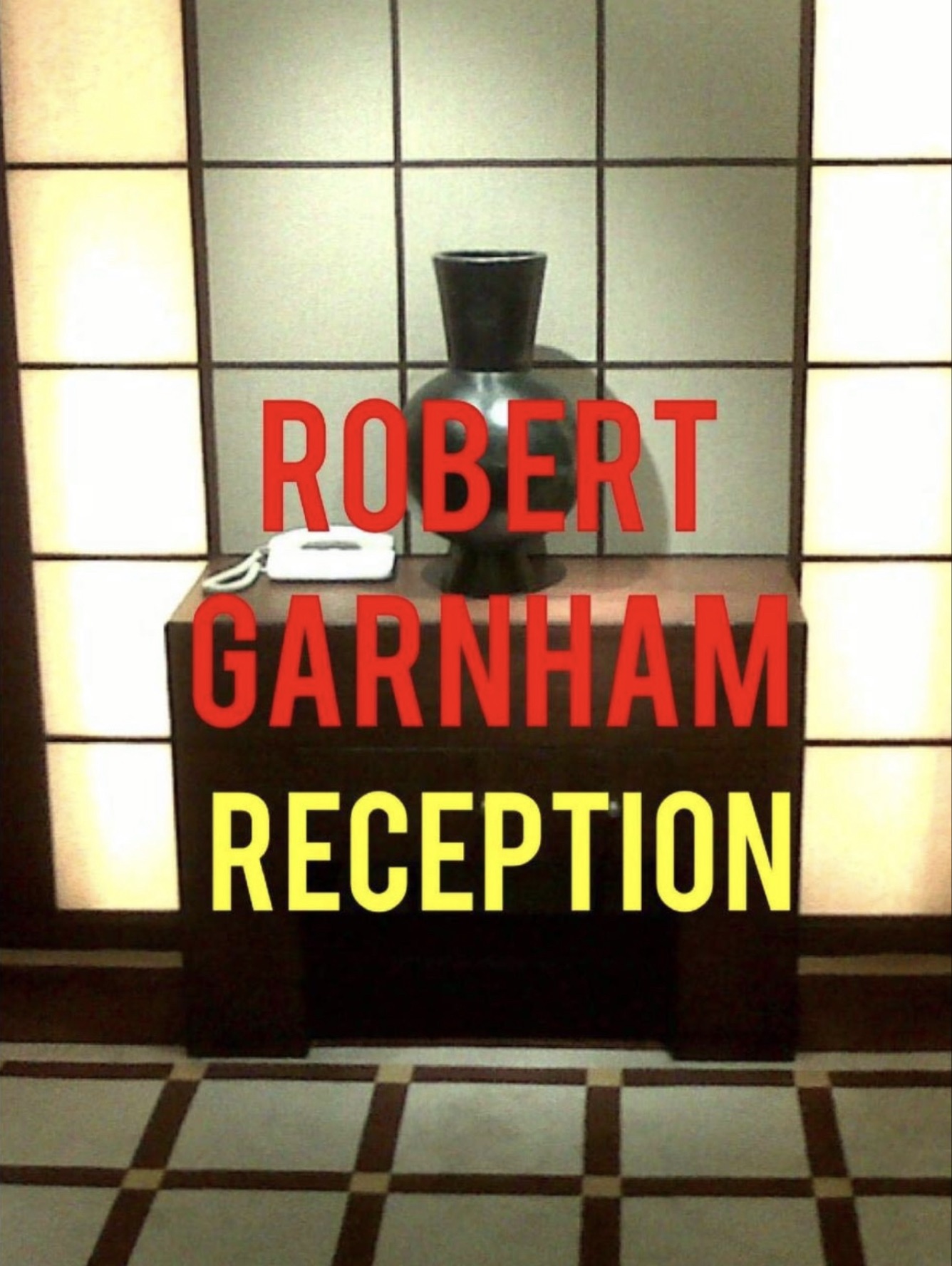
In 2010, on the way back from Australia, I stopped in Tokyo for a few days, arriving at midnight. I’d booked a hotel but they lost my booking and so began a strange few days of existentialist angst when I started asking, who am I? What is my history? Do I exist? I started writing this novel.
A few weeks later, of course, once the novel was finished, the tsunami hit, so reading this novel again always gives me a strange sense of foreboding.
The new fridge freezer is suspiciously quiet.
The new fridge freezer is suspiciously quiet.
I don't want to cause a fuss
And I don't want to cause a riot
But the new fridge freezer is suspiciously quiet.

Put some feta cheese in there,
Put some Camembert in there
Put some other things in there
It's very very quiet.

The new fridge freezer is suspiciously quiet.
The new fridge freezer is suspiciously quiet.
I don't want to cause a fuss
And I don't want to cause a riot
But the new fridge freezer is suspiciously quiet.

Bought it from a man from Bern
The man from Bern his name was Bern
Fridge freezer, Swiss geezer
So so quiet.

The new fridge freezer is suspiciously quiet.
The new fridge freezer is suspiciously quiet.
I don't want to cause a fuss
And I don't want to cause a riot
But the new fridge freezer is suspiciously quiet.

Have you turned it on?
Of course I’ve turned it on.
Have you plugged it in?
What am I, daft or something?

The new fridge freezer is suspiciously quiet.
The new fridge freezer is suspiciously quiet.
I don't want to cause a fuss
And I don't want to cause a riot
But the new fridge freezer is suspiciously quiet.

The old one went chigga chum chigga chum
The old one went witty witty woo
The old one went chigga chum chigga chum
The old one went to the tip.

The new fridge freezer is suspiciously quiet.
The new fridge freezer is suspiciously quiet.
I don't want to cause a fuss
And I don't want to cause a riot
But the new fridge freezer is suspiciously quiet.

The new fridge freezer is suspiciously quiet.
The new fridge freezer is suspiciously quiet.
I don't want to cause a fuss
And I don't want to cause a riot
But the new fridge freezer is suspiciously quiet.
Twenty years ago, I wrote a novel. And some of that novel had material in it from fifteen years before that. It’s lived at the bottom of a drawer for most of that time. Thanks to technology, I can now bring this to you. I will be sharing a chapter a week.
Here is a brief synopsis:
A comedy novel set at His Nibs, a fictional shop at a seaside town which sells only pencils. Assistant manager Robert once had a steamy and passionate romance with his colleague Matt. Matt is now with Clarissa, and it must be serious because they have got a cat. Meanwhile someone has burned down the pier, which means there are no tourists, and the shop is not making its targets. It rains a lot. Manager Carol has gone off the rails and harks back to the glory days of pencil retail. Robert is determined to win Matt back, or at least recreate the romance with someone else, while area manager Mona is determined to turn things round at the shop. Standing in their way are mystery shoppers, angry refunders, the company auditor, weird customers, light-fingered gang members, the local protection racket, increasingly bizarre memos from head office and the joys of the twice-annual stock take.
Chapter One
The Stock Take
We haven’t sold a pencil in hours yet we’re not supposed to start counting them until six o‘clock. It’s quite worrying that we haven’t sold a pencil in hours because the whole shop exists just to sell pencils. It’s a pencil shop. Pencils and the very minimum of pencil accessories. Pencil sharpeners. Pencil erasers. Pencil cases. And pencils. If we sold some pencils then there would be less to count, obviously. If we sold two pencils in the last hour then that would be two less pencils. The shop has probably got thirty thousand pencils in it. We will find out in the next six or seven hours. How long does it take to count one pencil?
But that’s life. The tills are all computerised now and if we were to sell a pencil after the stock take had started, then it would bugger everything up. The count would be wrong and we’d have gaps in the stock list where more pencils should be. And the area manager, Mona, she would get awfully sarcastic and make us do it all over again. And a part of me would understand the world a little better while simultaneously bemoaning its perpetual unpleasantness. A part of me would wish that the world would have less pencils in it. A part of me would want to be at home luxuriating in the freedom associated with a man who does not have to do a stock take. For some reason the company likes to know how many pencils it has.
‘Right, I’m off home’, Carol says. ‘Let me know how it goes’.
Carol’s the boss, the Manager. Carol is a canny operator. Carol has come up with a theory that when it comes to a stock take, it’s more accurate to have two people doing it instead of three. Two people can easily get on and do it. Three people would just complicate things. That’s what Carol says. And she lives furthest from the shop, so it only makes sense that she be the one to forego such nocturnal delights.
The door closes behind her. She locks it on the way out.
I’m not looking forward to it, obviously. One pencil starts to look like another after a while. There’s really been no innovation in the pencil industry for quite some time. Some have got rubbers on the end and some haven’t and that’s really the only source of variety, otherwise they’re all straight and made of wood and they’ve all got a pointy end which draws or writes. I’ve been working in pencils for over ten years and I still don’t know what the pointy end which draws or writes is called. I mean, the technical term. It’s easy to lose enthusiasm for pencils when you’re around them for as much as I am.
I’ve got Matt helping me with the stock take, though. That’s something, at least. I like Matt for a number of reasons. The first reason that I like Matt is that he’s accurate and occasionally conscientious. The second reason that I like Matt is that we’d sometimes stop counting for a bit and lose ourselves to the simmering sexual tensions that have existed between us since the very first day he walked into the shop with his CV and his boyish grin and his impetuosity and his fashionable hair and his love of life and the rumbling sense of innate masculine ecstatic oblivion I feel whenever I’m in his company which makes each nerve tingle and the air itself crack with hormonal longing. The third reason I like Matt is that he lifts some of the heavier boxes.
Alas, the chemistry between us has been somewhat depleted these last few months.
‘How’s Clarissa?’ I ask.
Because it’s only polite to ask.
‘She’s great’, he replies. ‘She’s perfect. We‘re thinking of buying a cat.’
Which is disappointing, because as well as being conscientious, masculine and impetuous, Matt is also alarmingly moral. Our stock-room trysts, foibles and peccadilloes are now a thing of the past. Clarissa is his life. A cat only compounds that.
‘Let’s start this thing’, he says, picking up a pen and a clipboard. (Carol doesn’t like us using pencils during a stock take for fear of accidentally using shop stock). ‘Let’s put this baby to sleep!’
It’s an unusual metaphor. This baby wont be asleep for another six or seven hours just yet.
Dextrously, Matt’s fingers pour over boxes of stock. His large brown eyes – the eyes of a particularly obedient puppy, eyes which have always seemed far, far too big for the rest of him – concentrate on the task at hand. One pencil, two pencils, et cetera. There’s no guess work, no cutting corners with Matt. He always goes for the maximum. If he wants it, he gets it. He does things properly.
I think back to a couple of years before, when Matt brought a sudden burst of romance into my life. Perhaps he was drunk on the wooden smell of all the pencils. He couldn’t control himself. What started out as a gentle re-organisation of the pencil case shelf in the stock room blossomed into full-blown rumpy pumpy. He became a floppy love machine, curling himself around me and oozing warmth and sensuous impossibility, it was all I could do to put down the pricing gun.
This happened again the next night, after Carol had seen the reorganised pencil case shelf in the stock room and told us to put it all back again. And then it happened once more the night afterwards, though we didn’t touch the pencil case shelf or reorganise anything, and Matt had brought some whipped cream along with him, you know, for some added pizzazz. It was only on the eighth night that we began to ask ourselves why we were using the stock room of a pencil shop when we could easily just go back to my flat and use the bedroom.
It kind of slowed down a bit after that.
But every now and then, perhaps excited by the sight of so many pencils in a kind of as yet undiagnosed drawing implement fetish, Matt and I would give vent to all kinds of ingenious desires, until Carol got suspicious at all the time we were spending together and thought that we were only doing it for the overtime. Then Clarissa sauntered in one day looking for a pen, (seriously!), and Matt didn’t seem to get quite so excitable around me any more.
‘1147367’.
‘HB hexagonal shaft blue with a white stripe?’
‘Six’.
‘1147374’.
‘HB hexagonal shaft red with a white stripe’.
‘Nine’.
It took us two hours to work out that all of the numbers started with ‘1147’. The stock count started to go a little bit quicker after this.
‘479’.
‘HB hexagonal shaft yellow with rubber’.
‘Seven’.
Matt is seemingly unflustered by the fact that we shared so many intimate moments in this very room. Yet I cannot get over the lack of passion he now shows. I pretend to count, gazing up from the boxes of pencils, and I cannot envisage anything beyond the madness to which we would willingly succumb. There are seven pencils in the box but I manage to lose count, and he makes me do it again. Two years before, we would have been all over one another. There’s nothing more sensual than a box of pencil sharpeners when you’re both naked and gagging for it. His new-found professionalism is an affront to the memory of our passion. If only a switch might be activated ensuring his sudden interest in matters other than the rigours of a damn good stock take.
But there’s no let up in his demeanour. Never before have I seen anyone so intent on the counting of pencils. It’s not that he wants to finish the job any quicker, though. It’s almost as if he relishes the opportunity to lose himself in stationery. This cheers me up for a little while, repays some of the faith that I have previously lost in the human spirit. But then I realise that he’s probably concentrating so intently so as to ward off some of the emotion he might otherwise feel on returning to the scene of our many romantic escapades.
‘45, er . . .’.
‘Yes?’
The thought has jarred me a little.
‘458. No. 459’.
‘So what is it?’
‘459’.
‘There is no 459’.
‘Ah. It’s 458. There was a bit of dandruff or something on the code number. It made the eight look like a nine’.
‘How many?’
‘I don’t suppose it matters’, I tell him. ‘There’s only one. And it’s snapped in half’.
‘It’s still got to be counted’.
‘But it’s snapped. It’s either one, or two halves. It wont make any difference in our overall figure whatever we decide to do with it’.
‘We will have to write it off. But first we need to count it. The Damaged Stock Form will arrive at head office after the stock take, so it’s officially still a part of the stock’.
‘I can fill out the Damaged Stock Form now and send it this moment. Then we wont have to count it at all’.
‘But it would be wrong’.
‘It’s one pencil’.
‘You know the procedure’.
‘It will cost more in postage and work hours filling out the form than the worth of the pencil’.
‘Procedures must be adhered to’.
‘Why don’t I just buy the pencil?’
‘The shop isn’t open. So therefore the pencil is officially part of the shop’s stock at the time of the stock take’.
Matt does not appear very happy for someone with a girlfriend and the chance of getting a cat.
As the evening wears on I feel the insanity of our chore become ever more evident until I cannot see the world except through the subtle variations and design of the pencils that we are counting. Chair legs, skirting boards, anything straight or wooden or both present themselves to my mind which then, automatically, starts looking for a serial code. Another hour and life itself – nay, existence – seems secondary to the task of counting all the pencils in the shop. 1147001, big bang, celestial detonation : one. 1147002, universe, (expanding), infinite : one. I start to wonder if counting the universe in our stock take might automatically nullify the need to carry on with the stock take, but Matt says no. It has to be done. It is the reason why we are here. It is our aim and our purpose. Without the stock take, we are as nothing.
And then a secondary madness takes over in which it becomes obvious, or at least, it feels obvious, that those at His Nibs head office damn well knows how many sodding pencils we have and that this is all some kind of cruel test or punishment inflicted on us just because we had the temerity to work for their company. And the company, oh, how it becomes in our minds so powerful and so all-consuming, directing us with its bulletins and conducting the whole shape of our lives with the list of items that we, us mere mortals, have to count, through the fabled, legendary stock take sheets. There’s no room for error, no room for improvisation. How deliriously do our managers sit in their offices compiling this list, laughing at themselves as they envisage the mayhem that it will bring to our lives! Oh, great and mighty stock-take co-ordinator, oh, you saintly powerful all-knowing New Goods department, how we aim to please you with our pitiful late-night counting!
A couple of years before Matt had been a completely different person. There had been something sly about him. It was as if he were throwing subtle hints all the time. I would catch them in the way that he would look at me at certain moments, or the way he’d brush a stray hair away from my shoulder while we were making a display of pencils, or perhaps it was the fact that whenever we were alone he’d run his hands under my shirt and beg for ten minutes of ecstatic human physical companionship as if enraptured by the pounding, constant sensuality conferred on all like-minded sexed-up individuals. Such subtlety. But things are much different now. There’s nothing.
I find myself looking at him as we embark into our fourth hour of counting. The clock on the wall nudges inexorable towards midnight. He opens boxes of pencils and spends a couple of seconds running his fingers lovingly through the stock within, and it is the first sign I’ve seen of him wavering from his professionalism. He’s almost mesmerised by the pencils. He used to be mesmerised by me. But this was all before Clarissa and the promise of a kitty.
‘Are you OK?’, I ask.
‘Often’, he says, ‘I get a feeling of . . .’.
An achingly long gap. He doesn’t say anything. Oh, the emotion, it must weigh heavily on his soul. My heart pounds with excitement.
‘Yes?’
He puts down the clipboard. This alone is significant. And all of a sudden I can feel the last two years peeling away. This is how we used to be, so eager to share our private feelings and comfortable in each other’s emotional presence. He was so unsure of himself back then, so driven by the needs of the moment. He needed guidance in the ways of the world and I was always there for him. The night starts to feel slightly different. It’s as if Clarissa and the cat don’t exist at all. I can feel that he wants to say something significant, yet the new version of himself that he has created over the past couple of years would never be so forthcoming.
He lets out a big sigh.
‘There are things in this life’, he says, ‘That I’m really not sure of’.
‘Such as?’
Silence again.
‘You can tell me’.
Much silence.
Emotional silence is all very well, but this is bordering on plain rude. At last, he says:
‘Have you ever looked at the world and thought that it’s been put together just ever so slightly askew? And that certain components of it were – how do I put this? – meant for some other plain of existence, and used in a kind of half-hearted attempt to cobble the world together – and by ‘the world’ I mean the way that we live our lives, the philosophies and strictures which we adopt to govern our behaviour?’
It’s not the most coherent question I’ve ever been asked.
‘What I mean is, do you often think there’s more to living than just this?’
Not going so well with Clarissa, then, I feel like saying.
‘Well . . .’.
‘Because for a while I’ve thought that even though I’ve got all the things I’ve always wanted, I’ve still been missing out on . . .’.
‘Yes?’
‘Life’.
It’s not the sort of thing that I’d been expecting him to say. I’d seen him become a machine over the last couple of years, a unit designed for living normally. And yes, I want to agree wholeheartedly with his sentiments. He’d gone chasing after the life that culture has told him to live, quite forgetting that he would still be the same person underneath.
‘Do you remember how it used to be?’ I ask. ‘The fun we used to have? Do you remember?’
‘To be honest’, he replies, ‘Not entirely’.
‘All those nights reorganising the pencil case shelf?’
‘Doesn’t ring any bells’.
‘And you’d say, gosh, it’s so hot, do you mind if I take my shirt off?’
‘Doesn’t sound like the sort of thing I’d say.’
He’s right, of course. It doesn’t. Not any more.
‘And anyway, what’s that got to do with . . With what I’ve just said?’
‘I’m just trying to remind you of the times that we used to have together, the fun and the physical nature of our relationship, and how you used to live for the nights and you’d come in to work and you’d whisper to me, hey, let’s reorganise the pencil case shelf tonight, and all day long I’d be longing for the moment when Carol went home and we could lose ourselves to the absolute bliss of each other’s company, and some times we got so into it that we’d finish reorganising the pencil case shelf and then start all over again, and the world seemed right and the night stretched before us with all its promise, and we’d be both so incredibly happy that we’d had the fortune to find each other, that the world should be a place where constant adventure could happen right here, right here, in this crappy little town’.
‘To be honest, I don’t remember any of that’.
‘You don’t remember?’
‘Not in the slightest’.
‘It was the highlight of my year!’
His eyes narrow.
‘If you must know’, he says, ‘It sounds a bit far-fetched’.
Far-fetched. I can remember every second of our many encounters. Emblazoned as they are on my memory in all of their vivid detail, there can be nothing more real than the exquisite mix of heart-felt longing and rampant masculinity, blending as they did into a fine madness into which we both so willingly succumbed. And yet, yes, he’s right. It does all sound magnificently far-fetched.
‘Often’, he says, ‘When something is very horrific, the mind shuts it out completely’.
‘But you must remember some of it’.
‘Well . . .’.
More silence.
‘What has all this got to do with what I was saying? I trust you enough to delve right down to the deepest part of my soul and you highjack the moment just to concoct some bizarre story about us having a relationship which I can’t even remember. It can’t have been that special, really. That’s what I’m thinking. It probably wasn’t even with me, was it? I don’t go around shagging work colleagues in the store room of a pencil shop. And just at the moment when I need some help in trying to understand the world, you go and make it even more complicated. Well, thanks. Thanks for that.’
‘So you don’t remember any of it, then?’
‘The only thing I remember is . . .’ He stops for a second. ‘Did you hear something?’
‘We need to talk about this. I don’t think you understand how important this is to me’.
‘Can you hear it? Movement, out the back. And it sounds very much like . . .’.
Please, no. Of all the times.
‘Bin robbers!’
‘You said yourself, Matt. You said that you weren’t sure about life. You said it just now, that there was something else. Well, there was. And you don’t remember any of it. I showed you what it was that you were missing. I showed you, two years ago, but . . .’
‘Bin robber!’
They come every night, the bin robbers. They rummage, standing on upturned milk crates in order to delve deeper into the mysterious delights of the pencil shop skip. They’re looking for pencils, obviously, or anything else that may have been thrown away during the day. It’s a wonder they find anything amid the boxes and the packaging and the assorted detritus of a pencil shop skip, but every now and then they find what they’re looking for. Pencils. Only the pencils have been broken in half, as per company guidelines. Go to any car boot sale and you’ll find a stall of short stubby pencils, sharpened, perhaps, at both ends. Discontinued lines from pencil shop skips, pencils with health and safety issues now illegal to trade, dug out from the bottom of pencil shop skips and sold by shady looking gentlemen with stubble and inappropriate piercings. Some of these gentlemen might even have tattoos. There’s money in pencils, obviously. The internet hasn’t killed everything.
But they’re nasty, too. There’s many a report of bin robbers threatening shop staff, managers holed up in their offices on the phone to the police or, god forbid, violence against any hapless employee who should go out after dark to empty a waste-paper bin and come across a bin robber. Territorial, occasionally hyped up on various concoctions, there are even stories of rival bin robbers fighting each other in front of bemused His Nibs shop staff. They leave a mess behind them and throw the non-pencil-related skip contents across the back yard in order to get to their bounty. Sometimes they even turn the bin upside down and empty it, which is no small task what with it being made from solid steel and as large as a small car. They threaten anyone who tries to stop them. Many a time a lowly His Nibs shop employee has had to call the old bill because a particularly nasty bin robber has promised some admittedly quite inventive form of personal injury while filling up their pockets with faulty pencil sharpeners or pencil cases that have been withdrawn from sale due to copyright issues. Illegally mass-produced Scooby Doo pencil cases that head office have bought cheaply and sold at quite a mark up until threatened with court action by the intellectual property owners of the Scooby Doo franchise, now filling up the Lidl’s carrier bags of the common bin robber. It’s a vicious circle.
It’s recycling, at least.
And tonight’s is a fine specimen. In his woollen cap and bomber jacket, he looks every inch the scrote. We watch through the back door as he sets up a powerful torch, climbs on his milk crate, then dives into the bowels of the skip, his army boots sticking out as he has a good rummage. You might think that it would be safe just to let him get on with it, but there are moral forces at work, a sense of personal violation which comes from seeing such an atrocity, particularly in the private enclosure of the back yard. Indeed, as the police have pointed out, each pencil sold by a bin robber feeds violence and drug abuse, underhand dealings, and the powerful local organised crime syndicates, and that it is our duty to prevent all further bin incursions. The police have better things to do.
Matt’s fingers reach for the door handle.
‘It’s not safe’, I tell him. ‘He might get violent’.
‘He’s upside down in a bin. We’ve got the tactical upper hand at the moment’.
‘He might have an accomplice’.
‘It’s a chance we have to take’.
‘We don’t have to. We’re not here to fight crime’.
The bin robber throws a sack of waste paper over his shoulder. It lands on the ground and scatters everywhere.
‘If we don’t make an effort’, Matt says, ‘Then it will just carry on’.
‘He might be armed, and dangerous . . .’
‘What better way is there to go?’
I can think of several other options rather than being knifed by a bin robber next to a rubbish skip out the back of a pencil shop at two ‘o’ clock in the morning in a deserted seaside town. It’s not an iconic death. But Matt is starting to open the door now.
‘Matt!’
‘Tell my parents that I love them’.
‘And what about Clarissa?’
‘Yeah, her to’.
I can only assume that the worst will occur. The bin robber will lunge at him, perhaps shouting, perhaps incomprehensible, no doubt far too stoned for any rational response other than shooting at us with a concealed weapon, or perhaps a bow and arrow. (The mind does funny things during moments of stress). And already I can envisage having to phone Matt’s parents and telling them the bad news, the police helicopter hovering overhead with spotlights trying to track down the ruthless bin robber, the whole thing conveyed live to local television.
‘Hey!’, Matt says, whipping the back door open.
‘All right?’, the bin robber asks.
‘What you doing?’
‘I’m robbing your pencils’.
‘From the bin?’
‘Yeah’.
‘But they’re broken’.
‘That’s the thing with pencils’, he replies. ‘They’re never really broken. You just sharpen the jagged ends and you’ve got yourself two new pencils. Hey. My name’s Dave’.
Dave holds out his hand and, amazingly, Matt shakes it.
‘That’s all very well’, Matt says, ‘But then you’ll end up with stumpy pencils’.
‘I know’.
‘What good’s a stumpy pencil?’
‘There’s a lot of people out there with SFS. Horribly afflicted. They can’t handle full sized pencils. They’re crying out for shortened pencils. I’m only happy to help them’.
‘SFS?’
‘Stumpy Finger Syndrome’.
‘You know, you really can’t do that. It’s stealing’.
‘But you’re throwing them away’.
‘It’s still stealing. That’s the law. And I’m here to uphold the law.’
‘It’s recycling. That’s what I’m doing. Otherwise it would all go into landfill, and do you know how long it takes for a pencil to biodegrade? I‘m saving the planet, my good friend, that’s what I’m doing’.
‘Go on’.
‘What?’
‘How long does it take for a pencil to biodegrade?’
‘Hey, I’m too busy bringing hope and comfort to those with SFS to worry about minor details like that’.
Dave takes out two more pencils from the bin and holds them up to the light.
‘Right, then. I’ll wish you two gentlemen a pleasant evening’.
He closes the lid of the bin and saunters away. Matt watches him leave for a couple of seconds.
‘Well’, he says, ‘I don’t think he’s going to mess with us again’.
This whole night has been profoundly confusing.
We count through the night. The Earth spins round one more time. The count is completed by five in the morning, the last pencil located in a plastic display case next to the till area at the front of the shop. What mystical powers that one pencil holds! I place it back in its case feeling a sense of ceremonial duty, for now we have completed our task. Yet the world seems just the same. I look out the plate glass window at the front of the shop floor at the dark, deserted street, the sodium lighting and the parked cars, the fascias of the other shops unlit, silent fashion shop dummies just standing there like memories of parties past, and it all looks like hardly anything has changed at all.
‘We are free’, I whisper.
Two hour’s sleep, and a new day starts.
It’s just as well that my tiny flat is over the road from the shop itself. It’s a constant joy to open the curtains each morning and see the little shop sitting there, taunting me with its pencils and its sense of constant dread. I dream of bin robbers screaming through several surrealist situations, none of which I can particularly remember within seconds of waking.
One of the eternal mysteries of retail is the stock count. The head office New Goods department has a figure which is supposed to match the number of pencils held in stock. In all likelihood, the shop will have this figure with a slight margin of error. Yet it all depends on how great this margin of error is. If it’s a lot more or a lot less, then there will have to be an investigation and it will be assumed that the stock has gone missing, somehow. If there are three thousand less pencils in stock than the paperwork says, then it means that someone has come in and robbed the shop of three thousand pencils. And this is rightly seen as an example of gross misconduct on behalf of the shop staff. But if the figure is, say, out by fifty or so, then that’s seen as officially All Right. It could easily be a mis-count. Fifty-one or more and there’s a problem. The area manager will demand that we do it all over again.
Our total is out by two hundred and fifty six.
This is when it’s wise to begin a subtle manipulation of the paperwork. The first thing to do is to look at the last Breakages list and assume that it hasn’t got to Head Office just yet. So if there’s eight pencils on the Breakages list, then these can be added to the stock count, therefore making it out only by two hundred and forty eight.
Then one has to look at the other stock that has been written off. Out of date pencils, deleted pencils, pencils that have been recalled due to various health and safety investigations. If a child somewhere gets a splinter from a pencil, then the pencil is withdrawn from sale. If an artist on a remote island artist’s community puts a pencil in their mouth and has an allergic reaction to the paint, then the pencil is withdrawn from sale. This can usually add another twenty or thirty to the final figure. And then there’s the stock that has been transferred to another branch. If shop A phones up shop B and asks for a box of two hundred HB red and white striped pencils, they will often be so relieved to receive the stock that they might quite forget to process the paperwork that comes with it until a couple of months later when it’s found at the bottom of the in-tray next to a mouldy bacon sandwich, the one that’s been funking up the office for the last few weeks. So these transfers, also, and quite cunningly, are added to the grand total of the stock count.
But Head Office gets its revenge. The stock count sheets themselves are incredibly long, a concertina of computer print-outs. A fully unfolded stock count sheet will stretch from here to halfway down the street. On each page are fifty serial codes of the different types of pencil held in stock, and there are three columns which must be filled in: stock in shop [A], stock in store room [B], and total stock [C]. Easy enough, you might think. But for a start, column [A] and [B] must add up to column [C], and each column must add up to the sub total at the bottom of each page, and then each page must add up to the grand total.
There are so many serial numbers that most of them will not be carried by the shop in question. Therefore, the total for each column will be zero. Except Head Office doesn’t like the number zero. They say that it can easily be mistaken for a six, especially if written hurriedly. Every time a zero occurs in the paperwork, the word ‘zero’ has to be written in the space allocated, rather than the number. A typical row will therefore read ‘zero zero zero’, which means that most of a stock count is taken up not with counting, but by writing the word ‘zero’ a couple of thousand times.
Oh, the unique joys of the stock take.
There’s always the dread of the familiar on arriving back at work, whatever the circumstances. The shop seems just to sit there over night, ostensibly inanimate yet filling itself with more reasons for you to hate it. There’s a crushing sense of obligation in every detail as if it’s playing with you, saying, ‘Forget any hopes and dreams you might once have had, forget anything else which might seem important in your life, because you exist for me now, and nothing else’. And while some might argue that in the modern economic climate it might be seen as advantageous and perhaps even privileged to have a job at all, there’s also something emasculating about putting so much energy and thought and worry and paranoia and everything else which makes us human and makes us function as individuals into the selling of pencils. As if to compound the delirium, there are emails from Mona.
She does a good line in sarcasm.
Indeed, it seems a pre-requisite that an area manager should dabble in the black art of sarcasm. Perhaps they teach it at Area Manager School. And like any art movement, it’s not just dependent on content, but also the circumstance and the delivery. An Area Manager standing in the doorway of a shop and saying ‘it looks like a herd of bulls has rampaged through this place’, seems to have a greater effect than merely, ‘Looks like you might need to tidy up in here’. Or then there’s the old classic ‘am I speaking a foreign language? Do you want me to provide a translation?’ This one works especially well when the simplest command has been seemingly ignored, Mona once again standing there with her hands on her hips, demonstrating that as well as being an expert in retail management, sales patterns and category space analysis, and all those other minutiae which make such middle managers feel important in the grand scheme of things, she is also something of a comedian. This morning’s email is profound with such literary shenanigans.
‘Yet again it would seem that most simple of tasks – counting stock – is beyond your capabilities’, is the cheerful phrase she uses to begin her message. I imagine her sitting at home, a plate full of cream buns next to her laptop and Wagner playing on the stereo, firing off this latest communication. ‘It’s not hard to keep a tally. Maybe I should run a seminar on it. Or perhaps not. Go into any good book shop and they will have a volume on simple mathematics’. She then has the sense to end the email with the phrase, ‘kind regards’.
Carol has called in sick. She always calls in sick the day after a stock count, you know, just in case. We open the shop. Matt goes on the till and fumes to himself for the whole of the morning. We have one customer in the first hour, getting a refund on a 25p pencil sharpener that she bought in another branch. Matt is somewhat abrupt with her. Then he’s somewhat abrupt with me when I quip that this is one more pencil sharpener that we will have to count. The fluorescent lights make my eyes hurt.
By midday we have come up with a plan to do the count again that night.
‘We’ll have to be more methodical’, Matt says. ‘Every time we count a box, I will attach a yellow sticky notelet to the side of it so that we can gauge where we have been and what has been counted’.
‘Oh yes, so that’s going to be the answer to everything, is it?’
‘I can’t see you coming up with any better suggestions’.
‘To be honest, I’m beyond caring’.
‘A sticky yellow notelet. And then we will write on all of these notelets, ‘counted’, which will act as a double check’.
I yawn.
‘You’re right’, I tell him. ‘That will be the answer to everything. Problem solved. Every problem the world has ever had, solved, just like that. Sticky yellow notelets’.
‘And they have to be yellow. No other colour will show up in the dark confines of the stock room’.
‘Another night together, then’.
He smiles.
The prospect of spending it in such a way fills me not with dread, but with a rising sense of excitement, especially as the afternoon rolls on. It’s all I can do to stop my heart from beating, seeing him there and knowing that we will be together again. Maybe it’s sleep deprivation, but the world seems suddenly filled with promise and excitement. Because last night, oh yes, last night, Matt came so close to admitting the truth. So incredibly close. And if he doesn’t do it again tonight, I might just sabotage the result myself just to make sure that it all goes in to a third night.
‘Yellow’, I repeat, ‘Notelets’.
Early evening, I find a box of two hundred and fifty pencil erasers in the kitchen microwave. I decide to hide them. Often it’s best not to admit to such things.











 Robert Garnham