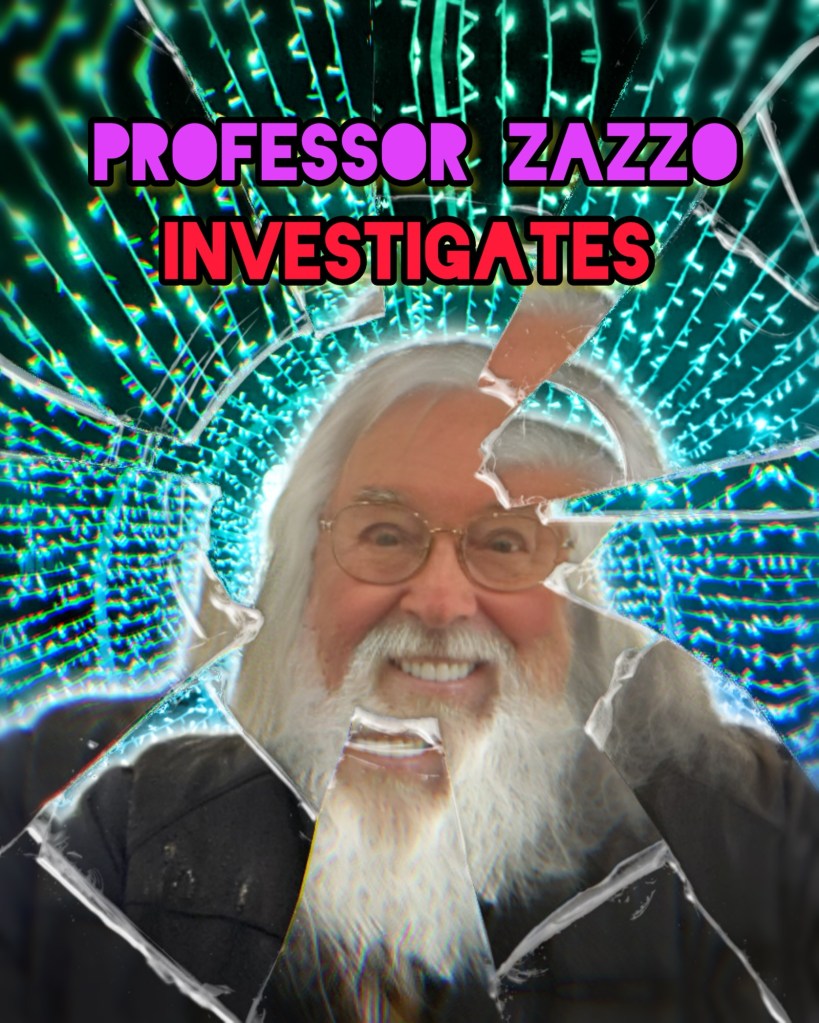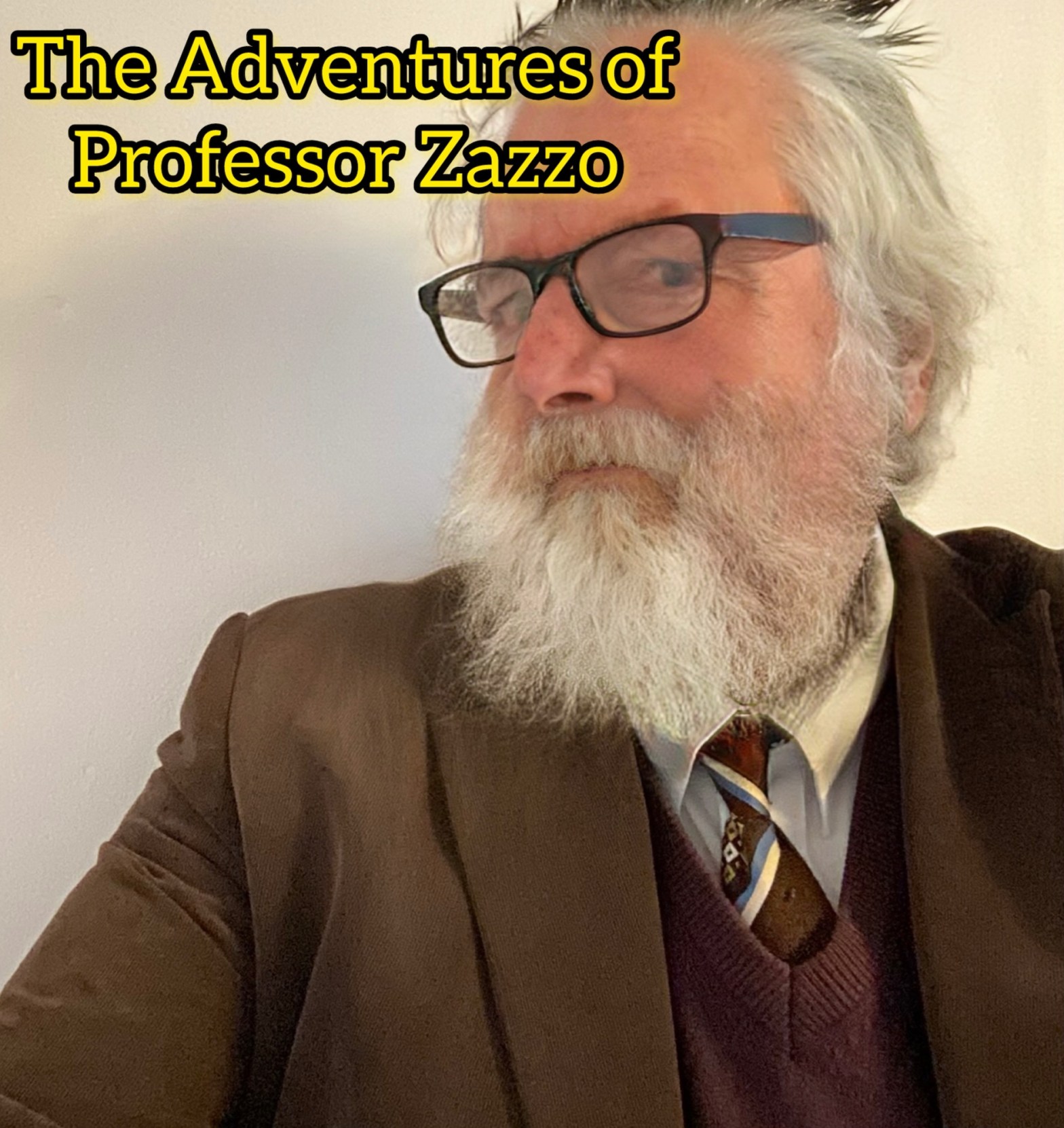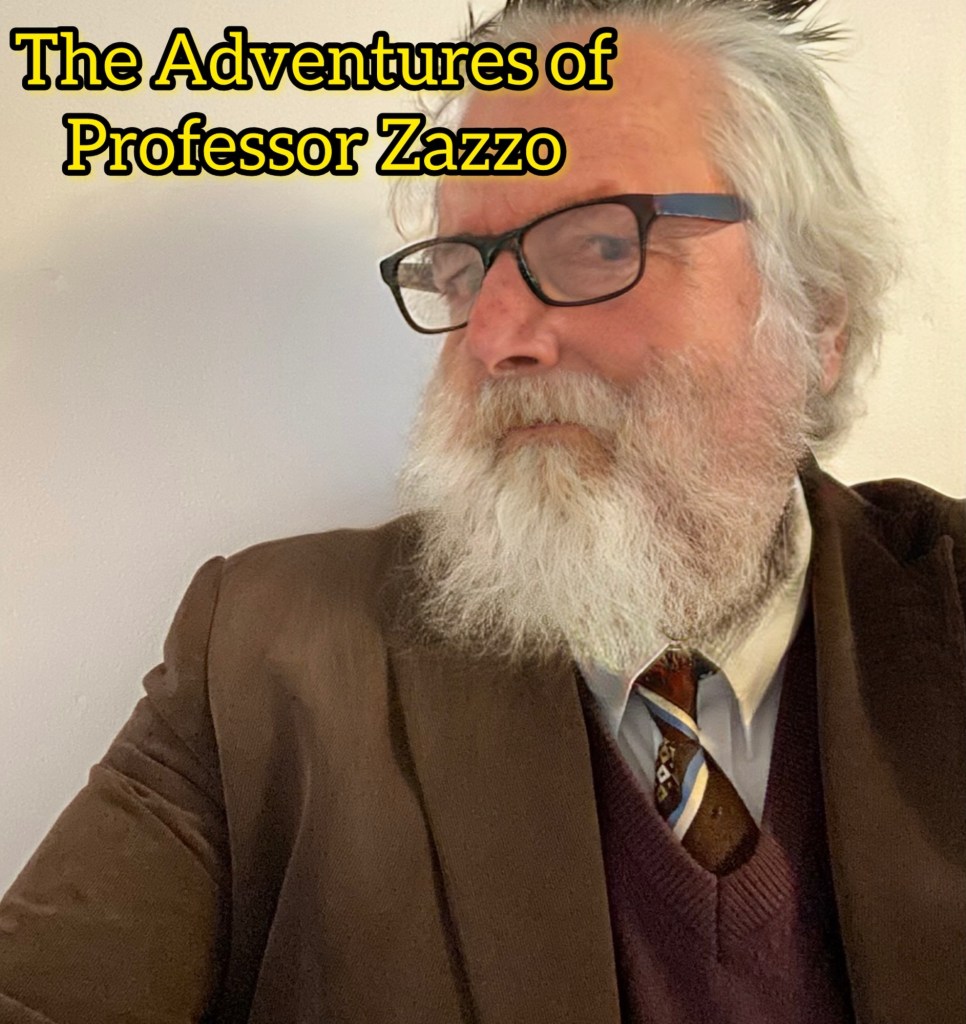
Professor Zazzo Investigates- 8. The Law of Infinite Reverse Criticism

THE LAW OF INFINITE REVERSE CRITICISM

I believe it was Professor Zazzo Thiim who first conceived of a branch of criticism which, in its entirety, was devoted to the criticism of criticism. For a while, only those in academic circles were aware of this new science, and the principals to which it could be attached. The theory of Reverse Criticism, it was hinted at the time, might be applied not only to literature and the arts, but also to other facets of human conscience and philosophic living. It was an interesting concept, and, more than a subtle joke, a hypothesis which demanded attention before, inevitably, it was superseded by the next fashion, the next phase. However, it seems only the one proponent has not completely abandoned the concept, and indeed, has made it the basis of his life work. And this man? None other than Professor Zazzo Thim himself.

          I first became aware of his work when I met him at an art gallery. It was one of those evening exhibitions open only to members of the gallery, in which work by a substantial artist, working in water colours,based on the life cycle of the grizzly bear, was being displayed for the first time. I noticed the Professor, a tall, white-haired man with a long scarf, working his way around the room and peering at the notes being taken by various critics. Indeed, it seemed he was more interested in the notes than the actual work hung around us. At last I managed to make my introduction.

          ‘A civilisation’, said he, ‘Is defined through its art critics. Every facet of its aesthetic life is categorised, pondered, and probed by those who profess to know better, or at least, those who offer advice on the protocols and temperaments observed’

          ‘And?’ I asked.

          ‘The point is, most of them have appalling handwriting

          I frowned, and started to walk away, but then the old man reached out and grabbed my arm.

          ‘Think of it!’, he said, excitedly. ‘There are but two layers – those who can, and those who criticise. Remember the old maxim – ‘those who can, do, those who can’t, teach?’

          I nodded.

          ‘What if there was another level? A level of those who can but decide not to? A civilisation in which even criticism is criticised, can only be a better place’.

          That night I went back to his office and he showed me some of his work. There were folders filled with script, reviews of art criticism, literary criticism. One critic was pointed out as having a more than average dependency on adverbs, another used too many paragraphs.

          The most interesting review was that of a literary critic who, according to Thim’s report, had made the mistake of reading James Joyce’s ‘Ulysses’ while wearing a hat. ‘A trilby, perhaps’, Thiim had written. ‘Even a beret, but certainly not a bowler! How can one ever have confidence in, or an affinity with, the content of the book they are reading, with a bowler hat perched on the top of their head?

          I soon became friends with the formidable Professor Thim and we would meet at least once a week so that I could read more of his Reverse Criticism. Yet towards the middle of this year there was something of a crisis, hinted at only in the fact that his secretary had phoned and warned me not to come for a couple of weeks. When one morning I finally insisted I arrive and carry on with my reading unhindered – using the flimsy excuse of a post-graduate thesis in the role of the critic – she told me that the Professor had been taken ill, and that the department could not be as accommodating as they had previously been.

          I arrived in any case, as if everything were the same. His office seemed fairly normal, though there was no sign of the Professor. As was my practice, I sat myself at his desk and leafed through one of his collections, although I did note that the book itself had been rearranged and some of the pages taken out. Half an hour passed with no sign of the Professor, and I was in the middle of making some notes for myself when the door opened.

          ‘Ah’, said a rather pleasant, middle-aged man. I was led to believe that nobody would be here’.

          I stood from the desk, feeling rather sheepish. ‘I rather bullied the secretary, I’m afraid’.

          ‘Yes’, said the man, leaning back and placing his hands in his pockets. ‘All very sad, isn’t it?’

          I asked what he meant, and watched as his face folded first into shock, then a well-meaning affectation of acceptance. ‘Zazzo’, said he, ‘Is very ill’.

          ‘What do you mean?’

          ‘It all started a few weeks ago.’ The man sat down on the other side of Thim’s desk and lit his pipe, an object which seemed to juxtapose with his relative youth. ‘My dear colleague had just returned from a production of Romeo and Juliet, and he was anxious to catch the first of the play’s reviews, that he might begin to dissemble them as was usual for him. Indeed, he was particularly excited, having clearly seen one of the critics picking his nose during the balcony scene. How could a critic properly criticise one of the key scenes in such a state? Zazzo wanted to begin work immediately. Ah, the poor fool. How tenaciously he clung to that outdated philosophy, and look what harm it has done him’.

          ‘What?’ I asked, impatiently. ‘What happened?’

          ‘While waiting for the reviews he sat down right here and began leafing through that selfsame folder, the one in which he had kept all of his Reverse Criticisms since he had first conceived of it. And what do you think occurred? He began criticising his own criticisms, themselves criticisms of criticisms. And when he had finished that, he looked at what he had written and decided that these, too, needed criticising. But this did not satisfy him, so he criticised the criticisms of criticisms of criticisms of criticisms, until he was literally spinning in circles, frantic that the cycle of event and criticism would never be broken. You see, each new criticism was a separate event, a new work worthy of classification’. My new companion looked down at his lap. ‘The poor man. He hasn’t stopped since.

          ‘And where is he now?’ I asked

          ‘He has been confined to the medical centre. A nurse administers whatever help she can, but Thim will not rest until he thinks his job is complete. Yet it does not take a genius to work out that his work will never be finished. Oh, poor Zazzo. Poor Nurse! How she suffers, merely trying to do her job’.

          ‘Why?’ I asked

          ‘Because he keeps criticising her!’

          For a while we both sat there and pondered the fate of our mutual friend. What a delirious, hateful circle he had invented.

          When Zazzo Thiim was judged to have improved sufficiently to leave the medical centre, myself and a few of his colleagues decided to throw a party on his behalf. The middle-aged academic I had met in his room – Doctor Hubert Worthington – had by now become a close friend too, and we had spent the last couple of weeks planning how we would handle the Professor when he returned.

          We had decided that there would be no criticism, not the slightest word for or against any aspect of our lives. Worthington suggested we shield Thiim from any work of art but, in an institution such as ours, this would almost certainly be impossible. The most important aspect of his return would be that there was no mention of the illness he had just suffered, or the reasons behind that illness. Apart from this, it was assumed that everything would go according to plan.

          The party was held in the main canteen of the building, and it was dutifully and respectfully attended by colleagues and students alike. The illness that had befallen Thiim had been worrying for us all, for he, despite his eccentricities, had always been respected and well-liked.

          The tables were spread with a buffet lunch and there were several bottles of white wine on a side-table. The chatter in the room was low-level and jovial, as if everyone was conscious that they were in the presence of a sensitive man. Thiim himself was happy, oblivious to the concern of his contemporaries, and he held court at the buffet table, explaining in great detail the hidden significance of works as diverse as Kafka’s ‘Metamorphosis’, Michelangelo’s ‘David’ and the Postman Pat books.

          Of course, I was especially anxious about meeting the Professor again, for our association had been built around the concept of Reverse Criticism, the very theory which had resulted in his illness. Yet the moment Thim saw me he opened his arms wide and greeted me with such friendliness that it was obvious he didn’t blame me at all.

          ‘My friend’, he said. ‘How are you?’

         Choosing my words carefully, so as not to hint at any criticism, I said: ‘How well aren’t I?

          ‘My word’, he said, throwing the end of his scarf over his shoulder. ‘The weather’s taken a turn for the worse, hasn’t it?’

          ‘It’s colder than it was yesterday’, I agreed, without the slightest criticism.

          ‘I must say, I do like your jumper’, he said, bending over and peering at the stitching.

          ‘Good’, I said.

          We stared at each other for a moment.

          ‘Well’, he said. He looked at his watch. ‘I suppose I’d better mingle. After all, isn’t that what this party’s for?’

          ‘Yes’, I agreed.

          I didn’t see much of the Professor after this, although I could tell from the various conversations he was having with his colleagues that they, too, were as cagey as I had been in their replies to his questions. For some reason, I gravitated towards Doctor Hubert and the Nurse, who were sipping white wine in the corner of the canteen.

          ‘How does he seem?’ I asked.

          The Nurse frowned. ‘It’s hard to say. Some people can be remarkably resilient after a period such as his. I would say, just by looking at him, that he has recovered most of his faculties. However, we must still be careful

          ‘You mean’, said Hubert, ‘That something could set it off again?’

         ‘Absolutely. And he could suffer as a result. His illness – I am sorry to say – would be much worse than it was before’.

          This was not good news, and I was dispatched round the room to warn the other guests that Thiim could suffer a relapse at the slightest mention of any criticism. However, the mood of the party did not suffer as a result, and Thiim remained oblivious to our sensitivities.

          I worked my way around the room and spoke with a good many people about a wide number of subjects. It seemed everyone had an opinion about the world, or about literature and art, and I got into a few heated debates about one aspect or another concerning these. Yet whenever we saw Thiim approach, we would change the subject and begin discussing, in earnest tones, what we could see through the window.

          ‘A bird!”

          ‘A tree!’

          ‘A house!’

          ‘A lawn-mower!’

          It was a tiring event and I wanted, desperately, to go home, to think about something else.

          The more I thought about it, the more I wanted no more to see Professor Zazzo Thiim, for I, more than any of his contemporaries, had been closer to the philosophy behind Reverse Criticism. To continue with my studies now, after everything that had happened to the main proponent of that philosophy, would not only be dangerous for Thim’s health, but also my own.

          What, I began to wonder, if the same thing happened to me? Would I be as lucky as Thiim?

          Would I make such a full recovery? Or would I spin out of control, into a vortex of eternal criticism, unable, ever, to find my way out?

          At last it came time to give a couple of speeches and applaud the return of Professor Zazzo Thim. Hubert Worthington took to the stage at the end of the hall and gave a moving – though empty – appraisal of Thiim’s work and career.

          ‘He became a Professor. He worked hard. He sat at a desk. He marked papers. He delivered lectures. He read books. He went for long walks in the orchard…

          And then, suddenly realising that this could, conceivably, be regarded as criticism, he amended his words.

          ‘A-hem. Sorry. He went for walks in the orchard’.

          When Hubert had finished his speech, there was a polite, muted applause, for anything more thunderous or spontaneous might probably have indicated some form of opinion.

          It was then the Nurse’s turn to make a speech.

          ‘Professor Zazzo Thiim is a man. He is a Professor. His name is Zazzo Thiim. I am a Nurse. He was my patient. We both work here’.

          Another muted round of applause followed, and the Professor himself stood on the stage.

          He thanked everyone for coming, and said how nice it all was, that the food had been good, that he particularly admired the brushwork on the painting over his left shoulder, though not the frame it had been placed in, and that he was looking forward to coming back to work, although his office needed a coat of paint and the radiator smelled. At the end of his speech there was a tentative, subdued clapping, and a buzz fell on the room as various guests began to file towards the door.

Alas, Hubert chose this moment to pick up the wrong cup of tea. ‘Oh god’, he said. ‘That’s disgusting!’

          A silence fell on the room and everyone looked at him.

          ‘No it isn’t’, someone yelled

          ‘I mean. the purpose of my saying that it was disgusting was

          ‘Handled with great sensitivity’, someone said, finishing his sentence for him.

          ‘No it wasn’t’, said the Nurse.

          ‘Not that it’s important, someone else said.

          I could see that the downward spiral had begun. ‘Of course it was important!’ I said.

          ‘Yes’, someone agreed. ‘Important, but not relevant.

          ‘The question is not the quality of the tea’, Hubert said, ‘But the fact it had sugar in it, which is, I think you’ll agree, only a product of my own prejudices regarding hot drinks’.

          ‘No’, a student yelled. ‘The whole criticism itself was not important’.

          ‘It wasn’t even a criticism’.

          ‘Yes it was’.

          ‘He smokes a pipe’, someone shouted. ‘How can someone who smokes a pipe make a valid judgement on taste?’

          By now, everyone in the room was shouting and screaming, adding their opinions and criticisms on the original criticism, which had been that Hubert had felt the cup of tea he had inadvertently supped to be disgusting. And while this was happening, Professor Zazzo Thim stood on the stage next to the microphone, regarding us all with a quizzical eye, puzzled, and yet strangely entertained. Indeed, the whole performance was only ended when the Nurse managed to round us all up and transfer us at once to the Medical Centre.

          Which is where we remain today, unable to finish our eternal criticism of the main point, the beginning factor, that of the cup of tea drank by Hubert being disgusting. We shout, we scream, we pound on the tables, unable to let go, unable to accept that the problem will never be solved, that the criticism will be infinite.

          Professor Zazzo Thim, meanwhile, has returned to work. He visits us every now and then. He always chooses his words carefully.
Professor Zazzo Investigates – 6. Fish! Fish! Fish! Fish! Fish! Fish!

FISH! FISH! FISHI FISH! FISH! FISH FISH

Professor Zazzo Thim’s experimentations with surrealism have been well-documented, though there are still one or two questions which have remained outstanding from this most provocative and exciting time of his life. Indeed, many historians have assessed the time to be one of great bonhomie among the surrealists, with Thim himself occupying the role of grand master. Yet my investigations have uncovered the truth, and it appears that the determination and the willingness to subvert which we now associate with the surrealist fad was, if anything, subdued.

          Jacques Collard was one of the surrealists. An old man now, he remembers the time fondly, though his brow creases into an ugly frown the moment I remind him of Zazzo Thim.

          “No, no, no!”, , he says. “The view we have no of Thim’s part in this is all wrong! It is based on Thim’s own testimony! We hardly ever saw him as one of us! If anything, we saw him as an annoyance …”.

          Collard paints a picture of the cafe culture prevalent at the time, of the surrealists, united by their subversive acts, holding court at one of the many Parisian bars associated with deep thought, philosophical ideals and literary merit. “We would make such grand pronouncements” Collard says, “Such as proclaiming the death of language, or at least, the terminal illness of the full stop. None of us had a clue what it meant, it just felt good to say it. Bilo was the master at the time – an artist, he had embraced surrealism for all its worth and he created bizarre works which he exhibited here and there throughout the city. We became known for our fine talk, our love of food, and our rebellious spirit. There were always disciples, or tourists eager to catch our glimpse. To start with we thought Zazzo Thiim was one of these”.

          Collard leans back and presses his palms together as if in prayer. His apartment looks out over a flower market, a merry-go-round, and the white wedding cake of Sacre Coeur towering above. His voice deepens as he remembers his subject. 

          “We knew very early on”, he whispers, “That Zazzo Thim was an idiot”.

          “Go on”.

          “The first thing he said was, I want to be like you. I want to be with you. I want to be a surrealist”. We asked him if he was a surrealist at heart, and if he ever dreamt of lobsters, or bearded nuns. No, he replies, but he did once spend a night in Basingstoke. At this we turned to each other, as if confirming our suspicions. ‘What form of surrealism are you developing at the moment?’, Bilo asked. ‘Literature’, Thim replies, without hesitation. I remember the groan which passed around the cafe terrace. ‘In a medium such as ours, the fullest impact is gained through visual means’, Bilo told the hapless youth. ‘Surrealism is about the ephemeral, the short-lived, the dream-like, the throw-away. You would have to prove to us your devotion to the cause before we even considered you as an equal’.

          “I can do it”, Thim said, filled with an unusual confidence.

          “Then you have one week.”

          “We all waited for Thiim to leave before we fell about, laughing. Oh, how I remember that week! A cold spell had fallen upon the city and we were frozen to the bone. The cafe terrace was warmed by a gas heater, yet the chill and the drizzle still fell from an overcast grey sky. We talked about many things, the surrealists and I. We talked of our art, and the methods we would employ, as we put it, to go beyond surrealism, to the next phase, whatever that might be. We would talk for hours of this exciting time, and speculate as to what the world might look like if surrealism was developed further.

          “Thim came back the next night. He always wore along scarf, the ends of which would trail along the cobblestones. ‘See here!’, he said, coming over to our table and standing in our midst. ‘For I have created a surrealistic masterpiece!’

Ms. Muller-Reed, an art critic of note, took a drag on her cigarette and motioned that he enlighten us further.

          ‘A poem’, Thim said. ‘Called, ‘Ode to a Washer-woman’.

          Thim straightened, pulled a piece of paper out of his pocket, and began to read. ‘Hippo hippo hippo! Yawn, oh hippo, oh yawn! And then we both swat at a swarm of bees..”

          We looked at him for a while, and it was Bilo who spoke first. ‘Merely a pastiche”, he said

          “We all laughed. Oh, how cruelly we laughed. Ms. Muller-Reed especially could find no sense in a poem about a hippo and a swarm of bees and she was most vociferous in her condemnation.

          “What do you take us for!”, she hooted, slamming her palm down on the table surface. “I’ve never heard such rot!”

          “Dejected, the hapless youth slouched off, and we continued our speculations as to the advancement of our cause.

          “The next night he came back again. By now it was very cold and there was a light snow falling from the sky. We wore gloves and sat around the heater, shivering, though unwilling to venture inside. ‘A-ha!’, said Bilo, on seeing young Zazzo. ‘Here he comes again with another poem for us!’

          ‘More than a poem’, Thim replied, ‘But a surrealistic masterpiece!’ 

          Knowingly, Ms. Muller-Reed winked, and we sat back in glorious expectation.

          “The Cinema’, Thim said. He cleared his throat and began to recite: In the cinema I cook asparagus. The marching band sneeze in unison. A-tisshoo! A-tisshoo! Here comes my aunt with the Christmas tree.

          ‘Stop!, Bilo said. ‘Please, stop!’ Dramatically, he placed his hands over his ears.           But it was too late, for Ms. Muller-Reed was already roaring with laughter.

          ‘Oh dear, oh dear! What a marvellous send-up! Never have I heard such a fateful attempt at surrealism! Go, go this instant! Oh dear, I think I shall be quite senseless if this were to continue any longer..!

          “The next night he came again, more determined than ever, and he grandly announced that he had a poem which would re-write the rules, and leave them gasping at his abilities. He then proceeded to show them a blank piece of paper. “Here it is’, he said, ‘My poem. At the bottom of the page was the smallest full-stop.

          ‘Now you’re just being silly’, Bilo said. And they all roared with laughter once again.

          “I must admit, I began to feel sorry for Zazzo Thim. A pattern emerged – he would come every night with his latest attempt at surrealism, and we would laugh, and then he would go home, dejected, crestfallen. It became our tradition, and we would speculate freely on what delights he would have for us. It was as if he was trying a little too hard, you know what I mean? Anyway, about a week afterwards I decided I would find where he lived and offer him some friendly advice.

          “He was staying in a decrepit hotel in the Quatier Latin. The concierge allowed me in and I took a winding, rickerty staircase up to his room. The walls were damp and the landing was ill-lit, I almost fell to my death when one of the steps gave way underneath my shoe. I knocked on his door and he let me in, surprised to see one of his beloved surrealists come to visit him. I remember the smell of his room even now, a mixture of dust and over-worked electrics, the dampness of his bed-clothes, the mould growing on the window-sill. He motioned that I sit in the one armchair, then asked why I had graced him with my presence.

          ‘I am concerned’, I told him, ‘That your work may be in vain’.

          He sat on the edge of the bed in front of me. That fact that you do not find my work notable in any way’, he said, ‘Does not detract from the fact that it is just as worthy, if not, worthier than you realise.’

          ‘An artist is always protective of his output’, I told him. He looked up at me, his forehead wrinkled, the scarf still wrapped around his neck. ‘Maybe you should write how you feel, rather than how you want to be perceived’.

          ‘In this modern world’, said he, ‘Are we not now defined by how we are perceived?”

          ‘ Exactly’, I told him. ‘And I see in you a serious man, a man of strong, sensible conviction, a man so far removed from the basics of surrealism as to irrefutable sober.”

          “At this, Zazzo looked down at the floor and let out big sigh.

           ‘Don’t you see?’, he whispered. I don’t care about surrealism. I don’t care about the basics of the movement, nor do I care about visual or literary representations. I just want to belong to a group, I want to be surrounded by friends’.

          “I got up from my seat. ‘Noble words, indeed’, I whispered. ‘But surrealism is more than just a social club. It is a way of living. And you, my dear friend, are in complete opposition to its aims and philosophies. I must leave you now, for the world here – if you don’t mind me saying – stifles me with its boredom’.

          At that moment the door opened and a llama came in. ‘Oh, for goodness sake’, Zazzo said. He ushered it back out into the hall again, and fought briefly, ducking to avoid a globule of spit from the irate beast. He was just about to close the door when a circus clown appeared on the landing from the floor above, inquiring as to the whereabouts of his monkey. I told you before’, Thim said, ‘The last place I saw him was in Papua New Guinea. “But I need it’, the clown whined, ‘Because we are meant to be trampolining for the Duke of Norfolk this afternoon!’ Thim turned to come back into the room when there came the sound of scampering from the stairs and a herd of badgers swamped the landing, jumping over the furniture, flowing en masse as if directed by some primal determination. At last he managed to push the door to, before turning to me again. ‘Sorry about that’, he said. ‘You know, sometimes this place can really get on your nerves’

          “The next night he was back at the cafe terrace with another one of his poems. It was about a nun, I remember that. And the nun was having trouble blowing up a balloon, it wasn’t very good. Ms. Muller-Reed made some biting comment about the translation of sense into the senseless, and Bilo snorted back his derision before waving Thim away with a flick of his hand, like a king, dismissing his servant.

          ‘The trouble with that lad is’, Bilo said, as we watched Thiim walk off to the end of the street, ‘He is far too serious’.

I thanked Collard for his observations, and I went for a walk around the local area. The streets were crowded with tourists, and commercial artists who, running up to me, asked that they paint my portrait for money. I wondered how Thim had acquired this reputation as a surrealist even though he was shunned by the surrealistic establishment, but then I recalled Thiim’s own account of this period, and the opening paragraph of his own autobiography, which begins with the words:

          Every day it seemed that strangeness was attracted to me. I became immune to the normal pleasures of living. I would open my brain, and things would be poured in. I didn’t really know what was happening.

          I realised that Thim himself had never proclaimed himself to be a master of surrealism, nor had he ever been noted for his surrealistic style, yet the image which has been brought to our consciousness now is of a man so steeped in strangeness as to be wholly consumed by it. And perhaps this was the very form that the cafe patrons were searching for, this one level beyond surrealism, unknowing, unbidden and unconscious. I sat for a while in the park on the steps of Sacre Coeur, and closed my eyes in the afternoon sun. I wondered if it were possible that strangeness can stick to people, that unusual events gravitated only to a certain type of person. How glad I was to be a sober, investigative fellow, inquiring, yet safe from the whims and unconventions of a truly strange world. How satisfying this last thought: that Zazzo Thim was so surrealistic, that the surrealists didn’t even know it. How I revelled in my ordinaryness!

          At that moment I was attacked by a flamingo.

Professor Zazzo Investigates- 5. The Rubaiyat of Viktor Khayyam

THE RUBAIYAT OF VIKTOR KHAYYAM

Great excitement greeted the first publication of the volume which, under the direction of that esteemed professor of literary extremism, Zazzo Thim, has uncovered more than the wild-eyed fanatic in all of us. I believe it is time we all express this instant our eternal gratitude towards this most learned individual and the service he has done mankind, in his uncovering of this volume, The Rubaiyat of Viktor Khayyam.

          On a wet winter morning I travelled to the distant city of education where I was due to meet him. The moment I got off the train I could feel the cold wind, which seemed to whip around the old, classical architecture and across the wide squares. I made my way down the main thoroughfare to a discreet cafe where we had arranged to meet.

          A couple of students watched me enter. I ordered a hot chocolate at the bar and sat down at a table in the corner where the Professor might easily see me. One of the students came over and asked who it was I would be meeting. 

          “Professor Zazzo Thim”,  I replied, with a hint of pride.

          “Oh, him”, , they replied, and they slouched off through the door into the rain.

          I watched them leave. They walked past the plate glass window and they were both smiling, laughing. How terrible, I thought, that such an intelligent man should not command the respect of his inferiors.

          After a while the Professor himself entered the room. I recognised him immediately from the promotional material which went with the book. The long scarf, the heavy coat, the pained expression on his face, the cane which he leant on as if it were the only thing in his life which made any sense. He saw me in the corner and waved, jovially, then ordered himself a cup of coffee at the bar. He then attempted to navigate the room with the cane in one hand and the cup of coffee in the other, a feat which resulted in most of the drink being spilled on the bare wooden floorboards. The bar staff, I noticed, nudged each other in the ribs and pointed to the elderly gentleman, before suppressing giggled comments. How rude, I thought to myself, how unaccountably rude.

          I introduced myself and pulled out a chair for the Professor to sit. He lowered himself down as if into a hot bath, then sighed. “Well well well, my dear child”, he said. He took off his wet cap, unwound his long scarf, then placed his palms flat on the table surface. “No doubt”, he said, “You have requested this meeting to add to the ill-feeling, the derision and the scandal. In that case, let the butchery commence

          I shrugged, then took out a notebook. I told him how much I had enjoyed the poems, and that their discovery was nothing short of a godsend in this modern age, where word and the power of language have so recently lost all of their power to enchant. The old man leaned back in his chair and made a pyramid out of his fingers, though his face creased into a frown as if he were unsure of my true sentiments. When I told him that he had done the whole world a favour, that he was an explorer akin to those ancient adventurers who had discovered the new continents, strange tribes, buried treasure and the geographical features which now make up our general knowledge of the planet, he let out a big, long sigh and said: “Go on – what’s the punch line?”

          “There is no punch line”, I replied, “My sentiments are sincere”.

          He hummed, doubtfully.

          “How strange”, he said.

          He leaned forward and, quite sadly, looked down at his hands. “There has been”, he said, “Some controversy over the last few weeks”

          I asked that he explain, and for the first time he looked up at me, looked me straight in the eyes. He told me that he had always assumed there to be a set of poems to be discovered in the ancient city of Tangiers, that the merchants and the council of that distant town had been hiding from the modern world a work of such literary merit as would change the world forever.

          “Such beauty was hinted at” Zazzo said, “Such magnificent constructions, I just had to investigate. You see, it all dates back to a Victorian guide book I had come across in an antique shop, some thirty years ago. In detailing the attributes of Tangiers, it mentioned – and I quote – ‘ a wondrous system of oudagogoo veritably produced by his eminence Viktor Bayyam and now kept for the benefit of his excellency the sultan’. How enraptured I was by these words, for l knew that to find an oudagogoo – (the western Berber-derived word for a four-line verse set into a unified system) – would be the defining achievement of my career”.

     N.   “I left earlier this year for Tangiers. I sailed from Southampton on a steamer filled with chickens and llamas, for the desert tribes have been encouraged to experiment with different kinds of meat. The seas were unforgiving and I spent most of the time confined to my cabin, vomiting profusely and calming my volatile stomach with the image of these verses, these celebrated, yet secretive oudagogoo”

          “When I finally arrived at the city I became inextricably lost in the labyrinth of back streets. Strange people crowded me in on all sides and I was hustled in the markets, shouted at, sneered at by unforgiving locals. At once I began to realise that they had already guessed the purpose of my visit, that I had come to steal their precious oudagogoo, that their secret would soon be in the domain of the world at large. The heat was oppressive, and as the sun went down I found lodgings for the night in a small hotel set around an inner courtyard with mosaic tile walls. The hotelier, a genial man who, despite the barrier of language, attested to my every need, allowed me to sleep in the open, under the stars where at night I would gaze up at the constellations, cursing my ill luck to be so near and yet so far.

          “The morning brought fresh sunshine and a renewed determination on my part to make this momentous discovery. My host showed me to the library in the middle of the town, where, among Arabic tracts and volumes of luxurious splendour, I found no mention of the oudagogoo. I realised quite soon that the verses, being so timeless and secretive, would never be mentioned so openly in any of these books, so l asked if there were any secret libraries or private collections where information might be gathered. When he took me to the local taxidermist and presented me with the head of a camel, I knew there had been a mis-translation.

          “By the end of my third day I realised that I would not find these mythic verses. The heat was getting to me and I longed for the cold winds, the fogs of my homeland. In desperation I kept notebooks and filled them with what I hoped to find in the poems, though the images I created were obscured by the drops of sweat which fell down the side of my head on to the page. I constructed poems about the desert, about the beauty of camels, dromedaries, about the dreams and mystic visions of a traveller who longed only to see the fabled city of Basing Stoke, though at the end of each day I would screw up these vile sheets and throw them in the waster paper basket.

          “And then came the twentieth day of my expedition. A knock at the gate of my lodgings, and a mysterious fellow entered, his hair wrapped in a thick turban despite the heat, his body covered by white robes which fell down to his sandalled feet. “I hear”, he said, “That you are looking for the oudagogoo”.

          “My heart jumped, yet I dare not demonstrate an over-eagerness.

          “And what of it?”, I asked.

          “I can take you to them”.

          “My word! I could barely speak with the excitement within me. Feigning indifference, I looked at my watch. “I can spare about half an hour”, I said

“Half an hour”, he said, “But a whole lifetime of wonder”.

          “He led me through the streets, past markets and decrepit quarters where small children ran barefoot and old men smoked in the doorways of bars. We seemed to walk forever, but at last we came to a nondescript house and a large wooden door, which he opened with a key hung round his neck. When we entered I could smell the dust and the sand, a burning smell as if the centuries were falling away, crumbling before me. At last, rather grandly, he said: “Behold! The most beauteous, divine oudagogoo”

          “He turned on a row of lights to reveal a row of laundry baskets.

          “Is that it?” I asked

          “He frowned and looked at me. “What were you expecting? When word reached us that an Englishman was looking for the oudagogoo, we decided we would not help you in the slightest.

          “We have cherished these four baskets for years and have built up a system of mystic belief in their divine protection. But when you went to the local library and kept asking people for poetry, we thought, ‘Well, this isn’t any fun, let’s just show them to him’. So here we are – the oudagogoo of Tangiers”

          “‘Oudagogoo?” I asked

          “Yes. Laundry baskets. The most splendid laundry baskets for many years. My grandfather quaked in their presence, such was their beauty and power. It is said that an artist, deeply in love with a simple washer-woman, but kept from the woman he loved by his allergies to detergents, could only proclaim his love to her by these splendid laundry baskets, which she would see every day, a new oudagogoo every time she washed the clothes”.

          “But there are only four of them”.

          “They split after a week. Love can be so fickle. But the story is still, I think you would agree, deeply touching”

          “But I thought oudagogoo were … •

          “Poetry?” he asked.’

          “If this were a western-influenced Berber word, it would indeed mean

‘four line verse’. But ‘oudagogoo’ in eastern Berber means laundry basket’. And you know, we Tangiers folk have a wicked sense of humour. We called these baskets ‘The Rubaiyat of Viktor Khayyam ”

          He then commenced a deep bellied laugh which caused him to rock back and forth on his feet.

          What could I do? I thanked my host, and returned back to the guest house. But now I was faced with a conundrum. I couldn’t go back to the university empty-handed having promised them such magnificent poems. Tired, I thanked my host and left that very afternoon, taking with me a wicker basket I could show my colleagues in demonstration of my folly.

          When I arrived home, seasick and delirious with the llama and chickens the Moroccans had sent back in disgust, I was confined to my bed, though the wicker basket was an object of fascination among my colleagues. Imagine my surprise, when I emerged from my delirium, to find that a whole series of poems had been published, resultant from my travels, The Rubaiyat of Viktor Khayyam. I was intrigued, and tentatively, opened a copy to see that my name was mentioned as translator. Yet the poems were oddly familiar, and dealt with many subjects, including camels, the beauty of sand dunes shifting in the evening wind, and the bountiful, mythical city of Basing Stoke.

          “We found them”, an assistant told me, “In the luggage you brought back. How feverishly you must have translated them to have left such stains of sweat on each page! And your madness, evident in the way you screwed them up, and hid them at the bottom of the basket in which you stored your linen, as if you never wanted to see them again”.

          I looked at the aged Professor.

          “They found out, didn’t they?” I asked.

          He nodded, sadly.

          “I have disgraced the university and made it a complete laughing stock”.

          Gently, he wiped a tear from his eye. “On the plus side, my designs for laundry baskets have been taken up by a well-known DIY company”.

          I left him short afterwards and walked back out into the windy, rainy streets. Students passed me on bicycles, others walked past with heavy volumes tucked under their arms. The whole world seemed darker, colder.

Professor Zazzo Investigates – 1. Zazzo Declares the Death of the Short Story

Between the late nineties and the mid 2000s, I wrote hundreds of short stories. This was a very hectic time in my life, and probably needlessly so. In 2000, I moved into a gothic flat near the seafront in Paignton, almost directly over the road from the shop where I worked. I was studying Open University every morning, getting up at 5, studying 6-9, going over the road and working 9-5, then home, and spending every single evening writing short stories.
On my day off I’d attend a Writers’ Circle and it soon became apparent that the other attendees seemed drawn to my funnier stories. In one story, I invented a character, a professor of literature by the name of Zazzo, and soon the other members of the writers’ circle started saying things like, ‘Oh, I can’t wait to see what Zazzo gets up to next week!’
My Open University degree was in Literature, so I’d have to watch a lot of videos (it was still videos back then), and listen to lots of cassettes presented by these eccentric academic types who were a million miles away from the milieu in which I moved. I saw Zazzo as belonging to this community, perhaps barely tolerated by his contemporaries, and often shooting off at a tangent, seeing patterns where there were no patterns, narratives where there were no narratives.
Zazzo was a literary investigator. Whenever there was a mystery with a literary element, Zazzo would be there. Skateboarders quoting Shakespeare for no reason? Send in Zazzo! A crab routinely predicting the winner of the Booker Prize every year? Another case for Zazzo! The discovery of yet another Brontë sister? Who do we call? Professor Zazzo!
The Zazzo stories were saved on various floppy discs, and then promptly forgotten about for twenty years. I had no way of accessing them for quite some time, but now, thanks to various technological developments (and some paper versions I recently found), Professor Zazzo has been saved from obscurity!
My life has moved on since those days. I’ve been working as a comedy performance poet since around 2008, and worked on various other projects, so it was a delight to rediscover this strange world. And I really hope you might enjoy reading some of the stories which I shall be publishing on this blog.

As the train pulled into the station, Professor Zazzo Thiim felt a twinge within him, deep down where he knew his heart should have been. He didn’t want to be there, he knew what was waiting for him. It was here, this very place where, years before – decades before! – he had given his infamous speech in which he had proclaimed the death, as an art form, of the short story. There had almost been a riot.

          But the Professor was a sentimental man, and when he had received, in the depths of the University in which he taught literary experimentalism, a letter from a middle-aged lady who had witnessed him that day, fleeing for his life amid the baggage trollies and the tourists, pursued by an angry mob, he knew he had to go, just for old times sake. How lucky that he had given them the slip on platform sixteen, he thought to himself, as the train slowly navigated the last few inches of the track. Would anybody recognise him now, all these years later?

          The grand old station was the same as it ever was. The glass roof was a dirty grey, matching the overcast skies outside, while the rusted superstructure was plastered with pigeon droppings. Zazzo pulled his coat collar around him as he stepped off the train on the worn tarmac of the platform. He felt a coldness in the air, an eternal coldness, as if all the emotion from the thousands, the millions of journeys begun and ended here, the lives separated, the people who would never see each other again, had somehow become crystallised and manifested just in him. The Professor began to shiver.

          She was waiting for him at the exit of the platform, next to the aerodynamic train engine which throbbed and sizzled as it recovered from its journey. She recognised the white-haired professor from the photographs on the jackets of his various, little-read volumes on the literature of Greenland and the cultural significance of the Haiku in Guatamala. (Verdict: virtually none at all). She stepped forwards and extended her hand, then helped him with the big bag slung over his shoulder which contained the manuscript of his latest novel. They went to the station cafe.

          “We talk about it even now”, she said, over a cup of coffee which steamed gently in the slant of morning light.

          “I didn’t realise it was such a big event”.

          “Big event?” she asked. “It was the only event”

          The cafe was filled with travellers, youths with backpacks, old ladies with small trollies, all of them static for this one moment in time before they each went their seperate ways to the furthest corners of the continent. Behind the counter, the coffee machine let off a cloud of steam which moistened the ceiling, while a small radio played jazz in the kitchen. The saxophone made Professor Thim feel sad, though he didn’t quite know why. Something about the passing of the years, perhaps.

          “You certainly caused quite a stir” the woman said. “Let me introduce myself. My name is Mathilda, and the day I saw you leaping over the tracks while being pursued by that mob, l was employed in the cigarette kiosk. I remember it now : your scarf trailing in the wind, the papers of your speech flying away behind you, the angry mob piling over baggage racks and the barriers like ants coming back to their colony. Nothing stood in their path! You started a change in me…”, she said, contemplatively.

          “What do you mean?” the Professor asked.

          “While I was working that morning I was listening to your speech. When I saw you set up on the main concourse with a soap box and a sheef of papers I thought you were just another religious nut, or maybe one of those hopeless politicians. But when you started speaking about the short story, and speaking so eloquently, I might add, I became entranced. I remember it to this day – the way you said that short stories no longer mattered, that we were all philistines because we preferred trashy novels or the television, that all writers of short stories are, in some ways, the chroniclers of the modern world, capturing moments and emotions in subtle

ways which other means can never attain. I remember the way you used to adjust the scarf around your neck as you talked, your face wrinkled in concentration. I was so captured by this! I couldn’t concentrate on my job, and when these people started crowding around you and heckling, I thought – a-ha! He has struck a nerve!”

          “It’s nice that you remember” “, the Professor said, fingering his collar where the scarf would have been. He remembered the scarf, he still had it at home, somewhere.

          “So I went home and I started to read short stories. Nothing major at first – romance, a bit of light comedy. Then I progressed to Dorothy Parker, Mark Twain, Chekov. After a few years I wanted more, so I started on James Joyce, Italo Calvino, even dear old Franz Kafka. Borges came next, of course, the master of them all. And now…”

          “Yes?” the old man asked, fearfully.

          “Now I’m reading Samuel Beckett”

          “My word” , he whispered

          “And it’s all thanks to you. My life has been enriched by that moment, by the passion and the fury of that one episode. I resigned from the cigarette kiosque, enrolled in university, and I began to acquire literary ideas of my own. Do you know what it means for a character to appear in a short story, for example? The characters believe themselves, for just one moment in time, to be so important as to be forever captured in the reader’s mind, and lodged there forever. Yet they do not have the longevity, the life-span of characters from, say, a novel. Such animosity exists between them! The moment in which they exist is so precious, so pure and concentrated that they could never last a whole novel with the same intensity. Just look at ourselves – if we two were to last a whole novel, we would be exhausted by the end of chapter three”

          The Professor nodded, solemnly.

          “I have so many ideas inside of me”, Mathilda continued. “And it’s all thanks to you. So when I read a textbook on the use of penguins in the shorter fiction of Virginia Woolf – (in which it was concluded that penguins hardly featured in any of her work) – and I saw that the author was a certain Professor Zazzo Thim, who, years before, had almost been lynched right here at this very station, I thought: T’ have to find him, I have to thank him personally for the life he has given me'”.

          The Professor fingered the clasp of his briefcase. He felt so many different emotions. “I’m glad”, he whispered, above the soft saxophone solo from the kitchen. “That I have made an impact on someone’s life”.He opened the briefcase and pulled out a manuscript. “In fact”, he continued, “I would like you to have this . .”.

          “What is it?” Mathilda asked, laying an expectant hand on her chest.

          “My latest academic work, explaining the death of surprise endings in short works of fiction. It is my belief that all surprises have been eliminated, that nothing more can ever be said at the end of a short story which may shock or confound the reader. I have called it, ‘No More the Lonely Badger'”

          “I’m touched”, Mathilda said. Zazzo passed the manuscript across the table towards her and she took it in her quivering hands. “No more surprises”, she whispered, reading the sub-heading. “An investigation by Professor Zazzo Thiim”.

          “Just one more thing”, he asked. “Why did the crowd react so badly to my speech? Why did they set about me in such a hostile manner? Surely, the people of this city don’t care that much for the short story as to attack me personally, just because of my hypothesis? I’ve thought about it for the last forty years, I’ve thought about the effect I had and the passion they displayed, you see, and it, too, changed my life, it changed my ideas, and I started to devote my life to demonstrating that short stories do make a difference, and I have used the episode as an illustration in lectures, academic works and after-dinner speeches. Indeed, it could be said that my whole career has been based on this one incident! So tell me, why was the crowd so incensed?”

          “Didn’t you know?”, Mathilda asked. “It was your scarf. They thought you were a United supporter.

Live at the Exeter Phoenix (Taking the Mic)

I had a lovely time last week performing a headline set at the Taking the Mic event at the Exeter Phoenix arts centre. Thank you Tim for having me!

I videoed my efforts and they can be viewed right here:

Let me know what you reckon!

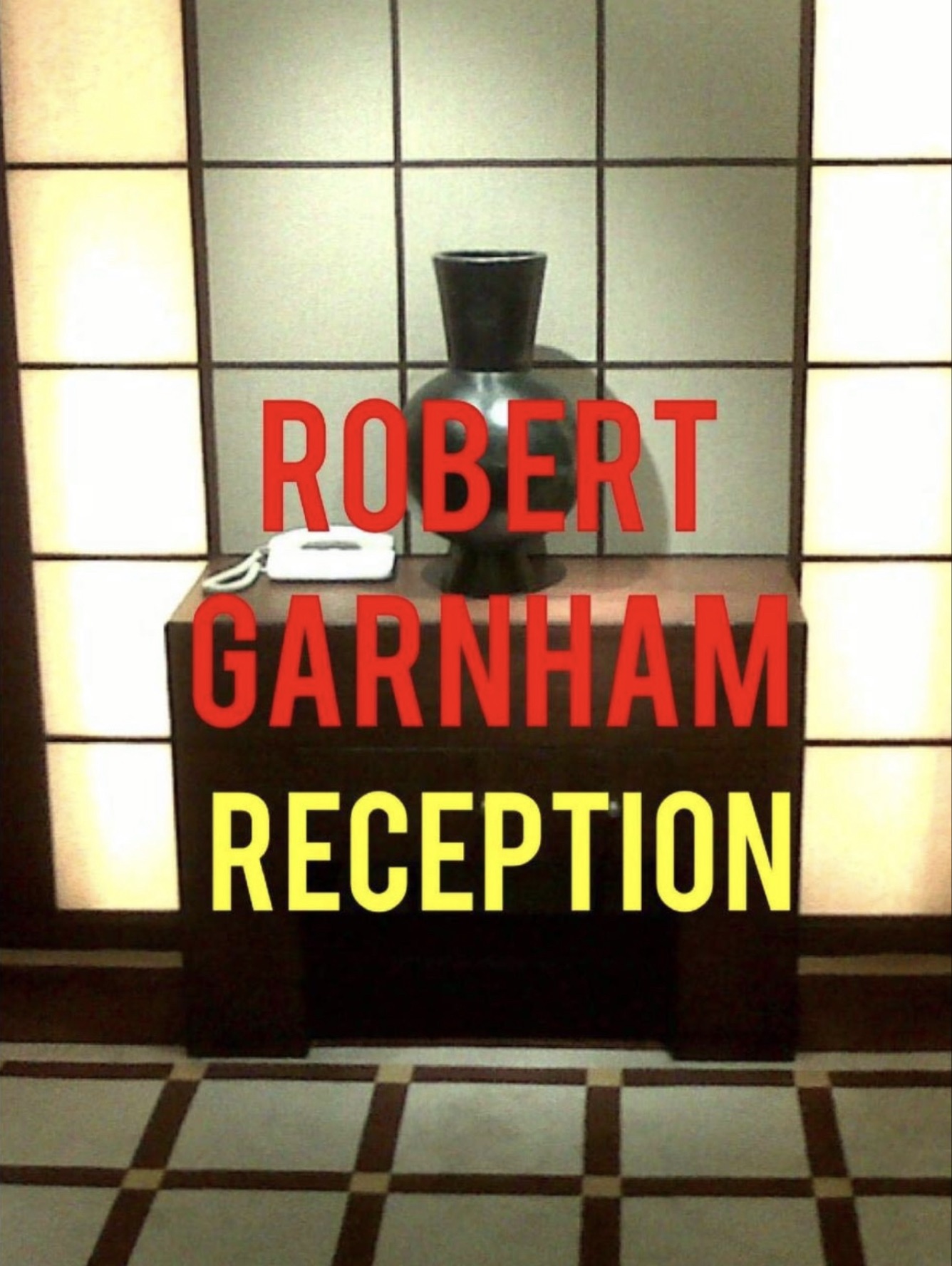
Reception

In 2010, on the way back from Australia, I stopped in Tokyo for a few days, arriving at midnight. I’d booked a hotel but they lost my booking and so began a strange few days of existentialist angst when I started asking, who am I? What is my history? Do I exist? I started writing this novel.

A few weeks later, of course, once the novel was finished, the tsunami hit, so reading this novel again always gives me a strange sense of foreboding.

Anyway, you can now read Reception as an ebook!

The New Fridge Freezer is Suspiciously Quiet

The new fridge freezer is suspiciously quiet.
I don't want to cause a fuss
And I don't want to cause a riot
But the new fridge freezer is suspiciously quiet.

Put some feta cheese in there,
Put some Camembert in there
Put some other things in there
It's very very quiet.

The new fridge freezer is suspiciously quiet.
I don't want to cause a fuss
And I don't want to cause a riot
But the new fridge freezer is suspiciously quiet.

Bought it from a man from Bern
The man from Bern his name was Bern
Fridge freezer, Swiss geezer
So so quiet.

The new fridge freezer is suspiciously quiet.
I don't want to cause a fuss
And I don't want to cause a riot
But the new fridge freezer is suspiciously quiet.

Have you turned it on?
Of course I’ve turned it on.
Have you plugged it in?
What am I, daft or something?

The new fridge freezer is suspiciously quiet.
I don't want to cause a fuss
And I don't want to cause a riot
But the new fridge freezer is suspiciously quiet.

The old one went chigga chum chigga chum
The old one went witty witty woo
The old one went chigga chum chigga chum
The old one went to the tip.

The new fridge freezer is suspiciously quiet.
I don't want to cause a fuss
And I don't want to cause a riot
But the new fridge freezer is suspiciously quiet.

The new fridge freezer is suspiciously quiet.
I don't want to cause a fuss
And I don't want to cause a riot
But the new fridge freezer is suspiciously quiet.