
Lately I’ve been pondering on professionalism, or more precisely, my own professionalism as a performance poet. The reason I’ve been pondering on professionalism is that I’d like to get to a stage where I can say definitely that I am a professional. And I suppose the ultimate definition of professionalism is that I get paid to be a performance poet, and that it is sustainable and economically viable.
So the thing is that I’m quite lucky at the moment on two counts. The first is that I have a job, a nine to five job in retail management. So whether I’m professional as a poet or not, I’m still going to get paid. The second lucky thing is that I get paid to perform, in the most part. I also have books to sell and workshops, and I organise poetry events, and every now and then I get commissions which also pay. So in that sense I’m professional in that it’s slightly more than just a hobby.
However, I still do things which I’m sure a ‘professional’ wouldn’t. I find myself doing lots of free gigs, and these gigs will never be economically viable. It’s all very well doing a free gig if it’s for charity, giving up ones time for a good cause. But a lot of the major gigs I’ve done over the last year have been unpaid.
I live in a very silly part of the world. Paignton is nowhere near any major urban hub. There’s no culture here, so therefore there are no major poetry gigs. The last spoken word gig in Paignton was probably when the Epicentre Cafe held one of its wonderful Word Command nights, and that’s about four years ago. And then there was my book launch on the local book shop, but that’s about it. So if I’m going get paid for a gig, it would be Bristol or London at the nearest, and that means two or three hours on a train.
So every gig that I get paid for entails expense of travel and time, and actually getting there in the first place. I’m very fortunate to have had paid gigs all over the Uk and have made a bit of money doing so. But a lot of the gigs I’ve done have been unpaid.
So why do I do them? I was pondering this last night. What are the benefits? I suppose the major one is that I meet new people and get a chance to sell them books. I see other performers and o get inspired, and it’s always great to network and meet new and exciting people. And I can use my old material and see that it still works, or try out new pieces.
If I was making a living from poetry, then this would not be a viable means of making a living. Yet we need the free gigs so that people can see us. It’s advertising, and the best kind of advertising. That’s what I always tell myself.
So I’m happy to do the free gigs if they’re doable, but I have to choose them wisely. If every performer demanded payment then the gigs wouldn’t happen. If I were to leave my job and concentrate on my art full time, (something I’m considering at the moment), then I’d have to think very hard about such events.
Tag Archives: spoken word
An Interview with Hannah Teasdale
Hannah M. Teasdale’s collection ‘Laid Bare’ is a beautiful selection of autobiographical poems built around themes of love, loss, longing, physicality, the body, motherhood and relationships. The book tells the story of the poet’s relationships with her family, with a lover, and with herself. And as such it is a powerful work, deeply honest and frequently mesmerising in its use of language.
I’ve known Hannah for a couple of years and her performances are equally assured and honest. She connects with the audience with a measured insistence that feels easy, allowing us to glimpse the human within.
Your poetry is very autobiographical. How useful is writing poetry in order to explore your own feelings and emotions?
The emotion is already there. The writing of it comes as a natural process, as a consequence; it is simply a way of ‘setting the emotion free’ from my mind – and to some extent, my body. The only way I can manage my feelings is to pour them out onto a page.
That said, I enjoy writing commissioned pieces where I am given permission to use language without the blood-letting.
The entirety of Laid bare was written ‘in the moment’ – some of the pieces, when they came to editing, I had barely any memory of writing. I estimate I wrote around 500 pieces in a six month period. Clearly, only a small selection made the final cut.
Clive Birnie was very clear from the outset that he wanted the book to follow a narrative, a natural arc. Therefore, I chose poems that followed this brief and could take the reader on a ‘journey’. I hope that it has been successful in creating a story that readers can follow, in a similar way to a short novel but also that the poems can stand alone, in their own right. There are poems, that for their literary quality, I wanted to keep, but knew they would take the reader off-course from the story. By the same token, I have included pieces that helped to knit the narrative together. I never censor myself during the process of pen to page, however, there are pieces that will never see the light of day due to their potential impact on other people. When I was a child, I wrote a story about my best friend’s family and was completely baffled why she didn’t speak to me for a month after I read it to her. I haven’t completely learned from that experience as sometimes, I have overstepped the mark, but I do put out a clear caveat to anyone who might become intimately involved with me, that I do have a tendency to speak my truth…
Some of the pieces were written for performance, and editing them for the page, was difficult. I began as a writer for page, screen and theatre. It was only after my first pamphlet was published, that I began to read my own work out loud. It has been an almost excruciating process and even at my first book launch, I couldn’t read my own work – I had friends ‘perform’ my poetry.
I learnt the ‘art’ of performing by watching others and understanding the need for flow and rhythm in my writing. This has stood me in good stead with other genres of writing and I am now more competent at both writing and performing. When it comes to answering the question, ‘which poem has received the biggest response?’, I think it would be true to say that sometimes, a poems such as ‘How not to say you love me’ and ‘Simply enough’ , have always been enjoyed by an audience but maybe for their lyrical quality and the ease at which I can perform them. However, there are other pieces that I don’t generally perform, like ‘Torn’ and ‘The Phone Call’ that I receive positive feedback for when people have read the book.
Do you write specifically for performance?
I do keep in mind whether a piece of writing is intended for performance to a live audience, or to be read on the page by the reader. This debate over ‘performance’ and ‘page’ poetry is a palpable hot potato currently and one that causes so many unnecessary divides at a time, when as writers, we should be embracing the art as a whole and not seeking to label and divide. It was said to me by a Professor of Poetry that ‘poetry is not meant to be accessible’, that it requires intellect to analyse and unpick. Others have argued the very opposite and have found great solace in discovering a genre that is not reminiscent of their claustrophobic school-days texts. Some have said that ‘Laid Bare’ dares to attempt to bridge that gap, but I am sure there are many critics who would argue against that.
Who are your literary influences?
My literary influences are broad in genre and writing style. I am naturally drawn to writers who speak a truth about human existence in a way that hits you in the stomach. Deborah Kay Davis consistently surprises me with her succinct use of lyrical but slicing language. She hits ‘that spot’ so effortlessly. Ted Hughes will always provide me with a come-back-to point of reference. If I am ever ‘stuck’, I open Birthday Letters and perhaps find a couple of words to write from. I will always be awestruck by his ability to draw upon the natural world to express the human consciousness. And it goes almost without saying, Dorothy Parker is a complete stand-alone in her ability to pull strands of light through the darkest of black.
What projects are you currently working on?
Over the past year, I have been working on a third collection that consists of much shorter poems dissecting the psychological and physical impact of brief sexual encounters. I hope that it pushes even further through the uncomfortable boundaries of the sexually taboo – without being too explicit.
Recently, I have been involved in a number of creative art’s projects – working with young people and vulnerable adults as a creative writing facilitator but also with artists on collaborations.
What advice would you have for aspiring poets?
I don’t know if I feel qualified to be giving aspiring writers or performers ‘advice’ as it is such a personal journey; what may be right for one person, is not for another. There is a fine line between pushing yourself just far enough out of your comfort zone to grow as an artist but keeping yourself safe and sane enough to keep going, without destroying yourself in the process. A very fine line indeed…
 A
A
Edinburgh Fringe Blog Part Seven
https://youtu.be/ZoRytcasNrc
So the good thing about the fringe is that you see all kinds of different acts and the potential for being inspired is heightened. I’ve seen so much while here that I’ve got a very clear idea of where I need to be and how the show can be massively improved with just a few small tweaks. Yesterday I was very privileged to have breakfast and a long chat with one of my favourite performers, (who wishes to remain anonymous because of the trade secrets that he divulged thereat). We met at a coffee shop in the new town area and he took me through every aspect of putting on a show, from the logistical detail of publicity and accommodation, to the more fundamental aspects of rehearsal, writing, learning the damn thing. It was the most enlightening couple of hours I’ve spent in a long time, as he imparted information which an artist might ordinarily have to cough up a lot of money for. I bought him toast and coffee to say thank you. In fact, I was so inspired that I went away and did a little bit of writing right then and there.
Now, obviously I should have been flyering. And I did a lot of flyering yesterday, both in the Royal Mile and Cowgate. I flyered like you wouldn’t believe. And while I was flyering I was thinking, I shouldn’t be doing this. But it’s a necessary evil. Spoken word show? Hello madam, I’ve got a show today at three. Spoken word show? Spoken word show?
It’s a lonely business, flyering, even though you’re surrounded by people. You’re surrounded by all the other flyerers. And they’ve all got various degrees of annoyance, like the pushy ones, or the cheeky ones, or the ones who are just plain rude, and even those who insult anyone who doesn’t take a flyer. What’s that all about?
So I did all this flyering, and what do you think happened? No audience. I could only be philosophical about it, of course. I’m at the fringe, yes, but really I’m not that well known in the slightest. My show is on directly after Harry Baker, and he’s a world slam champion. And I’m also a slam winner. Well, second at the Swindon slam, anyway. Later on in the day I watched Gecko’s excellent show and he did a song about the painting that shares the room with the Mona Lisa and I thought, hmm, I know exactly how it feels!
But it’s all a great experience and a valuable learning opportunity. I’ve seen so much that has inspired me that I know exactly the manner and tone that I shall be adopting in my writing. And yes, I’m probably the oldest performer on the spoken word scene up here by quite some margin, but I feel all new and eager to get on with it.

Edinburgh Fringe Blog Part Two
Heathrow
So here I am now at Heathrow Airport Terminal Five. I stayed last night in Woking, which is one of my favourite towns and a place where I’ve spent a lot of time. When I booked into the hotel I asked if it was okay to pay with a debit card. We accept anything, the receptionist said, apart from goats.
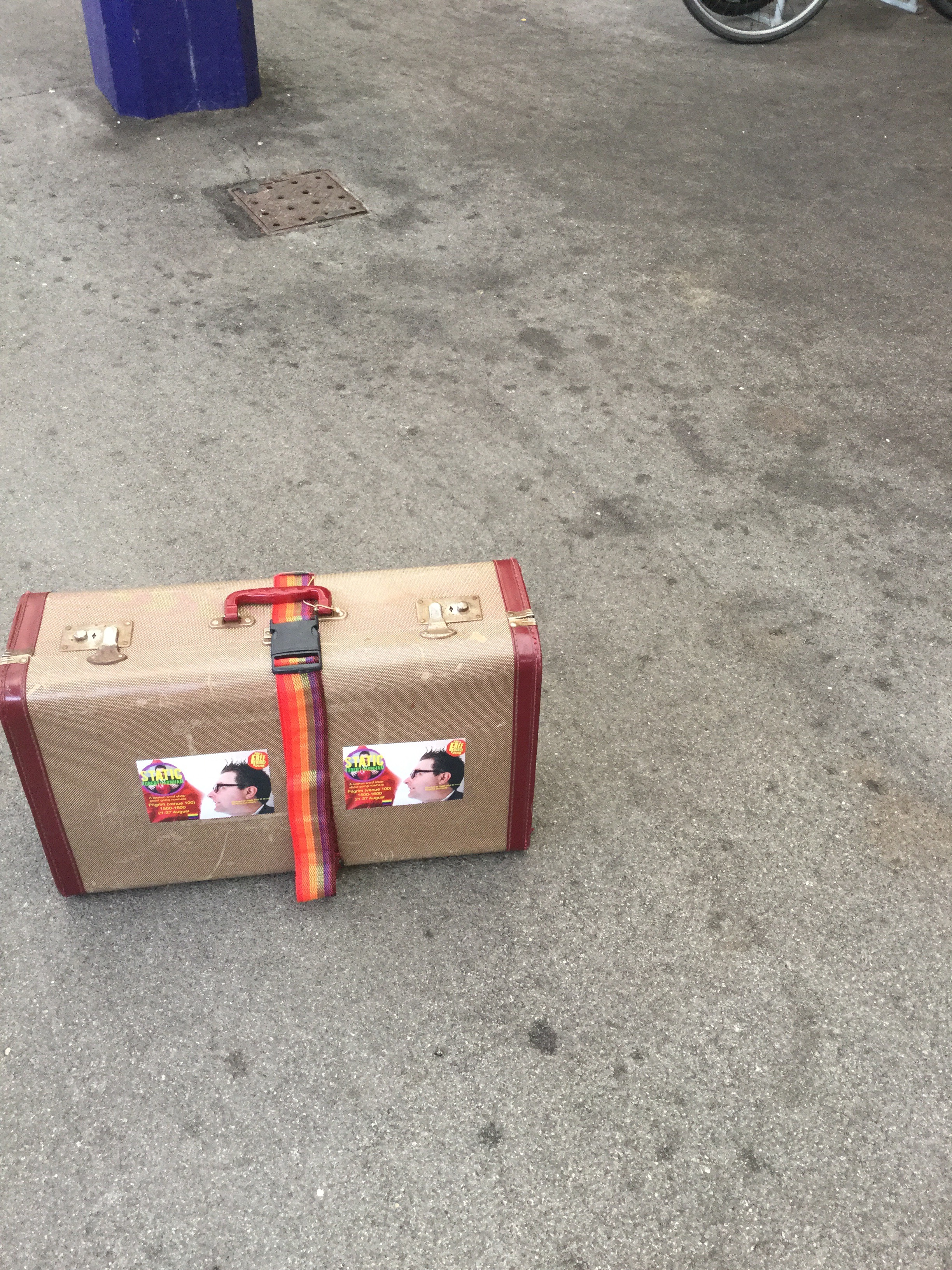
It seems kind of unreal at the moment that I shall be performing this afternoon in another country. Okay, that country is Scotland, but when you’re used to Torbay, anything north of Newton Abbot is dodgy ground. The coach driver from Woking to the airport was incredibly jolly and rather envious of my old suitcase, which forms part of the show. You don’t see many of those, he said.
I expect the baggage handling crew are saying that too, right at this moment.
Edinburgh
It was a weird day. I mean, they talk about the madness and the insecurity which hit some more than others. Has it already hit me?
The flight was fantastic. The stewardess who found me an empty overseat locker advised me to use it quickly as those who bring suitcases on board will nab it. She was one of the jolliest people I’ve met in a long while with an evident love of life and a loud booming laugh which echoed from the galley all round the plane.
The flight was 45 minutes. It took 30 to get my case at the baggage reclaim. I caught the bus to the city centre straight to my venue, arriving ten minutes before my show. The audience seemed to enjoy it, (both of them), but I treated it as a rehearsal and afterwards pondered on a raft of changes I might make for the rest of the run. I also need to be louder. Tomorrow will be an entirely different matter.
I walked the mile out to my student accommodation, then realised that I’d left my jacket at the venue!
It was great to see Dominic Berry and Chris White, and later on I bumped into Rose Condo, Dan Simpson and Rob Auton.
It’s going to be a mega week!

Edinburgh Fringe Blog Part One
Well here I am then, on a train heading to the Edinburgh Fringe. Well, almost. First of all I’m going to Woking to spend the night in a room over a pub, and then tomorrow morning I will be flying up. It was either that, or fifteen hours on a coach. In fact it’s cheaper this way than getting the train. How ludicrous is that?
So how am I feeling about all this right now? There are several emotions. I’m nervous, naturally, that everything is going to go tits up. Nobody will show up for any of the gigs, and when they do, I fall into that age old trap of being crap. I’m excited, because this is the Edinburgh fringe and a lot of my friends will be there. I’m also grateful that I am able to spend an entire week immersed in art and culture.
I’m also nervous that the logistical arrangements I’ve made will fall apart. The accommodation, the travel, the train, the plane.
So here so am, then, on the train, and I’ve managed to get a high profile seat in first class. It was a whole three quid extra to get in here, and I feel privileged, because they don’t just let anyone in. That three quid means a lot.
And I’m the only one in here as the train leaves Exeter, which makes me feel kind of poncey. But then a lusciously blonde muscular lad sneaks in and plugs his mobile phone into the charger. A minute or two back he’s later to look at his phone. Then he slides in, commandeers the seat for himself. Good move!
And oh mamma, what a good looking chap he is. Amazingly he offerere me a Fruit Pastel, and then we get talking. Where are you going? Woking? Me too! Where do you live? Paignton? Know it well! What do you do? Spoken word artist? I’m a property developer. And we chat for ages, about books he’s read, his love of To Kill a Mockingbird, his skills as a weekend surfer, and then it starts to get embarrassing. Whenever I try to relax he asks something else, and all the time I’m looking at those luscious legs.
At Honiton he gets off and meets a man on the platform who gives him a suit in a bag. He gets back in and looks at the suit, the tie, spreading them out on the table. Very smart! We chat some more, and then the man comes to check the tickets.
You’re in the wrong section, he says. Please move back to the standard class.
I’ve still got two hours of this train ride to go, but I’m already thinking, ah, yes. The adventure has begun!
And will I still be thinking of this blond lad in seven days time?
https://youtu.be/YjpL6VZtC78

Paignton station.
Exeter St David’s station.
The most significant full stop.
The aim is to make this the most famous full stop in the history of mankind.
It was originally typed at 0845 on a Wednesday morning, at a Costa coffee shop in Paignton, Devon, UK.
There will never be a full stop as momentous as this one.
Why, you ask. Why should it get all of the acclaim? To which we reply, why not?
The font is irrelevant.
This full stop could have gone anywhere but it gave up on all that potential because it sees the bigger picture.
Feel free to share this full stop. It needs you help.

A good gig!
I had a good gig on Wednesday night. In fact it was as good as it gets, because of several reasons. The first reason was that I practised really hard, memorised everything that I would say, and when it came to it, I didn’t forget a single thing. The second reason was that the audience was fantastic. The third reason was that the structure and the dynamic of the evening was perfect: a young audience, some of whom had trendy beards, and the fact that I was the middle poet, after a serious but incredibly good opening act, and before the main headliner. The fourth reason, and the most important one for me, was that several friends came along and I wasn’t naff, and that my publisher, too, was there.
Not being naff is the biggest contributory factor to a successful performance. I felt at ease with the material and with the props that I would be using. I started by dancing and saying, ‘I don’t know why, but I’m feeling really frisky tonight’. I then did a little dance. I don’t normally do a little dance, but the time just seemed right. This kind of set the whole thing up, and the audience were incredibly up for having a bit of a laugh. I think it helped that the person before me had been brilliant, but deeply serious and very poetic. I was the complete opposite. I ended the evening by dedicating this ‘car crash of a set’ to the memory of Victoria Wood.
So that was the gig, and it just went so smoothly. However, the feeling afterwards was one of mild euphoria mixed with the impression that perhaps every night should be like this. A young, youthful audience in a town where I don’t perform that often, and the feeling of being surrounded by friends. The best bit has to be the moment where I was chatting to my publisher, and someone came up to buy a book. At least that showed him that it was worth him publishing me!
The euphoria lasted all the way home, which was a long way, a two hour drive back to Paignton. There’s nothing better than the sense of a night coming together really well. As the lights of Bristol faded in the rear view mirror, we sped along the motorway passing sleeping towns, strange clusters of road lights and an empty motorway, the sort of place haunted by jobbing comedians and long distance lorry drivers, insomniacs, the perennially lost. I slept well and I was on a bit of a high the next day, until about lunch time.
That’s when the thought starts creeping in: Just what’s been going wrong at all the other gigs?

How spoken word changed my life.
I knew who I was from a very early age. Or rather, I knew that I fancied men instead of women. Which doesn’t seem so shocking these days, but growing up in 1980s Surrey with a very conservative family background, at the time it was quite a big deal indeed. For this reason it wasn’t until the year 2000 when I finally ‘came out’ to friends and family and work colleagues, even though I’d known myself since I was about eight.
Yet still there was this sense that I was operating on the fringes of society, and that for some reason my views and likes, my choice of music or film, and absolutely everything about me wasn’t as important or as valid as other people, because I would never get married or have kids or have a sudden urge to do an oil change on a Ford Mondeo. I think that inside, psychologically, i had convinced myself that nothing I did really mattered very much.
I came across spoken word by accident, by going along to a performance poetry night in Torquay, and I soon began performing and using comedy, the same way I’d used comedy in secondary school to avoid being beaten to a pulp every lunch time. However it was only after a year or so that I decided to tackle bigger themes and LGBT issues in poems such as “The Straight Poem”, combining comedy and social critique to look at the world from a slightly different viewpoint. The fact that the audience liked such poems, and that I could even win slams with them and get bookings for other poetry nights, made me think that instead of operating on the sidelines, I had an important voice, or at least, something interesting to say.
I’d always been a shy person and I did not come from a performance orientated background. My school did not teach drama and I’d never even been to a theatre until I was 25. In fact, the worst thing I could think of was wanting to ‘perform’ for an audience, or even stand on a stage and have lots of people look at me, judge me. Performance poetry gave me the confidence to do these things and to share my humour and my voice, and this then translated into other areas. I feel incredibly confident now with who I am as a person and how I conduct myself in life, because the experience of going on the stage and performing has seemingly validated the person I am. Spoken word is all about voices, and it’s great that the voices come from so many different backgrounds, whether black, Muslim, male, female, or a slightly nervous white gay bloke such as myself.

Some thoughts on performance poetry.

I was contacted by a student at Exeter University to answer some questions for her dissertation. Anyway, here are my responses. I hope they make good reading.
1. What is your impetus to write? When and why do you write and perform?
I suppose with me the impetus is just to make people laugh. I’ve always been a fan of comedy and humour but never found the vehicle to do this myself until I discovered performance poetry about five years ago. And once I started I realised I could tackle subjects such as gender, sexuality, human rights, loneliness and my own personal failures as a lover but using humour to mask these themes and make them more accessible for the audience.
Oh, and lust. Lust is a great impetus to write! Saying the things that you never could say in real life, knowing that the object of your affections will never know!
I write every day for at least an hour, and on my day off I try and write all day, with gaps for swimming etc. Exercise makes my brain work! The actual physical act of writing feels kind of like a little ceremony and that’s the only time when I feel like a real poet
2. Do you use YouTube/social media to promote your work? What are the advantages and disadvantages of using online platforms?
Yes indeed. In fact I don’t think I’d be getting half the gigs I do get without social media. For a start it’s a great way to keep in touch with what’s going on in the spoken word world. But it also gives you an accessible platform for promoters and other poets to see your work. I can go to a gig in Wolverhampton or Basingstoke and people know about my work because they’ve seen me on YouTube or Facebook.
You do tend to feel more like an avatar at times. I always wear the same sorts of clothes for performing because this is my trademark and people recognise me from photos. I’ve not had many drawbacks from using social media, no stalkers or online abuse or anything, but I’m sure it’s only a matter of time! And sometimes I wonder if I’m online too much and that people will get sick and tired of seeing yet another spikey haired selfie. I think you do have to be a bit shameless at times!
3. Do you try to cultivate a relationship with the audience? If so, how do you go about it?
Yes, it is always good to connect with the audience. I’ve actually read about this in performance books and acting manuals because I do not come from a performance background. I try to be warm on stage, I try to look at everyone in the room and look up from the page as I write. I try to smile a lot.
If I go to a gig in a new place, I’m usually very accommodating beforehand, being pleasant and saying hello, because these are the people who will be the audience once the gig starts. I also try to react to the previous performer. It’s hard to go on stage and do a poem about (for example) getting envious about beards, when the previous poet has just done a stirring emotional piece about her dead grandmother. So I try to warm everyone up perhaps with some audience participation. Everybody say yeah!
I also try to react to things that happen. Every now and then one audience member will make some funny sort of laughing noise at a place during a poem where it’s never happened before, so I will stop performing and look over at them. That always gets a laugh. And luckily, you don’t get heckled much during poetry. (See below).
4. Do you care what an audience thinks of your work?
It would be nice not to, but sometimes you do. If it all goes right and people laugh at the funny poems or clap enthusiastically, it’s a magnificent feeling. But every now and then you’ll get someone who disagrees.
There have been a couple of notable heckles. The first was sheer comedy, because I have a poem which starts with the words ‘isn’t it annoying when you turn the page’. I got as far as ‘isn’t it annoying . . ‘ when someone shouted, ‘Yes!’
And recently out in the sticks I did a gig in a church and I performed my Jeremy Clarkson poem, which usually gets a fantastic reaction in the city urban centres where I normally perform, Bristol, London, Exeter. But out in the sticks it was evident that everyone was a big Clarkson fan, and after the poem someone shouted, ‘At least Jeremy Clarkson makes me laugh’. And afterwards I thought, wow, if only they’d liked that poem! I shouldn’t have cared too much, but I did, and I thought of an amazing comeback to zap him with. Trouble was, it was six hours later, as I cried myself to sleep.
5. Would you alter your style to cater toward an audience? you were being paid and were asked to edit a poem (ex for swears), would you do it? If you weren’t being paid, would you do it?
Yes, absolutely. I’ve done this on numerous occasions. My poetry isn’t rude or heavy on expletives, but every now and then I do radio, or street poetry, or family fun days. (What the hell are they doing booking me for a family fun day?!). So I’ve excised verses and taken out rude bits, certainly. I’m very aware that he promoter is the person in charge and I don’t want to upset them.
I’d love to be more passionate about this and say things like, ‘I don’t want to compromise my artistic integrity’. But then I always think, ‘There’s a time and a place for everything . .’. Last summer I did a family fun day on Paignton Green to a beach full of families and kids in the hot August sun, and before I performed they played that ‘What does the fox say?’ song, and I remembered chuckling to myself before I went on thinking, ‘I’d love to do the poem about Orgasms right now’. But I was very professional.
6. What do you think an audience is looking for when they attend a performance poetry night or slam?
I think if it’s performance poetry, the audience just wants to be entertained. Poets like Pam Ayres and John Cooper Clarke have revolutionised the way that performance poetry is perceived. The audience will always be different to the more weighty, beard-stroking patrons of page poetry ‘readings’. In this, there are links to stand up comedy. Performance poetry is a wide church which embraces poetry, ranting, comedy, rhyming, rapping, and every night is different, so audiences love the mix and the variety. A well run night will have a bit of everything.
Slam audiences are up for the same but with the added bonus of a competitive element. Slams have a reputation for being youthful and raucous with lots of whooping and stamping of feet. Getting whooped is always a bonus. I’m always glad to be whoop-worthy, even if I’ve just crashed out of last place in a slam.
7. What is new about spoken word? Is spoken word poetry even new?
As you know, there’s always been a tradition of spoken word, and someone once told me that all poetry was originally intended for word of mouth.
I think lately spoken word has enjoyed a renaissance because of social media. A three minute poem makes a great YouTube video. A politician can say something stupid on the nine o clock news and by six o clock there are poems uploaded getting millions of hits. Social media allows politically aware poets with a good ear for a rhyme to react quickly.
Lately, performance poetry has been adapting to other media and using the language of stand up comedy, rap, chanting, pop music, even computing. (I’m currently working on a batch of poems which are written as if they’ve been produced by a computer programme that’s ever so slightly faulty). I know of performance poets who incorporate magic and juggling. And Cat Brogan performs which hula hooping!
In this regard I think performance poetry is the most postmodern of crafts. But it’s not new. My hero, Frank O’Hara, was influenced by movies, theatre and abstract expressionist art, and he was writing in the 1950s. And thanks to YouTube, Andy Warhol’s fifteen minutes of fame is now down to three minutes.
8. Do you use multimedia, props, or technology in your work (videos projected while you perform, music, loop pedals, etc) and why?
Personally, I’m rubbish at technology. But over the years I have (take a deep breath) performed a duet with a videoed version of myself on an iPad, built a large hadron collider on stage out of garden hose and custard cream biscuits, built a robot version of myself on stage out of cardboard boxes, a hair brush and a fishing rod, played a theremin on stage made from two French loaves and a pair of Wellington boots, and I regularly perform with a pink bird puppet called Mister Pinkerton.
9. What has spoken word poetry done for you in terms of shaping an identity? What has it done for you in general? Has performing poetry improved your confidence?
Yes, indeed. I’d been in a play before I discovered performance poetry, but I was terribly shy and unsure of the world right up until about 2011. When I started performing I discovered that there really isn’t that much to be scared about, particularly with performing, and better still, that everyone has a right to a voice and views and can be treated equally because of these. Coming from an LGBT background and being a teenager in the 1990s meant that I always saw myself as Not Being Right compared to the rest of society, but thankfully now things are a little more equal, and the fact that I can be judged – or better still, not judged at all – has come about purely through performance poetry and Being Myself. If that makes any kind of sense!
10. Do you feel that as a spoken word poet you’ve become part of a community? What is that community like and what does it do for you/what do you do for it?
Yes, there’s a wonderful community particularly down here in the south west, because there are so many different voices and styles of performance. There’s also a very strange crossover between page and performance here that you don’t tend to get in other areas. There’s no snobbishness! We are also very welcoming to newcomers, such as students from the university. Ian Beech, Tim King, Morwenna Aldiss and I all run different poetry nights and we are all keen on giving new people a platform to perform and to advance their abilities. I often get emails for advice. And also, over the last few years I’ve begun to realise that my best friends are all now spoken word poets. We hang out and drink and talk about our lives and that, I suppose, is a community!
Going back to the LGBT thing, I grew up seeing the LGBT community as being something to aspire to but also something that didn’t seem very interested in me. Last year I performed at London gay pride and afterwards I got this sense of my poetry helping me affirm who I am. It told me that i was already a member of this particular community!
11. Do you think you can “find yourself?” Does spoken word allow you to do this, and if so, how?
I’ve probably answered that already, actually. It’s helped me discover my identity and it’s given me friendship with similarly minded people.
And the writing process itself is somewhat like therapy. Being insecure about love and relationships and sex and the state of the world is a horrible state, but the moment you start to write about it, or make fun of (for example) having really bad sex, then it somehow makes you feel much better. So now I know how those ranty poets feel! It’s such a good therapy!
12. How would you characterize “yourself” on stage? What do you turn into? ex do you have a persona you fall into?
Absolutely.
It took a while to find this character. I used to perform in tshirt and jeans. Then one day I came from work in a shirt and tie and I just kind of kept that up. I don’t think many performance poets wear shirts and ties, because they’re all so trendy and they’ve got interesting hair. So my stage persona began to adapt to the clothes that I was wearing. Next I added a jacket, and then a jumper, and now the quintessential Robert Garnham look is complete! (And the tie is a little nod to Ron Mael, one of my favourite musicians).
My stage persona is an exaggerated version of myself. I always think of myself as being super confident on stage, but someone’s mother said that she really liked my slightly nervous manner. I became terribly self aware after this, which probably made me even more nervous! But I think if I go in with a clear idea of what to do and what to say, and then add this layer of nervousness, then that’s probably what’s working.
I try to sound like a very deep, meaningful poet who just happens to be saying very weird things. Slightly academic, a bit old fashioned. That’s my persona, I suppose.
It’s hard, then, slipping out of this persona. I usually need to wear different clothes and have a shower to get rid of the gel, and change my glasses, before I feel like the version of myself that I’ve always been. When poets see me in ‘real life’, in a hoodie and shorts for example, they always say, ‘I didn’t recognise you’.
13. Do you think a certain type of person does spoken word? If so, what is that person like?
I’m not sure. There are so many different types of poet and performer. I think more people would do it if it had the media coverage that comedy gets. I mean, if I can do it, then others can, because it felt like it was ready made for me before I’d even performed a poem!
If I look at the backgrounds of my closest poet friends, there’s an amazing array of routes into performance. Chris White comes from a theatrical trained background, Tim King was in music, Chris Brooks was a comedian. Yet there also seems to be a lot of librarians: Ian Beech, James Turner, Alaisdair Paterson. What’s that all about? And come to think of it, my background is in museum management!
Slam poets and performance poets often come from minority backgrounds. They act as powerful voices for their communities, such as Vanessa Kisuule, Chanje Kunda, Dean Atta and your good self. They have something to say, which needs saying, and performance poetry is as good a vehicle, and as accepting a vehicle, as any. Often there seems to be a gender bias towards men, which makes programming events difficult when you realise that you’ve got 10 men and 2 women appLying for slots at a poetry night, which is where curating comes into effect. (That’s my museum training coming out again!)
An interview with Project Adorno

During the last few years I have seen a number of music and spoken word acts, and combinations of the both. There’s something about the mix of styles which I rather enjoy. However, one group in particular seemed to touch on themes and ideas which I’ve always liked or had a fascination with: libraries, Doctor Who and the Pet Shop Boys.
I first saw Project Adorno when they came down to Torquay while I was hosting Poetry Island. It was an amazing and funny set of songs and witty banter which left my head filled with inspiration. Even my grumpy friend Mark, who did the door for me, bought their cd afterwards. Since then I have eagerly followed Project Adorno, stalking them via social media to see what they’re up to.
Project Adorno are Russell Thompson and Praveen Manghani.

Hello! What are you working on at the moment?
R: A musical appreciation of the screenwriter Dennis Potter (The Singing Detective, Pennies From Heaven, etc). It’ll be one continuous suite of songs, spoken word and ambient music, accompanied by Patrick Keiller-esque film. In fact, we’ll be doing for the Forest of Dean what Keiller did for London.
P: Yes, still very much a work in progress, though some nice bits emerging. It’ll either become an art-house Keiller-esque film or a quirky version of The Singing Detective complete with lip-synched songs…somewhere in-between I suspect. It has been nice to include visuals in some of our recent work. Just at the moment I’m very taken with the “information” films of Charles and Ray Eames…
– The last time we met you were working on a project about film maker Derek Jarman. How is that going, and why did you choose him?
R: Jarman would have hated the idea, but he does seem to have become a sort of countercultural national treasure. Even if you don’t admire every piece of work he produced, it’s still possible to think ‘thank God there was a Derek Jarman’. The arts are full of people who court controversy, but they seldom have the degree of integrity that he had, or the conviction of their own beliefs. Later, of course, that increasingly applied to his lifestyle as well as to his art. We took the show – Jarman in Pieces – to the Edinburgh Fringe in 2014, since when we’ve been doing one-off performances of it at various LGBT arts festivals around the country. We’re really pleased with it: it took the multimedia side of our work to a new level, and established the format we’re now using for the Potter show. I tend to think of Jarman in Pieces as our Dark Side of the Moon. Which of course means that Potter will be Wish You Were Here. After that we’ll be on to the inflatable pigs.
P: I was originally fascinated by the whole Super 8 DIY film-making ethos of Derek Jarman. I particularly loved the grainy look and feel of super 8 film. That, and his diaries, and his paintings and his house and garden in Dungeness (an artwork in itself). That’s the thing about Jarman – he had so many strings to his bow. I was also inspired by his oddball, left-field creative spirit (which seemed slightly at odds with his well-to-do middle class background). In 2014 we were asked to curate a film night as part of a local arts festival – as it was also the twentieth anniversary of his death we chose Jarman’s “Last of England”. We performed a short multimedia piece to accompany it and decided to develop it into a full-blown Edinburgh show. It was only when we started working on the Jarman project that Russell and I realised we’d both independently admired him in our respective formative years.
– Project Adorno seem to be fascinated with libraries. That’s no bad thing. Personally I believe that the downfall of western society began with the introduction of self service machines in libraries. What is it about libraries that appeals so much?
R: You’d better ask Praveen about the machines – it’s all his fault, I’m afraid. But we do have a song about the perfection of the date-stamp. My local library still has one available so that people can stamp their own books if they want. We’re not very progressive in East Sheen. Praveen works in libraries, I just hang around in them. Is it ‘customer’ or ‘user’ these days? Personally, I’m obsessed with books (which a visit to my house would confirm) and with a sense of order (which a visit to my house would not). I’m the sort of person who likes compiling indexes in their spare time.
P: Ah the appeal of libraries…don’t get me started…a world of possibilities, escape and imagination. A place to ponder, pontificate….and just generally sit and think, or learn, or just be…reading and books are of course still mainstays…but it’s not just about the “borrowers” any more (another one for the “customer” vs “user” terminology debate). I’ll always prefer the date stamp to the self-service machines but we must move with the times – people now demand computers and wi-fi and coffee shops so we have to adapt if we want to stay relevant. Libraries are one of the few places where one can go unchallenged without requiring a reason to visit and as long as the library remains a place that’s free to enter and universally available for everyone that’s good enough for me. Plus they’re now very established at putting on arts events and literature festivals – a natural home for Project Adorno gigs!
– One of your most famous songs is about Davros from Doctor Who. You’ve been working on a new version of this song. How is it different to the original?
R: A longer intro, just to ramp up the mounting excitement. Oh, and we’ve removed a slightly un-PC line. Apart from that, it’s fairly recognisable – still firmly entrenched in the Baker T era.
P: It’s actually become a bit more “prog-rock” to my ears – unintentionally so! Oh, and the opening verse is different to the original recorded version (something I’ve been meaning to fix for ages).
– Who are your influences?
R: Our influences are like a Venn diagram with a small intersection between the two circles. Most of my mine are things you may not guess from listening to us: ‘70s folk-rock, ‘80s anarcho-punk, and traditional folk – by which I mean hundred-year-old field recordings of shepherds singing songs about the Napoleonic Wars. My favourite comparison was when someone likened us to Radical Dance Faction, although I think that was just a kind way of saying I couldn’t sing. The intersection consists of The Wedding Present, Philip Jeays and Ian Dury, and we also share an unhealthy fixation with the doo-wop band Darts.
P: Originally for me it was all about Pet Shop Boys (I still marvel at the sleek simplicity of “West End Girls” and that supposed trick of a G chord with an E in the bass… or perhaps it was the other way round…) and early eighties electro-pop/disco in general. And of course Frankie Goes to Hollywood and in particular Trevor Horn. His production techniques and OTT arrangements and remixes just blew me away – I wanted to do things like that but was limited both by lack of musical ability and studio technology. An anologue Fostex 4 track tape recorder just didn’t quite compare to the (then) state-of-the-art Fairlight sequencer. After that I discovered indie and realised one could do quite a lot with just a few chords and some imaginative words. We’ve mutated into more of a song-based cabaret act over the years and in many ways I think the musical side of things has become more simplistic and DIY as we’ve progressed. The lyrical content, whilst always important, has become ever more so – influenced by Momus, Brel, Aznavour and Jake Thackray amongst others.
-I’ve read some Adorno. He’s incredibly dull and weighty. I tried to include him in my masters dissertation just so that it looked good in the bibliography. Why did you decide to reference him in the band’s name?
R: All I know is a useful four-word summary someone once gave me: miserable German, hated jazz. In other words, he despised popular culture. We like to see Project Adorno as a reconciliation beween high and low art. A modest little aim, there. We should also mention that there’s something called the Adorno Project, which monitors the migratory habits of birds. They’re not us. It’s crazy, though – they’re always getting invited to perform at cabarets in Brighton, we’re always getting invited to read our paper on the movements of the Manx shearwater.
P: It’s all my brother’s fault. He was doing a critical theory degree (or similar) and he came home one day spouting on about Adorno. We somewhat pretentiously concocted the name Project Adorno as it sounded good. Then my brother then decided to go to Germany and I was sort of left with the name, decided not to change it, and Russell came board. So we both inherited it really. I’ve mugged up a little on Adorno since then, but must agree, he’s not an easy read! As Russell says, he appeared to loathe popular culture, tho’ it would be fascinating to get his view on our work (especially as we’ve taken his name in vain). People have occasionally said of us “it’s very accessible on the face of it, but the lyrics deserve repeated listening as they often contain extra layers of meaning” (or something like that) – and that’s the best compliment I could hope for really.
-What are your creative processes? How do the songs come about?
R: Praveen is a one-man songwriting factory. I have a mental image of him gripped by bouts of creative frenzy, like Beethoven – unable to leave the room until he has given shape to his ideas. He seems to have written at least two new songs every time I see him. As for me, I either present pieces to him solely as lyrics – ‘See what you can do with that’ – or I’ll have an idea of a tune and attempt to sing it to him. Considering my inability to carry a melody, he always does a pretty good job at interpreting what’s in my head.
P: That’s a nice description from my esteemed colleague. Actually I still have a whole folder full of Russell’s poetry that I’d like to commit to music one day! What I like about Russell’s lyrics is that he often uses words that I either don’t understand or that have never before been used in the medium of popular song – usually both (Coalhole Cover Lover and Zubenelgenubi are just two such examples). He’s certainly broadened my vocabulary! I think we’ve both got a passion for the geekier side of popular culture which helps as reference points. We often each go away and write things on a particular theme (eg as in recent Potter and Jarman projects) and then choose the best of these. Tho’ some of my favourite pieces have emerged more organically with Russell reading a lyric and me just playing a basic guitar rhythm underneath (When London Shone and Famous Diplodocus are two that come to mind).
– What is the future for Project Adorno?
R: Gosh, there’s a question. As I say, the new multimedia, semi-ambient approach has great possibilities. I’m interested in places, so a show based on some sort of travelogue would be interesting. I’d like to do a show about the A1. That would at least ensure we were listed first in the Fringe brochure, if nothing else.
P: I’m quite liking the idea of writing some sort of play (It’s all Potter’s fault) – it will have to have songs or music in it of course, so I guess, if it happens, it will end up becoming a musical. Seriously though we’ve often talked about doing a Project Adorno book – a sort of creative “history of” as opposed to a biography. Still, I think we should strive to at least getting a mention on Wikipedia before that happens! If nothing else we are determined to record and release a new CD this year – there are loads of songs which need committing “to tape”. (Tho’ I guess in truth it’s all downloads these days). Anyway, that is a must. Beyond this I’ve often harboured the ambition of performing Project Adorno songs with a live orchestra at somewhere like the Royal Festival Hall…one can dream.

