I took two weeks off from performing. You’d never guess what happened! 

I had two weeks off from performing. You’d never guessed what happened!

It seemed I’d been performing every week since Christmas. Indeed, the last three months have been my busiest yet, what with the usual poetry nights and also performing with the Jocular Spectacular Roving Comedy show. I had a flying visit to Manchester, and I performed in packed theatre venues supporting Arthur Smith, Iszi Lawrence and Mitch Benn.

At the same time I was working on the proofs of my forthcoming collection, and busy writing my new novel.

Indeed, the camaraderie and jovial nature of the comedians I’ve been working with almost, almost tempted me to take that step into comedy which some performance poets have done in times past. But when the music stopped, and I had those two weeks off, I was able to take stock.

I became me again. Away with the spikey hair and the nerd chic glasses! Away with the tweed jacket and Converse All Stars! Hello to early nights and regular meals and sensible clothes.

I began to think about performance and what the finer points meant. I was able to take a step back and remind myself what performance poetry is. Words, expression, rhymes, audience reaction. And after a few days, my brain began to clear and new ideas formed. Thus began a kind if mental spring cleaning. All those ideas and half poems found their way to the page and I was able to work on them uninterrupted, without concerning myself about the next show, the next set.

I also got tonnes of admin done. Forms filled, emails sent, novel and play sent off to agents, publishers and theaters. I’ve got so much done.

But something else happened. Something weird. And that was that I completely forgot that I was a performance poet. Caught up in the minutae of my regular job, and then with the detail of living an ordinary life, doing the cooking, washing, dusting etc, the idea of performance and the prospect of doing so didn’t once cross my mind on some days. Which might be perfectly normal, except that when I finally sat down and thought about what I do, and what have done, it all came as a rather pleasant surprise!

Indeed, I felt a little proud of myself. It’s like I had a secret. It’s  like I’m a nighttime superhero, fighting crime. Well, fighting rhymes. And nobody suspects a thing! Even to this day, most of my friends and colleagues are completely oblivious.

Last night was my first gig for two and a half weeks, and I thoroughly enjoyed it. I relished every moment I spent performing and I had a great time. I have an amazing clarity of mind right now and I don’t want it to end!

So what’s the lesson here? Simple. It’s good to have a break, even if it’s from something you love doing. And it’s great to lead a secret second life! 


“So Much More Than The Professor of Whimsy: Turbulence by Robert Garnham”. (A review by Ian Beech). 

Last year I wrote a collection of serious poems all based around one theme. It was great to get away from my usual whimsical style. Some of the poems had been running through my mind for years.

I decided I would only ever print twenty copies of the resulting book, Turbulence. And even now I consider it my masterpiece.

Every now and then I reread bits of it. Some of the poems have deep and meaningful content, they’re more like riddles than poems and their meaning is known only to me.

Ian Beech, poet and promoter, had this to say about Turbulence:

“So Much More Than The Professor of Whimsy:

Turbulence by Robert Garnham

 There may be those of you who know and love the hilarious Professor of Whimsy who will be surprised by his latest poetry collection, Turbulence.  Some of us have glimpsed his more serious side in the past and noted that he is far more than just Paignton’s Funniest Man. True, his comic poems often harbour hidden depths butTurbulence provides further evidence of his ability to write powerfully in a more serious vein.

 There are still wonderful, whimsical, surrealistic moments, as in the opening poem Ms. Lucy Wellington, but even that ends with the line ‘What goes up must come down’, hinting at the hidden subtext that permeates the book.  The book title, front and back cover photographs all relate to an event that occurred before the author was born but which has fascinated him for much of his life. He interweaves powerful, moving poems, detailing various aspects of the incident, with enchanting, revealing glimpses of his childhood and adolescence.  In West London Rain we see the fledgling author ‘safe and cosy with/My writing pad’, his ‘Dad with motorbikes/And Mum with her incessant gardening’ but also learn that ‘once/They saw something in the murk.’

 Nowhere does Garnham clearly identify the event he describes and draws on so eloquently. If you don’t recognise it from the poems, a little internet research should make things much clearer.  Indeed, a second reading having perused the Wikipedia article (shame on a trained librarian for heading there for speedy convenience) allowed me to fully appreciate the many detailed references the book contains.  Alongside those serious topics, and the deep reflections they induce, it is a delight to travel back to Garnham’s early days. Cuckoo spit  brings to life so vividly a moment of childhood shared with his sister, full of customary Garnham charm and humour. In defence beautifully explores his awakening sexuality, and, sadly in my humble opinion, his disinterest in football and his total inability to play the game.

 There is so much more to enjoy in Turbulence but be warned, Garnham is hardly a hard-bitten capitalist poetry entrepreneur. He has only printed twenty copies of this marvellous book and claims that there will be no more, holding to some typically bizarre notion that he wants the book to gain mythical, legendary cult status: people will have heard of it but never seen a copy, being left to question its very existence. Well believe me it does exist. My copy is under lock and key and I suggest if you cannot buy one of the other nineteen, you demand he drops this preposterous limitation on spreading his wonderful words.  Turbulence is not to be missed.

Ian Beech

Host of Poetry Island

at The Blue Walnut Café, Torquay


I get nervous. I used to get nervous. I don’t get nervous.

I’ve been performing poetry now for about five years up and down the country. I’ve been to parts of Britain that I wouldn’t normally go to, like Wolverhampton and Swindon, Salisbury and Cheltenham. And I’ve met some great people who have become friends. But there’s one constant which won’t ever go away, and that’s the state if nervousness I get before a poetry night.

It’s been there since the start. I thought it would go away with practice, but it doesn’t. It starts as a dull ache in the chest and a funny feeling in my stomach, and then as the day goes on it increases.

I don’t think this is necessarily about the performance, either. Yes,it is scary to stand in front of strangers and do poems about ostriches and goats, and to tell jokes which they might not laugh at. But the nervousness which I get usually comes from realizing the logistical details of getting somewhere, finding the venue, arriving at the right time, performing, then spending the night somewhere.

Because I’ve got one of those minds which always thinks of the things that can go wrong. And while I try to plan in as many escape routes and procedures as possible to negate the effects of Something Going Wrong, there’s always the chance that Things Might Go Terribly Wrong.

I remember taking part in the Wolverhampton Love Slam in 2014. By chance it was the same day that the railway fell into the sea at Dawlish. It took almost twelve hours to get to Wolverhampton from Paignton. The first person I bumped into was Jonny Fluffypunk. That’s when I knew that everything would be okay. But the whole day up till that point had just been one huge nervousorama.

I used to be the host of Poetry Island. I loved the nights themselves, there was so much energy, it was the poetry equivalent of being in a tornado. But there was so much organizing to do, and so much worrying about all the minor details, that in the end it wasn’t worth doing. I would spend the hour before going to the venue lying on my back on the floor and staring at the ceiling, trying to calm myself and run through everything in my head. That can’t be normal behaviour, now, can it?

I’m sure it’s the same for other performers. But the results far outweigh the nervousness. I’ve been to such wonderful gigs this year already, and I’ve got loads planned for later in the year, that I’m not even thinking about the nervousness.

Lately, I’ve been pursuing a new tactic. It’s called Operation DontThinkAboutIt. The day before a gig, I just carry on as normal. And even when I’m changing into my poetry outfit, I’m not thinking about what it is I’m about to do. And then I lie on the bed and I listen to pop music on my iPod. Loud, disco beat kind of stuff. The upshot of this is that it all makes the act of going to the gig and performing almost natural, and it seems to work. I’ve been having much more fun when I get there, less nervousness, and I reckon I’ve been performing better, too. If I stress too much over the minor details, then the actual reason for being there gets left behind. But now I don’t stress so much at all and it’s cleared my mind, made me focused on what it is I am meant to be doing.

Having said that, I’ve got some gigs coming up further up the country. So I shall see how it goes! And as long as the railway line doesn’t fall into the sea at Dawlish again, things should be okay.

Anyway, for no reason whatsoever, here’s a poem I wrote late summer while staying in Brixham.

Poem

Too hot out
For serious contemplation.
I sit in the cool of my room
At my parent’s
Bunga
Low.

Window open,
Net curtains twitching on the slightest breeze,
Car tyres on the concrete road surface,
Apolo
Getic.

The stipples ceiling has cracks.
Little roads through a mountain landscape.
But instead of being round the world is
Rectangular
( Except for a slight recess in the east).
The capital city is the light fixture.
The explorers are ever so brave
Who reach as far as the
Archi
Trave.

Outside in the summer heat,
The plaintive honking
Of something that honks.
I’m a city boy so I don’t really know
What kind of animal honks.
But I wish it wouldn’t.
It gives me the willies.

I imagine the room filled with
Albino
Ocelot
Octopuses
Cool
Coral
A
Drinks
Vending
Machine
PepsiCo

It’s so hot
I try to visualise somewhere cool
Like an airport air conditioned coffee shop.

Actually the honking is probably
Just the shed door
Creaking in the breeze.

Evidently

I felt incredibly privileged, yesterday, to sample the fantastic array of poetry in Manchester, and to perform a feature slot at Evidently.

I’ve been to a few vibrant poetry nights up and down the country, and Evidently is definitely one of the best. The show is hosted by Kieran King with such energy and gusto as to be wholly infectious. His enthusiasm for every single performer radiates out and ripples across the audience like a Mexican wave. Every open mic poet is greeted with cheers and clapping and whoops, which must be especially exciting for a first-timer. How wonderful it is to see fresh talent being encouraged in such a way!

The venue is amazing. Google Maps sent me to a light industrial estate somewhere in Salford. I wondered if there had been an error, and as the mist began to roll in from the moors, (or wherever the mist rolls in from in these parts, as I’ve virtually no knowledge of Manchester or it’s geography), a strange magic overtook the night. Neon became blurred, the tower blocks loomed like tombstones, late night garages glared fluorescent light out into the gloom, and then, all of a sudden, the Eagle Inn appeared.

A beautiful old pub, preserved against the neighborhood, with brown tiled walls and architectural flourishes, fireplaces and flagstone floors, the place seemed perfect to evoke a Manchester of the past. As if to reinforce the image, a jukebox was playing The Smiths, and a young man at the bar was singing along, every now and then apologizing to me by saying, ‘They’re just wonderful, the Smiths, and this is my favourite song’.

Evidently is held in the back room of the pub. The back room has a stage and a balcony. The magic is reinforced by the subtle lighting of the room and the way it fills with souls coming in from the dark to spill their words to an appreciative audience. You could smell winter clinging on to their overcoats as the room filled to the brim. Others went upstairs and watched from the balcony.

My own set was a typical blend of Surrey whimsy and pink puppet shenanigans, the audience seemed to enjoy it very much. And then the open micers came on.

One thing that always strikes me about my own local scene in South Devon is the sheer variety. I’ve been to other towns, and each one seems to have its own style, but little variety. In London there’s rap, and it’s good rap, but after eight or nine rappers you begin to tire a little. In Bristol there’s the three-rhymes-per-line lets-all-be-nice-to-each-other style which is also very good and very effective but a little wearing after a while. But Evidently last night was different. It had variety, it had energy, it had humour and it had serious poems.

I wish I’d taken some names down. A poet did a wonderfully effecting piece about civil rights and police brutality which almost made me want to video it and show it to everyone. A young lady of 17 made her debut and recited a fantastic poem about what it means to be 17 and finding your place in the world. There was a chap called Alabaster (I believe), funny and engaging. Jamie Harry Scrutton was hilarious and energetic and I just wanted to take him home with me. Indeed,there were too many to mention here, and then to top it all off, Tony Walsh did a quick set about empowering women and women’s rights. Fantastic stuff!

Rose Condo did a brilliant set, too. Geography, the human spirit, bus stops, Winnipeg. She was hypnotic, truthful, she made me see the world through different eyes. In fact, everyone did.

So my first experience of Manchester was certainly positive and I feel that I should spend more time there. And yes, there was much derision over the fact that I flew up, further demonstrating that this poetry malarkey is just a glorified hobby for me rather than a business, but it only added to the sense afterwards of having had a very perculiar and very pleasant dream.

Here’s a poem I wrote while I was there.

Poem

I’m writing this poem in Manchester.
I’ve never been here before.
I didn’t know what to expect
But I wanted to find,
While I was here,
The real Manchester,
Something tangible and local that I
Can build on
As definitive proof,
(Apart from this poem), that
I have been to Manchester.

I found a Starbucks.
I found a Waterstones.
I saw on Google Maps
That there’s a Weatherspoons.

A man on the train said he was
‘going down tut pub’.
I saw another man
And he was wearing a flat cap.
I saw an advert for Yorkshire puddings.

Everyone sounds like
Daphne’s mum, from Frasier.
I feel like I’m
A long way from Guildford.

Ps, bit late now, but I’ve only just worked out why the night was called Evidently.

An Interview with AJ McKenna

Hello, AJ. You’ve had a busy couple of years, it looks like. What have been the highlights, both in terms of your poetry, and personally?

I think the two biggest highlights professionally have been my film, ‘Letter to a Minnesota Prison’, about the case of CeCe McDonald, which was shown at the Royal Festival Hall as part of ‘Architects of Our Republic’, an Apples and Snakes project – and, more recently, working as Deputy Editor at the online LGBT magazine So So Gay, which I did from last spring until I stepped down at the start of this year to concentrate on my own writing. The great thing about that role was the opportunity it gave me to amplify other trans voices, by commissioning work from people like J Mase III, Elaine O’Neill and Jude Enroljas.

– You’re a wonderfully outspoken person, fighting intolerance in all its forms. Do all poets have a duty to highlight the things that make them angry?

We live in very angry times: the news reports over the past week have been enough to confirm that. But equally, they’ve been very interesting in giving us space in which to consider what kinds of expression of anger are artistically worth it. If you look at the stuff that Charlie Hebdo was publishing, there is undoubtedly an anger behind it, but it’s a kind of spluttering, obvious, one-dimensional anger. No-one deserves to die for producing cartoons like that, but equally, they aren’t worth dying for either. If you think about some of the great free speech cases, stuff like the suppression of Ulysses, or the Lady Chatterley trial, or the Howl case, it absolutely would have been worth dying to have produced works like those. They were all to some extent motivated by anger, but it seems to me that they made something out of their anger which is beautiful and arresting and three-dimensional. So I think the question you have to ask is – can I make something worthwhile of my anger? Can I turn it into something which has space in it? That’s what you should ask yourself.

– Can you tell us a little bit about transphobia?

Well, it’s obviously the main thing I get angry about! Transphobia is the irrational prejudice people have against trans people – I don’t want to say it’s ‘the same as’ homophobia is for cisgender (non-trans) gay people, but obviously there are differences. Transphobia is still a lot more casually tolerated in this society than homophobia, for one. For another, you often encounter cis gay people who can be horribly transphobic, which really makes me angry, because you’d think if you understand what it’s like to be a minority you would hope people wouldn’t inflict the same hurt on other people.

– I see you are putting together a one hour show for the Edinburgh Fringe. Can you tell us anything about it?

The original idea for the show was to do an extended version of one of my 20-minute sets, a set which focuses on performing pieces which are inspired by the worst things people have said to me. It’s still based on that initial premise, but gradually other themes are emerging – politics (gender politics particularly), family, my years as a teenage anorexic, and a large helping of what I can only refer to as sex and violence. Hopefully people will find that a heady enough combination!

– Which poems do you consider to be your ‘greatest hits’?

The two poems people ask for most at gigs are ‘You’re fucking dead lol j/k’, which is my anti-banter poem, and ‘My revelation will not be trivialised’, which is a poem I wrote in response to transphobic labels. And the video of mine which has had the most hits on YouTube is ‘The Bathroom Thing’, my poem about anti-trans bathroom panic. So yes, I see your point about being outspoken…

– What aims do you have when you sit down to write a poem?

I tend to write in one of two ways – either something will make me very immediately angry, in which case I’ll write something as a kind of rapid response. Usually with these I don’t really have an idea of where the piece will end up – I’ll start with a line and then riff on it from there and see where it gets me. ‘My revelation’ was written in that way – I’d been annoyed by being referred to as a ‘TV’ and so I started riffing on the phrase ‘I am not a TV’, coming up with ways in which I’m not, which of course led me to think about Gil Scott-Heron and ‘The Revolution Will Not Be Televised’ and so I thought I’d carry on in that fashion and…eventually the poem was pretty much written, and only needed a few tweaks thereafter.

The other way I tend to write is that I’ll have an idea in my head which worries away at me for ages, unconsciously, then eventually I’ll find a way into it and come up with something. ‘Letter to a Minnesota Prison’ went like that: I’d wanted to write a poem about CeCe McDonald for a while – indeed I’d made numerous attempts and none of them had really came off. I’d heard about her being wrongly imprisoned for defending herself against a transphobic, racist attack, and I’d initially tried to write a poem about it in the style of that Bob Dylan song, ‘The Ballad of the Hurricane’, but…well, it worked out about as well as you can expect.

Then I was commissioned to do a poem for ‘Architects of Our Republic’, an Apples and Snakes event commemorating the 50th anniversary of Martin Luther King’s ‘I have a dream’ speech. I had no idea how to proceed with it – in fact I found the commission quite daunting. So I decided to start by reading over the speech – the whole speech, not just the peroration, the ‘I have a dream’ bit, which everyone remembers. One of the interesting moments in the earlier part of the speech is a point when he compares the Declaration of Independence to a bad cheque. The interesting thing about this in the context of the CeCe McDonald case was that one of the key pieces of evidence used against her in her pre-trial hearing was that she’d written a cheque that bounced. So this gave me a way in. I began with ‘Your cheque bounced, CeCe…’ and the poem flowed from there. Then it was just a matter of editing.

– Who are your heroes, both in literature, and more widely?

In contemporary poetry my heroes are, in no particular order, Joelle Taylor, Sophia Walker and Angela Readman. More widely I adore the work of Alison Bechdel, the cartoonist who wrote Fun Home, which was a key influence on my decision to come out; Laverne Cox, who’s used her fame from appearing in Orange is the New Black to help advance trans rights; Fallon Fox, who’s done similar work in a much more dangerous environment as the world’s first out trans mixed martial arts fighter…and I’ve always been a massive, massive Tori Amos fan. I don’t think I’d actually write poetry if it hadn’t been for Tori!

– And who are your villains?

Now that is a much longer list! But you could probably sum it up as Tories, transphobes, and Ukip supporters.

– There seems to be a thriving performance poetry scene in Newcastle. Who are the other notable poets who perform regularly there?

That’d be another long list then! But we are blessed to have some amazing poetry and spoken word artists in the region. There’s Jenni Pascoe, who runs Jibba Jabba, Kirsten Luckins, whose show ‘The Moon Cannot Be Stolen’ is an amazing blend of poetry and music…Rowan McCabe is a massive rising star too, who’s also done an amazing show called ‘North East Rising’. Degna Stone, winner of the Verb new voices award…Amy Mackelden, who…her shows are not pure poetry but as spoken word they’re amazing. I remember seeing a performance of her show the ‘Seven Fatal Mistakes of Online Dating’ which finished with her performing a poem to a random guy on Chatroulette, after which the entire audience gave him a big wave. Such an amazing, risk-taking moment. And so nice, too! There’s Ira Lightman, as well, who I consider Britain’s most avant-garde poet, though he doubtless knows 18 different people doing even more experimental stuff than him. Ask him about the clown t-shirts. There’s Asa J Maddison, whose performance poem, ‘Boom’, is one of the most powerful things I saw last year; Sky Hawkins, Chris Harland…there are loads of us. Just move up here already! All of you!

– What are your plans as a poet for the next couple of years?

There is no plan!

AJ is performing at Stirred in Manchester on Monday 23rd February, Talking Heids in Leith on Tuesday 22nd, and at ‘Do Us Proud’, a special event to mark the end of LGBT History Month in York, on Thursday 25th

2015/01/img_2673.jpg

An Interview with Tim King

Tim King

One of my best friends in the world of performance poetry is Tim King. He is a man of integrity and innovation, art and language, with a real sense of justice and an understanding of what it is which keeps us all going. His poetry is by turns personal and universal, exploring themes of loss, addiction and living. Some of his work is playful, with rules and strictures which he imposes on himself for the purposes of their composition. Some of his poems, also, are incredibly funny.

I first met Tim at a performance poetry workshop almost five years ago. Since then we have worked closely at venues all over the south west of England, appearing together at the Rest Festival in Salisbury, slams in Bristol and Cheltenham, and as part of a larger ensemble at festivals in both Barnstaple and Denbury.

We have also shared some crazy adventures getting to these events, most of which have been shared on this blog in months past.

Tim is a first class poet and performer and a wonderful human being. There’s also something very reassuring about his beard.

1. Hi Tim. It’s a simple question, but how did you get in to ‘performance poetry’?

Hello Robert. Thanks for breaking me in gently. I think it’s all to do with feeling I have stuff to say. I’m trying to discover what that stuff is and how best to say it, but of course it keeps changing. In the past I wrote songs and sung in bands, although I always deferred to the musicians in those situations so often the focus would slip. I had this idealistic notion that if we all worked together a certain synergy would occur and the end product would become more than the sum of it’s parts. In reality I found my ideas were routinely diluted. At that time I lacked the confidence, musicianship and persuasiveness to articulate myself adequately or the authority to impose my half-baked ideas on people who could do things I couldn’t do. Performance poetry seemed like a way to achieve roughly the same thing without having to worry about all the musical nonsense. Liv Torc got me started.

2. Your themes touch on issues which ought to concern everyone such as environmental matters and FGM. Should all poets or performers draw attention to such matters? Is it ok to be political?

I think it’s definitely okay to be political with a small ‘p’ – we’re social creatures and essentially society and politics are the same thing. That said, engaging from an explicitly party political perspective seems counter-productive. I don’t see the point in alienating folk before you’ve even started. I wouldn’t presume to say what other poets and performers should do, although I do think making work which reflects one’s own interests and enthusiasms is probably a good start. I feel passionately about the environment and the sexual abuse of children, so I make some of my work about those subjects. For me the whole point of performing is to connect in such a way that the audience realises I’m a person, just like them. Of course, everybody already knows this, it’s obvious… but there are levels of knowing. It’s about getting under the skin, exchanging a spark or doing whatever it takes to truly communicate the shared nature of our humanity – our oneness – if you will. To that extent, I think so long as it emanates from a real place all art is automatically political. It’s ultimately subversive, because accepting that all people are essentially the same makes it harder to countenance authoritarianism, inequity and cruelty.

3. Will you be doing more musical works in the future?

Yes and no. I’ll definitely be incorporating more musical ideas into my ‘act’ over the coming period but I’m not planning to do anything exclusively musical (e.g. a musical).

4. Who are your influences, both within poetry, and outside?

As a child I loved Spike Milligan, Edward Lear and Wilde’s Ballad of Reading Gaol. I also grew up entranced by 60’s pop music: the Beatles, the Kinks, the Small Faces, etcetera. I really like intimate, cosy, domestic seeming stuff that somehow speaks of underlying profundity. I like nonsense too.

As a teenager I was greatly influenced by gender-bending glam-rock minstrels Bolan and Bowie, although probably the biggest single impetus to my creativity came from the discovery of Kate Bush in the late 70’s.

I loved the way her work was so different from anything I’d encountered before. It opened the door to the possibility of not following the herd, not trying to be true to anything other than the little voice inside. She gave me the kick I needed to stop worrying about whether or not I was good enough and just get on with it. She touched me deeply and I love her to bits.

John Cooper-Clarke, John Hegley and Neil Innes all featured quite heavily in my adolescence and early adulthood, but it wasn’t until I went along to Taking the Mic in Exeter and saw Liv Torc host and perform in 2010 that I began to think seriously about doing something similar myself. Liv is great – totally outspoken, a brilliantly funny and original poet and very encouraging. She’s helped a lot of excellent poets in Devon on their way and now she’s doing similarly inspirational things in Somerset with Take Art and further afield with the Hip Yak Poetry Shack. I love Liv too – not to quite as many bits as Kate though. Kate gets the lion’s share of the bits and Liv gets more hugs. To be honest, I guess that’s more a matter of opportunity than anything else. I hope that doesn’t look bad? What was the question again?

5. Your work is unique and no two poems seem to adopt the same rules or format. Is constant reinvention important in any art form?

That’s an extremely kind thing to say. Thank you. With regard to rules and format, I’ve frequently read that, in design ‘form should follow function’. In art, I think form is much more an integral part of function. For me, working to rules is a really good way of tying up the analytical part of my mind just enough to let the subconscious stuff through. Left to free-run, I’d probably write pretty much in strict ballad form (I blame Wilde and 60’s pop music) which could quickly become quite boring. I’ve always enjoyed setting up alternative strictures and structures to avoid this. More recently I’ve found myself using more fractured forms – re-mixing predictable forms in unlikely ways, mashing poems together, shouting “CUT” periodically, that sort of thing. It’s pathetic really.

So far as re-invention goes, lots of great artists constantly repeat themselves: Monet’s lily ponds, Shakespeare’s interminable iambic pentameter, James Turner’s brilliant sonnets. I think it’s horses for courses. I’m more of a flighty filly – but hopefully I can still run the race.

6. You have maintained the same performance image since I first met you, wearing the same type of shirt at each event. In such a way, you have a trademark style. How important is this to your performance?

I’m not sure it affects my performance at all. It is useful when I go places and people recognise me from the clothes. I may have to change the shirts soon, as the elbows are wearing a bit thin. I’m considering a complete change of style. When I can be bothered to find a ‘new look’ I’ll probably stick with it for a while. Recognisability is definitely helpful.

7. What are your plans for the following year?

I have a couple of one-man shows I’m working towards: one about growing up, called Significant Childhood Sexual Trauma and another about climate change (as part of the research I’m doing a two-month online climate-science course with Exeter Uni starting in January) – I guess these shows will be ready when they’re ready. I don’t really think in terms of years. In the more immediate future I’m planning to get out and about a lot more during the coming months, hopefully putting together a small nationwide tour of Open Mics for the Spring and Summer. I’m also going to anthologise my chap-books into one mega-chap-book so I have something to sell on the tour which hasn’t been booked yet and I need to sort out my online presence. There may be some musical collaborations in the offing too. It’s possible I’ll need a life coach.

8. As a co-host of a performance night, what advice would you give to anyone who would like to get started as a performance poet?

Do what you want. Don’t try to second-guess the audience and do what you think they want you to do. They want you to do what you want to do. They want to see your passion. They need to see your passion. Don’t be a tribute act. Be you. You rock! That’s my advice – by all means, feel free to ignore it.

9. Which work of yours are you proudest of?

Back in 2013 I put together a show with a brilliant singer/songwriter called Rebecca Maze and fellow poets James Turner and Morwenna Griffiths. We did three performances of Returning the Dark Stare in three separate venues in Torquay and Exeter. People cried and laughed and felt transformed and said wonderful, wonderful things about the evening. Could that be my single proudest achievement to date? I don’t know. I’m not terribly susceptible to pride. Being one of the performers chosen for the first WOMAD Poetry stage in 2013 was pretty cool (as was being invited back for more in 2014) and working closely with Chris Redmond and client’s of MIND as part of Take Art’s ”The Thing Is…’ workshop project was another highlight. Running Taking the Mic with Morwenna for the past three years has been a joy. Watching people develop. Making friends. I dunno. For now I’m just having a ball. Mainly I feel gratitude. I know I haven’t really answered the question, but I promise I’ll be sure to let you know when I feel properly proud of something! http://iamnotasilentpoet.wordpress.com/tag/tim-king/

Thanks so much, Tim!

/home/wpcom/public_html/wp-content/blogs.dir/b5b/30862368/files/2015/01/img_2614.jpg

An Interview with Bob Hill

I first got in to the poetry of Bob Hill by accident. I was searching for a friend on Facebook, also named Bob Hill, when I noticed that there was a Bob Hill who had thirty-something mutual friends. Thinking that this Bob Hill was the other Bob Hill, I sent him a request. Bob Hill said yes.

The more I got into the world of performance poetry, the more I realized that this was a happy accident, for Bob is one of the finest names in the genre. Inventive, human and very funny, Bob’s oeuvre was right up my street.

I never did find the other Bob Hill.

Bob’s poetry is rich in wordplay and humour and a real concern for the way that we live our lives. Yet the emphasis is clearly on comedy. Bob is a ‘stand-up poet’, feeding off the reactions of the audience and making each performance a site-specific engagement.

Bob is also a significant figure in the poetry landscape, having supported such names as John Cooper Clarke and Porky the Poet. I urge everyone to seek him out on YouTube or at a poetry venue, or to sample his collection, ‘Jack Hughes is Dead’.

– Hello, Bob. How did you get in to performance poetry?
• Hi Robert, I started to perform poetry after searching for a poetry group in Bournemouth where I live. The only one I found on the internet was ‘Freeway Poets’, a monthly open-mic event. I went along, signed up and blasted out a political poem called ‘The Hatfield Anti-Nazi League’. I got a rather raucous and positive reception and really that convinced me that performing my poems was another option for me to get them out there. I consider myself a poet who performs and am just as happy at more low key readings as well as doing the ‘stand-up’ stuff.

– You have a brilliantly informed and cheerful performance style. How much of this is your actual personality, and how much is a persona that you adopt on stage?
• Wow, that’s a question I do ask myself as well. I think I’d have to say that my on stage persona is informed by and reflects my personality but so do my poems themselves when they are on the page. I hope that I am multi-faceted and I feel that my stage performances reflect the ‘me’ when I’m in the pub with my oldest and closest friends.

– You’ve supported some of the biggest names in performance poetry. Who are your heroes and influences in poetry?
• I don’t really have heroes as such, it’s a word that I’m not really that comfortable with. However, I do have influences but they change over time and with my reading of other poets and writers. The two poems which have influenced me in terms of kick starting my own attempts to write poetry in the first place were Browning’s ‘Porphyra’s Lover’ and Christina Rossetti’s ‘The Goblin Market’. Add to that the hip-hop lyrics of KRS1 and Public Enemy and the performance styles and lyrics and musicality of Esther Phillips, Jill Scott, Linton Kwesi Johnson and Gil Scott-Heron and there you have my direct influences regarding poetry. As I said though, the process of improving as a poet has ongoing and new influences with everything I read. This would also include prose writers too. Also, the old folk club comedians such as Billy Connolly, Mike Harding, Jasper Carrot and Jake Thackeray have been an influence in my writing and performance.

– Do any other art forms or media influence your work?
• Yes, I often use paintings, drawings and photographs as prompts to my writing. For example a recent poem of mine, ‘Reunion’, is based on a painting by John Atkinson Grimshaw entitled ‘An Autumn Idyll’. I also find that music has kickstarted some of my work as well.

– There’s a lot of wordplay in some of your poems. Is this influenced by a love of language?
• Broadly speaking, yes. However it is the wordplay that comes with really well told anecdotes and/or jokes that really influences any wordplay in my writing. A poem works like a well written or well told joke in that one has to trust the audience to understand it by its context and nuances rather than by signposting one’s own ‘meanings’. Jokes and poems work on shared experience and universal understandings and wordplay aids these understandings if the writer trusts the reader/listener.

– Poetry is just one of your interests and pursuits. What else do you do?
• I write short stories and flash fiction, I DJ and listen to a wide range of music, I read vociferously. I debate politics and social issues, I love facilitating others in their own writing. I visit Paris as often as I can. Just sitting and chatting over a drink of some kind or a meal happens a lot too. I have a road bike which I venture out on looking like a mis-shapen carrot in orange lycra. I also watch a lot of films of all genres.

– Do you have a set idea or theme for a poem when you write, or does the idea evolve along with the poem?
• It depends. For example, if it’s a commissioned piece then the theme is set by whoever is paying and what they want the poem to represent. The poem itself will evolve with every re-write and re-draft regardless of what the starting point was. I’ve just written a poem a day for #AdventPoems and I never really knew where those poems would go until I’d written them but the body of poems had the theme of ‘Christmas’ as a starting point.

– What would you say were your ‘greatest hits’?
• Two, in particular; ‘The Iron Lady: Rust in Peace’ which I wrote the day that the Chilean miners were pulled out of the ground and ‘Dividing Assets’ which is a bit of a morality and revenge tale involving a feckless man.

– Do you have any particular philosophy or message in your work?”
• I like to present the idea that all things can be seen from different perspectives; physical, philosophical, sociological, political whatever. Added to this I like to show the realities of ordinary lives but with the idea that all tragedy has comedy and vice versa and that the mundane has its own mysteries and fascinations.
https://bobhillpoetry.wordpress.com/

/home/wpcom/public_html/wp-content/blogs.dir/b5b/30862368/files/2014/12/img_2606-0.jpg

An Interview with Saskia Tomlinson

Saskia Tomlinson is one of my favourite Devon-based performance poets. Such is the breadth of her subject matter, the beauty and virtuosity of her writing, the ease of her performance style and her engaging personality, she could well become one of the most accomplished performance poets in the country.

I have only known Saskia for a couple of years, having first seen her at the Exeter Poetry Slam, and then booking her to perform at Poetry Island which I used to host at the time. Since then she has gone on to win slams and appear at festivals, while her art and animations go from strength to strength.

At the same time I detect a certain eccentricity beneath the surface, which only endears me to her, and her to her audiences, even more. Who else would give away free organic vegetables at a poetry slam? Who else would walk all the way across Barnstaple to make sure that a restaurant had recycled a plastic bottle? And most touchingly of all, who else would give me a present of a pink zebra-patterned roll of gaffer tape? I treasure it to this day.

As a result, Saskia gives the impression of being a fully rounded individual with a sly sense of humour and a clear sense of who she is and her place in the world.

A couple of months ago I decided to try and interview some of the local performers who make the South Devon scene so exciting, and who better to start with than the performer who might well become one of the finest on the national circuit?

– Hello Saskia. You recently performed a poem that you’d written at an early age. When, and why did you start writing and performing poetry?

“Yes I have been writing from an early age. At school I always loved the creative writing we had to do, and would happily stand up in front of the class to speak them. It’s amazing how children have so much confidence. I started preforming in front of people by singing songs I had written. Then I realised that I couldn’t really sing or play the guitar so speaking my words came much easier to me.”

– Who or what are your influences as a poet / performer?

“I used to be obsessed with TS Elliott’s poem “The Love Song of J. Alfred Prufrock”, even thought I really had no idea what it was about. The imagery really stood out to me. I used to completely nick lines from the poem and put them into mine. But over the last few years I have been going to spoken word events and been inspired by so many performers, and started the find my own voice in that crowd I think.

-Do you rehearse? And if so, how long does it take to become familiar with a poem?
“No I don’t really rehearse, sometimes I don’t know what I’m going to do until I get to the venue. I find it terrifying to read a poem on stage. So I memories my poems by going over them before I fall asleep at night.”

– As well as performance poetry, you also excel in art, animation and film making. Which of these interests you the most? Which are you most proud of?
“I do want to be an animator. I have found that animation and poetry go perfectly well together because they both work with images that are constantly evolving, and this can be really interesting”.

– Do you get nervous before a performance?
“Yes I get very nervous, and sometimes waffle on a bit when I am introducing a poem.”

– Your performance style seems closely related to your personality. Do you adopt or exaggerate certain aspects of your personality in performance? Do you perform a ‘version’ of yourself?
“I think everybody does that when they preform. Don’t they? It is important to stay true to your personality. I think in South Devon we have such a range of personalities in the performance poetry world, and thats why its such a vibrent scene.

Thank you very much, Saskia Tomlinson!

/home/wpcom/public_html/wp-content/blogs.dir/b5b/30862368/files/2014/12/img_2594.jpg

My Notebook has Finally Run Out of Pages

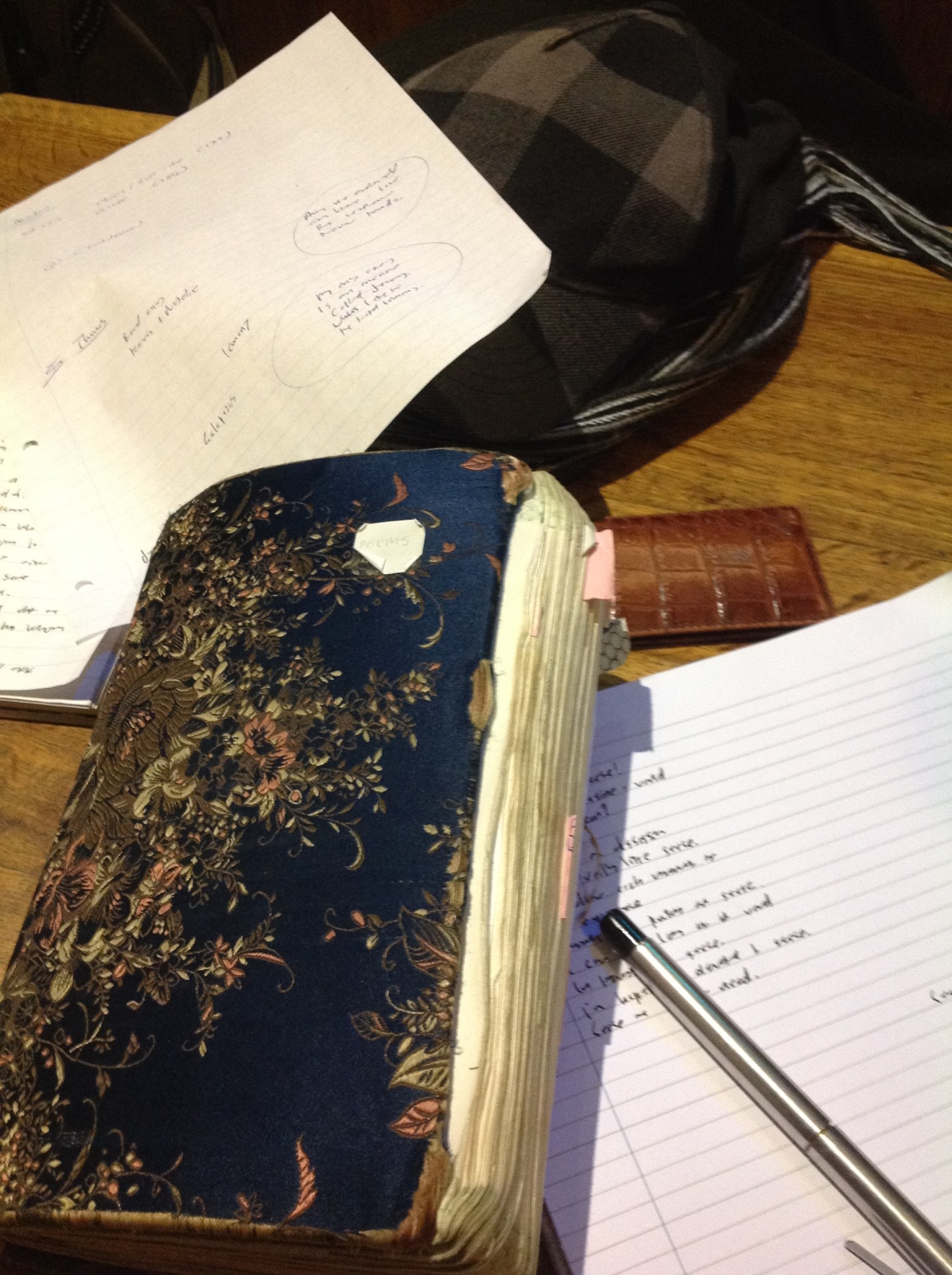
Since I started ‘performing’ poetry up and around and all over the place, I’ve used the same notebook. It has become a major part of my stage persona because it is the one thing that remains the same whenever I get behind a microphone. And as such, it has become an integral part of my image, and been prodded and cooed over by a wide variety of people from all over the country. Vanessa Kisuule got all unnecessary over it during an Apples and Snakes event in Exeter. Jack Dean held it, almost lovingly, while we shared a drink at a bar in Edinburgh. Other people have held it, stroked it, and even taken photos of it. Indeed, the damn thing has become more well-known and adored than its owner could ever be.

It started life as a weather diary, but I only bought it because I liked the fabric cover and the fact that I could glue poems on to the page. They seemed to stick really well, no matter what kind of glue stick I used. Oh, the hours I would spend cutting out poems and glueing them in! I stuck a label on the front with just the one word – ‘Poems’ – just in case I forgot which notebook they were in. As I advanced through my poetry career, this label became a source of amusement. Of course it’s got poems

The book is filled with corrections and amendments. When a poem was no longer seen as worthy enough to be performed, it would be carefully removed and a new poem placed on the page. Some of the pages were torn because of this. When I took part in a slam in Berlin, I had to write my name in phonetic letters ‘ GARNUM’ written in big letters on the inside cover. Then I had to make the poem German-friendly by removing elements that only English people would know about. Top Gear. Nick Clegg. That sort of thing.

There were stage directions, too, from various performances and productions. Scribbles, question marks and hasty revisions. The Swindon poem was mostly written during the interval while I waited to appear in the final of the Swindon Poetry Slam. (I lost to Tina Sederholm). There’s a funny smell to the cover, having put the book down in a closed shop doorway while doing outside street poetry. And it’s been battered by five years of travel up and down the country to various venues.

And then one day, a stern warning from a fellow performer at an event in Barnstaple. ‘Are there copies of the poems in there?’ ‘No’. ‘Then do you realise that if you lost that book, your career is doomed?’ Touchingly, he added, ‘I’m very worried about this happening’.

Saskia Tomlinson bought some pink zebra print gaffer tape for me and I covered some of the cover with it.

So yes, the book has become an integral part of me. But now it is full up!

I went out searching for a new book the other day and I found one. It’s smaller and more durable but it just isn’t the same. Nevertheless, I have already stuck some new poems in there, and it seems redolent with the promise of a new year, a new me.

The book will continued. It has a buddy now. Someone to share the workload.

To celebrate this fact, here’s one or two of these new poems.

Poem

Prevarication at the counter.

Putting it off and prevarication.

Damn its cold so cold and in here there are

Lazily thrown cushions

In the coffee shop where I now am

When I could have gone into work an hour early.

Its the coffee shop with the quote on the wall

From jack Kerouac

In the coffee shop where I now am

In the coffee shop where I am now.

Talk about the weather.

Talk about the cold.

Talk about attempts at fashion with scarves

For its probably the first truly cold day and

Scarves are still a novelty

In the coffee shop where I now am.

Slyly slyly slyly

They take serviettes from the dispenser

On noses which drip drip drip

And people cough like its a

Doctors waiting room

Which come to think of it

Could easily be the case as

The Doctor’s is just around the corner

Poem

I put my hopes and dreams

In the washing machine.

Whizzing round on the prewash spin,

A life of lost causes trundling within.

Contentment, opportunity, chance,

Caught in an endless dance.

Life so brilliant, a life of knocks,

Future hopes, and pants and socks,

Winners and duds amid the suds, and

There, tapping on the glass,

A dream that wants to get out

Before its cleansed of all that

Residual realistic grime on which

Our personalities are dependent

And define us as human.

Some dreams are too delicate,

And these have to be done by hand.

South Devon kicks ass when it comes to performance poetry!

For a while now I’ve had this thought that the South Devon poetry scene is one of the richest and most vibrant in the county, when you take into consideration the scarcity of the population in most of it, what with all them fields and things.

Torquay is a resort which has, admittedly, seen better days, but even here there are two vibrant performance poetry nights a month. Poetry Island is long established, first under Chris Brooks, and lately under Ian Beech, both of whom have done amazing things to bring big names down to the bay, and now there is a night at the Artizan Gallery, too. Exeter isn’t that far away and there are three regular monthly nights as well as an amazing array of one off events thanks to venues like the Phoenix and the Bike Shed. Plymouth has two regular nights, and even Totnes has events at the Kingsbridge Inn.

But it is the sheer variety of styles and performers which makes the scene so vibrant. It is impossible to come up with a definitive South Devon style, because there are so many different interpretations of what makes spoken word and performance poetry so engaging. Daniel Haynes is droll, funny, serious, human, everything which a Bard should be. Which is good, because he is the currently Bard of Exeter. Tim King is experimental, political, also very human. The most human of all humans is James Turner, who exiles literary excellence and a fantastic understanding of the importance of performance and voice, as did the late and very much missed Rodney Bowsher. Joanna Hatfull is impossible to categorise, fusing theatre and monologue, humor and reality into her poems which never stray too far into surrealism. And then there’s Ian Beech, whose poetry is heartfelt, honest, occasionally ranting, often fierce, always well meaning.

Add to this people like Jackie Juno, Ziggy Abd El Malak, Chris Brooks, Gavin McGrory, Morwenna Griffiths, Solomon Doornails . . .

So what flavor is there to this excellent scene? Are there any common traits? Most of the performers have developed parallel and each event serves to drive each participant on to find deeper modes of poetic expression and audience engagement. Yet there seems to be a willingness to perfect this individualism in a way that may not be the case somewhere like Bristol or London, where a similar style dominates. The rhythms are different from one poet to the next. You might get the excellent Marc Woodward with his fast paced calm delivery, followed by the enthusiasm of Chris Brooks, and then the calm, slow, assured delivery of Dan Haynes.

There’s a great thing going on down here in South Devon at the moment and it makes me glad to be a part of it. And now some of us are starting to get recognition from further afield, strange parts of the country who can only be intrigued by the creativity and art which seems so normal. When I first started performing at Poetry Island, Chris Brooks would end each evening with an appeal for performers. Yet now there are so many that there is a strict rota and waiting list! And that has got to be a very good thing.

For no reason whatsoever, here’s a couple of new poems.

Poem

You said you’d do a magic trick.
Is this your card?, you asked.
Or is this your card?
Or this?
And then you reached into my pocket
And you announced,
This, this is your card!
And then you looked at it and saw
That it was my one day megarider bus ticket
And a tiny tear formed
In the corner of your eye.
In any case,
I hadn’t even picked a card.

IMG_2498.JPG