I’m on the road at the moment, with three gigs in three towns over three days in three different parts of the country. It isn’t normally like this. In fact I can go for months on end before there’s anything outside of South Devon.
And it’s the weirdest feeling, because a lot of effort goes into travelling around, and it’s all because I stand on stage and say vaguely funny things and try to make people laugh through poetry. In fact, if you’d told me ten years ago that I’d be doing this, I’d have laughed, derisively.
But this time has been different, and I find myself clinging on to every moment. I don’t know why this is. Perhaps it’s because I’m getting old. Perhaps it’s because I still can’t really believe that spoken word is making me do all these things. So I concentrate on small details, such as the carpet pattern in the venues where I perform, the people I meet, the things that I might not necessarily remember.
Last nights gig was in the function room of a hotel in Bristol. It was the most unexpected space, in an urban environment, looking more like a Manhattan loft or comedy club than the function room of a family pub. As the night wore on a full moon drifted past the window, which only seemed to add to the candles and the fairy lights and I thought, hmmm, this is a good existence. We all came together and made an evening for people to enjoy. This night will never, ever be repeated exactly as it is right now.
I spent the night in Bristol and now I’m off to London. I’m looking forward to having a good old poke around Tate Modern this afternoon before the gig, no doubt enhanced by the anticipation of performing to a new audience.
It’s the people you meet that make the journey worthwhile. That’s where the anticipation comes from. It doesn’t even have to be because of the spoken word, it’s the idea that I, and others, have travelled to a specific place to be sociable and cultural and to share enthusiasm. As I sat on the station at half eleven last night in Stapleton Road I wondered where I would be in twenty four hours time and who I might meet.
Author Archives: Robert Garnham
Life lessons from performing spoken word
1. If at first you don’t succeed, act as if you’ve never failed.
2. Image is everything. If you arrive straight from work wearing a shirt and tie, then this will become your look and people will always see you as a performer who wears shirt and a tie.
3. If a poem isn’t working, give it a third verse freak-out. Then take out the first two verses.
4. Watch out for light fittings when using props.
5. The audience wants you to do well and will be on your side but try not to balls it up in the first place.
6. The whole world is an audience even if you’re not performing.
7. You never stop performing, even when you’re not performing.
8. If you need to ask the host if you’ve got time for ‘one more poem, a short one’, it means you haven’t rehearsed. In any case the host will always say yes, because they’re just being polite.
9. When you’re rehearsing, stand at the bottom of your bed and rehearse to the pillows. They will stare back kind of blankly.
10. Like sex, there’s no wrong way of doing it.
11. Like sex, you can get a lot of laughter from just one look.
12. Everyone has a voice. Authenticity is everything. Every stage character is just an exaggerated version of yourself.
13. If humour’s your thing, the obvious joke can often be the most effective. Sadly.
14. If it’s a high concept poem which needs a lot of explanation, then it’s probably not going to work very well. But don’t stop experimenting.
15. Music stands to hold your book allow you to make extravagant hand gestures if you haven’t learned the poem by heart.
16. It doesn’t matter if you haven’t learned the poem by heart. Just make sure you don’t hide behind a huuuuuuge folder.
17. You can imagine the audience naked if that helps, but the audience might be imagining you naked too. In fact they probably are. How else to explain the amazing amount of people who upchuck during my gigs?
18. Everything becomes subject material for your poetry. Emotional turmoil, break-ups, losing your car keys. The last time I had a break up I thought, oh good, I’m going to get some poems out of this.
19. It was going to happen eventually, the bastard.
20. By all means copy the mannerisms and style of your heroes, but for goodness sake, innovate.
21. I mean I thought it was going ok but then one day I suddenly thought, hmmm, we’re just going through the motions.
22. Spoken word artists get their points across, they draw attention to injustice and prejudice, they make you laugh, they make you cry. They play with language and dance on grammar, they play with rhythm and rhyme. It’s always sickening when this is all done by one genius youthful bright-eyed performer. I remember the Bristol Poetry Slam. I was up against someone performing an excellent poem about the death of their grandmother linked in with the entire history of the British black experience from slavery to the present day, and then I went up and did a poem about liking beards.
23. Don’t worry about anything.
24. Just a small planet in deep dark space and our time on it is incredibly small in the general scheme of things, everything is relative.
25. You can take the mic off the stand if you like, but move the stand out the way. Take down that barrier!
26. If you enjoy it and have fun, then so does the audience. And so does everyone. Even the people you see on the bus on the way home. Enjoy it. The world becomes a better place.
27. There’s no subtle way to plug a book.
28. My book is available here. https://burningeyebooks.wordpress.com/2015/11/19/new-nice-by-robert-garnham/
Life lessons from the British Touring Car Championship
Last week I did a corporate gig at the Nationwide Building Society headquarters in Swindon, where a bunch of us poets were asked to write on the spot poems for staff members on whatever subject their chose. During the day I met some lovely people and wrote poems about wives, boyfriends, kids, badminton, extreme frisbee (whatever that is), and the joy of working for the Nationwide Building Society. However one young lady asked me to write a poem about the British Touring Car Championship, and she really couldn’t have picked a better person to come to.
Since before I was a teenager I’ve been a fan of the British Touring Car Championship. In fact with the possible exception of spoken word, it’s one of my obsessions. I’ve watched almost every Live face on tv and I’ve been to some of the races too. I would say that it’s a guilty pleasure, but there’s no guilt here. I absolutely adore it. We spent far more time than is healthy, myself and this young lady, talking about our favourite drivers and races. The best thing was that she wanted me to write the poem for her mum, because she was also a fan of the BTCC, and they go to several races a year.
I was immediately Jealous!
The BTCC is amazing. The racing is pure and much more brash than open wheel categories, and the personalities are less robotic than in other sporting series. In fact the drivers seem more human, able to express their frustrations or their joy in a way that other sports seem to shun. The cars are recognisable, too, and the circuits are less clinical than those in formula one. There std three races during every meeting, and they are all shown live on ITV4, so on the day of a meeting I’m usually glued to the television for most of the afternoon. It’s heaven.
I’ve always been a fan of certain drivers. In fact, that’s another good thing about it, the drivers seem to hang around for decades. Jason Plato has been in it and winning regularly since the mid 1990s, and all of the other top names, such as Matt Neal, Colin Turkington, Rob Collard and Gordon Shedden, have been in the series for over ten years. In fact Rob Collard is one of my favourite drivers, we’ve often chatted on Twitter and he would probably win more races if he could qualify better. He’s one of the best overtakers in the business.
Obviously, I’m not used to writing about the BTCC. I’m a spoken word artist, and the community to which I belong is similarly small, welcoming and human. There are parallels between going out into a race and going out on stage with a mic. When I see a driver pull off a great overtake I often think, hmmm, that’s the same feeling I get when the audience reacts to a good line. I know just how they feel.
Except I don’t, not really. Motor racing is different, and I can only guess at the forces and the fears of stepping into a car and racing it hard. Those who are at the top of their game are very, very good and put in a lot of work to be so, and in a way, this is the same as with spoken word, or with any pursuit.
So I’ll be watching the races on tv today thinking of the young lady from Swindon with her mother.
What influences me?
Someone asked me not long ago what inspired me as a spoken word artist. Now, when I used to run Poetry Island and I was just starting out as a performance poet, I was hugely inspired by other performance poets, in particular Byron Vincent, Rachel Pantechnicon, Jackie Juno. I felt that my finger was on the pulse of the spoken word world and I would watch YouTube videos all the time, studying performance and techniques and generally trying to learn as much as possible. But I don’t do this now nearly as much as I should.
In fact my influences of the last few years have been almost entirely not spoken word based. Perhaps this is a good thing, because it might mean that I won’t subconsciously at least copy another poets style or content. One of the things I’ve been very careful to do is to create my own identity and not sound like any particular clique or group. The downside of this is that unless I’ve seen a contemporary performance poet for real, I probably don’t know much about them. Someone asked me not long ago what I thought of a particular Harry Baker poem, and they were mildly incredulous when I told them that I didn’t know it. ‘But it’s his most famous poem!’ He seems a nice lad.
I’m My major influences have always been music. Quite how these influence me is a mystery. I like pop music, and I kind of see spoken word as being the pop music of the poetry community. The approach of musicians such as the Pet Shop Boys, Sparks, Lady Gaga, Yello, and the way that they stay fresh and continually reinvent themselves, is more of an inspiration. Pop music is ephemeral and it cheers you up for three minutes, but it doesn’t change your life. And I hope that this is what my poetry does, too. I touch on social themes and issues such as gay rights, but I’m quite aware that my poetry will never change the world.
I’m also influenced by artists working in different genres, such as art, (abstract expressionism, pop art, Tracey Emin, Gilbert and George), performance art, (Laurie Anderson, naturally, and Marina Abramovich), storytelling, (Dandy Darkly), cabaret, (MargOH Channing, Flotilla de Barge), and page poetry (Frank O’Hara), and sitcoms such as Seinfeld, Curb Your Enthusiasm and Flight of the Comcordes. Oh, and also sport. The determination of certain participants in the British Touring Car Championship demonstrate the verve and drive needed to get to the top. I bet Colin Turkington doesn’t realise how much of an influence he is on a spoken word artist!
Funnily enough, i don’t watch much comedy, nor do I know much about the standup scene. I used to perform regularly at various comedy nights and see some great comedians such as Dave Thompson and Mitch Benn, and I really should seek out more work on YouTube from top comedians, as the basics are almost the same.
So there, that’s what drives me on, and if I’ve learned anything from this post it is that I should really watch more and keep up to date with those who excel in my chosen area of expression!

An Interview with Paul Cree
When I was in Edinburgh this year I shared a venue with Paul Cree. When my two audience members left, his crowd would come in, and a couple of times I stayed too and watched his show. It was fantastic, one of the best and most original slices of poetic life, suburban grit, humour and truth that I’d seen in a long while. And Paul was incredibly supportive too, we’d help each other leaflet the street outside and on a day when it looked like I’d have no audience, he rustled up six people to come and watch.
Anyway, I thought I’d send him some questions and see what makes him tick as an artist and performer, particularly as it’s good to hear from a fellow Surrey spoken word artist!
– How much of your material is based on real life? The characters in particular seem well drawn and remarkably believable.
Lots of the material is based on real life, by default I always draw from my own experiences, mainly because I don’t really know a lot else. I haven’t travelled much or lived outside the south east of England, however, within that small limited range that is my little life and surroundings I find many things which to me are poetic and inspiring. I have a minor obsession with moterway service stations for instance. Large up Fleet Services on the M3, looking like the forest moon of Endoor in Return of the Jedi. Often with the characters I’ve written, one person might be an amalgamation of two or three different people whom I’ve known or encountered. It’s bit like those miselaniois bits of Lego I’d use to make spaceships when I was a nipper
– You find humour in every day situations. Do you store things away for future use?
Yes i do sometimes store things, write little notes etc. I’m naturally a worrier and an observer, as well as being quite silly but I often worry that if I find something that really amuses me or interests me, if I don’t write it down il forget it. Through years of working a bunch of jobs I didn’t like, offices and call centres etc, I was able to condense ideas into short sentences, like a mental zip file, via a quick trip to the carzy, though I couldn’t do it to often as this would arouse suspicion about my toilet habits. Upon getting home, I could later unravel the sentence and expand on what I was thinking. It’s was worth running the risk of the office gossips thinking I had a bowel problem for the sake a good idea.
– How do you go shout putting a show together? How long does it take?
I don’t have a particular process for putting a show together. It really depends what the show is. I try and find the process as it goes along. With my first show, A Tale From The Bedsit, that was really just one long, linear, monologue but I had a very specific idea about the staging of it, so spent i spent (including the writing) probably over two years writing that then working with Stef O Driscol putting it all together. With CD Borderline it was a lot faster as my idea for the format of the show was very simple and I already had a lot of the material written. The rest was just putting it on its feet and trying out deferent combinations and finding out what worked best.
– Who are your artistic inspirations?
People, places, my own intravertness, rain drops on windowpanes . Rappers, comedians, motorway service stations (fleet services is my favourite) boredom.
– How does the real Paul Cree differ to the stage Paul Cree?
Not too far removed as most of the material is based on my own experiences.

On cutting out the inner editor
Lately I’ve been trying to write poems that are almost exact copies of those by another poet. In fact it’s been an obsession these last couple of years. I’ve been taking his poems, breaking them down line by line, syllable by syllable, to see how he gets the desired effect, then subtly changing bits here and there and adding distinct touches so that they don’t look too much like the original. The poet I’ve been copying so deftly is Robert Garnham.
I should explain that I am Robert Garnham. You probably know this already. It’s a little trick I was playing on you. But I should also explain that my work, my oeuvre has, inevitably, changed over the last few years. I know more about writing now, more about poetry and comedy and what makes people laugh. I now sit down and write poems with a specific idea and target in mind. I want this poem to make people laugh. I want this poem to be serious, I want this poem to be short, sharp, funny and with a pounding rhythm. And all of this has advanced me beyond those early years when I’d just write a poem for the thrill of writing a poem.
I’ve finally cracked it. And how have I done it? By disengaging my brain while I write. It’s an amazing system. I come up with the idea and then I just write, ignoring the inner censor, the inner editor who wants a specific, desired effect, and it really is most liberating. The poems of the last few years have been some of my best work, but they’ve been more like tightly structured pop songs rather than jazz improvisations. There’s not much wriggle room. I’d also been trying to write in order to fit in with certain types of poem rather than be myself. I’d see poets on YouTube and at gigs and I’d think, hmm, what can I adapt from these wonderful people?
For the last few months I’ve banned myself from thinking along such lines. This has had a profound effect on my enjoyment of performance poetry, it’s let me sit back and enjoy or relish other people’s performances without analysing every small detail. When I first started performing I had never seen any other performance poets, and this gave me an incredible freedom to do what I liked. By disengaging my brain and cutting out the inner editor, I’ve been able to reconnect with this part of my voice. It also puts me under less pressure to write.
Static, the talkie bits
I performed Static for the last time in Totnes this week, at an arts venue in an industrial estate. It’s been quite a year, touring the first show that I’d ever challenged myself to write, and touring it to venues in Guildford, Exeter, Bristol and the Edinburgh Fringe. It’s been a great learning experience, but also the show has been very well received by audiences. This has made me confident about writing the next show.
So for your delectation, here is the script of Static in its entirety. It should be noted that this is the first such script and beats a slight resemblance to the one that I finished with last week!
Robert Garnham
Robert is in the performance space with a small battery radio tuned loudly to static.
Poem : ‘Static / Wind’
I tell you what, it gives you the willies.
Thinks about things for a while. Opens performance book.
Poem: ‘The Increasing Physical Dexterity of Justin Bieber’
2009.
Feeling so damn unique. There’s nobody like me in the world! That sensation of circumstance, geography and time being in just the right alignment to create me, and me alone. And there’s poetry in my chest, it’s beating away, pounding out strange rhythms with the absolute promise of being such an individual, that I might one say change society and make a real difference to the world!
Putting pen to paper. Oh, you brave poet! Your words will echo like an aftershock, an earthquake as time itself bends in on you with your uniqueness, like Lord Byron with a megaphone, Wordsworth with an attitude, Ted Huges on the ten o clock news shaking his fists at convention.
2016
Seven years of writing poetry and discovering that there’s nothing really unique about me after all.
Seven years of writing poetry about minor trips out to the dentist, mild personal discomfort and vacuum cleaners. Seven years of looking in the mirror every morning and saying, Yeah, that’ll do. Seven years of my work being compared to that of John Betjeman, usually by people who say things like, ‘His work is not as good as that of John Betjeman’.
Seven years static. A life spent going nowhere.
(Sit)
I want this show to be one of those worthy shoes, you know, where you learn all about me as a person and all of my shortcomings. I suppose my first shortcoming is that I was born in Surrey, a county so bland and so irrelevant that absolutely nothing newsworthy or interesting has ever happened there. And that’s a fact. Look it up in the history books, if you like. Nothing interesting has ever happened in Surrey. My birth there in 1974 coincided with the resurfacing of the Guildford bypass, whereas here in the same year you of course had the Olympics. Oh, and later that year my aunt saw a badger.
I was brought up with this sense of low expectations and the absolute blandness of existence. Even my name is boring. Robert Garnham. I sound like an estate agent. I like to think that I was named after my dad’s favourite singer, Bob Dylan, who is of course, Robert Zimmerman, and this at least makes me a little bit excited about being called Robert. But at the time I was born my aunt worked in the factory making Robert’s Radios in Molesey. I can imagine the decision-making process that led to my parents choosing such a boring name.
(Improvised family conversation involving Robert’s Radios).
Robert sits in the chair as his own mother while feeding a baby, presumably Robert. He stands to indicate when his father is speaking.
I suppose I got off lightly. My Uncle worked for a fork lift truck company called Lansing Bagnall.
Robert builds a theremin on the table out of a corn flakes packet, two Wellington boots, a tape machine. He plays the theremin.
Let’s try and . . .
The tape machine interrupts him. Improvised silliness with the tape machine.
School was hell.
Poem : ‘2 Abbey 1’
(Stand)
I grew up in a house on a hill. Three generations, six of us in a two-up, two-down cottage surrounded by woods in the hills of Surrey. From the back bedroom window at night I could see the whole of West London. In the evenings I’d tune my radio through the static to the jazz stations, sit there for hours in the heat and the humidity of the sticky forest Surrey summer, and gaze at the neon and the road signs and the motorway lights.
Poem: ‘The Prince of Belgium’
Apart from being gay, that was.
(Sit).
And oh, mamma! I was very gay. I was probably the gayest thirteen year old that Surrey had ever seen. Yet my whole suburban mindset dictated that I should stay in the closet and not tell anyone because this was Surrey and people didn’t really want to know about such things, they were too busy buying bowler hats and going to wife swapping parties and voting for weird Conservatives and because of that I thought there was something wrong, a strange error in the system which just affected me. I knew that everything had to change but the time was never right.
It took a few years, and I came out to my friends first. They were surprisingly supportive, but at the same time they were incredibly surprised. Even though I’d been the gayest thirteen year old that Surrey had ever seen. You see, by the time I was twenty, I was a completely different person.
In fact, it still comes as a complete surprise when people discover that I’m one of those gay people that you hear about. I think, personally, it’s because I’m so macho, and manly, and tough, and masculine, and something of a hard nut. I think, basically, it’s because I’m a stud.
(Stand).
Though to be honest, I’ve always felt like a gay man trapped in the body of a bus driver.
I always wonder what my friends thought about that whole gay thing.
Poem : ‘Not Flamboyant’
I was set up on a blind date suggested by mutual friends and we hit it off immediately. At the time I was a part time shop assistant, and he was a trampoline salesman. Looking back now I see that he was incredibly patient with me. In fact he even said that it was what inside that counts, and that to him looks weren’t . . .
Hmmm.
Come to think of it, he charged me twenty quid.
Poem : ‘The First Time’
So I came out. And I had oodles of sex. And I masturbated a hell of a lot. It’s hard to believe looking at me now but when I was 18 to 20 I was a very attractive young slip of a thing with a trendy haircut and a face lit up with the evident joys of life. I always wondered what my first partner would be like and I would daydream about the usual ones, bearing in mind that this was the early 1990s. Peter Davison from Doctor Who, or Chesney Hawkes, or for some weird reason, foreign secretary Douglas Hurd. My first proper partner was a young man called Jamie, a slightly taller, thinner version of Lance from Neighbours. He invited me back to his place ostensibly to show me his collection of Star Trek memorabilia. I knew it was about to get really interesting when he took me up to his bedroom to let me see his collection of phasers.
Poem : ‘Jamie’.
Oh, when I look back on it now it’s like I was doing it all the time. But as I’ve got older, I’ve shown less and less interest in these matters. Things have slowed down. I’ve slowed down. I’ve become static.
I feel like there’s this sense that my life is going nowhere. I’m now officially middle aged and there’s a huge list of things that I’ve never done.
(The list is written on cards. Robert dances and improvises as he unveils them).
I’ve never bought a house.
Learned to drive.
Fallen in love.
Had a promotion.
Earned the respect of my contemporaries.
Had a jacket dry cleaned.
Hosted a barbecue.
Owned a sofa.
Walked a dog.
Got married and had kids.
Bought a round in a pub.
Used a power drill.
Been arrested.
Paid a bribe to council bin men.
Used an axe.
Slapped a yak.
When I look at my life I’m tempted to think that I haven’t done much with it. I don’t have a fancy job or a nice big house or a big throbbing monster of a car. In fact all of the things that seem to drive successful people seem to have passed me by.
And I’m ok with this.
It lets me concentrate on the important aspects of living, like sleeping and biscuits and buying hair gel.
Here’s a diagram to illustrate my thinking on this.
(Improvised diagram and flip chart section).
I’m about as camp as an oak tree. I’m about as flamboyant as Ryvita.
(Look left and right as if imparting a secret).
Yet I see wonder and amazement everywhere. I watched a documentary once in which it was pointed out that the echoes and shockwaves from the Big Bang which created existence itself can still be heard as static on a radio receiver. The idea of this has always interested me immensely. I may be just a poet, but I’ve always wanted to probe the origins of life and existence and make my own little mark on the world. The work of the large hadron collider, I believe, will ultimately shed new light on the mysteries of the universe, and I try to muck in and help where I can.
So for you, ladies and gentlemen, and for science in general, and for deeper understanding, I’m going to construct a large hadron collider right now, right here, on stage.
Robert takes a length of garden hose, a camera, a biscuit on a plate, and attempts to create a black hole by smashing atoms together in the garden hose. He finishes by holding up photos on his ipad of the resulting smashed atoms.
Of course, I would need a proper scientist to tell me what this all means.
It’s all connected. Everything is connected. Time and memory, light and shade, and all those atoms spinning around, radio signals from the original Big Bang, and me, me as a young man with all that wonder and amazement, I’m still that person only I’ve channelled it all elsewhere, the parts of it that haven’t been ground down by the finer detail of living, every now.
Yet I’m also aware that the world I live in is freer and more open and accepting than other parts of the world, and that’s what this next poem is about.
Poem: ‘The Doors’
Poem: ‘Badger in the Garden’
Robert performs the performance piece ‘Static’ which starts with the radio being switched on again.
The whole piece is delivered with the radio on. At the end of the piece, Robert packs away all of the paraphernalia and sits on the chair with the radio in his lap. He turns it off.
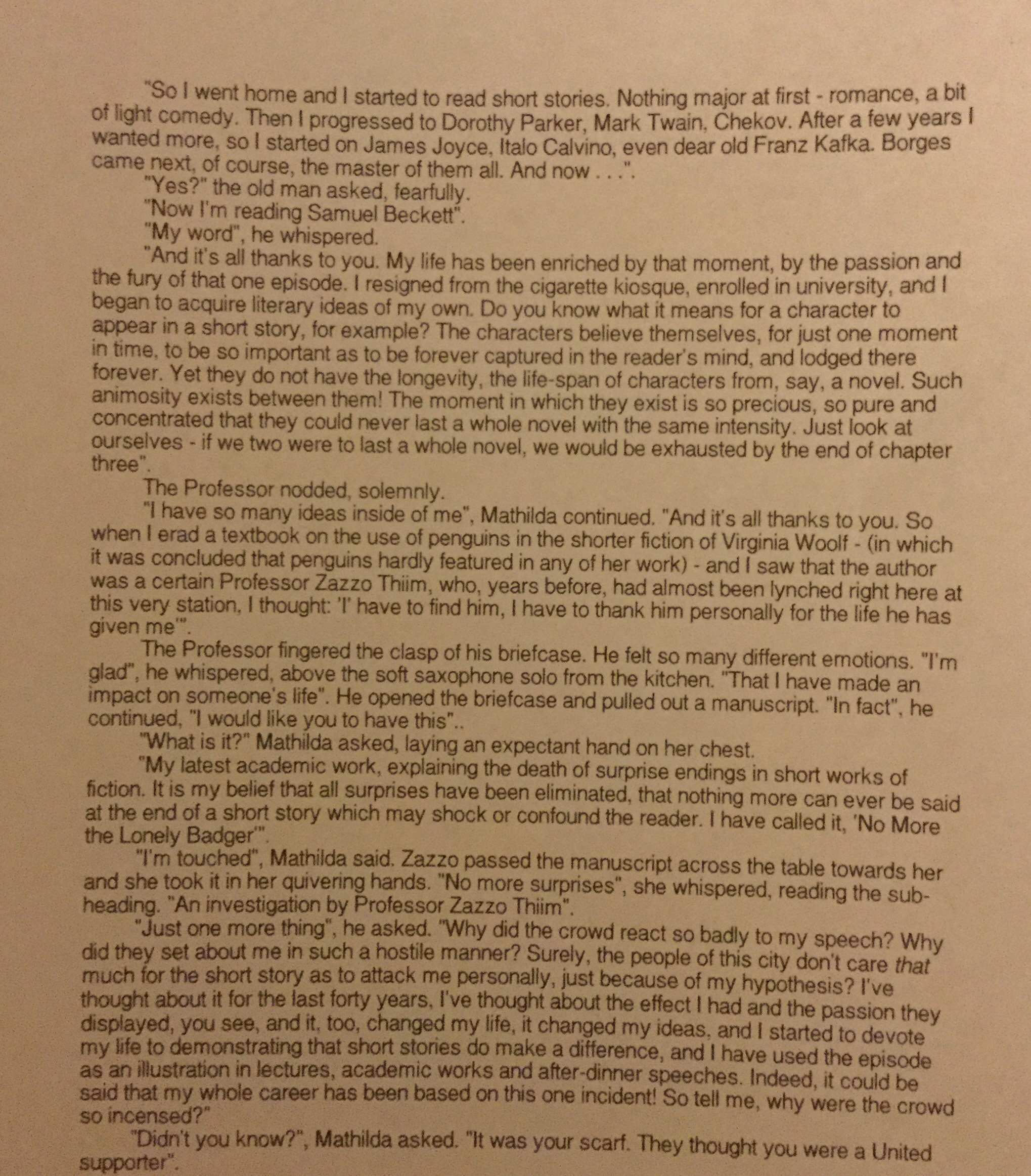
Professor Zazzo Thiim Episode One: The Passion and the Fury of the Man in the Scarf
Martin Hodge, an appreciation.
Martin Hodge was one of my favourite human beings. We met at a gig at the Bike Shed Theatre in Exeter, he came and sat on the same table as myself and a friend, and told me that he really liked my performance. He was so wonderfully sincere and immediately charming, and we exchanged email addresses, Facebook friend requests, all the normal modern means of connecting.
A couple of days later he sent me a text message asking if I’d like to appear on a radio show he was hosting, Listen Out, on Phonic FM. It was a radio show dedicated to Exeter’s LGBT community, and I jumped at the chance. I’d never done any radio work before, and I was incredibly nervous, I also had to journey up from Hayle in Cornwall, where I’d been staying with my parents.
But Martin was fantastic, we sat and had a pre show drink in a small pub on a Sunday night, and he completely put me at my ease. The show went very well indeed, and even though I was only on in the first hour, he invited me to stay for the whole programme, sat in the corner and listening to the music. Just before my section, he played Will Young, a beautiful song which even now reminds me of that night.
That was the first time I was his guest, and over the years I would guest again on both Listen Out and, when that had finished, The Respect Show. Martin was so genial and supportive, he got me a gig at a Phonic FM fundraiser at the Phoenix, and we’d keep bumping into each other at various events in Exeter. He was a keen fan of music and his knowledge of the local scene was almost encyclopaedic. One of the last times I saw him, he gave me a Pet Shop Boys cd, because he knew they were my favourite band, and he’d always play one of their tracks when I was on his show.
Martin was the most relaxed person I’ve ever met. Nothing ever seemed to faze him. He was the sort of person who could make anyone feel calm, his measured, genial tones perfect for the radio. He was incredibly generous too, with his praise, his time, his willingness to share his knowledge of music and the technology of radio work. I’ve never known someone with so many friends, either. It seemed that everyone in Exeter connected to music knew him, worshipped him, smiled at the mention of his name.
I last saw him just over a month ago. Croydon Tourist Office had a live gig on the Respect Show, and I’m sure it wasn’t exactly what he’d been expecting, but he seemed to enjoy it and immerse himself in the craziness of our act. I saw him briefly afterwards, as he walked past us, a cheery word or two and he was gone. That night we exchanged text messages, in which he thanked us for coming on the show.
Martin had so many friends, and it’s them that I’ve been thinking of the last few days. He will be so missed by so many people. His work in promoting music and encouraging people to have a good time will go on, you can still hear him on the archived pages of his radio show. To his family and loved ones I extend the deepest condolences, and to Martin I say simply, thank you.
The Arrival (A short story)
Another short story from the archives.
The Arrival
A committee was set up in order to plan for the visit. A chairman was voted for, an elderly gentleman with a walrus moustache. He was then replaced with another elderly gentleman. The secretary resigned because she objected to the name of the committee. The replacement secretary used to be the treasurer, so a treasurer had to be found. The original chairman wanted to be the treasurer but the new chairman objected. Both the chairman and the prospective treasurer then resigned from the committee, so a new chairman had to be found as well as a treasurer. The positions were eventually filled with a man who used to be a car salesman, who said he knew all about planning visits. And the Treasurer was shared among the other members of the committee on a rotation basis. Just like a quiz show on TV, someone commented. The comment was recorded in the minutes.
A name had to be invented. Someone suggested the Visit Committee, but there was another committee called the Visiting Committee and it was thought that this would lead to confusion. Someone else suggested the Committee for the Visit, but this was also voted down because it sounded boring. The person who suggested it was the person who was also the Treasurer on this occasion, and she resigned. A third suggestion was to call the committee something trendy, just like a modern company, a name which would hint at science and progress in the arts. Implosion was the name that was banded around. The secretary commented that it sounded like something from The Apprentice. The person who suggested it was very upset about this and he threatened to resign, but just as he did they came in with the coffees so he stayed on for a bit. This was recorded in the minutes.
They finally decided on the Systemal Function for the Application for the Arrival of the Visitor and His Entourage. Or SFAAVHE, for short. This was recorded in the minutes.
It was then time to decide what the committee would actually plan for the visitor’s arrival. There was no doubt that he was eminent, so it was agreed by all that he should have a red carpet when he stepped out of his car. Then someone said that he shouldn’t be in his own car at all. If he was so eminent, they argued, then, surely, he should be driven? OK, then. A limousine would pick him up from his house. But he lived two hundred miles away. This was a problem. They decided they would compromise. He would drive as far as the halfway point and then the limousine would pick him up. It was generally agreed that this was a good idea and it was recorded in the minutes.
Then someone pointed out that red carpets were hard to find, and they got mucky if it rained. The under-secretary was dispatched to source a long red carpet. She asked what sourced meant and the chairman said that it meant to go and fine one. She asked why he didn’t say that in the first place, and the chairman said that it was business-speak, that’s how they said things in the world of business. The under-secretary objected to the tone that the chairman took and she resigned. A new under-secretary was then voted in and he said that he would look on the internet to find a red carpet. Ten minutes later he said that he could only find a yellow one. That will have to do, the chairman said. And all of this was recorded in the minutes.
The meeting then moved on to who would be there to greet the visitor on his arrival. One of the members suggested the head of the department, but then someone else reminded her that the head of the department was currently being investigated for fraud and it would be best that he were to stay out of the limelight. The chairman said that this was not the way to treat the head of the department and that he should be there. The treasurer then reminded the chairman that he, too, was caught up in the same scandal, so the chairman then resigned and a new one was voted in. She thanked the previous chairman for his hard work, but then she spilled coffee on her lap. She resigned, so that she could go to the bathroom and wash it off. When she got back to the room, the original chairman had been voted back in. And all of this was recorded in the minutes.
The next item for discussion was the food that would be provided for the function once the visitor had arrived. Someone suggested prawn cocktail, but they were reminded that the budget would stretch so far. Someone then suggested prawn cocktail crisps, but they were laughed out of the room. Someone suggested those funny spicy sausage things that go on sticks and you have to move them upwards with your thumb as you eat them, and they are often seen in films set in North Africa, but no-one knew what he was going on about, so someone else suggested scotch eggs. Scotch eggs it was. Then the secretary announced that he was allergic to scotch eggs, and someone said that he wouldn’t even be at the function, he wasn’t important enough. He then resigned. A new secretary was voted in, and this was recorded in the minutes.
Much discussion then centred around the manner in which the eminent guest would be introduced to the members of the department before he entertained them all with his speech. One person suggested a strict clock-wise motion around the room, someone else suggested anti-clockwise. The chairman said that the guest should be left to speak to whoever he wanted, but that the most prominent members of the department should be introduced to him slyly, subtly, so as not to provoke suspicion that the whole thing was stage managed. Someone then suggested name-badges, coloured according to the importance of the person wearing them. It’s what we did in the war, he suggested. Even Hitler wore a name badge. There was a show of hands and it was decided that there would be name badges. The discussion of whether they should be in higher or lower case went on for half an hour. And all of this was recorded in the minutes.
The meeting had almost finished and no-one had resigned for a while. The secretary was asked to read out the minutes, but he objected, so he resigned. The new secretary was then asked to read out the minutes and he did so beautifully, but in Spanish. The next secretary read out the minutes. This included the reading of the last minutes, which included the reading of the minutes before that, which included the reading of the minutes before that. This went on for some three hours. By the time he had stopped reading the minutes, everyone else had gone home. And this was also recorded in the minutes.
The secretary then resigned, but as there was no-one around to record this in the minutes, no-one actually knew about it.
The visit did not go to plan. The eminent guest was not greeted half way by limousine because he caught the bus instead. And when he arrived at the department, (climbing off the number 443), he tripped over the yellow carpet because he though it was a continuation of the pavement. The head of the department met him, but just as he did so he was handcuffed by the police and dragged away for questioning. The eminent guest was then led to the hall where, instead of meeting and greeting, and looking at name badges – (the font of which was so small he couldn’t read them anyway, and he was colour-blind), he crammed a scotch egg into his mouth and promptly choked, before asking why they had not supplied, instead, those spicy sausage things on sticks that you see in films about North Africa. And on the way to the podium to deliver his speech, he almost tripped over the end of his scarf.
‘Ladies and gentlemen’, the chairman of the welcoming committee announced in to the microphone. ‘Let me introduce to you, Professor Zazzo Thiim!’
Nobody clapped, because the committee had forgotten to send out any of the invitations. It had not been recorded in the minutes.