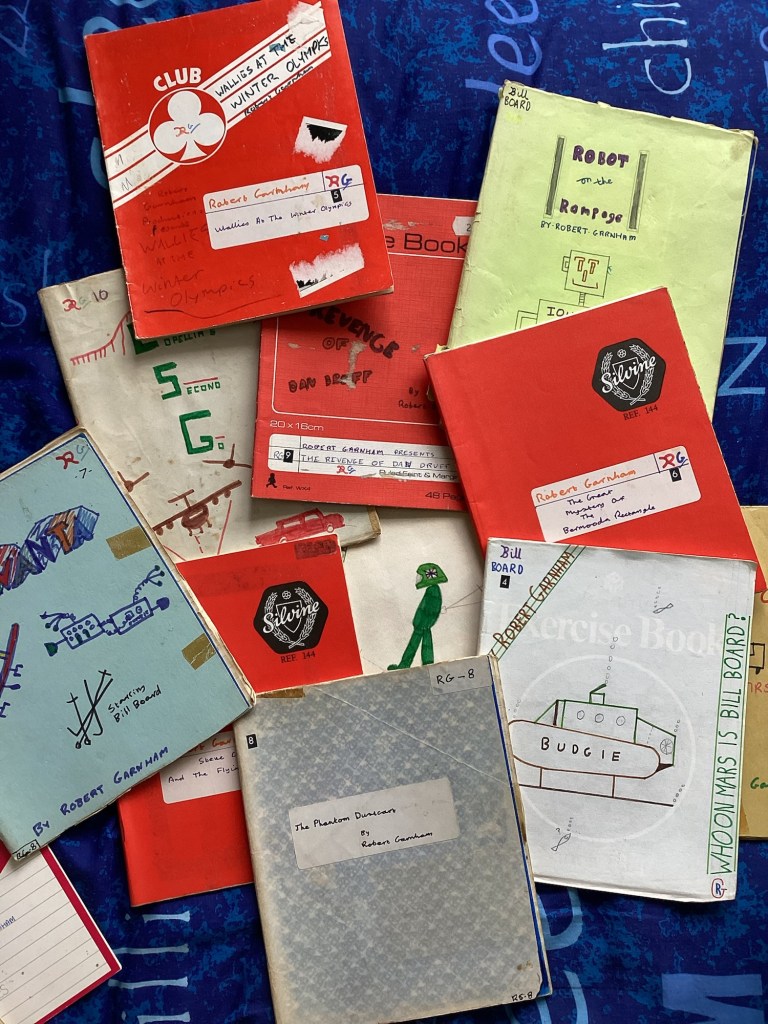
At ten years old, I did feel somewhat held back, and I worried that my stories about secret agent dogs were getting a bit old hat. In late 1985 I must have been given another exercise book, because before I knew it, I’d started a brand new story which was innovative on a number of different levels. The first level was that the lead character was not a secret agent. He was a skier, who competed in the skiing world championships and the Winter Olympics. The other level was that he was a human being. And his name was Bill Board. Now, looking at the title of that first book causes a shudder of embarrassment. Yet I can at least comfort myself that I did not come up with the title. You see, the story begins with a skier by the name of Clive, who comes up with the idea that he get a head start at the beginning of every ski race by having his friend, Bill, give him a hefty push. One day Bill pushes too hard, Clive falls over, and Bill goes off down the mountain on his own. Indeed, so well does Bill do, inevitably winning the race, that he is invited to participate in every ski race thereafter. So, representing the UK, Bill becomes, by the last chapter, the skiing world champion. And the title? ‘Nobody Can Fold Up the Union Jack’. At the time, I thought this a rather clever title. My friend Mark had suggested it, because Bill won his skiing races so often that the organiser had to keep the Union Jack out so that they could raise it on the winner’s rostrum. But soon afterwards I became aware of the patriotic overtones, which I found, even at the time, somewhat silly. I don’t know why I was intelligent enough to realise that the title was overtly and perhaps stupidly patriotic, and yet not intelligent enough to realise that I could simply change the title. By now I was 12 years old and I wanted, oh, how I so desperately wanted to be a writer. I was obsessed with writing, and it was probably all I ever did. Once Nobody Can Fold Up the Union Jack was finished, I launched into several more Bill Board stories. And some old habits began to creep in. Bill and his friend Clive, having won the skiiing championships, were then asked to become - oh dear - secret agents. Over the course of 1986 and 1987 I churned out fourteen of these buggers. I remember family holidays in which we’d all stay in a caravan somewhere like Bognor or Hastings, and I’d be writing away whenever I had the spare time. I vividly recall a summer evening in Hastings, walking along a hedge-lined country lane after dinner, riding a funicular railway down to the town where I bought an exercise book, the opening paragraph of the next Bill Board story winding its way through my head. We played crazy golf and walked along the beach, but I couldn’t wait to get back to the caravan. Once we’d taken the funicular back up to the site, I remember sitting at the caravan table, opening the exercise book, and writing into the night. By now I was at secondary school. You’d think I’d have to put all of my energy into my studies, but alas, the Bill Board stories came thick and fast. My English teacher, Mr Smith, was encouraging, and took a few of them home to read, and it’s a wonder that he didn’t then decide to retire right on the spot. He did correct some of the spelling, bless him. I remember that Christmas sending him a Christmas card and saying to my mother that he’d probably mark it out of ten and send it back. In 1988, I realised that I’d slowed down the Bill Board output. As a remedy,I bought an exercise book and worked on one final story, which was called ‘Robot on the Rampage’. A couple of things changed in this book: Bill’s friend Clive moved away. A lesser character, Ed, and Ed’s wife Lenda, kind of took Clive’s place. Bill was desperately trying to vanquish a rogue robot while at the same time take part in what he knew would be his last ever Winter Olympics. Things were changing, not only for Bill, but also for me. The big thing that had changed was that my Grandparents had given me a typewriter. It was a huge old Olivetti, the kind that wouldn’t look out of place in an old black and white film of a newspaper office. And oh, how I loved that typewriter! I nicknamed it ‘The Tripewriter’, and wow, I really had to bang down on those keys to get the feint ribbon to make any kind of mark on the page. It must have been insufferable for my parents and our neighbours in the estate, what with those thin walls, to hear this typewriter banging away all afternoon. I ended up using it in the garage, knowing that this would keep some of the noise pollution down, not knowing that our neighbours were running an illegal mini cab company from their caravan and the racket from my typewriter was interfering with their antiquated radio system. I’d grown up, and I’d decided that my stories should grow up too, now that I had a proper typewriter. My parents gave me a wad of yellow typing paper and I started work on a story called The Ghost of Professor Burton, a ghost story set in the fictional village of Englemede. It felt weird writing some that that didn’t have Bill Board as the lead character. In my mind, he was now safely retired from both skiing and being a secret agent, thus allowing me the serenity to work with other characters. The Ghost of Professor Burton was a minor achievement. I asked my sister to draw a front cover for it, and then launched into another ‘book’ based in the fictional village of Englemede. But I missed Bill. Oh, how I missed Bill. Once the second Englemede story was done, I knew that I would easily lose interest in writing unless I did something drastic. And that drastic thing was to bring back Bill Board. Only this time, things were different for Bill, too. The third Englemede story begins with Bill moving to the suburban village and, rather inexplicably, being hired to be the village policeman. His first job is to investigate a shady businessman who wants to build a theme park on the outskirts of the village, and this book, Scheme Park, (and oh, how I loved that title), was probably one of the most important things I’d write. By keeping a character I knew well but changing all of his circumstances at a time when everything was also changing for me, it felt, with hindsight, that Bill was also along for the ride, and that he’d never actually left me. Sure, Clive had moved away. And sure, now he had moved away from Ed and Lenda, but now he was in a new town, with a new job, and a new purpose. And I was on the cusp of my GCSEs and I had discovered that I rather liked men. I was very happy with Scheme Park. Happier still when a classmate called Kevin actually made an electronic Kraftwerk-inspired rap-infused song with Bill as the subject matter. The chorus went, ‘Bill Board, Bill Board, B-b-b-b-ba-Bill Board’, followed by, ‘Englemede, Englemede, Eng-eng-ah-Engle Englemede’. Kevin was a genius before his time. In 1989, I decided that what the Englemede stories needed was more Bill Board. But I was a veritable writing machine. Not satisfied with Englemede, I also wrote Ed and Lenda books, done the old fashioned way in exercise books, detailing their lives running a seaside bed and breakfast, and for some reason, a second hand book shop while getting into the usual japes, scrapes and highjinks. These were of lesser importance, as I was rationing my typewriter ribbon and typing paper for other projects. (Incidentally, I still have The Tripewriter even now and I often use it when I'm a poet in residence at various corporate events). The next Bill Board / Englemede story introduced a new assistant for Bill, in the shape of Justin. Justin was a by-the-rules stick-in-the-mud, and also, in my mind, significantly younger than Bill. In fact, to be honest, I see Justin as representing myself, whereas Bill was more the Bob Newhart kind of character who surrounds himself with eccentric types and bizarre storylines. And once this new partnership of Bill and Justin was established, I also introduced Bill’s girlfriend Polly, (artist and daughter of an inventor who lived in Scilly Isles, because, why not?), and his bosses Sue and James. So by the end of 1989 I had a lot going on with school work, an infatuation with various classmates, the usual throbbing hormones of any 15 year old, a weird interest in American stand-up comedy from the 1950s, and the pop music of the Pet Shop Boys. Things needed simplifying, and this is when I came on the novel idea of ditching the Englemede stories, the Ed and Lenda stories, and combining them all as The Defective Detective Casebook. By this time I’d also started reading other humorous writers. It didn’t matter who they were, so long as they made me laugh. Not only obvious choices like Douglas Adams and PG Wodehouse, but also anything else which used humour primarily, such as the Heroic Book of Failures, the Garfield cartoon strips, and of course, anything by Bob Newhart. As a result, the tone of my writing shifted towards an impulse to crack a joke in almost every sentence. And while this felt great at the time, the results are, sadly, quite unreadable. And in the midst of this maelstrom of gags and meta-fictional narrators who would address the reader personally and say things like, ‘Look what happens in this next sentence’, was Bill Board. Reading my work from this period now can be quite exhausting. It was around this time that my parents bought me an electric typewriter. And to be honest, I don’t blame them. They were probably fed up of the house being shaken to bits by the clunk and crash of my old Tripewriter, and I wouldn’t be surprised if the plaster wasn’t falling from the ceiling below my bedroom. But that electric typewriter was a godsend, and it meant that the typing process certainly wasn’t as strenuous as it had been with my old Olivetti. Indeed, for the first few months I would press the keyboard of this new electronic typewriter much more heavily than I actually had to because I wasn’t used to using a machine with such a light touch. Indeed, even today typing these very words, I have to make a conscious effort not to hit certain buttons heavier than others, because I have been so conditioned that certain letters stick. Like Z or X. It’s such a novelty to write words like zebra or xylophone without having to stop everything and prize the hammer away from the page. So by 1990, Bill, Ed, Justin, Lenda and Polly had been consolidated into the Defective Detective series. This made everything much easier. Ed and Lenda still lived at the seaside, but it seemed that every storyline had some reason for Bill and Justin to have to go down to the coast to solve a crime. Or perhaps Ed and Lenda might come back and visit Bill and Polly, and help with whatever case they were working on. Everything seemed right with the world. Also by 1990, I’d moved to sixth form college. And now I was studying for my A-Levels. I was never the world’s greatest student, and it is only recently that I’ve discovered that I’m one of the many people who have dyslexia, which certainly would have made things more difficult when it came to comprehending the higher levels and concepts of A-Level syllabuses. So the fact that I started churning out even more Defective Detective novels really was taking my attention away from my studies. The first Defective Detectives novel was just called Defective Detectives. The second, (and, oh dear, I’d discovered surrealism at this time), was called The Final Revenge of the Boring Spud. The third was called A Healthy Alternative to Suicide. These novels became fairly formulaic, with Bill and Justin tasked by their bosses, Sue and James, to go and investigate some robbery or kidnapping, only to discover that their arch nemesis, Count Ivan Von Wurstfrech, was behind everything. A trip down to the coast would follow, and invariably, a car chase or two, until Count Ivan was stopped in whatever mad scheme he had undertaken. Yet the storyline really served a secondary purpose to various one-liners, jokes and bits of silly wordplay which were probably far more fun to write than to actually read. Take this first paragraph of 1991’s Impending Headache:
Things never seem as bad as they are when seen from a different angle. But then again, things seem worse when they are viewed before they have occurred or if viewed from yet another angle, but things may turn out as expected if expected, but sometimes, if you expect something to happen, it doesn’t happen at all or happens but not as expected. This will cause the expector or expectee to look back upon what had happened and decide whether or not it was better or worse than expected, I expect. Unless he’s dead because of what happened. Or she. Can’t be sexist.
Impending Headache was one of the highlights of the Defective Detectives saga. Indeed, it was my most ambitious piece yet, set at the sixth form college where I was studying and featuring thinly disguised version of my friends and teachers. Bill and Justin went undercover to infiltrate the college, where Count Ivan was up to his usual tricks, and in the process one became a teacher, the other a student. The storyline was the usual faff, but the process of writing Impending Headache was one of the most fun of the whole series. I involved all of my classmates and got them to donate sentences, which became enmeshed in the actual narrative. My best friend Damian helped design a totally bonkers front cover which showed the college and most of the teachers as cartoon characters. At the bottom of each page were totally unrelated cartoon featuring a set of cartoon characters we’d devised, Geoff and his friend Mr Woollytarnish. In between each chapter were hidden extras which had absolutely nothing to do with the plot. The book ended with this legal warning: No part of this publication may be reproduced or transmitted in any form or by any means without first slipping the author a fiver. All major credit cards accepted. The thing is, I put so much work and effort into Impending Headache, and absolutely none into my A-levels. Consequently, my grades weren’t good enough for university, and in the summer of 1992, I started my first ever job at the local branch of Sainsbury’s. 1992’s first effort was called The Blue Chicken, which seemed a bit mundane after Impending Headache. Bill and Justin were tracking the evil Count Ivan and for some reason he’d ended up at the seaside town where Ed and Lenda had their book shop and guest house. By now, I would say that writing was definitely more of a therapy and an assertion of who I was as a human being. Still closeted, living in a world that was still largely homophobic, too afraid to find love as this was also the height of the AIDS crisis, and now separated from all my friends who had gone off to university, the only thing I could do, apart from cleaning the aisles, storerooms and toilets of the local supermarket, was write. And naturally, I fell in love, and had a brief friendship with someone which didn’t go anywhere much, so coming home every night and writing until about two in the morning seemed the perfect way to take myself away from the world. The Blue Chicken was followed very quickly by Bar Code Blues. This was probably the second best of the Defective Detective books. Kind of following the success of Impending Headache, this time Bill and Justin were sent undercover to the supermarket where I worked, where, surprise surprise, the evil Count Ivan was up to his ghastly schemes. Again, the actual storyline was thin to say the least, but the fun I put into presenting my new work colleagues as barely disguised characters was probably also deeply therapeutic. At around this time, some people in the office at the supermarket started a very short-lived newsletter and I answered a call-out for stories they could use for their monthly circular. And thus, the first half chapter of Bar Code Blues was printed and distributed around the staff rooms of the supermarket. This was the first thing I had ever had printed, and I would sweep the floors of the produce department and dream of the big time, of being a famous writer who got his first break with the staff newsletter of the local supermarket. It was probably read by as many as ten, fifteen people. In truth, at this time, I was probably quite a sad individual. In 1993 I decided to spend some of my wages on my first ever holiday alone. For some reason I chose the town of Looe in Cornwall, and on a Saturday morning I took the train from Reading down to the west country, and I booked into a bed and breakfast. I was 19 years old, and this felt like a big step for me. This would actually be the start of a life spent visiting towns, cities and countries and travelling to some wonderful places around the world, but this was the first time I had ever gone anywhere long distance on my own. And what did I do while I was in Cornwall that week? I started another Bill Board novel. By now I was running out of titles. And secondly, I thought, what’s the point? I don’t even have an audience any more. No more college friends to read the Bill Board stories, and the supermarket newsletter had disappeared after the second edition. And anyway, I thought, what’s the point of titles? I called the next novel 935, because it was the fifth thing I’d worked on in 1993. In the narrative, Bill and Justin had been sent down to Cornwall. The evil Count Ivan was doing something illegal which involved smuggling and the Isles of Scilly, where Polly’s family lived. And that’s about as far as the plot went. However, I did have fun working on the cover for 935 on Polperro beach, spelling out the numbers 9 3 5 in seaweed when the tide went out, and photographing it from several angles. As I say, I was 19 at the time. Three more Bill Board books followed. Last Resort Jack Chopsticks ended 1993 with something of a fizzle, and then in 1994 came A Date with Density, (I wasn’t too bad at titles after all), and then Some Stuff that Happened. (OK, maybe I wasn’t that good with titles). A Date with Density showed Sue and James being fired for incompetence and replaced, so that Bill and Justin had new bosses who they had to impress, but then their new bosses were also fired for incompetence and Sue and James came back. And Some Stuff that Happened kind of ended limply, with Bill, Ed, Polly, Lenda and Justin having Christmas dinner together. You could tell that I’d grown weary of the whole enterprise by this time, as the front cover was drawn in black biro in about three minutes, and the whole novel amounted to a massive thirty something pages. By now I was twenty. My life was a series of underwhelming events. I was still a couple of years away from my first relationship, and I had failed at A-Levels and had a highly prestigious job cleaning toilets. Which I know isn’t a bad thing, but when your friends are all off at university and having the times of their lives, it did kind of make me question several aspects of my life. I wanted to be a writer. Oh, how I ached to be a writer. Yet the Bill Board stories, even I had to admit, were virtually unreadable. One night in late 1994 I bit the bullet and decided that I had to write something - well, something well. And that meant no more Bill Board. By this time I’d made the mistake of discovering existentialism. Whereas before I was reading Douglas Adams, and reading for enjoyment, I was now reading for intellectual curiosity, and because I wanted to be feted as a serious writer. I turned my back on Bill and dived further into the world of existentialism, and as a result, probably further up my own backside. I started wearing black. I went into a shop and tried on a beret. I became the most boring twenty year old in existence. And I knew that one thing I had to do without was humour. If I was ever to be taken as a serious writer, then there couldn’t be any humour. Indeed, the humour only came back in - wait for it - 2009 when I discovered performance poetry, but that’s another story. So for an astonishing 28 years, I didn’t even touch the Bill Board books. I became a performance poet. I spent most of my twenties and thirties having lots of sex. I studied A-Levels, university and post grad university at night school. I moved to Devon. I travelled the world. And all the time, the Bill Board books remained as a kind of memory, as if a TV show I used to watch, the plots of which I could no longer recall, just the characters and the fun I used to have writing them, banging them out on my old Tripewriter. Also, I wonder if there was something deeper going on. At the time I was writing the Bill Board stories, I knew I was gay, but this was never mentioned not once in the text. Bill, Ed, Justin, Clive and James were all straight, in my imagination. (Though I have my doubts about Justin). Bill, Ed and Clive all had girlfriends or got married. The courtship of Bill and Polly is a major part of the later novels, though they never actually got married. It’s almost as if I had created a world where everyone was achingly straight and I, as their omniscient narrator, was therefore straight by association. In late 2021, I decided to start work on a new novel. And for some reason, I thought of Bill, and I wondered what he might have done during the last 28 years, and what he might now be up to. I decided that he would probably have left the police force by now. At the same time, I went to visit a friend and he was telling me the troubles he was having in getting a new recycling bin delivered. Indeed, he delivered this wonderful monologue which I told him should be the basis of an Edinburgh fringe show. And then when I got home that night, I kind of put this idea together with the idea of exploring what Bill might now be up to, and the narrative of Bin just kind of presented itself to me. It’s now the middle of 2022 and working on Bin has been one of the happiest projects I’ve been involved with for quite some time. On various streaming services you can now catch up with Jean-Luc Picard from Star Trek, and Obi-Wan Kenobi from Star Wars, because the trend seems to be for this kind of nostalgic comfort television, and in the same sort of way, this character who appeared in novels which only a sprinkling of college friends, one or two English teachers, and some staff of a suburban supermarket ever encountered, now has a chance, finally, to get something of a more modest appreciation. And only now do I realise, reading this, that Bill was there for me at a very important time of my life. School, college, my first job, and the entirety of my teenage years were echoed in the stories. Bill was there for me, and now, hopefully, I’ll now be there for Bill.
1986 Nobody Can Fold Up the Union Jack 1986 The Return of Hugo First 1986 Steve Cramp and the Flying Robots 1986 Who on Mars is Bill Board? 1986 Wallies at the Winter Olympics 1986 Aravanta 1987 The Phantom Dustcart 1987 The Revenge of Dan Druff 1987 Copellia’s Second Go 1988 Robot on the Rampage
1988 (Englemede) Scheme Park 1989 Defective Detective 1989 (Englemede) The Gold Mush 1989 Defective Detective Two 1989 (Englemede) The Really Interesting Club of Englemede 1990 Defective Detective Three 1990 (Englemede) Too Boring for Real Ghosts 1990 Defective Detective Four 1991 (Englemede) Notre-Dame-de-Bellecombe 1991 Defective Detectives 1991 Defective Detectives Two : A Healthy Alternative to Suicide 1991 Impending Headache 1992 Defective Detectives Three : The Final Revenge of the Boring Spud 1993 The Blue Chicken 1993 Bar Code Blues 1993 935 1994 Last Resort Jack Chopsticks 1994 A Date with Density 1994 Some Stuff that Happened 2022 Bin



 Robert Garnham