Cargo vessel. (A new poem).

Cargo vessel
On a millpond sea inky black

Reflecting stars in all their celestial

Magnificence,

The container vessel MSC Mercury Thora Hird,

Hulking, it’s behemoth hull

Silent as a ghost

Ploughing between continents with

Crates of tat,

Plastic merchandise, dodgy exports.
I creep past creaking metal boxes,

Alone,

For it is a sultry night,

The hot metal deck throbbing,

Equatorial,

Towering containers intersecting,

Stacked upwards all angular,

Forming skyscrapers and city blocks,

Grid iron walkways,

An imaginary city

With a population of one.
And the breeze

Which whistles through.
I find a private place,

A rectangular courtyard of my own

Near the bow, stark,

That I might lay here

Surrounded by right angles

And commune with the sighing wind.
Deep powerful engines

Throb through me

Pulsing their diesel propulsion

As I stretch out flat on the deck

Coated thick sigh non slip paint

The stars above unmoving

The universe

So soothing.
Where have you been?

– Right here.

What brought you back?

– Why not?

What is the mystery of your life?

– That I should exist at all.
Are you Marcel Proust?

– Yeeeeees.
The sea heaves like a breath exhaled.

Containers groan with obviousness.

Stars in all their beautiful magnificence,

Omniscient.
-I bit the Madeleine.

And things were never the same.

I threw it all away
I think of you every day.
– I think of you

I think of us.

I think of the

Baron de Charlus.
What are you doing here?

– It might be that I stop clocks

Like that time

At the Shanghai Docks.
Didn’t I see you

By the light of the moon?

– Off the coast

Of Cameroon.
Down in the boiler room?

– My heart went boom.

Titty boom.

Titty boom.
Nights in lonely cabins.

My formative years at navel college

The whole time

Gazing at my belly button.

Then an apprenticeship

On a battleship

Learning the ropes

On the HMS Hindrance,

Lonely bunks and

Shirtless hunks

Dockside manners and

Gangplank dreams

A life surrounded

By seamen.
-Dance with me

To the music of movement

We all carry baggage

And various cargoes

Dance with me

To the memory

I’m serious

Delirious

Dance with me

In the midnight burn

This may be the bow

Of the ship

But I’m really

Quite stern.
Marcel

-What?

Do you love me?

-Do I not?

Is this the end?

-Mother used to read me bedtime stories.

Former glories.

-Big verdant palms.

Conservatories.

– Shall we get this hot dance done?

You and me and the wind.

-Begin.

Begun.
The tinny tap of workboot on the moving metal floor speckled damp by sea spray and hardened salt in this dank deck quick step so very much like falling through someone else’s dreamscape look at me now I got the rhythm baby I got the moves not like last week when I threw my back out oh how I have put everything into this ship, every emotion and every aspect of my being, oh, the hull is the sum of my parts.
I wind my way

Back through the darkened blocks.

The tall gleaming bridge,

The accommodation decks,

Letting myself back in to its

Industrial brightness.

Fluorescent lights and safety valves,

To the recreation room.

Sailors, deck hands,

Engineers and navigators in their

Jovial down time

Look up as I enter all

Camaraderie and brotherly love.
Heyyyy Robert,

Did you hear about the

Documentary I watched set at a

Corn Flakes factory?

It’s on again next week.

It’s a cereal.

Professor in the Bathroom – A film diary 

The last few months I’ve been working on a short film with film maker John Tomkins.
Professor in the Bathroom is based on one of the poems from my collection ‘Nice’, published by Burning Eye Books. The idea of a professor trapped in someone’s bathroom gave John the idea of making a film with the restrictions evident in the text, a whole film shot in his bathroom!
The first thing we needed was an actor and John contacted Lee Rawlings. Lee is an amazing character actor, singer and full-time librarian. John and I met up and looked at the poem, working out how we might shoot the film, and I suggested he watch the film ‘Amelie’. We then went to Exeter and met Lee, by which time John had watched Ameile and was filled with inspiration about camera angles, cinematography, and all that kind of stuff.
Lee was amazing and very much interested in the project. A couple of weeks later we all met at his place of work after it had closed, and we spent the evening working on rehearsals, camera angles and the logistical side of things.
As a writer, I didn’t really have much input at this stage, so for me it was fun to sit back, watch them work, and make the occasional wise crack. I took some amusing photographs, too. The process was very valuable to the outcome of the film in that both John and Lee became very familiar with what they wanted from it.
A month or so later we all met at John’s house in Paignton. John had spent the intervening weeks looking at people’s bathrooms, but there were logistics involved. Like, if we borrowed someone’s bathroom, what happens when they need to use the bathroom? John concluded that his own bathroom was aesthetically and practically the place he was looking for.
At home, I recorded the poem and supPlied it by email, and then we all met up for filming. There were so many little bits which needed doing, so many small problems to create the illusion we needed. I found some free standing wooden shelves which stood in for the medicine cabinet, through which John could film as if from inside the medicine cabinet. Lee provided lots of pill bottles, and I had to find the meats and crisps for the professor to eat from underneath the door, a job made slightly harder by the fact that Lee is a vegetarian. The most cunning prop was a long piece of wood which John painted, which stood in for the bottom of he bathroom door.
Filming went very well. My job, as production assistant, was to carry the lighting equipment. Every angle in the bathroom necessitated Lee, John as cameraman, and myself with the lights,,all crammed into that tight space. It’s amazing what just one small poem can end up precipitating!
Once the filming was complete, John spent a couple of months editing, blending in the original soundtrack provided by a very fine musician, and some sound effects of the professor, provided by Lee post-filming, grunting and making strange noises into the microphone in John’s editing suite. My own part in the film may have been small, but it needed rehearsing, (I’m not an actor), and then my lines re-dubbing, which meant I had to go to John’s and match the words with my lip movements. Which is quite difficult!
So Professor in the Bathroom is completed and will soon premier at the Torbay Film Festival in late August. And I can’t wait for you to see it!


The Most Signficant Full Stop (Part Thirteen) and a general description of my current eye problems.

I’ve spent most of the last few months looking at full stops and insignificant moments. In an attempt to prove that nothing is truly insignificant, (especially where it is imbued with more significance than it should otherwise have), I have been focussing on full stops and magnifying them until they take up most of the sight.
A couple of weeks ago I woke up with reduced vision in one eye which meant that the very centre of my vision in my left eye was similar in proportion and design to the very full stops that I’d been magnifying. Needless to say it was a spooky coincidence, and it put me off the Significant Full Stop project for a while, because it seemed too weird to be looking at the fuzzy images of full stops through fuzzy vision, therefore adding further fuzziness to the project.
I have since undergone various tests and appointments during which the doctors and hospital have concluded that the condition is temporary. It’s called Central Serous Retinopathy, and it affects white males between the ages of 30 and 50, of which I am. It’s caused by too many steroids in the system, which the body produces naturally to counter stress. I’ve not been aware of being under any stress, but hey ho, if that’s what they reckon then I’ll go along with it.
The bad news is that it might last half a year.
So now I’m looking at insignificant things through different eyes, literally. I’m imbuing everything with a Significance than they should otherwise have, because for a while I was afraid that I would never see again. There were paint splattered dots on the floor of the eye clinic waiting room. The nurse had given me eye drops which had unfocused my eyes but I could still see the dots, only just. They reminded me of the floor of Manchester Airport. I was conscious that they were there, but my mind was filling in the details. The dots might not even have existed at all. But my brain told me so.
Part of the condition, apparently, or at least with macular degeneration, is that the eye will, every now and then, hallucinate and see things which aren’t really there. The eye will half see something and the brain will fill in the gaps. I will be seeing things that aren’t even there. Of course, I still have one functioning eye, so this will probably not happen, which is a shame. I’m rather looking forward to the hallucinations.
So for now the exact details of the original full stop exist in memory more than anything else, because even looking at it properly will not give a true representation of its real state. For some reason this is far more exciting than any of the experiments in magnification, because it exists far more vibrantly and explicitly in my imagination than it ever did on the page.

The Most Signficant Full Stop (Part Twelve)

For the last couple of months I’ve had a bit of a thing with full stops. You might have noticed. I’ve been obsessed with small events and how they have incredibly significance for only a very short period of time. A full stop on a piece of prose can be likened to walking through a town and scratching one’s arm, brushing a strand of hair from ones face. At that exact moment in time, which only lasts for less than a second, they are the most pressing concerns imaginable, only to be forgotten less than a second later.
For the purposes of this project, therefore, I have been giving full stops far more significance than they ever had, and expanding them to cover the entire screen.
It is therefore somewhat ironic that yesterday I woke from a normal nights sleep to find that I’d lost some vision in my left eye, and that everything I look at has a perfect round circle, very much like a full stop, right in the centre of my vision. The fact that this perfect circle resembles some of the art work that I have been creating is somewhat ironic.
Indeed, ever the optimist, I see the large circle in my vision as a piece of permanent conceptual art which is now with me all the time, (unless the hospital can sort it out for me). Which then led to other thoughts: what if it were possible to beam artwork directly into the vision of the viewer, that they might have it automatically plastered over their vision? A Jackson Pollock migraine, a Rothko headache.
I have attempted to recreate some of the variations of the circle theme that I have been seeing below. And if you look back at some of my previous posts about the Most Significant Full Stop, they do seem freakily similar.


The Most Significant Full Stop. (Part Eleven).

Yesterday I extrapolated a full stop from a text of writing, and then using screenshots, managed to magnify it to such an extent that it took up nearly the whole screen.

In doing so I was imbuing the full stop with far more significance than it might otherwise have. The next step was to print off the full stop on to some A4 paper, and affix it to an ordinary wall on the back of a shop, down an alleyway, in Paignton, Devon.

The full stop was certainly striking and again this imbued it with far more significance than it should have had. After all, this was just an ordinary full stop taken from some text, typed with no idea that it would be such a statement of intent, typed merely to aid the comprehension of the text.
Kafka’s father said that he was ‘morbidly preoccupied with the insignificant’ and I believe I understand what Otto Kafka was alluding to in the sudden elevation of this full stop.
The next part of the project was to reassign the full stop with its original intent, that of aiding in the comprehension of text. By taking photographs of the full stop as it hung on the back of a shop in an alleyway in Paignton, I was able to stand further away and keep on taking photographs, until the full stop was just a dot again.


Using poster making software, I coloured in the photograph with the exception of the full stop.

 I then added the full stop back into some random text, where it once again functions as a full stop, and not as a statement of insignificance. Can you spot it?

The Most Significant Full Stop (Part Ten)

The ability of anybody with word processing equipment, smart phones, tablets, computers, laptops and anything else which types, to create grammar of their own concoction, grammar of their own conception, means that there are more full stops now in the world than at any one time. One of the reasons for this is the short attention span of people used to sound bites and social media updates, Twitter accounts, website addresses, snippets of news and information. Sentences are now shorter. Like this one. This means that there are more full stops than ever before, less semicolons and commas, less brackets, except when using text speech.
This never used to happen in the days of Marcel Proust.
The paragraph at the start of this passage contains five full stops. Of those five full stops, one of them means a lot to me and idolise it. Can you guess which one it is?
As an experiment I have screensaved this page and magnified the full stop to its fullest extent. In the normal run of things, it would have been completely missed, a psychological notification, almost subconscious as they eye scans over it, picks up the necessary information. The next stage of this project will be that I print off the full stop and post it somewhere in the town in which I live, (Paignton, Devon). How many people will then see it?
This might very well prove to be a very exciting line of inquiry. 


The most significant full stop (part eight).

I asked my assistant Lars to write a full stop on a pebble and place it somewhere on the beach underneath the pier. (See fig A). The pen used for this was the same Parker pen that I’ve used every day since my Grandfather died in 1995. Because of this I thought I might be able to spot the pebble with the full stop on it immediately.

I was very keen to find the pebble with the full stop on it, but alas the search would be in vain. I like the idea of something so insignificant being there, unknown to almost everyone, yet very physical and real. A destination, in fact. Since I was a kid I’ve loved airports, so I’ve always been fascinated with the idea of destinations. I’m now away from the beach but the pebble will still be there and there are a few miles between me and it.

This reminds me of everything that has been lost over the years, and that makes me feel quite sad. 

The most insignificant full stop (part seven)

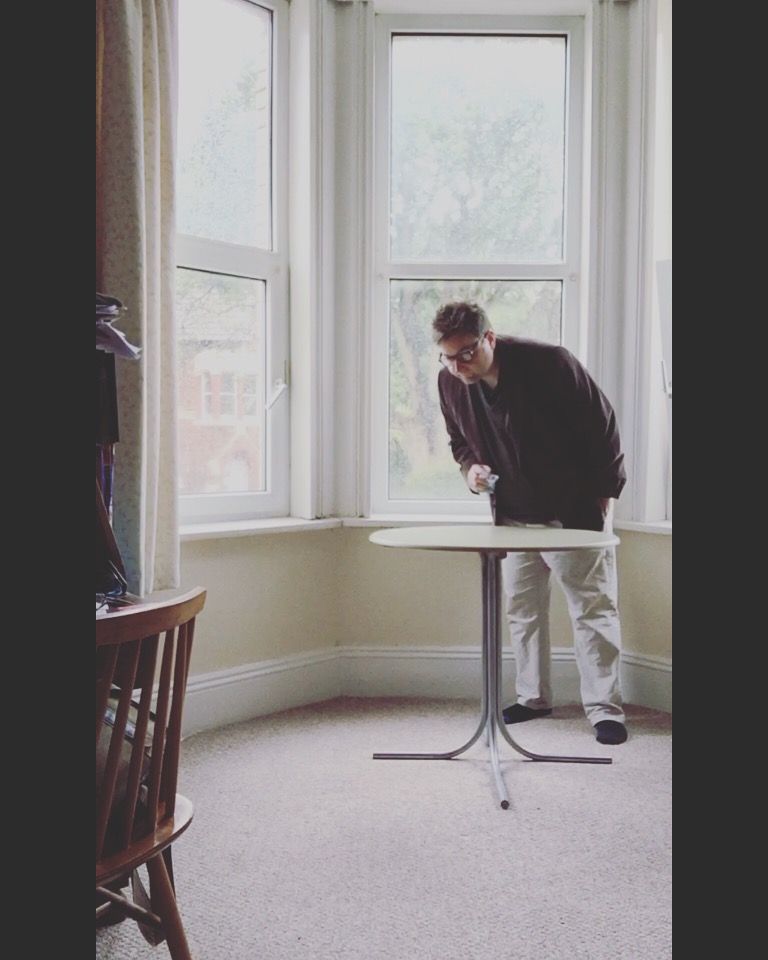
I asked my assistant Lars to write a full stop on the table while I was out of the room. My job was then to find it and eradicate this.
If I hadn’t found the full stop, the knowledge of its continued existence would have given it a significance far beyond its actual worth.

Or I would have begun to doubt that Lars had drawn it in the first place.

Or I would have begun to doubt the existence of Lars.

You can watch the video here.
https://youtu.be/9TDkQN-tbuI

The most significant full stop (part six)

Today I have been attempting to make the most insignificant full stop disappear completely, and then bring it back. I’m doing this because I’m sure that everything that has ever existed has a memory of sorts, even if that memory resides in the minds of those who utilised it or witnessed it.
Electronically, it’s a whole different matter, as the insignificant full stop exists only on an electronic plain. Having spent time zooming in on it and magnifying it through the editing processes of my IPad, I’m now doing the opposite and zooming out to see if there is any representable essence of the full stop left.
I then zoomed back in again to see whether or not the iPad in question could then find the almost non-existent full stop.
The results are viewable below.


And then the magnification  process began anew.

I think this demonstrates that the reality will always been superseded by the memory of an event, as the full stop exists now more as a memory than a visual certainty. What does this say about the world?

There are philosophical and even religious proofs definable through the certainty through memory process. The full stop existed at one point, and now it no longer does. Yet there was a definite physical act in pressing the symbol on my keyboard which resulted in a full stop on the screen. The creation of the full stop by me, that one fleeting moment, was the ultimate performance act.