
I don’t usually do politics. The kind of spoken word that I do is an escape from the real world, though I do poetry about themes and society, such as LGBT issues, representation and inequality. I don’t usually do pieces about real people either, unless you count Jeremy Clarkson and Katie Hopkins, both of whom I’ve performed humorous poems about. I always see such poems as having a relatively short shelf life. I haven’t performed the Clarkson poem much since the muppet was fired from Top Gear. It was a sad day.
However this year has truly been a bummer, politically speaking, not only with that whole Brexit thing, (what the hell was all that shout?), and the populism of that Farage bloke, the rise of the rather spooky Teresa May, (again obliterating one of my poems, in which I mention ‘Home Secretary Teresa May. Short shelf life, you see), but rather more scarily, the ominous buffoonery of Donald Trump.
I’ve tried to make sense of all this as the ultimate expression of celebrity culture, the rise of anti-intellectualism, image over content, bluster as a signifier of the supposedly downtrodden. The result of the Europe referendum demonstrated, to my way of thinking, the wilful protest of the supposedly under-represented. Both Farage and Trump have grasped the idea that it doesn’t matter what lies you tell, as long as you sound angry. They have created situations in which there is a supposed opposition to everything which their supporters only just now realise that they cherish. Abstract concepts such as freedom, identity of the dominant culture, fear of change, the foreign Other. The more they shout and lie, the more popular they get, because the lies are so obvious that they’ve become conceptual anti-political protests.
I’d like to write poetry about this. But none of it is very poetic. The best way to fight bluster and bullying is often with humour, and that’s happening a lot in the US but not so much over here. I can’t remember who said that you can’t win an argument against stupidity. But when the stupidity is a purposeful tactic to win arguments, that’s when we should be worried.
The Pet Shop Boys did a song called I’m With Stupid, which had the line, ‘Is stupid really stupid, or a different kind of smart?’
Will all of this blow over? Probably not. Mr Trump hopefully won’t win the election, but you can never be too sure. People are being put off politics, including the politicians, and this will lead to a whole generation of media-managed calculated blundering, office as character, celebrity warmongering.
Tag Archives: culture
The Most Significant Full Stop. (Part Eleven).

Yesterday I extrapolated a full stop from a text of writing, and then using screenshots, managed to magnify it to such an extent that it took up nearly the whole screen.

In doing so I was imbuing the full stop with far more significance than it might otherwise have. The next step was to print off the full stop on to some A4 paper, and affix it to an ordinary wall on the back of a shop, down an alleyway, in Paignton, Devon.

The full stop was certainly striking and again this imbued it with far more significance than it should have had. After all, this was just an ordinary full stop taken from some text, typed with no idea that it would be such a statement of intent, typed merely to aid the comprehension of the text.
Kafka’s father said that he was ‘morbidly preoccupied with the insignificant’ and I believe I understand what Otto Kafka was alluding to in the sudden elevation of this full stop.
The next part of the project was to reassign the full stop with its original intent, that of aiding in the comprehension of text. By taking photographs of the full stop as it hung on the back of a shop in an alleyway in Paignton, I was able to stand further away and keep on taking photographs, until the full stop was just a dot again.

Using poster making software, I coloured in the photograph with the exception of the full stop.

I then added the full stop back into some random text, where it once again functions as a full stop, and not as a statement of insignificance. Can you spot it?

The most significant full stop (part nine)

Hello.
Here’s a video I’ve made about my art project so far. Let me know what you reckon.

An Interview with Richard Thomas

I’ve know Richard Thomas for as long as I have been performing. Indeed, he was almost certainly one of the performers at the very first gig I went to as an audience member. He very quickly drew me in to his world of imagery and humour, strange juxtapositions and asides, in a manner which I found most compelling.
We both did the same literature course with the Open University, and it was through this that I discovered we both admired the poetry of Frank O’Hara and the music of British Sea Power. Because of this, I have always followed his career with interest.
His first published book, The Strangest Thankyou, came out almost two years ago now. It contained some wonderful poems including the delightful ‘Flamingo’ as well as more serious pieces, and others written after trips to Rome. I read the book twice over the course of two days, and then my mother borrowed it too. I was jealous that the cover was orange, because Frank O’Hara’s book Lunch Poems also has an orange cover!
One of the things I really admire in Richard is that he is so very different to almost any other performer both in his style of reciting, and in his subject matter. To watch or read Richard is to visit a strange new world, only to realize at the last moment that it’s a world you’ve always known.
I’ve known you for almost six years now. You were one of the first poet performers I remember seeing. How did you get in to writing poetry?
I had written lyrics here and there for various bands I had been in. The more I wrote, the more I realised I enjoyed playing with language, so I started to keep a notebook and would just write very stream of conciousness type stuff in it. Eventually, and mainly through the Open University course you mentioned, I learnt how to shape those ramblings in to actual poems, and it went from there.
How important is the performance aspect of your poems?
For me, when I write poetry, performance is the last thing on my mind, bar perhaps a couple of poems I have written. I think this is probably because I got in to poetry originally from a page-poet’s perspective, and I wasn’t aware of any performance opportunities in my area at the time. When I moved to Totnes, that changed: I did my first open mic and got hooked on the buzz it gave me. It still very much felt important to me, though, to keep writing primarily for the page, as seeing my poems in print was the dream. So I continue to do that, and then when I am performing, I will pick out the poems that translate on to the stage best. Half of my poems I have never read live. I quite like the idea of doing a live set of poems I would never usually perform, to see what happens, but I am yet to muster up the confidence.
Your book The Strangest Thankyou was one of the reading highlights of my year when it came out. How would you describe the new book?
Thanks, Robert. I remember you telling me your mum enjoyed it, too. Three of my friend’s mums have read it. And I think just one of those three friends has read it themselves (yourself). It’s good to know your audience. Perhaps that is why my new book is a collection – a pamphlet – of poems about babies. A subconscious effort to satisfy my target market. But seriously, it’s a little more than about babies, though it is that. Zygote Poems is about a young man’s journey in to the unfamiliar realms of fatherhood with the effects of anxiety. It uses phonetic language to both convey that effect, and at the same time mimic ‘baby talk’. There are some other fun techniques employed, but I guess I shouldn’t give too much away. Selling poetry books is hard enough. I think, though, this new pamphlet is my most focussed poetry so far.
Can you describe the writing process for it?
I wanted these poems to be as candid as possible, and given the subject, they were all personal. So to start with, it was a case of writing down every significant thing I could think of as I looked back over my journey up to that point. As I originally wrote it for my degree dissertation, I had to write a certain number of pages. So I worked out what kind of balance I wanted in terms of the content – what moods I wanted to give – and I drew up a table, dropping each significant event in to a particular mood box until I had filled the table with an equal amount of each. And then I went about working my way through the table, writing each poem that needed to be written. It got very mathematical, but it was a pretty interesting way to go about writing a collection of poems, and felt right for the to get the result I wanted. The hardest part was to write as candidly as possible. My mind often told me to censor stuff, so it took some redrafting to get all the poems as honest as possible, without them becoming unreadable.
How would you describe the content of your poems? Are there recurring themes?
The new pamphlet is all specifically themed, but I guess my poems do generally repeat certain themes, often without me realising. This is probably to do with the fact that I usually write whatever is on my mind at the moment of holding the pen. The Strangest Thankyou was a lot of love, lust, loneliness and confusion – even the surreal impersonal poems abour Flamingos, dancing butchers and dogs eating figs conveyed a sense of trying to understand the world and its obscurity. I think that had to do with the mindset of being in my early twenties, and I guess certain subjects tend to occupy the mind more than others at different ages. I like that idea: that my poetry up to this point could be read as being written by someone in their twenties, purely by the themes most covered, and that my thirties, forties, etc, will bring about their own re-occuring themes. I think this also helps me deal with the idea of ageing – being intrigued as to what poems the world might draw from me as time goes on – I look forward to poems more than I do birthdays. That wasn’t meant to sound as melancholic as it did…
Is humor important to you?
Definitely. I think humour is important to any art form to some extent, whether you’re Charlie Chaplin or Marina Abramovic. And even Beethoven was a prankster. There’s that story about him, as a kid, putting a whoopee cushion on Mozart’s piano stool, isn’t there. There’s no whoopee cushions in my poetry, but I like to think there is humour. Not in all my poems, but where it lacks, I try to make up for it with a sense of absurdity. I think humour can help a generally serious poem breathe, and lift it from the page. It helps the poem transcend from writer to reader.
You’re obviously a big fan of the beat poets. You even had a beard at one time. And it was a nice beard, too. How influential is Ginsberg both in your writing, and also modern poetry?
I have had two significant beards in my life so far. I think you saw the first. The second was a much better effort. That is a benefit of ageing. That beard was going places until I chopped it off. I have yet to properly grieve the loss of it. Who handed me that pair of scissors? Ginsberg had a great beard, and was a great poet, and I think I owe a lot to him for both of those things. Kerouac, Corso, di Prima and the others have been a great influence too. I discovered them at about twenty two, and really felt my poetry take a change of pace when I did. I remember the first time I read those lot – it felt like I had never read poetry before. I felt a different level of excitement for poetry, and it was around that time that I started to write ‘proper’ poems and do readings. Ginsberg was a huge influence on poetry, both then and now. I really believe him and his friends were game-changers, and had a significant effect in moulding the shape of poetry to come. Even for those who dislike him or the other beat poets – a negative influence is an influence nonetheless. But I think Ginsberg in particular proved that you could really say and do whatever you want with poetry, and it needn’t conform to certain ideals or standards. Amongst young poets today, I think this has particular resonance, knowing that there aren’t boundaries, and that poetry can say anything you want it to say.
Who are your favorite poets, both dead and alive?
Well, those that I have mentioned are favourites, for sure. I am still yet to read anything that gets me on the same level as Gregory Corso. I also love Sylvia Plath, Shelley, the Surrealist Poets, Leonard Cohen, and as you mentioned, Frank O’Hara. I have recently been getting in to Arthur Rimbaud and Ronald Duncan. The latter of which I found by grabbing a load of free poetry books from a box outside a lecturer’s office, and when I started reading, couldn’t understand why I had never come across him before, as his love poems remind me a lot of my own. Especially when he lived fairly local to us, too – North Devon I think.
What are your plans for the next year or so?
I am currently doing my MA in Creative Writing, so that, along with being a father to a toddler, is definitely keeping me busy. I have Zygote Poems coming out in June via Cultured Llama, so I hope to be promoting that as much as I can. I’m also working on various other writing projects: a short film, a children’s story and another poetry collection. Sometimes I wish I could just focus on one thing at a time, because I am sure life would be a lot easier that way, but my head refuses to work in that fashion it seems.
What advice would you give to anyone who’s always wanted to write poetry?
Read every type of poetry you can get your hands on and get started. The bigger the palette, the bigger the picture. Forget about trying to make it good, or what you think your neighbour, or the local baker, might like to read, and just write. Quality will come the more you write, and it’s important to be honest in your writing. The best and most genuine stuff will come when you are just trying to please yourself.
 The Strangest Thankyou is available for £8.00 from: http://www.culturedllama.co.uk/books/strangest-thankyou
Zygote Poems will be published by Cultured Llama in June 2015.
Why I really, really rather like Bristol.
I really like Bristol.
No, that’s not a euphemism or Cockney rhyming slang.
Since I started performing poetry all over the place, I’ve had the chance to visit towns which I never would have done for any other reason. I’ve seen Wolverhampton, Swindon and Manchester. Guildford, Berlin and Barnstaple. And all in the name of poetry.
But there’s one city which seems to have become a talisman, a good luck charm, and that’s Bristol. Good things have happened to be on many occasions in Bristol, poetically speaking. And I have never been there for any other reason than poetry.
When I first started performing around the Torquay and Exeter area, Bristol poets were held in awe by the local hosts and promoters, and we would regularly see people such as Nathan Filer and Byron Vincent, amazing us with their skill and commitment and their sheer brilliance. Consequently, it became a kind of goal to aim for, and Bristol itself stood as a beacon of poetic endeavor to which we should all aspire.
The first time I went to Bristol was for the Bristol Slam. Indeed, this was my first ever slam and there were many names there who would go on to be friends and colleagues in the poetry world. People like Vanessa Kisuule, Tim Vosper and Stephen Duncan. None of them knew me from Adam, and amazingly, I came second in the slam to Stephen. We went for a drink afterwards, the euphoria ensuring that it wouldn’t be able to get to sleep!
The next time I went to Bristol was to Acoustic Night at the Halo. It was a birthday present to myself a little journey away, and some of the Bristol slam people were there and they remembered me. Tim Ledwitch was as brilliant as ever. Amazingly, the host of the night liked me so much that he offered me a co-headline set for a couple of months later on! The euphoria ensured that I wasn’t able to get to sleep that night.
The next time I went to Bristol was to do the headline set at Acoustic, and it went very well indeed. The euphoria ensured that I wasn’t able to get to sleep that night.
By now I was zooming about all over the country and building up a reputation as a comedic poet, so the next time I came to Bristol was to support Vanessa Kisuule at Hammer and Tongue. I made a little holiday of it and stayed in a nice hotel, and I was just about to leave for the gig when I got an email to say that my first book had been accepted for publication! I remember dancing around the hotel room in my very camp manner indeed.
And then the gig itself went very well. The two Tims were there, and Graham Chilcott, and everyone was most complimentary about my set. The euphoria ensured that I wasn’t able to get to sleep that night.
Last night I was back in Bristol again, headlining at Milk. It was a fantastic night, filled with talent and friendship. All of my Bristol poetry friends were there, and my set was greeted marvelously. I didn’t get much sleep last night.
There is a constant criticism of Bristol poetry, that there really isn’t much variety, and that it is youth orientated, slam-style, three rhymes per line and too deeply serious for its own good. Last night at Milk there was plenty of variety and styles of performance, and it was great to see Samantha Boarer, who I really do admire in a deep and special way. She’s just about one of the funniest people I know.
So Bristol remains for me a city devoted to, and standing primarily for, spoken word and performance poetry. Indeed I cannot see it except through this lens. I’m sure I will be back there again very soon, and when I do, I shall take some sleeping tablets.
I also like it because someone has spray painted, in large letters, the word ‘Arse’ on a wall next to Bristol Temple Meads.
Foibles in Guildford and Other Poetic Adventures
This week I felt really badly. For the first time that I can remember, I cancelled going to a poetry gig and performing. Taking the Mic in Exeter is a brilliant event which I love. But I was just so, so tired! I asked Tim if I could phone it in from home, but I was too tired even to do this!
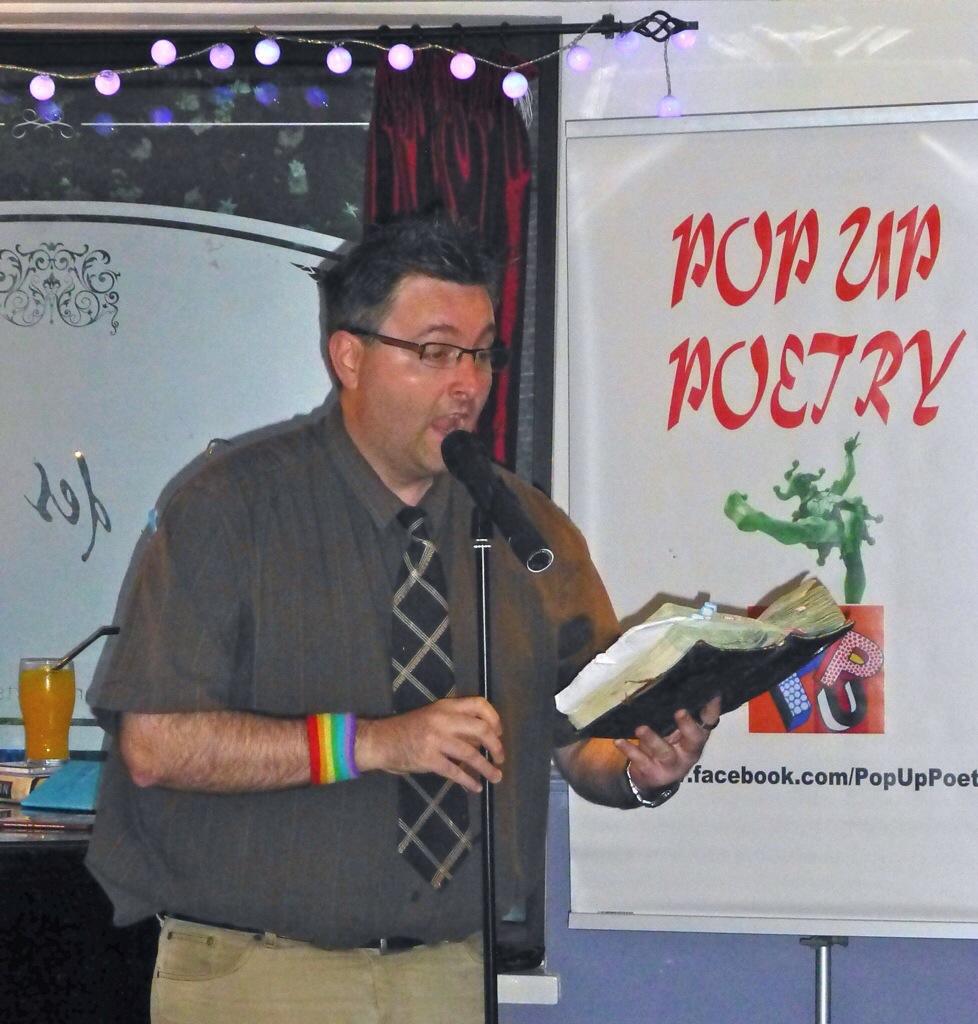
The reason was that I had a gig the night before in Guildford at the excellent Pop Up Poetry, run by Janice Windle and Donall Dempsey, two enthusiastic and lovely people who I first met a couple of years ago on a previous visit. This time they asked me to do a twenty minute slot, and even better, my sister came along to watch. It was the first time she had ever seen me before, and I’m glad that I didn’t suck that night.
The audience were amazing and receptive and my set was greeted with applause and laughter in all the right places, even if I did emit a loud belch halfway through one of the poems!
The one drawback was that I had to get up at half four the next morning to get the train back to Deb’n. Hence my fatigue the next night when Taking the Mic rolled around.
It had been a week of performing. The Friday before I’d participated in the poetry tent at GlasDenbury. Yes, you read that write, a music festival in the small Devon village of Denbury. There were young people there, and they played the music terribly loudly, and the headliners were those mighty rock leviathans Dr And the Medics.
The best part of performing at a festival was the wristbands. I wore mine for two days afterwards to show everyone that I had two wristbands. The first said ‘Artist’. The second was proof that it over 18. You know, just in case it wasn’t too obvious.
And then the next day I was performing at Paignton Green for the Family Fun Day. I was with two poetry friends, Ellie and Brenda, and we all decided we would do family friendly material. Which was ok, except Brenda decided to edit as she went along, and quickly had to change a very dodgy line mid-poem from explaining exactly what she did with the cheese-cutter knickers to ‘and then something else happened’.
It was good performing in my adopted home town. Especially because there was just a two minute walk home. Unlike the Guildford gig.
So that’s what I’ve been up to the last few days. And now I’m working on the Poetry Island Anthology, which will be available very soon!

 Robert Garnham