Last night I went to Pop Up Poetry in Guildford. It’s the closest spoken word event to where my sister lives in Woking and it’s the closest to where I grew up in Surrey. For these reasons it always feels like coming home . Not that South Devon doesn’t feel like home. Most if my friends live in Devon but in my heart I am a Surreyer. Or whatever you call someone from Surrey. Reaching out towards London, fingertips quivering.
So it’s always with strange emotions that I revisit my old home area particularly that I had no interest in spoken word or poetry when I moved to Devon. And now, every time I come back, well, there’s actually something I’m good at! So on a psychological level, performing in Surrey is very important to me.
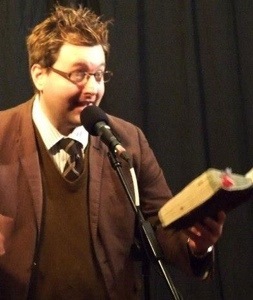
And what a wonderful night Pop Up Poetry is! Donall is a magnificent host full of energy and humour, he bounds around like a teenager and interacts with the poets, while Janice provides support and administrative duties. Between them they have cultivated an atmosphere of acceptance and creativity.
One of the joys of performing somewhere far from my normal area is that I get to see new poets and styles and there were plenty of fantastic poets. I was particularly taken by a young man in a trendy hat who did a fantastic slam poem taking Alice Through the looking glass as his inspiration. There were also a couple of poets who had only just started performing and they were both of a very high standard, and very funny, too. It was also great to catch up with Rodney Wood, we met before the show started and spent an hour or so chatting about poetry and poets we’d seen and inspiration and stuff.
So if you’re ever in the Guildford area and you fancy some poetry, get down to the Bar des Arts next to the River Wey.
Well I had another one of those poetry adventures at the weekend.
For weeks I’d been excited about the prospect of entering the Wolverhampton Love Slam, but when the day arrived there was, of course, consternation over the state of the railway and the sudden realisation that it would take a while to get there. Which it did. Bus, coach, coach, coach, train and train. It took about eight hours to get from Paignton to Wolverhampton. Not that I’m complaining, others have had it much worse of late.
Many people were surprised when I announced on Facebook that I liked Wolverhampton. The people all seemed nice and the town while somewhat smaller than I thought, had a great vibe to it. I had a poke around the museum.
The slam itself was typically well organised by Sarah Jane and Marcus. I was the first poet of the second batch and my classic ‘Fozzie’ was very well received, and while I didn’t win my group, my score of 254 was higher than any of those who performed before me, and stayed the highest runner up right to the end, when someone else got a 255. Damn! But as luck would have it, I was allowed into the next round.
I did The Straight poem next. And it was also very well received. Mindful that some of the score goes to performance, I really went for it, and managed to score a 259. Alas it was not good enough for the final, but I was very happy with my performance.
Met some lovely new people, such as Richard Tyrone Jones and Dominic Berry, and to catch up with Johnny Fluffypunk, Nick Lovell and Dave Viney. We all went for a quick drink afterwards, and all the time I could only think, ‘Wow, here I am out for a drink with Johnny Fluffypunk, Dave Viney, Richard Tyrone Jones and Dominic Berry’. And then on the way out I was accosted by first one and then another table of people who had been in the slam audience and wanted to chat about my poems. Oh yes, it was a good night!
The day after was even stranger. A set of trains and buses brought me to Exeter where I appeared on Martin and Karen’s Listen out show on Phonic FM. I had a great time, did a few poems and chose some music by A-ha and Pet Shop Boys. But then, catching the rail replacement coach to Paignton, I found myself on oove Sky News, sitting on a seat and gently crouching down as not to be seen. And as if that wasn’t weird enough, one of my Tweets was put on the BBC News website!
So it was a busy weekend, with lots of fun and some marvellous people. Can’t wait for my next poetry adventure now. Indeed, I’m off to London next week!
I went to Uncut Poets last night in Exeter. And it was good. Very good. A page poet night of ‘readings’ rather than a performance poetry night, the quality of writing was amazing.
The only trouble was, I took a friend.
I tried to put him off. I told him how ‘dreary’ it would be. ‘Not at all like Poetry Island’, quoth I. ‘You wont enjoy it’. Because I knew he wouldn’t. He’d sit there grumpy and moaning all the time about how slow people talked and how nobody would be doing any comedy poetry.
And how nothing rhymed.
So we get there after an hours train journey and I get him a lager and the night begins. The poets are brilliant. Astounding wordsmiths, worthy and heavy, deep emotional, plaintive, everything was going on. But Mark played computer games on his phone.
Now, as off putting as this was, I at least thought it would help him get in to the seriousness of the night. Next thing I know, the headliner is on and Mark is snoring.
The interval began. We arranged to split up. Mark would wait for me in the bar, I’d stuck it out with the Uncut mob. And indeed, we did do this. I stayed and listened to the poets, Mark sat in the bar and got bladdered.
As the night drew on I realised that I would have yo leave before the end to get the last train home. As quietly as I could, I began filling my bag, putting things away, putting on my coat. Only I didn’t realise that Mark’s lager had spilled slightly and made the floor sticky. When I lifted up my bag, right at a moment if poetic introspection from the current reader, my bag made a sudden and very loud ripping sound.
I met Mark in the bar. He was quite merry and a bit wobbly. We got the hell out of there.
But it was a good night. The poets were amazing and inspirational and I can’t wait to go back and perform again. ( I perform rather than read). Only this time I might go alone!
Some useful tips for performing performance poetry at performance poetry performance nights.
1. Sit at the back. Don’t sit at the front. If you sit at the front, when it’s your turn to perform you’ll be performing to an empty chair.
2. Also, if you sit at the back, the audience will clap for longer while you’re walking to the microphone.
3. If you are a prop poet and you bring a cow to the stage, don’t point out that you’ve brought a cow to the stage, because people can see that you’ve brought a cow to the stage.
4. Don’t milk it.
5. If you bring books to sell, beg the host for a slot in the first half. That way you can sell books during the interval and still have time to run off and get the train. Make sure you can change a twenty.
6. If someone says they like your stuff, they usually mean it. Sometimes they say it so that you’ll automatically reply that you like their stuff, but not always. Sometimes they’ll say it because you were awful and they feel sorry for you, but not always. But most of the time they mean it.
7. I mean, I think they do.
8. I’m pretty sure of it but you’ve got me thinking, now.
9. If it’s an open mic, spell your name legibly on the sign-in sheet. I usually end up being announced as Rupert Graham.
10. If you’re performing haiku, for gods sake, we all know what haiku are, so you don’t have to explain what a haiku is. Syllables and stuff. The explaining is usually longer than the haiku. Sodding haiku.
11. Don’t get rat-arsed.
12. If you’re using props, check for light fixtures and obstructions.
13. I mean, is it me, or do haikus always seem like they should be longer?
14. If you want to have a laugh while performing, make eye contact only with one audience member, then glare at them, give them the old state, really freak them out.
15. It’s not a competition.
16. Well, except for slams. I forgot about slams.
17. Don’t give away all your poem in the introduction.
18. If you bow to the audience at the end of your set, don’t bang your forehead on the microphone. It bloody hurts.
19. The long walk back to your seat is still part of the performance. Maintain your aura. Try not to trip over handbags. And listen out, because the compere might make some wise-arse remark about you.
20. Always leave them wanting more. Try to do less than the time allocated. The host will love you for it.
I’ve been writing poetry now for the best part of ten years. Yet my foray into the world of ‘comic’ verse did not come completely by accident.
There is one man who came before who showed me that performance poetry was a real art form and worthy of investigation. Indeed, when people ask who my influences are, (which, come to think of it, has only ever happened once), I often reply ‘Frank O’Hara, and to a greater extent, Professor Zazzo Thiim’.
Who is Professor Zazzo Thiim? Notwithstanding several attempts by many in the Californian poetry community to attribute the invention of performance poetry to their particular clique, or the claims of those within the British poetic movement to assign invention of this genre to those from various diverse backgrounds both cultural and symbolic, there remains a theory within the English departments of some major university establishments that the invention of ‘performance’ poetry can be traved to the moment in June 1953 when Professor Zazzo Thiim accidentally sat on a harpsichord while reciting the works of Tennyson. Indeed, it was seen as the most whimsical and amusing moment of the Basingstoke literary season, mainly on account of the audience reaction – (sheer disbelief mixed with a fair amount of loathing) – and the apparent embarrassment not only of Thiim himself, but also the Mayor, and Arthur Miller, to whom the harpsichored belonged. There were immediate appeals for a repetition of Thiim’s groundbreaking (and harpsichord-breaking) work. Indeed, he was asked to perform it on the radio (to general acclaim), and before the Ambassador to the United States, (who turned out to be just a man in a hat who was passing by). Performance poetry was born.
Thiim was astounded by the fact that he had invented an entire new genre. He began writing his own verse, which he would perform either sitting on a harpsichord, astride a harpsichord, while playing a harpsichord, while lying on a harpsichord, and finally, while lying underneath a harpsichord. This lasted for six years, until a colleague is said to have inquired of him, ‘What is it with you and all these bleeding harpsichords, anyway?’ He turned up at the next poetry event with a mouth organ. Throughout this time, not only did Thiim write poems to fit in with his harpsichordsmashing regime, but he also began to dissemble and play around with the poetic form. Working in unison with the University of Staines, he looked at poems in more detail than any other literary practitioner until he acquired a reputation as a literary and poetic experimenter. Poems were shot from cannons. Poems were jumped up and down on. One poem was whispered to the Queen, who was asked to ‘pass it on’. (She didn’t). One poem, entitledFrank (23 ½ Seconds of Silence)’ was performed as twenty three and a half seconds of silence. And another, ‘Frank (23 ½ Seconds of Silence with a Brief Interlude)’, was an extended version of the first but with a slight clearing of the throat in the middle. ‘Frank’ was a poem performed with a tambourine with the eminent professor repeating the word ‘scones’ over and over, finally ending the consuming of a whole scone live on stage, while ‘Frank’ consisted of the Professor shouting out the words ‘I do not believe in Aberystwith’ while pouring yoghurt over his head. One of his most famous poems, ‘Frank’, received some notoriety when it was discovered that it had been the last work read by Tony Blackburn before his debut on Radio One. And of course, who can forget the stirring moment when one of his better known poems, ‘Frank’, was included in the first space probe sent out by the Belgians?
There has been of course some question as to why the Professor should have , entitled all of his poems ‘Frank’. But as the good professor has pointed out on numerous occasions, all titles are essentially meaningless and spoil the anticipation of a poem or a work of art. Just look at ‘Last of the Summer Wine’. ‘Frank seemed as good a name as any. Do we enoy the Professor’s poems today? Naturally. As the performance poetry scene goes from strength to strength, the work of Professor Zazzo Thiim has been cited by many, including myself, as their main inspiration for taking to the stage. In areas where performance poetry is popular, there has also been a marked increase in sales of harpsichords, and there can be no other reason why this is so than the enduring legacy of Professor Zazzo Thiim. It also helps that he was something of a nutter
This is very scary not least because I remember my Dad being forty. I was a Scout at the time, and my Dad was one of the Scout leaders. One day after Scouts my mother came to pick me up, and she made sure he wasn’t looking before writing on a blackboard in big letters, ‘Bosun is Forty in January’.
It’s never struck me as unusual that I share the same birthday with my dad and my uncle and also my Grandfather. That’s three generations all born on the same date. In different years,of course. But 2nd January has always been ‘Birthday Day’ in our family and for me it seems somewhat weird that people have their birthdays on other days. My friend the performance poet and comedian Chris Brooks also has his birthday on this day. Which kind of just proves my point.
But forty seems very old. Especially that I feel much younger. I spent the whole of the last decade in academic work, with a-levels, undergraduate and postgraduate, which all ended in 2012, and now my time is taken up with writing comedy poems and performing them while wearing silly hats and dressing as robots. As a result of this, all of my friends are much younger than me, which in turn makes me feel younger. I’m down with the yoots. I can high five with the best of them. I know who’s at number one in the charts and I’ve seen Family Guy.
A result of this is that people are getting old all around me. The people I went to school with are mostly slap heads now. Yet my hair obstinately refuses to recede. I worked out that a lifetime of hair products, hair cuts and shampoo will cost me several thousand pounds, money which the slap heads won’t have to fork out for. It’s just not fare.
Forty years old. It’s frightening. Everyone has been very kind and saying things like, ‘it’s not that old, not really’. And the one of my yoot friends texted yesterday to say, ‘Ha ha, you are so old!’ I was so grateful to him.
So what’s my plan for next year? To get even younger? No. Just to keep plodding along. Write some poems. Wear silly hats. Make the occasional wisecrack.
Anyway. Here are some poems I’ve been working on. Best wishes for the next year, everyone. See you soon!
Poem
Today I feel very distracted.
I like greenhouses.
I wonder when my
Is that a rhododendron?
Poem
Piers are great, I love the way they elongate.
Pies are great, I love the way they taste.
Pi is great, I love the way it goes on and on
Unlike this poem.
Poem
Duck, I said.
I know, he said.
Quack quack, he said.
Knocked him on the head.
Poem
Helen’s got an X-ray goat.
It’s just like a normal goat
But with X-ray vision.
Or so Helen said.
She keeps it in a shed
To protect the modesty of the other goats
Some of whom object
To its X-ray vision.
I asked Helen
How she came about
This goat with supernatural clout.
She said she found it in a field
Looking at a horse
Strangely.
And later it turned out
That he horse had eaten a flip flop.
What are you going to do
With an X-ray goat, I asked.
And Helen beamed that famous grin
And said she was hiring it out
To Exeter Airport
In order that it search for bombs.
I asked what it would do
If it found a bomb
And she said
‘It will probably run away’.
It also shoots lasers
Out of its horns, she said.
Last Thursday it ignited a barn.
I had to remove the combine harvester
And two roosters.
That night we made sweet love
But I was put off by the X-ray goat
Glaring up at the bedroom
All night long in the yard,
Just staring up, staring up, staring up
At our bedroom.
It does that, she sighed.
In the morning, she continued,
Remind me to show you my fire-breathing donkey.
Another of my older poems which I’ve started updating and making snappier. This old classic, which always used to get a great reception at Epicentre on those crazy Epicentre Nights, now confined to legend.
Anyway, as a bonus there are four new poems:
On boobs. (2013 Remix)
Haberdasher in custody.
Space is big.
Singularity.
Urges.
Boobs. (2013 Remix)
I’ve never liked boobs.
I’ve never been in to them.
You can put those away, Mrs Palmer.
I’m not interested.
They cling on
Like limpets on the hull
Of a sleek yacht.
I have no fascination
In that area.
I’d much rather have a flapjack.
Why do they wobble
Like jelly on a washing machine
When you have a coughing fit?
What’s that all about?
My only interest is architectural.
My friend Mark goes all unnecessary
When he sees them.
I have to fan him with the Argos catalogue.
There’s only one tit in this room, I quip.
They make me feel
Claustrophobic.
Thrusty busts.
Improper floppers.
Bulbous knockers.
Flame-grilled whoppers.
Burial mounds
Harbouring the last rotting remains
Of my heterosexuality.
Protruding impediments to intimacy,
I expect,
I’ve never really tried it.
I don’t see the point.
The points.
Of them.
Unnecessary full-frontal terrain.
Stop that, Mrs Palmer!
I was going to have dumplings later
But you’ve put me right off.
It’s like being nuzzled, simultaneously,
By two rather curious polar bears
And I don’t like it.
When you dance they sway like airbag pendulums.
You went to buy a bra
But the alphabet only goes up to Z.
When you were sunbathing
A passing helicopter hovered for eight hours
And then ran out of fuel.
When you wore that tight t-shirt with a quote from
Wordsworth on it
The town’s literacy rate improved
Particularly among teenaged men.
And then a man
Walked straight into the window of Costa Coffee.
I don’t want to see your cleavage.
I can do without your puppies.
I’d rather not make one with your fun buns.
Not for me your gazongas, your jambongas,
Your bosoms, your melons your twin honkers,
I don’t find them tempting,
I don’t find them teasing
It’s a wonder carrying those around
You’re not constantly wheezing
They jump up and down whenever
You start sneezing
But you can’t tempt me, you can’t capture me,
You wont get very far with me
Because quite honestly
I don’t get boobs and I never have done
I can think of other ways of having fun
They don’t do it for me
They make me feel quesy
I prefer knobs.
Haberdasher in custody.
They’ve arrested my haberdasher.
He phoned and asked me for bail money
But I had none.
I can’t just magic it out of thin air,
Mr Haberdasher,
And say ‘Abracadabra’,
Mr Haberdasher.
I’d cook a meal
But I haven’t got a potato masher,
Mr Haberdasher.
Nor am I a party crasher
Or an atom smasher, or a gravel basher, or a flasher,
Mr Harberdasher.
Nor will I start a fight
While saying how much I like Swedish pop
Surrounded by people who like other kinds of music,
Over the years I have been influenced and affected by many poets, and my own style, whatever that is, has been formed by immersing myself in the works of greater types. Those who have shown me how to express myself artistically remain as references, that I might ask myself how they have got round the usual problems we all encounter while writing. In the world of performance poetry, the humour and wordplay of Rachel Pantechnicon was an early indication of the joy and hilarity which exists all around us and how it can be applied to performance. And Byron Vincent demonstrates that words, words, words in all their brilliance, can combine with imagery, panache, performance, real life and deep humour to create something sublime of which I remain truly jealous.
Oh my.
But the biggest influence on my poetry is one which I seldom try to replicate. Frank O’Hara was a poet I’d discovered during my university years. Previous to reading him for the first time, I’d not been a fan of poetry, with the exception of Allen Ginsberg. O’Hara’s words – and the fact that he was seen as worth of study- had a profound impact on my understanding of what poetry is and what it can be about. His poems are about everyday life in a major city, meeting friends, parties, culture, gay society, relationships, sex, bonhomie, art, and enjoying life to the full.
O’Hara came to me at just the right time. Very quickly, I read almost everything he’d written, from Lunch Poems to Meditations In An Emergency, a line from which sums up my own feelings about metropolitan society. ‘I can’t even enjoy a blade of grass unless I know there’s a subway handy, or a record store, or some other sign that people do not totally regret life’.
O’Hara’s oeuvre remains famous now mainly because of his so-called ‘I do this I do that’ poems, usually written during his lunch hour while he was working at the Museum of Modern Art in New York. These poems describe the minutiae of his life, details which incorporate both high and low culture. One of his most famous ‘I do this I do that’ poems is ‘A Step Away From Them’. (1956).
It’s my lunch hour, so I go
for a walk among the hum-colored
cabs. First, down the sidewalk
where laborers feed their dirty
glistening torsos sandwiches
and Coca-Cola, with yellow helmets
on. They protect them from falling
bricks, I guess. Then onto the
avenue where skirts are flipping
above heels and blow up over
grates. The sun is hot, but the
cabs stir up the air. I look
at bargains in wristwatches. There
are cats playing in sawdust.
(…)
Neon in daylight is a
great pleasure, as Edwin Denby would
write, as are light bulbs in daylight.
I stop for a cheeseburger at JULIET’S
CORNER. Giulietta Masina, wife of
Federico Fellini, è bell’ attrice.
And chocolate malted. A lady in
foxes on such a day puts her poodle
in a cab.
There are several Puerto
Ricans on the avenue today, which
makes it beautiful and warm. First
Bunny died, then John Latouche,
then Jackson Pollock. But is the
earth as full as life was full, of them?
And one has eaten and one walks,
past the magazines with nudes
and the posters for BULLFIGHT and
the Manhattan Storage Warehouse,
which they’ll soon tear down. I
used to think they had the Armory
Show there.
A glass of papaya juice
and back to work. My heart is in my
pocket, it is Poems by Pierre Reverdy.
This poem is filled with what some might describe as ‘low culture’, mentioning Coca Cola and cheeseburgers, neon, and builders with dirty, glistening torsos. But it also mentions abstract expressionist painters, many of whom were friends of the poet, Federico Fellini and Pierre Reverdy. It was this mix of different cultures, this self-curating, this very admittance that there really is no difference between one art form and another, or one way of living ones life and another, which struck me as so totally at odds with literary study and it’s cañon. It also helped that he was eating burgers and looking at builders with their shirts off.
If Frank taught me anything, it was how to end a poem. This sometimes seems the most difficult thing to do while writing, but O’Haras poems often end on the last line surprise, the stunning send-off. Every time I come to the last line of a poem, I always wonder WWFD?
I could write about Frank O’Hara all evening.
In a couple of weeks I shall be forty, which is the age O’Hara reached before he was wiped out by a dune buggy while walking in the dark on Fire Island in 1966. I hope to live for much longer. Like Frank, I’m surrounded by creative types and friends. Like Frank, I have to fit my poetry and writing in to the humdrum of having a full time job. Of all the writers and poets I’ve studied over the years both for university and college and for private interest, it is O’Hara whose life and philosophy seem most to mirror my own.
You, Sir. I’m thinking of a number between one and ten. Can you guess what it is?
Four? You were pretty close. It was actually five.
Let’s hear it for the humble koala!
Did you know, Sir, that the koala bear is not actually a type of bear? Did you know that? Somehow makes them less cuddly to be part of the marsupial family.
Let’s hear it for the humble koala!
It’s all koalas.
How many koalas does it take to change a light bulb?
One.
Because physically they’re probably able to but it’s not yet happened.
Unless the Australians are keeping something from us.
And it would probably take a while too. Probably quicker to do it yourself. I’m just saying that it’s very unlikely that a koala will get it done any quicker than a normal electrician.
I don’t know why you asked, Sir.
It’s all koalas.
Knock knock.
Who’s there.
A koala.
A koala who?
A koala who‘s actually former French secretary of state Dominique de Villepin.
That’s a cunning disguise.
A horse walked into a bar. So did a psychologist. The barman said to the horse, why the long face? And the psychologist said, yes, I’d be interested to know, too.
It’s all koalas!
A koala walked into a bar. It said, I’d like some eucalyptus, please. The barman said, I’m not going to serve you. I used to go out with a koala. She was very clingy.
Let’s hear it for the koala!
The koala said, you know, it’s a paradox. I can only eat eucalyptus. But the eucalyptus creates a toxin which means that I have to sleep for twenty three hours a day. And the hour I’m awake is when I’m eating eucalyptus. So you see, it’s an eternal paradox. I sleep to eat that which makes me sleep.
Hands up if you’ve ever had an existential paradox.
Here’s my existential paradox.
My friend Kevin runs assertiveness training courses. I asked him if it works. He said yes. Because if it works then someone’s going to be assertive. And if it doesn’t work and someone asks for their money back, then they’re being assertive. Which is proof that it works. Kevin’s on to a winner. Because if it doesn’t work then the people who want a refund wont have the assertiveness to ask for it.
Knock knock.
(Who’s there?)
A man brandishing eucalyptus.
(A man brandishing eucalyptus who?)
A man branding eucalyptus who’s fed up of being chased by koalas. Very slowly. And only for an hour.
The koala rested his elbows on the bar and said, ‘My friend Gerald puts on music evenings for those with short term memories. He puts all this money into hiring church halls and finding music. But if they’ve got short term memory then all he has to do is meet them the week after and say something like, ‘Fun last week, wasn’t it?’
Hands up if you have short term memory problems.
How many koalas does it take to change a light-bulb?
One. I told you already.
Do you like marsupials?
Do you?
Do you like marsupials?
Let’s hear it for the marsupials of the Australasian continental shelf.
Knock knock.
(Who’s there?)
A koala.
(A koala who?)
A koala who, bizarrely, can reach the door knocker.
What I’m going to do now, you see, is pretend, in order to extend this rather unusual pretext, that everything I’m talking about has been done by koalas.
Is everybody alright with that?
Anyway, a friend of mine, who’s a koala, has invented Cockney Non Rhyming Slang.
And one day the cockney koala was asked by a delivery man where he wanted the trampolines that Felicity ordered delivered. Now, in cockney non-rhyming slang, trampolines means lampshades. Obviously. So he pointed to a warehouse just next to the eucalyptus trees where they stocked lampshades. And it was because of that that my cousin’s trampoline did not arrive in time for her birthday.
Knock knock.
(Who’s there?)
Two koalas.
(Two koalas who?)
Two koalas who are looking for that other koala who was just here a moment ago.
My sister used to work in a newsagents. Every week a woman would come in and ask if her copy of Psychic News had come in.
I went to the sauna the other day. There was a koala in there. The koala said, every time I go to the supermarket I get the trolley with the wonky wheel.
I said, what do you need a supermarket for, you only eat eucalyptus? The koala said, I was trying out some new material. I said, you need to work on it. And by the way, what are you doing in a sauna? I get stressed, he replied.
And do you know what he said?
Do you know what he said?
Hands up if you think you know what he said?
He said, I’ve been trying to replace a light bulb for three years. An hour a day.
Do you mind if I open the door, it’s a bit hot in here.
It’s all koalas.
Knock knock.
(Who’s there?)
David Attenborough.
(David Attenborough who?)
You know, for a start I’d probably just peek through the curtains to see who it was. And then I wouldn’t need to ask.
I met a koala the other day. He was looking glum. I asked him why. I’ve put my name down for origami classes, he said. But they folded.
A koala went to the Doctor’s. Doctor, doctor, he said. I keep getting mistaken for former French foreign secretary Dominique de Villepin. And every time I go anywhere I‘m chased by French prosecuters who want to take me to court because of my role in several scandals under the previous president Jacques Chirac.
The Doctor said, stop wearing that ridiculous name badge, then.
While sorting through my drawers the other day, I chanced across the first performance poem I ever wrote.
A long time ago, ohhhh, it must be late 2008, I went along to Poetry Island at the Blue Walnut and watched a bunch of poets. Chris Brooks was the host at the time, and he was endlessly enthusiastic and very funny. (He still is, of course). Apart from Ellie Davies, who I’ve know since the year dot through the Paignton Writers’ Circle, I didn’t know anybody there. Clive Pig, Jeff Sleeman and Tom Austin were all there, and I remember getting them all confused during the interval, because they were all slap heads and I couldn’t remember who had done what, but I’d enjoyed their sets. Bryce Dumont was also there, I remembered seeing him in a local bookshop.
I went home and I thought, I’d like to try this. So I emailed Chris and, amazingly, he offered me a slot at the next Poetry Island.
The only trouble was, I’d never seen performance poetry before, and I had nothing to perform. I set to work immediately, writing a poem which seemed humorous, and the idea of it came with its own logic. I felt rather happy with it, and when I performed it at the next Poetry Island, people seemed to enjoy it. Indeed, Chris asked me back the next month.
And I’ve been every month since, except for two occasions.
So what of the poem? I’m a little embarrassed of it now, but I re-read it today and I thought, Hmmm, not too bad. I remember a couple of months later somebody said to me, ‘I liked your earlier, funnier stuff’. Which was this poem, seeing as though there was nothing else! And I performed it again when I had my very first paid headliner a year or so later, just to remind myself how it had all begun.
So here it is. And it’s never really had a title, so I shall just call it ‘Poem’.
Poem
There is no hint of madness in my family.
We are all quite sane, incapable of oddness.
We are all most sober
And delightfully plain.
Except for Aunt Jane.
She once went to Spain
Bought a hat with a wide brim,
Balanced candles around the edge,
Impersonated a chicken
Balanced precariously on a handrail,
Tap danced, her formal, clumpy shoes
Beating out rhythms
And all within seconds of getting off the plane.
She was deported.
Whiskey was to blame.
And since the court case, she’s never been the same.
Or great Uncle Cecil, the solitary type
Won a stage of the Tour de France on a toddlers trike
Later stripped of his win by the clerk of the course,
Spends his days now writing haiku in ancient Norse.
Or cousin Freddie, a zoologist by trade
Insists to all who meet him that he invented muesli.
And the greenhouse. And the corkscrew. And the beret.
And the 50p coin. And the handlebar moustache. And the question mark.
He keeps the blueprints in a biscuit tin.
Or Uncle Russ, who once made a fuss
Because he missed the last bus
And wrote a letter to the Queen, who told him he must
Stop writing to her or she’d call the police.
My sister Felicity
Watches Dynasty
On box set DVDs
I get to my knees and say to her, please
At least watch something else for a change.
She’s now addicted to Family Fortunes.
Uncle Jeff is suing scalectrix
Because he fell over his son’s racing car set
Uncle James wrote his name on a rice grain
He sneezed and lost it and he’s never been the same.
Cousin Jed pretended to be dead
As a joke to play on his best friend Ted.
Teds friend Fred told Ted that Jed was dead
And to prove to Ted thumped Jed in the head.
Jed rose from his bed and said to Ted, ‘I am the undead’.
But the joke was on Jed. Ted died of shock instead.
My mad aunt Delores decided
To memorise the dictionary.
She got as far as the letter B.
When I asked her why she gave up she said
She’d worked her way back from the letter Z.
A very dear Uncle once bought a big van.
He drove it into a very large tree.
On being asked why he’d performed such a move
He said he was making a statement.
The local council also made a statement
And made him pay for the tree.
My cousin Kate
Once baked a cake
And included hake.
I said, for goodness sake!
What more can I take?
What else will you mix in due course?
You’re right, she said,
I should have included tartar sauce.
The madness that resides, continually
Is not endemic in myself.
I’ve lived a life of wilful sanity
And never once needed a cry for help.
But in my darkest moments it dawns on me
That a hole exists where something else should be.
It’s cold in the dark. And awfully quiet, lonely,
Bereft of all but that which scares me.
Every night, with the words creeping in,
Take on hands with outstretched fingers
I feel death as the meaning if life.
I fear existence. I fear myself.
The world gapes in like a chasm of my own invention.
I have no madness save that which is born
Where eccentricity is seen as the norm.
Great Aunt Sally
Once said to me
She had a penguin in her rucksack.
We knew she was punning
And laughed at her cunning
Until the zoo phoned and asked for it back.